
Market Overview
| Study Period | 2020 - 2031 |
|---|---|
| Forecast Data Period | 2026 - 2031 |
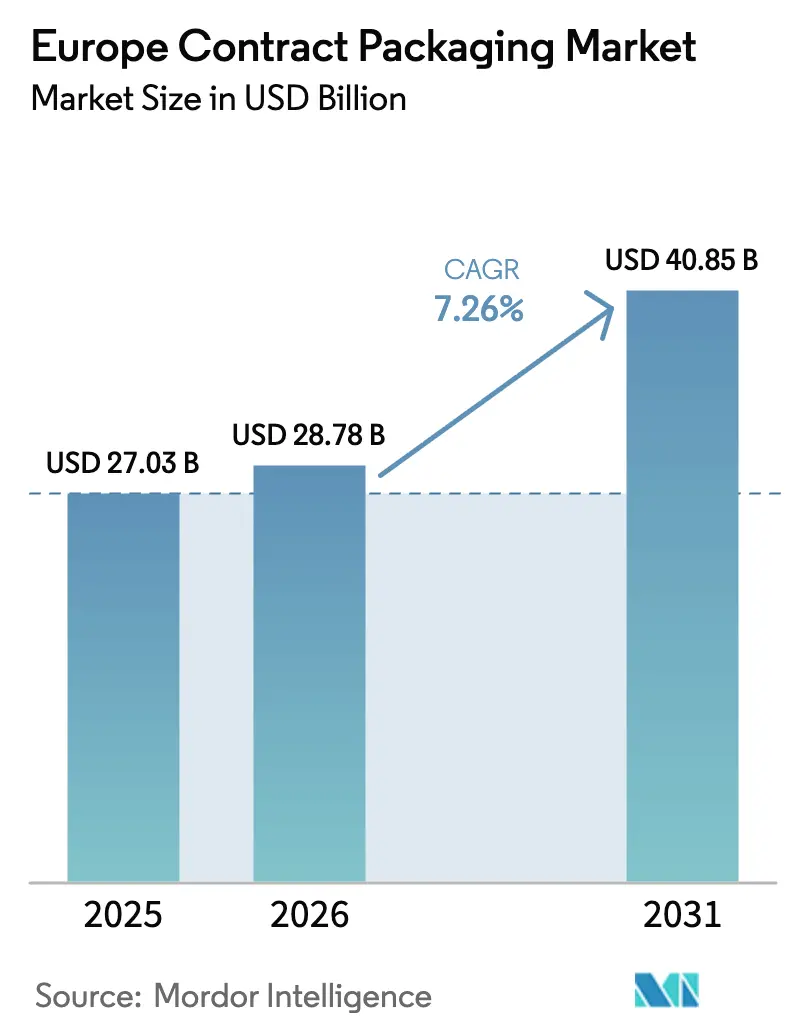
| Base Year Market Size (2025) | USD 27.03 Billion |
| Market Size (2026) | USD 28.78 Billion |
| Market Size (2031) | USD 40.85 Billion |
| Growth Rate (2026 - 2031) | 7.26 % |
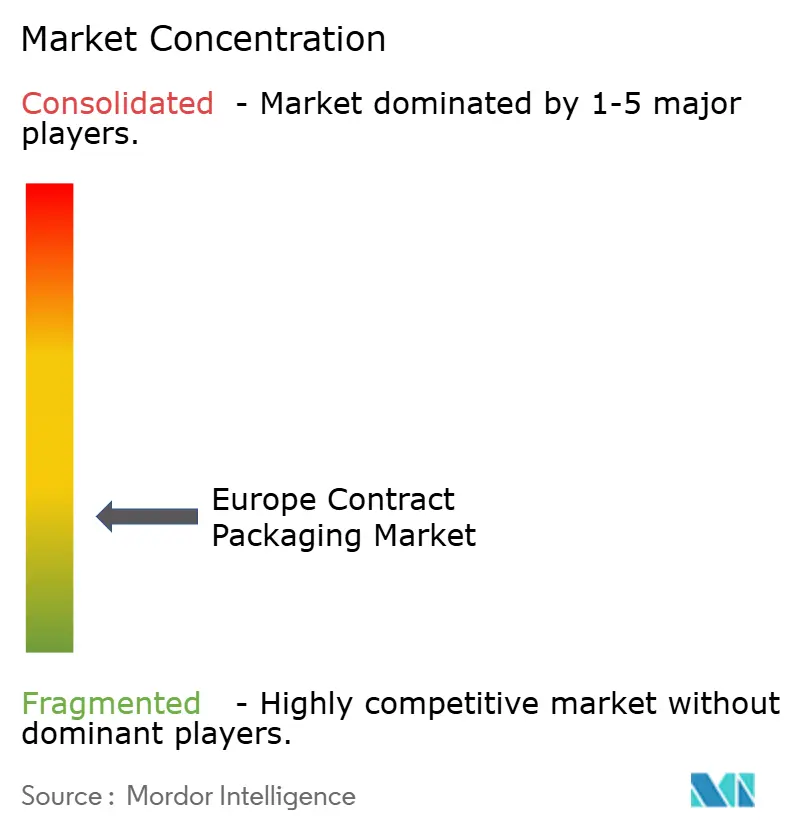
| Market Concentration | Low |
Major Players *Disclaimer: Major Players sorted in no particular order Image © Mordor Intelligence. Reuse requires attribution under CC BY 4.0. | |
Europe Contract Packaging Market Analysis by Mordor Intelligence
The Europe contract packaging market size is expected to increase from USD 27.03 billion in 2025 to USD 28.78 billion in 2026 and reach USD 40.85 billion by 2031, growing at a CAGR of 7.26% over 2026-2031. The steady rise reflects the surge in outsourced fulfillment for e-commerce orders, the growing number of direct-to-consumer (DTC) brand launches, and retailers’ preference for shelf-ready packs that minimize in-store labor. Demand for mono-material solutions is accelerating as producers strive to comply with the European Union's Packaging Waste Directive, while short-run digital printing enables rapid SKU changes without prohibitive plate costs. Post-Brexit supply-chain near-shoring is concentrating volumes within continental co-packing hubs, which, in turn, is stimulating investments in semi- and fully automated lines. Competitive intensity is increasing as logistics players, converters, and specialized co-packers vie for fast-growing, value-added projects, especially in food and cosmetics.
Key Report Takeaways
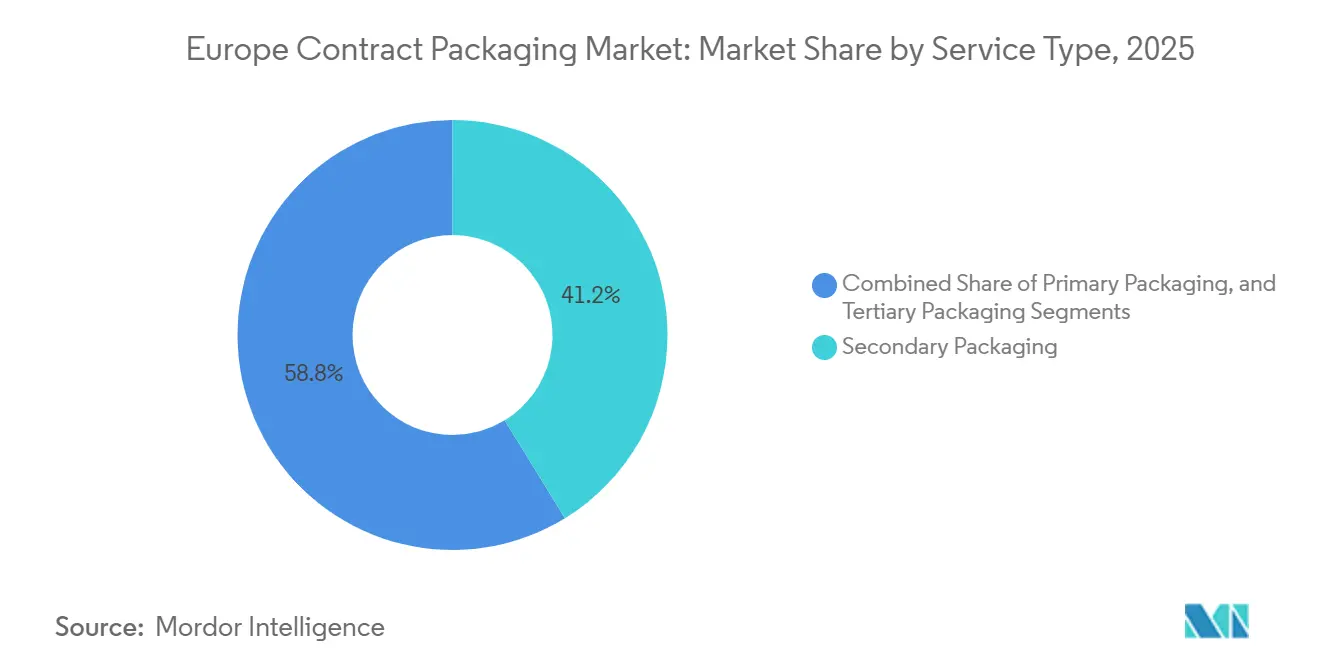
- By service type, secondary packaging led with 41.23% of the Europe contract packaging market share in 2025; tertiary packaging is forecast to expand at an 8.34% CAGR to 2031.
- By packaging format, rigid formats accounted for 52.32% share of the Europe contract packaging market size in 2025, while flexible formats are advancing at an 8.84% CAGR through 2031.
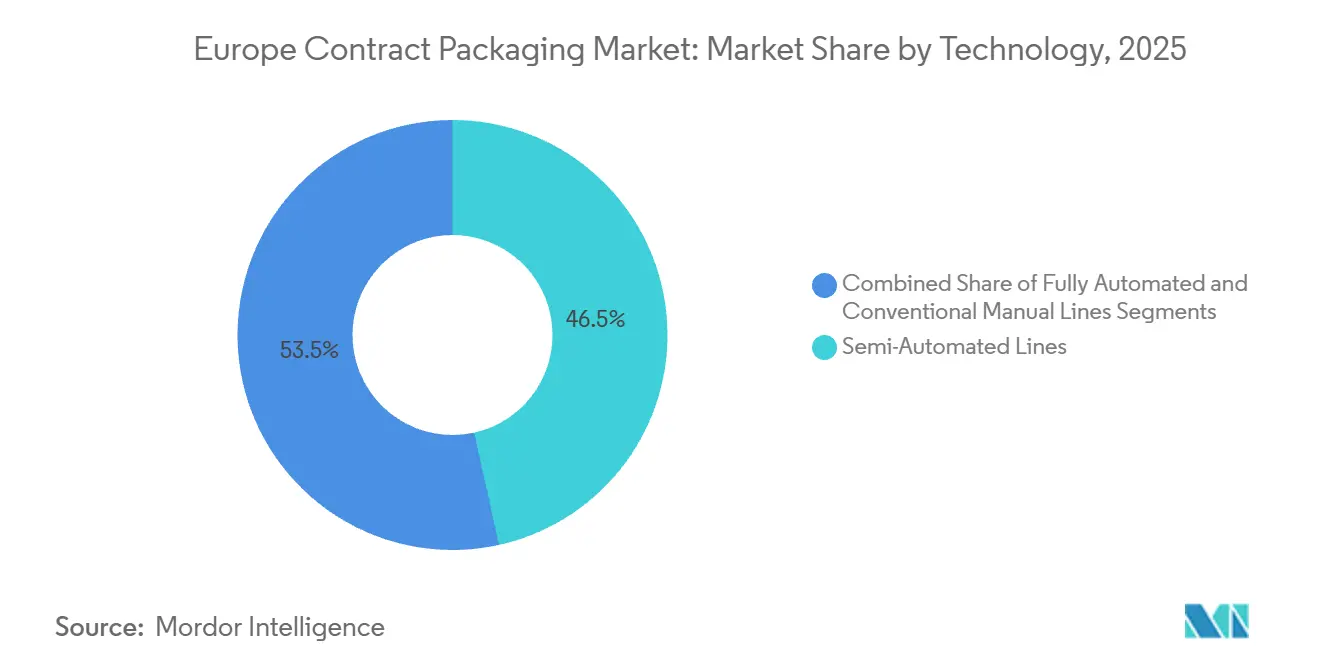
- By technology, semi-automated lines held 46.53% of the Europe contract packaging market share in 2025; fully automated and robotics-enabled lines are expected to post a 9.32% CAGR over 2026-2031.
- By end-user industry, food captured 28.62% revenue share in 2025, whereas cosmetics and personal care is the fastest-growing segment with a 9.56% CAGR to 2031.
- By country, Germany dominated with a 22.42% share in 2025, while Spain is poised for the quickest growth at a 9.18% CAGR between 2026 and 2031.
Note: Market size and forecast figures in this report are generated using Mordor Intelligence’s proprietary estimation framework, updated with the latest available data and insights as of January 2026.
Europe Contract Packaging Market Trends and Insights
Drivers Impact Analysis*
| Driver | (~) % Impact on CAGR Forecast | Geographic Relevance | Impact Timeline |
|---|---|---|---|
| Rising E-commerce Fulfillment Volumes | +1.8% | Pan-European, concentrated in UK, Germany, Netherlands | Short term (≤ 2 years) |
| Proliferation of DTC (Direct-to-Consumer) Brands | +1.5% | UK, Germany, France, Spain | Medium term (2-4 years) |
| Retailer Shift to Shelf-Ready Packaging Formats | +1.2% | Germany, UK, France, Netherlands | Medium term (2-4 years) |
| Growth of Sustainable Mono-Material Substrates | +1.4% | EU27, driven by PPWR compliance | Long term (≥ 4 years) |
| Adoption of Digital Printing for Short-Runs | +0.9% | Western Europe, early adoption in Germany and UK | Short term (≤ 2 years) |
| Near-shoring of Supply Chains Post-Brexit | +0.7% | UK, Ireland, Netherlands, Belgium | Short term (≤ 2 years) |
| Source: Mordor Intelligence | |||
Rising E-commerce Fulfilment Volumes
Online retail parcels jumped throughout 2025 as grocery, health supplements, and premium beverages migrated to direct shipment models. Contract packers that offer pick, fill, and ship services witnessed double-digit order growth, prompting them to standardize box sizes, install print-on-demand labelers, and add late-stage customization cells. Medium enterprises opted to outsource instead of building captive lines, citing the need for seasonal flexibility and avoiding capital outlay. Higher parcel velocity has made automated weigh-check-label modules essential for maintaining carrier compliance. Providers located near parcel sortation centers in Germany, the Netherlands, and France are benefiting from lower last-mile fees.[1]European Parcel Delivery Association, “B2C Parcel Volumes Europe 2025,” ecsda.org
Proliferation of DTC Brands
More than 480 new DTC labels opened regional web shops in 2025, targeting niche markets in health, beauty, and eco-friendly home care. These founders prefer variable-count cartons and influencer kits that must be assembled in small batches, accompanied by kitting instructions and QR-enabled inserts. Contract packers able to combine secondary packaging, fulfillment, and returns handling gained multi-year contracts that include periodic product restaging. Subscription-box curators also accelerated demand for insert printing and data-driven personalization, resulting in lead times of three days or less for short runs. As private-equity inflows sustain this launch cycle, co-packers that embed real-time order-status APIs are capturing repeat volumes.[2]European Startup Network, “Direct-to-Consumer Startups 2025 Landscape,” european-startup-network.eu
Retailer Shift to Shelf-Ready Packaging Formats
Large grocery chains now mandate shelf-ready cases for over-the-counter food and beverage assortments. The requirement increases the number of die-cut displays, tear-off perforations, and combination packs that must be erected and filled prior to distribution center delivery. Contract packers have responded by adding multi-lane cartoning machinery that forms, glues, and loads corrugated blanks at a rate of up to 60 units per minute. Retail compliance audits penalize misaligned print registers and improper tear lines, reinforcing the need for in-line vision inspection. The trend is particularly strong in Germany and the Benelux region, where Aldi, Carrefour, and Edeka expanded private label penetration in 2025.[3]EDEKA Group, “Private Label Shelf-Ready Requirements,” edeka.de
Growth of Sustainable Mono-Material Substrates
European consumer goods companies committed to meeting the 2030 recyclability pledge are phasing out multi-layer laminates. Mono-material polyethylene and polypropylene structures simplify recycling streams yet require delicate heat-sealing parameters. Contract packers invested in servo-driven pouch lines with precise temperature profiling to prevent seal failure. Sustainability scorecards attached to retailer listings make PCR content and end-of-life recovery mandatory, thus, co-packers offering film sourcing, line testing, and third-party certification are winning bid tenders. Upstream collaboration with substrate manufacturers has reduced downtimes associated with film gauge variability.
Restraints Impact Analysis*
| Restraint | (~) % Impact on CAGR Forecast | Geographic Relevance | Impact Timeline |
|---|---|---|---|
| Stringent EU Packaging Waste Directive Targets | -1.1% | EU27, compliance costs highest in Germany, France, Netherlands | Long term (≥ 4 years) |
| Rising Labour Costs in Western Europe | -0.9% | Germany, France, Netherlands, Belgium | Short term (≤ 2 years) |
| Competition from In-house Packaging Operations | -0.6% | Pan-European, most acute in food and beverage sector | Medium term (2-4 years) |
| Limited Access to Recycled PCR Material | -0.8% | EU27, supply constraints most severe in Southern Europe | Medium term (2-4 years) |
| Source: Mordor Intelligence | |||
Stringent EU Packaging Waste Directive Targets
The revised directive requires producers to reduce packaging waste by 15% per capita by 2030 and to achieve 65% recycling rates. Such mandates prompt brands to reduce over-packaging, thereby directly reducing the volume flowing through contract packers. Additionally, forthcoming eco-modulation fees penalize non-recyclable formats, forcing co-packers to requalify equipment for new substrates and thinner gauges with limited stretch tolerance. Compliance monitoring and reporting add administrative overhead, especially for small and mid-size facilities. While the rule accelerates innovation, it simultaneously delays investment as converters await definitive specifications for recycled content.
Rising Labour Costs in Western Europe
Nominal wages for machine operators and warehouse assistants increased by 5-7% in 2025 in Germany, France, and the Netherlands. To keep hourly rates competitive, some packers relocated low-complexity projects to Eastern Europe, fragmenting capacity and extending lead times. High labor expenses narrow margins on seasonal SKUs that require hand assembly, prompting providers to automate case loading, palletizing, and inspection. However, automation carries capital intensity and a learning curve in maintenance. Small co-packers without scale face erosion in profit, leading to consolidation or acquisition by large logistics groups.
*Our forecasts treat driver/restraint impacts as directional, not additive. The impact forecasts reflect baseline growth, mix effects, and variable interactions.
Segment Analysis
By Service Type: Secondary Leadership, Tertiary Momentum
Secondary packaging generated the highest volume of assemblies, capturing 41.23% of the Europe contract packaging market share in 2025. The dominance reflects ongoing retailer and e-commerce requirements for bar-coded cartons, security seals, and promotional over-wraps. In 2026, demand for automated cartoning and shrink bundling systems continues to climb as brand portfolios expand their SKU counts. Secondary workflows remain attractive due to recurring orders, high labor content, and the scope for late-stage pack differentiation. Providers are bolstering line flexibility, retrofitting robotic pick-and-place units that switch formats within 30 minutes to serve multi-client halls.
Tertiary operations, encompassing palletizing and stretch-hooding, are forecast to outpace all other service tiers with an 8.34% CAGR. The upswing aligns with wider adoption of integrated warehouse management and the transition to mixed-SKU pallet configurations favored by omnichannel retailers. Robotics-enabled pallet cells equipped with vision-guided tooling support higher output and ergonomic relief. Contract packers are marketing predictive-maintenance dashboards that lower downtime, appealing to fast-moving consumer goods customers under just-in-time restock pressure. Consequently, tertiary volumes are expected to chip away at in-house logistics, reinforcing the Europe contract packaging market narrative of specialized fulfillment partners.


By Packaging Format: Rigid Dominance, Flexible Upswing
Rigid formats, including glass bottles, aluminum cans, and high-density polyethylene jugs, led with a 52.32% share of the Europe contract packaging market size in 2025. Beverage filling, personal-care bottling, and pharma blistering rely on rigid systems due to product protection and dosing accuracy. Co-packers owning clean-room and cold-fill infrastructure enjoy high barriers to entry, leading to steady throughput. Moreover, returnable glass loops in Germany expand bottling line utilization. Brand owners remain keen on rigid packs for premiumization as well as real and perceived recyclability in closed loops.
Conversely, flexible substrates are set to be the fastest-growing category, advancing at an 8.84% CAGR during 2026-2031. Re-closable pouches, stand-up spouts, and sachets reduce material usage and shipping weight, appealing to retailers’ sustainability scorecards. Contract packers that certify migration-safe films for acidic foods and pharma powders are landing multi-year volumes. Integration of digital pouch printing allows shorter runs tied to geographic and language variations, bolstering agile marketing programs. Thus, flexible share is predicted to narrow the gap with rigid formats, reinforcing diversification across the Europe contract packaging market.
By Technology: Semi-Automated Prevalence, Robotics Acceleration
Semi-automated lines accounted for 46.53% of the Europe contract packaging market share in 2025, proving popular among mid-volume projects that balance labor flexibility with mechanical consistency. These cells often pair manual loading with motor-driven sealing or bundling, delivering cost-effective outputs without full capital lock-in. Operators appreciate the capability to add or remove stations as project scope fluctuates. Nevertheless, the ongoing wage inflation and demands for traceability are nudging facilities toward higher digitalization, including vision systems and industrial IoT sensors.
Fully automated and robotics-enabled lines are projected to post a 9.32% CAGR, the steepest among the three technology tiers. Six-axis robots with quick-change grippers now manage mixed product in-feeds, while collaborative robots undertake end-of-line packing within minimal footprints. Conveyorized inspection equipped with artificial intelligence detects label skew and fill-level variance in real time. Although upfront costs can exceed EUR 3 million (USD 3.2 million) per hall, payback periods shorten to three years in high-throughput beverage or cosmetics programs. Automation capability also positions co-packers as preferred partners during retailer audits, reinforcing premium billing rates within the Europe contract packaging market.
By End-User Industry: Food Hegemony, Cosmetics Growth
Food customers generated the largest demand, accounting for 28.62% share in 2025. Shelf-stable snacks, chilled ready meals, and organic pantry staples migrate to contract facilities to accommodate promotional spikes. The channel shift to grocery e-commerce intensifies unit picking and variety-pack assembly, workloads ideally suited for specialized pack halls. Food safety certifications such as BRCGS and IFS segregate allergen lines, bolstering customer confidence and repeat orders. Advanced traceability modules ensure instant recall mapping in compliance with EU Regulation 178/2002.
Cosmetics and personal care is the fastest-moving vertical, predicted to post a 9.56% CAGR. Clean beauty start-ups outsource blending, filling, and kitting to co-packers with ISO 22716 environments, avoiding capital lock-in. Secondary demand arises from European Union Cosmetics Regulation (EC) 1223/2009 documentation, which a full-service packer can streamline. Single-dose sachets, influencer gift sets, and sampler pouches underpin growth, especially in Spain, Italy, and France where tourism recovery pushes duty-free and travel retail orders. This evolution supports a broader shift toward premium, customization-oriented jobs across the Europe contract packaging market.
Geography Analysis
Germany held a 22.42% share in 2025, reflecting mature food, beverage, and household chemicals outsourcing, extensive cold-chain freight corridors, and a dense network of certified co-packers around North Rhine-Westphalia. Facilities benefit from proximity to large converters of rigid and flexible substrates, ensuring just-in-time material flow. Brands leverage the country’s engineering talent to pilot automated case erecting and palletizing robotics that lift line availability above 95%. Despite high labor costs, government subsidies for Industry 4.0 retrofits support efficiency drives, helping maintain Germany’s pole position in the Europe contract packaging market.
The United Kingdom is grappling with post-Brexit customs declarations, prompting some pharmaceutical and beverage filler projects to relocate to continental Europe. However, specialized health and nutrition packers in the Midlands continue to grow as DTC channels aimed at domestic consumers pay premiums for faster delivery. Regional players are expanding in-house printing to counter label-sourcing challenges stemming from rules-of-origin paperwork. Ireland’s proximity to major biologics plants sustains demand for serialization and aggregation services, even as shipping costs for raw materials rise.
Southern Europe demonstrates the fastest regional momentum, with Spain expected to register a 9.18% CAGR through 2031. A booming cosmetics hub in Barcelona and Valencia fuels growth, while Andalusia’s agritech sector increases fresh juice bottling contracts. Italy exploits strong design capability to attract premium chocolate and luxury fragrance owners seeking intricate gift assemblies. Eastern European nations, led by Poland and the Czech Republic, gain from lower wages and EU transport subsidies, enticing overflow projects from German and French customers. Overall, varying cost structures and regulatory regimes shape a dynamic landscape that keeps the Europe contract packaging market in constant capacity alignment.
Regulatory Landscape
Packaging compliance in Europe is being reshaped by the Packaging and Packaging Waste Regulation (PPWR), Regulation (EU) 2025/40, which entered into force on 11 February 2025 and generally applies from 12 August 2026 across EU Member States, repealing Directive 94/62/EC. The PPWR sets more uniform, EU-wide obligations on packaging design, conformity documentation, and reuse, which affects contract packers carrying out secondary and tertiary packaging for brands placing packaged products on the EU market.
Operationally, PPWR requirements touch common co-packing workflows, including transport and e-commerce packaging optimization (including a 2030 limit on empty space) and the scaling of reuse systems for transport and grouped packaging. To support consistent implementation, the European Commission issued guidance (C/2026/3084) on 10 June 2026, which increases the need for packers to formalize technical documentation and harmonize labeling and information practices as implementing details are clarified.
Value Chain Analysis
The Europe contract packaging value chain starts with raw materials and packaging inputs (films, rigid containers, corrugated, labels, inks, adhesives, and inserts), followed by converting and printing, and then contract packaging operations spanning primary filling (where in scope), secondary packing (cartoning, labeling, bundling, kitting), and tertiary services (palletizing, stretch-hooding). Distribution runs through retailers, e-commerce channels, and 3PL networks. Co-packers are increasingly operating as multi-service hubs that combine packaging execution with warehousing, inventory control, and direct-to-consumer fulfillment, supported by equipment OEMs and inspection or serialization technology providers.
Regulatory-linked compliance and material availability are key coordination points across the chain: PPWR, Regulation (EU) 2025/40 (entered into force 11 February 2025; applying from 12 August 2026), increases the need to verify packaging conformity and align responsibilities across brand owners, importers or distributors, logistics partners, and co-packers, including EPR-related processes handled at national level. Lead-time and cost advantages are also being pursued through integrated capabilities, such as pairing co-packing with in-house printing of labels and inserts and consolidating storage, to reduce transport moves and manage short-run SKU complexity.
Competitive Landscape
The supplier base blends specialized co-packers like Budelpack Poortvliet, Kompak, and Tjoapack with diversified 3PLs such as DHL Supply Chain and Staci Group. Large logistics operators leverage scale in warehousing and freight to cross-sell contract packaging as a value-added extension, placing pressure on mid-sized independents. Yet niche providers defend share through certifications, formulation know-how, or rapid line changeover capability. Several outfits completed strategic acquisitions in 2025, including Cygnia Logistics purchasing a regional cosmetics filler to deepen end-to-end fulfillment. Cross-border expansion is equally active; Driessen United Blenders added a French site to serve EU-mainland nutritional powders after border controls tightened.
Automation investments dominate capital expenditure. Marvinpac deployed six collaborative robotic cells for kitting prestige confectionery, shaving 20% unit labor. Similarly, NOMI Co-Packing integrated thermal inkjet coding across all pouch lanes, achieving real-time variable data. Financing often occurs via operating leases, permitting technology upgrades ahead of depreciation cycles. Partnering with equipment OEMs allows pilot programs, which later expand into permanent installations upon performance proof. Market participants also see sustainability credentials as a differentiator, with Total Pack implementing solar arrays to offset 40% of plant electricity usage.
Pricing remains project-specific, factoring in format complexity, line speed, run length, and compliance documentation. Large consumer packaged goods firms issue multi-year volume benches, whereas start-ups accept higher per-unit rates to secure agile capacity. Contract packers routinely add value-added services such as digital asset management, demand planning, and reverse logistics, building sticky relationships. The competitive stakes underpin an environment where technological sophistication and service breadth dictate longer-term positioning within the Europe contract packaging market.
Europe Contract Packaging Industry Leaders
Budelpack Poortvliet BV
Complete Co-Packaging Services Ltd.
Driessen United Blenders
Harke Packserve GMBH
Cygnia Logistics Ltd
- *Disclaimer: Major Players sorted in no particular order

Market Opportunities and Future Outlook
PPWR application from 12 August 2026 creates near-term whitespace for contract packers that can operationalize compliance at the pack-hall level, including packaging right-sizing for transport and e-commerce flows, documentation discipline, and faster re-qualification of mono-material structures and other formats aligned to recyclability and reuse obligations. This supports providers that combine secondary and tertiary execution with in-house print and label control, traceability, and packaging engineering support for retailers and DTC brands managing frequent SKU changes and multi-country labeling.
Capacity and capability investments across the packaging ecosystem also open partnership lanes for co-packers looking for secure supply of compliant printed materials and higher-barrier formats. Examples in 2026 include Van Genechten Packaging completing a EUR 10 million expansion at its VG Kvadra Pak JSC site in Riga, and Amcor announcing a multi-million euro flexographic printing investment at Hardenberg in the Netherlands, with added capacity coming online in 2026. These moves expand availability of upgraded printed packaging inputs that co-packers can convert into shelf-ready, promotional, and e-commerce configurations. In parallel, pharma and sensitive food applications create opportunities for co-packers aligned to cleanroom and quality standards as upstream players expand ISO-classified capabilities, reinforcing the value of outsourcing projects that require controlled environments and audit-ready processes.
Recent Industry Developments
- April 2026: Complete Co-Packing Services Ltd announced investments in a new 1,000L ribbon blender and upgraded powder filling lines, including single- and multi-head weighing systems. The additions expand throughput for nutrition and powdered food projects while supporting more SKU variants and pack-size flexibility without relying on manual batching.
- February 2026: Complete Co-Packing Services Ltd announced a partnership with Nulogy to implement its Shop Floor Solution for digitalized production workflows at the Abercynon facility. The system strengthens shop-floor visibility and production control, which is increasingly important for fast-turn kitting, labeling, and repeatable quality in multi-client co-packing halls.
- October 2025: Budelpack Poortvliet upgraded its snack plant with servo-driven pouch lines compatible with mono-material polypropylene films. The equipment upgrade supports the shift away from multi-layer laminates and positions the site for customers specifying recyclability-aligned flexible packaging structures.


Research Methodology Framework and Report Scope
Market Definition and Coverage
For this study, the market covers outsourced packaging services delivered by third parties for brand owners and manufacturers across Europe, including activities such as filling, labeling, assembly, and packing for shipment, where the service is paid for as a packaging contract.
Scope exclusions: We exclude in-house packaging done fully inside brand-owned plants, and we also exclude the value of the packaged product itself (only the packaging service revenue is counted).
Segmentation Overview
- By Service Type
- Primary Packaging
- Bottling and Filling
- Pouching
- Canning
- Blister Packaging
- Other Primary Packaging
- Secondary Packaging
- Cartoning
- Labeling
- Shrink Wrapping
- Other Secondary Packaging
- Tertiary Packaging
- Palletizing
- Bundling
- Other Tertiary Packaging
- Primary Packaging
- By Packaging Format
- Rigid Packaging
- Flexible Packaging
- By Technology
- Conventional Manual Lines
- Semi-Automated Lines
- Fully Automated / Robotics-Enabled Lines
- By End-user Industry
- Beverages
- Food
- Pharmaceuticals
- Cosmetics and Personal Care
- Other End-user Industries
- By Country
- United Kingdom
- Germany
- France
- Italy
- Spain
- Netherlands
- Rest of Europe
Data Sources, Market Sizing, and Validation
Desk Research
Desk research was used to set the boundaries of what counts as contract packaging in Europe, and then to build the first set of demand signals by end-use industries. We referred to public sources such as Eurostat for manufacturing and trade series, national statistics offices for industrial production indicators, and the European Commission for policy and cross-border movement context that can affect packaging outsourcing.
To anchor packaging activity and technology direction, we also used sources such as patent databases, peer-reviewed journals on packaging automation and materials, and trade association publications for packaging, food, and pharmaceuticals (illustrative examples only). Company annual reports, investor presentations, and reputable press helped in understanding service mix and capacity additions. In parallel, a paid subscription for company financials and intelligence and another for shipment-level import and export signals were used selectively when public data was too high level. These sources are not exhaustive, and many other references were also consulted for data collection, validation, and clarification.
Primary Interviews and Surveys
Primary work focused on packaging service providers, automation solution participants, and procurement and packaging operations stakeholders from key end-user industries such as food, beverages, pharmaceuticals, and personal care. Inputs from different European geographies were used to confirm outsourcing penetration, typical service bundles (primary, secondary, and tertiary packaging), and how price per pack shifts with labor, energy, and automation adoption, which then helped us firm up assumptions and cross-check desk findings.
Distribution of primary research fieldwork respondents
| Company type | Respondent position |
|---|---|
| Top tier: 28% | CXOs: 15% |
| Mid tier: 51% | Functional/Unit leaders: 34% |
| Smaller Players: 21% | Managers: 51% |
Market-Sizing & Forecasting
Sizing started with a top-down build where end-user packaging demand in Europe was reconstructed using industry output signals and then filtered through outsourcing rates for contract packaging services. That demand pool was translated into value by applying service-mix weights across primary, secondary, and tertiary packaging and then linking it to typical price per unit for common contract packaging tasks, which changes based on automation intensity and compliance needs.
To keep the totals realistic, results were corroborated with selective bottom-up approximations, such as sampling provider revenue ranges from public filings, checking capacity additions and automation upgrades, and validating implied volumes against packaging line utilization discussions from interviews. Key inputs used in the model included the share of outsourced packaging within target industries, the split of rigid versus flexible formats, the adoption rate of semi-automated and fully automated lines, labor and energy cost direction, and regulatory-driven handling requirements in pharma and food. Forecasting relied mainly on scenario analysis, where industry growth, outsourcing penetration, and ASP movement were varied within ranges that interviewees considered achievable, and gaps in the bottom-up checks were handled by using conservative ranges rather than forcing a full supplier roll-up.
Data Validation & Update Cycle
Model outputs were triangulated using multiple checks, including country-level sanity tests, service-mix consistency, and whether implied pricing aligns with what practitioners described for manual versus automated lines. Variances were reviewed in steps, where an analyst rechecks assumptions, reruns sensitivities, and then re-contacts sources when a country or end-user trend moves outside expected ranges.
The report is refreshed annually, and interim updates are made when material events occur, such as large capacity expansions, major regulatory shifts, or sharp currency and input-cost movement. Before delivery, a final review pass is completed so the latest public indicators and interview feedback are reflected in the numbers.
Mordor Intelligence's Europe Contract Packaging Market Size Versus Other Published Estimates
Published values for Europe contract packaging often vary because analysts do not always treat the same service boundary, the same year, or the same pricing logic in the same way. Differences also show up when one estimate is anchored to a single base year and another is presented as an average across a forecast window.
A refresh-led gap is common in this market because contract packaging pricing tends to move with labor, energy, and automation investments, and those shifts do not land evenly across European countries. When exchange-rate timing and the update date for ASP assumptions differ, the same activity level can convert into noticeably different USD totals. This is why Mordor Intelligence ties the value model to a defined base year and rechecks implied ASPs against interview-based ranges before sign-off.
Benchmark comparison
| Source | Market Size | Gaps in Research Methodology |
|---|---|---|
| Mordor Intelligence | USD 27.03 B (2025) | |
| Global Research Publisher A | USD 21.30 B (2023) | Uses an earlier valuation year, which can understate current pricing after recent labor and energy shifts, and its scope is often presented with broader material and end-user groupings that may apply different outsourcing rates across industries. |
| Industry Research Portal B | USD 16.99 B (2025) | Focuses on material-based revenue splits, which can miss service-intensity differences between primary, secondary, and tertiary work, and it can apply a different USD conversion timing that changes the reported total for the same base year. |
Taken together, the spread is mainly explained by base-year alignment, how pricing is carried forward for service tasks, and whether the model emphasizes service types versus material groupings. By keeping the scope tied to contract packaging services and then validating service-mix and ASP ranges through repeatable checks, the market size stays traceable to clear inputs that can be re-run when conditions change.


Key Questions Answered in the Report
How large is the Europe contract packaging market in 2026?
The Europe contract packaging market size is valued at USD 28.78 billion in 2026.
What CAGR will define growth through 2031?
Revenue is projected to rise at a 7.26% CAGR between 2026 and 2031.
Which service type leads the market?
Secondary packaging accounts for the highest share at 41.23% in 2025.
Which technology segment will grow fastest?
Fully automated and robotics-enabled lines are forecast to expand at a 9.32% CAGR during 2026-2031.
Which country shows the strongest growth outlook?
Spain is expected to register the quickest expansion, posting a 9.18% CAGR through 2031.
How does e-commerce influence demand?
Rising online order volumes boost demand for agile, late-stage customization, favoring contract packers that integrate fulfillment and packaging services.
Page last updated on:


 Your data is secure and never sold or shared.


