
Europe Construction Machinery Rental Market Size and Share
Market Overview
| Study Period | 2019 - 2031 |
|---|---|
| Forecast Data Period | 2026 - 2031 |
| Base Year Market Size (2025) | USD 35.15 Billion |
| Market Size (2026) | USD 36.64 Billion |
| Market Size (2031) | USD 45.11 Billion |
| Growth Rate (2026 - 2031) | 4.25 % |
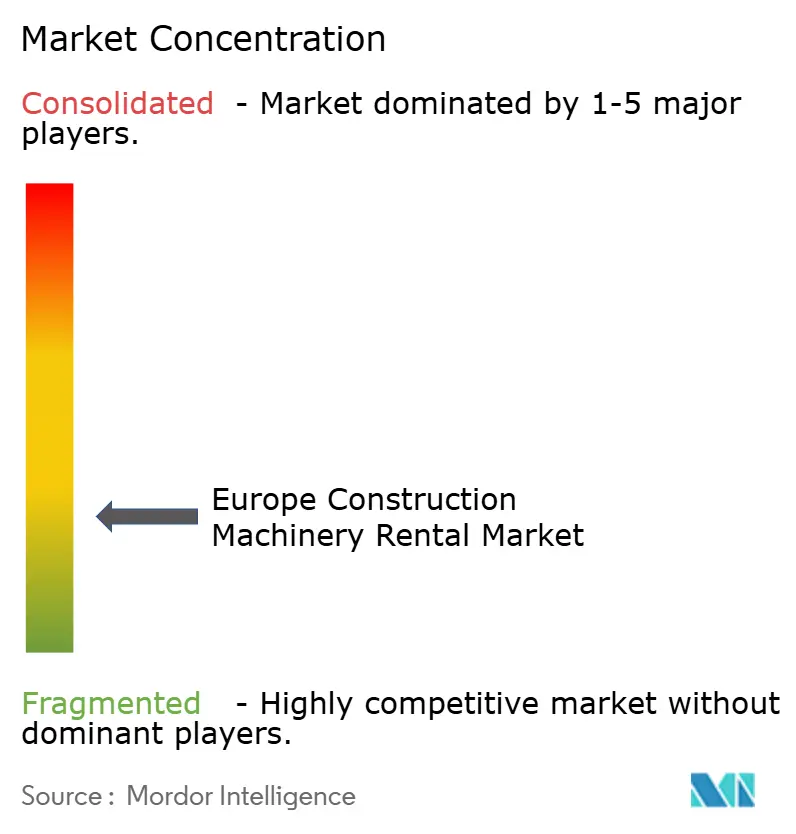
| Market Concentration | Low |
Major Players *Disclaimer: Major Players sorted in no particular order Image © Mordor Intelligence. Reuse requires attribution under CC BY 4.0. | |
Europe Construction Machinery Rental Market Analysis by Mordor Intelligence
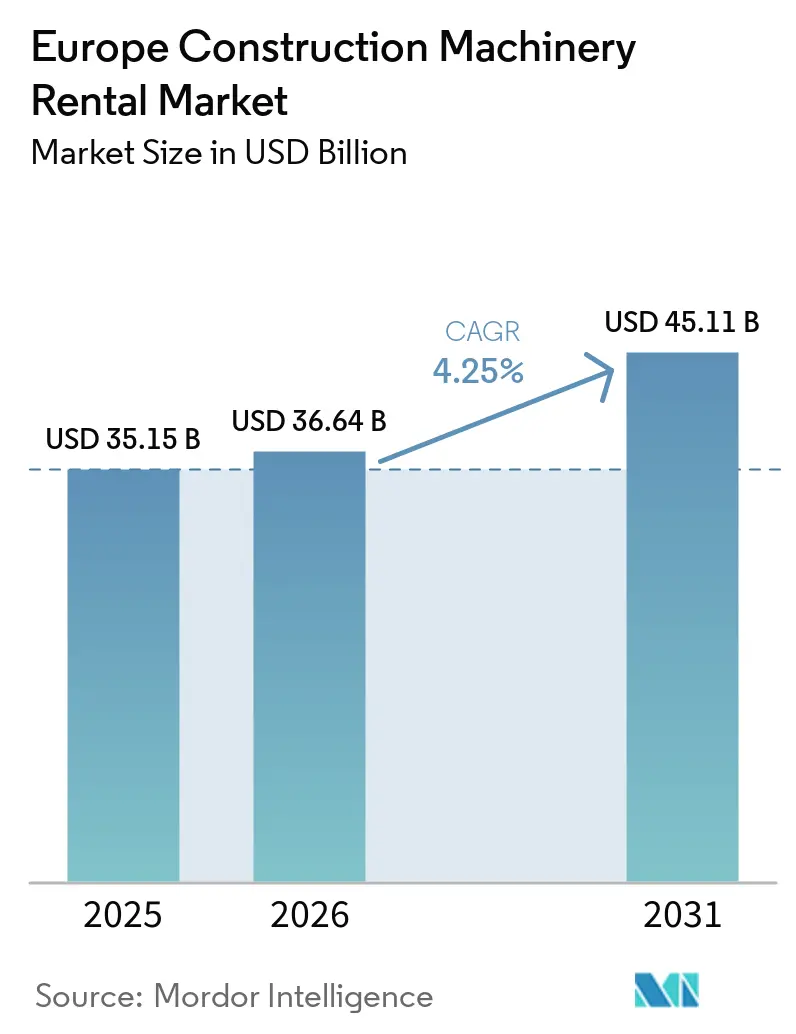
The European construction machinery rental market grew from USD 35.15 billion in 2025 to USD 36.64 billion in 2026 and is forecast to reach USD 45.11 billion by 2031 at a 4.25% CAGR over 2026-2031. This steady climb reflects resilient demand for rented machinery, expanding equipment-as-a-service agreements, and emission-driven fleet renewal across the region. The European construction machinery rental market benefits from EU-backed infrastructure stimulus, rapid electrification mandates, and ESG-linked lending that lowers capital costs for sustainable fleets. Operators prioritize telematics-enabled utilization gains, while governments reinforce demand with green transport corridors and digital connectivity projects. Competitive intensity is growing as OEMs form direct rental units, traditional rental giants accelerate pan-European acquisitions, and digital marketplaces shrink search and transaction costs for contractors.
Key Report Takeaways
- By machinery type, earthmoving equipment led with 41.88% of the European construction machinery rental market share in 2025; it is projected to advance at a 4.55% CAGR to 2031.
- By drive type, hydraulic systems held 77.95% of the European construction machinery rental market in 2025, while fully electric alternatives are expanding at a 11.85% CAGR through 2031.
- By application, building construction commanded a 57.56% share of the European construction machinery rental market size in 2025 and is progressing at a 4.62% CAGR through 2031.
- By payload capacity, medium-duty machines captured a 47.35% share of the European construction machinery rental market in 2025; light-duty units recorded the fastest 5.08% CAGR between 2026 and 2031.
- By geography, Germany dominated with 24.52% European construction machinery rental market share in 2025, while Spain posted the highest 5.05% CAGR through 2031.
Note: Market size and forecast figures in this report are generated using Mordor Intelligence’s proprietary estimation framework, updated with the latest available data and insights as of 2026.
Market Trends and Insights
Drivers Impact Analysis of Europe Construction Machinery Rental Market*
| Driver | (~) % Impact on CAGR Forecast | Geographic Relevance | Impact Timeline |
|---|---|---|---|
| Surging EU Infrastructure Stimulus | +1.2% | Germany, France, Italy, Spain | Medium term (2-4 years) |
| Accelerated Fleet Electrification Mandates | +0.8% | EU-wide with Nordic early adoption | Long term (≥ 4 years) |
| Shift Toward Equipment-as-a-Service Models | +0.7% | Concentrated in mature markets | Short term (≤ 2 years) |
| ESG-Linked Financing Lowering CAPEX | +0.6% | Western Europe expanding east | Medium term (2-4 years) |
| EU Taxonomy Focus on Embodied-Carbon Reporting | +0.4% | EU-wide with UK and Switzerland spillover | Long term (≥ 4 years) |
| On-Site Modular Power Units | +0.3% | Northern and Western Europe | Medium term (2-4 years) |
| Source: Mordor Intelligence | |||
Surging EU Infrastructure Stimulus (Post-2025)
The European Investment Bank has earmarked EUR 1.1 trillion for climate-aligned infrastructure through 2030, triggering a sustained uptick in rentals of excavators, pavers, and tower cranes as projects break ground across transport and digital corridors [1]. Germany is accelerating infrastructure and digital modernization, with federal plans committing approximately USD 192.5 billion in transport infrastructure investment through 2029, covering highways, bridges, and rail upgrades. Large-scale rail renewal and autobahn bridge replacement programs are sustaining demand for heavy earthmoving, piling, and lifting equipment. In parallel, nationwide gigabit and fiber-optic expansion initiatives are driving trenching and cable-laying activity across urban and semi-urban corridors. Renewable energy expansion, particularly onshore wind and associated grid connections, is further increasing demand for high-capacity cranes and deep-foundation machinery. This investment cycle is more infrastructure- and energy-transition focused than previous housing-led upswings, shifting construction equipment rental demand toward specialized fleets.
Accelerated Fleet Electrification Mandates
The European Commission’s Fit for 55 package requires a 55% emissions cut by 2030, pressuring rental firms to pivot from diesel to battery and hydrogen powertrains [2]. JCB’s hydrogen internal combustion engine program, now trialed in 11 countries, highlights how OEMs are responding to Europe’s decarbonization mandates. Early deployments in Sweden and Norway benefit from national incentives for low- and zero-emission equipment, helping offset higher upfront costs. Contractors operating in zero-emission urban zones can command premium rental rates while ensuring regulatory compliance. The shift is prompting investment in hydrogen refueling infrastructure, depot upgrades, and technician retraining for high-pressure systems. Telematics integration supports performance optimization and safety monitoring. While capital intensity increases initially, improved fuel cost visibility and lower carbon compliance risk enhance lifecycle economics. As public tenders increasingly prioritize emissions criteria, electric fleets strengthen rental competitiveness in infrastructure and urban projects.
ESG-Linked Financing Lowering CAPEX
European lenders are increasingly linking financing terms to sustainability performance, offering rental companies that disclose carbon metrics and electrification roadmaps interest rate reductions of roughly 25–50 basis points, lowering weighted average fleet acquisition costs. Loxam has embedded sustainability KPIs into a multi-currency revolving credit facility supporting its network of more than 1,000 branches, enabling greater capital flexibility for bulk orders of electric mini-excavators and low-emission equipment. Preferential green financing improves balance sheet efficiency and enhances return on invested capital for larger operators with transparent ESG reporting. This dynamic widens the funding advantage between scale players and smaller, less data-equipped competitors. As access to discounted capital becomes a strategic lever, well-funded rental groups are better positioned to acquire legacy fleets and accelerate electrification.
EU Taxonomy Focus on Embodied-Carbon Reporting
Starting in 2024, under the Corporate Sustainability Reporting Directive, large construction firms must report Scope 3 emissions from rented equipment, shifting demand toward fleets with robust carbon accounting systems. Rental companies are now tagging each unit with cradle-to-grave CO₂ metrics to meet disclosure requirements. Providers without digital traceability risk being excluded from tender lists, particularly for publicly funded projects governed by strict green procurement criteria. This regulatory push is accelerating the adoption of connected telematics, emissions monitoring, and lifecycle reporting across rental fleets, effectively making sustainability data a prerequisite for market participation and competitive bidding.
Restraints Impact Analysis of Europe Construction Machinery Rental Market*
| Restraint | (~) % Impact on CAGR Forecast | Geographic Relevance | Impact Timeline |
|---|---|---|---|
| Operator Talent Shortage | -1.1% | Western Europe most acute | Medium term (2-4 years) |
| Disharmony in NRMM Stage V Adoption | -0.9% | EU-wide with uneven enforcement | Short term (≤ 2 years) |
| Secondary Market Glut from Diesel Asset Obsolescence | -0.6% | Western Europe spreading east | Long term (≥ 4 years) |
| High Telemetry Retrofit Cost | -0.4% | Mature rental markets | Short term (≤ 2 years) |
| Source: Mordor Intelligence | |||
Disharmony in NRMM Stage V Adoption
Non-Road Mobile Machinery Stage V rules came into effect in 2019, but enforcement and penalty severity vary across EU member states, forcing rental fleets to navigate dual compliance standards. Operators working in multiple countries face rising logistics and retrofitting costs to ensure each unit satisfies the strictest local requirements. This regulatory fragmentation incentivizes investment in newer, Stage V-compliant machinery and drives demand for centralized fleet management systems to monitor emissions compliance across borders, increasing operational complexity and capital intensity for multi-national rental providers.
Secondary Market Glut from Diesel Asset Obsolescence
Rapid policy changes and the expansion of urban low-emission zones are reducing residual values for diesel excavators, loaders, and generators, prompting rental companies to accelerate write-downs on legacy fleets. Operators often redeploy affected units to regions with less stringent regulations or sell them at discounted export prices, impacting balance-sheet strength. This dynamic is increasing demand for zero- and low-emission machinery, encouraging fleets to upgrade more quickly, while also pressuring rental firms to integrate emissions forecasting and asset redeployment strategies into financial planning.
*Our forecasts treat driver/restraint impacts as directional, not additive. The impact forecasts reflect baseline growth, mix effects, and variable interactions.
Europe Construction Machinery Rental Market Segment Analysis
By Machinery Type:
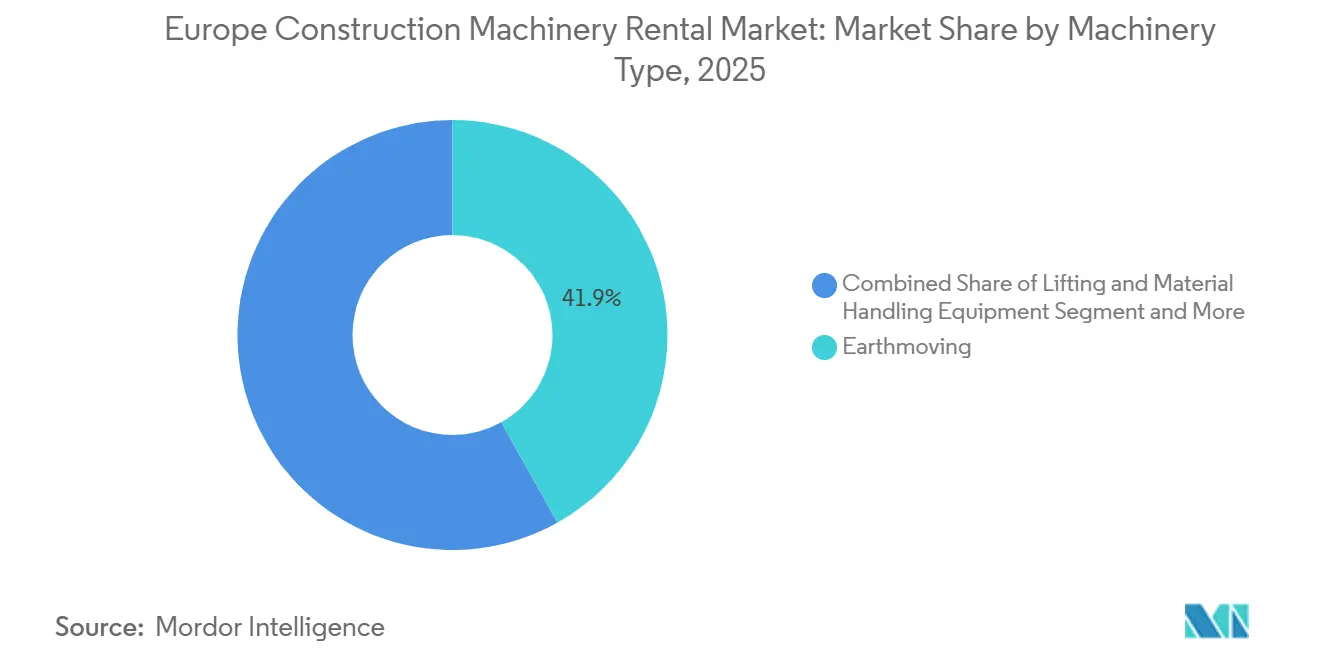
Earthmoving Dominance Drives ElectrificationEarthmoving equipment captured 41.88% of the European construction machinery rental market in 2025 and is projected to expand at a 4.55% CAGR through 2031. Crawler excavators continue to lead in large-scale civil works, while wheeled excavators support urban infrastructure and last-mile projects. Skid-steer loaders are increasingly used in tight refurbishment sites requiring compact maneuverability. Motor graders and dozers maintain steady demand along Eastern Europe’s growing highway and transport corridors. The segment is also a testing ground for electrification, with initiatives like Hitachi’s 1.7-ton battery excavator, scheduled for 2027 deployment, highlighting OEM focus on low-emission machinery.
Electrification adoption is accelerating as contractors strive to meet urban emission limits without sacrificing productivity. OEMs are piloting swappable battery systems to reduce charging downtime, while rental companies deploy mobile charging units to sustain high utilization. Leading rental operators are bundling earthmoving fleets with on-site power solutions and telematics monitoring, capturing added value from integrated offerings and positioning themselves for emission-compliant project contracts.

By Drive Type:
Electric Disruption Accelerates Despite Hydraulic DominanceHydraulic systems held a 77.95% share of the European construction machinery rental market in 2025, reflecting their reliability and extensive service support. Meanwhile, fully electric drives are growing at an 11.85% CAGR, fueled by Nordic subsidies and expanding urban low-emission zones. Diesel-electric hybrids provide a transitional solution, delivering fuel savings while mitigating range limitations on remote sites.
Adoption rates vary by equipment type. Compact excavators, scissor lifts, and small loaders are leading the shift as current battery technology now supports full-shift operation. Heavier machines are awaiting next-generation solid-state batteries or hydrogen fuel cells, with JCB’s ongoing trials illustrating longer-term potential. Rental companies are managing the transition by investing in modular fleets capable of switching between diesel and electric drivelines, balancing utilization and compliance across diverse project sites.
By Application:
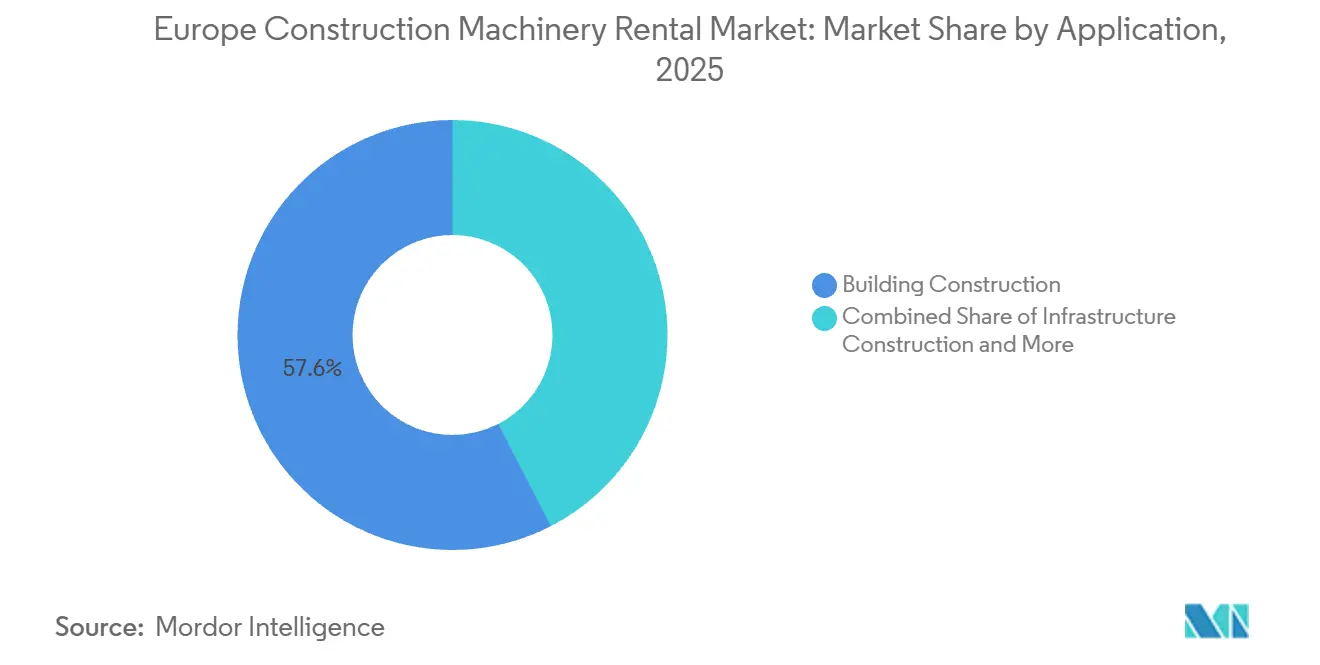
Building Construction Sustains Growth MomentumBuilding construction accounted for 57.56% of the European construction machinery rental market in 2025, growing at a 4.62% CAGR as governments address housing shortages and commercial space modernization. Residential projects benefit from loan guarantees and expedited permitting for affordable housing, while commercial developers upgrade offices and retail spaces with flexible layouts and smart-building technologies, boosting demand for scissor lifts and telehandlers. Industrial expansions tied to near-shoring in electronics and pharmaceuticals sustain steady equipment utilization.
Infrastructure follows as the second-largest application, driven by EU transport corridors, grid modernization, and broadband deployment. Renewable energy construction supports high-margin rentals for specialized cranes, drilling rigs, and foundation equipment. Mining and quarrying remain modest but consistent contributors, while disaster recovery rentals see seasonal spikes during floods, wildfires, and other extreme weather events.
By Payload Capacity:
Light-Duty Growth Reflects Urban ConstraintsMedium-duty machines captured 47.35% of the European construction machinery rental market in 2025, offering a balance of versatility and transport cost efficiency. Light-duty equipment, however, is expanding fastest at a 5.08% CAGR, as urban regulations on weight, noise, and emissions favor compact loaders, mini-excavators, and battery-powered scissor lifts. Contractors benefit from simpler licensing requirements and lower operator skill thresholds.
Heavy-duty rentals remain essential for large-scale infrastructure and mega-projects, but are subject to scheduling volatility due to permit lead times. The surge in light-duty demand is reinforced by EU Green Deal–driven refurbishment and energy-efficiency upgrades, which require compact indoor-capable equipment. Leading rental companies are responding with urban-optimized fleets and last-mile logistics hubs, reducing delivery times and supporting tighter project schedules.
Geography Analysis
Germany and Spain Construction Machinery Rental Market
Germany led the European construction machinery rental market with a 24.52% share in 2025, supported by a sophisticated industrial base and rising infrastructure investment that fuels earthmoving and road-building rentals. Urban diesel restrictions are accelerating the adoption of electric mini-excavators, allowing rental firms to command premium rates. Spain posts the fastest 5.05% CAGR, driven by tourism infrastructure upgrades and renewable energy parks financed through EU cohesion funds, with local providers leveraging flexible credit to modernize fleets quickly.
Broader European Markets
France and Italy sustain significant volumes via rail modernization and seismic retrofit programs. The United Kingdom, though outside the EU, shapes fleet movements as equipment is redeployed across the Channel during seasonal lulls. Nordic countries, particularly Sweden, set benchmarks for zero-emission machinery and digitalized job-site connectivity. Meanwhile, Poland and the Czech Republic offer expansion corridors for pan-European rental chains via EU-funded highway and energy projects, while Eastern markets contend with geopolitical uncertainty but maintain localized construction demand.
Cross-Border Operations Construction Machinery Rental Market
Pan-regional operators optimize fleet allocation to smooth seasonality, rotating heaters and generators south for winter construction, then moving aerial platforms north for summer refurbishments. Diverse regulatory regimes require agile asset management to prevent idle non-compliant units, while digital tracking and telematics enhance utilization across multiple jurisdictions. This balancing act reinforces the strategic value of scale, flexibility, and cross-border compliance expertise in sustaining rental profitability.
Regulatory Landscape
EU machinery compliance is shifting from the Machinery Directive (2006/42/EC) to the Machinery Regulation (EU) 2023/1230, with application starting 20 January 2027. The regulation tightens essential health and safety requirements for machinery placed on the EU market and raises documentation expectations for software-enabled safety functions, including cyber-safety provisions relevant to connected equipment used by rental fleets.
For cross-border fleet mobility, Regulation (EU) 2025/14 (adopted 19 December 2024, in force from January 2025) establishes an EU-level type-approval and individual approval framework for the road circulation safety of non-road mobile machinery, with key provisions becoming applicable from 29 January 2028. Alongside this, the Commission continues to update the harmonized standards backbone, including Commission Implementing Decision (EU) 2026/546 (March 2026). This affects categories such as earth-moving machinery and cranes, shaping procurement specifications and the conformity evidence required by professional fleet operators.
Value Chain Analysis
The value chain starts with OEMs and component suppliers (engines, hydraulics, batteries, telematics, and attachments), and then moves through national dealers and service partners to rental fleet owners that handle procurement, compliance, and lifecycle optimization (maintenance, refurbishment, resale/export). OEMs are increasing direct-to-rental engagement and bundling aftermarket support, while attachment ecosystems deepen differentiation. A 2025 supply agreement positioning engcon tiltrotators as a preferred option within Hitachi Construction Machinery (Europe) dealer channels illustrates this approach.
Downstream, rental companies monetize utilization through branch networks and digital customer portals, supported by transport and logistics providers and on-site service teams. Fleet renewal and emissions compliance shape upstream demand, with large multi-country renters placing bulk orders (for example, Boels Rental investing in 700 new JCB machines in February 2025) and requiring parts availability, technician training, and battery and charging readiness for electrified compact equipment. End users include building and civil contractors and specialized project operators, and tender-driven reporting requirements increase the value of telematics data capture, CO2 reporting, and standardized documentation across countries.
Competitive Landscape
Top Companies in Europe Construction Machinery Rental Market
The European construction machinery rental market remains fragmented yet shows accelerating consolidation. Loxam Group, posting EUR 2.6 billion in 2024 revenue across 1,091 branches[3], revamped its revolving credit to include sustainability KPIs that lower funding costs for electric fleet expansion. Sunbelt Rentals, part of Ashtead Group, continues acquisitive growth to build a trans-continental platform capable of pooling large-scale procurement and telematics data. Meanwhile, OEMs such as Volvo CE pilot direct rental offers, potentially sidelining intermediaries on premium technology units.
Digital differentiation is becoming a key market driver, with rental firms rolling out customer portals that provide real-time equipment tracking, CO₂ dashboards, and automated off-hire workflows. Predictive maintenance algorithms are reducing downtime and reinforcing service contracts, fostering more loyal and “sticky” client relationships. These digital tools are increasingly shaping procurement and operational strategies, enabling rental companies to optimize fleet utilization while meeting client sustainability mandates.
The market is also looking ahead to autonomous and software-integrated solutions. Prototypes like John Deere’s retrofittable articulated dump truck, showcased at CES 2025, hint at a future where rental agreements may combine hardware leases with software licenses. Competitive advantage is shifting away from sheer fleet size toward data analytics capabilities, financing agility, and regional regulatory compliance expertise, signaling that strategic innovation and digital maturity will define the leading European rental operators.
Europe Construction Machinery Rental Industry Leaders
-
LOXAM SAS
-
Kiloutou Group
-
Ashtead Group (Sunbelt Rentals)
-
Boels Rental
-
Caterpillar Inc.
- *Disclaimer: Major Players sorted in no particular order
Europe Construction Machinery Rental Market Companies Covered in this Report
- Loxam Group
- Ashtead Group (Sunbelt Rentals)
- Kiloutou Group
- Boels Rental
- Cramo (Renta Group)
- Zeppelin Rental
- Ahern Rentals
- Ramirent
- Ardent Hire Solutions
- Mateco
- Caterpillar Inc.
- Deere & Company
- Komatsu Ltd
- Hitachi Construction Machinery
- Liebherr Group
- JCB
- Manitou Group
- MECALAC
- Wacker Neuson
- Volvo CE
Read Analysis of Europe Construction Machinery Rental Companies
Market Opportunities and Future Outlook
Cross-border expansion into underpenetrated pockets and adjacency categories is increasingly visible, with momentum supported by announced M&A and financing activity in 2026. Kiloutou entered Ireland through the acquisition of KDM Hire (announced April 2026), targeting demand tied to infrastructure, energy, and data center project pipelines, while DWS Group took a stake in UK-based Flannery Plant Hire (June 2026). These transactions point to opportunities around network densification (branches, service coverage, and logistics) and broader product availability for contractors operating across multiple regions.
Compliance-led fleet modernization and data readiness also create monetizable service layers beyond daily or weekly hire. The Machinery Regulation (EU) 2023/1230 applying from 20 January 2027 increases the premium on compliant documentation and safe operation of connected machinery. Regulation (EU) 2025/14, applicable from 29 January 2028, adds a harmonized road-circulation approval pathway for non-road mobile machinery that can reduce friction for multi-country fleet redeployment. With CSRD-driven Scope 3 visibility already pushing builders to request equipment emissions information, rental providers that standardize telematics, maintenance traceability, and CO2 dashboards can differentiate in public and large-contractor tenders and expand equipment-as-a-service bundles that include uptime commitments and site support.
Recent Industry Developments in Europe Construction Machinery Rental Market
- May 2026: Sunbelt Rentals completed its USD 650 million acquisition of Reliant Asset Management (Aries Building Systems), expanding into modular space solutions. The acquisition broadens the addressable rental wallet on infrastructure and industrial sites by combining temporary space with equipment and services. It also improves cross-sell density across large projects.
- April 2026: Kiloutou announced its entry into Ireland through the acquisition of KDM Hire, adding local scale in Northern Ireland and the Republic of Ireland. The acquisition supports multi-sector project demand (infrastructure, energy, and data centers) and strengthens Kiloutou's ability to serve cross-border customers with a denser branch and service footprint.
- May 2024: Robert Baran Crane Group Petrolift announced an expansion of its crane fleet with 21 new Grove all-terrain cranes. The additional lifting capacity improves availability for complex industrial and construction lifts and reflects continued investment in high-value, specialized rental fleets.
Europe Construction Machinery Rental Market Report Scope and Research Methodology
Market Definition and Coverage
For this study, the market is defined as revenue earned from renting construction machinery to contractors and other users across Europe, typically on daily, weekly, or monthly terms, with fees tied to equipment class and utilization.
We exclude equipment sales, long-term financial leasing, and most on-site operator labor charges when they are billed as a separate service line.
Segments Covered in This Report
- By Machinery Type
- Earthmoving Machinery
- Excavators
- Crawler
- Wheeled
- Loaders
- Skid-Steer
- Wheel
- Backhoe
- Motor Graders
- Dozers
- Excavators
- Lifting and Material-Handling
- Cranes
- Mobile Cranes
- Tower Cranes
- Telescopic Handlers
- Aerial Work Platforms
- Cranes
- Road Construction Equipment
- Pavers
- Road Rollers
- Asphalt Mixers
- Other Machinery Types
- Earthmoving Machinery
- By Drive Type
- Hydraulic
- Diesel-Electric Hybrid
- Fully Electric
- Hydrogen Fuel Cell
- By Application
- Building Construction
- Residential
- Commercial
- Industrial
- Infrastructure Construction
- Road and Highway
- Rail
- Airport
- Energy Infrastructure
- Mining and Quarrying
- Disaster and Emergency Relief
- Other Applications
- Building Construction
- By Payload Capacity
- Light-Duty (Below 3 tons)
- Medium-Duty (3-10 tons)
- Heavy-Duty (10-30 tons)
- Super Heavy-Duty (Above 30 tons)
- By Country
- Germany
- United Kingdom
- France
- Italy
- Spain
- Netherlands
- Sweden
- Poland
- Russia
- Rest of Europe
Data Sources, Market Sizing, and Validation
Desk Research
Desk research was used to set the outside boundaries of the model and to anchor country-level construction activity. We relied on public releases and statistical series such as Eurostat construction output and price indices, national statistics offices, European Rental Association publications, and road infrastructure indicators from the European Commission.
We also reviewed safety and emissions rule changes published by EU bodies, since compliance requirements can affect fleet cost structures and, in turn, rental pricing. Alongside these, we used company annual reports, investor presentations, and reputable press coverage to map branch networks, fleet mix, and utilization commentary across major European markets. Where available, we referenced paid subscriptions for company financials and intelligence, import and export shipment-level data, and patent databases to cross-check supplier momentum and equipment technology direction. The desk sources listed here are illustrative, and we also used other public documents and data series to collect, validate, and clarify findings.
Primary Interviews and Surveys
Primary interviews and surveys focused on confirming how rental demand behaves in key countries and how pricing is managed under changing utilization and fleet availability. We spoke with rental business leaders, depot and operations managers, procurement and fleet planners, and contractor-side users to confirm typical rental durations, rate cards versus net realized pricing, and the split between large projects and local jobs. Because this is a multi-country market, the inputs were validated across major geographies in Europe so that country weights and seasonality patterns were not assumed.
Distribution of primary research fieldwork respondents
| Company type | Respondent position |
|---|---|
| Top tier: 30% | CXOs: 12% |
| Mid tier: 54% | Functional/Unit leaders: 29% |
| Smaller Players: 16% | Managers: 59% |
Market-Sizing & Forecasting
The model starts with a top-down demand pool build that links construction activity to rentable equipment needs, and then converts that demand into rental revenue using utilization and price logic. Country-level construction output trends, infrastructure starts, housing cycle direction, and contractor sentiment were treated as leading indicators for rental intensity. To keep the model aligned with how rental operators run, we also used fleet utilization ranges, average rental duration, and the mix shift between earthmoving, lifting, and road equipment as practical inputs.
We then corroborated totals using selective bottom-up checks, such as rolling up disclosed rental revenues for visible players, sampling daily and monthly rate cards for common equipment classes, and applying realistic utilization to approximate revenue per unit. When company disclosures were incomplete, gaps were handled through country-level scaling based on branch footprint, fleet age commentary, and known project pipelines, and then adjusted only after interview feedback supported the direction.
For forecasting, we mainly used scenario analysis since rental markets in Europe can swing with interest rates, public spending timing, and large project awards. Each scenario was tied to a small set of measurable drivers, and assumptions were re-tested with experts before final year values were locked.
Data Validation & Update Cycle
Outputs were checked against independent signals, including construction output movements, reported rental turnover commentary, and changes seen in utilization and pricing discussions from interviews. If a country result looked inconsistent with these signals, we rechecked the drivers and reworked the inputs, then completed a second analyst review before sign-off.
The report is refreshed annually, and interim updates are done when material events occur, such as sharp shifts in construction activity or major regulatory changes affecting fleet economics. Before delivery, a final review pass is completed so clients receive the latest updated view from the most recent data releases.
Mordor Intelligence's Europe Construction Machinery Rental Market Size Measured Against Other Published Estimates
Published numbers for this market often do not match because the scope line is drawn differently and the conversion from activity to rental revenue is handled in different ways. We see gaps when one source mixes total equipment rental with adjacent categories, or when countries included in Europe are counted differently.
Branch network footprints, utilization commentary, and country-level construction output checks are the evidence points that keep Mordor Intelligence's estimate anchored to pure construction machinery rental revenue across the covered European countries, rather than blending in broader machinery leasing or non-construction rentals.
Benchmark comparison
| Source | Market Size | Gaps in Research Methodology |
|---|---|---|
| Mordor Intelligence | USD 35.15 B (2025) | |
| Industry Association A | USD 36.30 B (2025) | Often reflects wider equipment rental turnover across 17 European countries and may include non-construction rental categories, which pushes the total above a construction-only boundary. |
| Cross-Industry Dataset B | USD 150.00 B (2026) | Uses a broad machinery rental and leasing industry definition across Europe that can include office, transport, and other equipment types, so it is not directly comparable to construction machinery rental. |
The spread mainly comes from how narrowly rental activity is defined and how Europe is counted country by country. When the scope stays limited to construction machinery rental and the inputs are tied back to utilization, rental duration, and construction output, the resulting number becomes easier to trace and repeat from year to year.
Key Questions Answered in the Report
What is the current value of the European construction machinery rental market?
The market is valued at USD 36.64 billion in 2026 and is projected to reach USD 45.11 billion by 2031.
How fast is demand for electric construction equipment growing in Europe?
Fully electric drives in the European construction machinery rental market are expanding at a 11.85% CAGR through 2031, outpacing all other drive types.
Which country leads European machinery rentals by revenue?
Germany accounted for 24.52% of European construction machinery rental market share in 2025, the largest national slice.
Which machinery segment commands the biggest rental share?
Earthmoving machinery held 41.88% of 2025 rental revenue and is forecast to remain dominant through 2031.
Why are rental firms adopting equipment-as-a-service models?
Labor shortages, demand for uptime guarantees, and digital monitoring needs encourage bundled offerings that combine machines, certified operators, and maintenance into one contract.