
Market Overview
| Study Period | 2021 - 2031 |
|---|---|
| Forecast Data Period | 2026 - 2031 |
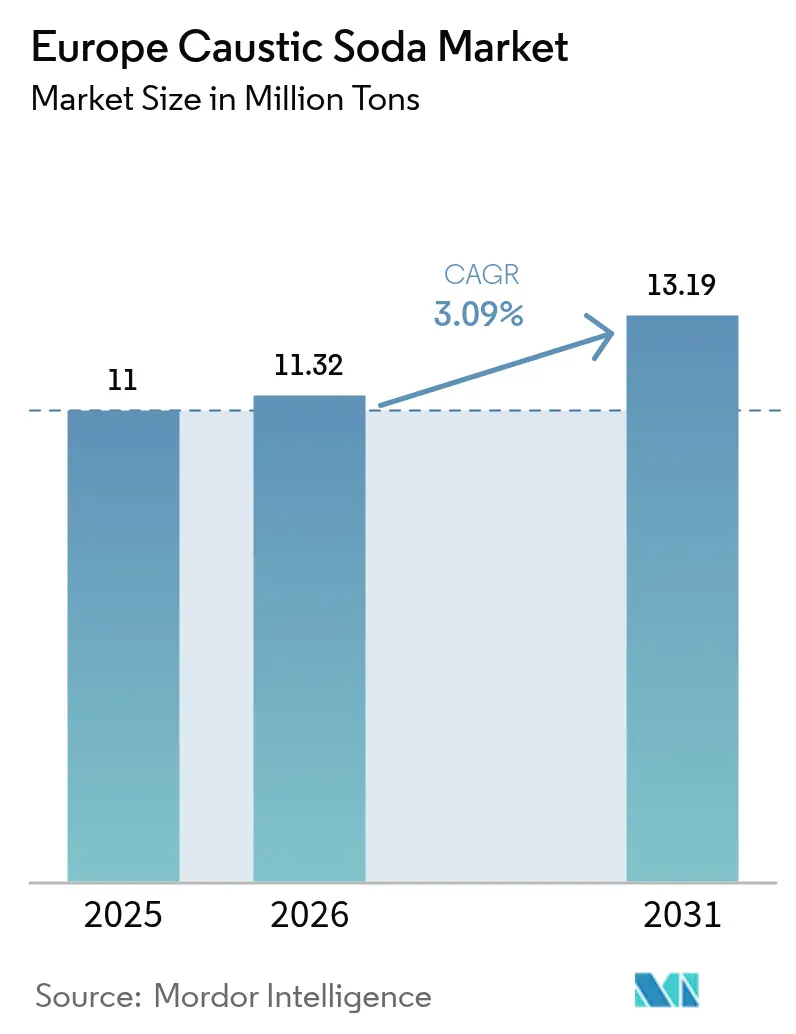
| Base Year Market Size (2025) | 11 Million tons |
| Market Volume (2026) | 11.32 Million tons |
| Market Volume (2031) | 13.19 Million tons |
| Growth Rate (2026 - 2031) | 3.09 % |
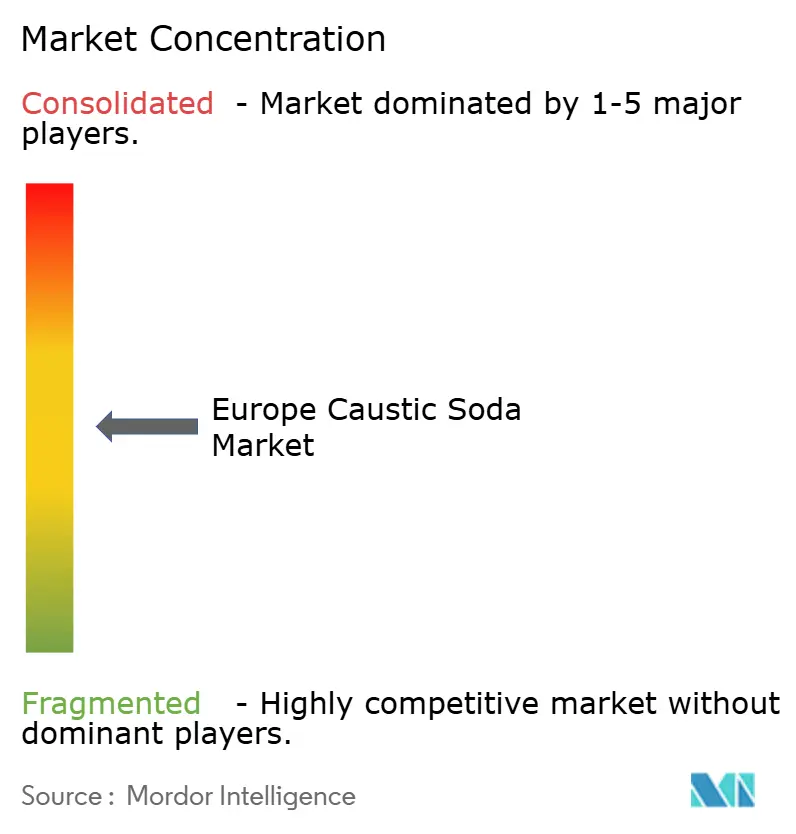
| Market Concentration | Medium |
Major Players *Disclaimer: Major Players sorted in no particular order Image © Mordor Intelligence. Reuse requires attribution under CC BY 4.0. | |
Europe Caustic Soda Market Analysis by Mordor Intelligence
The Europe Caustic Soda Market size is expected to grow from 11 Million tons in 2025 to 11.32 Million tons in 2026 and is forecast to reach 13.19 Million tons by 2031 at 3.09% CAGR over 2026-2031. Tight electricity supplies, cost‐inflation across chlor-alkali value chains, and the need to keep chlorine-caustic balances in check after persistent polyvinyl-chloride (PVC) capacity reductions are reshaping investment priorities. Large producers are ring-fencing renewable-power contracts, smaller operators are exiting high-cost diaphragm assets, and downstream users are switching to liquid grades to streamline logistics. Regulatory tailwinds from wastewater upgrades, fiber-based packaging, and battery-grade alumina projects are anchoring structural demand, while elevated energy tariffs and stringent REACH obligations remain the principal counterweights. Together, these forces explain why the Europe caustic soda market is expanding at a steady, rather than explosive, clip.
Key Report Takeaways
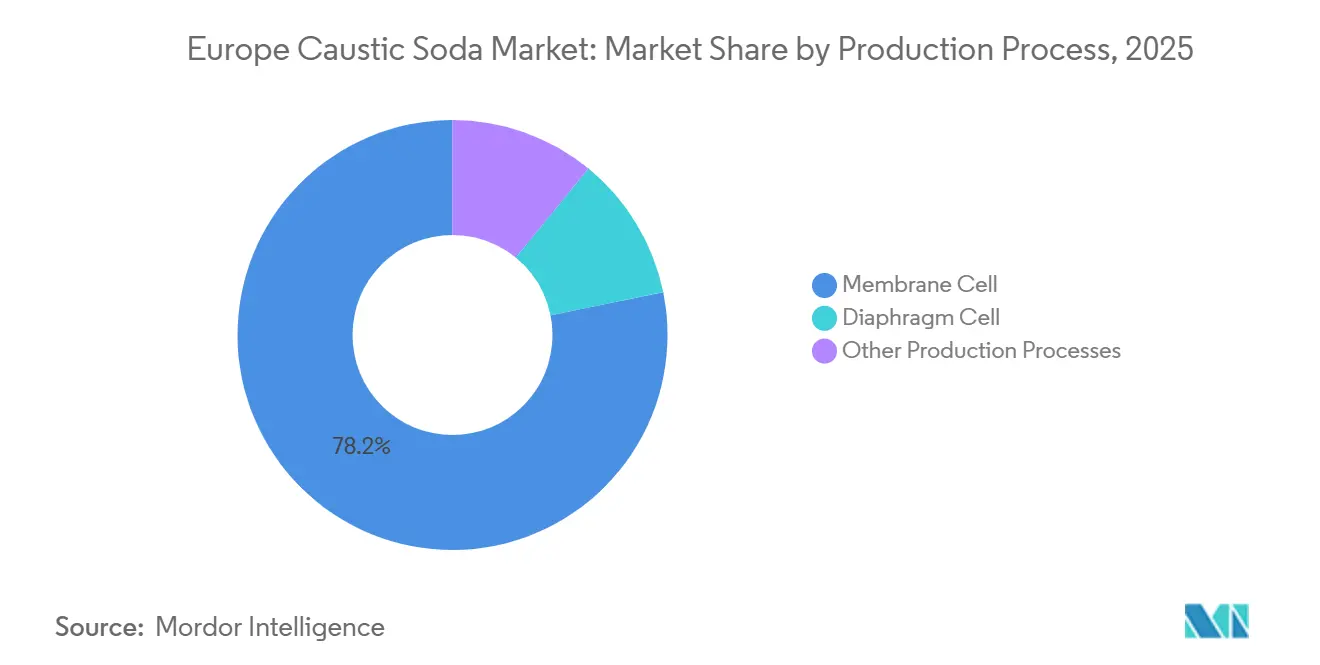
- Membrane cell technology led with 78.18% of Europe caustic soda market share in 2025 and remains the most energy-efficient route, while other production processes are forecast to grow at 3.22% CAGR through 2031.
- Liquid grades accounted for 61.22% of 2025 volumes and are on track to increase at 4.29% CAGR to 2031, outpacing solid forms thanks to lower freight outlays and rapid plant-wide dosing adoption.
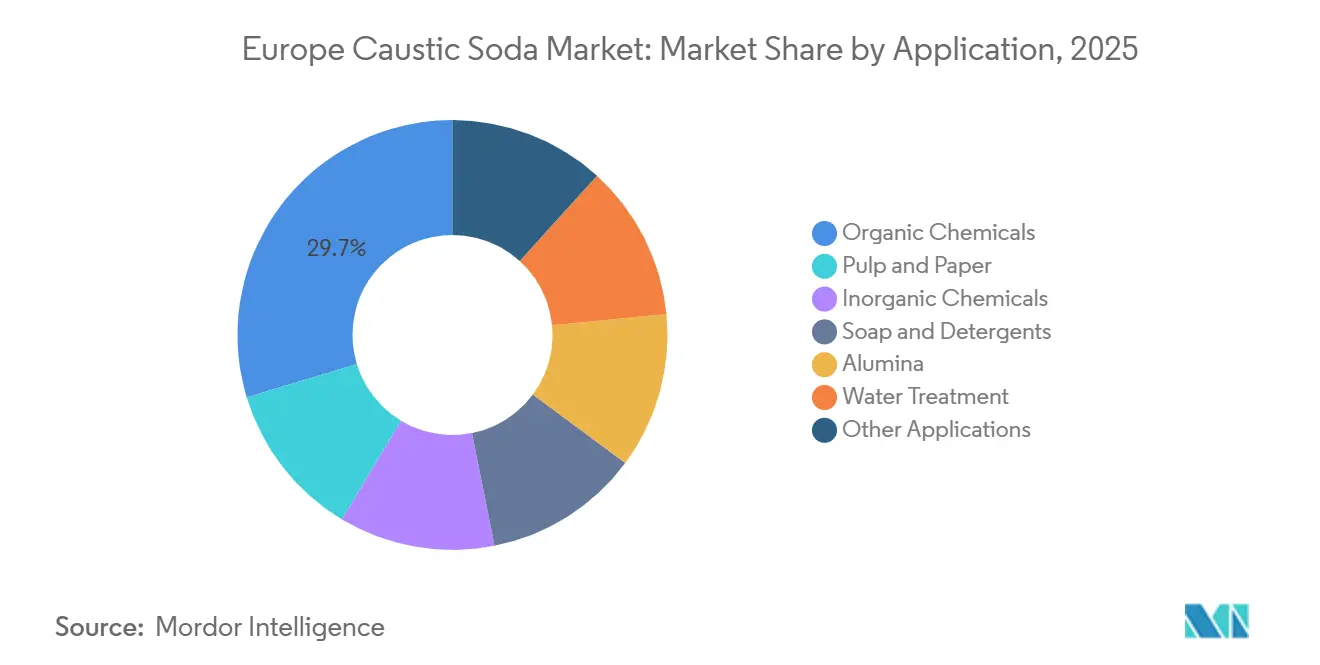
- Organic chemicals captured 29.69% of demand in 2025; alumina refining is set to record the fastest 3.47% CAGR as battery-grade projects restart idled Iberian refineries.
- Rest of Europe commanded 38.98% volume share in 2025, whereas Spain is expected to log a 4.77% CAGR, buoyed by Ercros’ capacity additions and municipal wastewater spending.
Note: Market size and forecast figures in this report are generated using Mordor Intelligence’s proprietary estimation framework, updated with the latest available data and insights as of 2026.
Europe Caustic Soda Market Trends and Insights
Drivers Impact Analysis*
| Drivers | (~) % Impact on CAGR Forecast | Geographic Relevance | Impact Timeline |
|---|---|---|---|
| Increasing Demand from Water Treatment Application | +0.6% | Germany, France, Italy, Spain, Poland | Medium term (2-4 years) |
| Rising Alumina Demand from EV-Battery Supply Chain | +0.5% | Spain, Italy, Germany | Long term (≥4 years) |
| Growth of Fiber-Based Packaging | +0.4% | Nordic Region, Germany, France | Medium term (2-4 years) |
| Expansion of Soap and Detergent Manufacturing Hubs | +0.3% | Germany, France, Netherlands | Short term (≤2 years) |
| Growing Requirement for Chemical Synthesis | +0.5% | Germany, Belgium, Netherlands | Short term (≤2 years) |
| Source: Mordor Intelligence | |||
Increasing Demand from Water Treatment Application
Municipal and industrial wastewater plants must now satisfy the 2024/3019 revision of the Urban Wastewater Treatment Directive, widening tertiary treatment to towns above 1,000 population equivalents and calling for net-zero-energy operations by 2045[1]. This mandates EUR 257 billion of upgrades by 2050, lifting caustic-soda use for nutrient removal and pH control by 15-20% over the outlook period. Germany and France, together holding roughly 35% of installed treatment capacity, earmarked EUR 3.2 billion and EUR 2.1 billion, respectively, in 2025 budgets for phosphorus-cut programs. Spain and Italy are channeling cohesion funds into coastal schemes, while Poland and the Czech Republic are decentralizing small-scale units that favor bagged solid NaOH. Suppliers of liquid 50% grades are winning multi-year supply contracts as utilities automate dosing and tighten occupational-safety protocols.
Rising Alumina Demand from EV-Battery Supply Chain
Alcoa opened negotiations in 2024 to revive its 465 kiloton/year San Ciprián refinery and is exploring a partial restart of the 800 kiloton/year Portovesme asset, contingent on sub-EUR 50/MWh renewable-power agreements[2]. Both projects hinge on sodium hydroxide at 50–80 kg per ton of alumina, with battery-grade specifications lifting purity thresholds. Norway-based Norsk Hydro pledged 100% renewable inputs across European alumina and aluminum operations by 2030, establishing co-location prospects for membrane-cell plants near wind and solar clusters. Sodium-ion cathode chemistries referenced in the IEA Critical Minerals Outlook further expand long-term caustic requirements.
Growth of Fiber-Based Packaging
The Packaging and Packaging Waste Regulation (2025/40), together with the Single-Use Plastics Directive, encourages kraft pulp mills to raise the output of recyclable board and molded-fiber products. Mills across Finland, Sweden, Germany, and France consumed 40–80 kg NaOH per ton of pulp in 2025, and leading players UPM, Stora Enso, and Smurfit Kappa posted 8–12% year-on-year pulp gains over 2024–2025. Finland injected EUR 120 million into bio-packaging research and development grants, supporting dissolving-grade pulp lines that run exclusively on liquid caustic soda for continuous digesters. Mandatory recycled-content rules under the EU Ecodesign framework make paper substrates more attractive than virgin plastics, firming long-range demand visibility.
Expansion of Soap and Detergent Manufacturing Hubs
Unilever, Henkel, and Procter & Gamble are consolidating Western and Central European production into fewer mega-sites. Henkel invested EUR 200 million at Düsseldorf in 2025 and will add 25,000 tons/year NaOH demand once the new liquid-detergent lines reach steady state by 2027. P&G’s EUR 150 million compaction tower in Amiens pushes powder-detergent output up 18%, translating into higher caustic-soda throughput. Formulation rules restricting phosphates stimulate greater use of soda ash and silicates, both upstream NaOH derivatives, and Unilever has publicly committed to sourcing only renewable-electricity-derived caustic soda by 2028.
Restraints Impact Analysis*
| Restraint | (~) % Impact on CAGR Forecast | Geographic Relevance | Impact Timeline |
|---|---|---|---|
| High European Energy Costs | −0.8% | Germany, Italy, the Netherlands | Short term (≤2 years) |
| REACH and Occupational-Safety Compliance | −0.2% | EU-wide | Medium term (2-4 years) |
| Chlorine-Balance-Driven Rate Cuts | −0.5% | Germany, France, Netherlands | Short term (≤2 years) |
| Source: Mordor Intelligence | |||
High European Energy Costs
Electricity makes up more than half of total chlor-alkali cash costs in Europe. Despite the retreat from 2023 peaks, 2024 industrial tariffs averaged 197 EUR/MWh, still 85% over the 2020 base. France, shielded by ARENH, pays 32–46 EUR/MWh, but Dutch and German producers contend with triple-digit quotes. Natural-gas parity against Henry Hub stays adverse. Consequently, Ercros saw average selling prices plunge 41% year-on-year, and margins compressed to 6.5% in H1 2024. Covestro’s 1.2 GW renewable-power deal with RWE, effective 2026, aims to cap delivered electricity below 60 EUR/MWh for a decade.
REACH and Occupational-Safety Compliance
Mandatory membrane conversion for legacy diaphragm units by 2028 under the sector BAT reference note intensifies capex. Czech producer Spolchemie disclosed EUR 8 million in REACH fees and monitoring upgrades in 2024,12% of revenue, forcing state-backed guarantees. Closed-loop transfer systems are now compulsory for NaOH above 25 wt%, adding EUR 15–25 million per site.
*Our forecasts treat driver/restraint impacts as directional, not additive. The impact forecasts reflect baseline growth, mix effects, and variable interactions.
Segment Analysis
By Production Process: Membrane Cells Sustain Dominance with Energy Savings
Membrane technology held 78.18% of 2025 volume, while other production processes segment is growing at a faster CAGR of 3.22%. The Europe caustic soda market size for membrane output is poised to benefit as every diaphragm retrofit delivers 20-30% electricity savings. Emerging routes such as oxygen-depolarized cathode cells could cut power draw under 2,000 kWh/t, and Horizon Europe earmarked EUR 45 million to pilot this technology.
Legacy diaphragm share, still near 10–12% in Poland, the Czech Republic, and Romania, will narrow as 2028 conversion deadlines approach. Producers that delay upgrades risk REACH penalties and customer flight toward low-carbon NaOH. Mercury cells have already vanished after the Minamata Convention. The Europe caustic soda market thus rotates firmly around membrane capacity, and any new build is expected to deploy next-generation cell rooms compatible with green hydrogen valorization.

By Form: Liquid Grades Accelerate on Freight and Automation Economics
Liquid NaOH represented 61.22% of shipments in 2025 and is forecast to grow 4.29% to 2031. End-users prefer the dilution-free form because it slashes handling cost by 15–20% and integrates seamlessly with automated dosing systems in pulp digesters and municipal clarifiers. A single 25-ton road tanker delivers 12.5 ton active NaOH, often within a 500 km radius, making it attractive against flakes, which require capital-intensive dissolution tanks. Therefore, the Europe caustic soda market is tilting ever more liquid, and transport fleets equipped with stainless-steel iso-containers are experiencing high asset utilization.
Solid forms, however, defend niches in pharma, food-processing, and rural water works that buy 25 kg bags for dosing precision. Textile mercerization in Turkey and Central Europe also values 98 wt% purity. Consequently, although flakes face slower growth, they stabilize margin spreads for sellers that can swing between packaging formats in response to seasonality.
By Application: Organic Chemicals Lead, Alumina Sets the Pace
Organic chemicals drew 29.69% of 2025 volume, anchored in epoxies, polycarbonates, and high-purity pharma intermediates. Domestic resin makers shield themselves via antidumping walls, but they still chase cost relief through captive NaOH pipelines, tying the Europe caustic soda market ever closer to downstream chemical synthesis clusters along the Rhine-Scheldt corridor.
Alumina refining clocks the fastest 3.47% CAGR to 2031 as Spain and Italy progress toward refinery restarts bound for battery-grade supply chains. Each ton of Bayer-route alumina absorbs up to 80 kg NaOH, so San Ciprián’s reactivation alone could consume an extra 30–35 kiloton yearly. Pulp and paper sits at a robust but lower trajectory, buoyed by kraft-linerboard orders from e-commerce packaging converts.
Geography Analysis
Rest of Europe covered 38.98% of 2025 demand as Poland, the Netherlands, and Nordic pulp territory preserved healthy procurement programs. PCC SE’s Brzeg Dolny hub moves liquid shipments across Central Europe via rail, while Nobian’s Delfzijl and Hengelo units benefit from maritime access to North-Sea customers. Nordic mills import sizable NaOH volumes to Kymi, Kaukas, and Skutskär, leveraging steady liquefied-cargo corridors from Baltic producers.
Spain is the volume growth outlier with a 4.77% CAGR projection. Ercros lifted first-half 2024 output to 207 kiloton and has lined up membrane upgrades at Vila-seca and Tarragona. Coupled with EUR 1.8 billion of wastewater capex in 2026-2028, Spanish utilities alone could lift NaOH pull by high-single-digit percentages. The logistics footprint is geared for truck distribution south of the Pyrenees, aided by port links in Tarragona and Bilbao.
Germany remains the single-largest consumer, backed by Covestro’s 900 kiloton nameplate capacity and clustered organic-chemical plants. Starting in 2026, the RWE-linked 1.2 GW renewable block contract stabilizes cost curves, enabling Brunsbüttel and Krefeld-Uerdingen to market “green” NaOH at sub-0.5 ton CO2/ton of product. France’s Berre and Belgium’s Jemeppe assets exploit ARENH’s power cap, keeping unit cash costs competitive. The United Kingdom’s Runcorn struggles with volatile post-Brexit energy tariffs near 180–200 EUR/MWh, and Russia’s flows have rerouted eastward after 2022 sanctions, leaving the continental Europe caustic soda market more inward-looking than at any time in the past decade.
Regulatory Landscape
Sodium hydroxide in Europe falls under the EU chemicals framework led by REACH (EC 1907/2006), with harmonized classification and labeling information maintained by the European Chemicals Agency (ECHA). For chlor-alkali producers, operating permits and continuous-improvement requirements are shaped by the Industrial Emissions Directive (2010/75/EU) and related Best Available Techniques (BAT) conclusions, which are a central reference point for ongoing membrane-cell conversions and compliance capex.
Labeling and communication obligations are tightening under the Classification, Labelling and Packaging regime, including updates introduced via Regulation (EU) 2024/2865 adopted in October 2024, which also covers aspects of online sales and non-EU economic operators. At the same time, the EU chemicals simplification push and shifting timelines around the broader REACH revision proposal increase uncertainty for multi-year compliance planning, even as industry programs continue to prioritize worker-safety controls for higher-concentration caustic soda handling.
Value Chain Analysis
Europe caustic soda is primarily produced through integrated chlor-alkali electrolysis, with membrane cells driving new and upgraded capacity because of lower power intensity versus legacy routes. Core upstream inputs include salt/brine and electricity, while steam is a key utility for concentration, with multi-effect evaporation taking a large share of steam demand when moving from roughly 32% caustic to 50% grade.
Production and merchant distribution cluster around industrial corridors and port-connected hubs in Germany, the Netherlands, Belgium, France, and Spain. Producers such as Nobian, Vynova, Kem One, INEOS, and Ercros connect to downstream clusters in organic chemicals, pulp and paper, detergents, and water treatment. Liquid logistics (tank truck, rail, and short-sea/ISO tank flows) dominate for 50% grades, while solids are used more for smaller buyers and remote utilities. The corrosive nature of NaOH, specialized storage needs, and tight chlorine co-product balancing limit long-haul arbitrage and keep procurement largely regional.
Competitive Landscape
The Europe caustic soda market is moderately consolidated. INEOS debuted ISCC PLUS-certified NaOH with a 70% carbon-cut in 2024 and closed Rheingarten in 2025 when chlorine economics went negative. Dow will shutter Stade by 2027, freeing capital for performance-materials lines.
Covestro’s decade-long power deal with RWE underwrites Scope 2 below 0.5 ton CO2 per ton, a level customers in pharmaceuticals and food now stipulate in purchasing frameworks. Olin leverages internal epoxide units to absorb chlorine co-production, hedging margin swings across the integrated chain. Nobian re-branded from AkzoNobel Specialties, refocusing on Dutch-based captive chlorine loops feeding water-treatment hypochlorite.
Second-tier producers Ercros, Spolchemie, Vynova, PCC SE, and Kem One collectively split most of the remaining 40%. Spolchemie’s 2024 bailout attests to the burden of retrofit and REACH overheads at sub-200 kiloton scale.
Europe Caustic Soda Industry Leaders
-
INEOS
-
Nobian
-
Vynova Group
-
Kem One
-
Ercros
- *Disclaimer: Major Players sorted in no particular order
Market Opportunities and Future Outlook
Near-term whitespace centers on low-carbon and power-advantaged caustic soda, alongside reliability-focused supply programs for large utilities and process industries. Concrete decarbonization and efficiency actions are already visible in the region, including long-term renewable-power contracting by large chemical producers and continued membrane retrofits that reduce electricity intensity and improve cost stability in high-tariff markets.
Iberia stands out as an active restructuring and investment zone within the European chlor-alkali map. Bondalti Chemicals started operating a new chlor-alkali plant in Estarreja, Portugal (Asahi Kasei electrolysis technology), and in February 2026 Spanish authorities approved Bondalti's bid to acquire Ercros. This would create a larger Iberian-scale platform for chlorine-caustic integration and merchant supply. Separately, Euro Chlor data for March 2026 showed caustic soda stocks at 196,568 tonnes (down 16.5% from February 2026), highlighting the operational emphasis on inventory control, contract structures, and logistics flexibility for liquid grades where power costs and chlorine economics can affect production rates quickly.
Recent Industry Developments
- February 2026: Spanish authorities approved Bondalti Chemicals' bid to acquire Ercros, a deal positioned to create a larger Iberian chlor-alkali player. The combination targets scale in chlorine-caustic integration and strengthens regional supply optionality for Spain and neighboring markets.
- March 2025: Kem One commissioned a new membrane electrolysis unit (ELYSE) at Fos-sur-Mer in France. The upgrade improves operational efficiency and lowers the site's emissions profile, reinforcing the shift toward modernized, power-efficient chlor-alkali capacity in Western Europe.
- October 2024: Nobian and Adven agreed to cooperate on building a new electric caustic soda production facility in Delfzijl, with operations planned for 2027. The project links to electrification and decarbonization needs while expanding future merchant availability from a port-linked Dutch chemical hub.
Research Methodology Framework and Report Scope
Market Definition and Coverage
This market covers caustic soda (sodium hydroxide) supplied and consumed across Europe, counted in volume terms using domestic production plus net trade, and then aligned to end-use demand patterns where relevant.
Scope exclusions: We exclude downstream products where caustic soda is only an embedded input, and we also exclude chlorine and other co-products of chlor-alkali.
Segmentation Overview
- By Production Process
- Membrane Cell
- Diaphragm Cell
- Other Production Processes (Mercury Cell (legacy), Emerging Electro-electrodialysis and Direct Electro-synthesis)
- By Form
- Solid
- Liquid
- By Application
- Pulp and Paper
- Organic Chemicals
- Inorganic Chemicals
- Soap and Detergents
- Alumina
- Water Treatment
- Other Applications (Food and Feed Processing, etc.)
- By Geography
- Germany
- United Kingdom
- France
- Italy
- Spain
- Russia
- Rest of Europe
Data Sources, Market Sizing, and Validation
Desk Research
Desk research was used to set the factual backbone on supply, trade, and operating context, since caustic soda output is tightly linked to chlor-alkali plant run rates and energy costs. We relied on public statistics and technical references such as Eurostat trade and industrial production series, UN Comtrade, OECD industry indicators, and publications from European chemical associations and customs authorities for import and export direction.
To keep assumptions realistic, we also reviewed corporate annual reports, investor presentations, and plant announcements that point to capacity changes, maintenance cycles, and chlor-alkali technology shifts (including membrane conversions). For cross-checks, a paid subscription for company financials and intelligence was used selectively to verify plant ownership and approximate supply footprints, and an import and export shipment-level database was used to sanity check trade flows for key corridors. The desk research sources listed here are illustrative only, and many other public documents were also referenced for data collection, validation, and clarification.
Primary Interviews and Surveys
Primary work focused on validating what drives volume movement in Europe, especially operating rates, contract versus spot behavior, and how chlor and caustic balance changes plant decisions. We spoke with producers, distributors, and large end users in pulp and paper, chemicals, alumina, and water treatment, so gaps from public datasets could be filled and then re-checked.
Because this is a regional market, the discussion was balanced across major consuming countries and cross-border trade hubs. The inputs were then used to tighten assumptions on utilization, net trade, and implied consumption before final sign-off.
Distribution of primary research fieldwork respondents
| Company type | Respondent position |
|---|---|
| Top tier: 39% | CXOs: 14% |
| Mid tier: 47% | Functional/Unit leaders: 41% |
| Smaller Players: 14% | Managers: 45% |
Market-Sizing & Forecasting
The core sizing step used a top-down build where production and trade data reconstruct the regional demand pool, and then country level consumption signals are used to test whether the implied volumes make practical sense. Once the Europe total was formed, selective bottom-up approximations were used as a check, such as plant capacity times utilization ranges, and sampled spot and contract volumes mapped to typical end-use shares.
Key inputs included chlor-alkali capacity and announced outages, electricity cost direction as it affects operating rates, import and export intensity by major corridors, pulp and paper output signals, and chemical intermediates activity that tends to pull caustic soda demand. For forecasting, scenario analysis was used so different energy and industrial production paths could be applied, and then the most likely case was selected after expert feedback. Where bottom-up checks had gaps (for example, limited disclosure on merchant sales versus captive use), we handled it through bounded utilization assumptions and trade reconciliation rather than forcing overly granular roll-ups.
Data Validation & Update Cycle
Model outputs were validated through several passes, starting with unit checks and country-level consistency tests so that production, net trade, and implied consumption do not drift apart. We then compare results against independent signals such as reported operating rate commentary, trade momentum, and major capacity change events, and any large variance is sent back for review.
Before publication, the analysis goes through an internal review where assumptions are challenged and any unusual step changes are documented. We also re-contact sources when the variance cannot be explained with public evidence. Reports refresh annually, and interim updates are made when material events occur, such as major shutdowns, restarts, or energy price shocks. Right before delivery, a final analyst pass is done so clients receive the latest updated view.
Mordor Intelligence's Europe Caustic Soda Market Size Versus Other Published Estimates
Published market sizes often differ in this market because some sources report value and others report volume, and because the implied pricing can swing quickly when electricity costs and chlorine-caustic balance shift. Differences also come from whether the estimate is based on production only, apparent consumption (production plus net imports), or a blended view that tries to reflect actual regional use.
A refresh-led factor is the pricing window used to convert tons into dollars, since quarterly contract resets and spot swings can move the value line even when volumes barely change. By aligning the pricing timing to the base-year window and re-checking implied average selling prices against trade and contract signals, Mordor Intelligence avoids mixing older price points into a newer volume base, which is a common reason the value numbers spread.
Benchmark comparison
| Source | Market Size | Gaps in Research Methodology |
|---|---|---|
| Mordor Intelligence | USD 11.00 M (2025) | |
| Regional Consultancy A | USD 11.00 B (2024) | Reports the market in value terms, and the implied price per ton can shift the total materially depending on whether the pricing window reflects contract resets or a spot-heavy snapshot. |
| Trade Journal B | USD 4.40 B (2035) | Uses nominal wholesale price valuation and a long-dated horizon, which can understate today's value if the current price cycle is higher, and it may not align with an apparent consumption definition for the same year. |
The table shows that the biggest spread is driven by unit choice (tons versus USD) and the timing of the price used to translate physical volumes into value. When the scope is kept consistent and the pricing window is refreshed to the same base year, the final estimate becomes easier to trace back to production, net trade, and realistic demand drivers, which makes the result more repeatable for planning.
Key Questions Answered in the Report
How large will European caustic-soda demand be by 2031?
Volume is forecast to reach 13.19 million tons by 2031, reflecting a 3.09% CAGR from 2026 levels.
Which production process will dominate supply?
Membrane-cell technology remains dominant, providing 78.18% of 2025 output and offering 20–30% power savings over diaphragm units.
Why is Spain the fastest-growing consumer?
Spain benefits from Ercros expansions and the potential restart of Alcoa’s San Ciprián alumina refinery, pushing caustic-soda volumes at a 4.77% CAGR.
What role does wastewater regulation play in demand?
The revised Urban Wastewater Treatment Directive mandates EUR 257 billion of upgrades, lifting sodium-hydroxide use for pH and nutrient control by 15–20%.
How are producers tackling high electricity costs?
Majors such as Covestro and INEOS are signing long-term renewable-power deals that fix delivered prices below 60 EUR/MWh and cut Scope 2 emissions below 0.5 ton CO2/ton.