
Market Overview
| Study Period | 2020 - 2031 |
|---|---|
| Forecast Data Period | 2026 - 2031 |
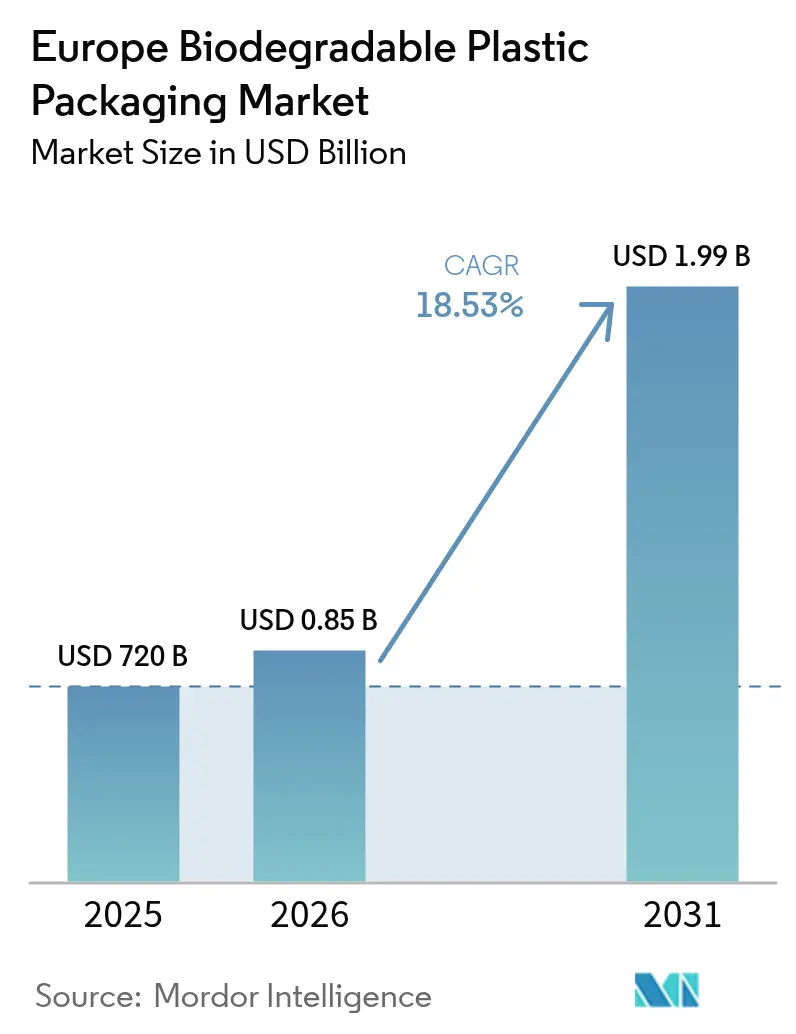
| Base Year Market Size (2025) | USD 720 Billion |
| Market Size (2026) | USD 0.85 Billion |
| Market Size (2031) | USD 1.99 Billion |
| Growth Rate (2026 - 2031) | 18.53 % |
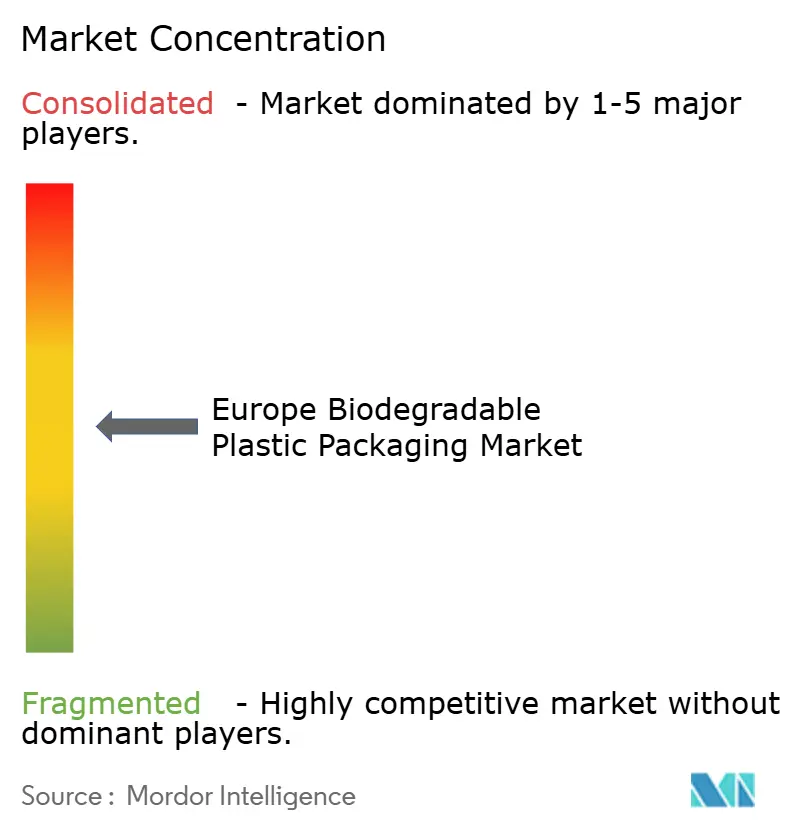
| Market Concentration | Medium |
Major Players *Disclaimer: Major Players sorted in no particular order Image © Mordor Intelligence. Reuse requires attribution under CC BY 4.0. | |
Europe Biodegradable Plastic Packaging Market Analysis by Mordor Intelligence
The Europe biodegradable plastic packaging market size is expected to grow from USD 720 million in 2025 to USD 853.4 million in 2026 and is forecast to reach USD 1.99 billion by 2031 at 18.53% CAGR over 2026-2031. Market momentum reflects the synchronized impact of the EU Packaging and Packaging Waste Regulation that enters force in 2026, national EPR levies such as Germany’s EUR 5.22 (USD 5.9) per-capita charge, and brand commitments to slash virgin resin use. PLA maintains scale leadership after the USD 565 million Normandy line reached nameplate output, while fast-rising PHA captures premium demand for marine-biodegradable claims. Flexible pouches and bags dominate volumes thanks to material efficiency and watermark-enabled sortation pilots showing up to 93.8% detection accuracy. Food packaging drives baseline demand, but foodservice registers the sharpest uptake as single-use plastic bans reshape institutional procurement.
Key Report Takeaways
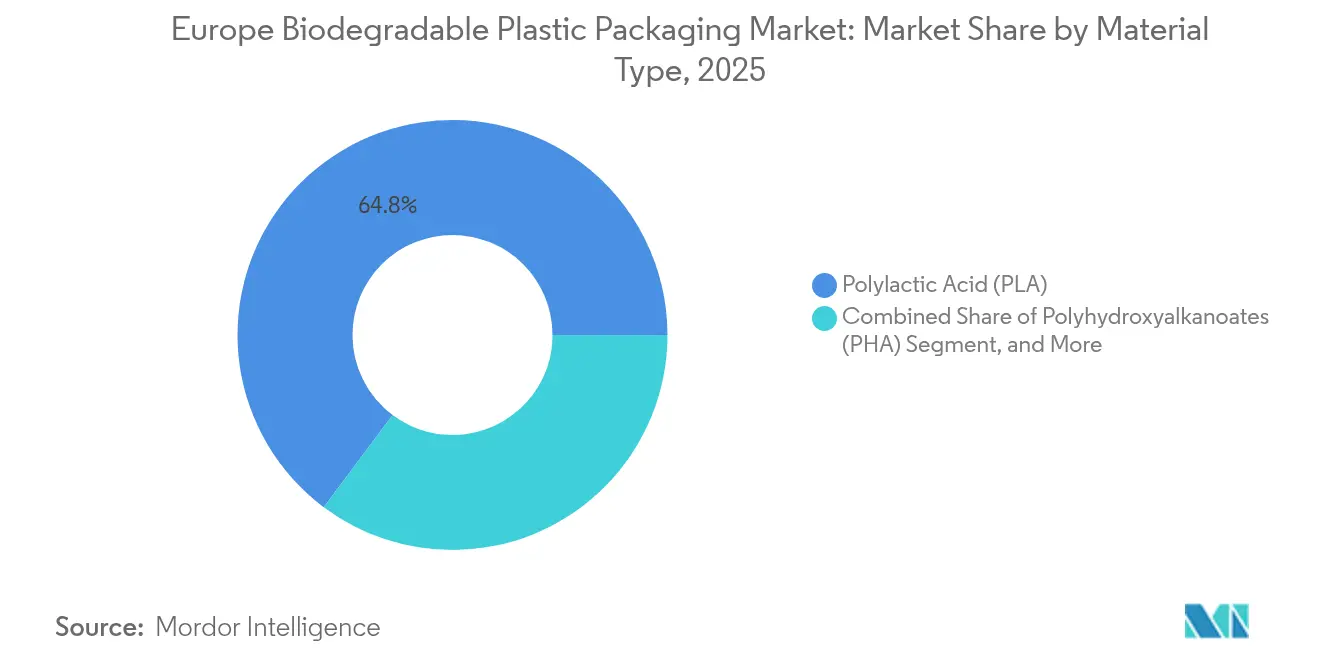
- By material type, PLA led with 64.78% of the Europe biodegradable plastic packaging market share in 2025; PHA is projected to expand at a 21.71% CAGR through 2031.
- By packaging type, flexible formats accounted for 57.91% of the Europe biodegradable plastic packaging market size in 2025, while rigid formats are forecast to have a 18.97% CAGR to 2031.
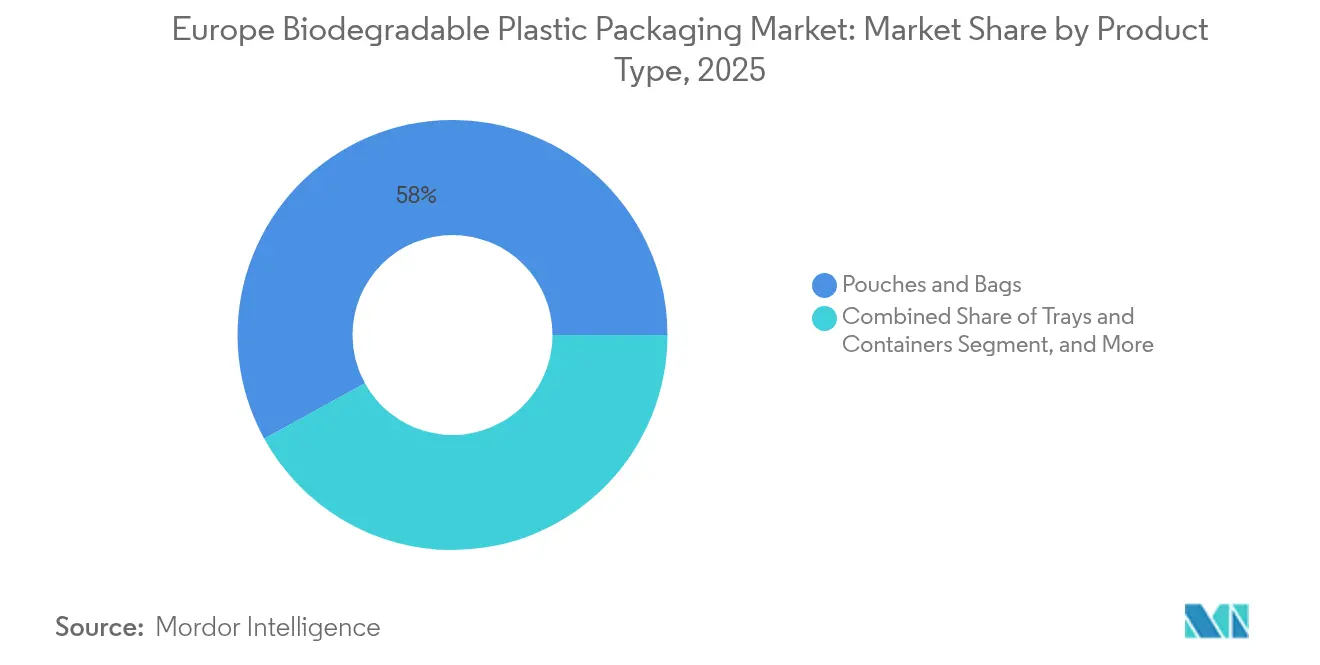
- By product type, pouches and bags held 58.02% revenue share in 2025; trays and containers are poised for a 19.98% CAGR to 2031.
- By end-user industry, food applications captured 29.21% share in 2025, whereas foodservice is advancing at a 21.85% CAGR between 2026-2031.
- By country, Germany commanded 22.22% of 2025 revenue, and France is expected to post a 19.74% CAGR through 2031.
Note: Market size and forecast figures in this report are generated using Mordor Intelligence’s proprietary estimation framework, updated with the latest available data and insights as of 2026.
Market Trends and Insights
Drivers Impact Analysis of Europe Biodegradable Plastic Packaging Market*
| Driver | (~) % Impact on CAGR Forecast | Geographic Relevance | Impact Timeline |
|---|---|---|---|
| Stringent EU single-use plastics and packaging waste regulations | +4.2% | EU27, UK, Norway, Switzerland | Medium term (2-4 years) |
| Rising consumer preference for sustainable packaging solutions | +2.5% | Western Europe, Nordics | Short term (≤ 2 years) |
| Corporate sustainability commitments among FMCG and retail brands | +3.8% | Western Europe | Medium term (2-4 years) |
| Expansion of composting and biowaste collection infrastructure | +2.1% | Core EU | Long term (≥ 4 years) |
| Beverage brand shift from glass to bio-PET/PEF bottles | +1.3% | Northern Europe | Medium term (2-4 years) |
| Convergence of digital watermarking with compostable films | +0.8% | Advanced waste hubs | Long term (≥ 4 years) |
| Source: Mordor Intelligence | |||
Stringent EU Single-Use Plastics and Packaging Waste Regulations
The 2026 PPWR deadline creates narrow but high-volume demand channels by limiting mandatory compostable use cases to tea bags, fruit labels, and ultra-light carrier bags. [1]European Commission, “Regulation (EU) 2024/1040 on Packaging and Packaging Waste,” Official Journal of the European Union, europa.euClarity on scope reduces investment risk, prompting converters to commit capacity to identified niches rather than resorting to blanket substitution. Germany amplifies the signal through its per-capita EPR fee, translating regulatory intent into immediate cost incentives. Synchronization of policy and plant start-ups, such as France’s Normandy PLA line reaching nameplate output in August 2024, illustrates public-private coordination that lowers market uncertainty. Brand owners now embed compliance clauses in multiyear supply contracts, locking in offtake and accelerating commercialization cycles.
Rising Consumer Preference for Sustainable Packaging Solutions
Seventy-three percent of European shoppers actively seek biodegradable options, with Nordics showing the highest willingness to pay premiums. [2]European Bioplastics, “Consumer Attitudes Toward Bioplastics,” european-bioplastics.orgThe consumer shift has evolved from generic eco-friendly messaging to material-specific literacy, pushing brands to substantiate claims under ISO and EN standards. Premium labels initially roll out biodegradable formats in high-income regions, then scale to price-sensitive southern markets as the cost curve falls. Nestlé’s paper-based wrappers, which cut plastic by up to 97%, exemplify how brand equity is leveraged to trial new substrates before mass rollout. As awareness grows, labeling accuracy and third-party certification become core purchase triggers rather than optional proof points.
Corporate Sustainability Commitments Among FMCG and Retail Brands
Net-zero and virgin plastic reduction pledges from leading FMCG groups translate directly into procurement targets that exceed minimum legal thresholds. Unilever’s 2025 goal to halve virgin plastic and PepsiCo’s 2030 objective to cut virgin resin in half have created a forward-order book for bio-based materials irrespective of near-term price premiums. These commitments cluster around mid-decade milestones, producing a demand bulge that underpins investment decisions such as BASF’s ecovio capacity expansion and Paques Biomaterials’ 6,000-tonne PHA unit slated for 2026. Supplier scorecards are increasingly weighing carbon intensity and end-of-life performance, transforming sustainability from a marketing differentiator into a qualifying attribute for vendor selection.
Expansion of Composting and Biowaste Collection Infrastructure
Europe operates roughly 5,800 bio-waste treatment sites with a combined capacity of 71 million tonnes, yet distribution is uneven. Germany, France, and Italy house most capacity, enabling mass-market compostable packaging, whereas Eastern Europe lags due to funding constraints. Grass-roots models, such as France’s 1,150-member Réseau Compost Citoyen, supplement municipal plants and increase collection density. EU Cohesion Fund and Interreg CORE initiatives earmark rural composting grants that will unlock new demand pockets post-2026. Suppliers now align product launches with rollouts of separate bio-waste bins, ensuring the disposal route is available at the point of sale.
Restraints Impact Analysis of Europe Biodegradable Plastic Packaging Market*
| Restraint | (~) % Impact on CAGR Forecast | Geographic Relevance | Impact Timeline |
|---|---|---|---|
| Higher production costs of biodegradable polymers versus conventional plastics | -2.3% | Global | Short term (≤ 2 years) |
| Limited industrial composting capacity across EU member states | -1.8% | Eastern Europe | Medium term (2-4 years) |
| Risk of feedstock competition with the food chain amid CAP reforms | -1.2% | EU27 | Long term (≥ 4 years) |
| Residual microplastics from incompletely digested PLA | -0.9% | Northern Europe | Medium term (2-4 years) |
| Source: Mordor Intelligence | |||
Higher Production Costs of Biodegradable Polymers Versus Conventional Plastics
PLA continues to trade at 2-3× and PHA at 5-7× fossil plastic benchmarks, reflecting fermentation complexity and specialized feedstock logistics. Although global bioplastic nameplate capacity is expected to rise from 2.47 million tonnes in 2024 to 5.73 million tonnes by 2029, unit costs remain sticky because lactide and PHA monomer supply chains are still maturing. Carbon taxes or plastic levies could narrow the delta, yet the timing and uniformity of such fiscal tools remain uncertain. Producers therefore focus on premium niches, such as marine-throwable items and high-barrier snack pouches, where performance advantages justify price gaps.
Limited Industrial Composting Capacity Across EU Member States
Infrastructure scarcity outside the Western core slows rollout. Italy counts 275 composting plants, but Eastern bloc states have single-digit facilities, creating logistical dead zones for certified compostable packs. [3]Italian Composting and Biogas Consortium, “Industrial Composting Capacity,” compostaggio.it Cross-border shipment of bio-waste faces regulatory hurdles and cost penalties, so converters hesitate to ship compostable SKUs into regions lacking treatment options. Spain’s 97 compost sites and mandatory bio-waste segregation for towns with over 5,000 residents illustrate how regulatory carrots and sticks can unlock capacity; however, build-out timelines mean full parity with Western Europe is still several years away.
*Our forecasts treat driver/restraint impacts as directional, not additive. The impact forecasts reflect baseline growth, mix effects, and variable interactions.
Europe Biodegradable Plastic Packaging Market Segment Analysis
By Material Type:
PLA Dominance Faces PHA DisruptionPLA delivered 64.78% of the Europe biodegradable plastic packaging market size in 2025, supported by Normandy’s new PLA line that adds regional supply security. PHA is accelerating at a 21.71% CAGR and is viewed as the go-to option for marine-exposed packaging, from coastal foodservice to aquaculture products. The cost challenge is higher, yet early adopters accept a premium to secure jurisdictional compliance in Baltic and North Sea markets that are tightening litter rules. The European biodegradable plastic packaging market share for PBAT and PBS remains modest; however, these polyesters carve out specific use cases, with the former in starch-based flexible blends and the latter in rigid, high-barrier trays.
Growth pathways diverge: PLA suppliers prioritize cost-down through scale, adding polymers with higher heat stability for microwaveable ready meals, whereas PHA developers pursue functional white spaces, such as medical absorbables. As brands implement supplier diversification programs, dual-sourcing between PLA and PHA has become increasingly common, ensuring resilience against fluctuations in feedstock supply.


By Packaging Type:
Flexible Formats Drive InnovationFlexible packs contributed 57.91% to the Europe biodegradable plastic packaging market size in 2025 and are tracking a 18.86% CAGR. Their thinner gauge reduces resin need, aligning with PPWR’s weight-reduction targets. HolyGrail 2.0’s watermark pilots confirm that compostable films can be recognized at MRF speed, clearing a critical sortation hurdle. Rigid formats lag but innovate in bio-PET and PEF: Avantium’s Dutch plant went online in October 2024, enabling premium beverage brands to switch without sacrificing barrier performance.
Developers of rigid solutions focus on multilayer simplification, allowing caps, labels, and closures to co-degrade or be mechanically removed without contaminating the compost. The emergence of thermoformable PLA grades is expanding application scope into deli trays and blister packs, adding incremental volume to the Europe biodegradable plastic packaging market.
By Product Type:
Pouches Lead Volume GrowthPouches and bags, already 58.02% of 2025 volumes, benefit from high line-speed compatibility and lower pack-to-product ratios. Adoption has surged in dried food, coffee, and pet nutrition lines where oxygen and moisture barriers can now be met with metallized PLA. Trays and containers register the fastest growth at 19.98% CAGR because canteens and quick-service restaurants phase out EPS clamshells in favor of compostable solutions.
Films and agricultural wraps provide functional benefits like soil biodegradation, reducing post-harvest clean-up costs for farmers. Bottle formats remain niche; yet the high visibility of Coca-Cola’s 100% plant-based prototype signals that mainstream beverage conversion is plausible once PEF supply scales.
By End-User Industry:
Food Dominance Contrasts Foodservice GrowthFood maintained 29.21% revenue share in 2025 as brand owners capitalized on consumer trust in certified compostable packs for direct contact. In contrast, foodservice is advancing at a 21.85% CAGR, driven by local bans on plastic cutlery and takeaway ware. Centralized purchasing by contract caterers accelerates volume ramp-up once specifications shift. Beverage producers remain technology scouts: Carlsberg’s fiber bottle consortium targets a 2025-2026 market entry, potentially unlocking a new rigid subsegment if performance metrics are met.
Personal care and pharma uptake is slower but steady, leveraging biodegradable caps and tubes to strengthen “clean-label” positioning among affluent consumers. Compliance with migration limits under EU Regulation 10/2011 adds qualification lead times, tempering speed to market for high-risk categories.
Geography Analysis
Europe Biodegradable Plastic Packaging Market
Germany leads the adoption with a 22.22% share in 2025, driven by its per-capita EPR fee, extensive biogas network, and successful watermarked sorting pilots that validate downstream recovery. France follows with the fastest trajectory, a 19.74% CAGR, underpinned by the Normandy PLA complex and a grassroots composting network comprising over 1,150 local schemes. Italy leverages 275 composting plants, including 61 integrated aerobic-anaerobic sites, to support starch-PBAT blends in deli and produce trays. Spain’s mandate for bio-waste segregation in municipalities above 5,000 residents unlocks incremental capacity at 97 compost facilities, positioning the country for mid-decade volume surges. The United Kingdom relies on more than 180 AD plants generating 6.6 TWh of biogas to process compostable liners, although regulatory divergence post-Brexit is slowing EN 13432 harmonization. The Nordics log the highest per-capita consumption of certified compostables, thanks to strong eco-label literacy and high household sorting rates, whereas Eastern Europe remains constrained by minimal composting infrastructure, despite EU Cohesion Fund allocations. Across the region, market penetration correlates with organic-waste treatment density, EPR-derived price signals, and proximity to domestic biopolymer supply.
Regulatory Landscape
The regulatory baseline for biodegradable plastic packaging in Europe is shifting from the Packaging Waste Directive (94/62/EC) to the Packaging and Packaging Waste Regulation (EU) 2025/40 (PPWR), which entered into force on 11 February 2025 and applies from 12 August 2026. PPWR tightens design and end-of-life rules by requiring packaging placed on the EU market to be recyclable by 2030. It also narrows where biodegradability and compostability claims can be used, which steers most formats toward recyclable designs rather than blanket substitution with compostables.
For compostable plastic packaging, PPWR Article 9 specifies applications tied to industrial compostability, including items such as sticky labels on fruit and vegetables and permeable tea/coffee bags. Requirements reference harmonised standards such as EN 13432, with implementation timelines extending to 12 February 2028 for the identified use cases. The European Commission also issued PPWR implementation guidance in 2026 (C/2026/3084) to support uniform adoption by Member States and operators. European Bioplastics revised its Seedling certification scheme effective 1 January 2026, reinforcing the role of third-party certification and harmonised testing in substantiating compostability claims.
Value Chain Analysis
The value chain starts with renewable feedstocks (starch and renewable sugars) and then moves into monomer and resin production. Players such as Novamont (starch blend platforms), Futerro (PLA with an integrated model spanning fermentation, polymerisation, and chemical recycling), and TotalEnergies Corbion supply base polymers and compounds. Distributors and technical intermediaries, including NaturePlast and Helian Polymers, support converter qualification by supplying development lots and bulk quantities, including for emerging materials such as PHA, while packaging converters such as SPHERE and SIPA Management translate resin availability into films, pouches, bags, and thermoformed formats for food and foodservice applications.
Downstream, brand owners, retailers, and foodservice operators shape specifications through sustainability scorecards. End-of-life performance in Europe then depends on collection, sorting, and organic recycling capacity. With PPWR (EU) 2025/40 applying from 12 August 2026, compliance workload increases across the chain, especially as packaging design is expected to align with recyclability requirements and compostable applications are constrained to defined categories. That raises the importance of certification, labeling discipline, and verified disposal pathways, reinforcing coordination between resin suppliers, converters, and waste-management ecosystems, particularly where biowaste collection and industrial composting infrastructure are already established.
Competitive Landscape
Market concentration is moderate as legacy converters and specialty bioplastic firms share the field. Tetra Pak pushes plant-based caps and wrapper laminates, Amcor markets high-barrier compostable films, and Mondi pilots water-soluble sachets for personal care. These incumbents wield distribution muscle but face cost erosion when scaling small-volume specialty resins. Specialty suppliers like NatureWorks (PLA), Novamont (PBAT-starch blends), and Paques Biomaterials (PHA) set technology benchmarks, but their limited nameplate capacity makes long-term offtake deals critical for financial closure.
Vertical integration is the emerging playbook: Futerro’s polymer-to-lactide back-integration secures margin, while Avantium’s PEF capacity pairs monomer production with downstream bottle partnerships. Partnerships flourish, Carlsberg’s fiber bottle consortium unites resin producers, bottle makers, and brand owners to hedge development risk. Digital watermarking provides a new competitive axis as converters that license the technology can promise higher recovery rates, addressing a frequent retailer concern.
Cost pressure is rising as sugar-based feedstock prices react to CAP revisions that incentivize alternate crop rotations. Converters hedge via multiyear feedstock contracts or by switching to waste-oil pathways where certification allows. Certification complexity around EN13432, ASTM D6400, and marine biodegradation standards adds compliance overhead that favors larger, better-capitalized players. Mergers between converters and resin start-ups are expected once early-stage facilities achieve stable yields.
Europe Biodegradable Plastic Packaging Industry Leaders
Tetra Pak International SA
Amcor Limited
Mondi PLC
Minima Technology
Tipa-corp Ltd.
- *Disclaimer: Major Players sorted in no particular order
Europe Biodegradable Plastic Packaging Market Companies Covered in this Report
- Tetra Pak International SA
- Amcor plc
- Mondi plc
- NatureWorks LLC
- BASF SE
- Taghleef Industries Inc.
- Sealed Air Corporation
- Huhtamaki Oyj
- Novamont S.p.A.
- Constantia Flexibles GmbH
- Biogreen Global Ltd.
- Minima Technology Co. Ltd.
- Tipa-Corp Ltd.
- Roquette Frères SAS
- Avantium N.V.
- Arkema SA
- Futerro SA
- Thyssenkrupp Uhde GmbH
- DuPont de Nemours Inc.
- FKuR Kunststoff GmbH
- BIOTEC Biologische Naturverpackungen GmbH & Co. KG
Read Analysis of Europe Biodegradable Plastic Packaging Companies

Market Opportunities and Future Outlook
PPWR (EU) 2025/40, applying from 12 August 2026, channels opportunity for biodegradable and compostable packaging into clearly defined use cases. It creates whitespace for certified solutions that can meet industrial compostability requirements (aligned with EN 13432) in applications listed under Article 9, including permeable tea/coffee bags and sticky produce labels. This regulatory clarification reduces ambiguity for converters and brand owners that need compliant formats, while raising the premium on credible certification and labeling systems, including schemes such as European Bioplastics Seedling, revised effective 1 January 2026.
On the supply and technology side, investment activity points to adjacent pathways that can complement biodegradable packaging portfolios where performance polymers, renewable feedstocks, and circularity capabilities are being scaled in Europe. In September 2025, Avantium, LVMH, and Tereos formed a strategic alliance to scale plant-based PEF (releaf) for packaging, showing how brand owners and feedstock suppliers are supporting new polymer ecosystems for food, beverage, and cosmetics. In Portugal, IMG Group disclosed large-scale investment around its Everbio Innovation Hub in 2026, including EUR 15 million in financing and a EUR 40 million total industrial investment, to advance recycled and bio-based polymer technologies. This indicates expanding regional capability building that can support converter innovation and multi-material sustainable packaging roadmaps alongside certified compostables.
Recent Industry Developments in Europe Biodegradable Plastic Packaging Market
- July 2026: IMG Group launched the Everbio Innovation Hub in Portalegre, Portugal, backed by EUR 15 million in financing and a EUR 40 million total industrial investment to scale recycled and bio-based polymer technologies. The program integrates capabilities across Evertis, Selenis, Renascis, and Renewis to mature materials and recycling pathways that packaging converters can translate into compliant formats under tightening EU rules.
- September 2025: Avantium, LVMH, and Tereos formed a strategic alliance to scale production of PEF (releaf), a plant-based and circular performance polymer targeted at food, beverage, and cosmetic packaging. By linking feedstock, polymer technology, and brand demand, the partnership strengthens the European pipeline for next-generation renewable materials that can substitute conventional plastics in premium packaging applications.
- October 2024: Avantium opened a flagship PEF plant in the Netherlands to supply premium beverage brands. The facility added tangible regional capacity for high-barrier renewable polymer packaging, supporting commercial trials and qualification programs with brand owners and converters focused on upgrading rigid packaging performance.


Europe Biodegradable Plastic Packaging Market Report Scope and Research Methodology
Market Definition and Coverage
For this study, we size the Europe biodegradable plastic packaging market as the value of packaging units and materials made from biodegradable polymers that are sold into packaging uses across European end markets, reported in USD at the point of sale from packaging suppliers to buyers.
Scope exclusions: We do not count paper-based or aluminum packaging, and we do not include conventional plastic packaging that is only recyclable or contains recycled content but is not biodegradable.
Segments Covered in This Report
- By Material Type
- Starch Blends
- Polylactic Acid (PLA)
- Polybutylene Adipate Terephthalate (PBAT)
- Polybutylene Succinate (PBS)
- Polyhydroxyalkanoates (PHA)
- Other Material Types
- By Packaging Type
- Rigid Packaging
- Flexible Packaging
- By Product Type
- Films and Wraps
- Pouches and Bags
- Trays and Containers
- Bottles and Jars
- Other Product Types
- By End-User Industry
- Food
- Beverages
- Foodservice
- Pharmaceutical
- Personal Care and Home Care
- Other End-User Industries
- By Country
- United Kingdom
- Germany
- France
- Italy
- Spain
- Rest of Europe
Data Sources, Market Sizing, and Validation
Desk Research
We start with desk research to define the market boundaries and to build an input sheet for packaging demand across Europe. Public sources are used to understand packaging output, waste rules, and end-use demand signals, such as Eurostat, European Commission publications on packaging and waste, and EEA datasets.
To anchor the model in observed product movement, we also review customs and trade statistics (such as UN Comtrade), national statistical office releases for key European countries, and peer-reviewed journals that track biodegradable polymers and compostability standards. Company annual reports, investor presentations, association websites, and reputable business press are then used to map capacity additions, product launches, and pricing direction, which we check against selective paid subscriptions for company financials and patent activity. These examples are not exhaustive, and we reference additional public and paid sources to collect, verify, and clarify inputs.
Primary Interviews and Surveys
Primary interviews and short surveys are used to pressure-test assumptions that desk research cannot fully confirm, especially around average selling price movement, end-user adoption, and the extent to which volume is truly biodegradable versus blended or partially certified. We cover packaging producers, material suppliers, distributors, and large packaging buyers across major European countries, so we can reconcile differences in regulatory readiness and industrial composting access.
Distribution of primary research fieldwork respondents
| Company type | Respondent position |
|---|---|
| Top tier: 38% | CXOs: 16% |
| Mid tier: 40% | Functional/Unit leaders: 27% |
| Smaller Players: 22% | Managers: 57% |
Market-Sizing & Forecasting
The sizing starts with a top-down build where packaging demand in Europe is reconstructed from end-use consumption and packaging intensity indicators, and then filtered by the share addressed by biodegradable polymers. Where the market signal is unclear, we corroborate totals with selective bottom-up checks, including sample supplier revenue roll-ups, channel feedback on shipped volumes, and an ASP times volume cross-check for the most common pack formats.
Several inputs are tracked closely in this market, including EU packaging waste and EPR direction, observed adoption of compostable packaging in food service and fresh produce, resin and converting price trends for PLA and related blends, available industrial composting access by country, and the pace of brand conversion commitments that change purchase volumes. For forecasting, we use scenario analysis anchored to the regulatory timeline and capacity additions, and then we tune the year-by-year curve based on interviewees' expectations for price easing, substitution limits, and adoption speed in key applications. When a country or company data point is missing, we fill gaps using proxy ratios tied to packaging output and end-use mix, then run a second pass to check whether the implied shares stay realistic.
Data Validation & Update Cycle
We validate outputs by checking whether implied per-capita packaging spend, biodegradable share by application, and price bands align with independent signals from public statistics and interview feedback. Variances are flagged, reviewed, and corrected through a multi-step analyst review so outliers in country splits or sudden price jumps do not get carried through.
The model is refreshed annually, and interim updates are made when material events occur, such as a major regulation change, a new capacity start-up, or a sharp resin price move. Before the report is delivered, we complete a final pass so clients receive the most current view consistent with the latest public releases and the newest field feedback we can obtain.
Mordor Intelligence's Europe Biodegradable Plastic Packaging Market Size Measured Against Other Published Estimates
Published market sizes for this topic often differ because the scope line is not drawn the same way, and the inputs used for volume and pricing are not always linked back to packaging demand in Europe. Differences also show up when authors group biodegradable plastics with broader biodegradable packaging, which pulls in paper-based formats and makes totals look much larger.
By tracking the demand pool from packaged end uses and then refreshing the biodegradable polymer share and ASP assumptions through interviews, Mordor Intelligence keeps the estimate tied to actual biodegradable plastic packaging spend in Europe rather than broader sustainable packaging baskets.
Benchmark comparison
| Source | Market Size | Gaps in Research Methodology |
|---|---|---|
| Mordor Intelligence | USD 0.72 B (2025) | |
| Trade Publisher A | USD 1.42 B (2024) | Uses a combined geography that includes the US along with Europe, and the number reflects a wider set of biodegradable plastic packaging formats and assumptions that are not normalized to a Europe-only demand base. |
| Packaging Portal B | USD 194.03 B (2024) | Covers biodegradable packaging at a broad level and likely includes paper and recycled-content packaging types, so the value is not comparable to biodegradable plastic packaging only, and the category boundary inflates the total. |
The spread in the table mostly comes from category boundaries and geography mixing, not from small math differences. When the scope is kept to Europe and limited to biodegradable plastics used in packaging, the market can be traced back to clear demand indicators and repeatable pricing and share assumptions, which makes the result easier to explain and update year after year.


Key Questions Answered in the Report
How large will the Europe biodegradable plastic packaging market be by 2031?
It is projected to reach USD 1.99 billion by 2031, supported by an 18.53% CAGR driven by EU regulation and corporate sustainability mandates.
Which material is growing fastest in European biodegradable packages?
PHA is expected to expand at a 21.71% CAGR through 2031 due to its marine-biodegradation advantage.
Why is France showing the highest growth among major markets?
France benefits from a new USD 565 million PLA plant and rapid expansion of local composting networks, pushing growth to 19.74% CAGR.
What segments lead volume in flexible biodegradable packs?
Pouches and bags hold 58.02% share because they use less material and align with smart-sorting pilots.
How do higher resin costs impact adoption?
PLA and PHA premium pricing, 2-7× fossil plastics, slows uptake in price-sensitive regions, but EPR fees and brand pledges offset some cost barriers.
What technologies improve end-of-life sorting for compostable films?
Digital watermarking trials under HolyGrail 2.0 show up to 93.8% detection efficiency, enabling automated identification at material recovery facilities.
Page last updated on:


 Your data is secure and never sold or shared.


