
Market Overview
| Study Period | 2020 - 2031 |
|---|---|
| Forecast Data Period | 2026 - 2031 |
| Historical Data Period | 2020 - 2024 |
| Growth Rate | 6.14 % |
Major Players *Disclaimer: Major Players sorted in no particular order Image © Mordor Intelligence. Reuse requires attribution under CC BY 4.0. | |
Europe Biobank Market Analysis by Mordor Intelligence
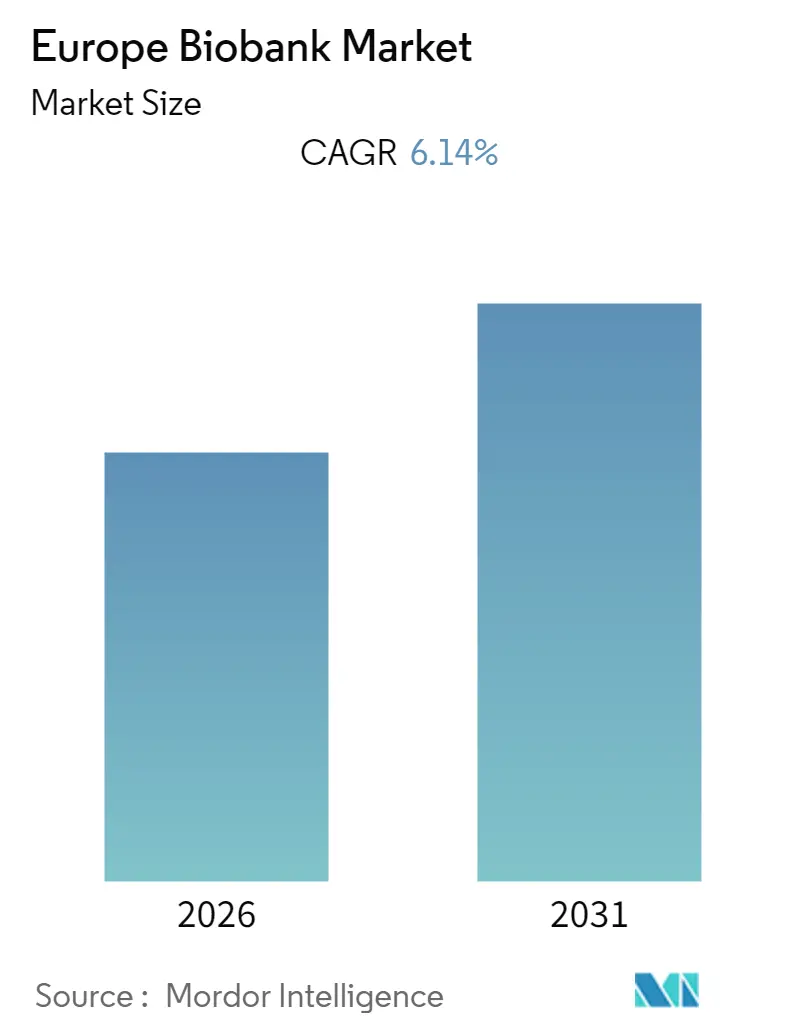
The Europe Biobank Market size is expected to register a CAGR of 6.14% during the forecast period (2026-2031).
Stem cell practices are on the rise in European countries and are contributing to the development of new solutions for various diseases. Several advancements have been made in regenerative medicine through stem cell technology over the past decade. Thus, it has become one of the vital treatment methods for diseases, such as Alzheimer's, diabetes, cancer, and rare genetic diseases. To benefit from the existing therapies, umbilical cord cells and other stem cells are preserved in Biobanks. The European Science Foundation (ESF) has been an active player in advancements made in stem cell and regenerative medicine research and in providing new treatments for incurable diseases and opportunities. With the increase in awareness about stem cell therapies, there have been a larger number of parents, who choose umbilical cord banks for their children. Biobanks not only aid in the therapies for genetic diseases, but also in medical research on rare genetic disorders. However, other factors such as rising burden of chronic diseases and R&D funding and investments by government and non-governmental organizations are also expected to drive the market in the forecast period.
Note: Market size and forecast figures in this report are generated using Mordor Intelligence’s proprietary estimation framework, updated with the latest available data and insights as of 2026.
Europe Biobank Market Trends and Insights
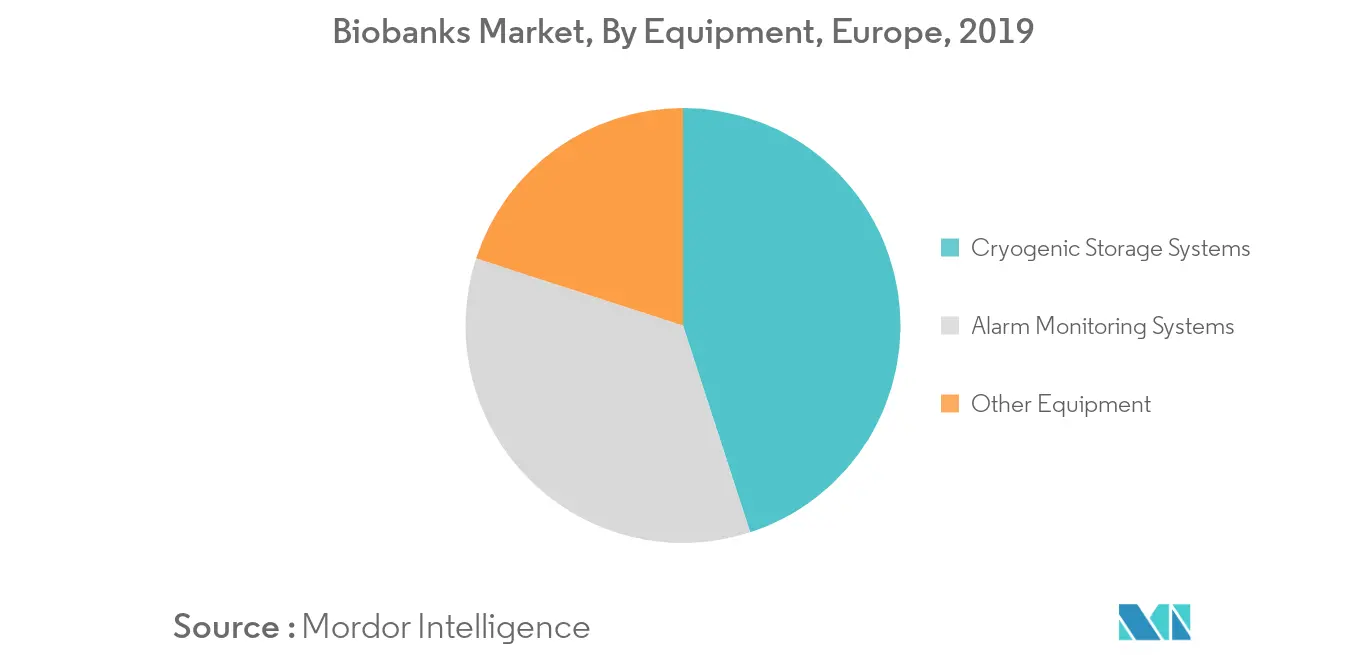
Alarm Monitoring Systems Segment is Expected to Show Better Growth in the Forecast Years
Based on Equipment, it is segmented into cryogenic storage system, alarm monitoring systems and other equipments. Stem cell banking is considered as one of the most promising and emerging fields. The cryogenic storage systems, freezers, refrigerators, and all other storage devices in a biobank require continuous monitoring of various processes. This is effectively done only with an alarm monitoring system. Alarms are used at various stages, from filling to continuous monitoring of temperature. Hence, with advancements in technology and the rising adoption of automated storage systems, there is high demand for automated alarm monitoring devices, which is expected to fuel the market growth.
Regulatory Landscape
The European Health Data Space (EHDS) Regulation (Regulation (EU) 2025/327) is a key cross-border policy anchor for biobanks operating as health data holders, as it sets EU-level rules and technical expectations for access and secondary use of electronic health data. In parallel, Regulation (EU) No 536/2014 continues to govern clinical trials across the EU, shaping how samples and associated data are handled when collected or used in trial settings.
Operational quality and competence requirements for biobanking are increasingly formalized through EN ISO 20387:2020, which the European Cooperation for Accreditation (EA) uses as the normative basis for accreditation. National adoption continues to expand, including the approval of SS-EN ISO 20387:2020/A11:2024 on November 22, 2024, which reinforces standardized expectations for impartiality, competence, and biobank operations in Europe.
Competitive Landscape
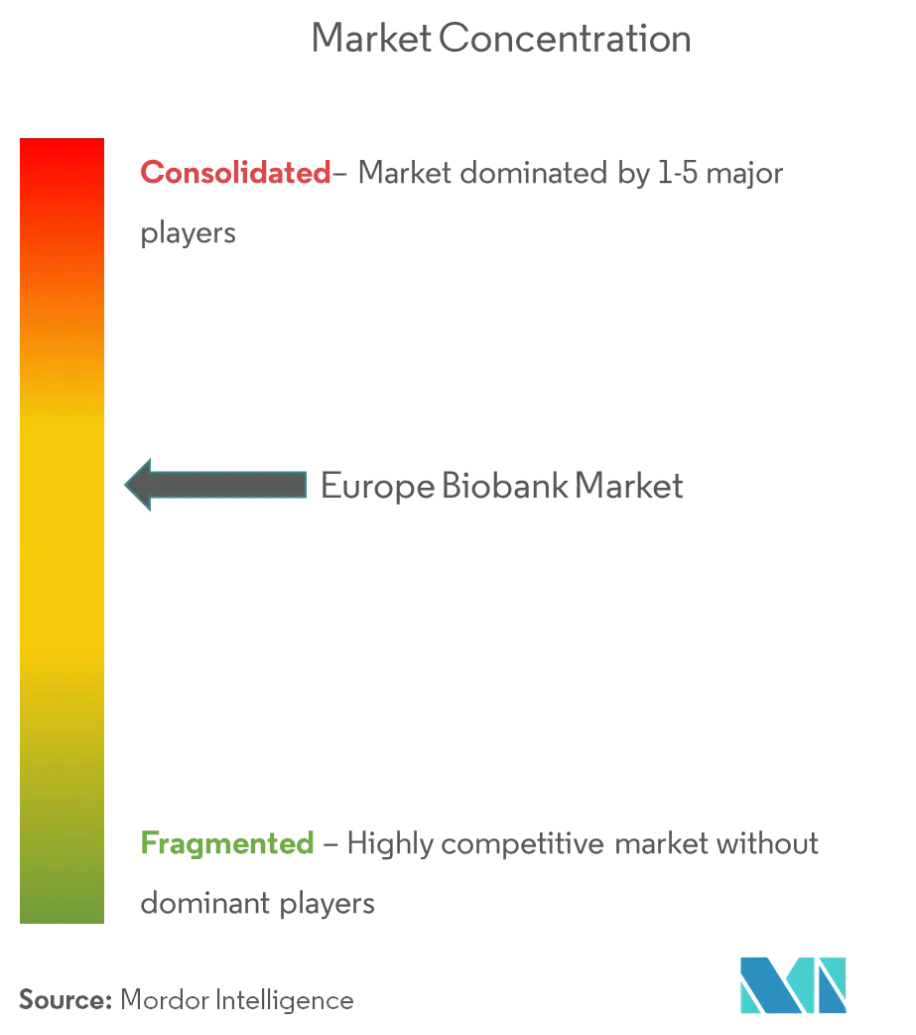
The market is competitive and with the entrance of key players, the market is expected to grow due to increased competition amongst the existing players. For instance, Atlanta Biologicals Inc. (Bio-Techne Corporation), Becton, Dickinson and Company, BioLifeSolutions Inc., Hamilton Company, Qiagen N.V, , Stemcell Technologies Inc., Thermo Fisher Scientific, etc. are providing these products across the globe.
Europe Biobank Industry Leaders
-
BioLifeSolutions Inc.
-
Hamilton Company
-
Sigma-Aldrich Inc. (Merck KGaA)
-
Thermo Fisher Scientific Inc.
-
VWR International LLC
- *Disclaimer: Major Players sorted in no particular order
Market Opportunities and Future Outlook
EU-wide data governance and interoperability programs are creating room for biobanks and suppliers to support digitization, standardized metadata, and privacy-preserving access models aligned with EHDS. BBMRI-ERIC has made platform integration a visible priority through its 10-year roadmap (launched October 2024) and its 2025-2027 work programme, while EvolveBBMRI (2024-2026) focuses on biobank datafication and federated discovery workflows. In April 2026, BBMRI-ERIC selected eight biobanks for targeted funding under EvolveBBMRI to onboard metadata into its Federated Platform using HL7 FHIR, which reinforces demand for compatible LIMS, data curation services, and interoperability tooling.
There is also a defined opportunity in sustainability-oriented and sample-type-specific infrastructure upgrades, supported by active European projects and national node programs. EvolveBBMRI includes a greening pillar, and European Commission-backed projects such as MICROBE are working on methodologies for microbiome sample preservation and data infrastructure, which raises requirements for validated media, cold-chain handling, and fit-for-purpose storage protocols. On the funding side, BBMRI.it reported in July 2026 more than EUR 9 million across 117 national and 8 European grants aimed at quality systems, interoperability, and FAIR data workflows, indicating continued procurement pathways for equipment (including monitoring systems) and services that help biobanks operationalize standardized, shareable collections.
Recent Industry Developments
- May 2026: Thermo Fisher Scientifics PPD clinical research business expanded bioanalytical and biomarker capabilities with a new laboratory in Gothenburg, Sweden, at GoCo Health Innovation City. The site adds capacity for clinical trial support workflows that depend on consistent sample handling, processing, and downstream analytics. The expansion strengthens local infrastructure around life science hubs, tightening integration between clinical research operations and biobanking-adjacent sample logistics.
- October 2025: Thermo Fisher Scientific announced an R&D partnership with AstraZeneca at BioVentureHub in Gothenburg, Sweden. The collaboration model ties instrument and method development closer to pharma R&D environments that rely on high-quality biospecimens and standardized data capture. This type of co-development setup can support faster adoption of new analytical and sample-management workflows that later feed into biobank and translational research settings.
- June 2024: Thermo Fisher Scientific opened a new GMP-certified ultra-cold facility in the EU, positioned to support advanced-therapy supply chains requiring controlled storage and distribution conditions. The expansion increases availability of compliant, ultra-low temperature infrastructure relevant to high-value biological materials. It also reinforces demand for validated cryogenic systems, monitoring, and quality management practices across European storage and handling networks.
Research Methodology Framework and Report Scope
Market Definition and Coverage
For this study, the Europe biobank market covers spending linked to collecting, processing, storing, and managing biospecimens within Europe, including the supporting equipment, media, and service revenue used by biorepositories serving research and clinical development.
Scope exclusions: Routine hospital pathology storage not organized as a biobank, and general laboratory consumables not used for biobanking workflows, are not counted.
Segmentation Overview
- Equipment
- Cryogenic Storage Systems
- Refrigerators
- Ice Machines
- Freezers
- Alarm Monitoring Systems
- Other Equipment
- Cryogenic Storage Systems
- Media
- Optimized Media
- Non-optimized Media
- Services
- Human Tissue Biobanking
- Stem Cell Biobanking
- Cord Banking
- DNA/RNA Biobanking
- Other Services
- By Application
- Regenerative Medicine
- Drug Discovery
- Disease Research
Data Sources, Market Sizing, and Validation
Desk Research
Desk research was used to set the market structure and to keep baseline assumptions realistic across European countries. We relied on public evidence such as European Commission health and research pages, OECD health statistics, Eurostat datasets, WHO Europe publications, and EMA guidance notes where they clarified compliance expectations that affect biobank operations.
In parallel, we reviewed company annual reports, investor presentations, press releases, association websites, and reputable clinical and biorepository journals to map typical service offerings and to capture how pricing can shift by specimen handling and storage duration. For company-level revenue context, and to reduce the risk of missing smaller private operators, we also referenced a paid subscription focused on company financials and intelligence, plus a patent database to track where storage and sample processing innovation is moving. The sources listed here are illustrative only, and additional public documents and datasets were also checked during data collection, validation, and clarification.
Primary Interviews and Surveys
Primary work focused on interviews and short surveys with biobank operators, lab managers, procurement teams, and research users across major European hubs, so the desk assumptions on service mix and pricing could be corrected when they did not match field reality. Respondent input was also used to validate adoption patterns for cryogenic storage, automation, and monitoring, and then to align the model with typical funding cycles in academic and public networks.
Distribution of primary research fieldwork respondents
| Company type | Respondent position |
|---|---|
| Top tier: 36% | CXOs: 22% |
| Mid tier: 42% | Functional/Unit leaders: 22% |
| Smaller Players: 22% | Managers: 56% |
Market-Sizing & Forecasting
Market sizing starts from a top-down build where Europe-level demand is reconstructed using the active research base, clinical trial activity, and biobanking participation signals, then translated into specimen handling and storage service needs. To keep the totals defensible, we used selective bottom-up checks, such as sampled price-per-specimen by workflow, service revenue per active biorepository, and a limited roll-up of supplier exposure for key equipment categories.
A few practical inputs that shaped the model include (as examples) the number of operating biorepositories by country, typical specimen types handled, average storage duration by program type, utilization of cold storage capacity, and the mix between internal biobank operations versus outsourced services. When a country-level data point was not available, we applied a proxy using nearby markets with similar research intensity and healthcare spend, then corrected it using interview feedback. Forecasting was built using scenario analysis supported by short-run trend smoothing for variables like research funding direction, trial pipelines, and automation adoption, and we discussed scenarios with experts to avoid relying on a single overly optimistic path.
Data Validation & Update Cycle
Outputs are validated through triangulation across independent signals, including whether implied price levels and activity volumes align with what operators report and with public indicators. Any outliers are flagged, re-checked for unit errors or currency timing issues, and then reviewed by another analyst prior to internal sign-off.
This report is refreshed on an annual cycle, with interim adjustments when a material change affects demand assumptions, such as a policy shift, a major funding program change, or a new compliance requirement impacting storage and handling. Before delivery, a final pass is completed so the latest public updates and interview learnings are reflected in the model.
Mordor Intelligence's Europe Biobank Market Size Compared With Other Published Estimates
Published market sizes for the Europe biobank space can look far apart because the underlying scope and counting logic are not the same, even when the topic label sounds identical. Differences usually come from what gets treated as a biobank activity versus general lab work, how services versus products are bundled, and which years and currencies are used for conversion.
Some sources stretch the scope to include a wider set of lab services and broader biobanking related logistics, which naturally lifts the total. In Mordor Intelligence, the value is limited to defined biobank workflows within Europe and it is counted only when the revenue is directly tied to specimen collection, processing, storage, or biobank-specific support services, which keeps adjacent lab spending from being mixed in.
Benchmark comparison
| Source | Market Size | Gaps in Research Methodology |
|---|---|---|
| Mordor Intelligence | USD 0.00 B (2025) | |
| Industry Databook A | USD 34.08 B (2025) | Uses a broader Europe biobank definition that bundles additional repository and logistics style services, and the headline is presented as revenue with limited detail on what is excluded. |
| Regional Research Publisher B | USD 27.07 B (2024) | Different base year and a wider product basket that can include software and generalized lab support items, which can shift totals even before growth assumptions are applied. |
The comparison shows that the spread is mainly driven by scope breadth, base-year choice, and how closely the counted revenue is tied to biobank-specific workflows. By keeping inputs tied to observable activity drivers and then checking them with field feedback, the estimate remains easier to reproduce and to adjust when market conditions change.
Key Questions Answered in the Report
What is the current Europe Biobank Market size?
The Europe Biobank Market is projected to register a CAGR of 6.14% during the forecast period (2026-2031)
Who are the key players in Europe Biobank Market?
BioLifeSolutions Inc., Hamilton Company, Sigma-Aldrich Inc. (Merck KGaA), Thermo Fisher Scientific Inc. and VWR International LLC are the major companies operating in the Europe Biobank Market.
What years does this Europe Biobank Market cover?
The report covers the Europe Biobank Market historical market size for years: 2019, 2020, 2021, 2022, 2023, 2024 and 2025. The report also forecasts the Europe Biobank Market size for years: 2026, 2027, 2028, 2029, 2030 and 2031.