
Europe Automotive Infotainment Systems Market Size and Share
Market Overview
| Study Period | 2019 - 2031 |
|---|---|
| Forecast Data Period | 2026 - 2031 |
| Base Year Market Size (2025) | USD 17.97 Billion |
| Market Size (2026) | USD 18.95 Billion |
| Market Size (2031) | USD 25.45 Billion |
| Growth Rate (2026 - 2031) | 6.08 % |
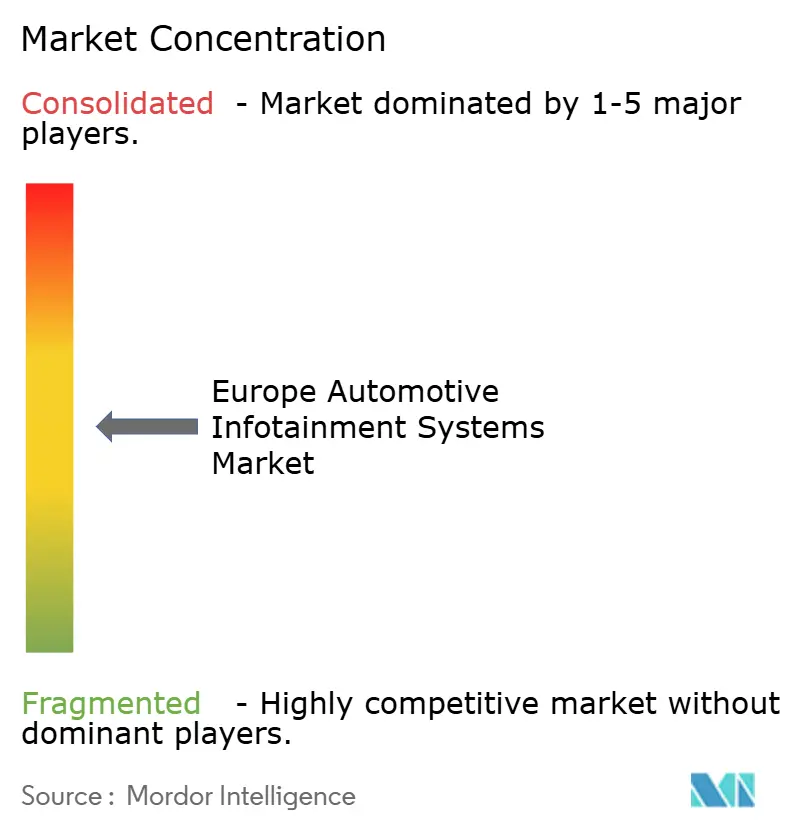
| Market Concentration | Medium |
Major Players *Disclaimer: Major Players sorted in no particular order Image © Mordor Intelligence. Reuse requires attribution under CC BY 4.0. | |
Europe Automotive Infotainment Systems Market Analysis by Mordor Intelligence
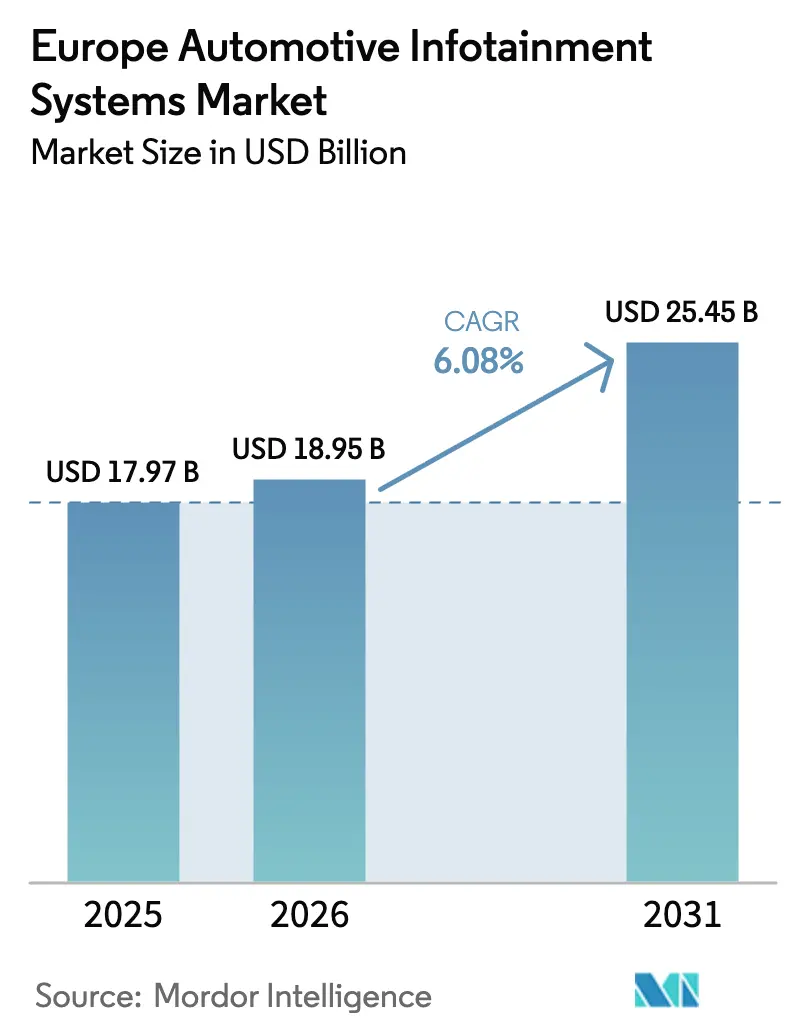
The European automotive infotainment systems market size was valued at USD 17.97 billion in 2025 and estimated to grow from USD 18.95 billion in 2026 to reach USD 25.45 billion by 2031, at a CAGR of 6.08% during the forecast period (2026-2031). This forward trajectory reflects rising battery electric vehicle penetration, tightening European safety mandates, and a shift in value from hardware to recurring software revenue within the European automotive infotainment systems market. Hardware prices are easing as display manufacturing scales, while 5G network slicing, open gateway APIs, and cloud-native operating systems intensify software differentiation across the European automotive infotainment systems market. German premium buyers continue to lead early adoption of large OLED screens and subscription bundles, yet low-cost Chinese battery electric vehicles with feature-rich cockpits now challenge incumbents, widening price-performance tension in the European automotive infotainment systems market.
Key Report Takeaways
- By installation type, in-dash systems held 72.13% of the European automotive infotainment systems market share in 2025, while rear-seat systems are projected to increase at a 14.27% CAGR through 2031.
- By vehicle type, passenger cars accounted for 86.42% of the European automotive infotainment systems market share in 2025, and battery electric vehicles are forecast to advance at a 38.56% CAGR over the same period.
- By component, display modules commanded 48.29% of the European automotive infotainment systems market size in 2025, whereas operating-system software and apps are expected to grow at a 16.84% CAGR to 2031.
- By propulsion type, internal-combustion vehicles represented 64.58% of the European automotive infotainment systems market share in 2025, while battery electric vehicles are set to expand at a 38.41% CAGR through 2031.
- By connectivity generation, 4G LTE led with 61.37% of 2025 revenue and 5G connectivity is anticipated to register a 24.73% CAGR during the forecast window.
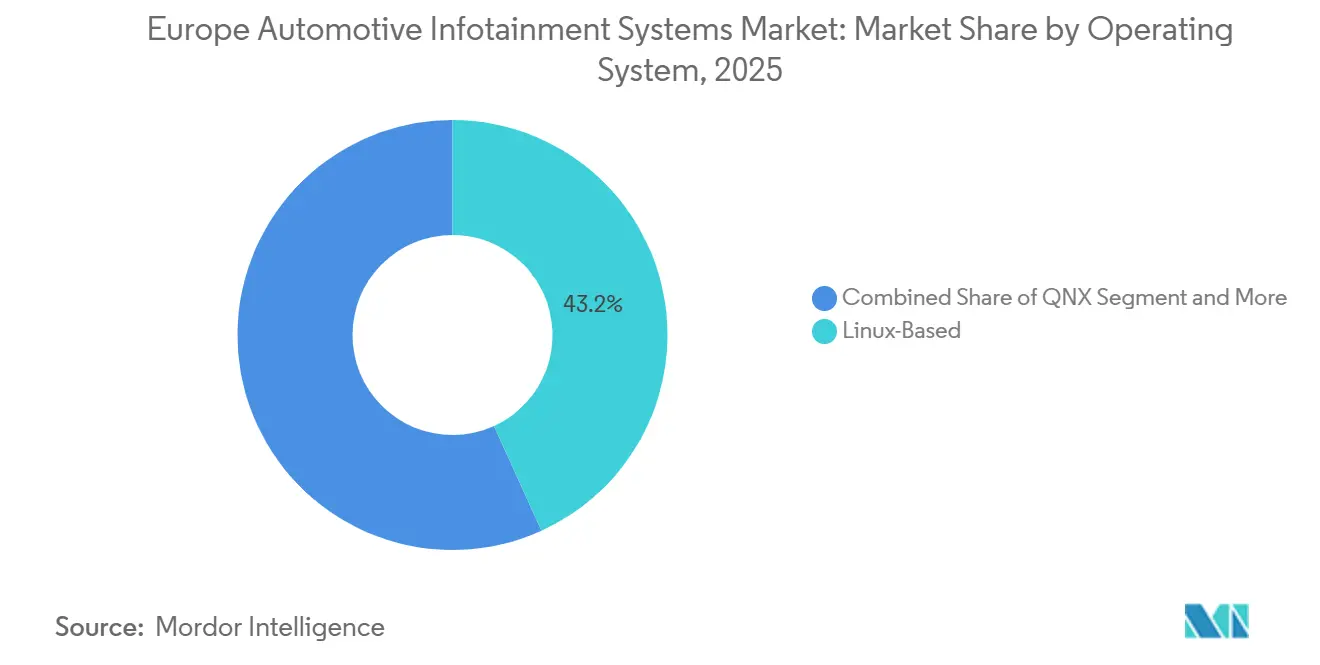
- By operating system, Linux-based platforms made up 43.18% of deployments in 2025 whereas Android Automotive OS is projected to climb at a 21.36% CAGR to 2031.
- By sales channel, original equipment manufacturer-installed systems dominated with 92.74% of the Europe automotive infotainment systems market share in 2025 while the aftermarket segment is poised to grow at a 12.48% CAGR through 2031.
- By geography, Germany generated 22.57% of regional revenue in 2025 and Spain is expected to post the fastest expansion at a 19.94% CAGR between 2026 and 2031.
Note: Market size and forecast figures in this report are generated using Mordor Intelligence’s proprietary estimation framework, updated with the latest available data and insights as of January 2026.
Market Trends and Insights
Drivers Impact Analysis of Europe Automotive Infotainment Systems Market*
| Driver | (~) % Impact on CAGR Forecast | Geographic Relevance | Impact Timeline |
|---|---|---|---|
| EU eCall and Safety Telematics Mandate | +1.8% | EU-27, United Kingdom | Short term (≤ 2 years) |
| Surge in Electric Vehicle Adoption | +1.5% | Germany, France, Netherlands, Norway-adjacent | Medium term (2-4 years) |
| 5G Stand-Alone Roll-out | +1.2% | Urban Germany, France, Spain | Medium term (2-4 years) |
| Rising Consumer Demand for Smartphone-Like Cockpits | +1.1% | Western Europe, Poland, Czech Republic | Short term (≤ 2 years) |
| Open Gateway APIs Unlocking Cross-Operator QoS | +0.4% | Multinational fleets, premium OEMs | Long term (≥ 4 years) |
| Chinese Entry-Level BEVs Forcing Feature-Rich IVI | +0.3% | Southern and Eastern Europe | Short term (≤ 2 years) |
| Source: Mordor Intelligence | |||
EU eCall and Safety Telematics Mandate (Reg. 2018/858)
Regulation 2018/858 compels every new passenger car and light commercial vehicle sold in the EU to embed an automatic emergency-call module[1], anchoring baseline infotainment specifications to include 4G modems and GNSS receivers. Enforcement concluded in 2024, but original equipment manufacturers quickly expanded the mandated module into a revenue hub that layers predictive maintenance alerts, insurance telematics, and stolen-vehicle tracking onto the same hardware. Continental and Bosch now market white-label telematics-as-a-service packages that original equipment manufacturers rebrand inside their own mobility apps. A 2025 Commission assessment showed emergency-response times in rural areas fell 40%, reinforcing consumer acceptance of always-connected cockpits across the European automotive infotainment systems market.
Surge in EV Adoption Driving Energy-Aware Infotainment
Battery electric vehicles captured a significant share of EU passenger registrations in 2025, shifting cockpit priorities from entertainment to energy stewardship. Infotainment systems now integrate battery-thermal modeling, charging-station availability, and range-optimized routing. Volkswagen’s ID.Software 4.0 reserves 5G bandwidth via network slicing to keep charger data current, an upgrade that cut charging-related complaints 28% in Q4 2025. BMW’s 2026 Dutch pilot offers off-peak charging discounts when drivers let infotainment schedule battery sessions, recasting the cockpit as an energy-management console and strengthening stickiness inside the European automotive infotainment systems market.
5G Stand-Alone Roll-Out and Network Slicing for In-Car Data
5G stand-alone cores permit network slices that guarantee low latency for eCall traffic while freeing surplus bandwidth for passenger streaming. Deutsche Telekom, together with partners including BMW Group, Valeo, Ericsson, and Qualcomm Technologies, conducted real‑world demonstrations of 5G Standalone network slicing with controlled Quality of Service (QoS) to support automotive applications[2]. GSMA’s 2026 Open Gateway APIs extend these slices across borders so a French vehicle roaming in Spain retains the same QoS contract. Premium OEMs embed the feature to differentiate connectivity, further elevating 5G demand in the European automotive infotainment systems market.
Rising Consumer Demand for Smartphone-Like Digital Cockpits
Buyers now expect seamless voice assistants, fluid touch response, and a wide app catalog mirroring their phones. Android Automotive OS delivers Google Maps, Assistant, and Play Store natively; Volvo, Renault, and Polestar expanded AAOS across full lineups by 2025. Stellantis forecasts USD 21.4 billion in annual software revenue by 2030, with infotainment subscriptions supplying 40%. As hardware commoditizes, the app ecosystem becomes the battleground inside the European automotive infotainment systems market.
Restraints Impact Analysis of Europe Automotive Infotainment Systems Market*
| Restraint | (~) % Impact on CAGR Forecast | Geographic Relevance | Impact Timeline |
|---|---|---|---|
| High Cost of Large OLED/Mini-LED Displays | -0.9% | Germany, United Kingdom, France premium | Medium term (2-4 years) |
| Compliance Burden from UNECE R155/R156 Cyber Rules | -0.6% | EU-27, United Kingdom, Switzerland | Short term (≤ 2 years) |
| North-South Electric Vehicle and Connectivity Adoption Divide | -0.5% | Greece, Portugal, Romania rural | Long term (≥ 4 years) |
| Asian Semiconductor Supply Dependency | -0.4% | Pan-European | Medium term (2-4 years) |
| Source: Mordor Intelligence | |||
High Cost of Large OLED/Mini-LED Displays and HPC SoCs
LG Display has been supplying advanced flexible P‑OLED panels for Mercedes‑Benz’s MBUX Hyperscreen infotainment system used in EQS and other electric vehicles, supporting curved panoramic display designs across the dashboard[3]. NVIDIA’s DRIVE Orin SoC adds USD 500 per unit, limiting adoption to luxury trims. Mainstream brands such as Volkswagen capped display upgrades at 10 inches in 2025 to preserve margins, restraining premium-screen rollouts in the European automotive infotainment systems market.
Compliance Burden From UNECE R155/R156 Cyber Rules
Starting July 2024, all new vehicle models were required to demonstrate robust cybersecurity measures and secure over-the-air (OTA) channels. In a bid to comply with these stringent regulations, Continental has earmarked a significant portion of its budget for non-recurring engineering across its infotainment initiatives. Meanwhile, smaller suppliers are finding themselves ensnared in extended validation processes, pushing back their product launches in the competitive European automotive infotainment landscape. These regulations, introduced under UNECE R155/R156, aim to enhance vehicle safety and protect against potential cyber threats. As a result, companies are investing heavily in research and development to align with these compliance requirements and maintain their market position.
*Our forecasts treat driver/restraint impacts as directional, not additive. The impact forecasts reflect baseline growth, mix effects, and variable interactions.
Europe Automotive Infotainment Systems Market Segment Analysis
By Installation Type:
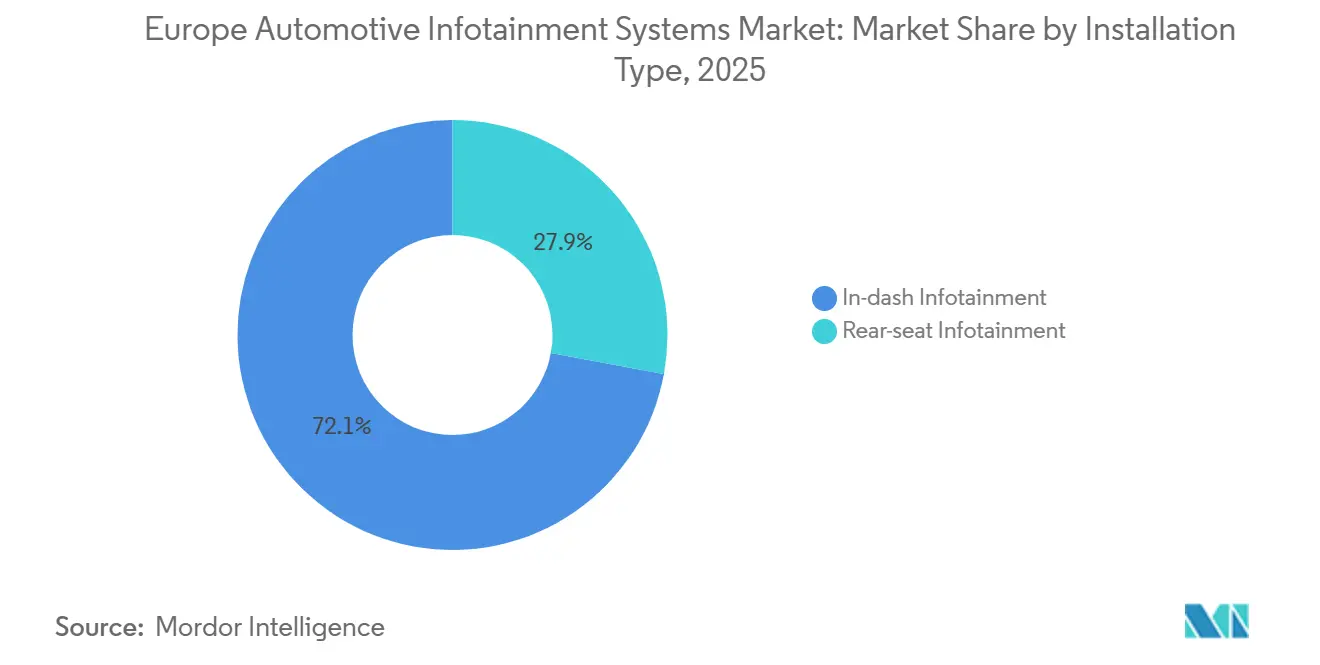
Rear-Seat Demand Outpaces In-Dash MaturityIn-dash units still held 72.13% revenue share in 2025, upheld by mandatory eCall connectivity, but single-digit growth underscores commoditization. Suppliers compete on integration cost, not screen size, as hardware converges on shared domain controllers. Rear-seat systems instead differentiate through content deals with Disney+ or Xbox Cloud Gaming, accelerating software subscriptions inside the European automotive infotainment systems market.
The rear-seat infotainment segment will climb at a 14.27% CAGR through 2031. Luxury original equipment manufacturers exploit long battery electric vehicle wheelbases to mount dual 11-inch touchscreens, wireless headsets, and gaming modes, delivering a lounge atmosphere. Chauffeur-driven executives in Germany, China, and the Middle East sustain this premium, while family-oriented MPVs in Spain and France expand addressable volumes.
By Vehicle Type:
Passenger Cars Lead While BEVs Redefine UXPassenger cars retained 86.42% share in 2025, anchored by 10.9 million EU registrations, yet battery electric vehicle variants of these cars will grow 38.56% a year. Energy-aware interfaces now display battery thermal state, regenerative-brake scores, and intelligent charging tips, features that elevate cockpit centrality within the European automotive infotainment systems market.
Commercial vans lag volumes but fast-track telematics for fleet optimization. The European Commission’s proposal to extend eCall to more than 3.5-ton trucks enlarges future demand. Medium-duty drivers require digital tachograph integration and real-time load analytics, nudging infotainment suppliers to tailor rugged HMI variants. Passenger-car dominance persists through 2031, yet light commercial vehicle digitization diversifies revenue streams across the European automotive infotainment systems industry.
By Component:
Software Captures Value As Screens PlateauDisplay modules represented 48.29% of 2025 revenue, but their CAGR trails 16.84% growth in operating-system software and apps. Original equipment manufacturers now embed app stores, cloud gaming, and feature-on-demand unlocks, turning the cockpit into a persistent revenue engine across the European automotive infotainment systems market.
Domain controller commoditization compresses hardware margins. Qualcomm and NXP ship turnkey reference boards that slash BOM by 18% for Visteon SmartCore customers. Subscription bundles, premium navigation, or in-car karaoke, generate >70% gross margin, shifting profitability toward software even while screens remain the largest absolute pool.
By Propulsion Type:
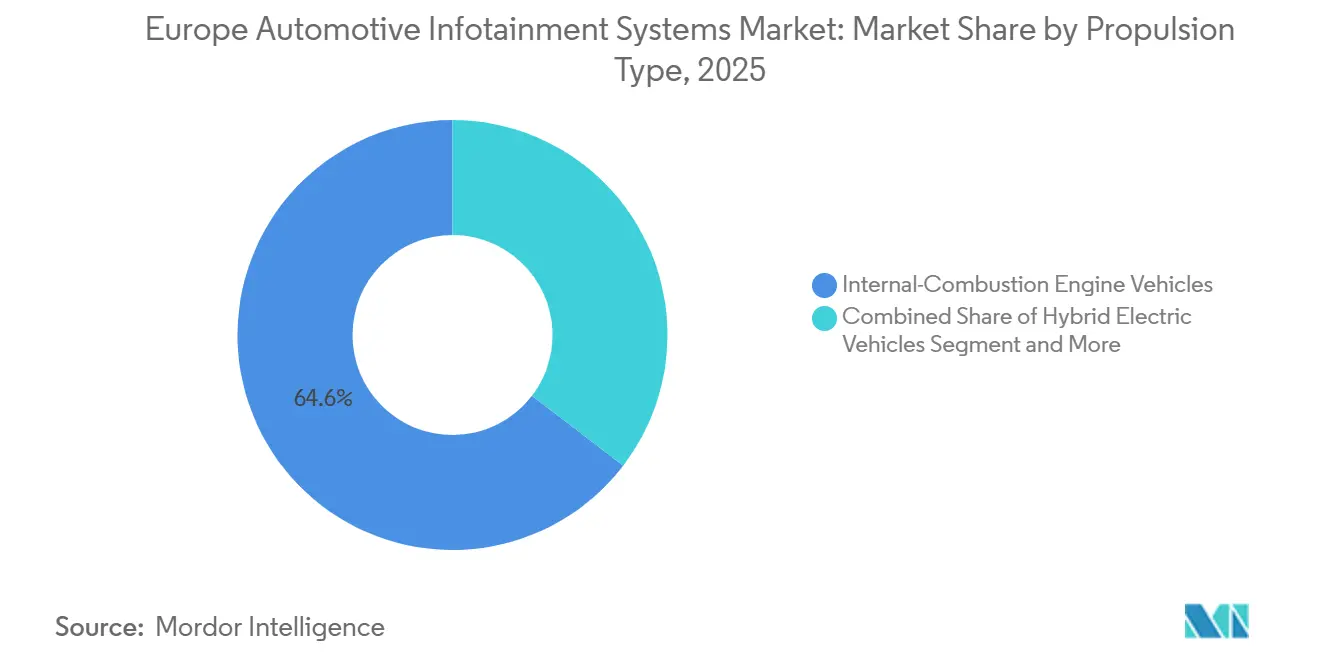
Electrification Spurs Deep IntegrationInternal combustion engine vehicles hold 64.58% of the European automotive infotainment systems market share in 2025, while battery electric vehicles surge at 38.41% a year. Their flat floors free cabin space for larger displays, and battery-aware HMI becomes mission-critical. Tesla’s “Camp Mode” sparked copycats from Ford and Volkswagen, illustrating how infotainment manages energy as much as entertainment.
Internal combustion engine vehicles dominate the installed base, but face subdued growth as the EU bans new sales by 2035. Hybrids plateau near 25% share by 2028, offering fewer unique infotainment hooks. Original equipment manufacturer differentiation pivots toward BEV-centric UX, cementing software-defined strategies in the European automotive infotainment systems market.

By Connectivity Generation:
5G Momentum Builds Despite Rural Lag4G LTE led with 61.37% revenue in 2025, yet 5G stand-alone subscriptions will compound 24.73% annually. Original equipment manufacturers market 5G cockpits as “future-proof” and exploit slices to isolate safety telemetry from 4K streaming. Vodafone closed its German 3G network in 2024, forcing retrofit head units to upgrade or risk losing data.
Rural Greece and Romania still operate on patchy 4G, so original equipment manufacturers tier 5G as a premium option. The Commission’s 2030 corridor-coverage mandate will close gaps, making 5G the default baseline in the European automotive infotainment systems market by decade-end.
By Operating System:
Android Automotive OS Scales FastestLinux derivatives held a 43.18% share in 2025, but Android Automotive OS alone will rise 21.36% per year. Google Maps' electric vehicle routing and Assistant voice control outweigh concerns about data sovereignty for several original equipment manufacturers. Volvo and Renault completed full-line Android Automotive OS (AAOS) rollouts by 2025, while Polestar commits through 2031.
QNX remains entrenched in safety clusters but recedes in infotainment. OEMs that crave data ownership, such as Volkswagen’s Cariad, continue adapting Automotive Grade Linux, balancing openness and brand experience. The operating-system battlefield shapes ecosystem control throughout the European automotive infotainment systems market.
By Sales Channel:
Factory Fit Dominates, Aftermarket Finds NichesOriginal equipment manufacturer installation covered 92.74% of 2025 shipments thanks to deep CAN and ADAS integration. Aftermarket vendors target aging fleets in Poland, Romania, and Bulgaria, pushing plug-and-play eCall dongles that win insurance discounts. Growth sits at 12.48% but remains niche.
Modern domain controllers unite HVAC, lighting, and ADAS on shared silicon, making later swap-outs costly. Nevertheless, enthusiast communities still retrofit 12-inch Android screens into decade-old Volkswagen Golfs, keeping a small but steady revenue pocket alive in the European automotive infotainment systems market.
Geography Analysis
Germany Automotive Infotainment Systems Market
Germany generated 22.57% of 2025 revenue, driven by Volkswagen, BMW, and Mercedes production volumes and a EUR 1,850 average infotainment spend per vehicle. High purchasing power sustains early adoption of OLED hyper-screens and 5G packages. Yet Chinese entrants opened local HQs in 2024 and price-damaged premium tiers, pressuring incumbent margins across the European automotive infotainment systems market.
Spain Automotive Infotainment Systems Market
Spain delivered the strongest trajectory, poised to post a 19.94% CAGR through 2031. Government PERTE VEC subsidies worth EUR 4.3 billion attracted Stellantis and Ford to base BEV lines near Valencia, pulling Visteon and Harman into new Barcelona and Madrid tech hubs. Infotainment demand follows production scale as suppliers localize just-in-time.
Europe Automotive Infotainment Systems Market
France, the United Kingdom, and Italy collectively hold a significant share. France leverages Renault-Nissan’s shared AAOS cockpit, reaching 1.2 million installs in 2025. The United Kingdom wrestles with a slower rural 5G rollout post-Brexit, tempering growth despite Nissan’s Sunderland Ariya output. Italy’s luxury niche commands high ARPUs with bespoke Maserati and Ferrari systems, albeit on small volumes.
Regulatory Landscape
European automotive infotainment specifications are increasingly shaped by connected-vehicle safety, cybersecurity, and data-access rules. UNECE UN Regulation No. 155 (cybersecurity management systems) and UN Regulation No. 156 (software update management systems) are enforced for new vehicle models from July 2024, with type-approval scrutiny carried out by national authorities such as the United Kingdom Vehicle Certification Agency (VCA); these requirements raise the bar for secure OTA update pipelines and supplier assurance across IVI, telematics, and domain controller stacks.
Data governance has become a parallel compliance track for connected cockpits. The EU Data Act applies from 12 September 2025 and sets rules for access to and sharing of connected-vehicle data under user consent and transparency principles, shaping OEM and supplier strategies for app ecosystems, diagnostics access, and service monetization. In addition, the European Commission Automotive Package released in December 2025 signals policy work to simplify technical requirements and reduce administrative burdens for manufacturers, while Euro 7 type-approval phases in from November 2026 and adds compliance attention on on-board monitoring and anti-tampering aspects that intersect with software-defined infotainment and telematics architectures.
Value Chain Analysis
The Europe automotive infotainment systems value chain runs from semiconductor and connectivity components (SoCs, modems, GNSS, antenna modules) and display/touch technologies through Tier-1 integration of head units and centralized cockpit/domain controllers, then into OEM vehicle platforms that package HMI, navigation, voice, and connectivity services. Software layers, including operating systems, middleware, app frameworks, cloud back ends, and content partnerships, increasingly drive differentiation, while OEMs and Tier-1s manage long-term OTA support and compliance artifacts as part of series production.
UNECE R155 and ISO 21434 have pushed cybersecurity obligations upstream, requiring OEMs to assess supply-chain risk and cascade security requirements into supplier agreements, development processes, and validation evidence. That is reinforcing ecosystem partnerships where specialists contribute subdomains into centralized compute platforms, exemplified by Continental and Pioneer cooperation around cockpit high-performance computing (HPC) architectures in which infotainment subdomains integrate into consolidated cockpit platforms, aligning hardware consolidation with shared software responsibility and compliance-ready delivery.
Competitive Landscape
Continental, Bosch, Harman, Visteon, and Panasonic Automotive controlled a significant share of 2025 revenue, marking moderate concentration. Each pivots toward software-defined vehicle platforms that merge infotainment, ADAS, and telematics on shared compute, minimizing redundant ECUs. Semiconductor suppliers erode Tier-1 leverage: Qualcomm’s Snapdragon Digital Chassis won 28 European design slots by Q4 2025, while NVIDIA DRIVE Orin powers Mercedes and Volvo domain controllers.
Strategic moves include Bosch’s 2025 alliance with Microsoft for Azure-based voice processing, Continental’s 2024 acquisition of an AR HUD startup to enrich cockpit visuals, and Harman’s 2025 Madrid hub to accelerate AAOS integrations. Chinese Tier 1s such as Huawei IAS and Desay SV now pitch complete infotainment stacks with built-in AI assistants, targeting value-focused OEMs.
Regulatory readiness shapes vendor selection; ISO 21434 cyber certifications became a sourcing gate in 2025. Continental embedded UNECE R155 templates into its reference architecture, shaving OEM audit cycles by three months. Patent filings tilt to software: 60% of Continental’s 2024–2025 infotainment patents addressed secure OTA pipelines, underscoring the service-centric future of the European automotive infotainment systems market.
Europe Automotive Infotainment Systems Industry Leaders
-
Continental AG
-
Robert Bosch GmbH
-
Denso Corporation
-
Pioneer Corporation
-
AISIN CORPORATION
- *Disclaimer: Major Players sorted in no particular order
Europe Automotive Infotainment Systems Market Companies Covered in this Report
- Continental AG
- Robert Bosch GmbH
- Harman International (Samsung)
- AISIN CORPORATION
- Visteon Corporation
- Panasonic Automotive Systems
- Alpine Electronics
- Denso Corporation
- Aptiv PLC
- LG Electronics
- Valeo SA
- Faurecia Clarion Electronics
- Pioneer Corporation
- Samsung Electronics (Exynos Auto)
- Qualcomm Technologies Inc.
- NVIDIA Corporation (Automotive)
- STMicroelectronics
- NXP Semiconductors
- Renesas Electronics Corp.
- TomTom N V
- Garmin Ltd.
Read Analysis of Europe Automotive Infotainment Systems Companies
Market Opportunities and Future Outlook
Connected-cockpit monetization is opening opportunities for suppliers that can package compliant data access, secure OTA, and cross-border connectivity quality into scalable software offers. The EU Data Act (applicable from 12 September 2025) increases the importance of clear consent, transparency, and governed access to in-vehicle data, creating whitespace for OEM-aligned platforms that unify infotainment, telematics, and app distribution while maintaining auditability under UNECE R155/R156. At the network layer, GSMA Open Gateway APIs highlighted in 2026 provide a practical route for OEMs and Tier-1s to contract Quality of Service across operators, supporting premium services such as energy-aware navigation and high-bandwidth in-cabin content without losing safety-telemetry isolation.
AI-enabled IVI and fleet-oriented sound and HMI tuning represent another opportunity set as BEV adoption shifts cockpit value toward energy management and personalized experiences. Pioneer’s 2025 work with Microsoft Foundry on advanced AI agents for in-vehicle infotainment, plus its 2026 involvement in the Toyota Communication Palette mobility project (developing acoustic and sound-tuning systems for the e-Palette battery-electric vehicle), show demand for cloud-to-edge orchestration and specialized cabin-experience modules that can be deployed across programs. On the hardware side, cockpit consolidation into centralized compute platforms continues to favor suppliers able to integrate display, audio, connectivity, and software into domain-controller architectures while meeting the higher validation burden imposed by cybersecurity and software-update regulations.
Recent Industry Developments in Europe Automotive Infotainment Systems Market
- February 2026: DENSO Corporation committed to promoting the standardization of automotive software through a partnership with AUTOSAR. This strengthens interoperability and reduces integration risk across OEMs, enabling broader adoption of common software platforms and interfaces.
- January 2026: Qualcomm Technologies / Volkswagen announced a multi-year collaboration to supply Snapdragon Digital Chassis platforms for next-generation, software-defined vehicle architectures. The launch enables high-performance infotainment and ADAS processing across VW models, accelerating software-defined cockpit maturation.
- January 2026: BMW unveiled its iDrive system upgrade with a large touchscreen and integrated Amazon Alexa Plus voice assistant. The upgrade enhances connected cockpit UX and supports voice-enabled services at scale within the premium segment.
Europe Automotive Infotainment Systems Market Report Scope and Research Methodology
Market Definition and Coverage
For this report, the market covers the revenue generated from automotive infotainment systems sold for use in vehicles across Europe, including in-dash and rear-seat systems that combine information, media, navigation, and connected functions.
Scope exclusions: We exclude standalone consumer devices that are not sold as part of an in-vehicle infotainment system (for example, portable navigation units bought separately).
Segments Covered in This Report
- By Installation Type
- In-dash Infotainment
- Rear-seat Infotainment
- By Vehicle Type
- Passenger Cars
- Light Commercial Vehicles
- Medium and Heavy Commercial Vehicles
- By Component
- Display/Touch-Screen Module
- Head Unit/Domain Controller
- Operating-System Software and Apps
- Connectivity ICs and Antenna Modules
- By Propulsion Type
- Internal Combustion Engine Vehicles
- Hybrid Electric Vehicles
- Battery Electric Vehicles
- By Connectivity Generation
- Legacy 2G/3G
- 4G LTE
- 5G
- By Operating System
- Linux-Based (AAOS, AGL, etc.)
- QNX
- Android Automotive OS
- Others (Proprietary, RTOS)
- By Sales Channel
- Original Equipment Manufacturer (OEM) Installed
- Aftermarket
- By Country
- Germany
- United Kingdom
- France
- Italy
- Spain
- Russia
- Rest of Europe
Data Sources, Market Sizing, and Validation
Desk Research
Desk research helps us set the starting structure and reality checks before we build the model. We review public production and registration statistics for Europe, along with connected-vehicle and telecom indicators that affect embedded connectivity and feature adoption. Sources used include, for example, ACEA vehicle registration data, Eurostat industry and trade tables, UNECE vehicle regulations, the European Commission mobility and digital policy releases, and patent databases to see where cockpit software and HMI innovation is clustering.
We also reference company annual reports, earnings decks, and product announcements to understand typical content per vehicle, option take rates, and timing of platform changes (like new head unit generations). When trade flows matter for components, import and export shipment-level data is checked selectively to sense direction and price movement. These desk research sources are illustrative, and many other public documents and datasets were also reviewed to validate assumptions and clarify gaps.
Primary Interviews and Surveys
Primary work was used to pressure-test what desk sources cannot fully show, such as typical system content per trim, how OEM-installed systems differ from aftermarket demand, and how pricing moves when screens, connectivity modules, and software features are bundled. We spoke with a mix of OEM-side stakeholders, component suppliers, distributors, and service providers across Europe so that adoption levels and country differences could be cross-checked before totals were finalized.
Distribution of primary research fieldwork respondents
| Company type | Respondent position |
|---|---|
| Top tier: 37% | CXOs: 14% |
| Mid tier: 43% | Functional/Unit leaders: 28% |
| Smaller Players: 20% | Managers: 58% |
Market-Sizing & Forecasting
The core sizing uses a top-down build where vehicle production and registration volumes by major European countries are reconstructed and then translated into an addressable infotainment demand pool using fitment rates for in-dash and rear-seat systems. Once the demand pool is set, average selling prices are applied by system content level (for example, screen size and resolution, embedded connectivity generation, and software feature packaging), and then split by OEM-installed versus aftermarket sales.
To keep the totals realistic, we corroborate results with selective bottom-up approximations such as sampled supplier revenue splits, channel checks on aftermarket units, and sanity checks based on typical bill-of-material movement for displays, head units, and connectivity modules. Inputs that matter most include vehicle mix shifts (passenger versus commercial), BEV and hybrid penetration, 4G and 5G embed rates, screen and touch-display attachment trends, and the pace of software-enabled feature bundling. For forecasting, scenario analysis is used so that slower and faster adoption of connected services and cockpit consolidation can be reflected without forcing one aggressive path. Where country-level pricing or take-rate gaps exist, assumptions are filled using closest-market analogs and then re-checked through follow-up calls.
Data Validation & Update Cycle
Validation happens in several passes so that weak inputs do not slip through. Analysts compare the model output against independent signals such as reported vehicle output, connectivity adoption direction, and observed pricing ranges for major infotainment components, and then investigate any abnormal jumps before sign-off.
We also run variance checks across countries so that the market does not grow faster than the underlying vehicle parc and new-vehicle sales would allow. If a key input changes materially (for example, a regulatory trigger, a large platform reset, or a sudden pricing move), respondents are re-contacted and assumptions are adjusted. Reports are refreshed annually, with interim updates for major events, and a final pre-delivery review is done so clients receive the most current view available.
Mordor Intelligence's Europe Automotive Infotainment Market Size Versus Other Published Estimates
Published market sizes for Europe automotive infotainment do not always match because authors often use different definitions of what counts as infotainment revenue, and they also vary the year, currency timing, and pricing logic used for screens and connected features.
Some estimates broaden the scope by blending in adjacent cockpit electronics and audio-only systems, and then apply a single average price across vehicle types. In contrast, Mordor Intelligence counts infotainment systems tied to in-dash and rear-seat installations and then prices them using content-linked indicators like connectivity generation and screen attachment, which reduces double counting and keeps country totals aligned to vehicle volumes.
Benchmark comparison
| Source | Market Size | Gaps in Research Methodology |
|---|---|---|
| Mordor Intelligence | USD 17.97 B (2025) | |
| Industry Subscription Publisher A | USD 1.89 B (2025) | Appears to treat Europe as a smaller slice within a global total and may be counting only a limited infotainment subset, which can compress the value by excluding OEM factory-installed system content. |
| Mobility Research Boutique B | USD 9.20 B (2025) | Uses a higher growth path and a narrower price base in the starting year, which can happen when connectivity and software value is not fully captured in system ASPs across passenger and commercial vehicles. |
Looking across the table, the spread is mainly explained by what is included in the price base and how system content is treated across vehicle types. When the model is anchored to vehicle volumes and then adjusted for fitment and content changes year by year, the resulting market size stays traceable to clear inputs and can be repeated during future refreshes.
Key Questions Answered in the Report
How large is the Europe automotive infotainment systems market in 2026?
The market stands at USD 18.95 billion in 2026 and is forecast to reach USD 25.45 billion by 2031.
Which installation type segment is the fastest-growing in Europe for automotive infotainment?
Rear-seat systems show the highest growth, advancing at a 14.27% CAGR through 2031.
What role does 5G play in European in-car infotainment?
5G enables network slicing that separates safety telemetry from passenger streaming, and 5G connections are projected to grow at 24.73% per year.
Why are battery electric vehicles critical to cockpit innovation?
BEVs require energy-aware interfaces for range and charging management, driving deep integration between the infotainment head unit and battery systems.
Which countries drive the most demand for advanced infotainment?
Germany leads revenue due to premium adoption, while Spain records the fastest growth because of aggressive EV manufacturing expansions.
Who are the leading suppliers in the European infotainment space?
Continental, Bosch, Harman, Visteon, and Panasonic Automotive collectively hold nearly half of 2025 market revenue.