
Market Overview
| Study Period | 2020 - 2031 |
|---|---|
| Forecast Data Period | 2026 - 2031 |
| Base Year Market Size (2025) | 2.59 Billion liters |
| Market Volume (2026) | 2.6 Billion liters |
| Market Volume (2031) | 2.65 Billion liters |
| Growth Rate (2026 - 2031) | 0.35 % |
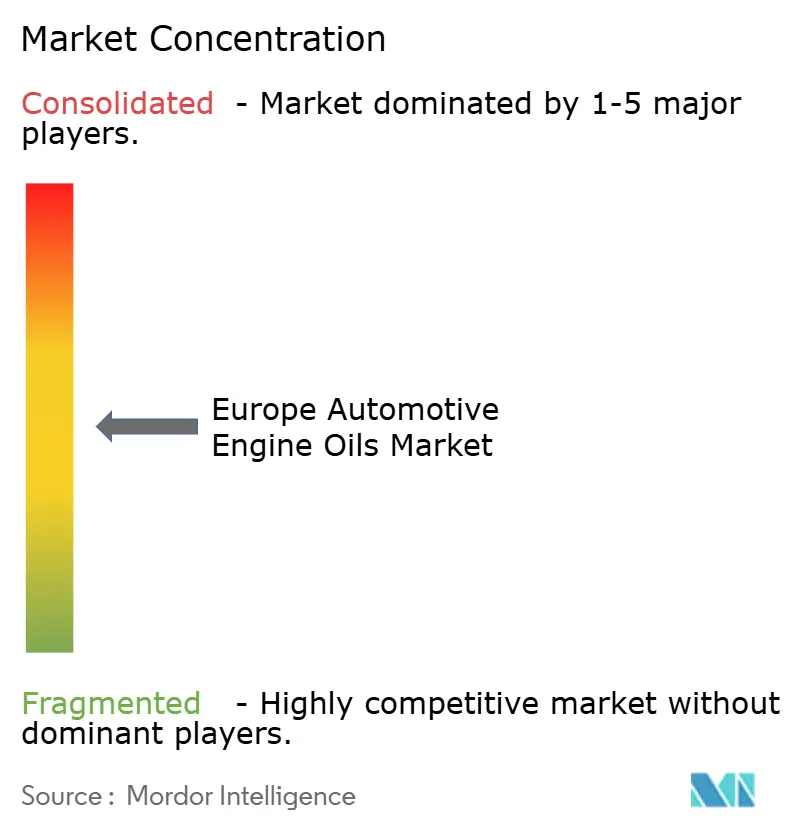
| Market Concentration | Medium |
Major Players *Disclaimer: Major Players sorted in no particular order Image © Mordor Intelligence. Reuse requires attribution under CC BY 4.0. | |
Europe Automotive Engine Oils Market Analysis by Mordor Intelligence
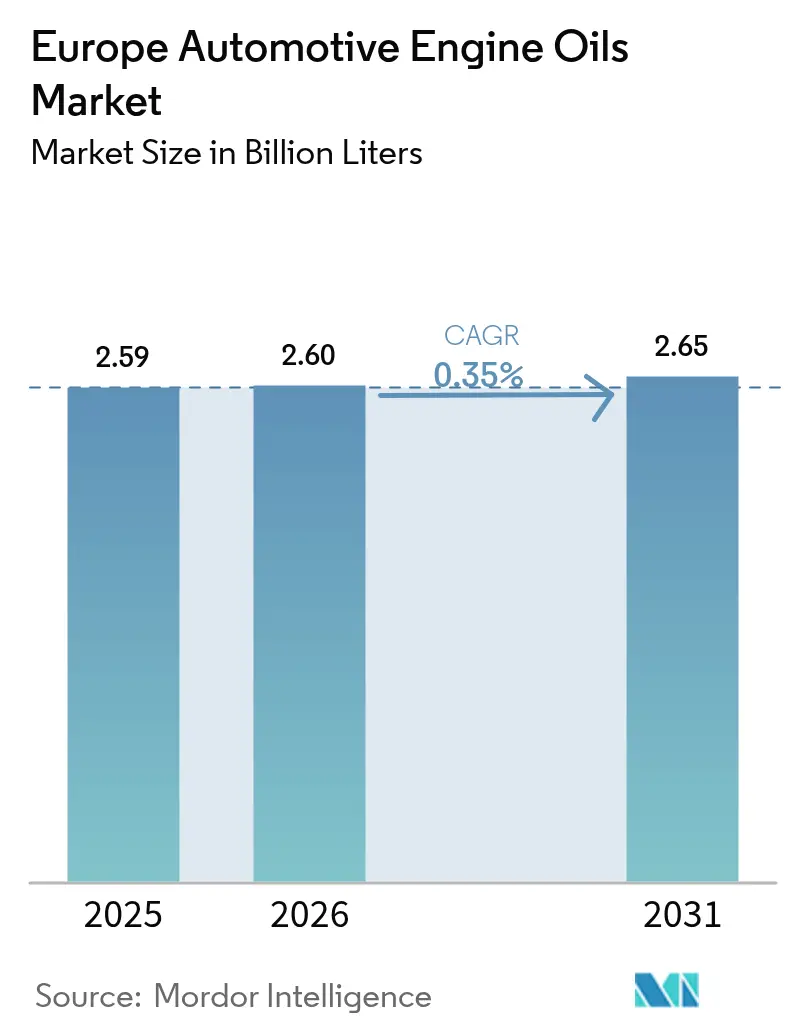
The European Automotive Engine Oils Market size in 2026 is estimated at 2.6 billion liters, growing from 2025 value of 2.59 billion liters with 2031 projections showing 2.65 billion liters, growing at 0.35% CAGR over 2026-2031. The muted trajectory reflects structural changes as battery-electric vehicles erode internal-combustion volumes, yet a large aging vehicle parc, low-viscosity regulatory mandates, and growing hybrid sales continue to underpin lubricant demand. Suppliers respond by intensifying research and development on premium synthetics, expanding regenerated base-oil capacity, and aligning specifications with stringent OEM approvals that favor low-sap, low-viscosity formulations. Competitive intensity now centers on technological differentiation and sustainability credentials rather than sheer output, while margin volatility stems from crude price swings and additive supply disruptions. Policy drivers such as the European Union “Fit for 55” package, national circular-economy regulations, and waste-oil regeneration quotas are accelerating the shift toward advanced synthetics and bio-based lubricants.
Key Report Takeaways
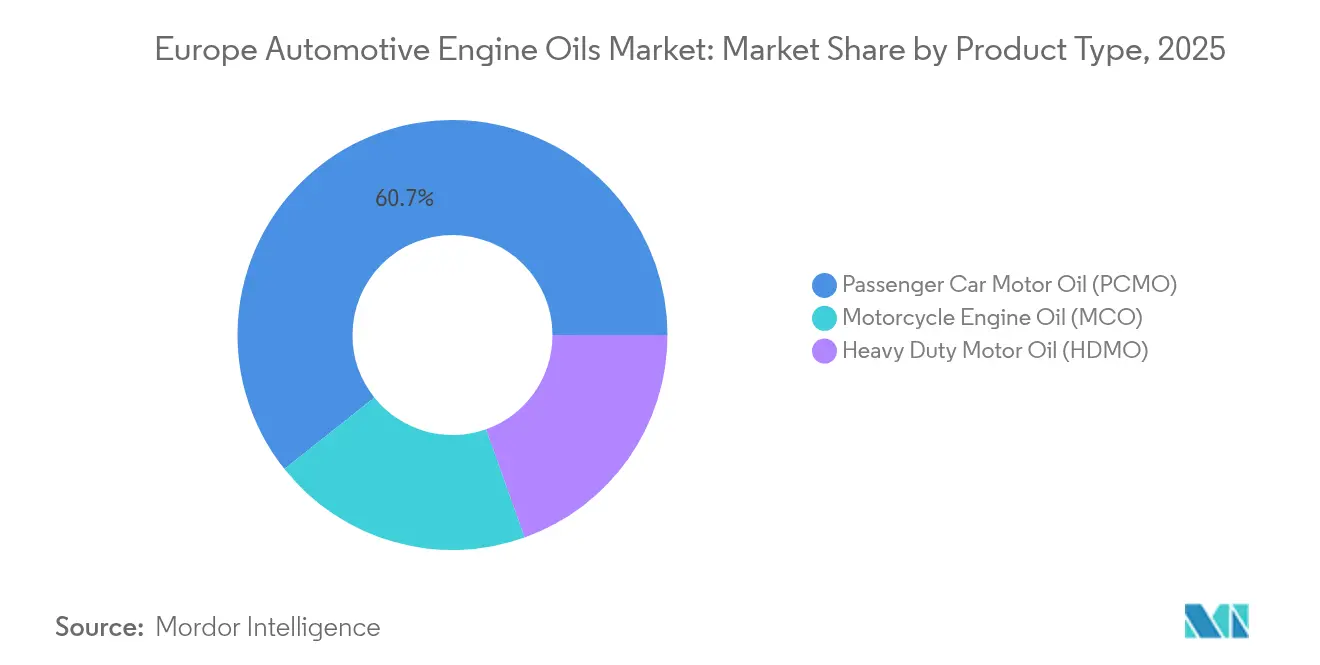
- By product type, Passenger Car Motor Oil held 60.72% of the Europe automotive engine oils market share in 2025, whereas Motorcycle Engine Oil is forecast to expand at a 0.92% CAGR through 2031.
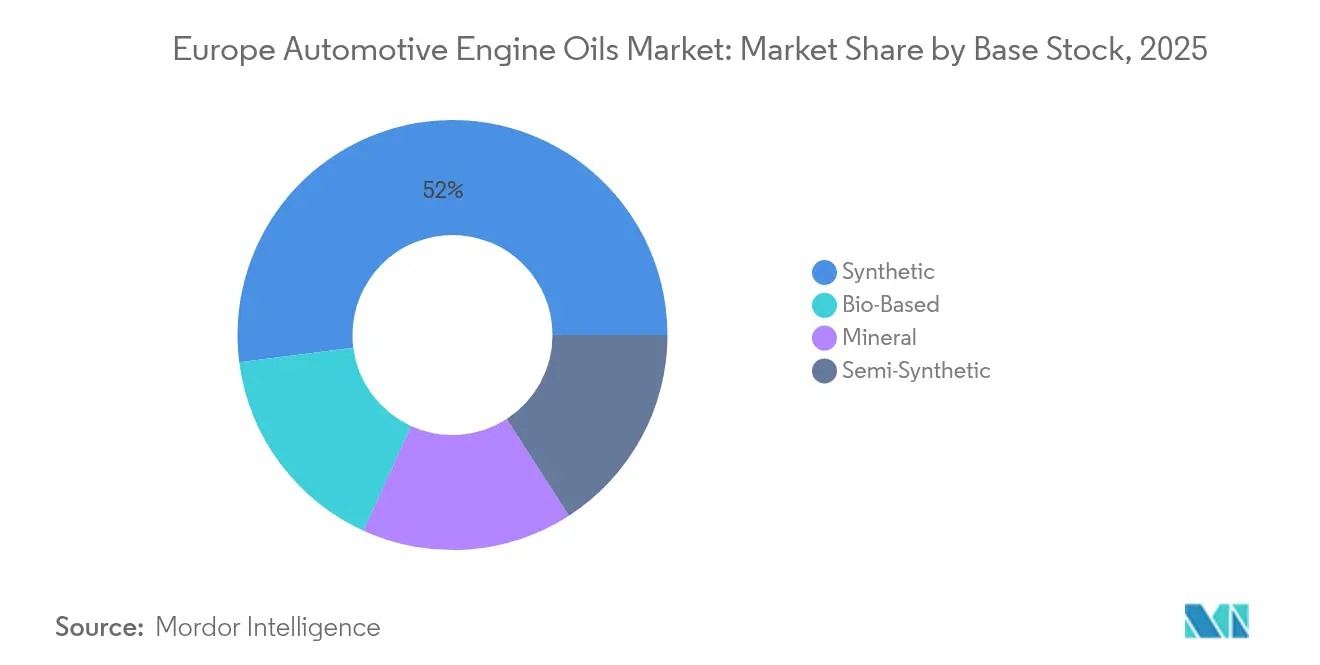
- By base stock, synthetic oils accounted for 52.02% share of the Europe automotive engine oils market size in 2025, while bio-based formulations record the highest projected CAGR at 0.9% to 2031.
- By geography, Russia represented 19.05% revenue share of the Europe automotive engine oils market in 2025; Poland is set to record the fastest growth at 0.83% CAGR during the outlook period.
Note: Market size and forecast figures in this report are generated using Mordor Intelligence’s proprietary estimation framework, updated with the latest available data and insights as of 2026.
Europe Automotive Engine Oils Market Trends and Insights
Drivers Impact Analysis*
| Drivers | (~) % Impact on CAGR Forecast | Geographic Relevance | Impact Timeline |
|---|---|---|---|
| European Union CO₂ and fuel-economy targets push low-viscosity formulations | +0.15% | EU core markets, spillover to UK and Nordic countries | Medium term (2-4 years) |
| Aging ICE vehicle parc sustains oil-change volumes | +0.12% | Germany, France, Italy, Spain with established vehicle fleets | Long term (≥ 4 years) |
| OEM specification proliferation drives premium synthetics | +0.08% | Germany, Nordic countries, premium vehicle markets | Medium term (2-4 years) |
| Hybrid-vehicle growth needs low-ash, low-viscosity oils | +0.06% | Western Europe, Nordic countries leading electrification | Short term (≤ 2 years) |
| Waste-oil regeneration quotas spur re-refined base-oil demand | +0.05% | France, Germany, Italy with established collection systems | Long term (≥ 4 years) |
| Source: Mordor Intelligence | |||
European Union CO₂ and Fuel-Economy Targets Push Low-Viscosity Formulations
Upcoming fleetwide CO₂ caps compel automakers to specify ultra-thin 0W-20 and even 0W-16 grades that deliver measurable fuel-efficiency gains. Volkswagen shifted its entire TSI engine family to 0W-20 service fills in 2025, prompting aftermarket workshops to stock advanced synthetics with high Group III and poly-alpha-olefin content[1]. Low-viscosity grades command 20-30% price premiums because heavier 5W-30 and 10W-40 oils cannot meet viscosity-temperature targets. The mandate boosts Europe automotive engine oils market demand for high-performance base stocks and premium additive packages while commoditizing legacy grades.
Aging ICE Vehicle Parc Sustains Oil-Change Volumes
The average German passenger car age climbed to 10.1 years in 2024, and similar trends appear across France, Italy, and Spain[2]. Older engines require more frequent oil changes and tolerate conventional or semi-synthetic formulations, offsetting volume lost to electrification. Independent workshops capture a larger share of this replacement business as vehicles exit warranty coverage, thereby maintaining baseline lubricant demand in the Europe automotive engine oils market even as new-car electrification rises.
OEM Specification Proliferation Drives Premium Synthetics
Mercedes-Benz introduced MB-Approval 229.72 for hybrid models, while BMW launched Longlife-17 FE+ in 2024, adding to more than 40 new approvals last year. Workshops now juggle a growing matrix of proprietary specs, and non-compliance can void warranties. This complexity locks in premium synthetics from suppliers with extensive approval portfolios, reinforcing price resiliency in the Europe automotive engine oils market.
Waste-Oil Regeneration Quotas Spur Re-Refined Base-Oil Demand
EU circular-economy legislation now requires member states to regenerate a minimum of 85% of collected waste oil by 2030, initiating a wave of re-refinery investments in France, Germany, and Italy. Suppliers incorporate recycled base stocks into premium blends to meet sustainability targets without compromising performance, adding a new competitive dimension to the Europe automotive engine oils market.
Restraints Impact Analysis*
| Restraints | (~) % Impact on CAGR Forecast | Geographic Relevance | Impact Timeline |
|---|---|---|---|
| Accelerating BEV penetration shrinks long-term ICE pool | -0.18% | Nordic countries, Netherlands, Germany leading adoption | Long term (≥ 4 years) |
| Volatile crude and additive supply costs pressure margins | -0.08% | Global impact with particular pressure on smaller European blenders | Short term (≤ 2 years) |
| OEM lifetime-fill and sensors extend drain intervals | -0.12% | Germany, premium markets with advanced vehicle technology adoption | Medium term (2-4 years) |
| Source: Mordor Intelligence | |||
Accelerating BEV Penetration Shrinks Long-Term ICE Pool
Battery-electric vehicles captured 14.6% of European new-car registrations in 2024, and the share could exceed 30% of the rolling fleet by 2035. Nordic markets already display lubricant volume contraction, signaling future pressure for suppliers heavily exposed to internal-combustion demand. The contraction risk looms largest for the Europe automotive engine oils market participants lacking diversification into electrification-adjacent fluids.
Volatile Crude and Additive Supply Costs Pressure Margins
Crude price spikes and additive shortages inflate raw-material costs, challenging small and mid-sized blenders that lack procurement leverage. Many have responded by raising prices or trimming product lines, but escalating input volatility still compresses margins, especially in price-sensitive mineral segments of the Europe automotive engine oils market.
*Our forecasts treat driver/restraint impacts as directional, not additive. The impact forecasts reflect baseline growth, mix effects, and variable interactions.
Segment Analysis
By Product Type: Passenger Car Motor Oil Dominance Faces MCO Growth Challenge
Passenger Car Motor Oil held 60.72% of the European automotive engine oils market in 2025. PCMO volumes benefit from a 250 million-unit passenger car fleet, yet growth remains flat as fleet electrification offsets miles-driven recovery. Premium fully synthetic 0W-20 and 0W-16 formulations extend drain intervals to 30,000 kilometers, allowing OEMs to advertise lower ownership costs while still protecting engines. Independent garages lead distribution, but authorized dealer channels retain high-margin factory-fill business where OEM approvals remain non-negotiable.
Motorcycle Engine Oil is expected to post the fastest 0.92% CAGR through 2031. Urban congestion, last-mile delivery, and recreational riding boost two-wheeler demand, especially in Italy, Spain, and France. High-performance motorcycles require JASO MA2 oils with shear stability, wet-clutch compatibility, and thermal resilience, driving premium pricing. Europe automotive engine oils market participants that cultivate dealer networks and sponsor racing events capture brand loyalty among enthusiasts who accept higher per-liter prices.

By Base Stock: Synthetic Leadership Meets Bio-Based Innovation
Synthetics comprised 52.02% of the European automotive engine oils market share in 2025. Group III and PAO heavy blends deliver superior cold-start viscosity and oxidation resistance, aligning with OEM goals for fuel economy and long service intervals. Semi-synthetic products bridge price and performance gaps for cost-conscious drivers.
Bio-based lubricants registers a leading 0.9% CAGR. EU eco-label programs and corporate sustainability pledges spur adoption, and regenerated base stocks satisfy circular-economy criteria. TotalEnergies cooperated with Stellantis to launch a recycled-content engine oil that meets OEM durability standards. As supply scales, cost parity approaches, positioning bio-based blends to carve a share from conventional mineral formulations across the European automotive engine oils market.
Geography Analysis
Russia generated 19.05% of the European automotive engine oils market volume in 2025. A 45 million-unit passenger car parc plus heavy-duty fleets serving resource extraction maintain robust lubricant demand. Sanctions impeded Western additive imports, prompting domestic players such as LUKOIL and Gazprom Neft to intensify local formulation work while sourcing alternative chemistries from Asia. Distribution remains primarily through fuel-station channels and independent retailers; however, premium synthetic penetration lags Western Europe, leaving room for future value-added growth.
Poland represents the fastest-growing national market at 0.83% CAGR. OEM investments from Stellantis, Volkswagen, and Toyota expand factory-fill requirements, while rising disposable income supports vehicle ownership growth. Aftermarket volume benefits from a relatively young but expanding passenger car fleet that leans toward semi-synthetic upgrades. Government incentives for industrial upgrading have also encouraged refinery construction, enhancing domestic circular-economy capacity in the European automotive engine oils market.
Germany, France, Italy, and Spain make up a mature core with flat volumes but strong premiumization. German consumers show the highest synthetic adoption, with 0W-20 now the dominant grade for new cars. France advances recycled content deployment, while Italy and Spain offer growth pockets in motorcycle lubricants owing to favorable climate and riding culture. Nordic countries provide a test bed for low-temperature and high-BEV specialty fluids, shaping future product roadmaps for the wider Europe automotive engine oils market.
Regulatory Landscape
The regulatory framework for automotive engine oils in Europe is increasingly shaped by EU vehicle-emissions legislation and related type-approval rules that push OEMs and workshops toward low-viscosity, low-SAPS formulations, alongside tighter in-use durability needs. Euro 7 (Regulation (EU) 2024/1257) introduces new type-approval requirements for M1 and N1 vehicles, with application milestones starting 29 November 2026, which increases the share of demand tied to OEM-approved oils designed to protect emissions systems and support fuel-consumption performance.
In chemicals, labeling, and sustainability, compliance requirements span EU product and environmental schemes that affect formulation and claims. The EU Ecolabel criteria for lubricants (Decision (EU) 2018/1702) remain valid until 31 December 2028, supporting differentiation for lower-impact products. At the same time, EU circular-economy direction and waste-oil management expectations reinforce the shift toward re-refined base stocks, which raises compliance and documentation demands across collection, regeneration, and traceability for finished lubricants placed on the market.
Value Chain Analysis
The Europe automotive engine oils value chain runs from base oil production (Group I-IV, plus re-refined and bio-based streams) and additive supply through blending, packaging, approvals, and multi-channel distribution into OEM factory fill and the aftermarket. Performance and claims are governed by industry technical frameworks such as ACEA Oil Sequences. ATIEL administers the European Engine Lubricants Quality Management System (EELQMS) via SAIL, which increases the need for validated formulations and controlled documentation as OEM-specific approvals proliferate.
Downstream, distribution spans authorized dealer networks, independent workshops, parts distributors, retailers, and fuel-station channels. Product selection becomes more complex as low-viscosity and low-SAPS requirements expand. Industry coordination also continues to tighten around specification transitions, including the December 2025 compliance timing for the 2024 ACEA Oil Sequences for Heavy-Duty Engines (Revision 1) and ATIEL Code of Practice updates (Issue 25 released March 2025, followed by Issue 26 effective 19 December 2025, which added specific statements around re-refined base stocks). These changes increase the value of additive access, testing capability, and approval-management know-how for blenders serving both passenger car and heavy-duty segments.
Competitive Landscape
The Europe automotive engine oils market displays moderate fragmentation. Medium-sized regional players compete through agility and local branding. LIQUI MOLY wins share in Germany via motorsport sponsorships and enthusiast marketing, while Wolf Oil grows in Benelux by offering OEM-approved private-label products. Strategic emphasis has shifted from volume to sustainability positioning. Suppliers promote carbon-neutral production, low-carbon packaging, and digital service platforms that guide workshops on correct oil selection, adding service value while defending premiums in the European automotive engine oils market.
Europe Automotive Engine Oils Industry Leaders
-
BP plc
-
Exxon Mobil Corporation
-
FUCHS
-
Shell plc
-
TotalEnergies
- *Disclaimer: Major Players sorted in no particular order
Market Opportunities and Future Outlook
One key opportunity is scaling circular, lower-carbon engine oils that still carry OEM approvals, especially products using re-refined base oils to meet sustainability and procurement requirements without trading off performance. TotalEnergies and Stellantis have already moved this into mainstream OEM-linked channels, commercializing a 100% regenerated-base-oil engine lubricant (Quartz EV3R 10W40) for compatibility with Stellantis brands. Renault Group has also been introducing and expanding a premium engine-oil range with lower carbon footprints, including RN17 5W-30, across its portfolio through 2026.
Another opportunity sits in service and product architectures that reduce mis-fill risk and help workshops navigate a widening matrix of OEM and ACEA requirements as Euro 7 compliance milestones approach (Regulation (EU) 2024/1257 applies from 29 November 2026 for key M1 and N1 type-approval steps). Suppliers that combine broader approval coverage with clear claim governance under ATIEL/EELQMS and ACEA sequences can differentiate as tolerances tighten for ultra-low viscosity grades and hybrid-focused requirements. With legacy grades facing commoditization, premiumization through validated low-viscosity formulations, documented circular content, and retailer and workshop enablement remains a practical route to defend margins even where overall volume growth is muted.
Recent Industry Developments
- April 2026: FUCHS SE completed the full acquisition of the remaining 50% stake in the OPET FUCHS joint venture, taking full control effective April 30, 2026. The transaction includes the Aliaga (Izmir) production plant and strengthens FUCHS control over production, portfolio, and go-to-market execution in Turkey. This consolidation supports tighter alignment of capacity and product positioning with regional OEM and aftermarket requirements.
- October 2025: FUCHS took over its long-standing Swiss distribution partner ASEOL SUISSE AG to expand its market presence in Switzerland. Bringing distribution in-house enhances route-to-market control and supports more direct execution of premium and OEM-approved lubricant strategies. The move also strengthens customer coverage and service levels for workshops and industrial accounts.
- November 2024: FUCHS SE successfully completed the acquisition of Swiss lubricants company STRUB & Co. AG. The deal broadened FUCHS product breadth and reinforced its position in specialty lubricants alongside its automotive portfolio. It also added regional capabilities and customer relationships that can be leveraged across European distribution networks.
Research Methodology Framework and Report Scope
Market Definition and Coverage
This market covers engine oils used in on-road vehicles across Europe, measured as finished lubricants consumed through factory fill and the in-use service market, and reported in liters for a consistent view across countries.
Scope exclusions: This sizing excludes industrial engine oils, marine oils, and aviation lubricants, and it also excludes non-engine automotive fluids such as transmission, gear, brake, and hydraulic fluids.
Segmentation Overview
- By Product Type
- Passenger Car Motor Oil (PCMO)
- 0W-XX
- 5W-XX
- 10W-XX
- 15W-XX
- Monogrades
- Other Grades
- Heavy Duty Motor Oil (HDMO)
- 0W-XX
- 5W-XX
- 10W-XX
- 15W-XX
- Monogrades
- Other Grades
- Motorcycle Engine Oil (MCO)
- 0W-XX
- 5W-XX
- 10W-XX
- 15W-XX
- Monogrades
- Other Grades
- Passenger Car Motor Oil (PCMO)
- By Base Stock
- Mineral
- Synthetic
- Semi-Synthetic
- Bio-Based
- By Geography
- Germany
- United Kingdom
- France
- Italy
- Spain
- Nordic Countries
- Russia
- Rest of Europe
Data Sources, Market Sizing, and Validation
Desk Research
Desk work started by pinning down the addressable vehicle fleet and how often oil is changed across the key European markets. For this, we used public datasets and standards sources such as Eurostat transport statistics, the European Automobile Manufacturers Association (ACEA) registrations and parc commentary, national vehicle agencies where available, and technical guidance from standards bodies such as ACEA oil sequences and SAE viscosity guidance.
We then built direction on trade flows and supply context using sources such as UN Comtrade, national customs releases, and reputable industry press and association pages covering lubricant demand trends. Company annual reports and investor presentations were used to understand product focus, channel emphasis, and typical packaging mix, and patent databases helped track formulation shifts tied to lower viscosity and emissions needs. In a few cases, paid subscriptions for company financials and shipment-level import-export checks were used to validate ranges. The sources listed here are illustrative, and many additional public documents were reviewed to clarify definitions, cross-check inputs, and close data gaps.
Primary Interviews and Surveys
Primary work focused on interviews and short surveys with lubricant marketers, distributors, service channel participants, and maintenance decision-makers, so we could validate drain intervals, packaging splits, and the share of synthetic versus mineral demand. We also used these conversations to test how country practices differ, and to confirm how quickly newer viscosity grades are replacing older ones in the installed fleet.
Distribution of primary research fieldwork respondents
| Company type | Respondent position |
|---|---|
| Top tier: 38% | CXOs: 14% |
| Mid tier: 44% | Functional/Unit leaders: 34% |
| Smaller Players: 18% | Managers: 52% |
Market-Sizing & Forecasting
The model is built mainly from a top-down demand pool, where vehicle parc by fuel type is combined with typical sump capacity and observed drain intervals to reconstruct annual liters consumed by the in-use market, followed by a separate adjustment for factory fill. To keep the totals realistic, we also corroborated results with selective bottom-up approximations such as sampled price-per-liter ranges by channel and a few supplier and distributor volume cues, and then tuned the assumptions where the spread was too wide.
Inputs used in the sizing include passenger car versus commercial vehicle mix, the diesel and gasoline parc split, average oil change frequency, average fill volumes, the pace of extended drain interval adoption, and the shift toward lower-viscosity and higher-spec oils driven by emissions targets. Forecasting used scenario analysis anchored on expected parc changes and service interval trends, with expert feedback used to select conservative, base, and faster-transition cases. When direct data points were thin for smaller countries, we scaled from comparable markets using parc structure and maintenance behavior, and then rechecked the outcome against trade and channel signals.
Data Validation & Update Cycle
Outputs were checked through multiple passes, starting with internal consistency checks across parc, drain intervals, and liters per vehicle, and then through variance checks against independent signals such as registrations trends and import-export movements. Outliers at country level were flagged, reworked, and discussed in analyst review before sign-off, and follow-up calls were triggered when a key assumption shifted or did not align with field feedback.
The report is refreshed annually, and interim updates are made when material events occur, such as major emissions rule changes, meaningful fleet mix swings, or sharp base oil pricing moves that can change buying behavior. Before delivery, we rechecked the latest public indicators so clients receive an updated view rather than an outdated snapshot.
Mordor Intelligence's Europe Automotive Engine Oils Market Size Compared With Other Published Estimates
Published market numbers for automotive engine oils in Europe do not always match because the scope boundary is not consistent, and the market can be reported in either value or volume depending on the publisher's preference. Differences also come from how the service market is separated from factory fill, and whether Russia and smaller European countries are treated the same way.
By checking vehicle parc, drain interval, and average fill volume inputs, Mordor Intelligence keeps the sizing tied to liters consumed by the installed fleet, which reduces the risk that coolant, transmission fluids, or broader automotive lubricants get blended into an engine-oil total.
Benchmark comparison
| Source | Market Size | Gaps in Research Methodology |
|---|---|---|
| Mordor Intelligence | USD 2.60 B (2026) | |
| Industry Association A | USD 3.10 B (2026) | Often aggregates passenger car engine oils with nearby lubricant categories in retail reporting, and it may apply a higher assumed oil-change frequency uniformly across countries, which can inflate total liters. |
| Trade Journal B | USD 2.20 B (2026) | Typically relies on reported sales value from a narrower set of channels, and it can miss independent workshops and do-it-yourself demand, which lowers totals in markets with fragmented distribution. |
The spread is mainly explained by what gets counted as engine oil demand and how channel coverage is treated across Europe. Keeping the model tied to clear consumption drivers, and then checking it against trade and channel signals, makes the resulting estimate easier to trace and repeat when assumptions change.
Key Questions Answered in the Report
What is the projected volume of lubricant demand in Europe by 2031?
The Europe automotive engine oils market is forecast to reach 2.65 billion liters by 2031, rising only marginally from 2026.
How fast will bio-based engine oils grow in Europe?
Bio-based formulations are projected to expand at a 0.9% CAGR through 2031 as circular-economy mandates boost recycled content adoption.
Which resin type is growing the quickest?
Motorcycle Engine Oil leads with a 0.92% CAGR thanks to urban mobility trends and high-performance bike popularity in Southern Europe.
Why do low-viscosity oils command premium prices?
They help automakers meet CO? targets and require advanced synthetic base stocks, allowing suppliers to price them 2030% higher than heavier grades.
Which country offers the strongest growth prospects?
Poland tops the outlook with a 0.83% CAGR, driven by expanding vehicle production and rising consumer ownership.