
Market Overview
| Study Period | 2020 - 2031 |
|---|---|
| Forecast Data Period | 2026 - 2031 |
| Base Year Market Size (2025) | USD 35.38 Trillion |
| Market Size (2026) | USD 38.89 Trillion |
| Market Size (2031) | USD 62.37 Trillion |
| Growth Rate (2026 - 2031) | 9.92 % |
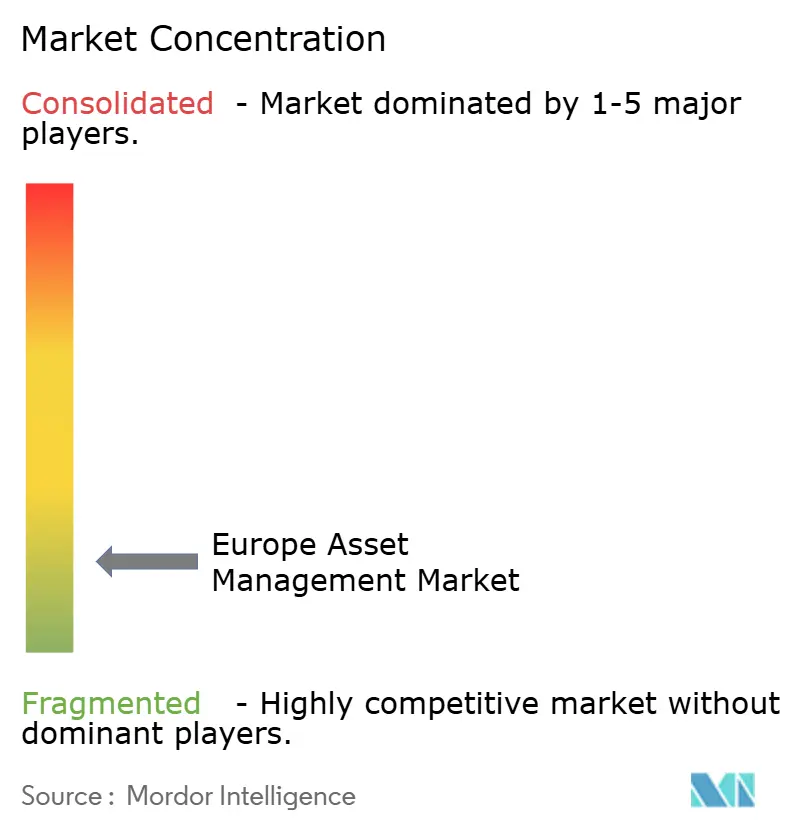
| Market Concentration | Low |
Major Players *Disclaimer: Major Players sorted in no particular order Image © Mordor Intelligence. Reuse requires attribution under CC BY 4.0. | |
Europe Asset Management Market Analysis by Mordor Intelligence
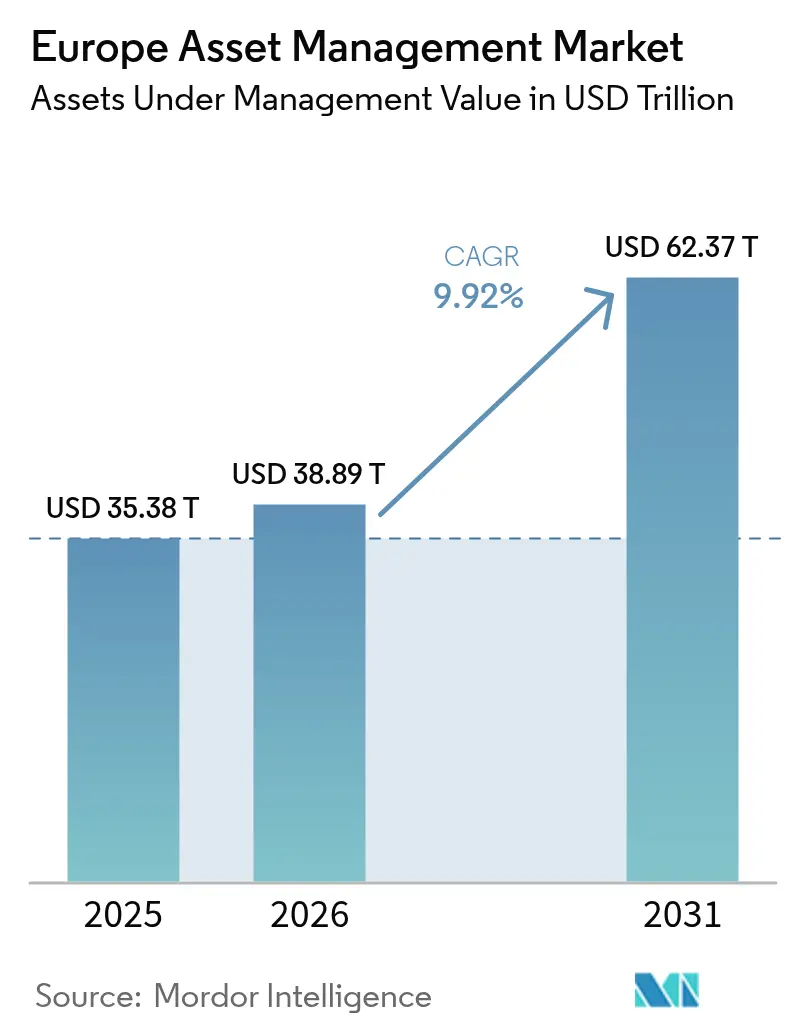
The Europe asset management market size is expected to grow from USD 35.38 trillion in 2025 to USD 38.89 trillion in 2026 and is forecast to reach USD 62.37 trillion by 2031 at 9.92% CAGR over 2026-2031. Heightened attention to sustainability, policy-driven pension reform, and fast-maturing digital-advice channels are amplifying structural inflows into the Europe asset management market. The EU Sustainable Finance Disclosure Regulation is nudging allocation from traditional active strategies toward impact-oriented Article 8 and Article 9 products, while defined-contribution pension schemes in Central and Eastern Europe expand the investible pool for long-duration capital. Post-Brexit equivalence mechanisms have preserved London’s distribution footprint yet stimulated a wave of fund re-domiciliation that benefits Dublin, Luxembourg, and other EU hubs. Fee pressure from ETFs and smart-beta strategies is forcing managers to adopt technology-enabled operating models and to diversify into private-market solutions that command higher margins. Against this backdrop, the Europe asset management market is transforming into a hybrid ecosystem where passive building blocks, alternative assets, and digital servicing co-exist to meet the return, risk, and sustainability preferences of a broadening investor base.
Key Report Takeaways
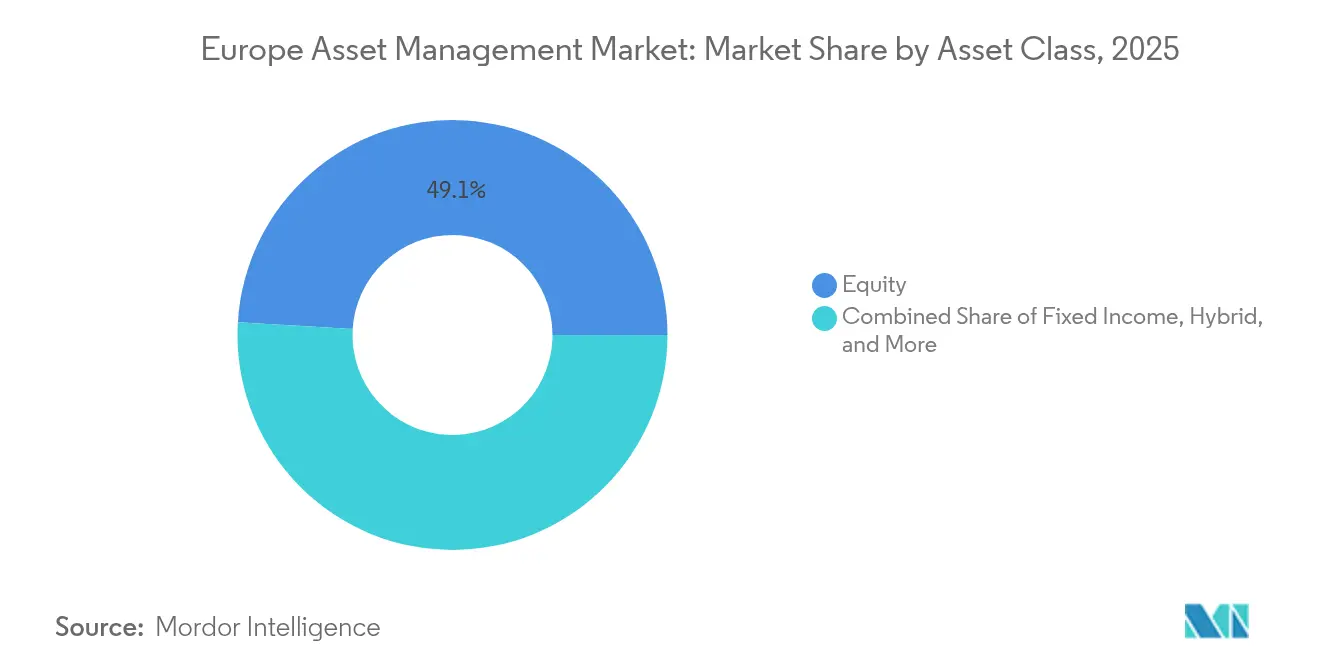
- By asset class, equity strategies captured 49.05% of the Europe asset management market share in 2025; alternative investments are projected to record the fastest 11.89% CAGR through 2031.
- By source of funds, pension funds and insurance companies accounted for 44.22% of the Europe asset management market size in 2025, whereas individual investors exhibit the highest 8.93% CAGR outlook to 2031.
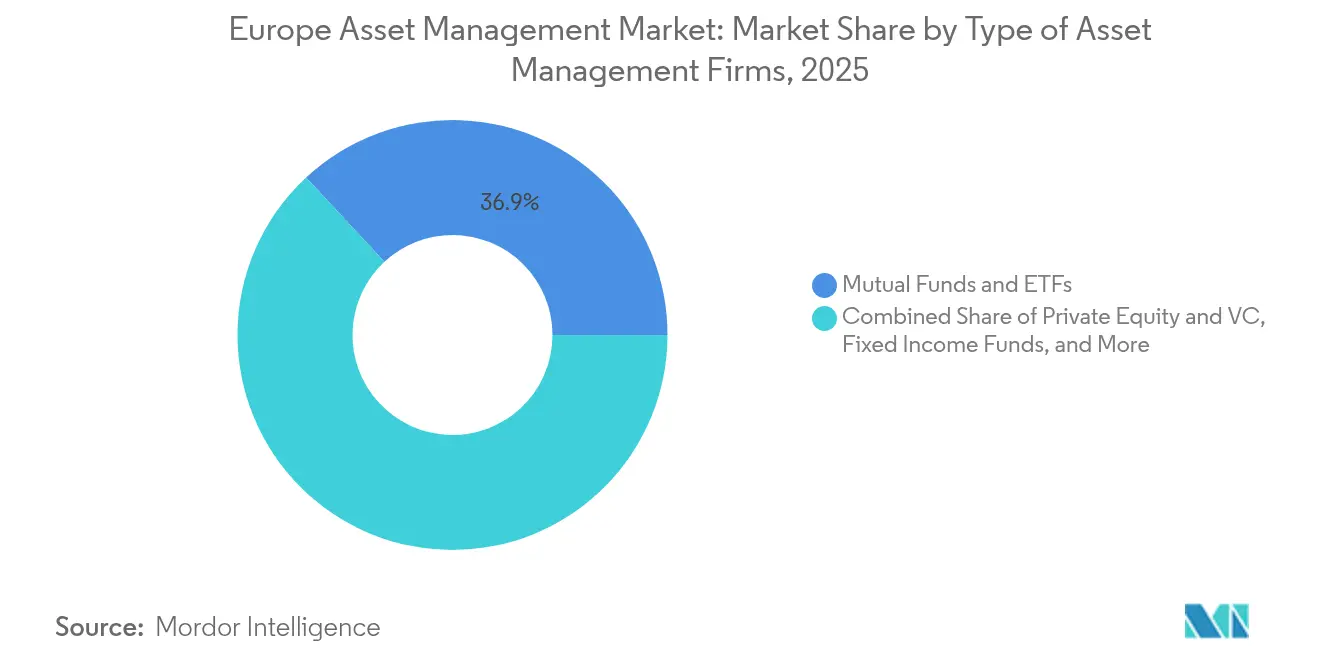
- By firm type, mutual funds and ETFs held 36.92% revenue share of the Europe asset management market in 2025, while private equity and venture-capital firms are poised to expand at 10.98% CAGR through 2031.
- By geography, the United Kingdom maintained 24.55% share of the Europe asset management market size in 2025; Spain is forecast to grow at 8.31% CAGR to 2031.
Note: Market size and forecast figures in this report are generated using Mordor Intelligence’s proprietary estimation framework, updated with the latest available data and insights as of 2026.
Europe Asset Management Market Trends and Insights
Drivers Impact Analysis*
| Driver | (~) % Impact on CAGR Forecast | Geographic Relevance | Impact Timeline |
|---|---|---|---|
| EU Sustainable Finance Disclosure Regulation (SFDR) | +2.1% | EU-wide, strongest in Germany, France, Netherlands | Medium term (2-4 years) |
| Growth of defined-contribution pensions in CEE | +1.8% | Central & Eastern Europe, spillover to Western Europe | Long term (≥ 4 years) |
| Rapid retail adoption of low-cost robo-platforms | +1.4% | UK, Germany, Netherlands | Short term (≤ 2 years) |
| Tokenisation pilots for UCITS funds | +0.9% | Luxembourg, Ireland, expanding to major EU markets | Medium term (2-4 years) |
| Cross-border passporting expansion post-Brexit | +0.7% | UK-EU corridor, secondary impact on Switzerland | Short term (≤ 2 years) |
| Institutional demand for Article 8/9 impact products | +1.6% | EU-wide, concentrated in Nordic countries and Germany | Medium term (2-4 years) |
| Source: Mordor Intelligence | |||
EU Sustainable Finance Disclosure Regulation (SFDR) Enforcement
SFDR implementation has proven transformative for the Europe asset management market. By mid-2025, Article 8 and Article 9 vehicles amassed USD 6.67 trillion (EUR 6.4 trillion) in AUM, equating to 59% of total EU fund assets. Sustainable-label funds amassed USD 80.2 billion (EUR 77 billion) net inflows in 2024, while conventional products saw USD 14.58 billion (EUR 14 billion) of net outflows[1]. The regulation’s Principal Adverse Impact disclosures add compliance overheads, but firms able to integrate reliable ESG data gain competitive moats. ESMA's review highlights that Article 9 funds define their impact objectives; however, they fail to provide adequate verifiable impact metrics. This deficiency has resulted in a notable increase in re-classifications and stricter due diligence requirements from investors. Banks and insurers increasingly tie lending or underwriting decisions to fund-level SFDR classifications, further embedding sustainability labels into capital-allocation decisions across the Europe asset management market.
Growth of Defined-Contribution Pensions in CEE
Demographic strain on pay-as-you-go systems has driven CEE governments to embrace funded pillars, a trend that is enlarging the Europe asset management market share. EU pension expenditure reached USD 2,070 billion (EUR 1,882 billion) in 2023; CEE nations sit far below Western ratios, leaving a wide gap as mandatory savings ramp up[2]. IORP II alignment enhances cross-border portability, and Western managers equipped with multi-asset capabilities are winning mandates in alternatives, multi-factor equities, and target-date solutions. Scale limitations among local firms create acquisition targets, allowing pan-European groups to broaden their footprint and data capabilities within the Europe aasset management industry.
Rapid Retail Adoption of Low-Cost Robo-Platforms
Millennial and Gen-Z investors, raised on seamless e-commerce, demand similar convenience in financial services. Robo-advisory platforms achieve lower cost structures compared to traditional channels by leveraging automated algorithms for portfolio construction and rebalancing. ESMA suitability rules oblige firms to conduct rigorous risk profiling, a task that API-driven data intake accelerates, making robo models compliant at scale. Academic studies from European central-bank researchers link robo uptake to higher digital-banking engagement and rising financial literacy, suggesting demographic tailwinds that support the Europe asset management market through at least 2030. Traditional advisers respond with hybrid models—algorithmic asset allocation plus human coaching—that preserve fee revenue while offering digital convenience.
Tokenisation Pilots for UCITS Funds
Luxembourg and Ireland enacted sandbox regimes that permit blockchain-based share classes for UCITS. ELTIF 2.0 further catalyzed adoption; AUM in long-term investment funds rose 38% in 2024 on 55 new launches[3]. Tokenised units allow instant trade-date settlement, automated compliance hooks, and fractional ownership of illiquid assets, attributes that lower minimums for smaller savers. Custody, consensus on valuation, and cross-jurisdiction legal recognition remain friction points, yet regulators laud the technology’s alignment with Capital Markets Union objectives. As data models standardize, tokenization can compress back-office costs, supporting margin resilience in the Europe asset management market.
Restraints Impact Analysis*
| Restraint | (~) % Impact on CAGR Forecast | Geographic Relevance | Impact Timeline |
|---|---|---|---|
| Fee compression from passive ETFs | -1.9% | Germany, UK, Netherlands | Short term (≤ 2 years) |
| Rising capital requirements under AIFMD II | -1.3% | EU-wide, the highest impact on smaller alternative managers | Medium term (2-4 years) |
| Ageing adviser network limiting retail reach | -0.8% | Germany, Italy, France | Long term (≥ 4 years) |
| Geopolitical energy risk dampening risk appetite | -1.1% | EU-wide, energy-intensive economies | Short term (≤ 2 years) |
| Source: Mordor Intelligence | |||
Fee Compression from Passive ETFs
The European ETF market has witnessed intensified competition as UBS introduced zero-cost select core equity funds, prompting competitors to reduce their expense ratios to remain competitive. Simultaneously, the expansion of factor and thematic ETFs has led to the commoditization of exposures that were previously exclusive to actively managed vehicles. Asset managers who rely on stock-picking fees are under increasing pressure to either consistently generate differentiated alpha or transition toward more specialized offerings. These offerings include customized ESG mandates, income-focused investment alternatives, or overlay risk management solutions. Additionally, the growing emphasis on cost efficiency is driving advancements in digitization and fostering shared-services partnerships. These developments are enhancing operational leverage and streamlining processes across the Europe asset management market, enabling firms to adapt to the evolving competitive landscape.
Ageing Adviser Network Limiting Retail Reach
Forty-plus percent of European advisers approach retirement age, especially in Germany and Italy, just as product complexity rises. Regulatory exam loads and preference for fintech careers dissuade younger entrants. Asset managers dependent on commission-based intermediaries confront distribution bottlenecks, particularly for structured ESG or alternative solutions requiring in-depth explanations. Hybrid digital-human advice can mitigate but not fully replace trusted human counsel for affluent, aging clientele, creating a medium-term brake on retail AUM growth within the Europe asset management market.
*Our forecasts treat driver/restraint impacts as directional, not additive. The impact forecasts reflect baseline growth, mix effects, and variable interactions.
Segment Analysis
By Asset Class: Alternatives Drive Innovation
Alternative assets hold 11.89% CAGR expectations, outpacing all other classes, while equity strategies capture the largest 49.05% share of the European asset management market. Low sovereign yields and rising inflation expectations fuel appetite for private equity, real assets, and infrastructure. ELTIF 2.0 lowered minimum tickets, enabling mass-affluent investors to allocate to evergreen private-market vehicles. Hybrid funds—mixing passive beta with active tilts, gain traction among institutional allocators, balancing cost control with tactical flexibility.
Alternatives’ ascendancy rests on performance: European private equity produced 1.2× public-market equivalents over a 20-year span. Infrastructure enjoys long-dated, often inflation-indexed cash flows matching pension liabilities, while private credit exploits bank deleveraging to generate double-digit yields. Cash-management solutions remain indispensable for corporates, yet compressed spreads constrain profitability. Fixed-income managers pivot toward unconstrained mandates and securitized-credit sleeves to justify fees. Combined, these dynamics keep alternatives at the vanguard of innovation within the European asset management market.

By Source of Funds: Individual Investor Momentum
Pension funds and insurers anchored 44.22% of assets in 2025, but individual investors’ 8.93% CAGR signals redistributive momentum within the European asset management market. Wealth transfer from baby boomers to digital-native heirs, open-banking APIs, and zero-commission brokerage models democratize market entry. ETFs and model portfolios dominate retail flows, yet interest in sustainable-label funds and fractional private-market exposure is rising via robo wrappers and ELTIF side-pockets. Corporate treasuries, seeking yield pick-up, remain cautiously invested in ultra-short duration vehicles amid elevated rate volatility.
Regulatory authorities are implementing stringent product disclosure requirements to ensure households have a clear understanding of cost structures, associated risks, and the broader impact of financial products. Data from EFAMA indicates that the retail segment's share of European Assets under Management (AuM) experienced significant growth in 2023, increasing by nearly five percentage points compared to 2019. Although retail investment flows are often influenced by market sentiment, the adoption of digital engagement tools, gamified educational resources, and integrated ESG scoring mechanisms within applications is fostering stronger investor relationships. These advancements are expected to support the sustained growth and long-term development of the European asset management market.
By Type of Asset Management Firms: Private Markets Ascendant
Mutual-fund and ETF complexes held 36.92% of assets in 2025, yet private-equity and venture-capital houses target 10.98% CAGR through 2031 in the Europe asset management market. Scale players like Amundi vault cross-border walls by leveraging turnkey platforms across indexing, factor investing, and private-markets co-investments. Specialist boutiques cultivate sector depth, offering, for instance, life-science venture or decarbonization infrastructure funds that fetch performance-linked fees.
Regulatory architecture aids momentum: AIFMD II sets a professional-investor framework clarifying risk disclosures and governance expectations, while ELTIF 2.0 opens retail funnels. Still, private-market operating models require intensive deal-sourcing networks, value-creation advisory, and institutional-grade risk analytics. This raises barriers, driving capital concentration toward well-capitalized franchises and accelerating consolidation waves inside the European asset management industry.
Geography Analysis
The United Kingdom commanded 24.55% of the Europe asset management market size in 2025, leveraging custody, legal, and talent ecosystems forged over decades. Passporting-lighter models post-Brexit enticed firms to operationalize parallel EU hubs, yet London remains the central brain-trust for portfolio management and global distribution. Spain, on an 8.31% CAGR trajectory, illustrates the potency of systemic pension reform. Auto-enrollment, tax-deferred savings incentives, and retail fund supermarkets have expanded domestic AuM while drawing global players to Madrid and Barcelona. Germany and France maintain substantial institutional pools but grow more modestly; both markets focus on ESG refinement and the digitization of employer-sponsored pension schemes.
BENELUX jurisdictions flourish as fund-administration nerve canters benefiting from tax treaties and multi-lingual workforces, whereas Nordic markets optimize sophisticated liability-driven investment approaches and ESG leadership to attract cross-border mandates. Central and Eastern Europe comprise the Rest-of-Europe cluster and harbour long-run upside as funded schemes scale. Expansion here requires patience, local regulatory fluency, and adaptable product architectures, conditions most readily met by diversified groups inside the Europe asset management market.
Regulatory Landscape
The European asset management market operates under EU-wide frameworks including UCITS and AIFMD, supervised by national competent authorities and coordinated by ESMA. A key recent anchor is Directive (EU) 2024/927 (AIFMD II and the UCITS review), which became applicable on 16 April 2026 and strengthened requirements around liquidity management tools, delegation oversight, and fund governance. ESMA also signaled in its 2026 agenda and public remarks by Chair Verena Ross (June 2026) that supervisory priorities include simplification through more integrated reporting, greater resilience, and support for digital innovation such as fund tokenization.
Sustainability regulation continues to shape product design and disclosures. SFDR remains central to fund classification and distribution, and the European Commission proposed a revision to SFDR in November 2025, reframing disclosure and product categorization discussions ahead of further legislative work. National transposition activity shows the implementation burden, for example Ireland signed S.I. No. 181/2026 on 1 May 2026 to transpose Directive (EU) 2024/927 into domestic law. ESMA has also mapped out follow-on technical standards work for fund reporting, with consultation targeted by end-2026 and final proposals in the first half of 2027.
Value Chain Analysis
The value chain in Europe asset management begins with product structuring (UCITS and AIF vehicles) and portfolio management, then moves through risk, compliance, and data, including ESG data lineage for SFDR, before reaching trading, custody/depositary, fund administration, and investor servicing. Distribution is a defining link across the region, with bank and insurer networks still important in many countries alongside platforms, model-portfolio providers, and digital channels such as robo and hybrid advice. Fund domiciles such as Luxembourg and Ireland concentrate manufacturing and administration, while post-Brexit operating models reinforce parallel EU hubs to support cross-border distribution and servicing.
Operational infrastructure providers, including custodians, depositories, administrators, index and data vendors, and technology platforms, increasingly influence cost and speed to market as fee pressure from ETFs pushes managers toward shared services and automation. The chain is also being re-wired by regulatory change and market plumbing upgrades: AIFMD II applicability from 16 April 2026 increases reporting and liquidity-management demands for alternative managers, and preparation for a European move to a T+1 settlement cycle by 11 October 2027 puts front-to-back process upgrades (trade capture, matching, collateral, and client reporting) on the near-term transformation agenda. On the demand side, flows are concentrating into scalable wrappers, with EFAMA reporting long-term fund net inflows of EUR 217 billion in Q1 2026 and UCITS ETF net sales of EUR 113 billion in Q1 2026, reinforcing the need for efficient manufacturing, distribution, and servicing at scale.
Competitive Landscape
The Europe asset management market remains fragmented: the top five managers capture a small share of assets, producing abundant scope for both consolidation and specialist-led differentiation. Scale houses, Amundi, BlackRock, Legal & General Investment Management, UBS Asset Management, BNP Paribas, capitalize on the breadth of product, regulatory capital, and cross-border sales machinery. They replicate passive capabilities at razor-thin fees, bundle model portfolios, and, increasingly, provide private-market access via feeder funds and evergreen strategies.
Boutique specialists coexist by exploiting inefficiencies in thematic equities, frontier-market debt, or sector-targeted private equity (for example, life sciences or digital infrastructure). Personalized client servicing and nimble decision cycles allow such firms to deliver differentiated alpha, albeit at a smaller capacity. M&A activity has accelerated: BNP Paribas’s pending EUR 5.1 billion (USD 5.61 billion) acquisition of AXA IM and the Allianz-BlackRock-T&D consortium’s EUR 3.5 billion (USD 3.85 billion) purchase of Viridium illustrate the pursuit of scale economies in technology, distribution, and regulatory compliance.
Technology has emerged as a critical area of focus for businesses. Research conducted by Strategy& highlights that the implementation of generative AI across various applications, such as customized investor reporting, detection of anomalies in trading activities, and automation of compliance-related disclosures, has the potential to drive substantial reductions in operational costs. These advancements underscore the growing importance of leveraging AI-driven solutions to enhance efficiency and streamline processes within organizations. European players must weigh build-versus-partner decisions amid global talent shortages. Fail-fast cultural shifts, agile governance, and cloud-native infrastructure distinguish leaders from laggards. At the same time, regulation remains stringent; SFDR data-lineage requirements and AIFMD II liquidity stress-tests favor firms with deep pockets and enterprise-grade risk systems. The competitive field thus rewards both giants able to exploit operating leverage and nimble boutiques that carve defensible high-margin niches within the Europe asset management market.
Europe Asset Management Industry Leaders
-
UBS Asset Management
-
Amundi Asset Management
-
Legal & General Investment Management (LGIM)
-
DWS Group
-
Allianz Global Investors & PIMCO (Europe)
- *Disclaimer: Major Players sorted in no particular order
Market Opportunities and Future Outlook
Opportunities are emerging where regulation and infrastructure changes create new distribution and product-design headroom. The EU Retail Investment Strategy (RIS) compromise advanced in June 2026, tightening Value for Money and disclosure expectations across fund regimes, which creates space for managers that can industrialize peer-group cost and performance benchmarking, simplify share-class and fee architecture, and strengthen direct-to-consumer or platform-first distribution while staying within suitability and disclosure constraints. In parallel, SFDR revision work that began with the European Commission proposal in November 2025 is driving renewed product taxonomy and labeling discussions, pushing for clearer sustainable product ranges and more robust data and reporting controls for Article 8/9 strategies.
Tokenization and digital-market infrastructure are becoming more investable themes for fund manufacturers and service providers, supported by central-bank and market-infrastructure initiatives. In May 2026, the ECB announced a two-track Eurosystem work programme for a tokenized financial system (Pontes and Appia), with Pontes entering a pilot phase in Q3 2026. In June 2026, the European Investment Bank issued a DLT-native commercial paper on Clearstream D7. Together, these developments move tokenized issuance and settlement from concept toward repeatable workflows. This creates opportunities for UCITS and alternative managers operating in hubs such as Luxembourg and Ireland to develop tokenized share classes, fractionalized access to private-market sleeves including via ELTIF 2.0 structures, and digitally native servicing models that lower minimums and improve operational efficiency, while aligning governance, custody, and valuation practices with regulator scrutiny.
Recent Industry Developments
- July 2026: UBS announced a strategic partnership with MSCI to integrate MSCI data, analytics, and models with UBS alternatives expertise to develop an AI-powered private markets data platform. The move targets better data standardization and transparency in private assets, strengthening product design, risk management, and client reporting capabilities as private markets expand within multi-asset portfolios.
- April 2026: Amundi and ICG announced a long-term strategic and equity partnership to broaden access to private markets, including Amundi taking a 9.9% economic stake and establishing a 10-year exclusive distribution arrangement. The structure combines product manufacturing and distribution scale with private-markets origination capabilities, supporting higher-margin offerings amid fee compression in public markets.
- November 2024: Amundi agreed to acquire the German wealthtech aixigo for EUR 149 million (USD 163.9 million) to strengthen API-based digital tools for financial advisers. The acquisition reinforces adviser workflow integration and hybrid distribution models, which are critical as traditional intermediary networks age and client servicing shifts toward digital-first journeys.
Research Methodology Framework and Report Scope
Market Definition and Coverage
For this report, the Europe asset management market is sized as total assets under management (AUM) handled by professional asset managers across Europe, covering both fund-based products and discretionary mandates, and measured as end-period AUM value in USD.
Scope exclusions: We exclude insurance balance-sheet assets managed in-house, corporate treasury self-management, and assets that are only advised on without an ongoing management mandate.
Segmentation Overview
- By Asset Class
- Equity
- Fixed Income
- Alternative Investment
- Hybrid
- Cash Management
- By Source of Funds
- Pension Funds and Insurance Companies
- Individual Investors (Retail + HNW)
- Corporate Investors
- Other Sources (Government, Trusts etc.)
- By Type of Asset Management Firms
- Large Financial Institutions / Bulge-Bracket Banks
- Mutual Funds and ETFs
- Private Equity and Venture Capital
- Fixed Income Funds
- Hedge Funds
- Other Types of Asset Management Firms
- By Geography
- United Kingdom
- Germany
- France
- Spain
- Italy
- BENELUX (Belgium, Netherlands, Luxembourg)
- NORDICS (Denmark, Finland, Iceland, Norway, Sweden)
- Rest of Europe
Data Sources, Market Sizing, and Validation
Desk Research
Desk work started with pinning down the AUM definition and the Europe coverage so the same boundaries are applied year to year. We referenced public, non-paywalled sources such as European Central Bank statistical releases, Eurostat macro series, ESMA publications on fund markets, and trade bodies such as EFAMA for AUM splits and country-level signals. To anchor market behavior, we also used annual reports, regulatory filings, investor presentations, and reputable financial press for flow drivers, fee direction, and product launches.
After the definition and core series were mapped, we used subscription databases for company financials and news context, plus a patent database to track longer-run shifts such as digital advice and fund automation, which can affect distribution and AUM growth patterns. The desk inputs mainly helped set guardrails for country splits, currency conversion choices, and trend direction before speaking with market participants. The sources listed here are illustrative, and many other public references were also checked during data collection and clarification.
Primary Interviews and Surveys
Primary discussions were carried out with asset managers, distributors, and service providers that sit close to fund flows and mandate wins, and then with industry specialists who track regulation and cross-border distribution. These conversations were used to confirm what is counted as managed assets, validate country mix and product mix, and pressure-test assumptions on net flows, market performance effects, and the pace of fee compression across Europe.
Distribution of primary research fieldwork respondents
| Company type | Respondent position |
|---|---|
| Top tier: 38% | CXOs: 15% |
| Mid tier: 44% | Functional/Unit leaders: 29% |
| Smaller Players: 18% | Managers: 56% |
Market-Sizing & Forecasting
Sizing starts from a top-down reconstruction that links Europe investable asset pools to managed-penetration assumptions, which are then adjusted using public AUM splits between investment funds and discretionary mandates. Key inputs used in the model include equity and bond market performance indicators, net subscription and redemption flow direction, household savings and pension contribution trends, product mix shifts (passive versus active), and fee-rate pressure that can change reporting behavior across channels. Where country coverage differs across public series, we used consistent inclusion rules and then normalized the totals so the region adds up cleanly.
To keep totals realistic, we corroborated the outcome with selective bottom-up approximations using sampled manager AUM disclosures, country-level rollups from public filings, and channel checks on where AUM is being booked. If a smaller country or sub-segment lacked disclosure, we filled gaps using proxy relationships such as investable assets and fund domiciliation intensity, and then rechecked the implied shares with interview feedback.
Forecasts were built using scenario analysis supported by trend indicators and expert views on rate cycles, risk appetite, and regulatory changes that affect distribution. The scenarios were translated into AUM paths by combining expected market return ranges with net flow expectations, and then reviewed so the final numbers match plausible country and asset-class patterns.
Data Validation & Update Cycle
Outputs are validated through multiple passes, starting with mechanical checks that confirm the country totals reconcile to Europe and that year-to-year moves align with known market signals. We also run variance checks against independent indicators such as fund-flow direction, major market drawdowns, and the timing of regulatory events that can shift reporting or product labeling.
Before sign-off, assumptions and formulas are reviewed by another analyst, and outliers trigger follow-up calls to recheck definitions or currency choices. The report is refreshed annually, and interim adjustments are made when there are material events such as sharp market moves or major rule changes. Right before delivery, a final review pass is completed so clients receive the most current view available.
Mordor Intelligence's Europe Asset Management Market Size Versus Other Published Estimates
Published market sizes for Europe asset management can look far apart because not everyone measures the same thing, and the timing choices can shift totals by trillions. Differences usually come from what is treated as managed AUM versus advised assets, how discretionary mandates are handled, and whether figures reflect end-year levels or an average across the year.
In practice, the refresh cadence and currency timing matter in this market because EUR and GBP moves can change USD-reported AUM even when local-currency assets are steady. Some estimates also apply broad growth rates without checking whether net flows and market performance can jointly explain the implied jump. For that reason, our update cycle and cross-checks are set up to surface these gaps before publication.
Benchmark comparison
| Source | Market Size | Gaps in Research Methodology |
|---|---|---|
| Mordor Intelligence | USD 35.38 T (2025) | |
| Industry Association A | USD 35.64 T (2024) | Uses an AUM figure reported in EUR and tied to a year-end snapshot, so the USD level depends heavily on the EUR to USD rate chosen and may include association-based country estimates that do not match the report country list. |
| Global Consultancy B | USD 25.99 T (2023) | Appears to apply a broader, multi-asset definition with a different base year and unclear treatment of mandates versus fund vehicles, which can compress the starting value when coverage is narrower or when only selected manager categories are counted. |
The spread mainly comes from timing and scope, not from a single math error. By locking the AUM definition to funds plus discretionary mandates, applying consistent USD conversion timing, and rechecking the implied growth versus flows and market moves, Mordor Intelligence keeps the estimate aligned to a repeatable set of drivers that users can follow and stress-test.
Key Questions Answered in the Report
How large will the European asset management market be by 2031?
It is projected to reach USD 62.37 trillion, expanding at a 9.92% CAGR.
Which investor segment is growing fastest across Europe?
Individual investors, empowered by digital advice and pension reform, are forecast to grow assets at 8.93% CAGR through 2031.
What role does SFDR play in European fund flows?
In 2024, SFDR labels directed investment flows toward Article 8 and Article 9 strategies, which accounted for a substantial portion of EU fund assets and recorded significant net inflows.
Why are alternative investments gaining share in Europe?
Private equity, infrastructure, and private credit offer inflation-hedged, uncorrelated returns and benefit from policy support such as ELTIF 2.0.
How is technology reshaping competition among European asset managers?
Generative-AI tools, robo-advice platforms, and tokenized fund structures reduce costs, enhance personalization, and differentiate service quality.
What is the impact of AIFMD II on smaller alternative managers?
Increased capital and reporting requirements are driving up compliance costs, prompting a shift toward larger platforms that can leverage scale efficiencies.