
Market Overview
| Study Period | 2021 - 2031 |
|---|---|
| Forecast Data Period | 2026 - 2031 |
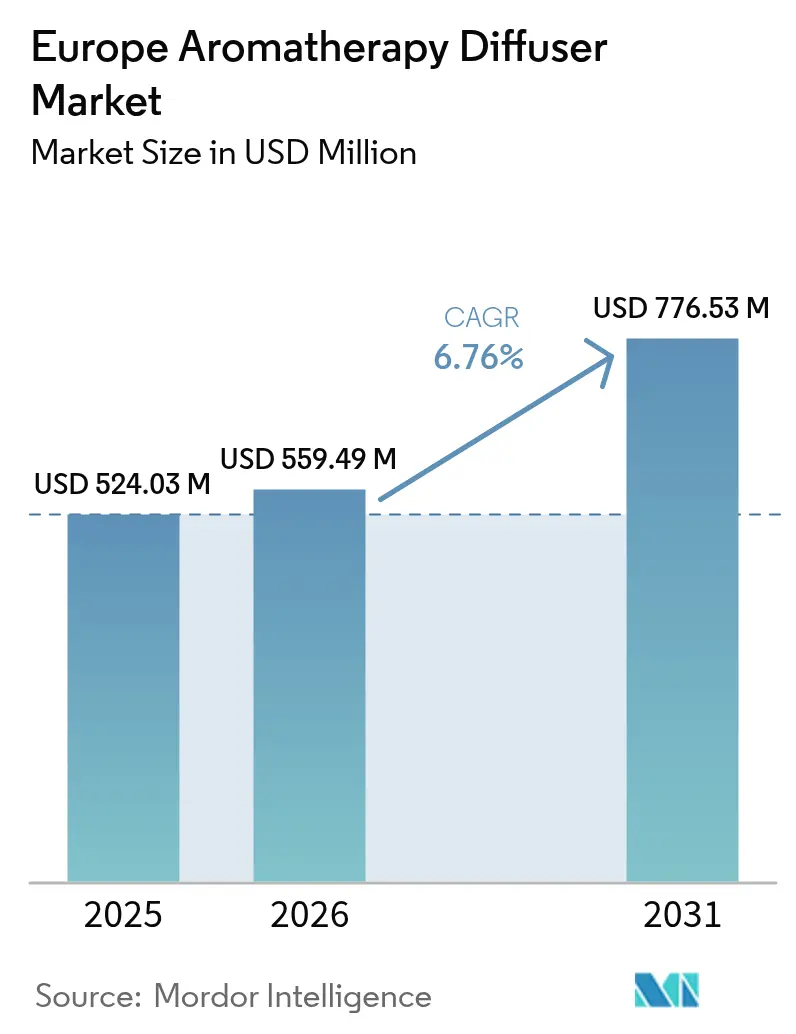
| Base Year Market Size (2025) | USD 524.03 Million |
| Market Size (2026) | USD 559.49 Million |
| Market Size (2031) | USD 776.53 Million |
| Growth Rate (2026 - 2031) | 6.76 % |
| Market Concentration | Medium |
Major Players
*Disclaimer: Major Players sorted in no particular order Image © Mordor Intelligence. Reuse requires attribution under CC BY 4.0. |
|
Europe Aromatherapy Diffuser Market Analysis by Mordor Intelligence
The European aromatherapy diffuser market size was valued at USD 524.03 million in 2025 and estimated to grow from USD 559.49 million in 2026 to reach USD 776.53 million by 2031, at a CAGR of 6.76% during the forecast period (2026-2031). As consumers increasingly prioritize air quality and regulations on indoor environments tighten, the demand for diffusers is surging in both residential and light-commercial spaces. This momentum is further fueled by device manufacturers integrating humidity and volatile organic compound sensors with building management systems. Such advancements empower homeowners and facility managers to not only meet EN 16798 benchmarks but also enhance occupant comfort. The European aromatherapy diffuser market is also reaping rewards from rising disposable incomes, a trend towards premium wellness gifts, and a growing acceptance of subscription oil bundles, which facilitate repeat purchases. While challenges like counterfeiting, fluctuations in raw material costs, and compliance with electronic waste regulations persist, they predominantly impact low-margin players. This dynamic offers better-capitalized brands an opportunity to expand their market share through a focus on product quality, traceable sourcing, and initiatives centered around circular design.
Key Report Takeaways
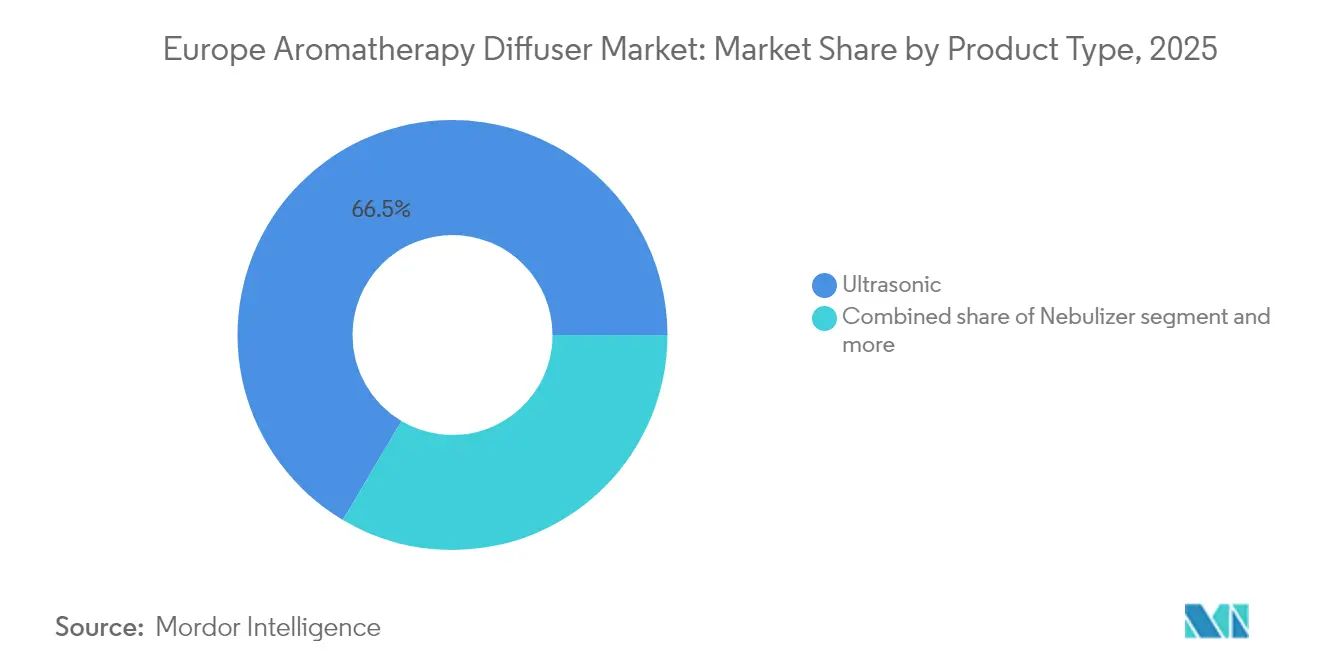
- By type, ultrasonic diffusers led with 66.48% of the Europe aromatherapy diffuser market share in 2025, while nebuliser units are forecast to grow at a 7.13% CAGR between 2026 and 2031.
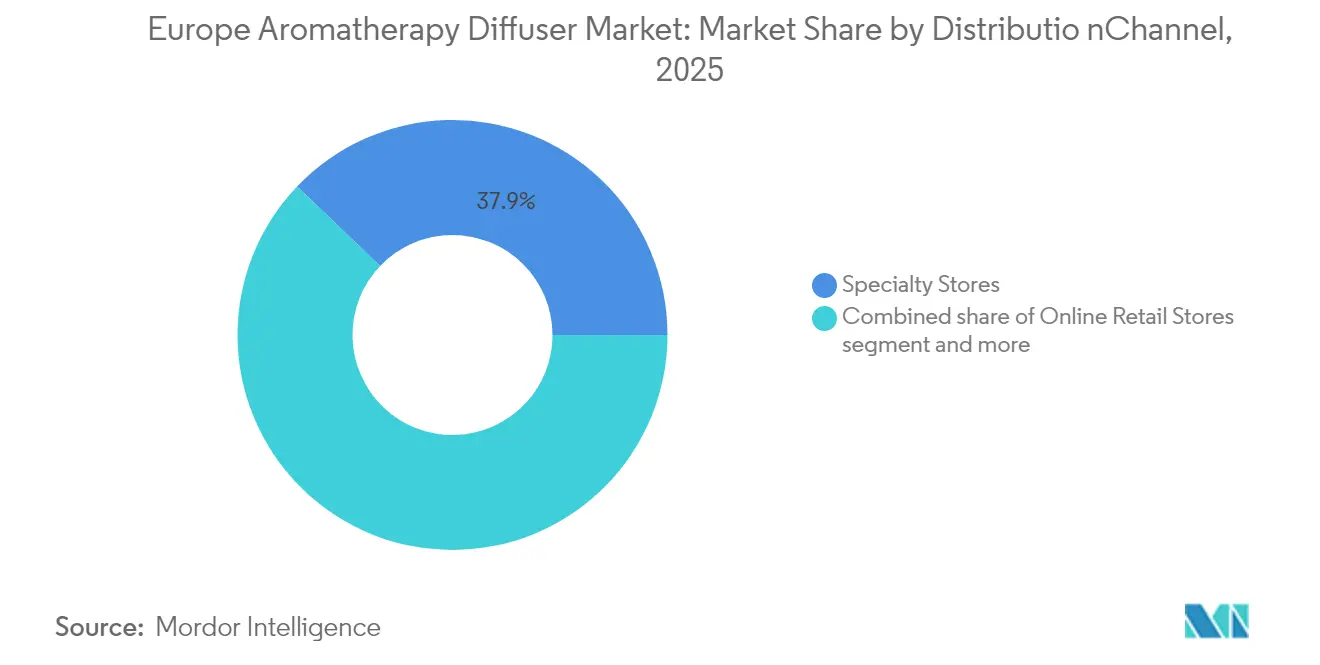
- By distribution channel, specialty retail held 37.86% of 2025 revenue; online platforms are projected to expand at an 8.52% CAGR through 2031.
- By geography, France accounted for 21.54% of regional revenue in 2025, whereas Italy is set to advance at a 7.25% CAGR from 2026 to 2031.
Note: Market size and forecast figures in this report are generated using Mordor Intelligence’s proprietary estimation framework, updated with the latest available data and insights as of 2026.
Market Trends and Insights
Drivers Impact Analysis of Europe Aromatherapy Diffuser Market*
| Driver | (~) % Impact on CAGR Forecast | Geographic Relevance | Impact Timeline |
|---|---|---|---|
| Rising popularity of home-wellness rituals | +1.2% | Germany, France, UK, Netherlands, Nordics | Medium term (2-4 years) |
| Growing penetration of smart/IoT-enabled diffusers | +1.4% | Urban hubs in Germany, UK, France, Netherlands, Sweden | Short term (≤ 2 years) |
| Premiumisation and gifting trends in Europe | +0.9% | France, Germany, UK, Italy | Medium term (2-4 years) |
| Mandatory indoor-air-quality directives (EN 16798) | +0.8% | EU-wide, led by Germany, Netherlands, Belgium | Long term (≥ 4 years) |
| Retailer private-label expansion | +0.7% | Germany, Netherlands, Poland | Short term (≤ 2 years) |
| Subscription-based essential-oil bundles | +0.6% | UK, France, Germany, Netherlands | Medium term (2-4 years) |
| Source: Mordor Intelligence | |||
Rising popularity of home-wellness rituals
In Western Europe, consumers are now integrating in-home recovery, productivity, and relaxation into their daily routines. Diffusers have emerged as essential devices, joining the ranks of yoga mats and sound machines. This transition from mere decorative items to essential wellness tools has led to increased repeat purchases of oils. As a result, brands that curate blends targeting sleep, focus, and stress relief are witnessing a boost in their lifetime value. Users in the Nordics, facing prolonged winters, exhibit heightened engagement with these products. Meanwhile, urban residents are opting for compact ultrasonic units, which produce a silent mist, perfectly suited for their smaller apartments. Brands emphasizing scientifically-backed mood enhancements and promoting low-maintenance operations are resonating more with first-time buyers. Specialty retailers are capitalizing on this trend, offering in-store trials and bundled starter kits to alleviate any purchase hesitations.
Growing penetration of smart/iot-enabled diffusers
Tech-savvy households are increasingly turning to voice-controlled diffusers that seamlessly integrate with platforms like Alexa, Google Home, and Apple HomeKit. These diffusers come equipped with app dashboards, allowing users to adjust mist intensity, set schedules, and receive low-oil alerts. Moreover, they can integrate sensor data into broader home-automation routines. A 2024 peer-reviewed study highlighted the efficacy of these smart diffusers, noting an 18% reduction in indoor particulate matter when activated during peak traffic hours. Manufacturers are capitalizing on anonymized usage metrics, using them to refine designs and enhance predictive maintenance features. Adoption is strongest in Germany and the Netherlands, driven by robust broadband infrastructure and enticing smart-device subsidies from energy utilities. This shift, merging air-quality monitoring with aromatherapy, positions diffusers as essential health-tech appliances rather than mere lifestyle luxuries.
Premiumization and gifting trends in Europe
Consumers are increasingly gravitating towards diffusers priced above EUR 100 (USD 110), drawn by artisanal glass, ceramic finishes, and low-EMF certifications, which align with the growing demand for premium and health-conscious products. Brands are enticed to introduce holiday lines and limited collaborations, as seasonal gift packs pairing designer hardware with themed oil assortments boast margins 40-50% higher than standalone units, making them a lucrative segment. French and Italian shoppers, with their cultural appreciation for craftsmanship and fragrance heritage, exhibit the highest willingness to pay, further driving premiumization in these markets. Retailers, recognizing this trend, structure displays around gift-ready packaging, streamlining purchasing decisions and curbing return rates by offering convenience and aesthetic appeal. Moreover, the predictable demand spikes from the European gifting calendar aid producers in refining their production planning and inventory turnover, ensuring a steady supply chain and optimized resource allocation.
Mandatory indoor-air-quality directives (EN 16798)
Under the revised Energy Performance of Buildings Directive, new and renovated structures are mandated to continuously monitor CO₂, humidity, and volatile organics.. The revised EPBD, effective from 2024, extends these requirements to a broader range of building types, including multi-family residential units and small commercial spaces, expanding the addressable market for IoT-enabled diffusers[1]Source: European Commission, "Energy Performance of Buildings Directive", energy.ec.europa.eu. This directive aims to improve energy efficiency and indoor air quality, aligning with broader sustainability goals across the European Union. As a result, building managers are increasingly viewing sensor-enabled diffusers not just as tools for regulatory compliance, but also as enhancements to occupant experience by ensuring healthier and more comfortable indoor environments. In Germany, the Netherlands, and Belgium, municipal codes mandate digital logbooks to track and report building performance metrics. This regulation positions compliant diffusers as a cost-effective alternative to traditional monitoring stations, reducing the need for separate, dedicated monitoring systems. Brands that provide third-party certifications and ensure seamless integration with building-management software are establishing a strong competitive edge against cheaper imports, which often lack the necessary compliance and interoperability. Looking ahead, as indoor-air regulations tighten and awareness of air quality's impact on health grows, these diffusers are set to transition from being mere accessories to essential fixtures in multifamily housing and small commercial suites, driving demand in the market.
Restraints Impact Analysis of Europe Aromatherapy Diffuser Market*
| Restraint | (~) % Impact on CAGR Forecast | Geographic Relevance | Impact Timeline |
|---|---|---|---|
| Safety concerns over synthetic fragrance oils | -0.5% | EU-wide, notably France, Germany, Netherlands | Short term (≤ 2 years) |
| Counterfeit and low-quality imports from Asia | -0.6% | Italy, Spain, Poland, Russia | Medium term (2-4 years) |
| EU eco-design and WEEE compliance costs | -0.4% | Germany, Netherlands, Sweden | Long term (≥ 4 years) |
| Volatility in essential-oil raw-material prices | -0.7% | All European markets | Short term (≤ 2 years) |
| Source: Mordor Intelligence | |||
Safety concerns over synthetic fragrance oils
Under the EU REACH framework, manufacturers are now compelled to disclose fragrance ingredients and undertake toxicity assessments. This regulatory shift aims to enhance consumer safety and environmental protection by ensuring transparency in product formulations. Following this, the French agency ANSES advised that diffuser sessions be capped at thirty minutes in well-ventilated rooms to minimize potential health risks[2]Source: National Agency for Food, Environmental and Occupational Health & Safety, "Essential oils should be used with caution", vigilanses.anses.fr. This recommendation has led retailers to increasingly seek third-party safety certificates to validate product safety and compliance. Budget brands, which often rely on less transparent blends, are grappling with heightened testing costs and diminishing shelf space, as they struggle to meet these stringent requirements. In contrast, premium brands that proudly market their 100% pure oils are reaping the benefits of consumer trust, leveraging their transparency as a competitive advantage. The issue has gained traction on social media, thanks to consumer watchdogs, who are actively raising awareness and influencing purchasing decisions. This has steered shoppers towards products that are both traceable and certified, further pressuring manufacturers to adapt. Consequently, players without in-house toxicology expertise or transparent supply chains are feeling the pinch, as the compliance demands eat into their profit margins and challenge their operational sustainability.
Volatility in essential-oil raw-material prices
In 2024, spot prices for essential oils saw significant fluctuations: neroli prices plummeted by 40%, and geraniums by 30%, while lavender and peppermint prices held steady. Subscription services, which set prices for monthly kits in advance, grapple with these price swings, often needing to renegotiate contracts, a move that risks customer loyalty. To mitigate risks, vertically integrated companies are diversifying their acreage and entering into forward contracts with growers located in North Africa and Eastern Europe. Meanwhile, some innovators are exploring biotech alternatives that can replicate terpene profiles on a larger scale. While these alternatives promise price stability, they still await regulatory approval. The ongoing price volatility is pushing companies to adopt multi-sourcing strategies. However, this approach introduces added logistical complexities, which can elevate costs, particularly for smaller brands with limited procurement capabilities.
*Our forecasts treat driver/restraint impacts as directional, not additive. The impact forecasts reflect baseline growth, mix effects, and variable interactions.
Europe Aromatherapy Diffuser Market Segment Analysis
By Type:
Ultrasonic Dominance Meets Nebuliser PremiumisationIn 2025, ultrasonic units commanded a dominant 66.48% share of the European aromatherapy diffuser market. Their appeal lies in silent operation, energy efficiency, and versatility with various oil viscosities, making them favorites in bedrooms, offices, and yoga studios. By employing a water-dilution method, these units not only extend their run times but also offer cost savings for commercial wellness spaces. A peer-reviewed trial in 2024 highlighted the efficacy of ultrasonic diffusers equipped with air-quality monitors, showcasing an 18% reduction in particulate matter during urban rush hours. This positions them as compliant tools for indoor air management, aligning with EN 16798 standards. Additionally, the integration of smart sensors has captivated tech-savvy consumers, solidifying the dominance of ultrasonics in the market.
Nebulisers, with their unique water-free and heat-free atomization of pure oils, are set to outpace the European aromatherapy diffuser market, boasting a projected CAGR of 7.13% through 2031, slightly ahead of the market's average of 6.76%. While they operate louder than their counterparts, premium spa operators are drawn to their undiluted efficacy, often justifying the higher prices with hand-blown glass and medical-grade materials. Meanwhile, emerging hybrids are making waves, blending the mist of ultrasonics with the bursts of nebulisers for an optimal balance of endurance and purity. The "others" category, encompassing evaporative and heat-plate models, is carving a niche in travel and decor, though it remains smaller in scale.


By Distribution Channel:
Specialty Retail Faces Digital DisruptionIn 2025, specialty retail claimed 37.86% of Europe's aromatherapy diffuser market revenue. This surge was fueled by tactile product discovery, guided scent matching, and bundled starter kits, all of which elevated the average basket value. In-store educators played a pivotal role, demonstrating diffuser settings and safe oil dilution ratios. Their efforts not only alleviated buyer hesitation but also curtailed return rates. Such hands-on engagement cultivated trust and loyalty, especially among wellness-centric consumers desiring tailored experiences. Specialty retailers also emphasized creating an immersive shopping environment, where customers could test products and receive personalized advice, further enhancing the overall shopping experience. Meanwhile, mass retailers, including supermarkets and drugstores, introduced private-label diffusers at prices 20-30% lower than branded counterparts, broadening access for budget-conscious shoppers and appealing to a wider demographic.
Online sales are projected to grow at a CAGR of 8.52% through 2031, outstripping the overall market. This growth is attributed to direct-to-consumer tactics, emphasizing influencer reviews, flexible payment options, and auto-replenish subscriptions. E-commerce platforms harness zero-party data on scent preferences, offering personalized recommendations that boost repeat purchases. These platforms also invest in user-friendly interfaces and targeted marketing campaigns to attract and retain customers. Supermarkets' click-and-collect programs merge digital sales with the ease of physical pickup, blurring the lines of traditional channels. Leaders in the market adopt omnichannel strategies, harmonizing inventory, loyalty, and service across various platforms, ensuring they remain at the forefront amidst rising demands for effortless returns and consistent pricing. Additionally, seamless integration of online and offline channels allows companies to cater to diverse consumer preferences, driving sustained growth in the competitive landscape.
Geography Analysis
France and Italy Aromatherapy Diffuser Market
In 2025, France capitalized on its rich aromatherapy heritage and the trust pharmacists command, accounting for 21.54% of total sales. French consumers, valuing certified organic oils, are drawn to premium diffusers. These diffusers, often crafted from artisanal glass or ceramic, find a willing audience among buyers who appreciate craftsmanship and regional sourcing, even at a higher price. Meanwhile, Italy is set to experience a 7.25% CAGR growth rate until 2031, driven by rising household incomes, deeper e-commerce penetration, and a rapidly expanding smart-home base. Italian producers of citrus and rosemary oils leverage short supply chains, ensuring freshness and weaving in stories of their unique terroir.
Broader European Markets
Germany, the UK, and Spain collectively represent a substantial portion of the market demand. In Germany, stringent regulations mandate CE markings and WEEE registration, compelling suppliers to embrace eco-design and transparent safety labeling. The UK, benefiting from established logistics, has seen a surge in subscription services that offer curated monthly oil deliveries, ensuring a steady revenue stream. In Spain, a resurgence in tourism has led to increased diffuser use in hotels and vacation rentals. This trend extends to urban residences, where renters increasingly seek wellness amenities. Secondary markets such as the Netherlands, Poland, Belgium, Sweden, and Russia are emerging as diverse opportunities. In the Netherlands, consumers are at the forefront of smart-home diffusion, seamlessly integrating diffusers into routines that control lighting and heating through unified apps. Polish retailers are revamping store layouts, emphasizing wellness sections to entice trial among aspirational shoppers. Despite currency fluctuations, affluent urbanites in Russia are drawn to premium imports. In Sweden, consumers are willing to pay a premium for products made from sustainable, recyclable materials. Meanwhile, smaller economies in Central and Eastern Europe are leaning on cross-border e-commerce. Today, they favor budget-friendly ultrasonic units, but as disposable incomes rise, there's a clear signal towards future premiumization.
Regulatory Landscape
Aromatherapy diffusers sold across the EU fall under the General Product Safety Regulation (EU) 2023/988, which became applicable on 13 December 2024. The regulation requires economic operators to demonstrate product safety, keep technical documentation and risk assessments on file, and appoint an EU-based responsible person for consumer goods placed on the market. For electrical diffusers, EU market access is also linked to CE marking under the Low Voltage Directive (2014/35/EU) and the Electromagnetic Compatibility Directive (2014/30/EU). Safety is demonstrated through relevant harmonized standards, including IEC 60335-2-101:2024 for vaporizers.
For consumables, essential oils and fragrance mixtures supplied for use in diffusers must comply with EU chemicals rules, including REACH for substance obligations and CLP for classification, labeling, and packaging. This results in a combined compliance stack, where diffuser hardware safety (electrical and electromagnetic) and oil safety (chemical hazard communication and traceability) must be managed together. The practical effect is a higher bar for documentation, supplier data quality, and in-market surveillance readiness under the EU Safety Gate framework.
Competitive Landscape
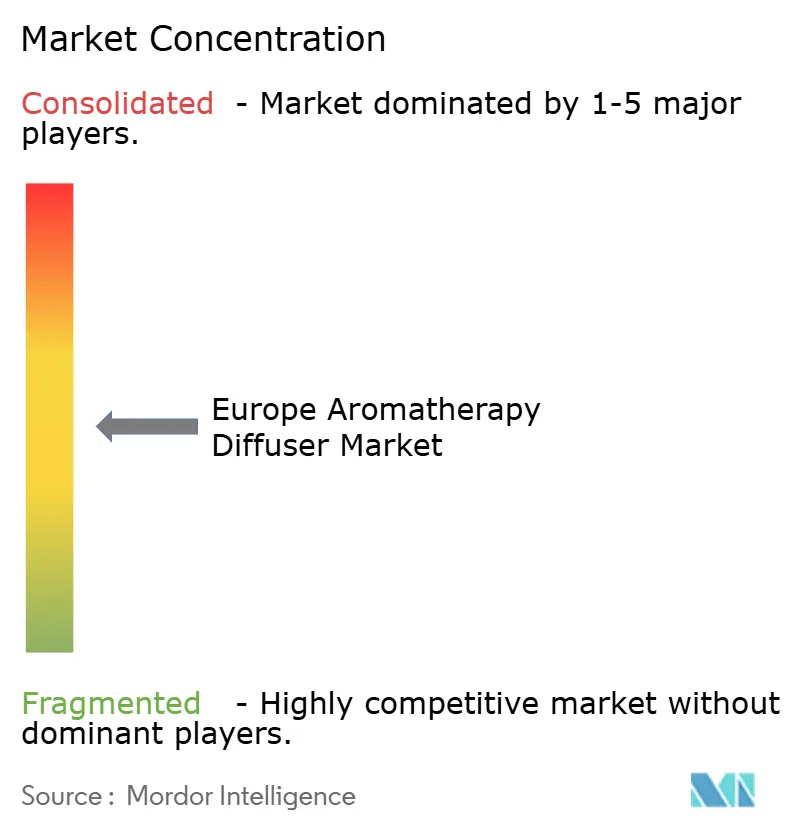
In Europe, the aromatherapy diffuser market is moderately fragmented, with no single vendor commanding a double-digit share. Leaders in multi-level marketing, doTERRA and Young Living, utilize vertically integrated farms and proprietary distillation. Their direct-selling networks bundle hardware with exclusive oils, ensuring a steady stream of consumable revenue. Electronics experts Stadler Form and HoMedics market diffusers as essential home upgrades, highlighting features like quiet fans, expansive room coverage, and app-based controls. Meanwhile, lifestyle brands Muji and AromaWorks cater to design aficionados, offering minimalist ceramics and eco-friendly packaging.
Entry-level devices from private labels like DM, Rossmann, Etos, and Hema are priced 20-30% lower than leading brands, squeezing margins for mid-market suppliers without distinct offerings. In response, innovators are introducing subscription bundles, blockchain technology for oil provenance, and extended warranties to foster repeat purchases. A 2024 European Patent filing revealed an adaptive diffuser that adjusts mist output based on biometric data from wearables, hinting at a future link with personalized health monitoring.
Today's vendor differentiation hinges on three main pillars: proven oil quality, advanced smart features, and a commitment to sustainability. Brands that offer repairable designs, trade-in initiatives, and modular parts find it easier to meet WEEE obligations and gain favor with eco-conscious retailers. On another front, legitimate players are countering counterfeit imports, which often lack CE marks, by implementing tamper-evident seals and QR-based authenticity checks, bolstering consumer trust at the point of sale. Looking ahead, collaborations between diffuser manufacturers and sectors like lighting, HVAC, and wellness apps are set to deepen, increasing switching costs and broadening potential use cases.
Europe Aromatherapy Diffuser Industry Leaders
-
Young Living Essential Oils
-
doTERRA International
-
Muji Europe Holdings
-
Puzhen Life
-
Stadler Form
- *Disclaimer: Major Players sorted in no particular order
Europe Aromatherapy Diffuser Market Companies Covered in this Report
- Puzhen Life
- doTERRA International
- Young Living Essential Oils
- Muji Europe Holdings
- Stadler Form
- Edens Garden
- OrganicAromas
- Aromis Aromatherapy
- VicTsing (VILINKS)
- nnoGear
- HoMedics (Ellia)
- ASAKUKI
- Airome (Candle Warmers Etc.)
- Scentsy
- AromaWorks London
- Pilgrim Collection
- Scentcares
- Royal Aromas
- Yankee Candle (WoodWick diffusers)
- HELL ENERGY Magyarország Kft

Market Opportunities and Future Outlook
The move toward mandatory demonstration of consumer product safety under the EU General Product Safety Regulation (EU) 2023/988 (applicable since 13 December 2024) creates clearer room for brands that can run end-to-end compliance, from CE-marked electrical hardware under LVD 2014/35/EU and EMC 2014/30/EU to REACH- and CLP-aligned fragrance and essential-oil dossiers. In-market advantage also increasingly comes from packageable documentation, clear labeling, and EU-responsible-person coverage that fit the way premium channels and cross-border e-commerce operate, especially as retailers and marketplaces screen for defensible compliance and traceable sourcing.
Opportunity is also growing around diffusers that sit closer to monitored indoor environments and connected homes. The report context points to sensor-enabled diffusers aligned with EN 16798-oriented indoor air quality practices, alongside broader building performance monitoring under the revised Energy Performance of Buildings Directive. That supports demand for devices that integrate with platforms such as Alexa, Google Home, and Apple HomeKit, including in small commercial and multifamily settings. Repeat-purchase economics can improve further when device makers and oil brands connect compliant hardware with subscription oil bundles, and newer blend-led portfolios can be extended into refill ecosystems and giftable premium sets, with Evolve Beauty's functional blend range launched in September 2025 reinforcing the direction toward benefit-positioned assortments.
Recent Industry Developments in Europe Aromatherapy Diffuser Market
- March 2026: dōTERRA held a Leadership Retreat in San Diego and communicated a forward wellness agenda, including naming Orlando, Florida as the site for its September 2026 convention. The continued cadence of large-scale field engagement supports demand planning for bundled consumables and devices across its global network, including Europe served from its Cork, Ireland operations.
- April 2025: dōTERRA expanded its global market footprint with the launch of its Kazakhstan market. While outside the EU, the move indicates continued geographic expansion by a major essential-oil player whose cross-border logistics and advocate networks can influence diffuser-and-oil bundle availability in Europe.
- December 2024: Aluxury expanded its aromatherapy range with new premium essential oils, additional diffuser oils, and an upgraded Nebula waterless diffuser, with documentation referencing IFRA, CLP, and MSDS. The combination of waterless hardware updates and compliance-forward oil documentation supports retailer expectations in Europe for clearer chemical safety information and higher-spec device positioning.


Europe Aromatherapy Diffuser Market Report Scope and Research Methodology
Market Definition and Coverage
For this study, the market covers the value of aromatherapy diffuser units sold across Europe through retail and online channels, focusing on household and small commercial buying where purchases are typically made as a finished device.
Scope exclusions: We exclude essential oils, refills, candles, home fragrance sprays, and add-on smart home hubs that are not sold as a diffuser unit.
Segments Covered in This Report
-
By Type
- Ultrasonic
- Nebuliser
- Others
-
By Distribution Channel
- Supermarkets/Hypermarkets
- Convenience/Grocery Stores
- Specialty Stores
- Online Retail Stores
- Other Distribution Channels
-
Country
- Germany
- United Kingdom
- France
- Italy
- Spain
- Russia
- Netherlands
- Poland
- Belgium
- Sweden
- Rest of Europe
Data Sources, Market Sizing, and Validation
Desk Research
Desk work starts with building a clean fact base on Europe-wide wellness and home-product demand, then narrowing it to diffuser-relevant signals. We referenced public sources such as Eurostat for household consumption indicators, UN Comtrade for trade flows linked to small electrical appliances, and national statistics offices for retail and e-commerce context in key countries.
To keep product and safety context realistic, we also checked standards and regulatory references that affect small electrical devices, such as CE marking guidance and WEEE-related compliance notes, along with EU publications and trade association material for consumer goods. Company annual reports, product catalogs, and investor presentations were used to understand price ladders and how brands describe unit features, such as ultrasonic versus nebulizer, which later helps align pricing assumptions. Where available, we also used paid subscriptions for company financials and a patent database to validate innovation cycles and feature adoption timing. These examples are illustrative only, and many other sources were used to collect data, validate assumptions, and clarify gaps.
Primary Interviews and Surveys
Primary inputs were gathered through expert interviews and structured surveys with manufacturers, distributors, specialty retailers, and channel partners that track small appliances and wellness products. We also spoke with managers responsible for category pricing and inventory to pressure-test average selling prices, promotional intensity, and how demand shifts between offline and online buying across Europe.
Distribution of primary research fieldwork respondents
| Company type | Respondent position |
|---|---|
| Top tier: 35% | CXOs: 14% |
| Mid tier: 47% | Functional/Unit leaders: 29% |
| Smaller Players: 18% | Managers: 57% |
Market-Sizing & Forecasting
The core sizing logic uses a top-down and bottom-up approach, where country demand is first reconstructed from retail category signals, e-commerce share patterns, and adoption rates for home wellness appliances, then rolled up to a Europe total. To keep totals grounded, we corroborated the result with selective bottom-up approximations, such as sampled price x unit volume checks from major channels and distributor feedback, and then adjusted for overlaps and gaps.
Key model inputs include average selling price bands by diffuser type, online versus store-led sales mix, promotion intensity in peak gifting periods, replacement and multi-room ownership behavior, and the share of sales coming from specialist stores versus general retailers. Where interview coverage was thinner for smaller countries, assumptions were bridged using per-capita appliance spend indicators, then validated against import trends and retailer presence. Forecasts were built using scenario analysis, where the base case is guided by expert views on premiumization, e-commerce penetration, and compliance-driven product refresh cycles, and then sensitivity-tested for price changes and demand softness.
Data Validation & Update Cycle
Outputs are checked in several steps so the number does not rely on one single data point. We compare country totals against independent signals like trade movement direction, pricing ranges seen in major retail channels, and whether online share assumptions align with what channel experts report.
If the model produces sharp jumps, unusually high prices, or country shares that do not match what distributors see, the assumptions are reopened and respondents may be re-contacted for clarification. The report is refreshed annually, and interim updates are made when material events occur, such as regulation changes that affect small electrical devices or major pricing shifts. Before delivery, analysts do a final pass to ensure the latest public updates and field notes are reflected in the final dataset.
Mordor Intelligence's Europe Aromatherapy Diffuser Market Size Compared With Other Published Estimates
Published market sizes for Europe aromatherapy diffusers can vary even when they appear to describe the same space, because the counted products and the year assumptions are not always aligned. Differences usually come from what is treated as a diffuser unit sale, how pricing is averaged across offline and online, and whether the estimate is revised after major channel or currency shifts.
The main gap comes from whether oil and refill spending is counted inside the device market, where Mordor Intelligence keeps the scope to diffuser unit revenue and leaves essential oils and consumables outside the market value total.
Benchmark comparison
| Source | Market Size | Gaps in Research Methodology |
|---|---|---|
| Mordor Intelligence | USD 524.03 M (2025) | |
| Trade Journal A | USD 610.00 M (2025) | Often folds essential oil and refill revenue into the same basket as devices and applies higher online pricing without clearly separating discounting and bundles, which can raise the reported value. |
| Regional Consultancy B | USD 480.00 M (2025) | May use a narrower country set within Europe or exclude premium nebulizer models sold through specialist channels, and may also apply conservative pricing progression that lowers the estimate. |
The spread in published values mainly traces back to what is counted as a sale and how prices are normalized across channels and countries. When scope is kept to device units and then cross-checked with channel feedback and country-level demand signals, the resulting value stays easier to audit and repeat across update cycles.


Key Questions Answered in the Report
How large is the Europe aromatherapy diffuser market in 2026?
The Europe aromatherapy diffuser market size is valued at USD 559.49 million in 2026.
What is the expected growth rate for aromatherapy diffusers in Europe to 2031?
Regional sales are forecast to advance at a CAGR of 6.76% through 2031.
Which diffuser technology holds the biggest share today?
Ultrasonic models dominate with 66.48% of Europe aromatherapy diffuser market share in 2025.
Which sales channel is growing fastest across Europe?
Online platforms are projected to grow at an 8.52% CAGR as direct-to-consumer brands widen reach and push subscriptions.
Page last updated on:


 Your data is secure and never sold or shared.


