
Market Overview
| Study Period | 2020 - 2031 |
|---|---|
| Market Size (2026) | USD 30.35 Billion |
| Market Size (2031) | USD 52.34 Billion |
| Growth Rate (2026 - 2031) | 11.52 % |
| Fastest Growing Market | Asia Pacific |
| Largest Market | North America |
| Market Concentration | Medium |
Major Players
*Disclaimer: Major Players sorted in no particular order Image © Mordor Intelligence. Reuse requires attribution under CC BY 4.0. |
|
Esoteric Testing Market Analysis by Mordor Intelligence
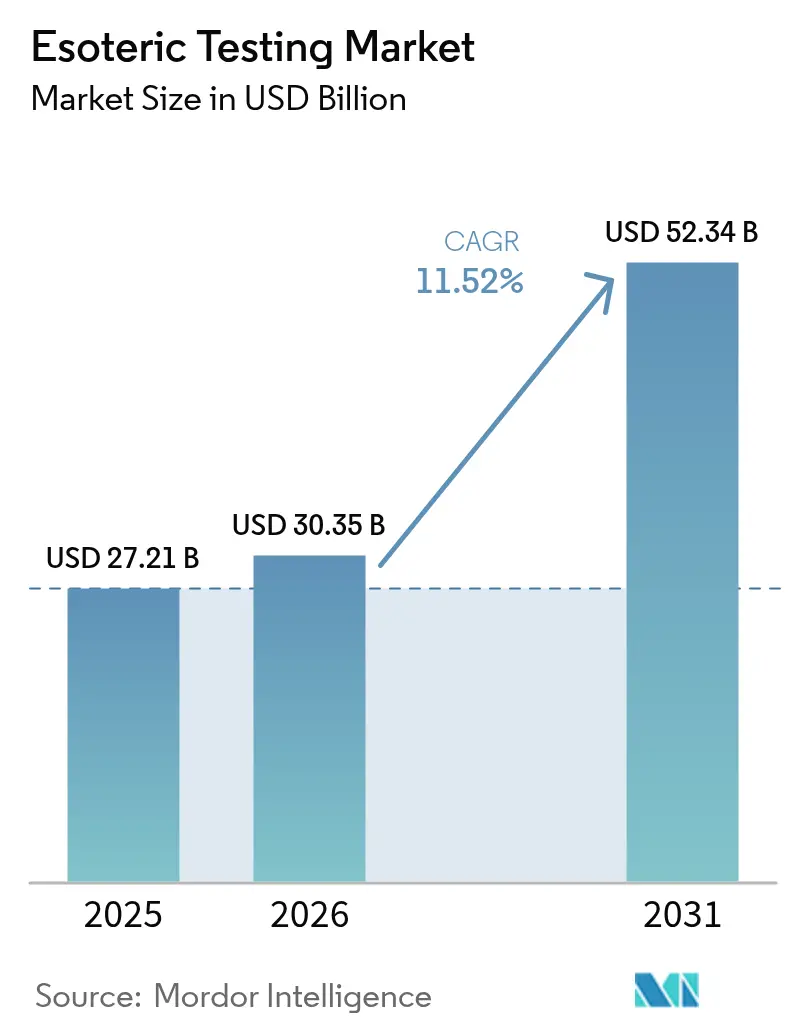
The Esoteric Testing Market size was valued at USD 27.21 billion in 2025 and estimated to grow from USD 30.35 billion in 2026 to reach USD 52.34 billion by 2031, at a CAGR of 11.52% during the forecast period (2026-2031).
Demand accelerates as chronic disease prevalence rises, next-generation sequencing (NGS) becomes routine, and hospitals outsource complex assays to reference laboratories. New FDA rules classifying laboratory-developed tests as medical devices introduce cost but ultimately set clear quality standards that can boost global credibility [1]U.S. Food and Drug Administration, “Final Rule: Medical Devices; Laboratory Developed Tests,” fda.gov . Automation investments, declining sequencing costs, and payer support for high-impact panels further reinforce growth momentum.
Key Report Takeaways
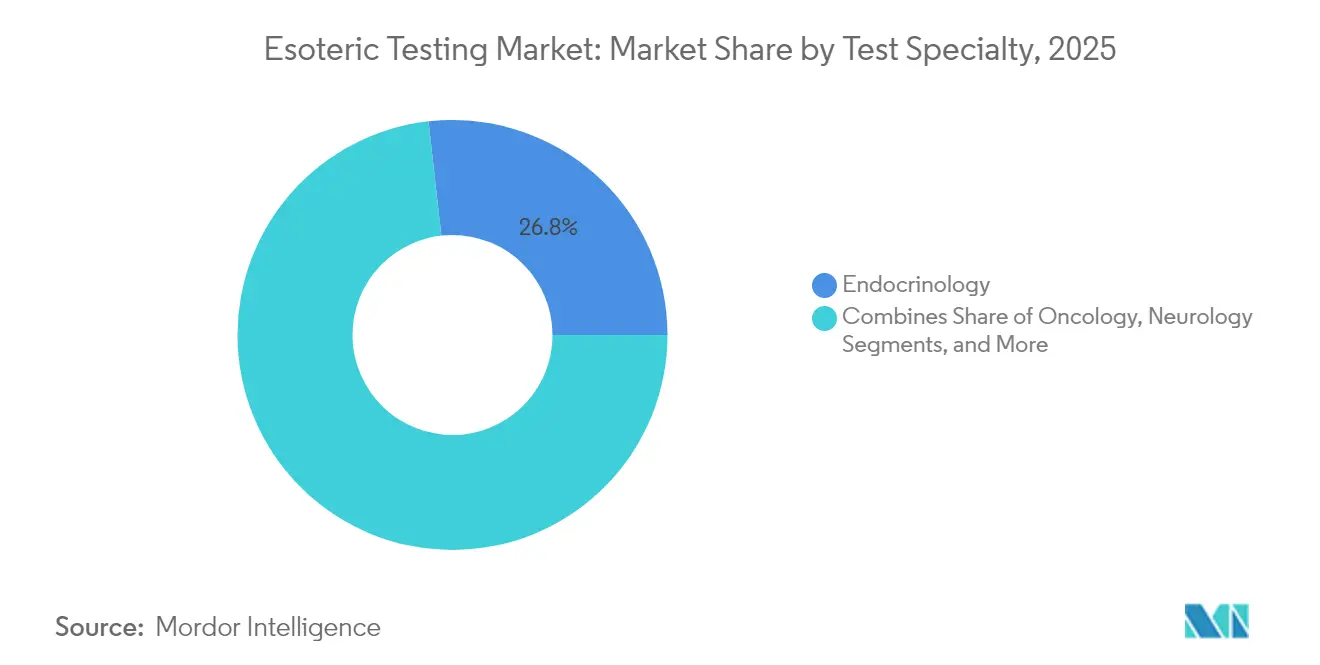
- By test specialty, endocrinology led with 26.78% of the esoteric testing market share in 2025; oncology tests are projected to grow at a 12.18% CAGR through 2031.
- By technology, chemiluminescence immunoassay held 26.45% of the esoteric testing market size in 2025, while NGS platforms are advancing at a 12.05% CAGR to 2031.
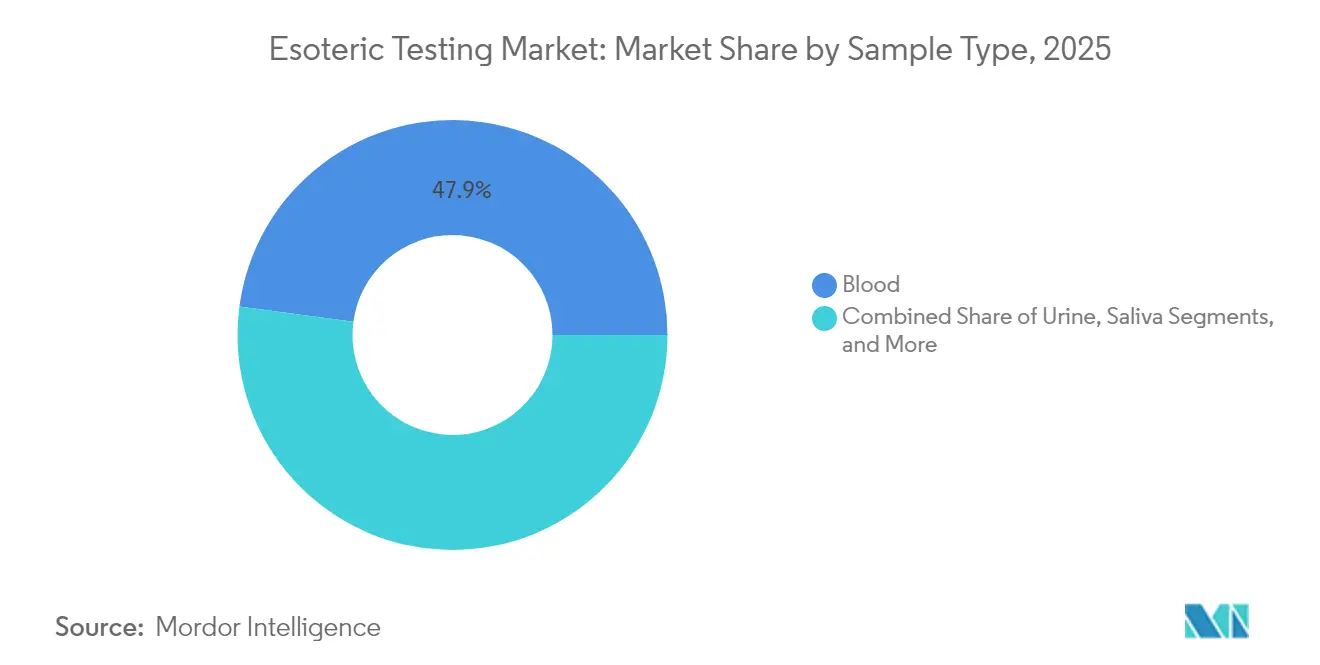
- By sample type, blood accounted for 47.88% of the esoteric testing market size in 2025; saliva specimens record the fastest 12.21% CAGR to 2031.
- By end user, hospitals and clinics controlled 51.35% of the esoteric testing market size in 2025, whereas diagnostics laboratories expand at a 12.29% CAGR to 2031.
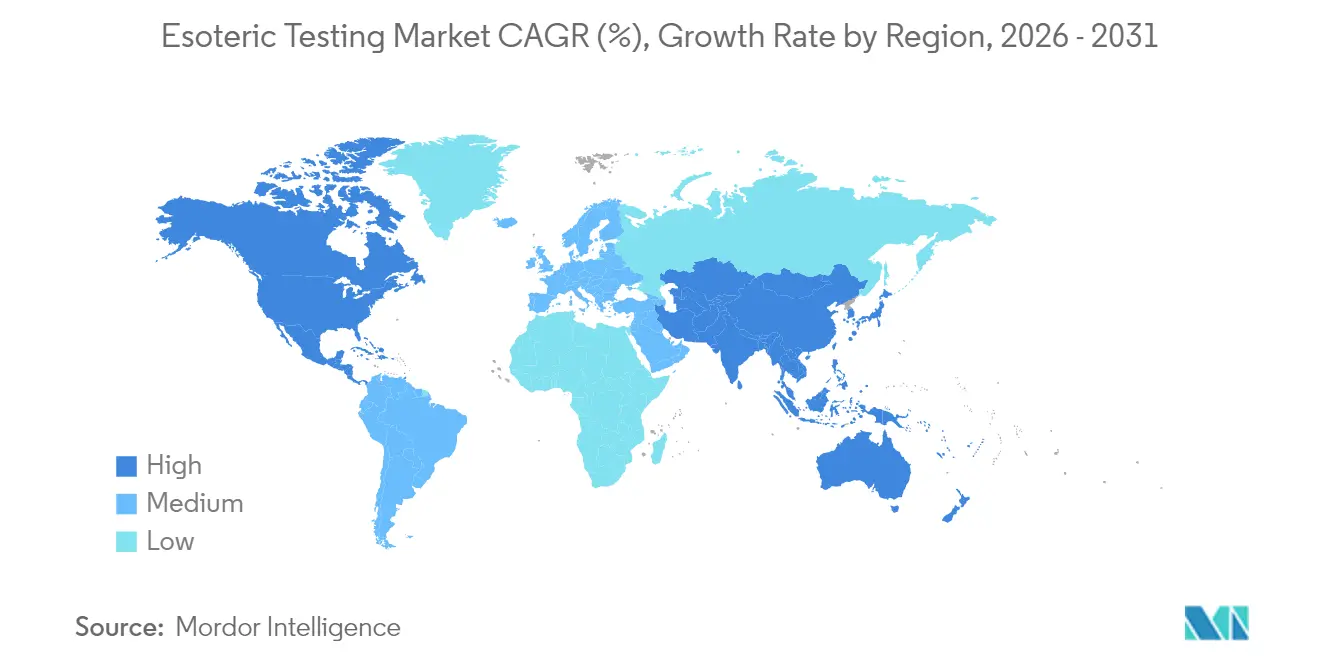
- By geography, North America controlled 41.35% of the esoteric testing market size in 2025, whereas Asia-Pacific expand at a 12.07% CAGR to 2031.
Note: Market size and forecast figures in this report are generated using Mordor Intelligence’s proprietary estimation framework, updated with the latest available data and insights as of 2026.
Global Esoteric Testing Market Trends and Insights
Drivers Impact Analysis*
| Driver | (~) % Impact on CAGR Forecast | Geographic Relevance | Impact Timeline |
|---|---|---|---|
| Rising burden of chronic & complex diseases | +2.8% | North America, Europe | Long term (≥ 4 years) |
| Growing demand for rare-disease diagnostics | +2.1% | North America expanding to APAC | Medium term (2-4 years) |
| Advances in molecular & multi-omics platforms | +3.2% | North America, EU, APAC | Medium term (2-4 years) |
| Increased R&D funding and lab automation | +1.9% | Developed markets worldwide | Long term (≥ 4 years) |
| Value-based reimbursement for high-impact panels | +1.6% | North America, EU | Medium term (2-4 years) |
| Digital e-ordering portals | +1.2% | Global | Short term (≤ 2 years) |
| Source: Mordor Intelligence | |||
Rising Burden of Chronic & Complex Diseases
Long-term growth is tied to diabetes, autoimmune disorders, and cancer, all of which require multi-analyte panels that routine labs cannot handle. Medicare’s MolDX program links payment to clinical utility, encouraging physicians to order advanced assays [2]Centers for Medicare & Medicaid Services, “Molecular Diagnostic Services (MolDX) Program,” cms.gov . As populations age, clinicians face overlapping comorbidities; definitive esoteric testing offers clarity, reduces misdiagnosis costs, and supports value-based care.
Growing Demand for Rare-Disease Diagnostics
Improved physician awareness and over 54,000 available genetic tests have boosted orders for ultra-low-volume assays. The FDA breakthrough device pathway accelerates approval timelines, while orphan-drug sponsors fund companion diagnostics that identify niche patient cohorts, enabling laboratories with deep genomic capability to command premium pricing.
Advances in Molecular & Multi-Omics Platforms
NGS panels that profile hundreds of genes, such as Illumina’s TruSight Oncology Comprehensive, signal regulatory acceptance of broad molecular insights [3]U.S. Food and Drug Administration, "Premarket Approval (PMA)," accessdata.fda.gov. Integration with mass-spectrometry-based proteomics gives clinicians holistic disease signatures. AI tools aggregate data layers and flag actionable variants faster than manual review, justifying higher test reimbursement.
Increased R&D Funding and Lab Automation
Robotics and “dark labs” reduce manual error and mitigate a workforce deficit estimated at 20,000–25,000 professionals in the United States. Venture capital flowed into workflow-automation start-ups during 2024, and connected laboratory information systems now deliver predictive maintenance and real-time quality metrics.
Restraints Impact Analysis*
| Restraint | (~) % Impact on CAGR Forecast | Geographic Relevance | Impact Timeline |
|---|---|---|---|
| Stringent regulatory & compliance requirements | -1.8% | North America, EU | Short term (≤ 2 years) |
| High per-test cost in price-sensitive economies | -1.4% | APAC, Latin America, MEA | Medium term (2-4 years) |
| Shortage of highly skilled laboratory personnel | -1.1% | North America, Europe | Long term (≥ 4 years) |
| Data-integration hurdles for multi-omics reports | -0.9% | Advanced markets | Medium term (2-4 years) |
| Source: Mordor Intelligence | |||
Stringent Regulatory & Compliance Requirements
The FDA now demands that laboratory-developed tests meet medical-device rules, adding up to USD 3.56 billion in cumulative costs across U.S. labs and causing smaller facilities to reconsider new-test launches. Ongoing legal appeals create uncertainty that may defer capital spending.
High Per-Test Cost in Price-Sensitive Economies
Specialized assays often exceed USD 500, dwarfing routine-test fees. Limited insurance coverage in emerging markets forces self-pay, curbing uptake despite clinical need. Currency volatility and shipping costs for reagents further elevate final patient charges.
*Our forecasts treat driver/restraint impacts as directional, not additive. The impact forecasts reflect baseline growth, mix effects, and variable interactions.
Segment Analysis
By Test Specialty: Oncology Drives Precision Medicine Growth
Oncology’s 12.18% CAGR makes it the fastest-moving specialty because liquid biopsy and comprehensive genomic profiling guide targeted treatments. FoundationOne CDx and Guardant Shield approvals show regulators view broad tumor panels as clinically essential. Endocrinology remains the revenue anchor, capturing 26.78% of the esoteric testing market size in 2025 through insulin, HbA1c, and thyroid assays.
Clinical focus continues to shift from high-volume thyroid testing to sophisticated biomarker suites that stratify cancer risk. Infectious-disease, neurology, and immunology segments benefit from AI-driven interpretation, but oncology captures the spotlight as payers reimburse for tests that match therapy to mutation, shortening hospital stays and improving outcomes.


By Technology: NGS Platforms Reshape Molecular Diagnostics
Sequencing costs have fallen below USD 200 per genome, and regulatory green lights for multi-gene panels propel NGS to a 12.05% CAGR. Illumina’s kit-based oncology panel gained FDA clearance, giving smaller labs plug-and-play capability. Chemiluminescence immunoassay remains dominant with a 26.45% esoteric testing market share due to its scalable menu across endocrinology and infectious disease.
Flow cytometry broadens from hematology into immune profiling, while mass spectrometry moves from research to routine through automated sample prep. Although real-time PCR sustains infectious-disease demand, ELISA and radio-immunoassay fade as labs consolidate around faster, multiplexed options.
By Sample Type: Saliva Testing Gains Non-Invasive Advantage
Blood retained 47.88% of the esoteric testing market size in 2025 thanks to clinician familiarity and robust reference ranges. Yet saliva registers the strongest 12.21% CAGR as patients prefer painless self-collection and telehealth expands kit distribution.
COVID-19 catalyzed saliva acceptance; now hormone, pharmacogenomic, and viral-load assays routinely run on spit specimens. Urine and cerebrospinal fluid serve niche metabolic and neurological needs, but logistics, not clinical value, restrict wider adoption.
By End User: Diagnostics Laboratories Lead Specialization Trend
Hospitals delivered 51.35% of revenue in 2025, yet reference labs grow faster at 12.29% CAGR as health systems outsource complexity. Staffing gaps—80% of microbiology labs report vacancies—push work to high-throughput centers with robotics.
Academic institutes pilot novel assays, then license them to commercial labs. Consolidators such as LabCorp snapped up BioReference oncology assets to broaden menus nationally, signaling that size plus specialization beats geography alone.
Geography Analysis
North America commanded 41.35% revenue in 2025. Medicare’s MolDX pathway speeds coverage for molecular tests, and the region’s payer mix supports premium pricing. Ongoing mergers—including Quest Diagnostics’ takeover of LifeLabs—bundle logistics networks with AI-enabled result portals, reinforcing regional dominance.
Asia-Pacific is the fastest-growing region at a 12.07% CAGR. China’s regulator cleared 228 new drugs in 2024, 92 with companion diagnostics, sparking hospital demand for multi-gene tests. Indian chains such as Dr. Lal PathLabs push into tier-3 cities while Molbio Diagnostics readies a USD 265 million IPO to fund molecular expansion. Mobile health platforms link rural clinics to reference labs, shortening sample-to-result cycles.
Europe posts stable single-digit gains. Cross-border lab alliances streamline sample routing, and sustainability mandates spur demand for environmental toxicology panels. Eurofins reported EUR 6.951 billion revenue in 2024 after 31 acquisitions, highlighting a buy-and-build model that keeps menu breadth ahead of regional peers. Latin America and Middle East & Africa advance steadily as private insurers widen coverage, though infrastructure gaps and import duties temper immediate scale.

Regulatory Landscape
Regulatory oversight for esoteric testing is tightening as regulators align clinical laboratory quality and in vitro diagnostic (IVD) requirements with medical-device frameworks. In the United States, the FDA issued a final rule in May 2024 to classify laboratory-developed tests (LDTs) as medical devices (amending 21 CFR 809.3(a)). During 2025, legal and policy reversals reset the immediate compliance baseline, but scrutiny remains elevated for high-complexity molecular and multi-omics assays.
Quality system and IVD conformity expectations have also risen across key geographies. The FDA Quality Management System Regulation (QMSR) became effective in February 2026, harmonizing 21 CFR Part 820 with ISO 13485:2016, and increasing the need for standardized documentation, validation, and change control for esoteric-testing workflows that interact with device-like components (instruments, software, and assay kits). In Europe, the EU IVDR framework continues to shape market access and notified-body capacity planning; Spain added country-level specificity with Real Decreto 942/2025 (published October 23, 2025) detailing national requirements including procedures for in-house laboratory testing. The European Commission also presented a December 16, 2025 proposal to simplify device/IVD rules while maintaining core safety and performance requirements.
Competitive Landscape
Market concentration is moderate. LabCorp, Quest Diagnostics, and Eurofins together control roughly one-third of global revenue, aided by nationwide logistics, regulatory muscle, and multi-omics menus. Each firm inked multiple acquisitions in 2024; LabCorp’s purchase of BioReference assets broadened oncology reach, while Eurofins picked up 18 start-ups to boost regional depth.
Specialist players carve niches. ARUP Laboratories secured the first FDA-authorized AAV5 DetectCDx for gene-therapy monitoring, underscoring academic labs’ role in pioneering new categories. Caris Life Sciences combined whole-exome and transcriptome sequencing in its MI Cancer Seek test, winning approval for pan-tumor profiling.
Technology partnerships proliferate. AI vendors integrate with LIMS software to flag contamination, while robotics firms supply modular aliquoting lines that raise throughput without adding staff. Workforce shortages create barriers to entry, yet cloud-hosted analysis pipelines let smaller labs run sophisticated panels without building local bioinformatics teams.
Esoteric Testing Industry Leaders
-
bioMontr Labs
-
Quest Diagnostics
-
Kindstar Globalgene Technology, Inc.
-
H.U. Group Holdings, Inc.
-
Laboratory Corporation of America Holdings
- *Disclaimer: Major Players sorted in no particular order


Market Opportunities and Future Outlook
Policy activity in 2026 is creating a near-term window for laboratories and test developers to shape modernization priorities and target compliance investments for advanced, evidence-based esoteric diagnostics. In the United States, CMS, CDC, and HHS issued a July 2026 Request for Information on potential CLIA updates that directly affect esoteric-testing operations, including laboratory procedures, breath testing, AI use, and cybersecurity. At the same time, CMS posted an updated PAMA FAQ in July 2026 requiring hospital outreach laboratories to report private payer clinical diagnostic laboratory data for the first six months of 2025 by July 31, 2026, which raises the operational value of billing and ordering systems that can support data-audit needs across complex test menus.
There is also an opportunity for compliance-led differentiation in high-cost, high-impact panels as payer and enforcement activity tightens documentation expectations. Labcorp's July 2026 USD 14.5 million settlement with the U.S. Department of Justice over alleged medically unnecessary urine drug-testing panel claims highlights how clinical utility and ordering controls can function as commercial gatekeepers for proprietary or bundled esoteric offerings. Outside the United States, the UK's MHRA published an IVD Roadmap in January 2026 with 2026-2027 deliverables aimed at innovative diagnostics, pandemic resilience, and performance study pathways, supporting companies that can produce robust performance evidence for multi-omics and companion diagnostics. Workflow integration that reduces manual handling (sample-to-result automation) and enables complex interpretation (multi-omics reporting and AI-supported analytics) remains a key whitespace, particularly as reference-lab outsourcing and standardized quality systems drive buying decisions.
Recent Industry Developments
- June 2026: Quest Diagnostics received New York State Department of Health Clinical Laboratory Evaluation Program (CLEP) approval for Haystack MRD, a circulating tumor DNA (ctDNA) liquid biopsy test used to identify residual or recurring disease in solid tumor cancers. The state-specific clearance removes a key rollout constraint for high-complexity oncology assays and broadens access in a major U.S. regulated jurisdiction. The approval also reinforces the role of MRD testing as a scalable esoteric offering across national lab networks.
- March 2025: LabCorp acquired BioReference Health's oncology testing assets, expanding its cancer-genomics capabilities and menu breadth. The acquisition strengthens competitive positioning in outsourced, high-complexity oncology esoteric testing where turnaround time, logistics, and interpretation infrastructure drive share. It also supports deeper integration of molecular testing into health-system pathways as hospitals shift complex assays to reference laboratories.
- July 2024: Quest Diagnostics entered a global collaboration agreement with Becton, Dickinson and Company (BD) to develop, manufacture, and commercialize flow cytometry-based companion diagnostics for cancer and other diseases. This partnership supports standardization and scale-up of specialized flow cytometry technologies that are increasingly used alongside molecular profiling in precision medicine workflows. It also links diagnostic service delivery with device manufacturing expertise, helping translate novel assays into broader clinical adoption.


Research Methodology Framework and Report Scope
Market Definition and Coverage
For this methodology, the esoteric testing market includes specialized clinical laboratory tests that need complex methods, advanced instruments, or rare expertise, and that are commonly processed in reference or specialty labs for patient diagnosis and monitoring.
Scope exclusions: The sizing excludes routine, high-volume common chemistry and basic hematology tests that are typically processed with standard hospital lab workflows.
Segmentation Overview
-
By Test Specialty
- Endocrinology
- Infectious Disease
- Oncology
- Neurology
- Immunology
- Genetics
- Others
-
By Technology
- Flow Cytometry
- Chemiluminescence Immunoassay
- Mass Spectrometry
- Real-time PCR
- Next-Generation Sequencing (NGS)
- ELISA
- Radio Immunoassay
- Others
-
By Sample Type
- Blood
- Urine
- Saliva
- Cerebrospinal Fluid (CSF)
- Others
-
By End User
- Hospitals and Clinics
- Diagnostics Laboratories
- Academic and Research Institutes
- Others
-
By Geography
-
North America
- United States
- Canada
- Mexico
-
Europe
- Germany
- United Kingdom
- France
- Italy
- Spain
- Rest of Europe
-
Asia-Pacific
- China
- Japan
- India
- Australia
- South Korea
- Rest of Asia-Pacific
-
Middle East and Africa
- GCC
- South Africa
- Rest of Middle East and Africa
-
South America
- Brazil
- Argentina
- Rest of South America
-
North America
Data Sources, Market Sizing, and Validation
Desk Research
To set the boundaries and create a clean starting dataset, we first reviewed public healthcare statistics and lab-testing references. Sources used include items such as the Centers for Medicare and Medicaid Services (coverage and payment schedules), the US CDC (disease burden indicators), the WHO (global testing and public health signals), and the OECD (healthcare utilization indicators).
We also used supporting materials like company annual reports, investor presentations, regulatory and accreditation guidance (such as CLIA and CAP related documentation), and peer reviewed studies on advanced diagnostics adoption. In a few cases, paid subscriptions for company financials, news and financials, and patent databases were referenced to cross-check growth signals and technology shifts. These desk research sources are not exhaustive, and many other public references were used to collect, validate, and clarify the final assumptions.
Primary Interviews and Surveys
Our primary work focused on validating what is counted as esoteric testing in real lab operations and how volumes are shifting across specialties. We spoke with a mix of independent laboratories, hospital labs, distributors, and industry experts across APAC, EMEA, and the Americas, and then used their input to confirm pricing logic, outsourcing rates to reference labs, and adoption timelines for advanced technologies.
Distribution of primary research fieldwork respondents
| Company type | Respondent position | Region |
|---|---|---|
| Top tier: 37% | CXOs: 15% | APAC: 42% |
| Mid tier: 46% | Functional/Unit leaders: 38% | EMEA: 33% |
| Smaller Players: 17% | Managers: 47% | Americas: 25% |
Market-Sizing & Forecasting
Market size was reconstructed using a top-down approach where healthcare utilization and specialty testing demand pools were built by geography and then converted into esoteric testing revenues using penetration and outsourcing rates. To keep the totals realistic, we also ran selective bottom-up checks using sampled test menus, indicative volume ranges by specialty, and typical pricing bands by technology, which were used to adjust for gaps.
Inputs that were used in the model include the share of complex tests routed to reference labs, the mix shift toward molecular and mass spectrometry based workflows, reimbursement and pricing movements for specialized assays, growth in oncology and infectious disease related testing, and lab capacity and turnaround expectations that influence outsourcing. For forecasting, scenario analysis was applied around adoption speed of advanced diagnostics and reimbursement direction, and then the final curve was smoothed using short-horizon trend behavior from historical series. Where direct volume or price data was missing, ranges were taken from interviews and checked against public reimbursement references before being applied to the demand pool.
Data Validation & Update Cycle
We validate the model through triangulation across independent signals, then investigate outliers until they can be explained by scope, timing, or unit assumptions. Checks include comparing implied revenue per test against reimbursement references, reviewing regional shares against healthcare utilization patterns, and confirming specialty growth rates with expert feedback.
Before sign-off, the outputs go through multi-step analyst reviews, and respondents are re-contacted when a variance is large or when a key assumption changes. Reports are refreshed annually, with interim updates triggered by material events such as major reimbursement updates, regulation changes, or meaningful shifts in test adoption. Right before delivery, a final pass is completed so clients receive the latest updated view.
Mordor Intelligence's Esoteric Testing Market Estimate Compared With Other Published Estimates
Published market values for esoteric testing can look far apart because each publisher draws the line differently around what counts as esoteric, how pricing is averaged, and which year is treated as the starting point. The way outpatient versus hospital lab activity is handled also matters, and it can change totals quickly when applied at a global level.
By tracking specialty level demand indicators and refreshing key pricing and outsourcing assumptions with interview feedback, Mordor Intelligence keeps the estimate anchored to test types that require advanced methods rather than folding in routine diagnostics revenue. In addition, some estimates use aggressive adoption paths for advanced testing or apply broad revenue-per-test averages without checking reimbursement realities by region, which can shift the base year value and the growth slope.
Benchmark comparison
| Source | Market Size | Gaps in Research Methodology |
|---|---|---|
| Mordor Intelligence | USD 27.21 B (2025) | |
| Global Consultancy A | USD 32.20 B (2024) | Uses a different base year and can include a wider revenue set by bundling more routine specialty diagnostics under esoteric testing, and then applying broad average pricing across regions. |
| Industry Publisher B | USD 27.56 B (2025) | Relies on a longer-range projection path to 2034, where adoption and pricing uplift assumptions can run ahead of near-term reimbursement and lab capacity constraints, which lifts the implied growth trajectory. |
The table shows that most of the spread is explained by scope boundaries and how pricing and adoption are carried forward from the base year. With clear inclusions, practical cross-checks, and repeatable inputs tied to demand signals, the final number stays easier to interpret and to update as conditions change.


Key Questions Answered in the Report
What is the projected value of the esoteric testing market by 2031?
The esoteric testing market is expected to reach USD 52.34 billion by 2031.
Which test specialty is growing the fastest?
Oncology testing leads growth with a 12.18% CAGR through 2031, driven by liquid biopsy and comprehensive genomic profiling approvals.
Why are saliva-based assays gaining popularity?
Saliva sampling is non-invasive and supports at-home collection, fueling a 12.21% CAGR for saliva tests within the esoteric testing market.
How will the new FDA LDT rule affect laboratories?
Labs must meet medical-device standards, adding compliance costs of up to USD 3.56 billion industry-wide but ultimately ensuring higher quality and global credibility.
Which region offers the highest growth potential?
Asia-Pacific records the fastest 12.07% CAGR, buoyed by China’s companion-diagnostic approvals and expanding molecular-testing infrastructure.
What technology holds the largest esoteric testing market share today?
Chemiluminescence immunoassay leads with 26.45% of 2025 revenue, though NGS platforms are growing the quickest.
Page last updated on:


 Your data is secure and never sold or shared.


