
End User Computing Market Size and Share
Market Overview
| Study Period | 2020 - 2031 |
|---|---|
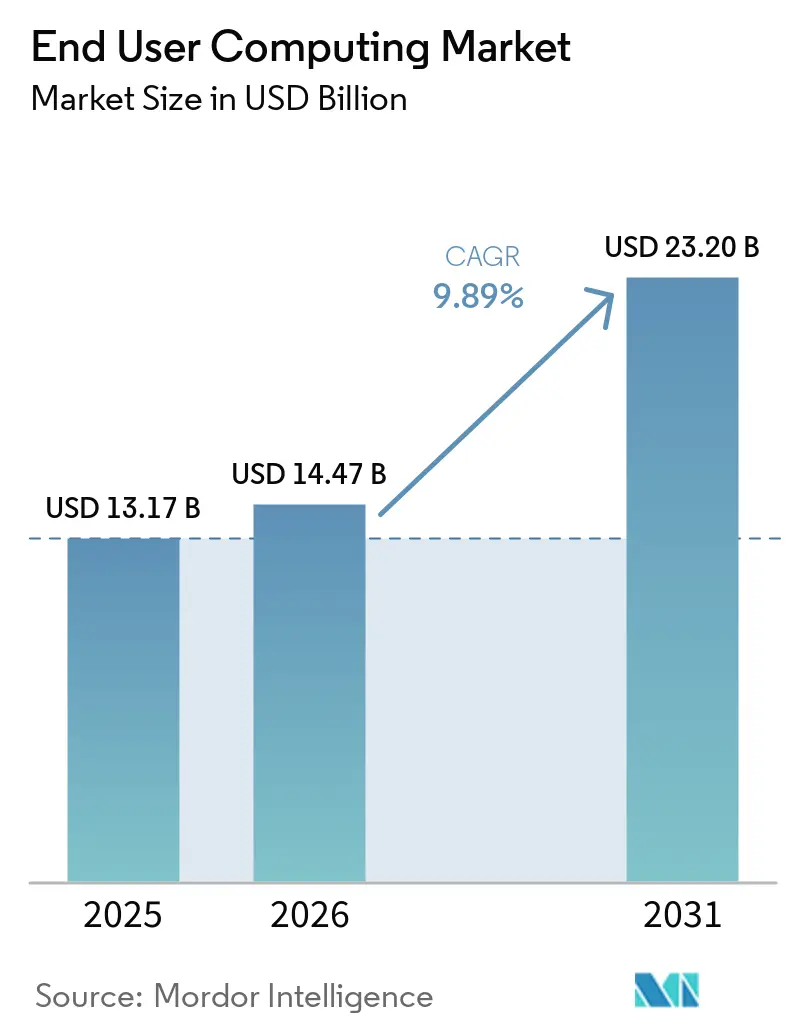
| Market Size (2026) | USD 14.47 Billion |
| Market Size (2031) | USD 23.20 Billion |
| Growth Rate (2026 - 2031) | 9.89 % |
| Fastest Growing Market | Asia-Pacific |
| Largest Market | North America |
| Market Concentration | Medium |
Major Players *Disclaimer: Major Players sorted in no particular order Image © Mordor Intelligence. Reuse requires attribution under CC BY 4.0. | |
End User Computing Market Analysis by Mordor Intelligence
The End-User Computing market size was valued at USD 13.17 billion in 2025 and estimated to grow from USD 14.47 billion in 2026 to reach USD 23.2 billion by 2031, at a CAGR of 9.89% during the forecast period (2026-2031). This sustained expansion is driven by large-scale digital workplace programs, mandatory hardware refresh cycles ahead of the Windows 10 end-of-support deadline, and a rapid shift toward cloud-hosted virtual desktops that reduce capital expenditures while enhancing flexibility. Demand is further amplified by organizations rolling out AI-capable endpoints that can process generative models locally, as well as the strong adoption of bring-your-own-device (BYOD) policies across 82% of enterprises. Additionally, there is a growing investment in unified endpoint management to protect a diverse range of devices. Competitive intensity remains high as vendors race to bundle endpoint operating systems, virtualization software, cloud services, and AI tooling into a single value proposition, forcing buyers to assess road-map certainty, licensing stability, and data-sovereignty safeguards. The End-User Computing market also benefits from telecom-edge partnerships that push ultra-low-latency augmented-reality and virtual-reality workloads closer to field workers, thereby expanding the addressable use cases.
Key Report Takeaways
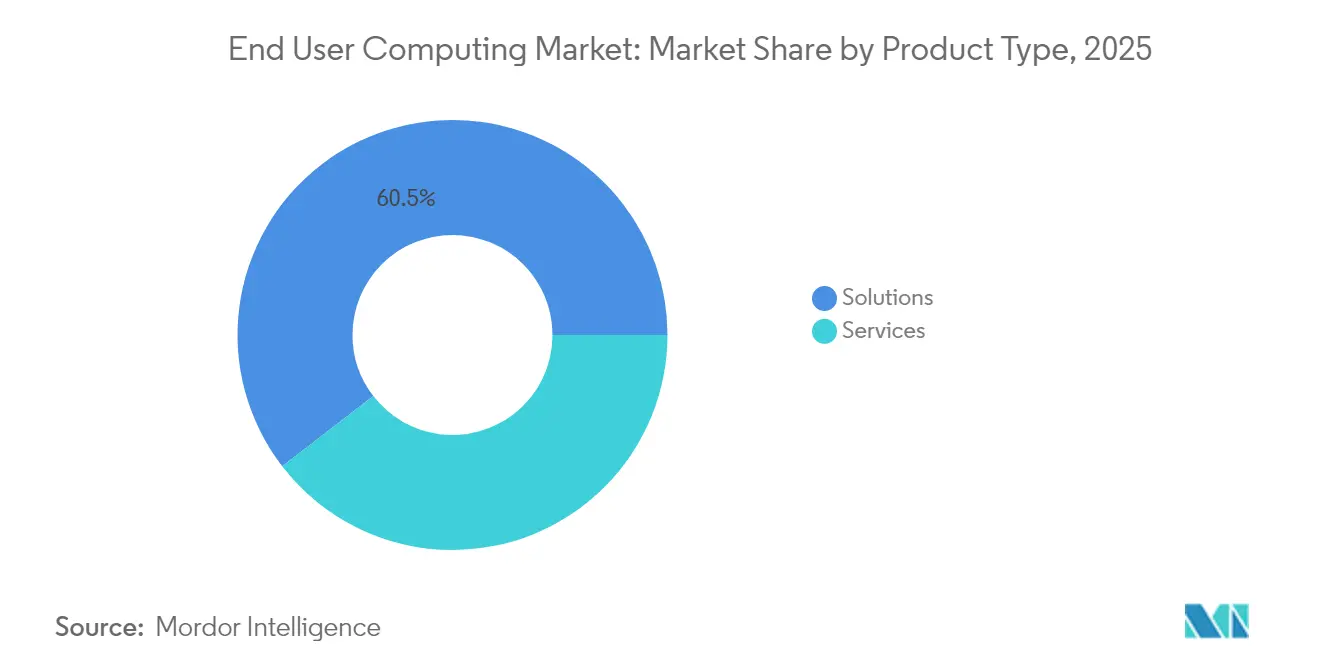
- By product type, Solutions held the largest market share in 2025 at 60.45%, while Managed Services are projected to grow the fastest from 2026 to 2031 with a CAGR of 10.05%.
- By organization size, Large Enterprises dominated in 2025 with a 45.85% share, whereas Small and Medium Enterprises are expected to expand most rapidly, growing at a CAGR of 10.25%.
- By deployment mode, on-premises solutions led with a 28.95% market share in 2025, while Cloud deployments are forecast to grow fastest at a CAGR of 10.38%.
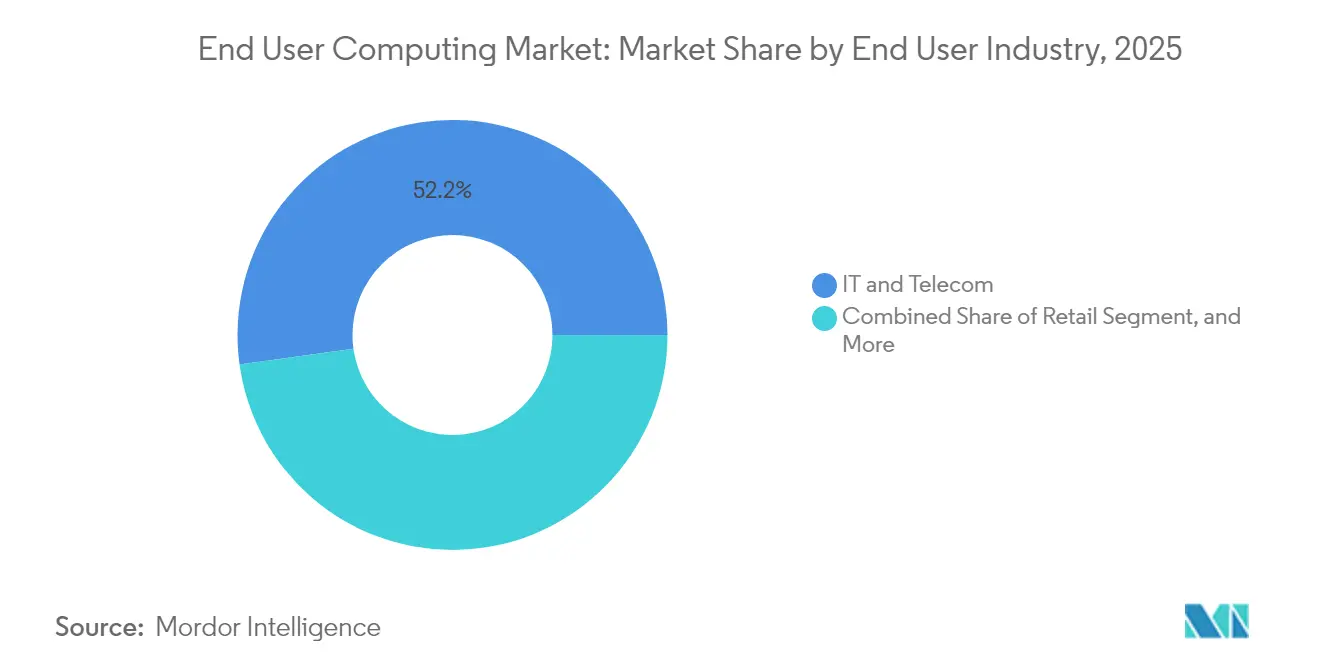
- By end-user industry, IT and Telecom accounted for the largest share in 2025 at 52.20%, while Healthcare is projected to be the fastest-growing sector with a CAGR of 9.97%.
- By delivery model, Virtual Desktop Infrastructure led with a 36.65% share in 2025, while Desktop-as-a-Service is expected to grow at a CAGR of 10.12%.
- By geography, the Asia-Pacific was the largest regional market in 2025 with a 62.40% share, and it is also forecast to be the fastest-growing region with a CAGR of 10.72%.
Note: Market size and forecast figures in this report are generated using Mordor Intelligence’s proprietary estimation framework, updated with the latest available data and insights as of 2026.
Market Trends and Insights
Drivers Impact Analysis of End User Computing Market*
| Driver | % Impact on CAGR Forecast | Geographic Relevance | Impact Timeline |
|---|---|---|---|
| Drive to increase employee productivity via digital workspaces | +2.8% | Global (APAC leading) | Medium term (2-4 years) |
| Growing adoption of cloud-based desktop and application virtualization | +2.5% | North America, Europe, fast-scaling APAC | Short term (≤ 2 years) |
| Rising BYOD policies and mobile workforce requiring unified endpoint management | +2.1% | Global | Short term (≤ 2 years) |
| Windows-10 end-of-support triggering enterprise PC refresh cycles | +1.8% | Global | Short term (≤ 2 years) |
| Emergence of AI-capable endpoints enabling on-device GenAI workloads | +1.6% | North America, APAC | Long term (≥ 4 years) |
| Telco edge-cloud partnerships enabling ultra-low-latency EUC for field AR-VR | +0.9% | APAC, North America | Long term (≥ 4 years) |
| Source: Mordor Intelligence | |||
Drive to Increase Employee Productivity via Digital Workspaces
Enterprises are reimagining productivity by combining virtual desktops, collaboration suites, and AI copilots inside a single digital workspace. Organizations that reach advanced workplace maturity levels report a 57.8% boost in positive employee experience metrics, thanks to quicker access to resources, app self-service, and uniform security controls. Microsoft’s early field data shows AI copilots save roughly 10 hours per employee each month, translating into tangible capacity gains. The result is a measurable uplift in innovation, inclusion, and well-being, as seamless device hopping and automated workflows reduce friction and burnout.
Growing Adoption of Cloud-Based Desktop and Application Virtualization
Consumption-based desktop hosting is scaling fast because it eliminates capital expenditure and shortens deployment timelines from months to days. Azure Virtual Desktop production use already spans 26% of surveyed organizations, with 58% planning rollouts within the next two years, driven by policy-based scaling, pay-as-you-go pricing, and native Microsoft 365 integration. Healthcare providers illustrate the upside: browser-delivered desktops logged sub-minute sign-ins, freeing clinicians to spend more time with patients and less on IT wait states.
Rising BYOD Policies and Mobile Workforce Requiring Unified Endpoint Management
The U.S. mobile workforce alone now exceeds 93.5 million workers, forcing IT teams to secure personal devices, such as phones, tablets, and laptops, without hindering user choice.[3]A mature BYOD program can save USD 341 per employee each year, yet 82% of breaches still involve human error, prompting firms to invest in zero-trust authentication, remote wipe, and containerized workspaces.[1]Unified endpoint management brings policy consistency to this sprawl, integrating device telemetry, patch automation, and experience analytics into a single console.
Windows-10 End-of-Support Triggering Enterprise PC Refresh Cycles
Microsoft ends extended support for Windows 10 in October 2025, exposing unpatched PCs to a 74% higher risk of breach. Hardware-eligibility checks reveal that roughly 40% of business PCs lack TPM 2.0 or a compatible CPU, compelling organizations to either swap devices or virtualize the desktop instead. Many buyers view the mandatory refresh as an opportunity to transition to zero-touch deployments using Windows Autopilot and Intune, while standardizing on AI-ready chipsets to future-proof their investments.
Restraints Impact Analysis of End User Computing Market*
| Restraint | % Impact on CAGR Forecast | Geographic Relevance | Impact Timeline |
|---|---|---|---|
| Complexity integrating EUC with legacy applications and infrastructure | -1.4% | Global, heavily regulated verticals | Medium term (2-4 years) |
| High upfront transformation costs for VDI and DaaS migrations | -1.1% | SMEs, cost-sensitive regions | Short term (≤ 2 years) |
| Vendor consolidation-driven license uncertainty | -0.8% | Global VMware customer base | Short term (≤ 2 years) |
| Data-sovereignty concerns hindering full cloud adoption | -0.6% | Europe, Asia-Pacific | Medium term (2-4 years) |
| Source: Mordor Intelligence | |||
Complexity Integrating EUC with Legacy Applications and Infrastructure
Banks, hospitals, and government agencies still depend on thick-client applications tied to specific OS versions, hard-coded drive mappings, or serial-port peripherals. Virtual desktops must replicate these dependencies while guaranteeing millisecond response times in mission-critical workflows. Integration projects therefore add middleware, APIs, and parallel test environments, extending timelines and inflating costs. Change-management gaps further undermine ROI; 73% of employees who move to digital workspaces without structured training feel disengaged, risking project rollback. Firms mitigate the drag by phasing workloads, rewriting monoliths into modular services, and introducing user-experience analytics that flag adoption bottlenecks early.
High Upfront Transformation Costs for VDI and DaaS Migrations
Licensing, infrastructure, consulting, and user-training fees produce steep entry barriers, particularly for SMEs. On-premise VDI requires servers, storage, GPUs, and skilled administrators, whereas cloud-hosted DaaS converts the spend into OPEX but can spike as workforces scale unpredictably. Managed DaaS providers promise savings of up to 60% by pooling expertise and automating patching, yet customers must master metering and right-sizing to dodge cost overruns. Investment hurdles often delay adoption until a major event—such as OS end-of-life or office relocation—creates an unavoidable business case.
*Our forecasts treat driver/restraint impacts as directional, not additive. The impact forecasts reflect baseline growth, mix effects, and variable interactions.
End User Computing Market Segment Analysis
By Product Type:
Solutions Dominate, Services AccelerateSolutions retained 60.45% End User Computing market share in 2025, underpinned by mature VDI platforms, device-management suites, and software-asset tools that together generated roughly USD 8 billion in annual recurring revenue. Vendors use unified consoles to orchestrate endpoints, apps, and security, which simplifies compliance audits across thousands of assets. Growth now skews toward managed services, with a 10.05% CAGR, as enterprises prefer outcome-based contracts that offload patching, scaling, and experience monitoring to specialists.
Managed service providers embed AI-driven observability and self-healing capabilities, enabling customers to transition from firefighting tickets to proactive optimization. Healthcare customers, for instance, adopt Device-as-a-Service bundles that convert capex to predictable opex and deliver pre-configured clinical workstations on 36-month refresh cycles, reducing help-desk volumes by double-digit percentages.

By Organization Size:
Large Enterprise Scale Meets SME AgilityLarge enterprises controlled 45.85% of End User Computing market size in 2025 and rely on tailored integrations, zero-trust overlays, and global federated identity to secure tens of thousands of users. Concurrent licensing and in-house talent give them lower per-seat operating costs, yet hardware refresh mandates and AI upgrade cycles force continual reinvestment.
SMEs, conversely, expand at 10.25% CAGR because cloud-native desktops remove the need for data-center space or specialized staff. Browser-launched workspaces deploy in under 48 hours and include automatic scaling, backup, and compliance templates. For many SMEs the Windows 10 sunset is a trigger to jump straight to cloud desktops, avoiding hardware outlays and accessing Windows 11-ready environments instantly.
By Deployment Mode:
Cloud Momentum Outpaces On-Premise ControlOn-premise estates still hold a 28.95% share in 2025, favored by defense, finance, and healthcare entities that prioritize data residency and deterministic performance. Co-location within corporate LANs also supports latency-sensitive imaging or CAD tasks. The trade-off is heavy capex and reliance on scarce virtualization experts.
Cloud endpoints are the clear growth engine, with a 10.38% CAGR, led by Azure Virtual Desktop and similar offerings that integrate conditional access, autoscaling, and consumption-based billing. Hybrid blueprints dominate enterprise roadmaps: sensitive workloads stay on-site, while burst capacity, disaster recovery, and contractor access shift to cloud regions nearest to users, lowering latency without ceding governance.
By End-User Industry:
IT-Telecom Leads, Healthcare SurgesIT and telecom operators generated 52.20% of their revenue in 2025, leveraging virtual desktops to isolate development sandboxes, secure call-center agents, and experiment with 5G edge computing that hosts AR-enabled field diagnostics. The sector’s technically adept staff accelerates adoption cycles and drives early proof-of-concepts.
Healthcare is logging the fastest 9.97% CAGR as hospitals modernize their clinical workspaces. GPU-accelerated virtual desktops render medical images in real-time, keeping patient data within secure data centers that support telehealth consultations, cross-disciplinary collaboration, and mobile ward rounds. Early pilots show doctors reclaim up to 30 minutes daily and nurses up to 50 minutes through single-sign-on roaming.
By Delivery Model:
VDI Foundation, DaaS InnovationVDI accounted for 36.65% End end-user computing market size in 2025 and remains the backbone for organizations that demand full control over hypervisors, storage, and networking. NVIDIA virtual GPUs enable the seamless operation of graphics-intensive applications for architects and radiologists, maintaining performance parity with high-end workstations.
DaaS, growing at a 10.12% CAGR, removes infrastructure burdens altogether. Microsoft, Citrix, and niche providers combine autoscaling, compliance dashboards, and integrated backup, letting customers spin up global workspaces via API. Gartner projects virtual desktops will be cost-effective for 95% of employees by 2027, highlighting DaaS as the mainstream trajectory for knowledge work.
Geography Analysis
APAC End User Computing Market
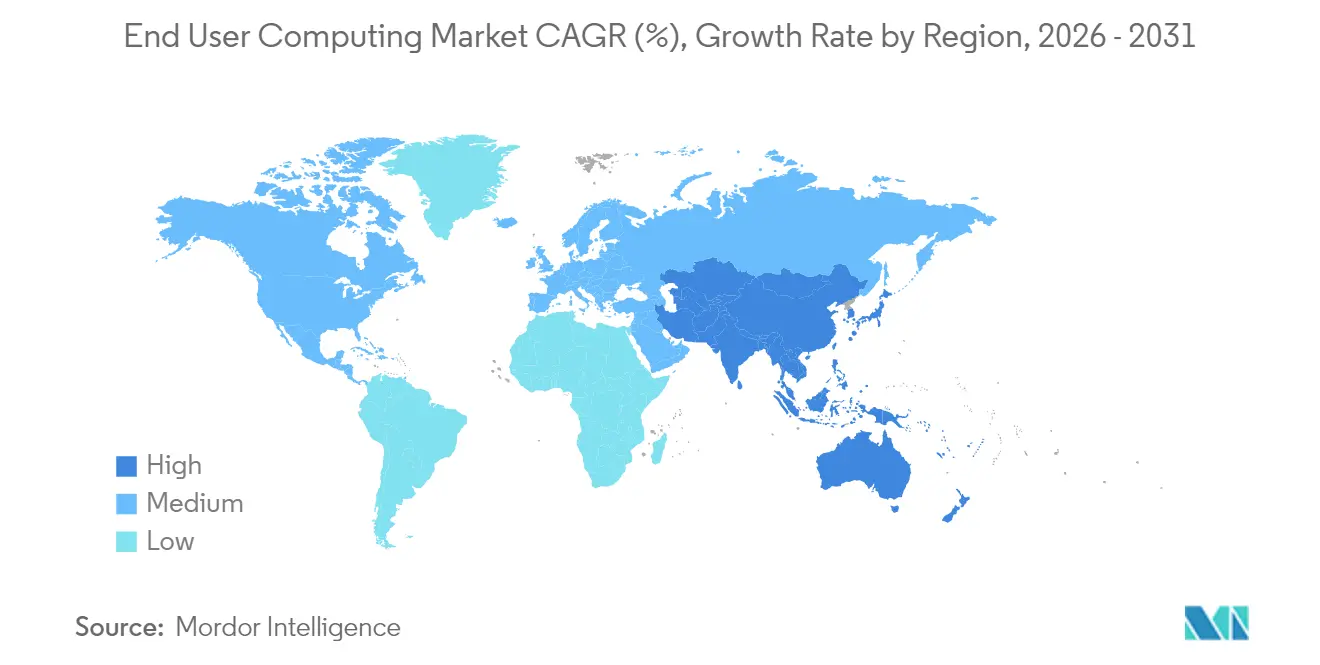
The Asia-Pacific controlled 62.40% of the End-User Computing market in 2025 and is projected to post a regional 10.72% CAGR from 2026 to 2031. A Zoho survey reveals that APAC organizations have achieved a 66.35% digital workplace maturity score, five points above the global average, with 76% reaching advanced levels. Penetration of AI-enabled tools (54%) and team chat (72%) epitomizes a mobile-first mentality, while steady 5G rollouts create fertile ground for edge-enhanced virtual desktops.
North America and Europe End User Computing Market
North America exhibits entrenched VDI estates across regulated sectors and leads the early adoption of AI copilots, which save roughly 10 hours per user per month. The Windows 10 cutoff brings an immediate refresh wave that favors modern endpoint management and DaaS. Europe mirrors the pattern but adds stringent GDPR mandates, steering multinationals toward hybrid deployments that balance local data residency with global cloud scale.
MEA and LATAM End User Computing Market
Emerging markets in the Middle East, Africa, and Latin America treat cloud desktops as a leapfrog opportunity to bypass legacy infrastructure. Consumption models align with budget constraints, while telco-edge collaborations promise sub-20-millisecond latency for immersive field maintenance or remote-assistance scenarios. Governments increasingly codify data-localization rules, encouraging regional cloud zones and sovereign VDI stacks that can interconnect with global platforms.
Regulatory Landscape
End-user computing (EUC) deployments are increasingly shaped by cross-border data protection and AI governance requirements that affect endpoint telemetry, experience analytics, and virtual desktop operations. In the European Union, the AI Act entered into force on 1 August 2024, and its timetable adds AI-specific transparency and risk-management requirements alongside GDPR for organizations deploying AI features within digital workspaces, including copilots and automated remediation. The main rules apply from 2 August 2026, with transparency obligations referenced for providers and deployers, which raises auditability expectations for EUC platforms handling user activity data and AI-generated outputs.
In the United States, public-sector and national security policy is moving toward tighter controls on AI systems and remote access to sensitive computing capabilities. In January 2026, the U.S. House passed the Remote Access Security Act (H.R. 2683), indicating a broader export-control lens that can extend to cloud-based computing services and regulated remote access patterns. Separately, in June 2026 the General Services Administration proposed adding GSAR clause 552.239-7001 to set requirements for safeguarding Government Data within large language model systems used by federal agencies, reinforcing vendor and integrator obligations around logging, oversight, and data-handling controls in EUC environments that serve government users.
Value Chain Analysis
The EUC value chain spans endpoint hardware and peripherals, operating systems and endpoint OS (including thin-client OS), virtualization and application delivery (VDI, DaaS, and cloud workspaces), unified endpoint management (UEM), security and identity, and the experience layer (DEX analytics and observability). Upstream hardware production and assembly rely heavily on Asian electronics manufacturing services, with Taiwanese providers such as Foxconn, Wistron, Quanta, Inventec, Wiwynn, Mitac, and others supporting large-scale device and infrastructure buildouts used in on-prem VDI stacks and cloud-hosted desktop back ends. As organizations refresh estates ahead of operating-system end-of-support cycles, device OEMs, silicon vendors, and virtualization providers increasingly coordinate around AI-capable endpoints and GPU-enabled virtualization to support graphics-heavy and on-device AI workloads.
Downstream, distributors, cloud marketplaces, and managed service providers package EUC into outcome-based contracts that combine provisioning, patching, security policy enforcement, and user-experience monitoring. Service delivery is shifting from fragmented tools to unified platforms, with greater use of zero-touch onboarding and automation in service desks and operations, which increases the importance of integration partners and MSPs that can connect identity, security, and application performance telemetry into a single operational model. Regionalization pressures also influence the chain, with more split production and sourcing strategies for US- and China-aligned markets, affecting lead times and the availability of certain compute configurations used in VDI and DaaS deployments.
Competitive Landscape
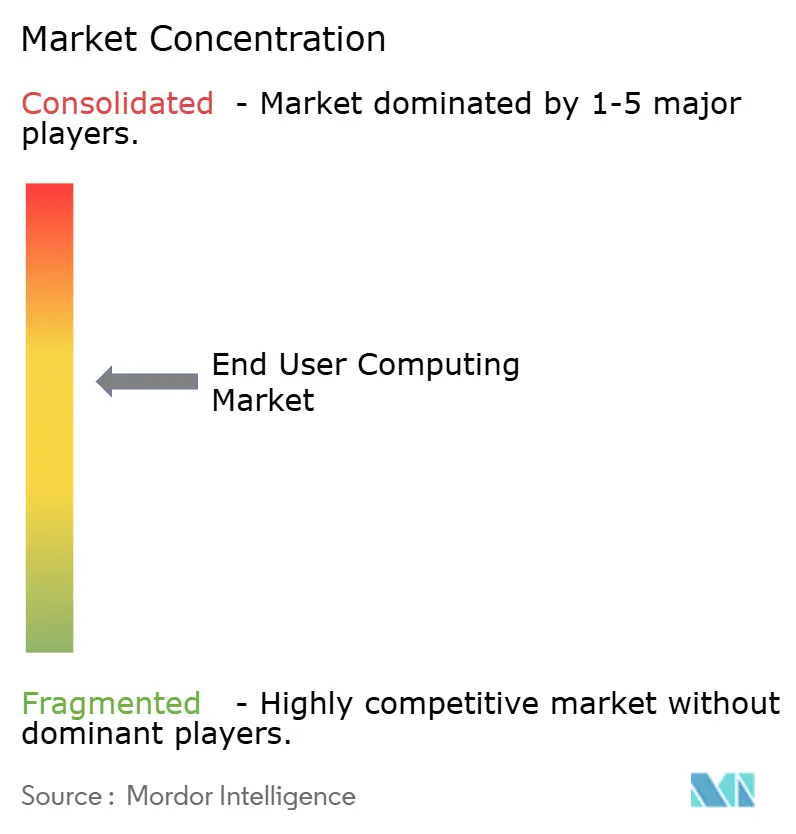
Vendor consolidation has reshaped competitive dynamics, yielding a moderately concentrated field where the top five providers hold about 60% share. KKR carved out VMware’s EUC division for USD 4 billion and re-launched it as Omnissa, instantly inheriting USD 1.5 billion in annual recurring revenue and 26,000 customers. Omnissa is now adding AI-powered diagnostics, self-healing, and “Omni” chat-assistants while extending App Volumes from VDI to physical PCs.
Citrix strengthened its control plane by acquiring eLux, an endpoint OS running on 2.5 million devices, enabling secure, lightweight clients that pair with its management stack. HP targeted the experience layer through its purchase of Vyopta, integrating collaboration analytics that surface meeting-room utilization and voice-quality anomalies. Qualcomm entered the arena with an on-premise AI appliance suite, allowing enterprises to run generative models locally, reducing cloud inference costs and preserving data sovereignty.
Differentiation now hinges on end-to-end platform cohesion: device firmware, operating system, virtualization, security policies, and AI workflows are being woven into unified offerings. Buyers weigh roadmap certainty, especially when licensing terms can shift abruptly after acquisitions. Trust in data-sovereignty controls and zero-day patch cadences are emerging as procurement deal-breakers alongside traditional cost and performance metrics.
End User Computing Industry Leaders
-
Genpact
-
Citrix Systems, Inc.
-
Vmware, Inc.
-
Fujitsu Ltd.
-
Hitachi
- *Disclaimer: Major Players sorted in no particular order
End User Computing Market Companies Covered in this Report
- Omnissa (VMware EUC)
- Citrix Systems Inc.
- Microsoft Corporation
- Amazon Web Services Inc.
- Dell Technologies Inc.
- Lenovo Group Ltd.
- HP Inc.
- Nutanix Inc.
- Fujitsu Ltd.
- Genpact Ltd.
- HCL Infosystems Ltd.
- Infosys Ltd.
- LTIMindtree Ltd.
- NetApp Inc.
- Tech Mahindra Ltd.
- Hitachi
- IGEL Technology GmbH
- Parallels International GmbH
- Nerdio Inc.
- ControlUp Inc.
- Cisco Systems Inc.
- Google LLC
Market Opportunities and Future Outlook
A major whitespace sits in operationalizing digital employee experience (DEX) and automation as measurable controls for cost, performance, and security across hybrid work. Enterprises are adopting zero-touch device onboarding, reported as up to 90% faster Day 1 setup than traditional processes, and moving service desks toward autonomous, AI-led models that are cited as delivering 30% lower costs and 40% faster issue resolution in practice-led programs. This creates room for EUC platforms and service providers to differentiate with closed-loop remediation that connects UEM policy, identity controls, and real-time experience analytics across physical endpoints, VDI, and DaaS.
Licensing and delivery models are also opening new commercialization paths as buyers shift away from one-size-fits-all bundles toward persona-based consumption aligned to role requirements and actual usage. Citrixs introduction of Citrix Platform Flex in May 2026, built around Flex credits for persona-based desktop and application delivery, highlights buyer preference for flexible consumption and integrated control planes over standalone point tools. In parallel, the Windows 10 end-of-support in October 2025 continues to push organizations toward cloud-hosted desktops and managed device lifecycle options, particularly where hardware eligibility constraints make virtualization or cloud PCs a faster compliance path than full fleet replacement.
Recent Industry Developments in End User Computing Market
- May 2026: Citrix introduced Citrix Platform Flex, a persona-based consumption model built around Flex credits for delivering desktops and applications through a full-stack secure access platform. The update gives buyers more control over cost alignment across different worker personas and supports platform consolidation versus separate licensing for access, virtualization, and management.
- January 2026: Dizzion and Expedient launched a Private Cloud PC offering powered by Nutanix to deliver managed cloud PC environments on private infrastructure. This expands deployment options for organizations that want cloud-PC operating models while retaining tighter control over data residency and infrastructure governance.
- November 2024: IGEL announced compatibility between IGEL OS and Zscaler Cloud Browser Isolation and Privileged Remote Access to support secure, agentless access patterns for remote and hybrid work. The integration strengthens the thin-client and endpoint OS layer in EUC stacks by reducing exposure from unmanaged browsing and improving control for privileged workflows.
End User Computing Market Report Scope and Research Methodology
Market Definition and Coverage
For this study, the end user computing market is the revenue generated from platforms and services that help enterprises deliver, manage, secure, and support end-user access to applications and desktops across devices, whether users are on-site or remote.
Scope exclusions: We exclude general-purpose endpoint hardware sales (PCs, tablets, smartphones) and broad IT outsourcing that is not tied to end-user workspace delivery and management.
Segments Covered in This Report
- By Product Type
- Solutions
- Virtual Desktop Infrastructure
- Device Management
- Unified Communication
- Software Asset Management
- Services
- Solutions
- By Organization Size
- Large Enterprises
- Small and Medium Enterprises
- By Deployment Mode
- On-Premise
- Cloud
- Hybrid
- By End User Industry
- IT and Telecom
- Banking, Financial Services and Insurance
- Healthcare
- Retail
- Government
- Education
- Transportation and Logistics
- By Delivery Model
- Virtual Desktop Infrastructure
- Desktop-as-a-Service
- Cloud Workspaces
- Enterprise Mobility Management
- By Geography
- North America
- United States
- Canada
- Mexico
- South America
- Brazil
- Argentina
- Rest of South America
- Europe
- United Kingdom
- Germany
- France
- Italy
- Spain
- Russia
- Rest of Europe
- Asia-Pacific
- China
- India
- Japan
- South Korea
- Southeast Asia
- Rest of Asia-Pacific
- Middle East
- Saudi Arabia
- United Arab Emirates
- Turkey
- Rest of Middle East
- Africa
- South Africa
- North Africa
- Rest of Africa
- North America
Data Sources, Market Sizing, and Validation
Desk Research
Desk work started with mapping the demand pool and the policy signals that drive refresh cycles in workplace computing. We relied on public sources such as US NIST and CISA guidance, US SEC filings, the US Bureau of Labor Statistics, OECD digital economy indicators, and ITU connectivity statistics to frame adoption conditions and the security requirements enterprises reference in procurement.
To ground shipments and device mix assumptions without moving into endpoint device market sizing, we also used reputable press, vendor investor decks, and association publications that describe enterprise digital workplace programs. On the supply side, we screened product disclosures, pricing pages, and partner ecosystem notes to understand typical packaging (per user, per device, or per month) and common attach rates.
Where needed, paid subscriptions for company financials and intelligence, patent databases, and news and financials helped validate revenue exposure and timing of major product launches. The sources mentioned here are illustrative, and many other public and paid references were used for cross-checking and clarification during the build.
Primary Interviews and Surveys
Primary work focused on validating what enterprises actually buy for digital workspaces, and how pricing is negotiated across contracts and renewal cycles. We spoke with IT decision makers, EUC administrators, channel partners, and managed service providers across the Americas, EMEA, and APAC so adoption signals, deployment preferences, and average contract values could be aligned to real buying patterns seen in the field.
Distribution of primary research fieldwork respondents
| Company type | Respondent position | Region |
|---|---|---|
| Top tier: 29% | CXOs: 16% | APAC: 50% |
| Mid tier: 53% | Functional/Unit leaders: 26% | EMEA: 29% |
| Smaller Players: 18% | Managers: 58% | Americas: 21% |
Market-Sizing & Forecasting
The core model starts from a top-down demand pool build where enterprise workforce counts, remote and hybrid work penetration, and digital workplace maturity indicators are used to reconstruct the addressable spend on EUC platforms and services. That total is then distributed using market fingerprints such as virtual desktop and app delivery adoption rates, endpoint management penetration, security and compliance intensity in regulated industries, and typical contract duration and renewal patterns.
Results are subsequently corroborated with selective bottom-up approximations, including sampled price-per-user ranges, inferred user seats from public disclosures, and channel checks on common bundle structures. These inputs are then used to adjust areas that are likely over- or under-counted.
Where a supplier does not report EUC revenue cleanly, we bridge gaps using product-mix logic and interview-led splits rather than forcing a full vendor roll-up. For forecasting, scenario analysis was used around key drivers like Windows 10 end-of-support driven refresh planning, cloud-hosted virtual desktop take-up, and security posture tightening, and the assumptions were aligned to expert views on timing and budget elasticity.
Data Validation & Update Cycle
Validation was handled through multiple checks so that one noisy input does not swing the final market value. We compared model outputs against independent signals such as enterprise IT spending direction, reported seat growth trends, and contract pricing ranges heard in interviews, and then reviewed and corrected outliers.
When large variances appeared by region or deployment type, experts were re-contacted to confirm whether the gap was due to timing, currency conversion, or a real demand shift.
Before sign-off, the work passes through multi-step analyst reviews that focus on math integrity, assumption consistency, and year-over-year movement logic. Reports are refreshed annually, with interim updates when material events occur that can change adoption or pricing, and a final freshness pass is completed right before delivery so clients receive the latest updated view.
Mordor Intelligence's End User Computing Market Size Versus Other Published Estimates
Published EUC market values often differ because the included items are not consistent, and because pricing is treated differently across cloud subscriptions, perpetual licenses, and managed service contracts. Timing also matters, since some figures anchor to an earlier year, while others assume a faster or slower ramp in cloud-hosted desktops.
Endpoint device revenue can look adjacent to EUC, yet it sits outside Mordor Intelligence's scope. This keeps the 2025 value tied to software and services that directly enable and manage end-user workspaces. The spread is usually driven by whether device management is counted as a full platform spend or a partial add-on, how many seats are assumed per enterprise, and how currency conversion is handled across regions when multi-year contracts are priced.
Benchmark comparison
| Source | Market Size | Gaps in Research Methodology |
|---|---|---|
| Mordor Intelligence | USD 13.17 B (2025) | |
| Trade Journal A | USD 13.29 B (2024) | Uses a different base year and mixes near-term growth expectations into a single point estimate, which can shift the implied run-rate versus a 2025 value and can blur subscription timing. |
| Regional Consultancy B | USD 22.50 B (2024) | Appears to include broader adjacent spend such as endpoint hardware and wider workplace IT services, which inflates totals when the intent is to isolate EUC platform and service revenue tied to user seats. |
The table shows that year choice and scope expansion are the two biggest reasons the numbers drift apart. By keeping the spend anchored to identifiable seat-based adoption, contract pricing patterns, and deployment mix signals, the estimate stays easier to audit and repeat when assumptions are updated.
Key Questions Answered in the Report
How big is the End User Computing market in 2026?
The End User Computing market size is valued at USD 14.47 billion in 2026.
What is driving the shift from VDI to Desktop-as-a-Service?
It stands at USD 14.47 billion and is projected to reach USD 23.2 billion by 2031.
What is driving the shift from VDI to Desktop-as-a-Service?
Organizations seek elastic scaling, lower upfront costs, and provider-managed security, pushing DaaS to a 10.12% CAGR through 2031.
Why is Asia Pacific leading adoption?
APAC firms post the highest digital-workplace maturity scores, aggressive 5G rollouts, and the fastest uptake of AI-enabled tools.
How will Windows 10 end-of-support affect spending?
The October 2025 deadline forces hardware refreshes and accelerates moves to cloud desktops that support Windows 11 without new PCs.
Which industry vertical is growing fastest?
Healthcare, expanding at a 9.97% CAGR as hospitals deploy virtual desktops to secure patient data and boost clinician mobility.
What role does AI play in modern EUC platforms?
AI copilots save around 10 hours per employee monthly, while on-device inference preserves data sovereignty and trims cloud costs.