
Encryption Software Market Size and Share
Market Overview
| Study Period | 2020 - 2031 |
|---|---|
| Market Size (2026) | USD 22.81 Billion |
| Market Size (2031) | USD 51.32 Billion |
| Growth Rate (2026 - 2031) | 17.60 % |
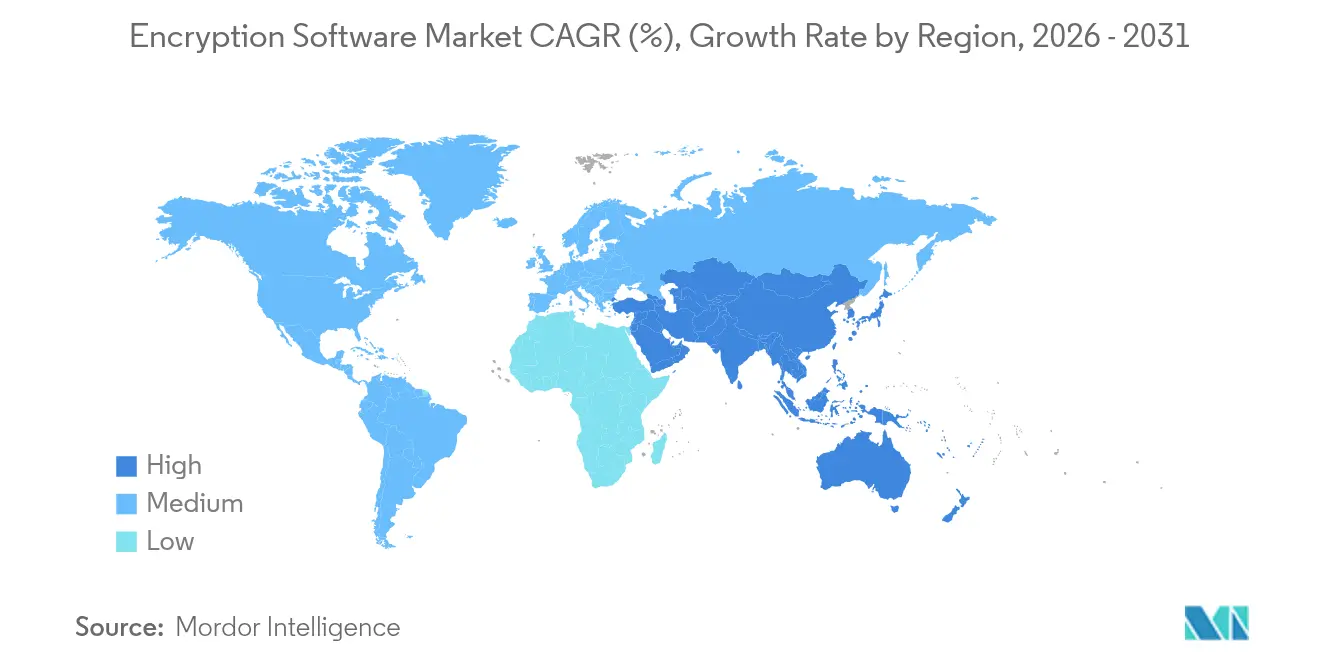
| Fastest Growing Market | Asia Pacific |
| Largest Market | North America |
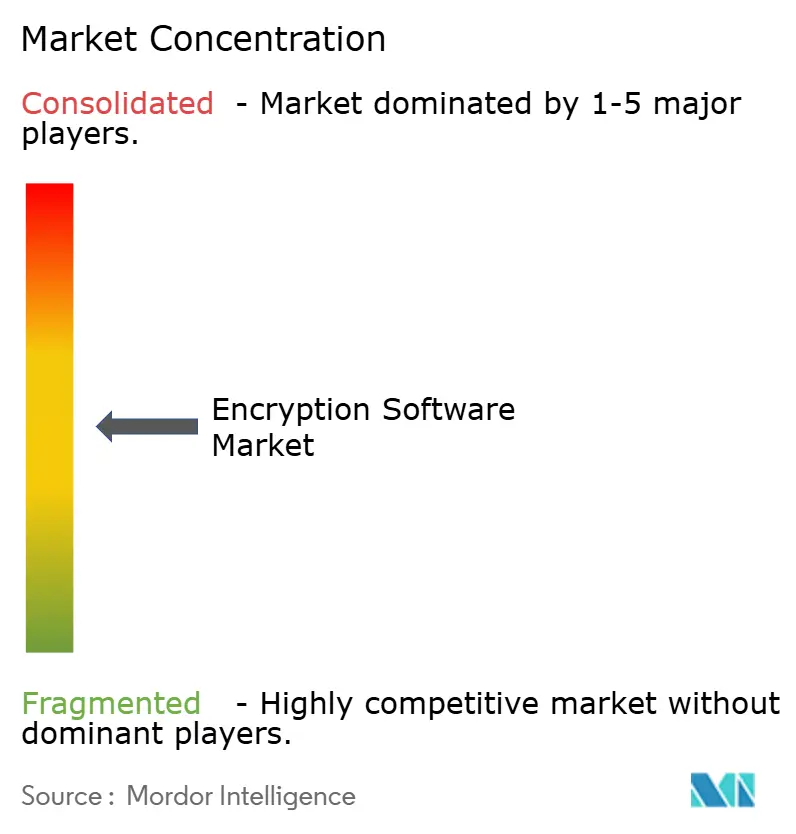
| Market Concentration | Medium |
Major Players *Disclaimer: Major Players sorted in no particular order Image © Mordor Intelligence. Reuse requires attribution under CC BY 4.0. | |
Encryption Software Market Analysis by Mordor Intelligence
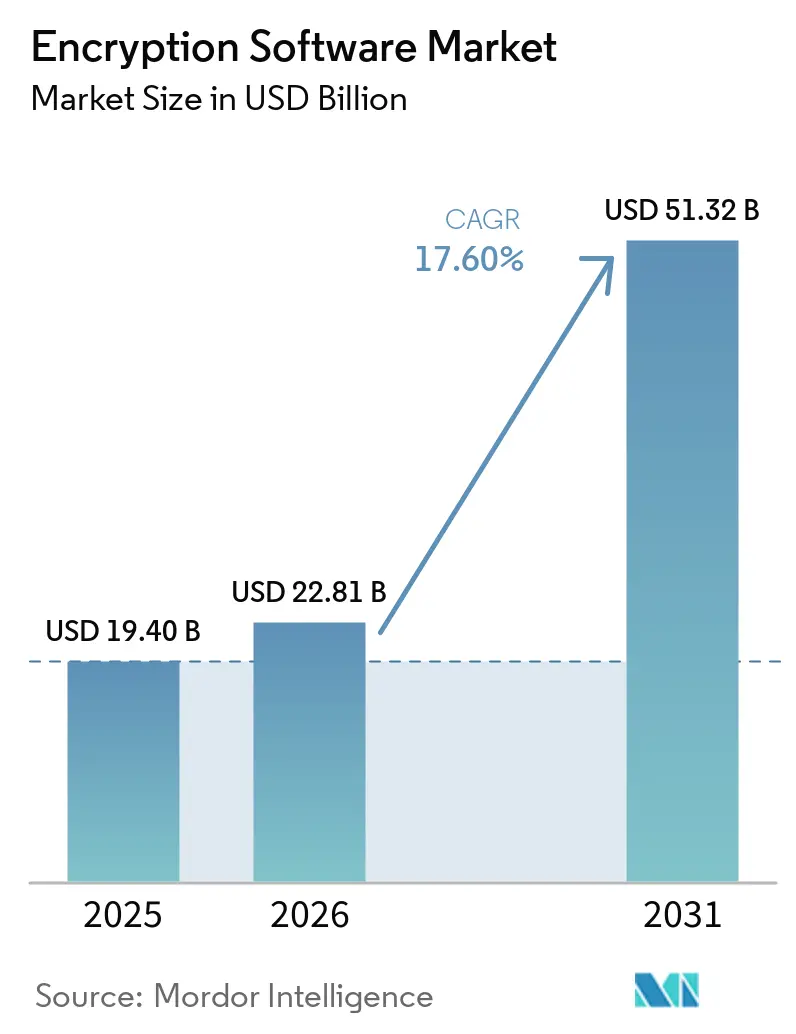
The encryption software market size was valued at USD 19.4 billion in 2025 and estimated to grow from USD 22.81 billion in 2026 to reach USD 51.32 billion by 2031, at a CAGR of 17.6% during the forecast period (2026-2031). Rapid adoption follows the August 2024 release of the first three NIST post-quantum cryptography (PQC) standards and a 2035 federal deadline for PQC implementation, which together de-risk procurement decisions and unlock budget allocations.[1] Enterprises are embedding encryption across zero-trust frameworks mandated by U.S. Executive Order 14028, while the permanent hybrid workforce pushes cloud-native deployment models and distributed key management. Competition is intensifying as incumbent security vendors race against quantum-cryptography start-ups, with acquisitions filling capability gaps and platform integration emerging as a key differentiator. APAC’s surge, healthcare’s regulatory urgency, and a pivot from perimeter to data-centric protection all reinforce sustained expansion opportunities across the encryption software market.
Key Report Takeaways
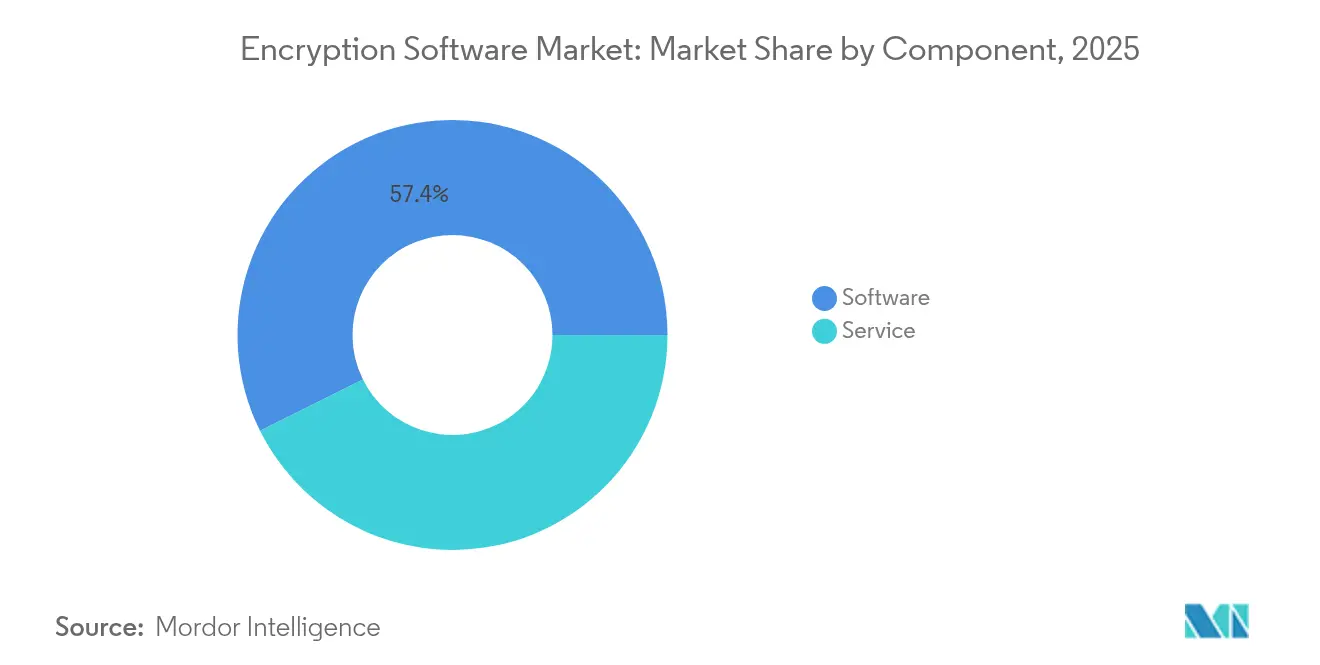
- By component, software maintained 57.35% of encryption software market share in 2025, while services are projected to grow fastest at 20.6% CAGR to 2031.
- By deployment model, on-premise held 61.28% of the encryption software market size in 2025; cloud deployment is forecast to expand at a 24.07% CAGR through 2031.
- By function, disk encryption accounted for 32.85% of encryption software market size in 2025; cloud encryption is advancing at a 26.85% CAGR.
- By vertical, BFSI led with 29.40% revenue share in 2025, while healthcare is poised to rise at a 20.55% CAGR.
- By geography, North America captured 42.60% of encryption software market share in 2025; APAC is set to climb at a 19.78% CAGR.
Note: Market size and forecast figures in this report are generated using Mordor Intelligence’s proprietary estimation framework, updated with the latest available data and insights as of 2026.
Market Trends and Insights
Drivers Impact Analysis of Encryption Software Market*
| Driver | (~) % Impact on CAGR Forecast | Geographic Relevance | Impact Timeline |
|---|---|---|---|
| Stringent data-protection regulations | +4.2% | Global; EU & US lead | Medium term (2-4 years) |
| Rising cyber-attacks on cloud workloads | +3.8% | North America & APAC | Short term (≤ 2 years) |
| Remote & hybrid workforce needs | +3.1% | North America, EU | Medium term (2-4 years) |
| Homomorphic encryption uptake | +2.4% | North America, EU | Long term (≥ 4 years) |
| Quantum-resistant pilots | +2.1% | US & allies | Long term (≥ 4 years) |
| Hardware root-of-trust for IoT | +1.6% | APAC hubs | Medium term (2-4 years) |
| Source: Mordor Intelligence | |||
Stringent Data-Protection Regulations
Global watchdogs now require proactive encryption mandates that embed security into digital infrastructure rather than treat it as a check-box exercise. The U.K. Information Commissioner’s Office updated guidance in May 2025, mandating algorithm-strength oversight that directly steers procurement choices. In the United States, Cybersecurity Maturity Model Certification 2.0 compels contractors to encrypt Controlled Unclassified Information in transit and at rest, widening the addressable encryption software market among federal suppliers.[2] The Department of Justice’s Civil Cyber-Fraud Initiative raises financial penalties for non-compliance, turning encryption into a material risk-management imperative. Financial institutions supervising USD 23 trillion in assets face overlapping GLBA, SOX, and PCI-DSS mandates, each specifying encryption requirements, reinforcing multi-layered adoption across front-, middle-, and back-office systems. Together, these statutes contribute a 4.2% uplift to the forecast CAGR.
Rising Volume & Sophistication of Cyber-Attacks on Cloud Workloads
Attacks have shifted from opportunistic data theft to systematic “harvest-now-decrypt-later” campaigns that bank encrypted datasets for future quantum decryption. Canada’s National Cyber Threat Assessment 2025-2026 flags state-sponsored actors escalating AI-assisted campaigns targeting critical infrastructure.[4] Enterprises answer with defense-in-depth strategies layering multiple encryption protocols and unified key hierarchies. Cloud encryption’s 27.6% CAGR reflects the urgency to protect multi-tenant workloads as ransomware evolves into double and triple-extortion assaults. Consequently, encryption becomes the final shield once perimeter defenses fall, fuelling integrated solution demand across hybrid environments.
Remote & Hybrid Workforce Fueling Endpoint-Level Encryption Demand
Distributed work dissolves fixed perimeters, forcing encryption onto every endpoint. SMEs, in particular, cite security and privacy concerns among chief cloud adoption hurdles, prompting demand for user-friendly encryption tools. Bring-your-own-device culture expands the diversity of endpoints, requiring encryption solutions that operate agnostic of ownership or network context. Zero-trust policies treat each device as potentially compromised, making endpoint-level encryption non-negotiable. Healthcare provides a prominent example: 92% of providers now use TLS for data flows and 87% have multi-factor authentication in place to secure remote electronic health records iaeme. The trend drives steady advance in unified data-at-rest and data-in-motion protection.
Homomorphic Encryption Adoption in Privacy-Preserving Analytics
Homomorphic encryption moves from academic theory to enterprise pilots, allowing analytics on encrypted data without exposing the plaintext. Banks apply the technology to fraud-detection algorithms that span multiple institutions, preserving client confidentiality while improving risk models. Healthcare research groups carry out federated genomic studies across hospitals without leaking patient data. Performance barriers shrink thanks to hardware acceleration and algorithmic refinements, making real-time encrypted computation feasible for advertising-tech analytics within evolving privacy laws. Cloud providers now position homomorphic encryption as a managed service, lowering entry hurdles for firms lacking deep cryptographic talent.
Restraints Impact Analysis of Encryption Software Market*
| Restraint | (~) % Impact on CAGR Forecast | Geographic Relevance | Impact Timeline |
|---|---|---|---|
| High TCO of full-disk encryption at scale | −2.8% | Global; SMEs hardest hit | Short term (≤ 2 years) |
| Proliferation of open-source & pirated tools | −1.9% | APAC & emerging markets | Medium term (2-4 years) |
| Source: Mordor Intelligence | |||
High TCO of Full-Disk Encryption at Enterprise Scale
Total cost of ownership encompasses not just licensing but hardware upgrades, performance overhead, and specialist staffing. Post-quantum algorithms can impose 10-30% processing overhead, forcing infrastructure refresh cycles. Key management introduces further capital outlays for hardware security modules and segregated networks. Annual enterprise key-management budgets can range from USD 500,000 to USD 2 million, outstripping software fees. In latency-sensitive environments such as high-frequency trading, even microsecond delays translate into lost revenue, compelling expensive hardware acceleration. SMEs with limited budgets therefore delay or scale down broad encryption roll-outs, shaving 2.8% from the CAGR.
*Our forecasts treat driver/restraint impacts as directional, not additive. The impact forecasts reflect baseline growth, mix effects, and variable interactions.
Encryption Software Market Segment Analysis
By Component:
Services Surge Amid Quantum TransitionServices currently trail software yet register the steepest ascent as enterprises confront the 2035 PQC compliance horizon. The encryption software market size attributed to services will climb on a 20.6% CAGR, driven by demand for cryptographic asset inventories, algorithm migration roadmaps, and managed key-lifecycle oversight. Federal agencies earmark an estimated USD 7 billion for PQC transition services—an indicator of the consulting windfall in play. Software still secures recurrent revenue through subscriptions, but rising complexity favors turnkey managed offerings, especially within healthcare and finance where certified expertise and continuous compliance are mandatory.
At the same time, software vendors embed automated migration tooling, prompting vendors to bundle advisory services for differentiated value. This dual revenue track—license plus services—strengthens vendor lock-in, particularly where platform integration minimises operational friction. Over 60% of new deals scoped in 2025 combine software licenses with professional-service packages that cover discovery, remediation, and PQC-ready architecture validation. Consequently, partnerships between software publishers and global systems integrators are proliferating, helping both sides monetise the quantum shift inside the encryption software market.

By Deployment Model:
Cloud Encryption AcceleratesDespite on-premise deployments commanding 61.28% of encryption software market size in 2025, cloud encryption climbs fastest at a 24.07% CAGR on the back of hybrid architectures and federal cloud-first mandates. Government agencies implementing zero-trust frameworks require scalable key management that spans public-, private-, and multi-cloud estates gsa. Small and mid-sized enterprises favour cloud subscriptions to sidestep capital outlays and access enterprise-grade security on demand, aligning with operational efficiency gains noted in 82% of SME studies businesses.
On-premise solutions retain appeal where data sovereignty or ultra-low latency demands prevail, such as regulated banking workloads and high-frequency trading platforms. Yet cloud providers now offer Hardware Security Module-as-a-Service and confidential-computing enclaves, eroding legacy objections to off-premise key custody. Cloud-native encryption enables rapid policy propagation across containers and serverless functions otherwise hard to cover with traditional disk encryption. As a result, the encryption software market witnesses a secular tilt towards flexible SaaS models while hybrid adoption ensures on-premise tools remain relevant, albeit at a slower growth pace.
By Enterprise Size:
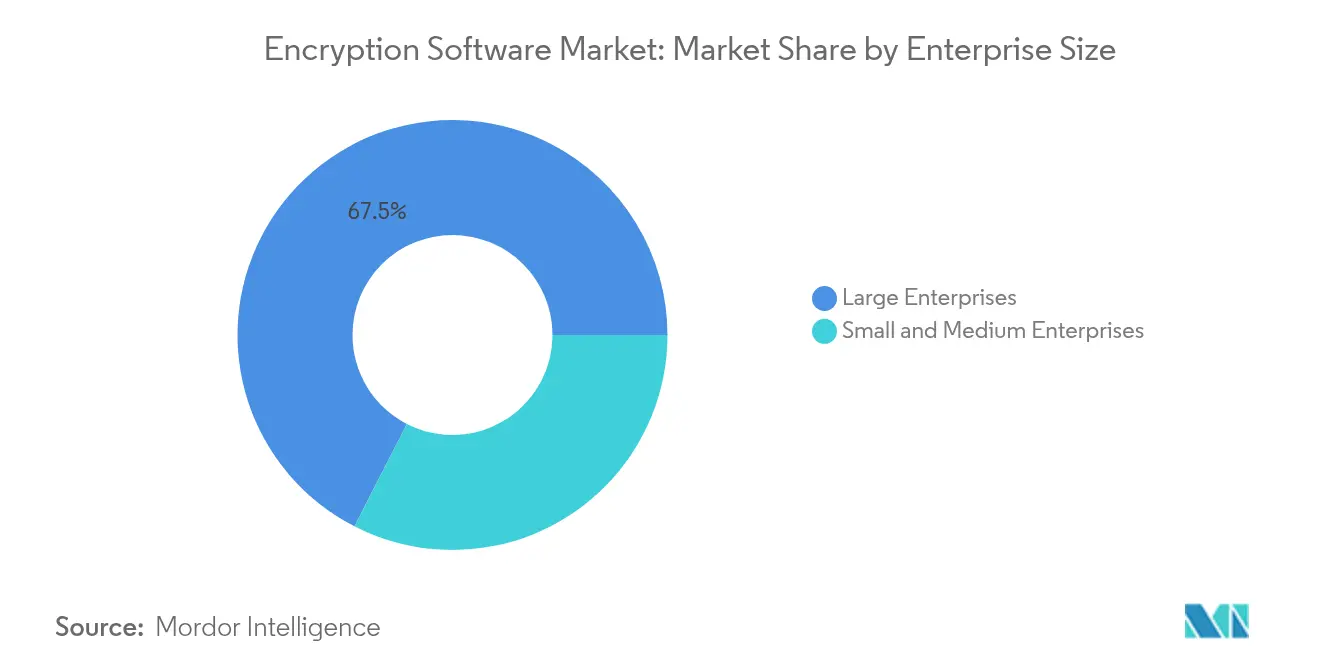
SMEs Embrace Cloud-First EncryptionLarge enterprises hold 67.46% revenue share, reflecting complex multi-layer deployments and deep compliance obligations. Still, SMEs are the fastest-expanding cohort at 22.5% CAGR, empowered by user-friendly cloud services that abstract cryptographic complexity. Surveyed SMEs highlight phishing, ransomware, and insider abuse as top threats, with encryption cited among preferred safeguards to fulfil customer trust commitments jis.
However, cost and skills gaps persist. Providers therefore package encryption with managed detection and response, automating key rotation and audit reporting. Vendors targeting the SME channel emphasise rapid onboarding, subscription pricing, and compliance templates aligned to PCI-DSS and HIPAA. Meanwhile, large enterprises drive custom integration projects that stitch encryption into legacy ERP and data-warehouse environments, leveraging vendor professional services at scale. The two-speed demand underscores why portfolio breadth—from entry-level SaaS to bespoke on-premise modules—remains pivotal for capturing share across the encryption software market.
By Function:
Cloud Encryption Leads InnovationDisk encryption continues to top revenue at 32.85%, yet its share will erode as organisations pivot to the cloud. Cloud-specific encryption is forecast to outstrip every other function at a 26.85% CAGR, buoyed by containerised workloads and the need for granular, data-centric protection. Communication encryption supports remote work, while database encryption advances steadily under zero-trust mandates. Vendors increasingly bundle multi-function capabilities under a unified management plane, curbing console sprawl and easing compliance audits.
Emerging homomorphic encryption and secure multi-party computation modules extend functional scope, letting users process encrypted datasets without decrypting them. Demand is strongest in regulated analytics—fraud scoring, collaborative healthcare research—where data sensitivity precludes plaintext sharing. Consequently, R&D pipelines concentrate on performance optimisation to make advanced encryption practical for latency-intensive use cases, cementing function-level diversification as a growth catalyst within the encryption software market.
By Industry Vertical:
Healthcare Drives Regulatory ComplianceBFSI retains the largest wallet share, but healthcare records the highest trajectory at 20.55% CAGR. HIPAA revisions and telehealth expansion require end-to-end protection of electronic health information, boosting TLS adoption to 92% and MFA usage to 87% within provider networks. Hospitals also gravitate toward homomorphic encryption for multi-institutional research in genomics and drug discovery, safeguarding patient privacy while enabling large-scale analytics.
Government adoption rises alongside PQC mandates, while IT-telecom sectors pioneer edge-to-cloud encryption for 5G rollout. Retail and education display steady uptake as e-commerce and digital-learning channels widen attack surfaces. Vertical demand therefore aligns to the regulatory burden and digital-transformation velocity, not the fundamental need for confidentiality, underscoring a broadening opportunity pool for vendors across the encryption software market.
Geography Analysis
North America Encryption Software Market
North America leads at 42.60% market share, fortified by early zero-trust adoption and a robust vendor ecosystem. The region benefits from the National Quantum Strategy, which allocates CAD 360 million (USD 267 million) to post-quantum cryptography R&D and aims to deliver a secure quantum communication network. State legislatures are equally active, with 75 cybersecurity bills enacted in 2024 alone, driving encryption procurement within the public sector.
APAC and Europe Encryption Software Market
APAC, climbing at 19.78% CAGR, reflects rapid digitisation in manufacturing, finance, and healthcare plus accelerating regulatory frameworks in Japan, South Korea, and Singapore. The region’s semiconductor dominance advances hardware-root-of-trust shipments yet also reveals supply-chain fragility, spurring interest in software-only encryption that mitigates component shortages. Europe grows at a steady clip under GDPR compliance and new U.K. guidance that stresses algorithm-strength governance, reinforcing encryption’s role in digital sovereignty. Collectively, these trends map a geographic landscape where leadership in policy, supply chains, and cloud adoption determines regional momentum within the encryption software market.
Europe’s trajectory aligns to data localization and privacy priorities. Renewed focus on homomorphic encryption facilitates cross-border analytics without breaching GDPR. Member states coordinate quantum-safe pilot projects to protect critical infrastructure, driving procurement of PQC-enabled email gateways and VPNs. Email encryption solution providers are also focusing on cutting-edge technology-enabled solution development to mitigate the security risk of BFSI players. Brexit imposes data-transfer complexity, making encryption essential for U.K.–EU commerce. Fragmented national regulations create opportunity for vendors offering policy-aware key management capable of adapting to differing retention and disclosure rules.
Regulatory Landscape
The regulatory environment is tightening around quantum-safe and secure-by-design cryptography requirements. In August 2024, NIST published the first post-quantum cryptography standards (FIPS 203, 204, and 205), giving procurement-grade baselines for vendors and buyers. In June 2026, a US Executive Order directed the transition of Federal information systems to NIST-approved PQC standards, and it also set a path to embed PQC compliance into the Federal Acquisition Regulation by 2030. OMB Memorandum M-26-15 (June 2026) then formalized a multi-phase civilian-agency migration program spanning 2026 to 2035, including an October 22, 2026 deadline for agencies to submit PQC migration plans. That timeline is likely to increase demand for crypto-inventory, algorithm agility, and migration tooling across federal and supplier ecosystems.
In Europe, the Cyber Resilience Act (Regulation (EU) 2024/2847, adopted October 2024) extends obligations for products with digital elements to protect confidentiality and integrity using state-of-the-art cryptographic mechanisms. It shifts compliance from point controls to lifecycle security engineering. Alongside these requirements, NIST continued to maintain core cryptographic guidance, including a June 2026 call for comments on revisions to SP 800-38D (GCM/GMAC) and a December 2025 draft of SP 800-57 Rev. 6 that incorporates new PQC algorithms and updated key-management guidance. This supports a steady cadence of standards evolution that vendors must track for validation and audit readiness.
Competitive Landscape
Encryption remains a moderately fragmented field where established giants and nimble specialists collide. IBM, Microsoft, and Broadcom leverage existing customer footprints and broad security suites, cross-selling encryption modules bolstered by cloud, identity, and analytics offerings. Quantum-specialist start-ups such as Arqit advance differentiated intellectual property on symmetric key-agreement protocols, drawing interest from defense and telco clients. Patent filings around hybrid PQC algorithms and quantum-secure communication channels underscore mounting barriers to entry.
Acquisition momentum reflects strategic gaps: Arqit’s May 2025 purchase of Ampliphae’s encryption-visibility technology augments its quantum-safe portfolio. NetSfere launched the first enterprise-ready ML-KEM 1024 communication platform, targeting regulated industries with immediate PQC compatibility. Vendors now compete on platform integration—unified key orchestration across SaaS, IaaS, and on-premise assets—rather than isolated point solutions. Industry-specific templates for HIPAA, PCI-DSS, and CJIS bolster value propositions, especially among SMEs seeking turnkey compliance. Artificial-intelligence-driven policy automation further differentiates offerings by cutting operational overhead and addressing the high TCO restraint shadowing the encryption software market.
Consolidation is expected as cash-rich incumbents acquire algorithm innovators to fast-track PQC portfolios. Meanwhile, open-source communities pressure pricing on commoditized components, encouraging premium vendors to double down on managed services and regulatory expertise. Success hinges on the ability to deliver end-to-end encryption lifecycle management—from discovery and inventory through migration and continuous audit—across heterogeneous customer estates.
Encryption Software Industry Leaders
-
IBM
-
Microsoft
-
Broadcom Inc.
-
Sophos Ltd.
-
Thales
- *Disclaimer: Major Players sorted in no particular order
Encryption Software Market Companies Covered in this Report
- IBM
- Microsoft
- Broadcom Inc. (Symantec)
- Sophos Ltd.
- Thales
- McAfee LLC
- Trend Micro Incorporated
- Dell Inc.
- Check Point Software Technologies Ltd.
- Micro Focus International plc
- Cisco Systems, Inc.
- Proofpoint Inc.
- WinMagic Inc.
- ESET spol. s r.o.
- F-Secure Corporation
- Amazon Web Services Inc.
- VMware Inc.
- Fortinet Inc.
- Oracle Corporation
- Google LLC
Market Opportunities and Future Outlook
PQC migration programs are creating white space for cryptographic agility, discovery, and remediation capabilities that let organizations operate mixed classical and PQC stacks while preserving compatibility. The June 2026 Executive Order on securing the nation against advanced cryptographic attacks, plus OMB M-26-15 and its October 22, 2026 deadline for federal PQC migration plan submissions, is lifting near-term demand for tools that automate cryptographic asset inventories, map dependencies across applications and endpoints, and support policy-driven algorithm transitions. Vendors also have an expanding target for compliance-ready controls, such as standardized reporting, key-lifecycle governance, and migration playbooks, aimed at federal contractors and adjacent regulated operators.
At the same time, implementation barriers are being reduced as PQC capabilities move into mainstream platforms and developer tooling. Microsoft incorporated configurable hybrid PQC key exchange (ML-KEM) into the Windows TLS/Schannel stack via July 2026 updates, and OpenSSH added experimental composite post-quantum signature support in version 10.4 (July 2026). This broadens the set of endpoints and secure-communications layers that can be upgraded without bespoke crypto integration. In embedded security, GlobalPlatform launched Pavona (May 2026), an open-source silicon distribution with production-grade PQC components and reference designs for root-of-trust chips, which supports additional device and IoT use cases that need encryption anchored in trusted hardware while staying standards-aligned.
Recent Industry Developments in Encryption Software Market
- July 2026: Microsoft delivered Windows updates that integrate configurable hybrid post-quantum key exchange (ML-KEM) into the Windows TLS/Schannel stack. This moves PQC from optional libraries into a default enterprise protocol layer, accelerating compatibility testing and creating pull-through demand for key-management and policy controls that span endpoints, servers, and applications.
- May 2026: Syncsort (Precisely) announced the acquisition of Townsend Security’s IBM i encryption, tokenization, and authentication products, alongside a partnership around Alliance Key Manager. The deal consolidates data protection capabilities around IBM i estates and strengthens vendor positioning in regulated environments that require centralized key control and audit-ready governance.
- October 2024: IBM introduced the IBM Guardium Data Security Center with expanded capabilities spanning data security and quantum-safe readiness. The platform approach supports unified visibility and control across disparate encryption and data-protection assets, aligning with enterprise demand for consolidated management as cryptographic standards and compliance requirements evolve.
Encryption Software Market Report Scope and Research Methodology
Market Definition and Coverage
In this report, we define the encryption software market as revenues earned from software tools that encrypt data at rest, in transit, or in use across endpoints, servers, networks, and cloud environments. It includes license and subscription revenue tied to encryption and related key management capabilities sold to end users.
Scope exclusions: We exclude stand-alone hardware modules, consultancy-only engagements, and managed security service fees from this market sizing.
Segments Covered in This Report
- By Component
- Software
- Service
- By Deployment Model
- On-premise
- Cloud
- By Enterprise Size
- Large Enterprises
- Small and Medium Enterprises
- By Function
- Disk Encryption
- Communication Encryption
- File/Folder Encryption
- Cloud Encryption
- Database Encryption
- By Industry Vertical
- IT and Telecommunication
- BFSI
- Healthcare
- Government
- Retail
- Education
- Others
- By Geography
- North America
- United States
- Canada
- Mexico
- South America
- Brazil
- Argentina
- Rest of South America
- Europe
- United Kingdom
- Germany
- France
- Italy
- Spain
- Rest of Europe
- Asia-Pacific
- China
- Japan
- India
- South Korea
- Australia
- Rest of Asia-Pacific
- Middle East
- Saudi Arabia
- United Arab Emirates
- Turkey
- Rest of Middle East
- Africa
- South Africa
- Nigeria
- Egypt
- Rest of Africa
- North America
Data Sources, Market Sizing, and Validation
Desk Research
We start by mapping the demand story for encryption to measurable public signals, and then connect it to supplier side revenue reporting. For this, we use public sources such as NIST publications for cryptography standards, ENISA guidance on cybersecurity controls, and NIST NVD data for vulnerability patterns that often trigger encryption upgrades. We also refer to regulatory and policy references that influence adoption, including GDPR materials, and sector guidance such as the FFIEC for financial security expectations.
To turn that context into a usable market model, we review company annual reports, earnings call transcripts, product documentation, and trusted press coverage to separate what gets sold as encryption software versus adjacent security tools. In parallel, we use paid database subscriptions for company financials and intelligence, news and financials, patent databases, and global contracts and tenders to cross check revenue exposures, product positioning, and deal activity. These desk sources are not exhaustive, and we used many other public references during data collection, validation, and clarification.
Primary Interviews and Surveys
Primary interviews and surveys were used to confirm what buyers actually pay for, how encryption is budgeted inside broader security programs, and how pricing changes with cloud adoption and compliance requirements. We spoke with a mix of software providers, channel partners, security architects, and IT risk owners, which helped fill gaps where public financials do not break out encryption revenue cleanly. Since this is a global market, validation was taken across major regions to avoid relying too heavily on a single geography's adoption pattern.
Distribution of primary research fieldwork respondents
| Company type | Respondent position | Region |
|---|---|---|
| Top tier: 31% | CXOs: 12% | APAC: 48% |
| Mid tier: 47% | Functional/Unit leaders: 37% | EMEA: 34% |
| Smaller Players: 22% | Managers: 51% | Americas: 18% |
Market-Sizing & Forecasting
The core sizing logic uses a top-down and bottom-up blend, where overall cybersecurity software spending and encryption adoption patterns are reconstructed by region and major user groups, and then corrected using selective supplier and channel checks. We begin with known enterprise security spend anchors and then apply encryption specific splits based on how data protection is prioritized in regulated industries and cloud migration programs. Where categories overlap, the model assigns revenue only to encryption software when the product is directly sold for encryption or key management outcomes.
A few practical inputs keep the model grounded, including the share of workloads running in public cloud versus on premises, typical encryption attach rates in regulated sectors, identity and key management packaging practices, average subscription pricing movement, and the pace of compliance led refresh cycles (including crypto agility work as post-quantum planning becomes more common). Forecasting is built using scenario analysis supported by expert consensus on cloud adoption, regulation intensity, and breach driven spending behavior, and then a short trend fit is used as a reasonableness check for each region. If a vendor does not report encryption revenue separately, we estimate exposure using product mix cues, partner feedback, and comparable pricing to avoid leaving material gaps.
Data Validation & Update Cycle
Outputs are checked against independent signals such as reported security software growth rates, procurement activity patterns, and region level IT spending direction, and any large variances are reworked before sign off. When results look inconsistent, we re contact relevant interviewees to retest assumptions like encryption attach rate, cloud packaging, and renewal pricing movement. A second analyst review is done to make sure the math, unit logic, and conversions are consistent across regions and years.
The report is refreshed annually, and interim updates are made when material events change adoption or pricing, such as major regulatory actions or step changes in cloud security requirements. Before delivery, an analyst completes a final update pass so that clients receive the latest view based on the most recent information available.
Mordor Intelligence's Encryption Software Market Size Compared With Other Published Estimates
It is normal to see different market sizes for encryption software because researchers do not always count the same revenue streams, and they also pick different base years and price assumptions. The spread usually comes from how broadly "encryption" is defined, whether key management is treated as part of the market, and how cloud delivered encryption is booked.
Some published figures fold in managed security services or hardware security modules because buyers often purchase these together as a bundle. In Mordor Intelligence, only encryption software revenue (licenses, subscriptions, and embedded cloud-service revenue) plus encryption related key management add ons are counted, and stand-alone hardware, consultancy-only work, and managed security service fees are excluded.
Benchmark comparison
| Source | Market Size | Gaps in Research Methodology |
|---|---|---|
| Mordor Intelligence | USD 22.81 B (2026) | |
| Trade Journal A | USD 17.45 B (2024) | Uses an earlier base year and tends to blend software with services in data protection programs, which can lower the pure software line item and change the implied pricing curve. |
| Global Consultancy B | USD 15.29 B (2025) | Tracks a narrower commercial encryption scope and relies more on historic trend extension, which can understate cloud-driven expansion and the separate monetization of key management add-ons. |
Overall, the table shows that the biggest drivers of variance are what gets included with encryption software and which year is being measured. By tying the total to clear revenue types, adoption indicators, and repeatable split assumptions, our estimate stays easier to audit and update when pricing or cloud mix shifts.
Key Questions Answered in the Report
What is the encryption software market worth today and how fast is it growing?
The market stands at USD 22.81 billion in 2026 and is forecast to reach USD 51.32 billion by 2031, posting a 17.6% CAGR.
Which deployment model is expanding most quickly?
Cloud-based encryption leads with a 24.07% CAGR through 2031 as organizations migrate workloads to hybrid and multi-cloud environments.
Why is healthcare showing the highest vertical growth?
Updated HIPAA rules, rapid digitization, and the need to secure telehealth data are propelling healthcare encryption at a 20.55% CAGR.
How do U.S. federal mandates influence adoption rates?
Executive Orders 14028 and 14144, plus a 2035 deadline for post-quantum cryptography, require end-to-end encryption across federal systems and their supplier networks, accelerating market demand.
Which region will grow fastest over the next five years?
Asia-Pacific is projected to expand at a 19.78% CAGR, driven by rapid digital transformation and tightening data-protection regulations across major economies.