
Electrotherapy Devices Market Size and Share
Market Overview
| Study Period | 2020 - 2031 |
|---|---|
| Forecast Data Period | 2026 - 2031 |
| Historical Data Period | 2020 - 2024 |
| Growth Rate | 4.15 % |
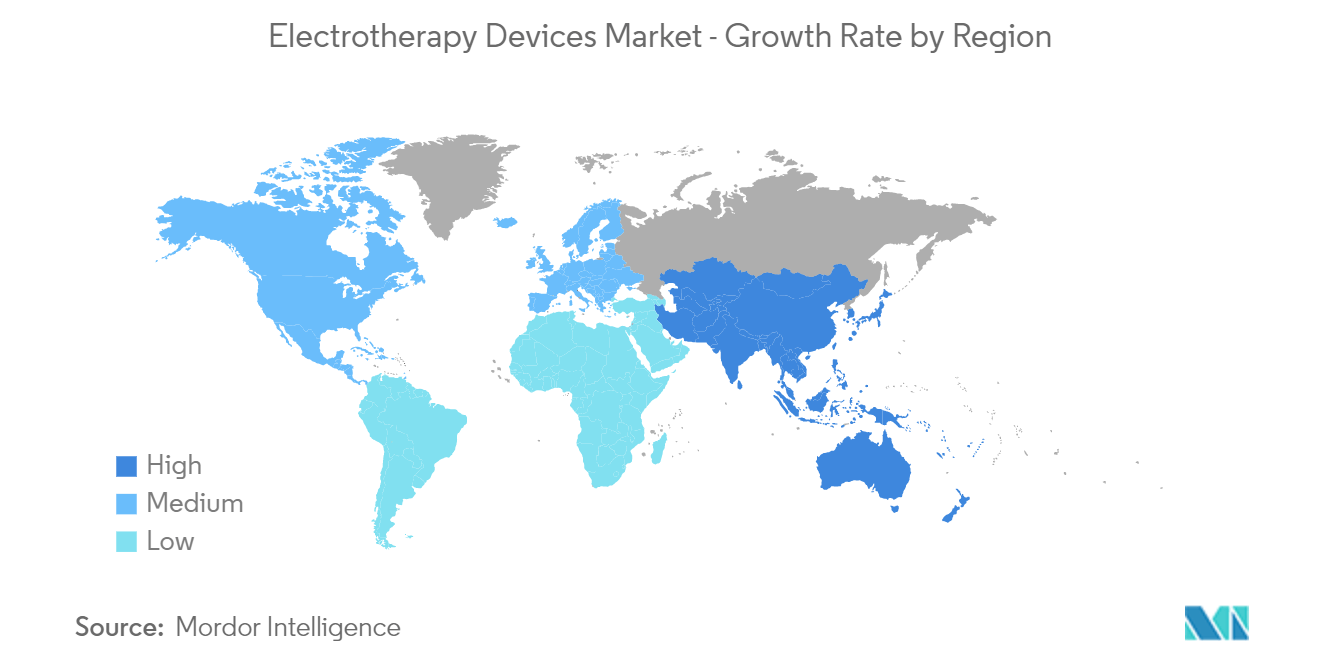
| Fastest Growing Market | Asia Pacific |
| Largest Market | North America |
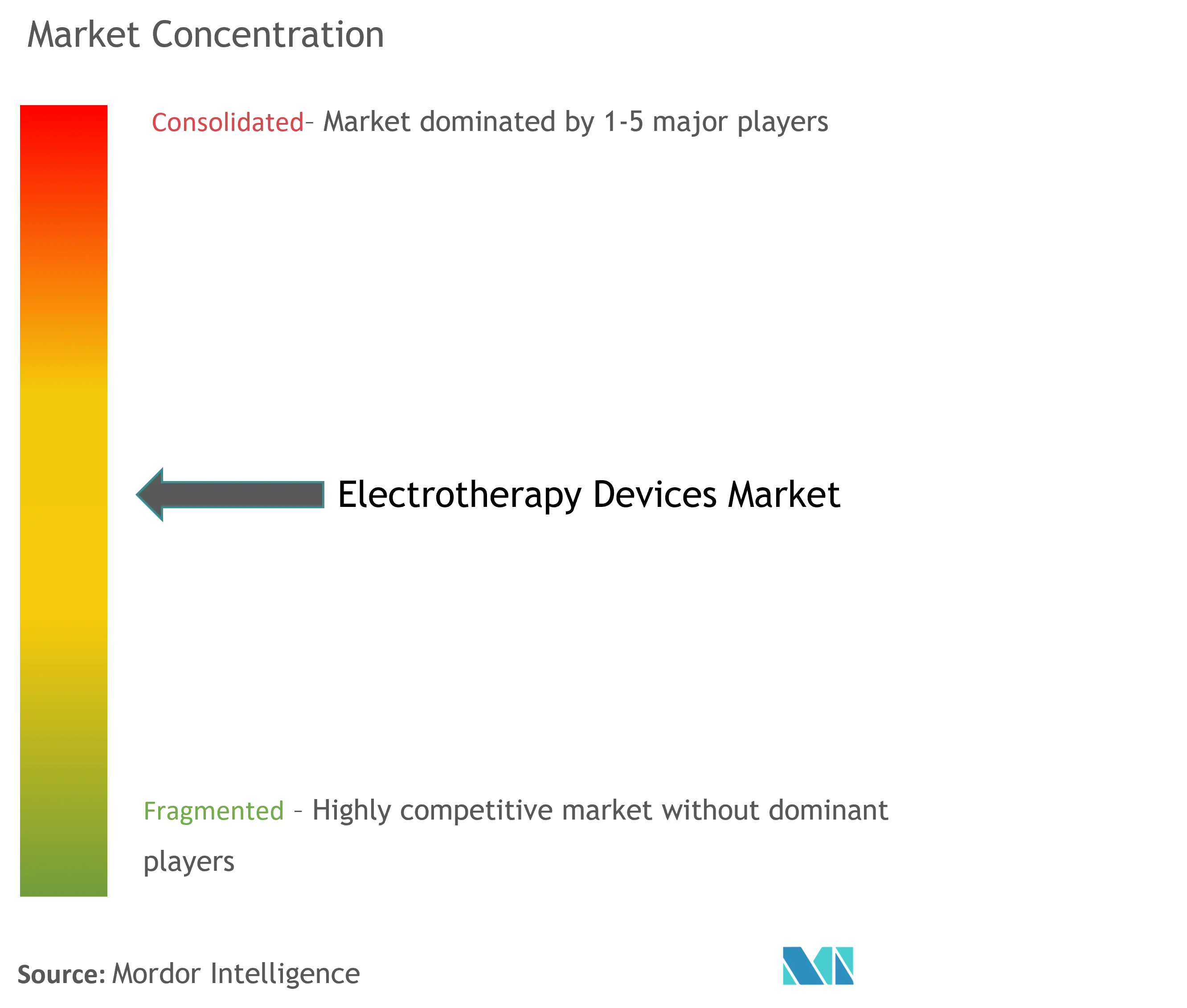
| Market Concentration | Medium |
Major Players *Disclaimer: Major Players sorted in no particular order Image © Mordor Intelligence. Reuse requires attribution under CC BY 4.0. | |
Electrotherapy Devices Market Analysis by Mordor Intelligence
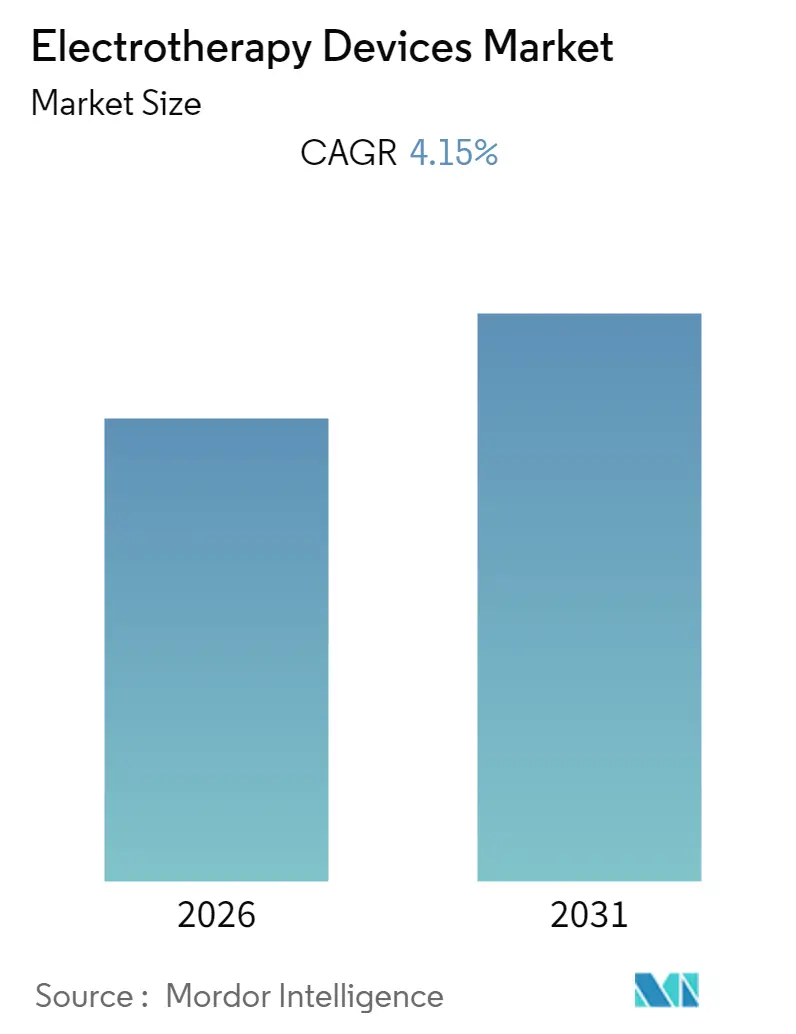
The Electrotherapy Devices Market size is expected to register a CAGR of 4.15% during the forecast period.
The studied market was adversely impacted by the COVID-19 pandemic. The research article published in Practical Pain Management in January 2022 stated that patients who dealt with mental health issues during the pandemic faced worsening pain symptoms. The researchers of the above-mentioned study suggested cranial electrotherapy stimulation helps in such issues leading to the adoption of electrotherapy during the pandemic. Therefore, the COVID-19 pandemic has significantly impacted the studied market. However, as the pandemic has subsided as the adoption of such therapy and devices has increased during the pandemic, the market is expected to have stable growth.
Factors such as increasing spinal injuries, back pain, and sports injuries are primary drivers of the studied market. Electrotherapy is used to treat neurological, muscular, or muscle-nerve diseases that cause pain. Electrotherapy can be beneficial in people who experience severe sensitivity, numbness, or weakness in back muscles. According to the data published by the National Safety Council of the United States in 2021, it is estimated that around 3.2 million people were treated in emergency departments for injuries involving sports and recreational equipment in the United States in 2021. The most common activities that were frequently associated with injuries were exercise, cycling, and basketball. The injury rate for exercise was 123.8 per 100,000 population in the United States in 2021, for bicycles and accessories, it was 113.7, for basketball, it was 78.6, for skateboards, scooters, and hoverboards, it was 74.2, and for football, it was 67.2.
Moreover, according to an article published in the National Library of Medicine in April 2022, a study was conducted in China in 2021 which showed that 31.3% of high school students, 23.8% of middle school students, and 19.2% of primary school students had sustained injuries while participating in campus football activities. Thus, the high prevalence of sports-related injuries around the world is expected to boost the growth of the market.
Additionally, approval from the regulatory authorities is also propelling the market's growth. For instance, in May 2021, ITO CO., LTD., one of the pioneers of electrophysical agents in Japan, received 510(k) clearance from the United States Food and Drug Administration for its Electrical Muscle Stimulator named TMJ Pain Relief "D function" for dental use.
Therefore, due to the factors mentioned above, such as increasing spinal injuries, back pain, and sports injuries, the studied market is anticipated to witness growth during the forecast period. However, the lack of awareness of the treatment is predicted to hinder market growth.
Note: Market size and forecast figures in this report are generated using Mordor Intelligence’s proprietary estimation framework, updated with the latest available data and insights as of 2026.
Global Electrotherapy Devices Market Trends and Insights
Nervous Disease Segment is Expected to Hold a Significant Market Share Over the Forecast Period
Neurological disorders are conditions that affect the spinal cord, brain, and body's nerves. The demand for nerve stimulation is increasing with the increasing number of cases of neurological diseases, especially in the use of electrotherapy devices. Hence, it is expected to fuel the segment's growth over the analysis period.
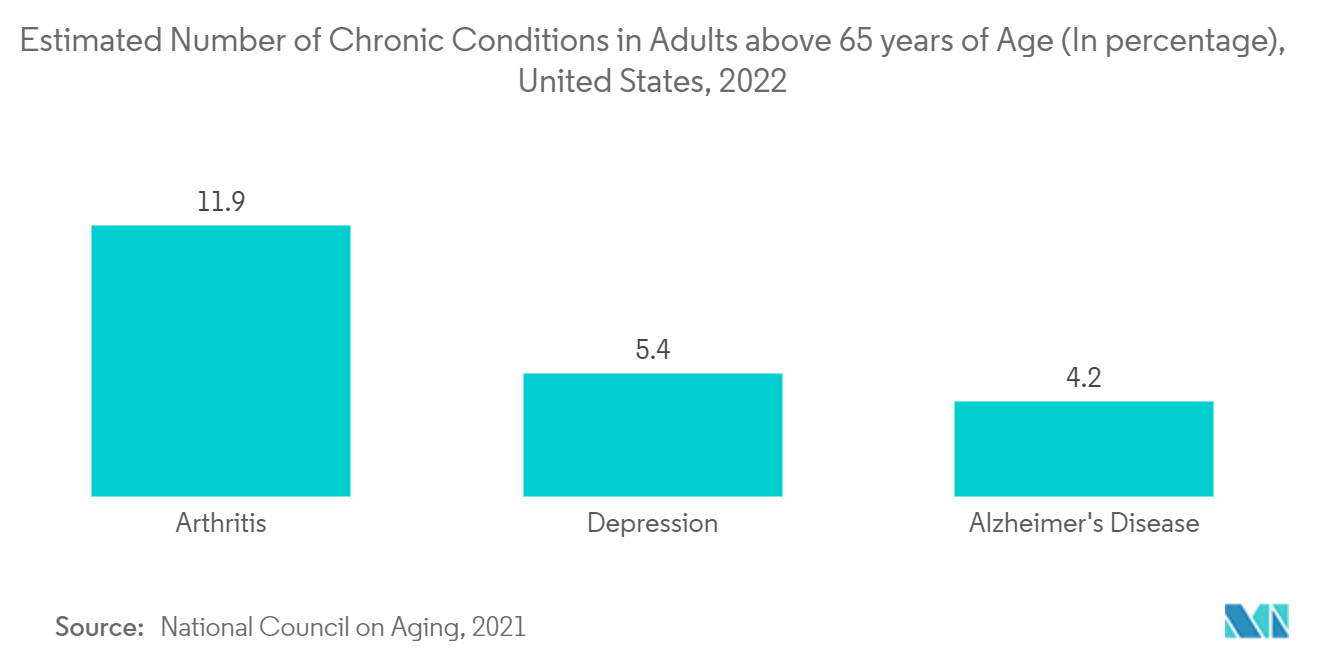
An increase in the number of patients suffering from central nervous system (CNS) disorders is likely to be the key factor contributing to the growth of the segment in the studied market. As per Alzheimer's Disease Facts and Figures 2022, published by the Alzheimer's Association in April 2022, Alzheimer's is more prevalent among people above 65 years of age. Additionally, the WHO data also reported that the number would reach 82 million by 2030. This increasing burden of nervous system disorders is anticipated to drive the demand for electrotherapy. Thereby driving the segment's growth globally.
Moreover, neurologic spinal cord injury impacts almost all physiologic systems, and patients may have a wide range of symptoms that have a significant impact on their function and quality of life. According to the article published in the National Library of Medicine in January 2022, muscle contraction is induced by electrical stimulation and can be used for neurorehabilitation after spinal cord injury (SCI). Additionally, as per the source above, the electrotherapy technique is currently a significant treatment strategy that helps individuals with SCIs regain their motor function. Thus, with an increasing incidence of SCIs and nervous disease globally, the demand for electrotherapy is increasing. This is further expected to drive segment growth.
Therefore, owing to the increasing burden of nervous diseases, the segment is expected to witness growth over the forecast period.
North America is Expected to Hold a Significant Market Share Over the Forecast Period
North America is one of the major contributors to the studied market, owing to the rise in sports injuries and increasing clinical trials in the region. The incidence of sport-related injuries, such as ligament sprains, muscle sprains, supraspinatus tendinitis, and others, is increasing among the population. This is anticipated to fuel the demand for electrotherapy products, boosting the market growth. For instance, according to the National Safety Council (NSC), in 2021, exercise equipment accounted for about 409,224 injuries in the United States, the most in any category of sports and recreation. Next, to exercise equipment injuries, the injuries caused by bicycles and accessories accounted for 375,797 in 2021. Furthermore, as per the Sports Accident Statistics report updated by LegalMatch in August 2022, injuries to the anterior cruciate ligament (ACL) occur roughly 150,000 every year in the United States.
According to the article published in the Acta Médica Journal stated, in a study conducted in Hospital Ángeles Mocel, Mexico, in 2021, the sport with the highest incidence of surgical sports injuries is soccer, with 39% for both genders. Meniscal injuries and anterior cruciate ligament (ACL) injuries are the most frequent diagnoses. Hence, the high burden of sports injury in the region is anticipated to drive the demand for electrotherapy procedures.
Furthermore, clinical trials in the region are another factor in market growth. For instance, in January 2022, a clinical trial was initiated by Institut Cancerologie de l'Ouest to evaluate the effectiveness of TENS and TENS ECOMODYN on the management of chronic breast pain after surgery. The study is expected to be completed by 2024. Such clinical trials are expected to provide innovative products in the market for breast pain post surgeries. Thus, such clinical trials are expected to increase market growth in the region.
Therefore, owing to these factors above, such as sports injuries, and clinical trials, North America is believed to hold a significant share of the market studied over the forecast period.
Competitive Landscape
The electrotherapy devices market is moderately competitive and consists of a few major players. The major market players are focusing on technological advancements. Some companies currently dominating the market are Omron Healthcare, Eme srl, STYMCO Technologies, Zynex Medical, Johari Digital, DJO Global, Inc., Astar, GymnaUniphy, Enraf-Nonius B.V., and Medtronic, among others.
Electrotherapy Devices Industry Leaders
-
Omron Healthcare
-
Eme srl
-
Zynex Medical
-
NeuroMetrix, Inc.
-
BTL Corporate
- *Disclaimer: Major Players sorted in no particular order
Market Opportunities and Future Outlook
Regulatory classification updates and new clearances are widening the set of electrotherapy indications and form factors moving through mainstream medical-device pathways. In 2026, the US FDA published final orders placing certain transcutaneous electrical nerve stimulator (TENS) products into Class II with special controls for specific uses, including fibromyalgia symptom treatment (effective May 29, 2026) and congestion relief (effective April 16, 2026). It also issued a Class II classification for combined acoustic and electrical external stimulation devices for tinnitus relief (effective June 10, 2026). These actions standardize expectations for safety and performance claims and create clearer submission routes for manufacturers targeting chronic pain and ENT-adjacent symptom management.
Product and indication expansion in 2026 also points to whitespace beyond clinic-based pain relief, including neurorehabilitation and home-use neuromodulation. ANEUVO reported FDA clearance (April 2026) for ExaStim, a portable, non-invasive transcutaneous spinal cord stimulation system for individuals with chronic spinal cord injury. Bioness Medical reported FDA 510(k) clearance (June 2026) for its PoNS (Portable Neuromodulation Stimulator) System to treat dynamic gait deficit in patients with chronic stroke using tongue-based electrical stimulation. In parallel, Johnson and Johnson launched the VARIPULSE Pro pulsed field ablation platform in Europe following CE Mark approval, highlighting continued investment in clinically integrated electrical-energy platforms and intensifying adjacent competitive pressure around workflow efficiency, physician adoption, and evidence generation across electrotherapeutic modalities.
Recent Industry Developments
- April 2026: Altivera Medical reported that the Defense Health Agency lifted the temporary payment suspension for TRICARE claims for Zynex Medical, Inc., effective March 31, 2026. The change restores a key reimbursement channel for Zynex electrotherapy offerings in the US military health system and supports continuity of patient access where coverage eligibility drives device utilization.
- February 2026: Zynex, Inc. announced a provider agreement with Humana Inc., effective February 1, 2026, making Zynex electrotherapy products including the NexWave device available to Humana members. The in-network status improves payer access and can reduce friction in prescribing and fulfillment for covered populations.
- March 2024: Omron Healthcare introduced AI-powered AFib detection functionality within its blood pressure monitoring ecosystem under the IntelliSense AFib capability. While not a therapy device, it reinforces the broader shift toward connected, algorithm-enabled home hardware platforms that can influence purchasing behavior and distribution channels used by electrotherapy device makers.
Research Methodology Framework and Report Scope
Market Definition and Coverage
This market covers revenues generated from medical electrotherapy devices that deliver electrical energy to support therapy, rehabilitation, and pain management across clinical and home-care settings.
Scope exclusions: we exclude general physiotherapy equipment that does not deliver electrical therapy, along with non-medical wellness gadgets that are not positioned for therapeutic use.
Segmentation Overview
- By Product Type
- High Frequency
- Med Frequency
- Low Frequency
- By Application
- Nervous Disease
- Muscle Injury
- Inflammation
- Pain Relief
- Others
- Geography
- North America
- United States
- Canada
- Mexico
- Europe
- Germany
- United Kingdom
- France
- Italy
- Spain
- Rest of Europe
- Asia-Pacific
- China
- Japan
- India
- Australia
- South Korea
- Rest of Asia-Pacific
- Middle East and Africa
- GCC
- South Africa
- Rest of Middle East and Africa
- South America
- Brazil
- Argentina
- Rest of South America
- North America
Data Sources, Market Sizing, and Validation
Desk Research
Desk research starts by mapping care pathways where electrotherapy is prescribed, then linking those pathways to device demand and replacement behavior. We relied on public sources such as World Health Organization burden-of-disease statistics, U.S. FDA device databases and safety notices, USGS and World Bank macro indicators, and peer-reviewed clinical journals that cover utilization and clinical adoption.
To keep regional numbers realistic, we also reviewed hospital and rehabilitation association websites, government health spending releases, and public company filings and investor presentations that mention portfolio mix and geographic exposure. In parallel, we used paid subscriptions for company financials and intelligence, news and financials tracking, and patent databases to understand innovation intensity and product-cycle timing. The desk sources listed here are illustrative only, and additional public references were used for data collection, cross-checking, and clarification.
Primary Interviews and Surveys
Primary work focused on verifying adoption, pricing, and procurement patterns that differ across countries, especially for pain-relief and rehab use cases. We spoke with a mix of manufacturers, distributors, clinicians, rehab-center operators, and procurement contacts to confirm product mix and pressure-test the assumptions used in the model. Respondent input was balanced across major geographies so regional differences in reimbursement, care setting, and channel structure were reflected in the demand and ASP assumptions.
Distribution of primary research fieldwork respondents
| Company type | Respondent position | Region |
|---|---|---|
| Top tier: 31% | CXOs: 19% | APAC: 38% |
| Mid tier: 50% | Functional/Unit leaders: 32% | EMEA: 35% |
| Smaller Players: 19% | Managers: 49% | Americas: 27% |
Market-Sizing & Forecasting
Sizing starts with a top-down build that reconstructs demand from therapy volume indicators and care-setting capacity, then ties that to likely device placement and replacement cycles. For electrotherapy devices, the model is anchored on variables such as outpatient rehab visit volumes, pain-management procedure mix, population aging, prevalence trends for musculoskeletal and neurological conditions, device replacement periods, and typical ASP bands by modality and setting.
Those totals are then checked using selective bottom-up approximations, mainly by rolling up sampled supplier revenues, distributor channel checks, and an ASP times unit volume sanity test for a few key countries. Where bottom-up inputs are incomplete, gaps are handled through ratio-based extrapolation from comparable markets, with adjustments for healthcare access and reimbursement intensity.
For forecasting, scenario analysis is used with a base case agreed through expert feedback, and then stressed with slower and faster adoption paths. Forward drivers include policy support for non-drug pain relief, the shift toward home-care, and product refresh cycles that influence ASP progression and unit demand.
Data Validation & Update Cycle
Validation is done by comparing model outputs against independent signals, such as regional healthcare spend direction, procedure and rehab utilization trends, and observed pricing ranges from channel feedback. If a country-level result looks unusually high or low, the assumptions are rechecked first, and then the relevant experts are re-contacted to confirm whether a real market shift has occurred.
Before sign-off, the work goes through multiple analyst reviews focused on arithmetic checks, scope alignment, and year-over-year logic. The report is refreshed annually, and interim updates are made when material events occur, such as major regulatory changes, pricing shocks, or meaningful shifts in care delivery. Right before delivery, a final pass is completed so clients receive the latest updated view.
Mordor Intelligence's Electrotherapy Devices Market Size Compared With Other Published Estimates
Published market sizes for electrotherapy devices can differ even when the product name looks identical, because the included modalities, end-use settings, and pricing assumptions are not matched across studies. Timing also affects comparability, since some estimates use older currency conversion points or keep ASPs flat even when product mix changes.
Some external estimates fold in a wider therapy toolkit and sometimes blend adjacent modalities, such as therapeutic ultrasound, into the same total, which can lift the reported number. In Mordor Intelligence sizing, the count is kept to electrotherapy devices revenue, and totals are constrained using rehab utilization signals and replacement-cycle logic so that volumes and ASPs do not drift away from realistic care delivery.
Benchmark comparison
| Source | Market Size | Gaps in Research Methodology |
|---|---|---|
| Mordor Intelligence | USD 2.20 B (2024) | |
| Industry Research Outlet A | USD 2.08 B (2024) | Uses a longer-dated growth curve and a broader definition that can mix additional therapy modalities and end-users, and this can pull the 2024 level down if pricing bands are set conservatively. |
| Healthcare Consultancy B | USD 2.45 B (2024) | Includes a wider set of device categories and indications, and the 2024 total is sensitive to how bundled kits and clinical setting markups are treated in ASP build-ups. |
The table shows that most of the spread comes from scope choices and the way pricing is progressed by setting and product mix. By keeping clear inclusions and checking totals against utilization and replacement patterns, we make the estimate easier to reconcile back to observable market signals.
Key Questions Answered in the Report
What is the current Electrotherapy Devices Market size?
The Electrotherapy Devices Market is projected to register a CAGR of 4.15% during the forecast period (2026-2031)
Who are the key players in Electrotherapy Devices Market?
Omron Healthcare, Eme srl, Zynex Medical, NeuroMetrix, Inc. and BTL Corporate are the major companies operating in the Electrotherapy Devices Market.
Which is the fastest growing region in Electrotherapy Devices Market?
Asia Pacific is estimated to grow at the highest CAGR over the forecast period (2026-2031).
Which region has the biggest share in Electrotherapy Devices Market?
In 2025, the North America accounts for the largest market share in Electrotherapy Devices Market.
What years does this Electrotherapy Devices Market cover?
The report covers the Electrotherapy Devices Market historical market size for years: 2019, 2020, 2021, 2022, 2023 and 2024. The report also forecasts the Electrotherapy Devices Market size for years: 2026, 2027, 2028, 2029, 2030 and 2031.