
Electrosurgical Generators Market Size and Share
Market Overview
| Study Period | 2020 - 2031 |
|---|---|
| Market Size (2026) | USD 2.34 Billion |
| Market Size (2031) | USD 3.01 Billion |
| Growth Rate (2026 - 2031) | 5.12 % |
| Fastest Growing Market | Asia-Pacific |
| Largest Market | North America |
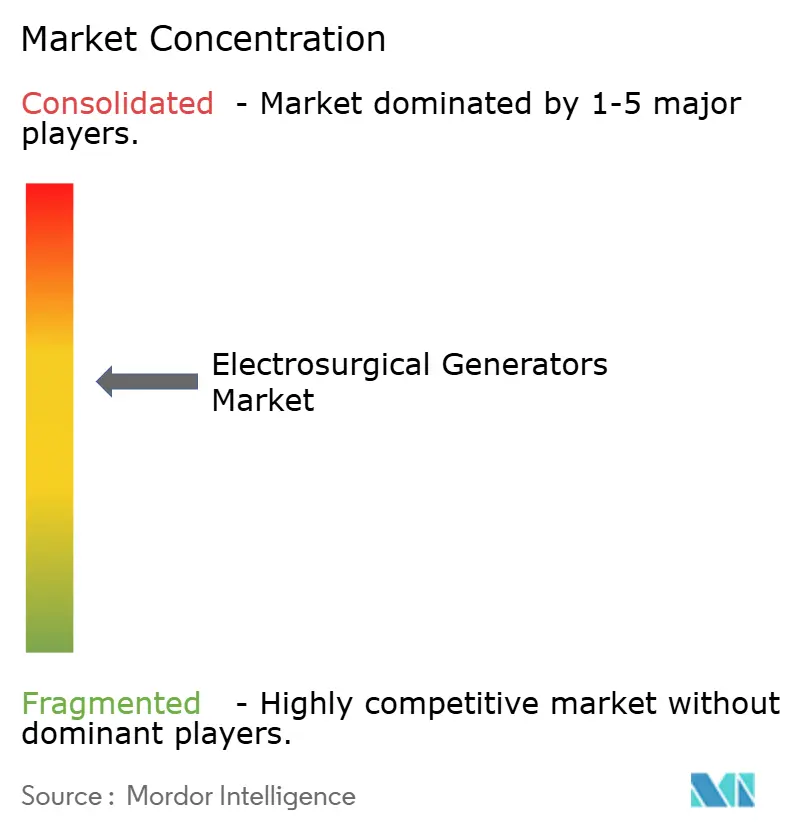
| Market Concentration | Medium |
Major Players *Disclaimer: Major Players sorted in no particular order Image © Mordor Intelligence. Reuse requires attribution under CC BY 4.0. | |
Electrosurgical Generators Market Analysis by Mordor Intelligence
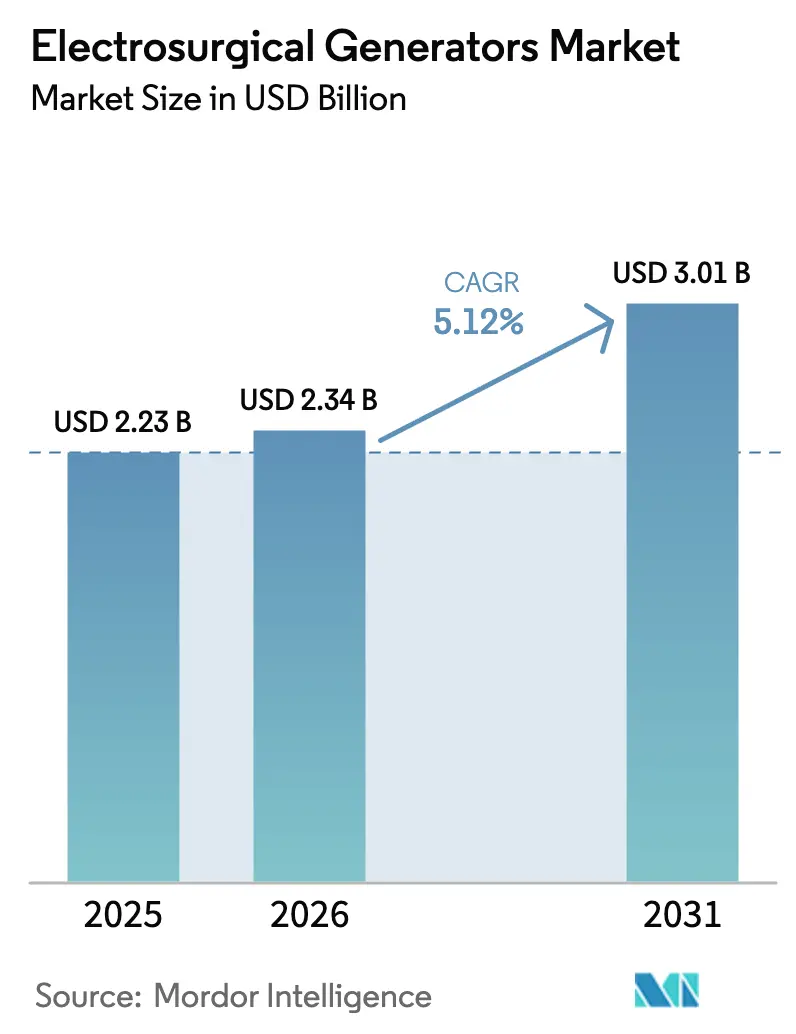
The electrosurgical generator market size in 2026 is estimated at USD 2.34 billion, growing from 2025 value of USD 2.23 billion with 2031 projections showing USD 3.01 billion, growing at 5.12% CAGR over 2026-2031. This steady climb indicates a maturing electrosurgical generator market where software-driven intelligence, rather than hardware volume, fuels additional value. Artificial-intelligence-enabled tissue-specific power modulation, wider uptake of pulsed field ablation, and legislative smoke-evacuation mandates jointly raise performance requirements. At the same time, platform convergence allows imaging, robotics, and energy delivery to interoperate seamlessly, tightening switching costs for hospitals while enlarging the addressable electrosurgical generator market.
Key Report Takeaways
- By product type, monopolar generators led with 45.33% electrosurgical generator market share in 2025, whereas ultrasonic-hybrid platforms are poised to rise at a 6.18% CAGR through 2031.
- By application, general surgery held 29.39% electrosurgical generator market size in 2025, while cardiovascular procedures are expanding at a 6.74% CAGR on account of pulsed field ablation adoption.
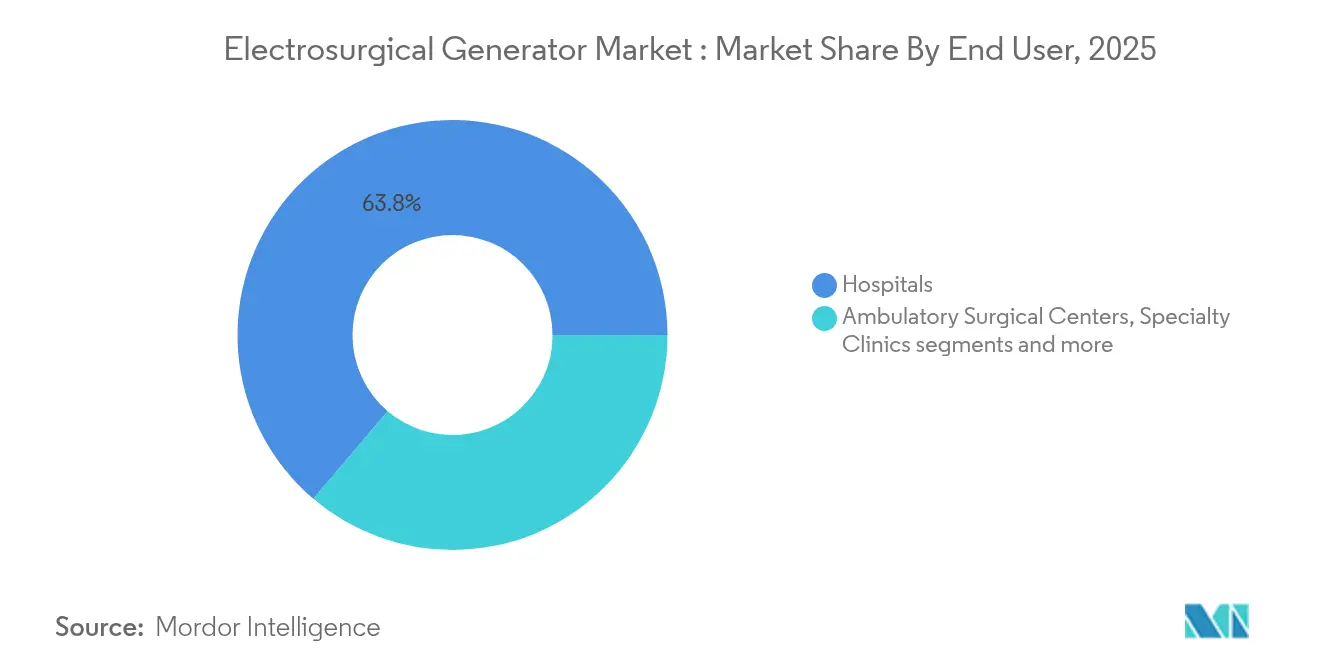
- By end user, hospitals retained 63.79% revenue share in 2025; ambulatory surgical centers are forecast to grow at 6.02% CAGR to 2031.
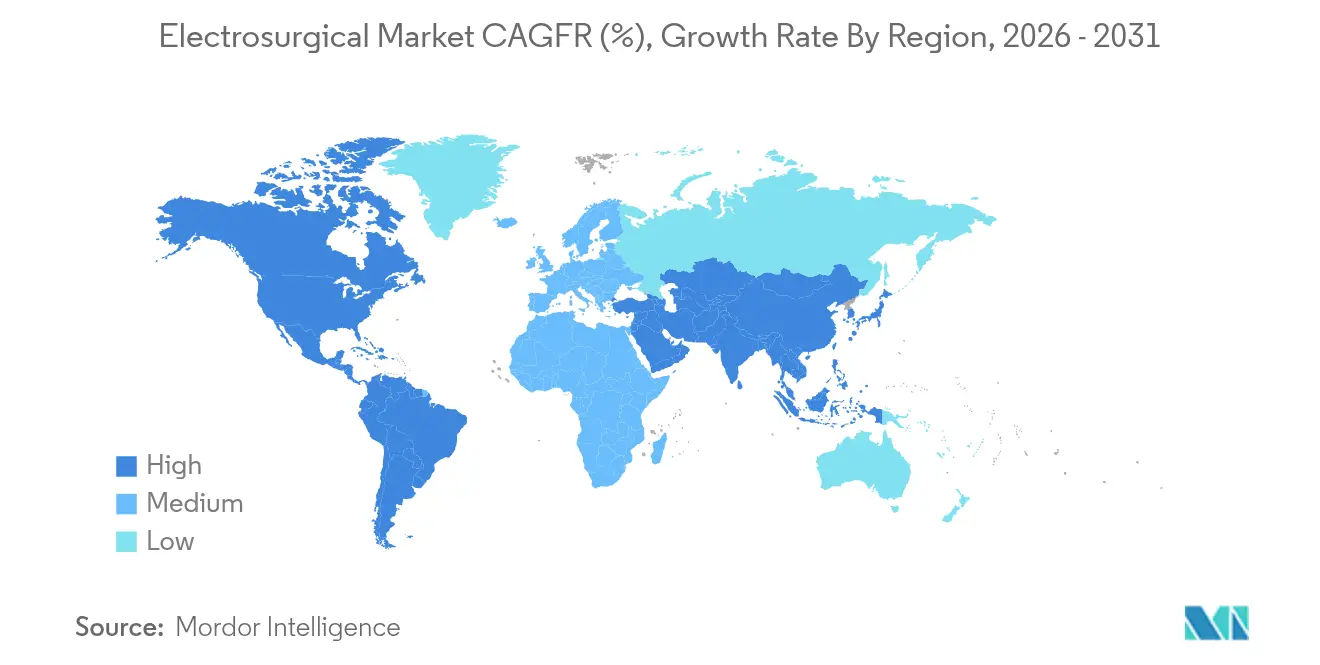
- By geography, North America commanded 41.78% of the electrosurgical generator market size in 2025, yet Asia-Pacific is the fastest-growing region with a 6.88% CAGR.
Note: Market size and forecast figures in this report are generated using Mordor Intelligence’s proprietary estimation framework, updated with the latest available data and insights as of 2026.
Market Trends and Insights
Drivers Impact Analysis of Electrosurgical Generators Market*
| Driver | (~) % Impact on CAGR Forecast | Geographic Relevance | Impact Timeline |
|---|---|---|---|
| Rising prevalence of chronic diseases requiring surgery | 1.20% | North America, Europe, Japan | Long term (≥ 4 years) |
| Growing adoption of minimally-invasive procedures | 0.90% | North America, Europe expanding to Asia-Pacific | Medium term (2-4 years) |
| Technological progress in bipolar & ultrasonic platforms | 0.80% | Innovation in North America & Europe; adoption in Asia-Pacific | Medium term (2-4 years) |
| Expansion of ambulatory surgical centers | 0.70% | Asia-Pacific core, Latin America & MEA spill-over | Long term (≥ 4 years) |
| AI-based tissue-specific power modulation | 0.60% | North America & Europe, global roll-out later | Long term (≥ 4 years) |
| Demand for smoke-free ORs | 0.50% | Mandate-driven in North America, Europe following | Short term (≤ 2 years) |
| Source: Mordor Intelligence | |||
Rising Prevalence of Chronic Diseases Requiring Surgery
Cardiovascular interventions are climbing as atrial fibrillation now affects close to 60 million people worldwide. Adoption of pulsed field ablation sharpens focus on non-thermal tissue modification, lowering collateral damage and enabling same-day discharge pathways that align with value-based care. Integrated mapping-and-ablation systems reduce procedural complexity, fostering competitive advantage for firms able to pair power sources with real-time navigation.
Growing Adoption of Minimally-Invasive Procedures
Shift toward laparoscopic and robotic surgery intensifies demand for generators that plug directly into robotic stacks. Johnson & Johnson’s 2025 DualTo launch illustrates how the electrosurgical generator market rewards platform-agnostic, software-upgradable designs that manage precise thermal envelopes within confined spaces.
Technological Progress in Bipolar & Ultrasonic Platforms
Hybrid models such as Olympus THUNDERBEAT combine ultrasonic vibration with bipolar sealing, curbing thermal spread while shortening operating times. Integrated impedance monitoring adapts power in real time, an increasingly valuable safeguard as procedures migrate to outpatient settings where postoperative complications carry higher economic penalties[1].
Expansion of Ambulatory Surgical Centers in Emerging Markets
Elective procedures continue drifting toward ASCs where costs run up to 144% lower than hospital outpatient departments, accelerating demand for compact, user-friendly units with predictive maintenance capability. Manufacturers offering plug-and-play reliability gain a strategic edge as lean ASC staffing cannot absorb extensive troubleshooting OR Management.
Restraints Impact Analysis of Electrosurgical Generators Market*
| Restraint | (~) % Impact on CAGR Forecast | Geographic Relevance | Impact Timeline |
|---|---|---|---|
| Electrosurgical injuries & litigation concerns | -0.80% | Highest in North America | Medium term (2-4 years) |
| Stringent HF-device reclassification by regulators | -0.60% | Led by FDA & EU | Long term (≥ 4 years) |
| Power-supply instability in low-resource hospitals | -0.40% | Rural Asia-Pacific, Africa, Latin America | Long term (≥ 4 years) |
| Post-pandemic capital-budget freezes | -0.30% | Mid-tier hospitals worldwide | Short term (≤ 2 years) |
| Source: Mordor Intelligence | |||
Electrosurgical Injuries & Litigation Concerns
Surgical plume exposure equals inhaling 27–30 cigarettes daily, prompting 15 U.S. states to mandate smoke evacuation at the point of generation. Hospitals now prefer generators with built-in plume control, simultaneously meeting compliance and reducing equipment count Vizient.
Stringent HF-Device Reclassification by Regulators
The FDA’s Quality Management System Regulation, effective February 2026, aligns with ISO 13485:2016 and elevates documentation thresholds. Firms with robust global quality systems can secure approvals faster and at lower incremental cost, while smaller rivals face higher barriers[2].
*Our forecasts treat driver/restraint impacts as directional, not additive. The impact forecasts reflect baseline growth, mix effects, and variable interactions.
Electrosurgical Generators Market Segment Analysis
By Product Type:
Monopolar Dominance Faces Hybrid DisruptionMonopolar units generated 45.33% electrosurgical generator market share in 2025, underscoring their role in high-volume general surgery. Yet ultrasonic-hybrid generators are scaling at a 6.18% CAGR, buoyed by demand for precise hemostasis in cardiothoracic and gynecologic procedures. Bipolar models cater to settings where isolated current paths are mandatory, whereas dual-mode systems attract multi-specialty centers consolidating capital assets. Disposable compact units—suited to outpatient centers—reflect broader healthcare shifts toward single-use devices that sidestep reprocessing costs. Integrated smoke evacuation further differentiates premium offerings as mandated safety standards tighten.
Procedural convergence is forcing product roadmaps to include AI-driven feedback loops, larger touchscreen interfaces, and cloud-based performance dashboards. The electrosurgical generator market benefits as hospitals use software upgrades instead of full hardware replacement to meet new standards. Over the forecast horizon, incremental gains in algorithmic precision may outpace pure wattage specifications, steering procurement conversations toward evidence of reduced thermal spread rather than headline power ratings.


By Application:
Cardiovascular Procedures Drive Premium GrowthGeneral surgery remained the largest slice of the electrosurgical generator market size at 29.39% in 2025 thanks to broad procedure prevalence. Cardiovascular applications, however, are advancing at 6.74% CAGR on the back of pulsed field ablation’s growing clinical acceptance for atrial fibrillation. Neurosurgery and spine require sub-millimeter accuracy, sustaining premium price tolerance for adaptive power systems that safeguard delicate anatomy. Urology leverages radiofrequency in robot-assisted partial nephrectomy, reporting median blood loss of only 15 mL, while dermatology favors portable units for office-based aesthetic treatments.
As application diversity widens, hospitals increasingly seek modular consoles capable of hosting monopolar, bipolar, and ultrasonic handpieces on a common platform. This flexibility cuts capital expenditure and training overheads, reinforcing vendor lock-in. Platform vendors that can bundle disposable electrodes, plume management, and analytics dashboards are best positioned to deepen wallet share across varied surgical departments.
By End User:
ASC Migration Reshapes Market DynamicsHospitals still concentrate 63.79% of electrosurgical generator market revenue, but ambulatory surgical centers are set to grow 6.02% annually through 2031. Reimbursement reform and payer pressure steer low-acuity cases toward ASCs, amplifying demand for generators engineered for high reliability with minimal user calibration. Specialty clinics utilize compact electrosurgical consoles tailored to ENT or dermatology, whereas academic institutes influence long-term innovation by leading early adopters’ research trials.
Generator suppliers now offer subscription-based service models pairing hardware with remote predictive diagnostics, which resonates with ASC administrators guarding slim operating margins. Over the next five years, the electrosurgical generator market will likely see bundled device-and-service contracts emerge as a standard procurement format for outpatient chains.
Geography Analysis
North America Electrosurgical Generators Market
North America held 41.78% of the electrosurgical generator market in 2025, benefiting from entrenched reimbursement structures and state-level smoke-evacuation mandates that accelerate fleet replacement cycles. Nonetheless, market saturation and hospital budget constraints temper incremental unit growth. Canada and Mexico add moderate demand as capacity upgrades align with federal infrastructure funding, while U.S. hospitals prioritize integrated platforms that feed outcome data back to value-based care dashboards.
APAC Electrosurgical Generators Market
Asia-Pacific is expanding at a 6.88% CAGR, the fastest region-wide trajectory in the electrosurgical generator market. Urban hospital build-outs, greater insurance penetration, and workforce training programs boost procedure volumes. China’s updated risk-based approval pathways and Japan’s focus on mechatronic precision open doors for global suppliers, providing they localize supply chains and service hubs. India likewise targets rapid device uptake, propelled by a push to raise surgical throughput per operating room hour.
Europe Electrosurgical Generators Market
Europe records measured growth as the Medical Device Regulation heightens documentation demands, favoring incumbents with proven quality management systems. Sustainability imperatives nudge procurement teams toward low-energy-draw generators and recyclable accessories. Germany, the United Kingdom, and France together anchor roughly half of regional revenue, whereas Eastern European markets represent catch-up potential dependent on structural healthcare investment.
Regulatory Landscape
Electrosurgical generators fall under a standards-driven safety framework that increasingly focuses on validated performance for high-frequency surgical equipment, particularly around leakage currents, thermal injury safeguards, and electromagnetic compatibility. In the United States, the FDA recognizes IEC 60601-2-2 for electrosurgical devices, which supports conformity-based test strategies alongside other applicable device-specific requirements.
In Europe, manufacturers continue to rely on harmonized standards under the EU Medical Device Regulation (Regulation (EU) 2017/745). The EN IEC 60601-2-2:2018/A1:2024 update provides a presumption-of-conformity anchor for electrosurgical generator offerings in the EU, increasing emphasis on robust technical documentation and verification activities when platforms change (software, energy modalities, or accessories).
Value Chain Analysis
The value chain covers concept development and clinical application definition, electronic and software design, regulatory and quality-system execution, manufacturing and final assembly, and commercialization through direct hospital/IDN contracting as well as distributor channels. High-value work concentrates in R&D and system integration, particularly the generator console, algorithms, and the user interface, along with regulatory strategy. Component manufacturing and sub-assembly are often distributed across global hubs, including Asia-Pacific, for electronics, power supplies, and cables.
On the downstream side, hospitals and ambulatory surgical centers increasingly consolidate procurement around bundled generators, compatible handpieces (monopolar, bipolar, and ultrasonic-hybrid), and lifecycle support. This increases the weight of field service, preventive maintenance, and accessories logistics, while cross-border resilience efforts put additional emphasis on supply chain visibility, forecasting, and risk management for critical components that can constrain generator availability or delay installations.
Competitive Landscape
The electrosurgical generator market shows moderate concentration. Medtronic, Johnson & Johnson, and Olympus leverage scale and multidisciplinary portfolios to integrate energy systems with imaging and robotics. Medtronic’s Affera platform couples cardiac mapping with pulsed field ablation, achieving 88% arrhythmia-free results one year post-procedure, illustrating the premium that hospitals place on closed-loop therapeutic ecosystems. Johnson & Johnson’s DualTo aligns generator firmware with Ottava robot kinematics, reducing latency between surgeon console input and tissue response .
Mid-tier players pursue niche adjacencies—incorporating smoke capture, sterile disposable tips, or AI-guided impedance sensing—to avoid direct wattage-based competition. Regulatory tightening via the FDA’s 2026 QMSR further entrenches incumbents that already have globally harmonized quality platforms. Consequently, new entrants find the most practical on-ramps in disposable accessories or algorithmic upgrade modules rather than full-console launches.
Looking ahead, competitive battlegrounds will likely center on cloud analytics subscriptions that translate intraoperative generator data into actionable insights for postoperative care teams. Early-mover advantage will favor manufacturers capable of demonstrating reduced readmission rates and faster recovery timelines tied to precise energy deployment metrics.
Electrosurgical Generators Industry Leaders
-
Medtronic
-
CONMED Corporation
-
Johnson & Johnson Services, Inc. (Ethicon, Inc.)
-
Olympus Corporation
-
B. Braun SE
- *Disclaimer: Major Players sorted in no particular order
Electrosurgical Generators Market Companies Covered in this Report
- Medtronic
- Johnson & Johnson
- Olympus
- Conmed
- BOWA-electronic GmbH
- B. Braun Melsungen AG (Aesculap)
- Erbe Elektromedizin
- KLS Martin Group
- Stryker
- Boston Scientific
- Smiths Group
- Zimmer Biomet
- Applied Medical Resources
- Acoma Medical Industry Co.
- Xcellance Medical Technologies
- Guangdong Wego Medical
- Microline Surgical
- Ellman International
- Utah Medical Products
- KENTAMED Ltd.
Market Opportunities and Future Outlook
A near-term opportunity is the compliance-driven upgrade cycle that steers facilities toward integrated systems rather than stand-alone consoles, particularly where smoke-free OR requirements and electrosurgical-injury risk management shape purchasing decisions. With the February 2026 effective date of the FDA Quality Management System Regulation (QMSR), aligned to ISO 13485:2016, manufacturers face a higher operational bar around design controls, software updates, and accessory compatibility at scale. This setup supports established platform vendors and also favors suppliers that can offer compliance-ready service programs.
Platform convergence around advanced energy and multi-modality procedures also expands monetization beyond the console into procedure-specific instruments and software-enabled workflows. Medtronic’s disclosed performance in fiscal year 2026, supported by its surgical and advanced energy platforms (fiscal year ending April 24, 2026), and CONMED’s full-year 2026 organic revenue growth outlook raised after first-quarter results (quarter ending March 31, 2026) both point to ongoing investment in advanced energy portfolios, vessel sealing, and tissue management capabilities. These offerings map directly to electrosurgical generator ecosystems used in minimally invasive and robotic-assisted surgery.
Recent Industry Developments in Electrosurgical Generators Market
- July 2026: Johnson & Johnson MedTech received FDA approval for the Dual Energy THERMOCOOL SMARTTOUCH SF Platform. The dual energy capability enables multi modality energy delivery within a single catheter ecosystem. The approval expands Johnson & Johnson MedTech's addressable market for integrated electrosurgical solutions.
- September 2025: Medtronic launched the Valleylab FT10 energy platform in India. The geographic expansion broadens access to high performance energy systems in an emerging market. The move supports footprint optimization and local deployment of advanced energy tools.
- April 2025: Erbe Elektromedizin GmbH introduced the VIO 3n family and the VIO seal dedicated bipolar generator. The lineup delivers high performance electrosurgical generators to the market. The introduction strengthens Erbe's workflow focused platform integration.
Electrosurgical Generators Market Report Scope and Research Methodology
Market Definition and Coverage
This market includes revenue earned from electrosurgical generator consoles sold to healthcare providers, along with related system-level upgrades sold as part of the generator platform, across major care settings globally.
Scope exclusions: We exclude hand instruments, disposable electrodes, and smoke evacuation devices when they are sold and priced as separate product lines.
Segments Covered in This Report
- By Product Type
- Monopolar Generators
- Bipolar Generators
- Combined Mono/Bipolar Units
- Ultrasonic-Hybrid Generators
- Argon-Plasma Generator Systems
- Disposable Compact Generators
- By Application
- General Surgery
- Gynecology
- Orthopedics & Spine
- Cardiovascular Surgery
- Neurosurgery
- Urology
- Dermatology & Cosmetology
- ENT & Dental
- By End User
- Hospitals
- Ambulatory Surgical Centers
- Specialty Clinics
- Academic & Research Institutes
- By Geography (Value)
- North America
- United States
- Canada
- Mexico
- Europe
- Germany
- United Kingdom
- France
- Spain
- Italy
- Rest of Europe
- Asia-Pacific
- China
- India
- Japan
- South Korea
- Australia
- Rest of Asia Pacific
- Middle East and Africa
- GCC
- South Africa
- Rest of Middle East and africa
- South America
- Brazil
- Argentina
- Rest of South America
- North America
Data Sources, Market Sizing, and Validation
Desk Research
Desk research was used to build the fact base for procedure volumes, care setting mix, and medical device spend signals that shape generator demand. We referenced public sources such as the World Health Organization, OECD health statistics, the US FDA device databases and recalls, CDC healthcare data, and peer-reviewed surgical and biomedical engineering journals.
To translate these demand signals into a revenue view, we also reviewed manufacturer annual reports, SEC filings, investor presentations, procurement releases, and reputable medical press coverage on operating room technology adoption. Where useful, paid subscriptions were used for company financial intelligence, patent databases, and shipment-level import and export trade tracking to cross-check directional movements. The desk sources listed above are illustrative and not exhaustive, and additional sources were reviewed for data collection, validation, and clarification.
Primary Interviews and Surveys
Primary work focused on confirming what gets purchased as a generator system, typical replacement cycles, and how pricing changes with bundled features, such as integrated vessel sealing modes. We spoke with a mix of hospital and ambulatory surgery center buyers, biomedical engineering teams, and distributor-side product specialists across key regions to refine assumptions and close gaps left by public data.
Distribution of primary research fieldwork respondents
| Company type | Respondent position | Region |
|---|---|---|
| Top tier: 26% | CXOs: 12% | APAC: 43% |
| Mid tier: 55% | Functional/Unit leaders: 41% | EMEA: 35% |
| Smaller Players: 19% | Managers: 47% | Americas: 22% |
Market-Sizing & Forecasting
Sizing starts with a top-down build where procedure volumes and site-of-care activity are used to reconstruct the addressable generator demand pool, which is then converted into revenue using typical price bands. To keep the model grounded, totals were corroborated through selective bottom-up approximations such as sampled average selling price times estimated unit placements, channel checks on replacement demand, and supplier revenue sanity checks where disclosures allow.
Key inputs used in the model include surgery volume growth by major specialties, operating room modernization spending, installed-base replacement timing, adoption of advanced energy modes that influence upgrade decisions, and regional tendering or capital budget cycles that can shift purchase timing. Forecasts were produced using scenario analysis supported by trend lines on procedure growth and replacement behavior, then adjusted based on expert views on pricing progression and budget pressure. When country-level unit visibility was incomplete, gaps were handled through proxy indicators such as hospital count, surgical throughput per facility, and regional utilization patterns, and then rechecked during interviews.
Data Validation & Update Cycle
Outputs were checked through triangulation across independent signals, including procedure growth, the direction of healthcare spending, device approval and recall activity, and manufacturer revenue commentary. If a region showed an unusual jump or drop, the assumptions were re-opened, and follow-up conversations were triggered to confirm whether it was a true market shift or a modeling artifact.
Before sign-off, the model and assumptions go through step-by-step analyst review, with variance checks at the region and end-user levels so large swings can be explained. Reports are refreshed annually, and interim updates are made when material events affect demand or pricing. Right before delivery, a final pass is completed so clients receive the most current view available.
Mordor Intelligence's Electrosurgical Generators Market Estimate Compared With Other Published Estimates
Published market sizes for electrosurgical generators can differ because each estimate picks its own scope boundaries, year cut, and pricing logic, which changes the final number even when the growth story sounds similar.
The main gap comes from scope mixing, where Mordor Intelligence counts only generator console revenue and treats separate instrument and consumable sales as out of scope, while some other publications blend broader electrosurgery device revenue into a generator headline value.
Benchmark comparison
| Source | Market Size | Gaps in Research Methodology |
|---|---|---|
| Mordor Intelligence | USD 2.34 B (2026) | |
| Industry Publisher A | USD 1.81 B (2024) | Uses an earlier base year and applies a faster growth curve that appears to lean on aggressive adoption assumptions, and its scope language can include adjacent revenue beyond generator consoles. |
| Market Tracker B | USD 4.26 B (2024) | Combines generators with consumables in a high-frequency electrosurgery bundle, which inflates the total versus a console-only view, and it is not always clear how pricing is normalized across regions. |
Across the three figures, the spread is explained more by what is being counted and how the starting year is set than by disagreements on demand direction. By keeping scope tied to generator console revenue and cross-checking assumptions with procedure signals and interview feedback, the model remains traceable to inputs that can be reviewed and repeated.
Key Questions Answered in the Report
What is the projected growth of the electrosurgical generator market?
The electrosurgical generator market size is expected to expand from USD 2.34 billion in 2026 to USD 3.01 billion by 2031 at a 5.12% CAGR.
Which product segment is growing the fastest?
Ultrasonic-hybrid platforms are the fastest-growing product type, advancing at a 6.18% CAGR between 2026 and 2031.
Why are ambulatory surgical centers important to market expansion?
ASCs offer procedures at up to 144% lower cost than hospital outpatient departments, driving 6.02% CAGR in generator demand as surgeries migrate to lower-cost sites.
How will new FDA regulations affect manufacturers?
The Quality Management System Regulation effective February 2026 raises documentation and audit requirements, favoring companies with mature ISO 13485-aligned systems.
Which region is forecast to add the most incremental revenue?
Asia-Pacific, growing at 6.88% CAGR, will contribute the largest share of new revenue through 2031 due to hospital build-outs and rising insurance coverage.