
Electric Vehicle Battery Recycling Market Size and Share
Market Overview
| Study Period | 2019 - 2031 |
|---|---|
| Market Size (2026) | USD 5.29 Billion |
| Market Size (2031) | USD 20.64 Billion |
| Growth Rate (2026 - 2031) | 31.29 % |
| Fastest Growing Market | Asia-Pacific |
| Largest Market | Asia-Pacific |
| Market Concentration | Medium |
Major Players *Disclaimer: Major Players sorted in no particular order Image © Mordor Intelligence. Reuse requires attribution under CC BY 4.0. | |
Electric Vehicle Battery Recycling Market Analysis by Mordor Intelligence
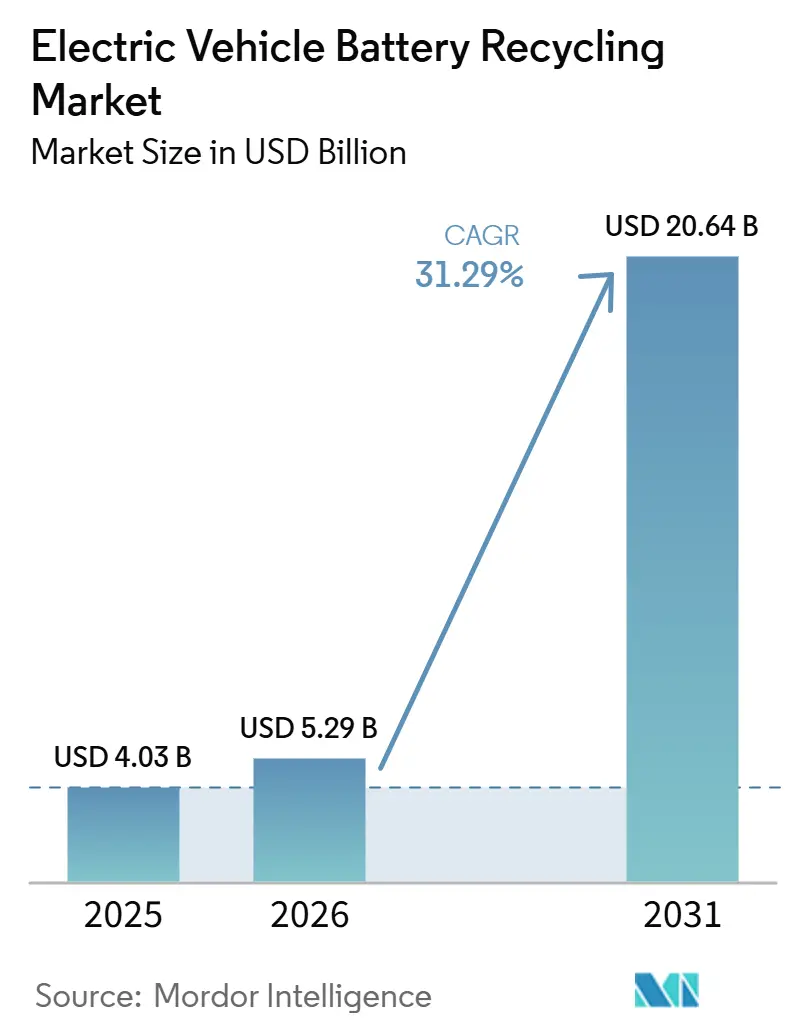
The electric vehicle battery recycling market size is expected to be USD 4.03 billion in 2025, USD 5.29 billion in 2026, and reach USD 20.64 billion by 2031, growing at a CAGR of 31.29% from 2026 to 2031. Automakers are increasingly relying on closed-loop supply agreements to shield themselves from price spikes in lithium and cobalt. Coupled with stringent recycled-content mandates in the European Union, China, and India, recycling is evolving from a mere option to an operational imperative. As installed electric vehicle (EV) fleets age and head towards retirement, the resulting physical scrap is starting to surpass the mechanical and pyrometallurgical capacities that were anticipated to be sufficient. Meanwhile, hydrometallurgical technologies, now reaching commercial viability, are achieving impressive metal recoveries. These technologies also boast lower energy intensity than traditional smelting methods, setting the stage for rapid expansion in the electric vehicle battery recycling market. Price fluctuations in lithium carbonate have not only heightened the return on investment (ROI) for recycled materials but also spurred the adoption of long-term offtake contracts. These contracts play a crucial role in stabilizing processors' cash flows. Furthermore, regional decarbonization targets amplify the appeal of recycled materials: recycled cathode-active materials come with significantly lower embedded emissions than their mined counterparts. This significant reduction offers downstream buyers a distinct Scope 3 advantage, all without incurring a cost premium.
Key Report Takeaways
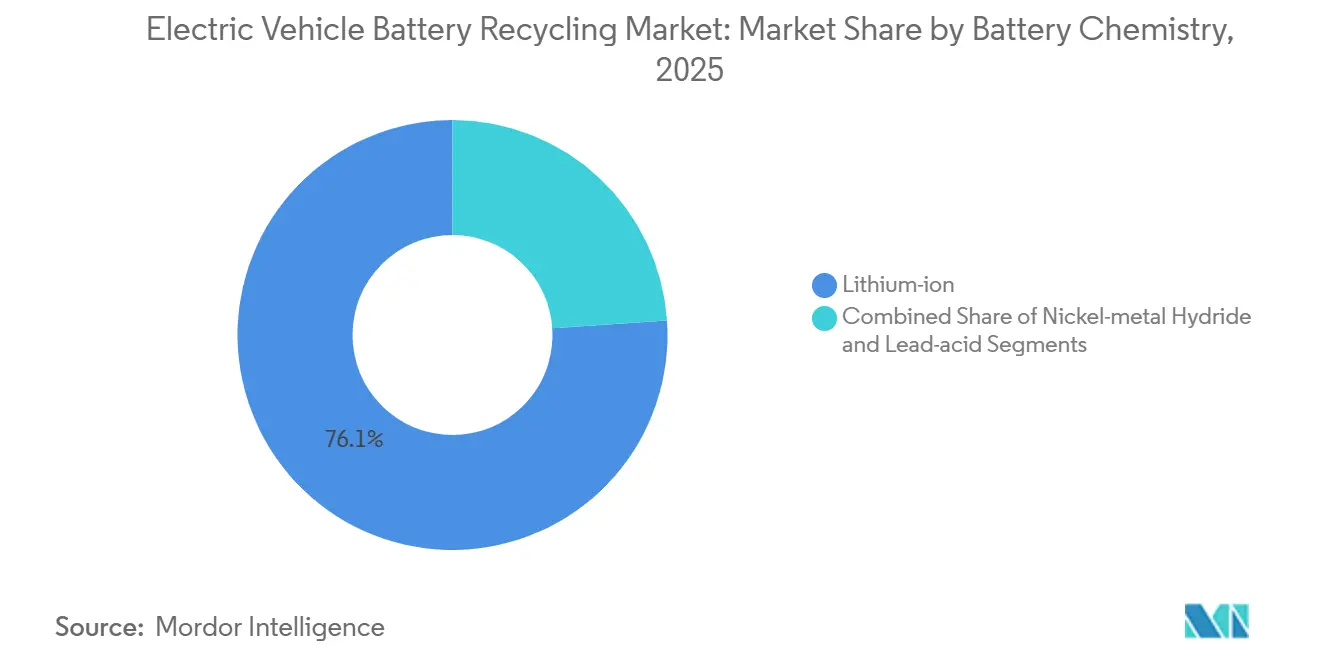
- By battery chemistry, lithium-ion captured 76.07% of the electric vehicle battery recycling market share in 2025, while lithium-ion feedstock is forecast to expand at a 32.07% CAGR through 2031.
- By source, production scrap led with a 58.37% share of the electric vehicle battery recycling market in 2025; end-of-life batteries are projected to grow at a 32.15% CAGR through 2031.
- By recycling process, hydrometallurgy accounted for 61.11% of 2025 revenue, whereas direct and mechanical routes are advancing fastest at 32.82% through 2031.
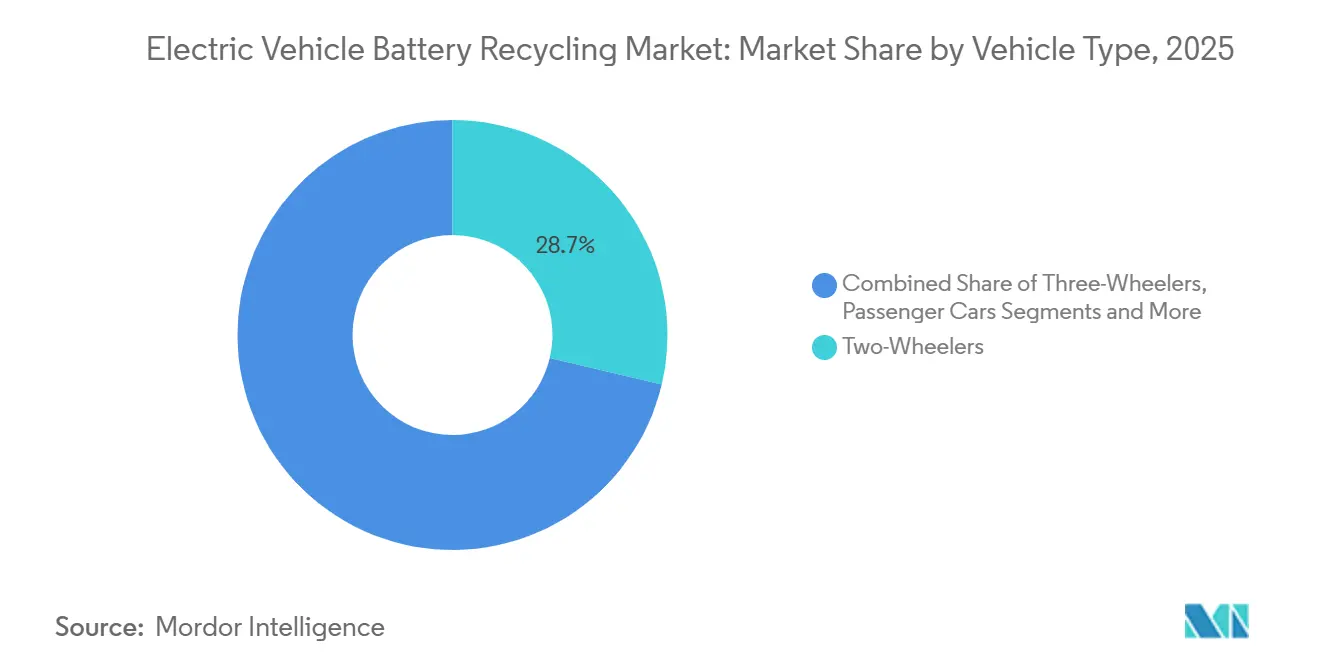
- By vehicle type, two-wheelers held 28.73% share in 2025 and are climbing at a 33.47% CAGR, driven by India, Indonesia, and Thailand.
- By recovered material, lithium represented 36.58% of the value in 2025 and is expanding at 33.71%, outpacing cobalt and nickel on the back of LFP adoption.
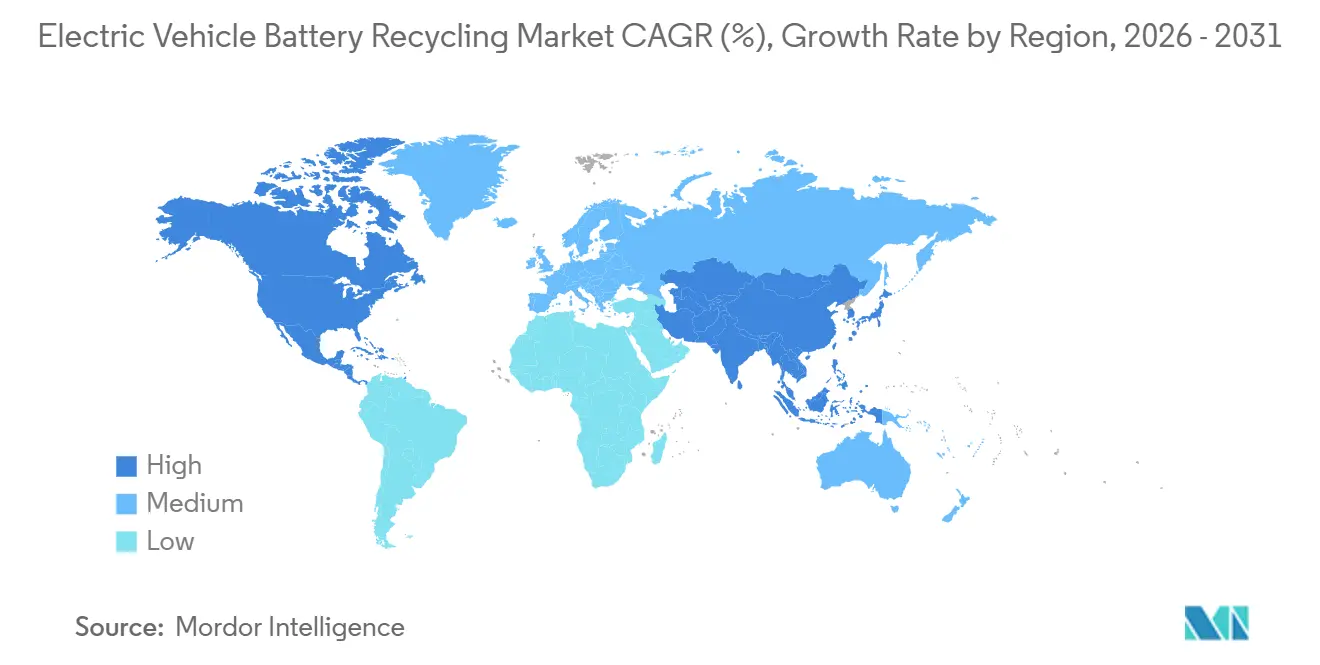
- By geography, Europe dominated with 32.87% revenue share in 2025, while Asia-Pacific is the fastest-growing region at a 33.12% CAGR.
Note: Market size and forecast figures in this report are generated using Mordor Intelligence’s proprietary estimation framework, updated with the latest available data and insights as of January 2026.
Market Trends and Insights
Drivers Impact Analysis of Electric Vehicle Battery Recycling Market*
| Driver | (~) % Impact on CAGR Forecast | Geographic Relevance | Impact Timeline |
|---|---|---|---|
| Surging EV Sales | +9.1% | Global, concentrated in China, Europe, North America | Long term (≥ 4 years) |
| Stringent Extended-Producer-Responsibility (EPR) Mandates | +7.2% | Global, with early gains in Europe, China, emerging in United States | Medium term (2-4 years) |
| Escalating Critical-Mineral Prices | +6.3% | Global, particularly impacting import-dependent regions | Short term (≤ 2 years) |
| OEM Drive for Low-Carbon | +4.3% | North America and Europe, spill-over to Asia-Pacific | Medium term (2-4 years) |
| LFP-Specific Lithium-Recovery Economics | +3.2% | APAC core, spill-over to global markets adopting LFP | Medium term (2-4 years) |
| AI-Enabled Automated Pack Disassembly | +2.1% | Global, with early adoption in developed markets | Short term (≤ 2 years) |
| Source: Mordor Intelligence | |||
Surging EV Sales Creating End-of-Life Battery Tsunami
Sales of electric vehicles (EVs) have increased significantly, signaling an unprecedented wave of battery retirements over the next decade. Vehicles sold during the initial surge are now nearing the end of their duty cycles. Consequently, annual scrap availability is expected to grow substantially. However, despite capacity additions, some regions face a significant shortfall. In one major market, recyclers processed a large volume of battery packs but struggled to cover black-mass payables, highlighting a tight supply scenario. Tesla's collaboration with Redwood Materials exemplifies the trend: their closed-loop partnership channels both production scrap and post-consumer packs back into anode-foil and cathode-precursor lines, reducing reliance on virgin materials. Regions like Norway and certain areas of California, pioneers in EV adoption, are set to face challenges. As early adopters retire their vehicles en masse, these regions will grapple with a localized undersupply of recycling capacity.
Stringent Extended-Producer-Responsibility (EPR) Mandates
The EU Battery Regulation, which entered into force in August 2025, requires 90% recovery of cobalt and nickel and 50% recovery of lithium by 2027, with sharper thresholds by 2031[1]. China’s updated traceability code forces every shipped cell to be linked to an approved recycler, while India mandates increased collection rates for battery waste over time. Meanwhile, Australia's Battery Stewardship Council, which now encompasses almost the entire retail sector, aims for higher collection rates in the future. The economics of compliance play a pivotal role: a hydromet plant processing significant volumes can achieve a higher internal rate of return (IRR) with European recycled-content credits than in areas without regulation. Original Equipment Manufacturers (OEMs) are innovating designs for quicker disassembly; for instance, BMW's snap-fit modules have significantly reduced labor time when compared to traditional adhesive-bonded designs.
Escalating Critical-Mineral Prices Boosting Recycled-Material ROI
Lithium carbonate prices surged, while nickel prices also increased during the same period. Additionally, cobalt supply in the DRC faced disruptions, positioning recycled intermediates as a competitive alternative to mined feedstock. CATL’s Brunp complex achieved a lower cash cost for recycled lithium salts compared to spodumene-derived hydroxide [2]. Automakers responded by securing long-term supply contracts that fixed cathode material prices relative to LME benchmarks, thereby protecting themselves from spot-market volatility. For high-nickel NMC 811 scrap, hydrometallurgical recovery processes now deliver high-grade nickel sulfate at a cost advantage over the Indonesian Class 1 supply. Direct regeneration has emerged as the most economical method for LFP scrap, with pilot runs demonstrating significant recovered value.
OEM Drive for Low-Carbon, Localized Supply Chains
Purchasing policies embedding Scope 3 emissions targets are now favoring suppliers of cathode materials, particularly those making notable strides in reducing life-cycle CO₂ emissions. Volkswagen, teaming up with Umicore, is poised to produce cathodes in Europe, with plans to source a portion of its nickel and cobalt from recycled streams. This initiative aligns with the growing emphasis on sustainability and the circular economy within the automotive industry. Due to the U.S. Inflation Reduction Act’s credit, which incentivizes cells with recycled content, domestic hydrometallurgical projects are reaping a cost advantage on levelized cathode costs. This advantage is expected to drive further investment in recycling technologies and infrastructure. In Dunkirk, Stellantis and Orano are collaborating on a plant that harnesses expertise from the nuclear sector's solvent extraction to achieve impressive lithium recovery. This partnership underscores the increasing role of cross-sector collaboration in addressing critical material supply challenges.
Restraints Impact Analysis of Electric Vehicle Battery Recycling Market*
| Restraint | (~) % Impact on CAGR Forecast | Geographic Relevance | Impact Timeline |
|---|---|---|---|
| High CAPEX and Long Payback | -4.7% | Global, particularly impacting new market entrants | Medium term (2-4 years) |
| Volatile Black-Mass Spot Prices | -3.8% | Global, with highest impact in import-dependent regions | Short term (≤ 2 years) |
| Safety and Logistics Risks | -2.3% | Global, with stricter enforcement in developed markets | Short term (≤ 2 years) |
| Patent Thicket Around Direct-Recycling IP | -2.2% | Global, with strongest impact in North America and EU | Long term (≥ 4 years) |
| Source: Mordor Intelligence | |||
High CAPEX and Long Payback for Hydromet Plants
Building a hydromet line with typical capacity requires significant capital expenditures (capex) and incurs high operational expenses (opex). This financial setup significantly extends the payback period, especially in the absence of subsidies. Li-Cycle's Rochester hub faced substantial budget overruns and subsequently sought bankruptcy protection, underscoring the inherent execution risks. Outside prominent mining regions, there's a notable shortage of chemical engineering professionals. This shortage has led to labor costs in North America and Europe being significantly higher than in China. Under the EU Industrial Emissions Directive, obtaining environmental impact permits can significantly extend project timelines. As a result, well-funded industry players like Umicore and CATL Brunp are aggressively consolidating their market presence. In contrast, emerging startups are either securing offtake guarantees backed by OEMs or shifting towards direct recycling methods that require lower capital expenditures.
Volatile Black-Mass Spot Prices
Black mass traded at a fraction of its contained-metal value but exceeded full value for high-purity NMC blends, tightening hydromet margins. Chinese giants, spearheaded by CATL Brunp and GEM, dominate long-term contracts, leaving merchant processors vulnerable to daily fluctuations. This is particularly evident with LFP scrap, which is devoid of cobalt and nickel. The varied chemistry within a single truckload compels buyers to impose discounts to mitigate compositional risks, a challenge intensified by scant assay data. Materials from the EU, when rerouted to non-OECD recyclers, sidestep traceability regulations, leaving compliant processors to lose out on bids. Without an exchange-traded hedge, recyclers are venturing upstream: Redwood Materials has established its own collection, shredding, and hydromet facilities, effectively shielding itself from black-mass price fluctuations.
*Our forecasts treat driver/restraint impacts as directional, not additive. The impact forecasts reflect baseline growth, mix effects, and variable interactions.
Electric Vehicle Battery Recycling Market Segment Analysis
By Battery Chemistry:
Lithium-ion Dominance Drives Market EvolutionLithium-ion chemistries accounted for 76.07% of 2025 revenue and are forecast to grow at a 32.07% CAGR, anchoring the electric vehicle battery recycling market. Nickel-rich NMC variants dominate high-end passenger cars, while lithium-iron-phosphate (LFP) now leads in commercial fleets and budget models. CATL Brunp processed significant volumes of lithium-ion scrap, achieving notable lithium recovery, underscoring the efficiency of hydrometallurgy. Recovered NMC scrap commands a higher metal value compared to LFP, prompting processors to favor direct regeneration for LFP. With technology diversification, the Electric Vehicle (EV) battery recycling market for NMC is set to grow, while LFP's share will see increased tonnage output but at a diminished value density. OEMs are enhancing the effective EV battery recycling market share through design-for-recycling initiatives—like modular packs, rapid disassembly, and chemistry QR codes—making them more amenable to automated facilities. The second-life energy-storage market is now less aligned with high-nickel packs, as stationary markets are increasingly favoring LFP, which returns to recyclers after a single refurbishment. Upcoming European policies mandating higher recycled-lithium thresholds are poised to amplify the profitability divide between NMC hydrometallurgy and LFP's direct routes.
Inputs like lithium-manganese-oxide and nickel-metal-hydride create a long-tail flow but seldom influence spot prices due to their limited volumes, typically associated with legacy hybrid programs. The ongoing expansions by BASF, Umicore, and Northvolt highlight a sustained commitment to hydrometallurgical capacities, especially for high-nickel scrap. As the industry gravitates towards nickel-rich and cobalt-lean solutions, processors brace for a dip in average revenue per tonne, intensifying their pursuit of low-energy direct pathways that preserve cathode crystal integrity.

By Source:
Production Scrap Yields to End-of-Life TransitionProduction scrap accounted for 58.37% of feedstock in 2025 and anchors closed-loop contracts that guarantee chemistry homogeneity. Redwood Materials, receiving all of its United States scrap from Tesla, Panasonic, and Ford, produced recycled copper foil sufficient for a significant number of electric vehicles (EVs). While scrap rates can peak during gigafactory ramp-ups, leading to short-term surpluses that inflate the size of the electric vehicle battery recycling market, it's anticipated that rising line yields will eventually reduce this surplus stream.
End-of-life volumes are growing 32.15% per year and are forecast to overtake production scrap. India expects to retire a significant volume of battery packs in the future. However, only a portion of these packs is formally collected. This shortfall is being addressed by informal dismantlers, who often discard valuable cathode materials. Meanwhile, the EU is working towards higher collection targets. This push is hastening the adoption of QR-code battery passports, ensuring packs are directed to certified recyclers. As a result, compliant operators in the electric vehicle battery recycling sector are seeing their market share expand. In Asia's two-wheeler sector, centralized swap-station logistics are streamlining the large-scale collection of smaller battery packs, slashing transport costs per unit.
By Recycling Process:
Hydrometallurgical Leadership Faces Direct-Recycling ChallengeHydrometallurgical plants processed 61.11% of the 2025 throughput, delivering metal purities above 99% suitable for cathode synthesis. When cobalt prices surpass a certain threshold, and nickel exceeds another specific level, the average margin per kilogram falls within a defined range. The electric vehicle battery recycling industry is now scaling direct regeneration, expanding at 32.82% CAGR. Ascend Elements’ Hydro-to-Cathode line in Kentucky, online since 2025, recovers 98% lithium and produces cathode powder with cycle life on par with virgin material.
While pyrometallurgy continues to be utilized for mixed scrap flows emphasizing cobalt, it inadvertently loses lithium to the slag. This oversight puts the process at odds with the EU's lithium-recovery target. China’s white-list system assigns higher scrap quotas to hydromet plant operators, effectively steering feedstock toward high-yield processes. United States federal R&D at the DOE ReCell Center aims to standardize direct-regeneration IP, but opaque licensing slows diffusion, giving first movers a defensive moat.
By Vehicle Type:
Two-Wheelers Lead Volume and GrowthTwo-wheelers held 28.73% share in 2025 and are growing at a 33.47% CAGR. India has surpassed a significant milestone in electric two-wheeler sales. Under the newly introduced EV Policy, Delhi mandates the installation of battery swap stations at regular intervals along its commercial corridors. With regular battery exchanges, a predictable stream of scrap emerges, benefiting local recyclers. This trend is bolstering the electric vehicle battery recycling market, especially when contrasted with the longer service life of traditional passenger cars.
While passenger cars, often equipped with large batteries, contribute the largest mass per unit, they also retire later, resulting in a more gradual scrap profile. Light commercial vehicles, now transitioning to LFP packs, are reducing their cobalt content while simultaneously increasing scrap generated for lithium recovery. In certain regions, municipal bus fleets are already returning batteries from their initial deployments. Notably, the inaugural wave of retirements in one city alone delivered a significant amount of scrap to a major recycler. Furthermore, consolidating ride-hailing three-wheeler fleets has streamlined battery collection, slashing logistics costs compared to the more scattered approach of individual passenger-car owners.
By Recovered Material:
Lithium Economics Drive Segment GrowthLithium commanded 36.58% of the 2025 recovered-material value and is growing fastest at 33.71%. CATL Brunp is set to produce lithium salts at a cash cost that significantly undercuts virgin hydroxide prices. In response to the EU's mandate for recycled lithium, BASF and Umicore are establishing dedicated recovery lines to selectively precipitate lithium phosphate.
As cell designs transition to NMC 811 and LFP, cobalt's share is diminishing. However, recycled cobalt sulfate commands a premium due to its transparent sourcing. In high-nickel chemistries, nickel economics remain robust: hydromet processes produce nickel sulfate at a cost that outpaces new outputs from Indonesia. Manganese and graphite are gaining traction as secondary products; Ascend Elements has achieved a high recovery rate for graphite and markets it to anode manufacturers at competitive prices.
Geography Analysis
APAC Electric Vehicle Battery Recycling Market
Asia-Pacific held 72.87% of the Electric vehicle battery recycling market share in 2025. The Electric vehicle battery recycling market size in the region is projected to expand at a 33.12% CAGR between 2026 and 2031, supported by China’s manufacturing scale and India’s two-wheeler electrification. China processes significant volumes of spent batteries, with CATL’s Brunp subsidiary achieving high recovery rates for nickel, cobalt, manganese, and lithium from substantial feedstock quantities. By leading the white-list certification scheme, Brunp influences a majority of the national recycling standards, consolidating technical expertise and feedstock flows within a limited number of licensed plants. Meanwhile, India's Battery Waste Management Rules set ambitious collection targets for the coming years. However, a notable capacity shortfall is already attracting investments from key players such as Attero Recycling, Tata Chemicals, and Exide Industries.
Europe Electric Vehicle Battery Recycling Market
Europe ranked second in the electric vehicle battery recycling market share in 2025, anchored by Germany’s OEM base and the EU Battery Regulation, which mandates 16% cobalt, 6% lithium, and 6% nickel recycled content by 2031. Fortum secured a EUR 40 million Innovation Fund grant in 2025 to double its Harjavalta plant to 20,000 t/y, and Volkswagen sources recycled precursors for its Salzgitter gigafactory from Duesenfeld’s hybrid line [3]. Spain and Italy are positioning as collection gateways, with Stena Recycling’s new Barcelona hub aggregating scrap from North Africa for hydromet refiners in northern Europe. Norway's fleet, now accounting for a significant share of new sales, is set to create a localized scrap pulse. This could strain regional capacity unless cross-border logistics expand.
The Americas and Middle East Electric Vehicle Battery Recycling Market
North America's electric vehicle battery recycling market is expanding rapidly, supported by incentives under the U.S. Inflation Reduction Act, which provides credits for cells utilizing recycled content. Redwood Materials has established an anode-foil plant in South Carolina, targeting significant annual output sourced from production scrap and dealer-collected packs. Ascend Elements has also launched a Hydro-to-Cathode facility in Kentucky. However, Li-Cycle has faced cost overruns at its Rochester hub, prompting Glencore to intervene. In Canada, the federal government has allocated funding to enhance recycling infrastructure in key provinces, leveraging its connections to mining clusters. Beyond the primary regions, countries such as Brazil, Saudi Arabia, and the UAE are conducting pilot projects and feasibility studies, indicating potential geographic diversification, though their current contributions remain limited.
Competitive Landscape
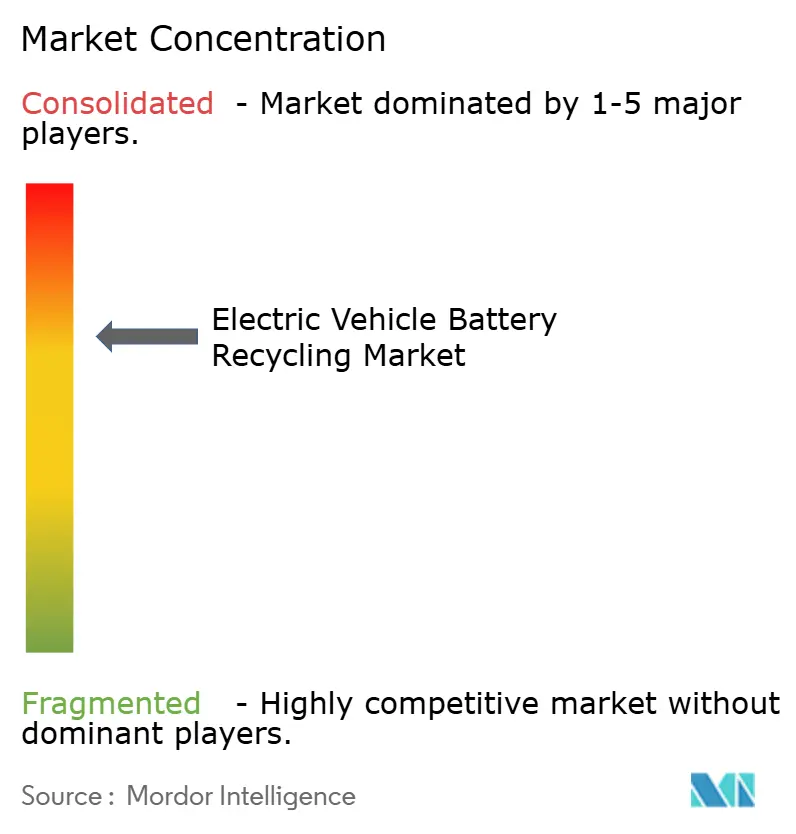
Fragmentation remains evident in the market: the leading quintet—Guangdong Brunp Recycling Technology Co., Ltd., Umicore, Redwood Materials, and Ascend Elements—commands a significant share of the global nameplate capacity. This leaves ample room for regional specialists to maneuver. Companies adopting vertically integrated models are gaining traction; for instance, Redwood Materials oversees the entire process from collection and shredding to hydromet refining and foil production, insulating itself from fluctuations in black-mass prices. On the other hand, Li-Cycle's ambitious hub-and-spoke model, heavily reliant on capital, faced a downturn and declared bankruptcy, underscoring the risks associated with multi-site hydromet operations.
Technology leadership is gravitating towards direct regeneration methods and AI-driven disassembly techniques. Ascend Elements has pioneered a Hydro-to-Cathode process that produces cathode powder with cycle life matching that of virgin materials while consuming less energy. This innovation sets a licensable benchmark for direct LFP routes. Meanwhile, R3 Robotics introduced a vision-guided disassembly line, achieving a significant reduction in mechanical costs and a substantial increase in throughput, providing users with a notable labor edge. Intellectual property (IP) intricacies are becoming a barrier to entry: the DOE ReCell Center's patent portfolio on direct recycling underscores the strategic importance of licensing for newcomers.
Processors without offtake contracts face the brunt of price fluctuations. Black-mass payables surged past the contained-metal value, squeezing merchant refiners' margins to minimal levels. This financial strain led to a wave of consolidations and asset divestitures. Conversely, firms like Umicore, whose Hoboken smelter is backed by OEMs such as Volkswagen and LG Energy Solution, enjoyed stable EBITDA amid the market's turbulence. Regional policies play a pivotal role in shaping competitive dynamics: in China, only MIIT-certified recyclers gain access to OEM packs, narrowing the market to a limited number of players. Meanwhile, Europe's stringent compliance standards, particularly the ISO 14001 and Industrial Emissions Directive, establish a capital threshold that tends to favor established players over newcomers.
Electric Vehicle Battery Recycling Industry Leaders
-
Redwood Materials
-
Ascend Elements
-
Guangdong Brunp Recycling Technology Co., Ltd.
-
Glencore
-
Umicore
- *Disclaimer: Major Players sorted in no particular order
Electric Vehicle Battery Recycling Market Companies Covered in this Report
- ACCUREC Recycling GmbH
- American Manganese Inc. (RecycLiCo Battery Materials Inc.)
- Aqua Metals, Inc.
- Ascend Elements, Inc.
- Call2Recycle, Inc.
- Eco-Bat Technologies Ltd.
- Fortum Battery Recycling (Fortum Oyj)
- Glencore
- Redwood Materials, Inc.
- Umicore
- Guangdong Brunp Recycling Technology Co., Ltd.
- GEM Co., Ltd.
- Duesenfeld GmbH
- Retriev Technologies Inc.
- Veolia Environnement S.A.
- Ganfeng Lithium Group Co., Ltd.
- RecyBat (Société Nouvelle d'Affinage des Métaux – SNAM)
- TES-AMM Pte Ltd. (TES Sustainable Technology Solutions)
Recent Industry Developments in Electric Vehicle Battery Recycling Market
- April 2026: BASF and TSR Group, a division of the REMONDIS Group, have joined forces to enhance electric-vehicle battery recycling throughout Europe. Their collaborative effort will focus on dismantling used batteries and transforming them into black mass. Furthermore, the partnership seeks to explore joint ventures in metal recovery and battery logistics, bolstering the commitment to a circular economy in electromobility.
- January 2026: MaxVolt Energy has launched MaxVolt ReEarth, a new subsidiary dedicated to lithium battery recycling in India. MaxVolt ReEarth offers comprehensive battery recycling services, including second-life applications, disassembly, shredding of used batteries, production of black mass, and extraction of valuable minerals. The subsidiary will handle LFP, NMC, NCA, and LCO battery materials, focusing on recovering essential resources like lithium, nickel, cobalt, and manganese.
Global Electric Vehicle Battery Recycling Market Report Scope
The electric vehicle battery recycling market report is segmented by battery chemistry (lithium-ion, nickel-metal hydride, and lead-acid), source (EV-production scrap and end-of-life EV batteries), recycling process (hydrometallurgical, pyrometallurgical, and direct/mechanical & other emerging), vehicle type (two-/three-wheelers, passenger cars, light commercial vehicles, medium and heavy commercial vehicles, and buses and coaches), recovered material (lithium, cobalt, nickel, manganese, and graphite and other), and geography. The market forecasts are provided in terms of value (USD).
Segmentation Overview
| Lithium-ion (NMC, NCA, LFP, LMO, LCO) |
| Nickel-metal Hydride |
| Lead-acid |
| EV-production scrap |
| End-of-life EV batteries |
| Hydrometallurgical |
| Pyrometallurgical |
| Direct / Mechanical and Other Emerging |
| Two-Wheelers |
| Three-Wheelers |
| Passenger Cars |
| Light Commercial Vehicles |
| Medium and Heavy Commercial Vehicles |
| Buses and Coaches |
| Lithium |
| Cobalt |
| Nickel |
| Manganese |
| Graphite and Others |
| North America | United States |
| Canada | |
| Rest of North America | |
| South America | Brazil |
| Argentina | |
| Rest of South America | |
| Europe | Germany |
| France | |
| United Kingdom | |
| Italy | |
| Spain | |
| Norway | |
| Netherlands | |
| Russia | |
| Rest of Europe | |
| Asia Pacific | China |
| Japan | |
| India | |
| South Korea | |
| Australia | |
| Indonesia | |
| Thailand | |
| Rest of Asia Pacific | |
| Middle East and Africa | Saudi Arabia |
| United Arab Emirates | |
| Rest of Middle East and Africa |
| By Battery Chemistry | Lithium-ion (NMC, NCA, LFP, LMO, LCO) | |
| Nickel-metal Hydride | ||
| Lead-acid | ||
| By Source | EV-production scrap | |
| End-of-life EV batteries | ||
| By Recycling Process | Hydrometallurgical | |
| Pyrometallurgical | ||
| Direct / Mechanical and Other Emerging | ||
| By Vehicle Type | Two-Wheelers | |
| Three-Wheelers | ||
| Passenger Cars | ||
| Light Commercial Vehicles | ||
| Medium and Heavy Commercial Vehicles | ||
| Buses and Coaches | ||
| By Recovered Material | Lithium | |
| Cobalt | ||
| Nickel | ||
| Manganese | ||
| Graphite and Others | ||
| By Geography | North America | United States |
| Canada | ||
| Rest of North America | ||
| South America | Brazil | |
| Argentina | ||
| Rest of South America | ||
| Europe | Germany | |
| France | ||
| United Kingdom | ||
| Italy | ||
| Spain | ||
| Norway | ||
| Netherlands | ||
| Russia | ||
| Rest of Europe | ||
| Asia Pacific | China | |
| Japan | ||
| India | ||
| South Korea | ||
| Australia | ||
| Indonesia | ||
| Thailand | ||
| Rest of Asia Pacific | ||
| Middle East and Africa | Saudi Arabia | |
| United Arab Emirates | ||
| Rest of Middle East and Africa | ||
Key Questions Answered in the Report
How large will the electric vehicle battery recycling market be by 2031?
The electric vehicle battery recycling market size is projected to reach USD 20.64 billion by 2031, expanding at a 31.29% CAGR over 2026-2031.
What region is growing fastest in battery recycling?
Asia-Pacific leads growth with a 33.12% CAGR, driven by China’s white-list traceability regime and India’s 2025 Battery Waste Management Rules.
Which battery chemistry generates the most recycling revenue?
Nickel-rich and lithium-iron-phosphate lithium-ion batteries together hold more than 76% of 2025 revenue, with lithium-ion remaining the economic backbone of the Electric vehicle battery recycling industry.
How does the EU Battery Regulation impact recyclers?
It mandates recycled content thresholds—65% cobalt and 6% lithium by 2031—guaranteeing demand and raising penalties for non-compliance.