
Electric Cookers Market Size and Share
Market Overview
| Study Period | 2020 - 2031 |
|---|---|
| Market Size (2026) | USD 5.88 Billion |
| Market Size (2031) | USD 7.44 Billion |
| Growth Rate (2026 - 2031) | 4.83 % |
| Fastest Growing Market | Asia-Pacific |
| Largest Market | Asia Pacific |
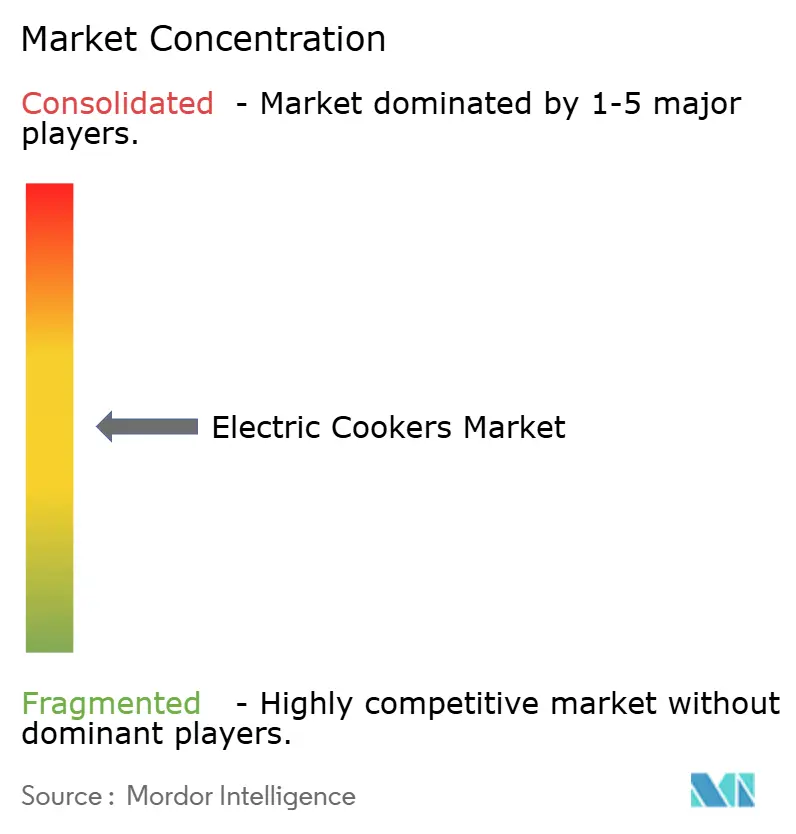
| Market Concentration | Medium |
Major Players
*Disclaimer: Major Players sorted in no particular order Image © Mordor Intelligence. Reuse requires attribution under CC BY 4.0. |
|
Electric Cookers Market Analysis by Mordor Intelligence
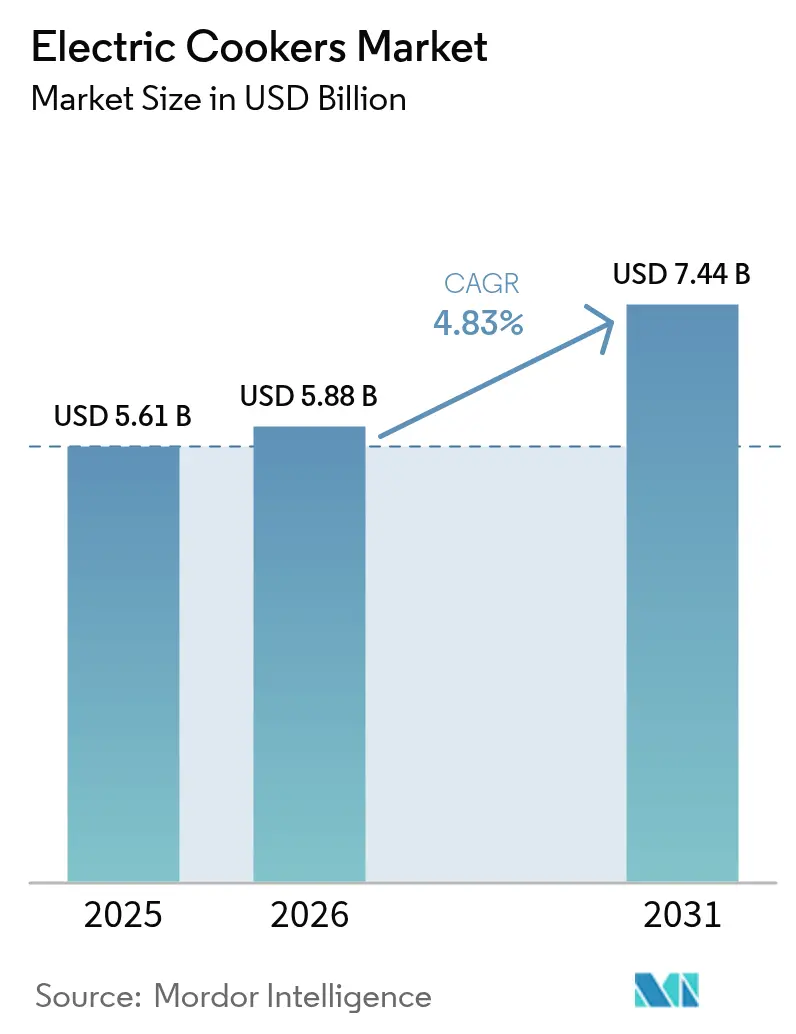
Electric cookers market size in 2026 is estimated at USD 5.88 billion, growing from 2025 value of USD 5.61 billion with 2031 projections showing USD 7.44 billion, growing at 4.83% CAGR over 2026-2031. This growth stems from urban population pressures that shrink average kitchen footprints, rising electricity-LPG price parity, and rapid smart-home adoption that embeds connected appliances into day-to-day routines. Energy-efficiency mandates and carbon-neutral construction rules further encourage households and businesses to shift from flame-based to induction or multi-function cookers, reinforcing the upward trajectory of the electric cookers market. Manufacturers are responding with compact, high-output models that integrate IoT controls, while distributors accelerate omnichannel strategies to reach digitally savvy buyers. Asia-Pacific remains the demand anchor owing to its large consumer base and dense manufacturing ecosystem.
Key Report Takeaways
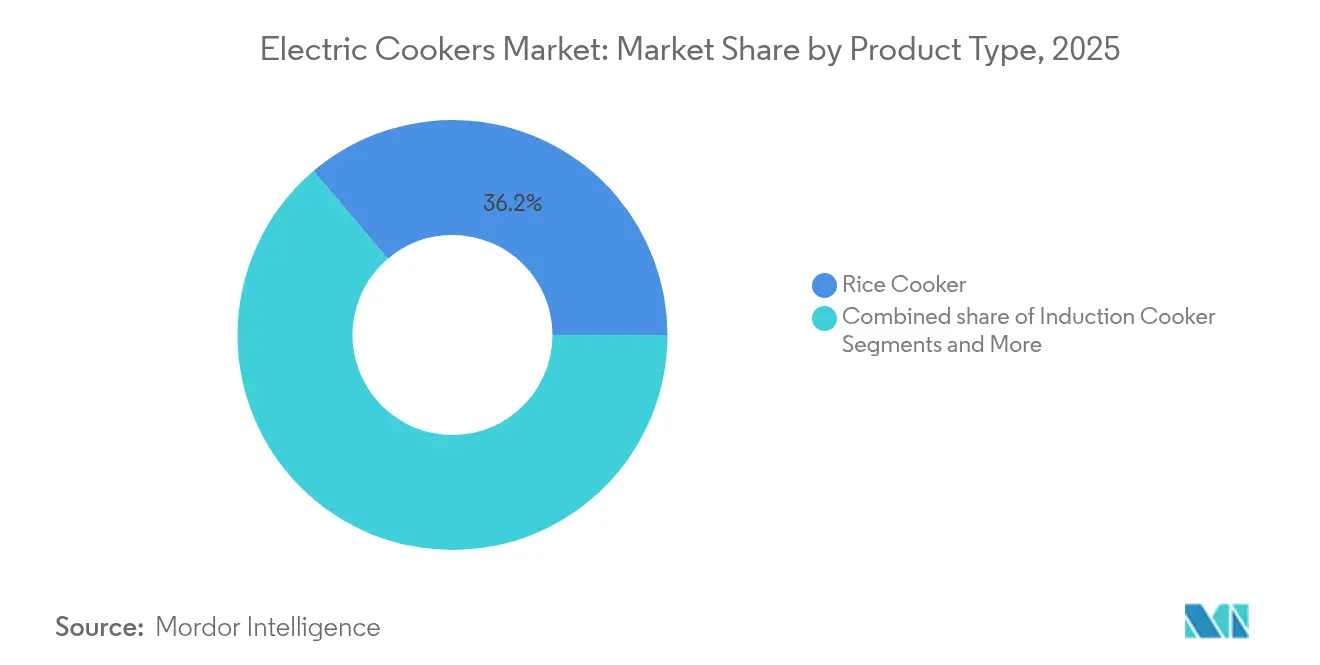
- By product type, rice cookers retained leadership with 36.20% of the electric cookers market share in 2025, while induction cookers recorded the quickest expansion at 6.78% CAGR through 2031.
- By capacity, the 3.1-6 liter segment captured 44.50% share of the electric cookers market size in 2025, whereas the ≤3 Liter segment is projected to grow at 6.28% CAGR between 2026 and 2031.
- By end-user, residential appliances held 69.70% of the 2025 revenue share of the electric cookers market; the commercial HoReCa segment is advancing at 4.98% CAGR through 2031.
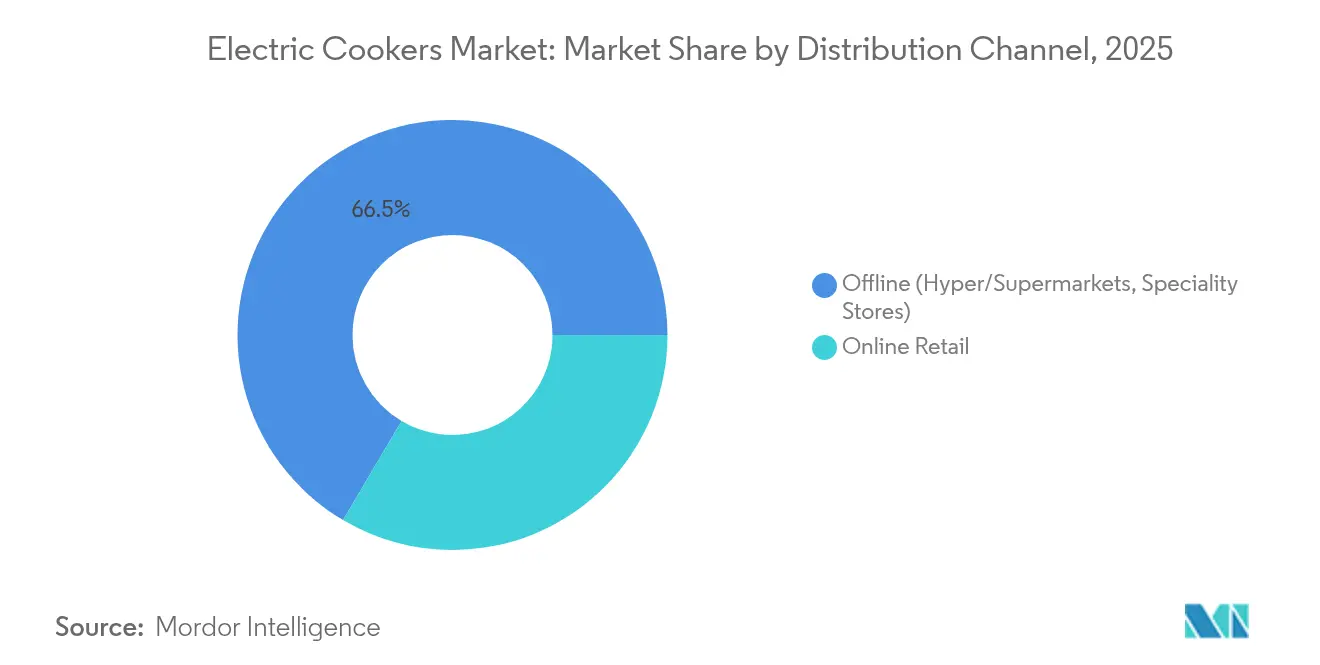
- By distribution channel, offline outlets controlled 66.50% revenue of the electric cookers market in 2025, while online retail is forecast to rise at 7.35% CAGR to 2031.
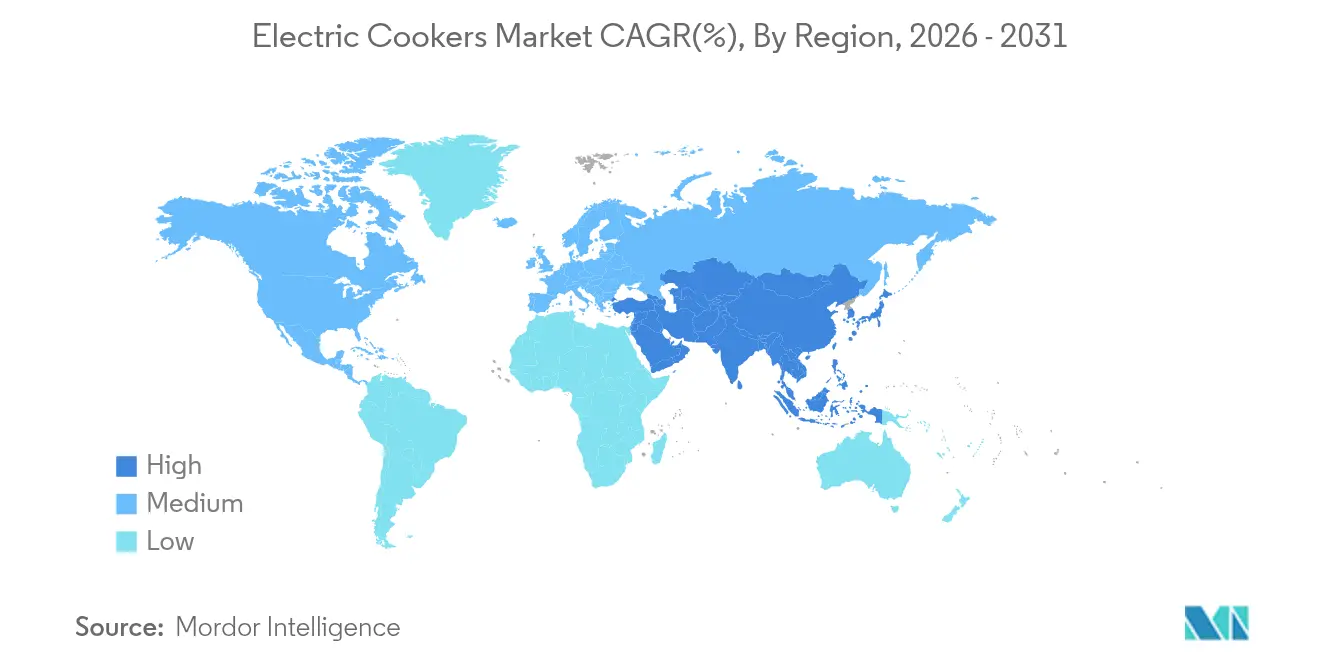
- By geography, Asia-Pacific dominated the electric cookers market with 34.00% revenue and is projected to be the fastest-growing region with a 6.55% CAGR outlook to 2031.
Note: Market size and forecast figures in this report are generated using Mordor Intelligence’s proprietary estimation framework, updated with the latest available data and insights as of 2026.
Market Trends and Insights
Drivers Impact Analysis of Electric Cookers Market*
| Driver | % Impact on CAGR Forecast | Geographic Relevance | Impact Timeline |
|---|---|---|---|
| Rapid urbanization & shrinking kitchens | +1.2% | Global, with a concentration in APAC and MEA urban centers | Medium term (2-4 years) |
| Rising electricity vs. LPG price parity | +0.8% | APAC core, spill-over to South America and MEA | Long term (≥ 4 years) |
| Surge in smart / IoT-enabled cookers | +0.9% | North America & EU, expanding to APAC premium segments | Short term (≤ 2 years) |
| E-commerce penetration in small appliances | +0.7% | Global, led by North America, the EU, and urban APAC | Short term (≤ 2 years) |
| Electrification programmes in emerging Asia | +0.6% | APAC emerging markets, selective MEA adoption | Long term (≥ 4 years) |
| Carbon-neutral mandates for residential cooking | +0.5% | EU core, expanding to North America and developed APAC | Medium term (2-4 years) |
| Source: Mordor Intelligence | |||
Rapid Urbanization & Shrinking Kitchens
City living forces households to maximise every square metre, making multifunction cookers indispensable. The ≤3 Liter class, growing at 6.50% CAGR, suits single-person and couple households that dominate new apartment construction in Chinese, Indian, and Gulf cities. Market analysis of European appliance sales forecasts that revenue from small appliances will achieve significant growth by 2027, as 80% of UK consumers cite energy bills as the main purchase trigger. Similar dynamics appear in Jakarta and Manila, where limited ventilation favours sealed electric solutions over open-flame gas. Developers integrate dedicated appliance niches into kitchen cabinetry, ensuring long-run demand for compact cookers within the electric cookers market. Brands that package rice, pressure, and slow-cook functions into a single countertop device benefit most from the urban downsizing trend.
Rising Electricity vs LPG Price Parity
Volatile LPG import costs and subsidy cuts are narrowing the total-cost gap between electric and gas cooking. Indonesia’s pilot induction programme found that a switch from LPG to electric pressure cookers trimmed annual household fuel spending, supporting wider roll-outs. As utility regulators add more renewables, electricity tariffs flatten, improving household budgeting predictability. The economics strengthen the electric cookers market in regions where grid upgrades coincide with phased reductions of gas subsidies. Over the forecast horizon, energy parity is expected to normalise electric cooking as a default choice among first-time appliance buyers.
Surge in Smart / IoT-Enabled Cookers
Networked cookers transform meal preparation into an automated process guided by cloud-based recipe libraries and sensor analytics. Panasonic’s HomeCHEF line now links to Fresco’s AI platform, allowing users to upload recipes and receive adjusted time-temperature profiles over a smartphone interface[1]Panasonic Corporation, “Panasonic and Fresco Extend Partnership,” panasonic.com . From 2022 to 2027, the smart appliance market is projected to experience significant growth, positioning the electric cookers market as a pivotal component within the connected kitchen ecosystem. Remote monitoring supports busy professionals, while diagnostics data feeds predictive maintenance platforms that extend product life cycles. In premium housing projects, developers market energy dashboards that visualise cooker electricity use, underscoring the efficiency benefits of induction over resistance heating. These digital features produce switching incentives that reinforce the shift from gas hob to smart countertop cooker.
E-Commerce Penetration in Small Appliances
Online channels compress appliance discovery, comparison, and purchase into a single session, scaling especially fast in middle-income economies where smartphone adoption outpaces physical retail development. Global shoppers favour detailed specification sheets and user reviews when choosing between induction, pressure, or rice cooker models. Direct-to-consumer sites allow mid-tier brands to bypass wholesale margins, while flash sales generate volume spikes that help clear inventory across multiple regions. Robust last-mile networks in metropolitan areas close the service gap with physical shops, enhancing buyer confidence and helping online retail outgrow brick-and-mortar within the electric cookers market.
Restraints Impact Analysis of Electric Cookers Market*
| Restraint | % Impact on CAGR Forecast | Geographic Relevance | Impact Timeline |
|---|---|---|---|
| High upfront cost of induction technology | -0.9% | Global, particularly acute in price-sensitive emerging markets | Medium term (2-4 years) |
| Interoperability issues with legacy cookware | -0.6% | Global, with regional variations in cookware replacement cycles | Short term (≤ 2 years) |
| Intermittent power supply in rural LATAM & Africa | -0.8% | Rural LATAM & Sub-Saharan Africa | Long term (≥ 4 years) |
| EMF-related health perception risks | -0.4% | Developed markets with high health awareness | Medium term (2-4 years) |
| Source: Mordor Intelligence | |||
High Upfront Cost of Induction Technology
Induction cookers require sophisticated coils, power electronics, and reinforced ceramic glass, pushing retail prices beyond the reach of low-income households. In 2025, a battery-equipped countertop induction stove hit the market, but its price tag remained steep, even after incentives, highlighting a significant affordability gap for the average consumer. Installation often demands new 240-volt circuits, raising the total project cost for renters and older homes. Commercial buyers such as housing authorities can absorb premiums, yet mass residential uptake lags until component prices fall through scale manufacturing. The price hurdle slows the diffusion of high-end models but also opens space for streamlined, single-zone units that match core cooking needs at lower costs.
Intermittent Power Supply in Rural LATAM & Africa
Households in parts of Kenya, Nigeria, and Peru face voltage dips that interrupt cooking cycles, tarnishing the reliability perception of electric appliances. In Latin America, the adoption of electric cooking remains limited compared to the extensive penetration of LPG, primarily due to challenges associated with grid stability[2]International Energy Agency, “Africa Energy Outlook,” iea.org . Solar-integrated systems offer a workaround but add battery expenses that many rural consumers cannot shoulder. Government electrification roadmaps prioritise grid expansion, yet must still confront outage frequency that undermines appliance performance. Until voltage consistency improves, penetration in these regions will build slowly, moderating the global growth outlook for the electric cookers market.
*Our forecasts treat driver/restraint impacts as directional, not additive. The impact forecasts reflect baseline growth, mix effects, and variable interactions.
Electric Cookers Market Segment Analysis
By Product Type:
Rice Cookers Sustain Leadership While Induction Gains SpeedRice cookers held 36.20% of the 2025 volume as staple food habits in China, Japan, Indonesia, and the Philippines guarantee daily use occasions. This dominance makes rice cookers the anchor of the electric cookers market and creates a replacement cycle that cushions overall demand fluctuations. Induction cookers, though starting from a smaller base, deliver a significant percentage of energy-transfer efficiency that attracts both eco-conscious consumers and commercial kitchens. Integration with recipe apps spurs experimentation beyond basic boiling functions, broadening appeal. Slow/multi-cookers benefit from urban dwellers seeking one-pot convenience, while pressure cookers occupy the meal-prep niche for time-pressed households. Brands with modular platforms that share heaters and electronics across models capture scale benefits, reinforcing cost leadership across product categories.
Second-generation induction units incorporate adaptive coil zoning, enabling pan-size detection that reduces standby losses and improves safety. Rice cooker innovation now focuses on texture algorithms that tune heat profiles for different grain varieties, catering to premium consumer segments. Electric pressure cookers extend into commercial service lines as hotels seek to cut LPG costs in buffet operations. Multi-cookers, meanwhile, cannibalise single-use appliances by bundling bake, sauté, and sous-vide modes, trimming countertop clutter in small kitchens. Collectively, these shifts diversify the electric cookers market, yet rice cookers remain the largest contributor to electric cookers market size through 2031.


By Capacity:
Mid-Range Units Dominate Yet Compact Models AccelerateThe 3.1-6 liter category satisfied family meal volumes and controlled 44.50% of revenue in 2025, establishing it as the mass-market sweet spot for the electric cookers market. Manufacturers deliver this capacity with minimal price premiums, making it accessible to middle-income households. Urbanisation is, however, lifting ≤3 Liter demand at a 6.28% growth clip, mirrored in high-rise apartments across Mumbai, Seoul, and Dubai, where countertop real estate is scarce. Brands market these cookers with fold-in handles and detachable cords to support portability and easy storage.
Above 6 liters, sales concentrate in schools, canteens, and full-service restaurants that prize large batch output. Energy audits show that replacing gas boilers with large induction vats saves up to 40% on monthly utility bills and simplifies ventilation. In the consumer arena, extended families in rural China still prefer 5-liter plus units for batch cooking, sustaining baseline volume. Over time, smaller households and solo living will lift compact-segment contribution to the electric cookers market size, although mid-range models will remain the revenue core thanks to their versatility.
By End-User:
Residential Rules While Commercial Kitchens Catch UpResidential buyers generated 69.70% of 2025 turnover, reflecting the centrality of cooking in daily routines and the continual need to replace ageing units. Safety, convenience, and lower ambient heat are the deciding factors that keep homes loyal to electric formats. Meanwhile, the HoReCa channel is forecast to expand at 4.98% CAGR as restaurants face rising gas prices and labour shortages that elevate the value of precision temperature control. Induction’s near-instant response slashes line-cook idle time and reduces kitchen heat, lowering HVAC costs.
Hotel chains in Singapore and Dubai stipulate induction cooktops for staff canteens during refurbishments, promoting best practice demonstrations that spill into consumer awareness. Ghost kitchens add another growth node, choosing compact induction ranges to maintain flexible layouts for multi-brand menus. In many markets, commercial adoption precedes residential change, reinforcing trust in electric solutions. This feedback loop strengthens the long-run outlook for the electric cookers market despite the present residential dominance.
By Distribution Channel:
Offline Still Leads, Online Rises FastBrick-and-mortar outlets, hypermarkets, electronics chains, and appliance specialists, retained 66.50% of 2025 sales as shoppers value tactile inspection before investing in a core kitchen tool. Store displays allow live demonstrations of induction responsiveness, building purchase confidence among first-time buyers. The electric cookers market is, however, migrating online at 7.35% CAGR as e-commerce platforms refine return policies and instalment payment options. Marketplace algorithms surface long-tail brands, expanding consumer choice beyond national incumbents.
Omnichannel plays dominate strategic roadmaps: manufacturers encourage showroom visits coupled with QR-code links that route customers to brand web-stores for colour or feature variants unavailable in store. In emerging Asia, social-commerce livestreams showcase cooking demos that convert viewers within minutes via integrated checkout. Supply-chain digitalisation gives brands unprecedented visibility into sell-through rates, enabling dynamic pricing that balances inventory across regions. As connectivity improves, the online route will contribute a rising share of the electric cookers market size without displacing physical retail altogether.
Geography Analysis
APAC Electric Cookers Market
Asia-Pacific commanded 34.00% of global revenue in 2025 and is projected to grow at 6.55% CAGR to 2031. China’s dual role as mega-market and production base grants unmatched scale, while Indonesia and Vietnam push adoption through LPG-to-induction conversion schemes backed by tariff subsidies. Rice-centric diets lock in rice cooker demand, and dense urban clusters favour compact multi-function units. Manufacturers such as Midea, with 100 million-unit annual output capacity, flood both domestic and export channels at competitive prices. Parallel investments in smart-appliance R&D help regional brands extend reach into premium segments.
North America Electric Cookers Market
In North America, the market's growth is influenced by gas-restriction regulations in cities such as San Francisco, which mandate the use of electric appliances in new constructions. These regulations are driving builders to prioritize electric solutions, thereby boosting demand. The replacement market is also witnessing growth as property owners upgrade outdated ranges with induction models to comply with energy codes. This trend underscores the increasing importance of energy efficiency in the region's appliance market. Additionally, the rising adoption of IoT-enabled cookers, which integrate with voice assistants, positions connected devices as the fastest-growing segment within the electric cookers market.
Europe Electric Cookers Market
The European market is experiencing steady growth at a consistent CAGR, supported by stringent carbon-neutral construction regulations and increasing consumer demand for energy-efficient appliances. The small appliance segment is projected to witness significant revenue growth, driven by the rising adoption of smart appliance categories. E-commerce continues to gain traction in key markets like Germany and the UK, with penetration rates exceeding regional averages and bolstering the online sales channel. Scandinavian utility providers are introducing time-of-use tariffs, encouraging consumers to shift cooking activities to off-peak hours. This initiative further enhances the cost competitiveness of electricity compared to LPG, aligning with broader energy efficiency goals.
South America Electric Cookers Market
Urbanization across key cities such as Lima and Bogotá, along with the expansion of e-commerce platforms, is driving a favorable CAGR outlook for South America. Clean-cooking initiatives targeting the millions of individuals reliant on solid fuels are creating opportunities for subsidy-driven electric cooker programs. However, gaps in distribution networks remain a significant challenge. Meanwhile, increasing smartphone penetration is enhancing consumer awareness and fueling demand in the region.
Africa Electric Cookers Market
Africa is experiencing regional growth rate, driven by hydropower-supported electrification initiatives and rapid population growth. Government efforts, such as Uganda's national eCooking roadmap and Kenya's off-grid solar stove pilot programs, highlight a strong commitment to advancing electric cooking solutions despite ongoing grid stability issues. While the market remains in its nascent stage, the rising urban middle class in cities like Lagos and Nairobi is beginning to perceive induction cookers as premium products, positioning Africa as a critical growth frontier for the electric cookers market.

Value Chain Analysis
The electric cookers value chain starts with upstream inputs such as steel and aluminum housings, ceramic glass tops (for induction), heating coils or induction coils, thermostats and sensors, and electronic controls (MCUs, power semiconductors, and connectivity modules for IoT models). These components feed into midstream manufacturing and assembly, which is concentrated in Asia-Pacific, with China accounting for a large share of global electric cooking appliance production volume. Scale producers and brand owners (including Midea, Panasonic, Whirlpool, Haier, Electrolux, and Groupe SEB) then distribute finished goods through regional importers, offline appliance chains and hypermarkets, and fast-growing online marketplaces and brand D2C stores. After-sales service networks and spare-parts logistics complete the chain.
Key friction points increasingly sit in cost and compliance, rather than basic fabrication capacity. Trade measures such as the United States Department of Commerce action effective June 23, 2025, adding tariffs on steel-derivative household appliances, raise landed costs for steel-heavy categories and push brands to adjust sourcing, pricing, and regional assembly decisions. At the same time, connected cooker lines remain sensitive to semiconductor and memory component pricing, tightening BOM economics for smart and IoT-enabled cookers. In emerging markets, distribution and affordability are addressed via B2B2C channels and Pay-As-You-Go financing models used by eCooking ecosystem participants, which link appliance sales with energy access, last-mile delivery, and service provision.
Competitive Landscape
Moderate concentration defines the electric cookers market, with the top five suppliers holding half of the revenue. Midea leverages its 100 million-unit output scale to deliver cost leadership across rice, pressure, and induction categories while integrating Wi-Fi and voice-control modules into flagship lines. Panasonic differentiates through partnerships that embed AI recipe engines, anchoring its premium positioning. Groupe SEB pursues R&D-driven innovation, investing in NUTRICE rice-texture optimisation and Cook2Health digital-coaching projects to maintain brand equity.
Strategic activity spans three paths. First, portfolio consolidation: Whirlpool’s EMEA spin-off into Beko Europe extends geographic presence and synergies in sourcing and logistics. Second, technology intensification: Copper’s battery-equipped induction platform addresses outage-prone areas, although price premiums limit near-term volume. White-space opportunities persist in mid-tier smart cookers that balance affordability and connectivity, especially for emerging-market consumers.
Competitive intensity escalates as new entrants exploit online channels to bypass legacy distribution, compressing product life cycles. Intellectual-property portfolios around induction coil design and smart-control algorithms are becoming decisive as brands seek defensible margins. Market incumbents, therefore, ramp up joint ventures with chipset makers and cloud platforms. Scale operators who couple efficient manufacturing with modular electronics stand to widen their share, yet local specialists that cater to regional taste profiles and cookware norms can still command loyal niches in the electric cookers market.
Electric Cookers Industry Leaders
-
Panasonic Corporation
-
Midea Group
-
Koninklijke Philips N.V.
-
LG Electronics Inc.
-
Groupe SEB (Tefal)
- *Disclaimer: Major Players sorted in no particular order
Electric Cookers Market Companies Covered in this Report
- Panasonic Corporation
- Midea Group
- Koninklijke Philips N.V.
- LG Electronics Inc.
- Groupe SEB (Tefal)
- Samsung Electronics Co., Ltd.
- Whirlpool Corporation
- Zhejiang Supor Co., Ltd.
- Breville Group Ltd
- Toshiba (Arçelik AŞ)
- Cuisinart (Conair Corp.)
- Electrolux AB
- Haier Smart Home Co., Ltd.
- Hitachi Global Life Solutions
- Xiaomi Corp. (Mi Home Appliances)
- Instant Brands Inc.
- SharkNinja Inc.
- Gree Electric Appliances Inc.
- Joyoung Co., Ltd.
- Butterfly Gandhimathi Appliances Ltd.

Market Opportunities and Future Outlook
The clearest opportunity is in policy-linked adoption programs that convert households from LPG or solid fuels to electric cooking. This shifts demand toward induction cooktops, multi-cookers, and efficient rice and pressure cookers that fit constrained kitchen footprints. In April 2026, India weighed induction cooktop subsidies under the PM Suryaghar Muft Bijli Yojana and considered changes such as reducing GST on select electric appliances, while also assessing lower customs duties on induction cooktop components to ease input costs and support domestic manufacturing. These signals point to localized product designs that suit typical household electrical infrastructure, including 120V or lower-power induction platforms and compact <=3 liter form factors aligned with urban living and smaller households.
A second area of opportunity is standardization and compliance management as efficiency and test protocols diverge across the United States, the European Union, and China, increasing certification overhead for multi-region launches. Manufacturers that build modular platforms (shared electronics, heaters, and firmware) and maintain flexible test-and-certification playbooks can reduce launch cycle times across geographies while keeping SKU complexity controlled. In Africa, new institutional structures for clean cooking create more programmatic demand channels. In July 2026, Nigeria inaugurated a National E-Cooking Steering Committee and announced an AGNES Nigeria country office, adding momentum for results-based financing and coordinated procurement that can support affordable, serviceable electric cooker portfolios, alongside compatible cookware bundles.
Recent Industry Developments in Electric Cookers Market
- May 2026: Midea Group released a new kitchen appliance lineup in Australia that included a 6L multi pressure cooker and a 5L induction rice cooker. The launch reinforces the shift toward multi-function and induction-based formats that compete directly with stand-alone cookers, while using seasonal demand moments to drive category trial and retail visibility.
- December 2025: Midea simultaneously launched 18 Midea brand stores across Malaysia and introduced its SMART MASTER series featuring AI-powered and IoT-enabled appliances. The store network expansion strengthens offline demonstration and service coverage, supporting omnichannel conversion for higher-value connected cooking appliances.
- March 2025: Panasonic launched the HomeCHEF Connect 4-in-1 Countertop Multi-Oven, integrating app control through its Kitchen+ experience and the Fresco smart kitchen platform. The product push highlights the market move toward software-enabled cooking workflows and recipe-led ecosystems that differentiate premium electric cooker offerings beyond basic heating performance.


Electric Cookers Market Report Scope and Research Methodology
Market Definition and Coverage
The market covers electric-powered cooking appliances used to heat, cook, or prepare food at home and in light-commercial kitchens, where the cooking function is delivered mainly through electricity (including induction and resistive heating).
Scope exclusions: We exclude stand-alone gas cookers, outdoor camping stoves, and fully professional combi-ovens.
Segments Covered in This Report
-
By Product Type
- Induction Cooker
- Rice Cooker
- Slow/Multifunctional Cooker
- Electric Pressure Cooker
- Electric Range & Cooktop
- Other Electric Cookers
-
By Capacity
- ≤3 Litre
- 3.1-6 Litre
- >6 Litre
-
By End-User
- Residential
- Commercial/HoReCa
-
By Distribution Channel
- Offline (Hyper/Supermarkets, Speciality Stores)
- Online Retail
-
By Geography
-
North America
- United States
- Canada
- Mexico
-
South America
- Brazil
- Argentina
- Chile
- Peru
- Rest of South America
-
Europe
- Germany
- United Kingdom
- France
- Italy
- Spain
- BENELUX
- NORDICS
- Rest of Europe
-
Asia-Pacific
- China
- Japan
- India
- South Korea
- Australia
- South-East Asia
- Rest of Asia-Pacific
-
Middle East and Africa
- Saudi Arabia
- United Arab Emirates
- South Africa
- Nigeria
- Rest of Middle East and Africa
-
North America
Data Sources, Market Sizing, and Validation
Desk Research
Desk work was used to set the market boundaries and to anchor the model inputs to public indicators that move with electric cooking demand. We mainly reviewed official and non-paywalled sources such as UN Comtrade trade statistics, the World Bank macro data series, OECD consumer and housing indicators, and energy price and electricity access datasets from agencies such as the IEA and national energy departments.
To avoid relying on one data stream, we also checked manufacturer and retailer disclosures such as annual reports, investor presentations, and earnings call notes, along with customs commentary and reputable press coverage on appliance shipments and pricing changes. For spot checks, we used paid subscriptions focused on company financials and intelligence, news and financials, and import/export shipment-level records to cross-verify trade direction and timing. These examples are not exhaustive, and other sources were also referred to for data collection, validation, and research clarification.
Primary Interviews and Surveys
Primary discussions were run with a mix of appliance manufacturers, component and channel participants, and trade experts who track household appliance demand and pricing. The respondent input helped us confirm adoption trends for induction and multifunction cookers, sanity check average selling price movement, and clarify how demand differs across APAC, EMEA, and the Americas before final totals were signed off.
Distribution of primary research fieldwork respondents
| Company type | Respondent position | Region |
|---|---|---|
| Top tier: 34% | CXOs: 16% | APAC: 42% |
| Mid tier: 46% | Functional/Unit leaders: 32% | EMEA: 33% |
| Smaller Players: 20% | Managers: 52% | Americas: 25% |
Market-Sizing & Forecasting
Our sizing starts with a top-down demand pool build where appliance spending and replacement cycles are reconstructed by region, and then mapped to the electric cooking share using signals like electrification levels and kitchen appliance penetration. Once regional totals are formed, we cross-check them using selective bottom-up approximations, such as sampled price points by product type and channel checks on unit volumes, which helps adjust for outlier years.
Key model inputs include household formation and urbanization, electricity access and relative power versus LPG price direction, replacement and upgrade cycles, product mix shifts toward induction and multifunction models, and average selling price movement by region (including currency conversion timing). Forecasts are built using scenario analysis supported by short-run trend smoothing on the most sensitive variables, mainly ASP progression and adoption speed for induction cookers. Where direct unit signals are weak in a country, gaps are handled using proxy markets with similar income bands and appliance ownership patterns, and then re-tested with expert feedback.
Data Validation & Update Cycle
Outputs are validated through triangulation across independent indicators, including trade direction, macro demand signals, and interview-based checks on pricing and product mix. If a variance looks unusual, we reopen the assumptions, recheck the driver series, and place follow-up calls to confirm whether the change is structural or temporary.
Before publication, the model goes through multi-step analyst review, where calculations are repeated and the logic is compared against recent market events and public disclosures. Reports are refreshed annually, and interim updates are made when material events affect demand, supply, or pricing. Right before delivery, we do a final pass to ensure the latest data and developments are reflected.
Mordor Intelligence's Electric Cookers Market Size Versus Other Published Estimates
Published numbers for electric cookers do not always match because the product list, end-use coverage, and pricing basis can change from one study to another, even when the titles look similar. Differences also show up when the base year is not aligned, or when a forecast assumes a faster shift to premium induction models without enough checks on what buyers actually purchase.
Electric ovens and large built-in cooking suites sit outside Mordor Intelligence's scope here, and that single exclusion can pull totals away from sources that group ovens, cooktops, and cookers into one combined bucket. Some estimates also lean on aggressive ASP expansion or include heavier commercial kitchen equipment, which can raise the market value even if unit demand is steady, especially when currency conversion is taken at peak-year rates.
Benchmark comparison
| Source | Market Size | Gaps in Research Methodology |
|---|---|---|
| Mordor Intelligence | USD 5.61 B (2025) | |
| Global Consultancy A | USD 4.70 B (2025) | Tighter product interpretation that emphasizes core cooktops and a limited set of electric cooker formats, with less visibility on multifunction electric pressure and slow cookers in some regions, which can reduce the counted value. |
| Industry Publisher B | USD 14.50 B (2024) | Broader appliance basket and earlier base year that can blend adjacent categories and apply higher assumed price points across a wider set of devices, which expands the market beyond standalone electric cookers. |
The spread mainly comes from what is counted as an electric cooker and how price and mix are carried forward year to year. By keeping the scope tied to standalone electric cookers and then checking the totals against trade, adoption, and interview inputs, we end up with a figure that is easier to trace back to clear demand drivers and repeatable steps.


Key Questions Answered in the Report
What is the current value of the electric cookers market?
The electric cookers market generated USD 5.88 billion in 2026 and is forecast to reach USD 7.44 billion by 2031 at a 4.83% CAGR.
Which product segment leads the electric cookers market?
Rice cookers dominate with a 36.20% market share in 2025, reflecting consistent demand across Asian households.
Why are induction cookers growing faster than other types?
Induction units convert a significant amount of input energy into heat, offer precise temperature control, and integrate easily with smart-home platforms, driving a 6.78% CAGR through 2031.
What region is expected to grow the fastest?
Asia-Pacific shows the highest regional percentage because of expanding electrification programs and rising urban middle-class consumption.
How significant is online shopping for electric cookers?
Online retail is the fastest-growing channel at 7.35% CAGR, driven by detailed product information, reviews, and direct manufacturer promotions that appeal to digital-first consumers.
What are the main obstacles to the wider adoption of electric cookers?
High upfront costs for induction technology and unreliable power supplies in rural Latin America and Africa remain the principal barriers, trimming global growth potential by almost 1.7 percentage points.
Page last updated on:


 Your data is secure and never sold or shared.


