
Elastomeric Membrane Market Size and Share
Market Overview
| Study Period | 2020 - 2031 |
|---|---|
| Market Size (2026) | USD 30.72 Billion |
| Market Size (2031) | USD 41.28 Billion |
| Growth Rate (2026 - 2031) | 6.09 % |
| Fastest Growing Market | Asia Pacific |
| Largest Market | Asia Pacific |
| Market Concentration | Medium |
Major Players *Disclaimer: Major Players sorted in no particular order Image © Mordor Intelligence. Reuse requires attribution under CC BY 4.0. | |
Elastomeric Membrane Market Analysis by Mordor Intelligence
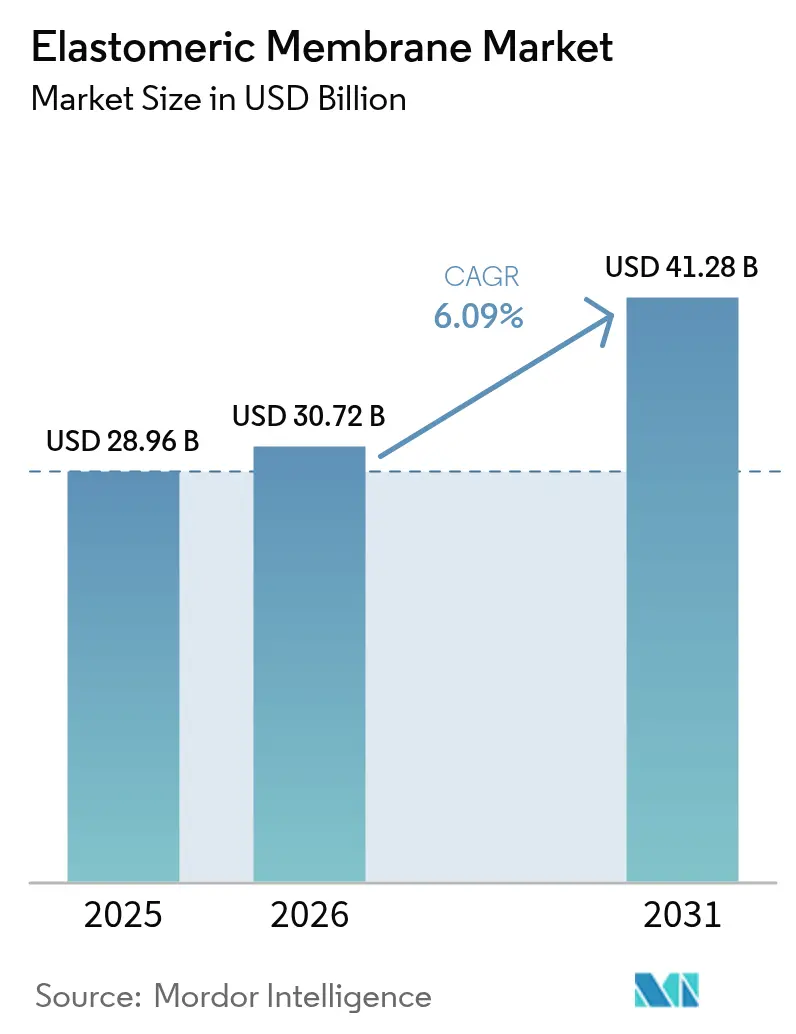
The Elastomeric Membrane market size is expected to grow from USD 28.96 billion in 2025 to USD 30.72 billion in 2026 and is forecast to reach USD 41.28 billion by 2031 at 6.09% CAGR over 2026-2031. Demand is advancing because rehabilitation projects now outnumber new-build activity in mature economies, while governments everywhere tighten energy-efficiency codes that specify low-permeability membranes with high solar reflectance. Technology selection has become performance-led rather than price-led as contractors look to limit liability in an era of volatile weather patterns. Liquid-applied solutions are carving out share thanks to their seamless installation over existing substrates, and suppliers able to document 20-year warranties or longer gain preference on major bids. Competitive advantage is shifting toward companies that combine polymer innovation with on-site technical support, reflecting the growing complexity of membrane specification on high-performance envelopes.
Key Report Takeaways
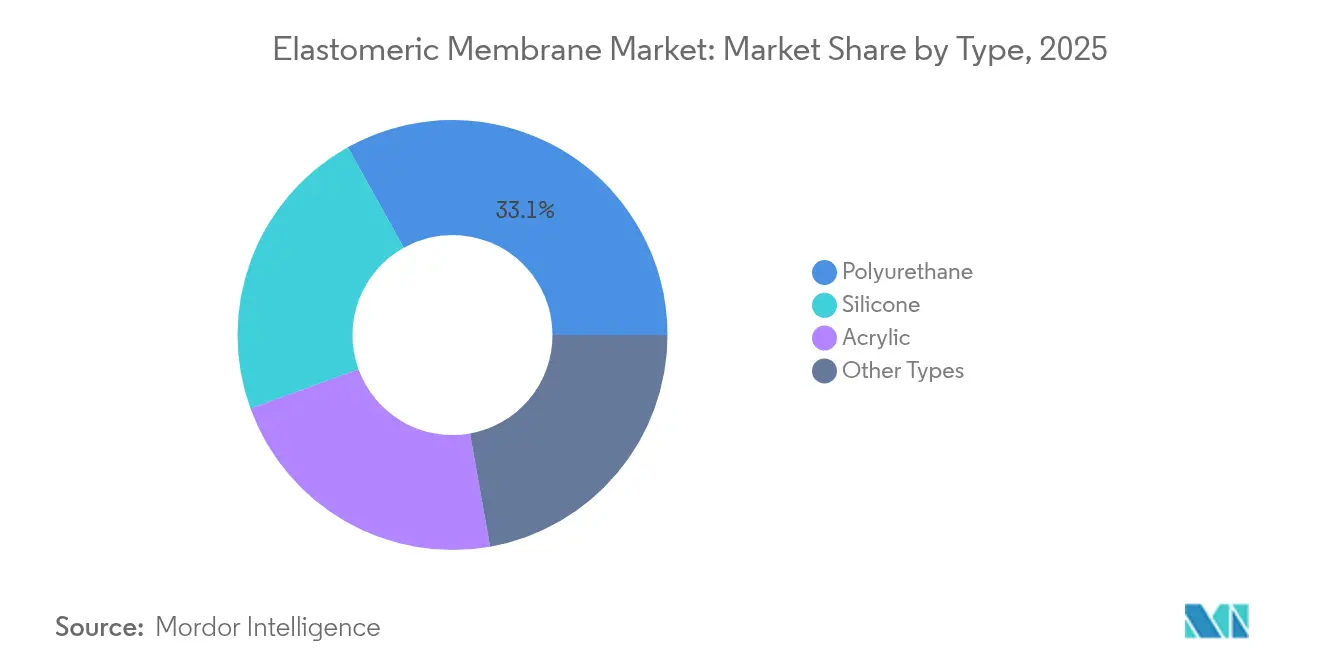
- By type, polyurethane captured 33.10% revenue share of the elastomeric membrane market in 2025, whereas silicone is projected to expand at a 6.44% CAGR through 2031.
- By application, roofing commanded 51.05% share of the elastomeric membrane market size in 2025, while wet areas are advancing at a 6.83% CAGR to 2031.
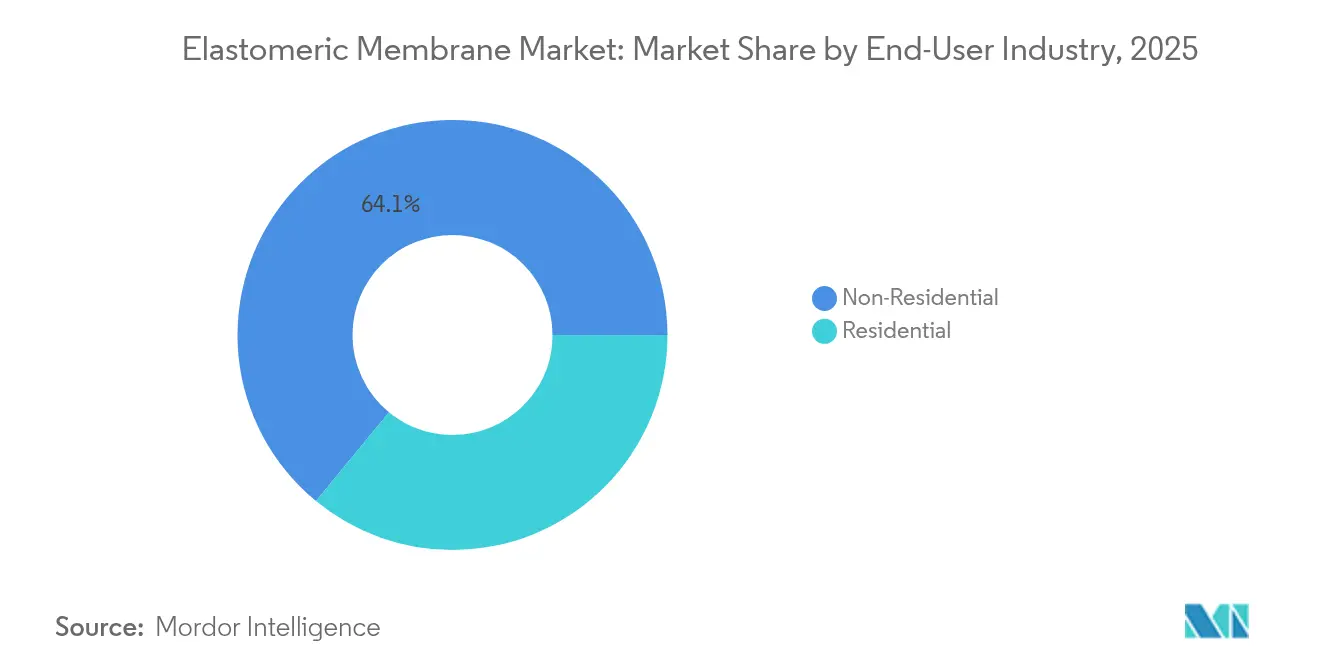
- By end-user, non-residential accounted for 64.05% of demand in 2025; residential is the fastest-growing user segment at 6.55% CAGR through 2031.
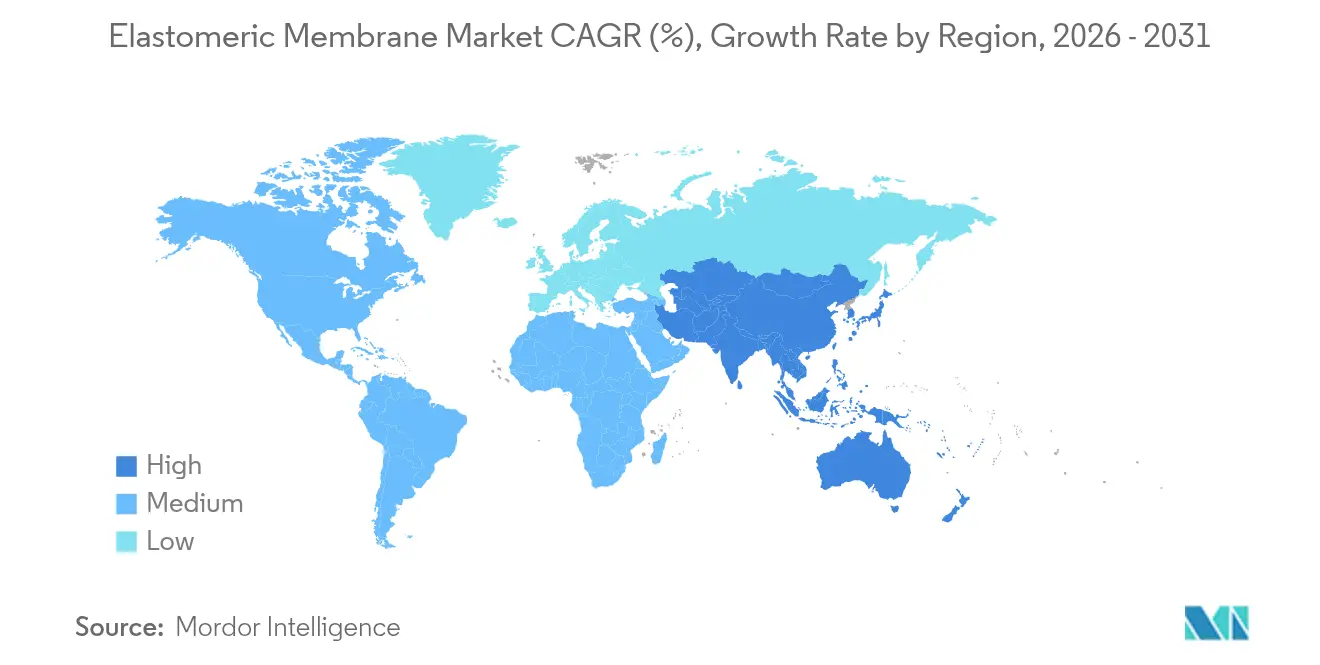
- By geography, Asia-Pacific led with 35.40% of the elastomeric membrane market share in 2025 and is tracking a 6.30% CAGR to 2031.
Note: Market size and forecast figures in this report are generated using Mordor Intelligence’s proprietary estimation framework, updated with the latest available data and insights as of 2026.
Market Trends and Insights
Drivers Impact Analysis of Elastomeric Membrane Market*
| Driver | (~) % Impact on CAGR Forecast | Geographic Relevance | Impact Timeline |
|---|---|---|---|
| Surging demand for durable waterproofing in infrastructure rehabilitation | +1.80% | Global, with concentration in North America & Europe | Medium term (2-4 years) |
| Rapid urban & commercial construction growth | +2.10% | APAC core, spill-over to MEA | Long term (≥ 4 years) |
| Stringent energy-efficiency & green-building codes | +1.20% | North America & EU, expanding to APAC | Medium term (2-4 years) |
| Aging roof stock driving refurbishment activities | +0.90% | North America & Europe primarily | Short term (≤ 2 years) |
| Adoption of liquid-applied membranes in modular off-site builds | +0.60% | Global, early gains in Europe & North America | Long term (≥ 4 years) |
| Source: Mordor Intelligence | |||
Surging Demand for Durable Waterproofing in Infrastructure Rehabilitation
Infrastructure rehabilitation dominates procurement agendas as owners replace membranes installed in the 1980s and 1990s. Sika AG recorded 13.5% sales growth in EMEA and 15.1% in the Americas during 2024, largely from rehabilitation work that specified high-performance coatings over concrete structures. Liquid-applied elastomeric systems benefit because they form seamless barriers across irregular substrates without full tear-off, reducing downtime on bridges, tunnels, and parking decks. Climate volatility further raises the stakes: membranes must tolerate more intense freeze-thaw and storm events without splitting. Because failures can trigger costly litigation, specifiers increasingly demand 20- to 30-year warranty cover backed by field performance data. Suppliers that can certify adhesion to damp substrates earn preference in fast-track repair programs where surfaces cannot always be fully dried.
Rapid Urban & Commercial Construction Growth
Asia-Pacific’s building boom is stretching beyond sheer volume into technical sophistication. Smart-city master plans require membranes that integrate moisture protection, heat reflectivity, and, in some cases, photovoltaic compatibility. High-rise developers specify elastomeric membranes able to accommodate structural sway without cracking, a performance envelope that traditional bituminous sheets rarely meet. Contractors running concurrent projects across multiple provinces favor systems with standardized application protocols to minimize retraining, boosting preference for single-component polyurethanes and silicones supplied with manufacturer-certified installer programs. Spill-over demand is visible in Gulf Cooperation Council countries where large commercial complexes mirror Asian design templates.
Stringent Energy-Efficiency & Green-Building Codes
Regulators now frame membrane selection as an energy-management decision. California’s Title 24, for example, mandates aged solar reflectance of 0.63 and thermal emittance of 0.75 for low-slope roofs, effectively excluding dark or non-reflective membranes from many specifications[1]California Energy Commission, “2008 Building Energy Efficiency Standards,” energy.ca.gov . European directives are moving the same way, and Australia’s NCC requires named performance classes for wet-area waterproofing[2]Australian Building Codes Board, “Part 10.2 Wet Area Waterproofing,” ncc.abcb.gov.au . Beyond reflectivity, certification systems such as LEED award points for recyclability and low embodied carbon, prompting suppliers to reformulate with bio-based feedstocks such as Dow’s NORDEL REN EPDM launched in 2025. Owners view premium membranes as a hedge against rising energy tariffs, balancing higher upfront cost with lower cooling loads.
Adoption of Liquid-Applied Membranes in Modular Off-Site Builds
Modular construction relies on factory-assembled volumetric units that must ship weather-tight. Liquid-applied membranes deliver continuous coverage over complex junctions created by bolted modules, eliminating joints that would otherwise require tapes or heat welding. European contractors piloting net-zero schools report cycle-time reductions of three days per block when liquids replace sheets because crews avoid mechanical fastening and cuts. Global adoption should accelerate as automated spray lines scale within modular factories, supported by robotic QA imaging that verifies wet-film thickness in real time.
Restraints Impact Analysis of Elastomeric Membrane Market*
| Restraint | (~) % Impact on CAGR Forecast | Geographic Relevance | Impact Timeline |
|---|---|---|---|
| Cost-effective bituminous alternatives | -1.40% | Global, particularly price-sensitive markets | Short term (≤ 2 years) |
| Installation-skill shortages delaying projects | -0.80% | North America & Europe, expanding globally | Medium term (2-4 years) |
| Fire-performance regulatory scrutiny on some polymers | -0.30% | Global, with stricter enforcement in developed markets | Long term (≥ 4 years) |
| Source: Mordor Intelligence | |||
Cost-Effective Bituminous Alternatives
Built-up felt and asphaltic rubber membranes can undercut elastomeric material costs by up to 50%, a gap persuasive to cash-constrained owners. In emerging economies, labor remains inexpensive, and crews are already trained on torch-applied systems, reducing switching incentives. However, rising energy-performance penalties and carbon taxes are eroding this price advantage because bituminous roofs often fail cool-roof criteria. Commodity suppliers respond with reflective mineral granules, but these coatings degrade faster under UV, reopening lifecycle-cost debates and indirectly supporting elastomerics.
Installation-Skill Shortages Delaying Projects
Modern elastomeric membranes require calibrated mixing, substrate moisture checks, and strict ambient-temperature windows. The North American Roofing Contractors Association reports vacancies for skilled applicators remain near a decade high, leading to scheduling delays that erode contractor margins. Manufacturers are accelerating certified-installer programs, supplying mobile mixing rigs, and integrating IoT sensors that log application conditions for warranty validation. While these measures ease the bottleneck, they add cost and complexity, limiting adoption where contractor ecosystems are fragmented.
*Our forecasts treat driver/restraint impacts as directional, not additive. The impact forecasts reflect baseline growth, mix effects, and variable interactions.
Elastomeric Membrane Market Segment Analysis
By Type:
Polyurethane Dominance Faces Silicone InnovationPolyurethane held 33.10% of the elastomeric membrane market share in 2025, confirming its status as the workhorse for commercial roofs and parking decks. Widespread availability, balanced tensile strength, and chemical resistance keep volume high, especially in refurbishment where adhesion to aged bitumen is critical. Yet silicone grades are accelerating at a 6.44% CAGR as designers prioritize superior UV stability and service temperatures from –50 °C to +200 °C, qualities essential in desert or alpine climates. The elastomeric membrane market size for silicone is therefore projected to close rapidly on polyurethane, buoyed by demand for long-life cool roofs that retain solar reflectance beyond ten years. Suppliers differentiate through one-part moisture-cure chemistries that simplify application and extend open-time in humid conditions.
Innovation also surfaces in bio-content and hybrid chemistries. Dow’s NORDEL REN EPDM line, manufactured with bio-residues under ISCC PLUS, exemplifies how the elastomeric membrane industry is aligning with net-zero targets while preserving mechanical performance. Acrylic dispersions gain niche traction in residential repaint programs where odor restrictions rule out solvent systems, though their lower elongation limits structural applications. Overall, competition is shifting from raw tensile strength to demonstrated service-life data under accelerated-weathering protocols, encouraging transparent third-party testing and longer warranty offers.


By Application:
Roofing Leadership Challenged by Wet-Area GrowthRoofing accounted for 51.05% of the value in 2025, reflecting decades of experience with elastomeric sheets and liquids on low-slope commercial decks. Owners value ease of inspection, straightforward repairs, and compatibility with photovoltaic mounts. However, wet areas—bathrooms, balconies, and plant rooms—are set to grow at a 6.83% CAGR, making them the fastest-expanding slice of the elastomeric membrane market. Australia’s NCC now stipulates specific moisture-transmission benchmarks for internal wet zones, pushing builders toward membranes with higher elongation at break and resistance to alkaline screeds. Similar rulemaking is underway in Singapore and parts of the EU, elevating technical entry barriers.
The elastomeric membrane market size for wet-area systems will rise as multifamily residential towers proliferate and as health-care facilities retrofit for infection control, where monolithic, easy-to-clean surfaces are mandatory. Roofing nonetheless remains the brand-recognition platform where manufacturers prove credibility before cross-selling to interior trades. Emerging integrated-envelope designs encourage products certified for multiple uses, enabling contractors to hold one stock-keeping unit for roofs, walls, and wet zones, reducing waste and simplifying training.
By End-User Industry:
Non-Residential Dominance Amid Residential AccelerationNon-residential clients—commercial offices, factories, transport infrastructure—represented 64.05% of 2025 revenue. This segment values corporate-level supply agreements, long warranties, and tested assemblies under FM 4470 or EN 13501, factors suiting global brands with strong technical staffs. Infrastructure, particularly bridge and tunnel waterproofing, adopts customized EPDM sheets with ribbed profiles that bond to concrete decks, exemplified by Polyguard’s bridge membranes. Project scales and public-sector funding make this channel less sensitive to upfront price.
Residential demand is gaining momentum at 6.55% CAGR because stricter building codes mandate resilient wet-area barriers and reflective roof coatings to cut cooling loads. Homeowners increasingly view membranes as energy-saving investments rather than hidden construction items. DIY-friendly acrylic membranes that roll on like paint broaden the addressable base, yet premium single-component polyurethanes are gaining as housing markets shift toward multi-storey concrete construction where movement joints and vibration demand greater elongation.
Geography Analysis
APAC Elastomeric Membrane Market
Asia-Pacific maintained 35.40% of global spending in 2025 and is advancing at 6.30% CAGR to 2031, making the region the primary engine of the elastomeric membrane market. National programs—from India’s Smart Cities Mission to Australia’s Resilient Buildings Package—embed waterproofing and heat-island mitigation criteria in public-works tenders, thereby standardizing high-performance membranes. Local producers rapidly climb the technology ladder, licensing European formulations while engineering cost-down versions tailored to tropical or monsoon climates. Singapore’s green-roof mandates encourage cool roof membranes with root-inhibitor additives, a niche where APAC firms now export know-how globally.
North America Elastomeric Membrane Market
North America remains a premium market focused on refurbishment and code-driven upgrades. Consolidation is reshaping supply: Carlisle Companies invested more than USD 2 billion between 2024 and 2025 to add Henry Company, MTL Holdings, and Plasti-Fab, linking membranes with insulation and sealants to deliver complete envelope packages. Energy codes such as ASHRAE 90.1 push cool-roof adoption, while insurance providers reward high-impact-resistance ratings; these features sustain elastomeric adoption despite competition from cheaper modified bitumen.
EMEA Elastomeric Membrane Market
Europe’s mature construction scene drives innovation in sustainability. Architects specify EPDM systems advertised to last 50+ years and be fully recyclable, aligning with circular-economy regulations. Net-zero directives under the EU Green Deal are ratcheting up reflectivity and VOC limits. Growth rates lag APAC but value per square metre is highest worldwide. Meanwhile, the Middle East and Africa leverage investment in mega-projects and climate-resilient infrastructure. The UAE and Saudi Arabia together consume over half of regional sealants and membranes, stimulated by decision-makers seeking LEED or Estidama certification. Hot-climate performance and sand-abrasion resistance become critical selling points.

Regulatory Landscape
Elastomeric membranes are shaped by building-envelope performance codes and material or product standards that affect specification, testing, and permitted chemistries. In the United States, ASTM specifications such as ASTM C957/C957M (liquid-applied elastomeric membranes) and ASTM D6134/D6134M (vulcanized rubber sheets) are commonly used as reference points for product qualification and project submittals, while energy-driven roof requirements such as California Title 24 continue to anchor minimum aged solar reflectance and thermal emittance thresholds that drive cool-roof membrane selection.
Regulatory scrutiny is also moving toward chemical composition and documentation. In China, GB 45320-2025 sets safety and technical requirements for building waterproofing membranes, including synthetic rubber and resin-based systems, pushing suppliers to align labeling and performance claims to a national baseline. In Europe, EOTA European Assessment Documents (for example, EAD 030378-00-0605 and EAD 030218-01-0402) provide technical assessment routes for flexible waterproofing products where harmonized standards do not fully cover the system, while ongoing 2025-2026 discussions around potential REACH polymer and low-molecular-weight polymer registration increase compliance planning needs for membrane formulators and upstream polymer suppliers. Parallel PFAS-related measures, including expanded US TRI reporting applicable by 2026 and the EU PFAS restriction workstream (with essential-use criteria under development in 2026), reinforce reformulation and raw-material disclosure pressure across coatings, additives, and sealant-adjacent inputs used in elastomeric membranes.
Value Chain Analysis
The elastomeric membrane value chain begins with upstream feedstocks and intermediates, including petrochemical derivatives for polyurethane and acrylic systems, EPDM rubber and related monomers for sheet goods, and siloxane-based inputs for silicone membranes. It then progresses to midstream formulation, compounding, and manufacturing of sheets or liquid-applied products. Downstream, distribution is heavily influenced by system selling and certified installer networks that bundle primers, reinforcements, and accessories with defined application protocols, which helps manufacturers underwrite long warranties and manage liability on high-value roofing and waterproofing projects.
Standards and specification pathways determine how value moves through the chain and where differentiation is captured. ASTM C836 remains a common reference for cold liquid-applied elastomeric membranes, and ASTM D8463 (released in December 2025) adds a specification framework for high-solids, cold liquid-applied silyl-terminated polymer based waterproofing membranes used with a separate wearing course, supporting efforts to standardize newer chemistries for demanding applications. Input and logistics volatility can transmit quickly into membrane pricing, illustrated by Kuraray's April 2026 price revisions for Liquid Rubber and ISOBAM polymers tied to rising petroleum-product and logistics costs, which increases the importance of multi-sourcing and inventory buffering for contractors and formulators during maintenance seasons. Industry associations also influence downstream practices and compliance alignment, including Waterproofing Europe (WE) and CEFEP in Europe, which engage on circularity, raw material legislation, and converter-related requirements that affect membrane system design and documentation.
Competitive Landscape
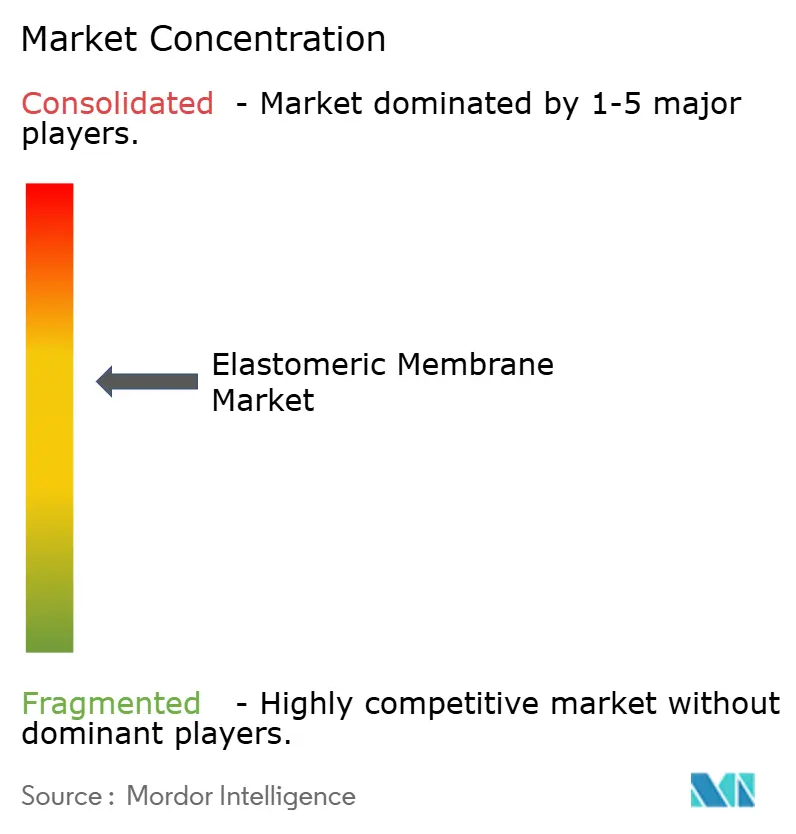
The elastomeric membrane market features moderate consolidation. The top five suppliers collectively control an estimated 58% of revenue, led by Sika AG, Carlisle Companies, Soprema Group, Dow, and BASF, each employing acquisition-driven expansion to assemble end-to-end envelope portfolios. Sika’s 2025 purchase of Cromar Building Products adds traditional roofing materials that complement its liquid-applied lines, illustrating a strategic pivot toward “one-stop” offerings. Carlisle, meanwhile, embeds membranes within a bundle that includes rigid insulation and metal edge systems, promoting single-source warranties attractive to design-build contractors.
Technological differentiation outweighs capacity scale. Niche rivals focusing on liquid-applied silicone or polyurea systems win projects where extreme UV exposure or rapid return-to-service is critical. Warranty extensions to 30 years are emerging weapons, backed by accelerated-weathering datasets and remote moisture-scan monitoring embedded in the membrane surface. Sustainability credentials also shape competition; Dow’s bio-based EPDM gives specifiers a tangible carbon-reduction narrative, while BASF promotes solvent-free polyurethanes to comply with urban VOC caps.
Distribution partnerships and certified-installer networks act asgatekeepers; manufacturers that train roofers and provide on-site quality audits gain pricing power, whereas generic commodity providers remain exposed to project delays and skill shortages. Digitization adds another frontier: suppliers now embed QR-coded batch data, allowing contractors to verify shelf life and installation conditions via mobile apps, pushing the market toward traceable, performance-assured supply chains. As technology and sustainability outpace simple volume scale, new entrants offering specialized chemistries continue to pressure incumbents, ensuring that product innovation rather than price remains the decisive battlefield.
Elastomeric Membrane Industry Leaders
Sika AG
Carlisle Companies Inc.
Soprema Group
BASF
Dow
- *Disclaimer: Major Players sorted in no particular order
Elastomeric Membrane Market Companies Covered in this Report
- Barrett Company
- BASF SE
- Carlisle Companies Inc.
- Covestro AG
- Dow
- Fosroc Inc.
- GAF Materials LLC
- Hempel A/S
- Holcim
- IKO Group
- Johns Manville
- KEMPER SYSTEM AMERICA Inc.
- Lapolla Industries, Inc.
- Malarkey Roofing
- POLYGLASS S.p.A
- Saint-Gobain
- Sika AG
- Soprema Group
- Triton Inc
- Uniflex

Market Opportunities and Future Outlook
The largest near-term opportunity sits at the intersection of durability, labor productivity, and documentation, where owners increasingly specify longer warranties and contractors look for systems that reduce rework risk on refurbishment-heavy programs. Liquid-applied elastomeric membranes and hybrid chemistries support this through seamless coverage on irregular or aging substrates, while manufacturers that combine polymer innovation with installer training, application-condition logging, and traceable batch data can convert technical performance into lower project risk for non-residential and infrastructure end users.
Material availability and sustainability-driven reformulation also open room for suppliers that can secure feedstocks and offer compliant alternatives. In June 2026, Shandong Dawn Polymer Materials Co., Ltd., through Ningbo SK Synthetic Rubber Co., Ltd., announced a 500 million yuan investment to expand EPDM capacity by 25,000 tons per year to 90,000 tons per year, explicitly linked to construction waterproofing demand, underscoring the strategic role of EPDM supply for sheet and system manufacturers. Separately, published research directions in styrene-acrylic and waterborne polyurethane membranes highlight improved crack-bridging, UV resistance, and multifunctional performance (including self-healing and self-cleaning concepts), which aligns with tighter energy-efficiency and chemical-compliance scrutiny and supports premium positioning where lifecycle cost and specification compliance matter more than the lowest first-cost alternatives.
Recent Industry Developments in Elastomeric Membrane Market
- July 2026: Sika launched Sikalastic Rapid PMMA, a two-component liquid resin system positioned for flashing (Rapid-724) and field membrane (Rapid-723) applications under a unified global brand. The launch strengthens Sika's liquid-applied offering where fast return-to-service and detailing complexity favor PMMA systems, and it supports portfolio harmonization across regions for specification-led projects.
- March 2026: Carlisle SynTec Systems expanded its 16-foot Sure-Weld TPO membrane line with a High Slope (HS) option for roofs exceeding 1/2 inch slope and integrated SeamShield technology for standard-formula TPO membranes. Wider sheets and weld-assist features target installation speed and workmanship consistency, which is strategically relevant as contractor labor constraints and schedule risk influence material selection.
- June 2024: SOPREMA's DuoFlex hot melt waterproofing systems received British Board of Agrément (BBA) accreditation for use in inverted, zero fall, and protected flat roof specifications in the United Kingdom. The accreditation supports specification acceptance in regulated assemblies and expands the addressable project set where third-party certification is a prerequisite for procurement.


Elastomeric Membrane Market Report Scope and Research Methodology
Market Definition and Coverage
The elastomeric membrane market is defined as revenues generated from flexible, waterproofing membrane systems used to protect buildings and structures from water ingress and weathering, including roof, wall, and wet-area use cases across residential and non-residential construction.
Scope exclusions: This sizing excludes adjacent roof finishes and insulation layers, as well as non-membrane waterproofing chemicals that are not sold as membrane systems.
Segments Covered in This Report
- By Type
- Polyurethane
- Acrylic
- Silicone
- Other Types
- By End-user Industry
- Residential
- Non-Residential
- Commercial
- Industrial
- Infrastructure
- By Application
- Roofs
- Walls
- Wet Areas
- Other Applications
- By Geography
- Asia-Pacific
- China
- India
- Japan
- South Korea
- Australia and New Zealand
- ASEAN
- Rest of Asia-Pacific
- North America
- United States
- Canada
- Mexico
- Europe
- Germany
- United Kingdom
- France
- Italy
- Spain
- Russia
- Rest of Europe
- South America
- Brazil
- Argentina
- Rest of South America
- Middle East and Africa
- Saudi Arabia
- United Arab Emirates
- Qatar
- South Africa
- Rest of Middle East and Africa
- Asia-Pacific
Data Sources, Market Sizing, and Validation
Desk Research
Desk work starts with the demand context linked to construction activity and waterproofing needs, then we translate that into a membrane consumption logic. Public sources were used to anchor the macro picture and sanity-check regional splits, including the US Census Bureau construction spending series, Eurostat construction indicators, UN Comtrade trade flows for relevant polymer and sheet categories, and national building code and energy-efficiency guidance published by regulators.
We also refer to trade association publications on roofing and waterproofing practices, peer-reviewed papers on membrane performance and durability, and patent databases to understand where product innovation is moving, for example shifts in liquid-applied chemistry and UV resistance claims. Company filings, investor presentations, and reputable press coverage help spot capacity additions and channel changes, and paid subscriptions for company financials and news keep updates organized. The desk source list is not exhaustive, and additional references were used for cross-checking, clarification, and filling smaller data gaps.
Primary Interviews and Surveys
Primary work focuses on validating what gets specified and installed, and how pricing moves by region and application. We speak with manufacturers, applicators, distributors, and building envelope consultants across APAC, EMEA, and the Americas so assumptions on roofing share, wet-area adoption, and renovation versus new-build exposure can be confirmed and adjusted when needed.
Distribution of primary research fieldwork respondents
| Company type | Respondent position | Region |
|---|---|---|
| Top tier: 27% | CXOs: 12% | APAC: 43% |
| Mid tier: 54% | Functional/Unit leaders: 40% | EMEA: 34% |
| Smaller Players: 19% | Managers: 48% | Americas: 23% |
Market-Sizing & Forecasting
The model is built using a top-down approach where construction activity and waterproofing demand pools are reconstructed by region, then translated into membrane value using adoption and price assumptions. To keep the result grounded, we corroborate it with selective bottom-up approximations, such as sampled price per square meter by membrane type, channel checks on installed area, and supplier revenue patterns, and then adjust totals when cross-checks do not align.
Key inputs in the sizing include the mix of non-residential versus residential construction, the share of reroofing and refurbishment activity, since aging roofs tend to pull membrane demand, typical membrane coverage rates for roofs versus walls and wet areas, and the observed shift between liquid-applied and sheet solutions where labor and detailing matter. We track material mix signals, including elastomeric chemistry preferences, for example polyurethane, acrylic, silicone, and other formats, because these affect price points and replacement cycles. For forecasting, scenario analysis is used around construction cycle timing and renovation intensity, and then growth paths are refined using expert consensus on how codes, energy-efficiency programs, and climate exposure are likely to influence specification rates. Where bottom-up views are incomplete for smaller countries, gaps are handled through proxying from similar construction intensity markets, then rebalanced to match regional construction totals.
Data Validation & Update Cycle
Validation is done through multiple checks so the final number is not driven by one data stream. Outputs are compared against independent signals like construction spending direction, trade movement in relevant materials, and implied installed-area economics, and then anomalies are reviewed before sign-off.
If variances are large, assumptions are re-tested and the team re-contacts selected interviewees to confirm whether the shift is real or a data timing issue. Reports are refreshed annually, with interim updates when material events occur, such as regulation changes or notable capacity moves. Before delivery, a final analyst pass is completed so clients receive the most current view available at that time.
Mordor Intelligence's Elastomeric Membrane Market Sizing Compared With Other Published Estimates
Published market values for elastomeric membranes often differ because the product perimeter and how pricing is treated are not consistent across sources. The differences show up quickly when one estimate leans more toward construction waterproofing membranes, while another blends in broader coatings or neighboring building envelope items.
The biggest gap drivers we see are scope choices, including liquid-applied versus sheet coverage and whether wall and wet-area applications are counted alongside roofing, base-year timing, and how average selling prices are progressed across regions. Some sources also apply a single global growth curve without re-checking renovation cycles, which can overstate or understate demand in markets where reroofing is the main pull.
Benchmark comparison
| Source | Market Size | Gaps in Research Methodology |
|---|---|---|
| Mordor Intelligence | USD 28.96 B (2025) | |
| Global Consultancy A | USD 12.76 B (2024) | This estimate anchors on a 2024 base and places heavy weight on roofing and liquid-applied products, which can narrow the counted demand pool when wall and wet-area membrane use is treated lightly. |
| Industry Publisher B | USD 13.62 B (2025) | The scope is presented around construction waterproofing, but the value level suggests a tighter inclusion set or different price-per-area assumptions, especially where regional currency timing and ASP inflation are simplified. |
The spread in the table is mainly explained by what is counted as an elastomeric membrane system and how widely non-roof applications are included, and then by how price-per-area is carried across regions. By keeping roofing, walls, and wet areas inside one consistent demand pool and rechecking shares through refurbishment signals, the 2025 value lands higher in this study, which is how Mordor Intelligence applies the scope.


Key Questions Answered in the Report
What is the current value of the elastomeric membrane market?
The elastomeric membrane market size stands at USD 30.72 billion in 2026.
How fast is demand expected to grow over the next five years?
Global value is projected to expand at a 6.09% CAGR, reaching USD 41.28 billion by 2031.
Which geographic region leads consumption?
Asia-Pacific holds 35.40% of global expenditure and posts the fastest regional CAGR at 6.30%.
Which application is growing quickest?
Wet-area waterproofing demand is forecast to rise at a 6.83% CAGR, outpacing roofing.
What factors most constrain adoption?
Cost-competitive bituminous sheets and shortages of skilled installers remain the primary restraints.
How are suppliers addressing sustainability targets?
Leading firms introduce bio-based or solvent-free chemistries and publish third-party carbon footprints to meet green-building specifications.
Page last updated on:


 Your data is secure and never sold or shared.


