
Egypt Mining Equipment Market Size and Share
Market Overview
| Study Period | 2019 - 2031 |
|---|---|
| Forecast Data Period | 2026 - 2031 |
| Base Year Market Size (2025) | USD 176.53 Million |
| Market Size (2026) | USD 193.05 Million |
| Market Size (2031) | USD 301.97 Million |
| Growth Rate (2026 - 2031) | 9.36 % |
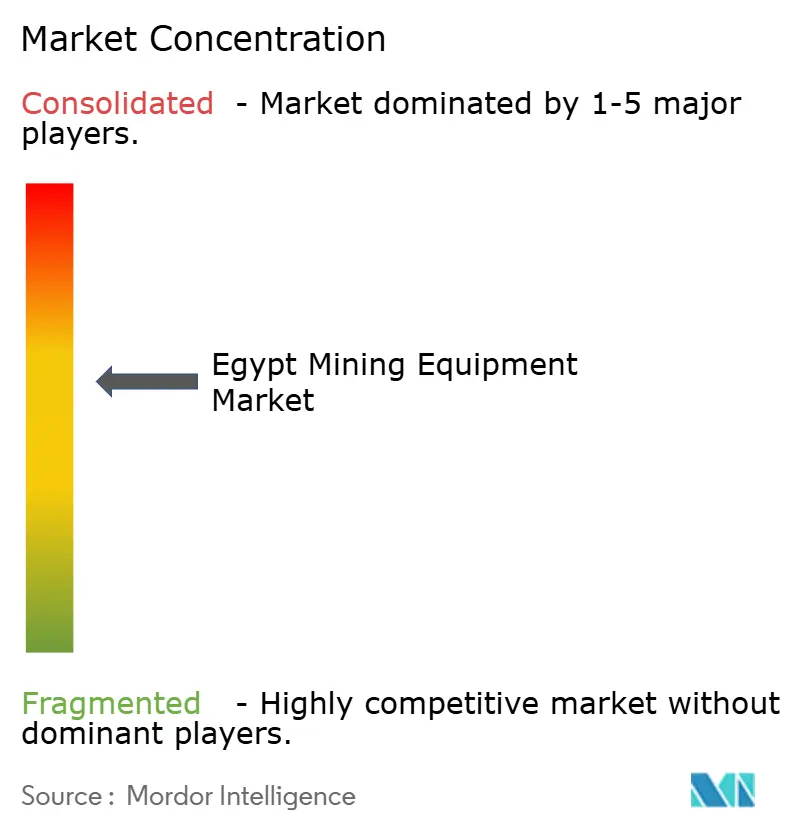
| Market Concentration | Medium |
Major Players
*Disclaimer: Major Players sorted in no particular order Image © Mordor Intelligence. Reuse requires attribution under CC BY 4.0. |
|
Egypt Mining Equipment Market Analysis by Mordor Intelligence
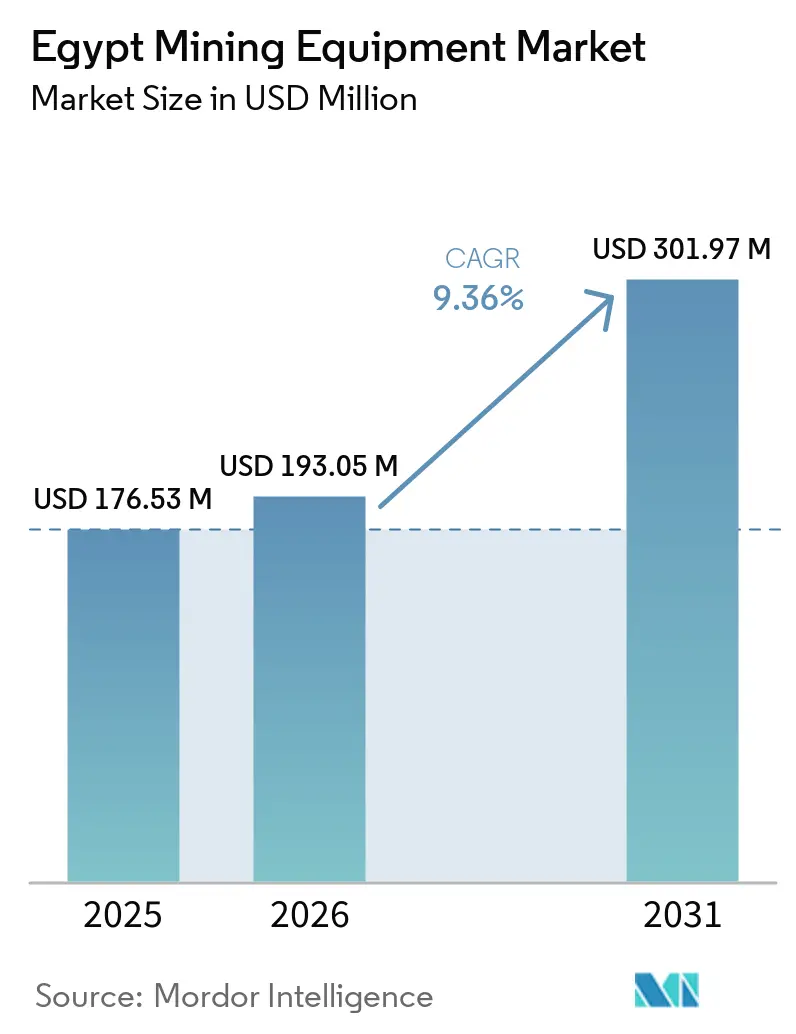
The Egypt mining equipment market size was valued at USD 176.53 million in 2026 and is forecast to reach USD 301.97 million by 2031, up from USD 193.05 million in 2026, at a CAGR of 9.36% during the forecast period (2026-2031). Policy changes that simplify mining investment can bring exploration projects closer to equipment purchasing decisions. Replacement demand also supports sales because many surface fleets have operated through extended maintenance cycles. Operators are weighing equipment cost, service access, financing, and fuel use more closely than before. Rental and lease arrangements can help smaller operators use newer machinery without making a full upfront purchase. The Egyptian mining equipment market, therefore, depends on both mine development activity and suppliers' ability to support equipment throughout its operating life.
Key Report Takeaways
- By equipment type, surface mining equipment accounted for 48.38% of the Egyptian mining equipment market share in 2025 and is projected to record the fastest CAGR of 14.28% through 2031.
- By automation level, manual equipment held 72.84% of the Egyptian mining equipment market share in 2025, while fully autonomous equipment is projected to record the fastest CAGR of 16.25% through 2031.
- By powertrain type, ICE equipment held 84.17% of the Egyptian mining equipment market share in 2025, while battery-electric equipments is projected to record the fastest CAGR of 16.68% through 2031.
- By power output, 500–1,000 HP equipment accounted for 57.43% of the Egyptian mining equipment market share in 2025, while equipment below 500 HP is projected to record the fastest CAGR of 10.64% through 2031.
- By application, mineral mining held 50.27% of the Egyptian mining equipment market share in 2025, while metal mining is projected to record the fastest projected CAGR of 9.67% through 2031.
- By geography, the Cairo and Suez Canal Zone held 62.84% of the Egyptian mining equipment market share in 2025, while the Nile Delta is projected to record the fastest CAGR at 9.88% through 2031.
Note: Market size and forecast figures in this report are generated using Mordor Intelligence’s proprietary estimation framework, updated with the latest available data and insights as of January 2026.
Egypt Mining Equipment Market Trends and Insights
Drivers Impact Analysis*
| Driver | (~) % Impact on CAGR Forecast | Geographic Relevance | Impact Timeline |
|---|---|---|---|
| Government Push to Raise Mining Contribution | +2.1% | National, with concentration in Eastern Desert and Golden Triangle | Long Term (≥ 4 Years) |
| Gold and Phosphate Exploration Licenses | +1.8% | Eastern Desert, Western Desert, Sinai Peninsula | Medium Term (2–4 Years) |
| Replacement Demand for Aging Surface Fleets | +1.2% | National, particularly existing mining regions | Short Term (≤ 2 Years) |
| Rental and Leased Equipment Adoption | +0.9% | Cairo and Suez Canal Zone, Alexandria Region | Medium Term (2–4 Years) |
| Green-Hydrogen Input Demand | +0.8% | Suez Canal Economic Zone, Red Sea Coastal Areas | Long Term (≥ 4 Years) |
| Solar-Plus-Storage for Battery-Electric Trucks | +0.6% | National, with early adoption in major mining operations | Medium Term (2–4 Years) |
| Source: Mordor Intelligence | |||
Government Push to Raise Mining to 5-6% of GDP by 2030
Egypt’s mining policy has moved toward more active investment promotion. The revised mining investment framework endorsed in May 2026 reduced the minimum government equity requirement and lowered site lease costs[1]"Egypt Amends Mineral Resources Regulations: What You Need to Know," Al Tamimi & CO., tamimi.com. It also established a shorter licensing process, which can reduce the time between a resource decision and project activity. The government’s plan for a comprehensive aerial geophysical survey can improve the geological information available to prospective investors. Better information can lower early-stage uncertainty for gold, phosphate, and other mineral projects. The reform agenda also places greater importance on the Egyptian Mineral Resources Authority as an institution capable of moving projects through the approval process. The policy effort is relevant across Egypt, but it is particularly important for deposit areas in Upper Egypt and the Sinai and Red Sea corridor.
Growing Gold and Phosphate Exploration Licenses Post-2019 Mining Law
Mining activity may require more equipment when ore is processed locally rather than shipped in raw form. Egypt’s policy direction has emphasized manufacturing and extractive industries, which support interest in domestic beneficiation. Phosphate projects are especially important because they can link extraction with fertilizer manufacturing. This connection can create demand for excavation equipment, materials-handling systems, crushing, and mineral-processing capacity. Green hydrogen projects in the Suez Canal Economic Zone may also increase demand for upstream inputs such as iron ore and phosphate. The relevant demand is not limited to a single machine category because industrial projects may require equipment at the mine, the processing plant, and the transport interface. The Egyptian mining equipment market is affected when industrial planning brings these activities closer together.
High Replacement Demand for Aging Surface-Mine Fleets
A substantial share of the active surface fleet entered service before 2015 and has remained in operation through extended maintenance cycles. Continued repairs can keep equipment available, but they can also reduce reliability and increase operating pressure at mine sites. Operators increasingly need to balance the cost of major overhauls against the value of replacing older units. This replacement requirement is especially relevant to loaders, haul trucks, drilling equipment, and support machinery used in open-pit operations. The Egyptian mining equipment market is supported by this need, even when new mine construction proceeds slowly. Rental and lease-to-own options give operators another way to manage the cost of imported equipment. Local-currency payment structures can reduce some of the immediate exposure that a buyer faces when exchange rates move. These arrangements are especially useful for mid-sized operations that have limited access to foreign-currency credit.
Rise of Rental/Leased Equipment to Defer Capex
Equipment rental is growing as a procurement channel as economic pressures make outright purchases harder. Currency volatility makes the landed cost of imported machinery unpredictable, while local-currency rental payments shift foreign-exchange risk to suppliers. Mantrac Egypt structures Cat Financial lease-to-own products for Egyptian market conditions, helping mid-tier operators that have limited access to United States dollar credit[2]"Financing," Mantrac Group, mantracgroup.com . Rental also provides smaller operators with access to newer equipment, which could broaden the addressable market beyond the large-scale gold and phosphate operations that currently anchor demand.
Restraints Impact Analysis*
| Restraint | (~) % Impact on CAGR Forecast | Geographic Relevance | Impact Timeline |
|---|---|---|---|
| Currency Volatility and Imported Equipment Cost | -1.4% | National, with acute impact on import-dependent operations | Short Term (≤ 2 Years) |
| Fragmented Small-Scale Mines and Autonomous Uptake | -0.8% | National, particularly affecting smaller regional operations | Medium Term (2–4 Years) |
| Slow Rail-Logistics Upgrades for Bulk Minerals | -0.7% | National, especially Upper Egypt and remote mining corridors | Medium Term (2–4 Years) |
| Limited Local Component Manufacturing | -0.5% | National, with pronounced effects in maintenance-intensive sites | Long Term (≥ 4 Years) |
| Source: Mordor Intelligence | |||
Currency Volatility Inflating Imported Equipment Cost
Most large mining machines and many critical components are imported into Egypt. Exchange-rate volatility can therefore change the local-currency cost of an equipment order before it is completed. This uncertainty can lead operators to delay purchases and extend the use of existing fleets. Dealers also face inventory risk when spare-part costs move quickly. Lower stock availability can create longer repair cycles for equipment already in service. The Egyptian mining equipment market is affected because the cost of machinery, parts, financing, and maintenance can all rise at the same time. Lease products and export-credit support can ease some pressure, but they do not eliminate the cost challenge for smaller buyers. Egypt is also working to develop logistics corridors linking mining areas and ports, although the pace of rail and bulk transport improvements remains critical for remote projects.
Fragmented Small-Scale mines Limiting Autonomous Uptake
Many mining and quarrying operations in Egypt are small or mid-sized and rely on straightforward equipment that local teams can maintain. These sites may lack the telemetry infrastructure, trained remote-operations staff, or standardized safety systems required for full autonomy. As a result, operators are more likely to adopt fleet management, fatigue detection, and grade control before they consider fully autonomous systems. Large, structured surface mines have a more suitable setting for automated drilling and hauling because their operating patterns are more consistent. Large African orders for autonomous and electric equipment illustrate the type of operation that can support these systems. Desert dust and remote communications can add further practical challenges for automated equipment in Egypt. Rail and road links also affect the cost and timeliness of moving machinery and bulk mineral output.
*Our forecasts treat driver/restraint impacts as directional, not additive. The impact forecasts reflect baseline growth, mix effects, and variable interactions.
Segment Analysis
By Equipment Type: Surface Extraction Remains the Core Equipment Base
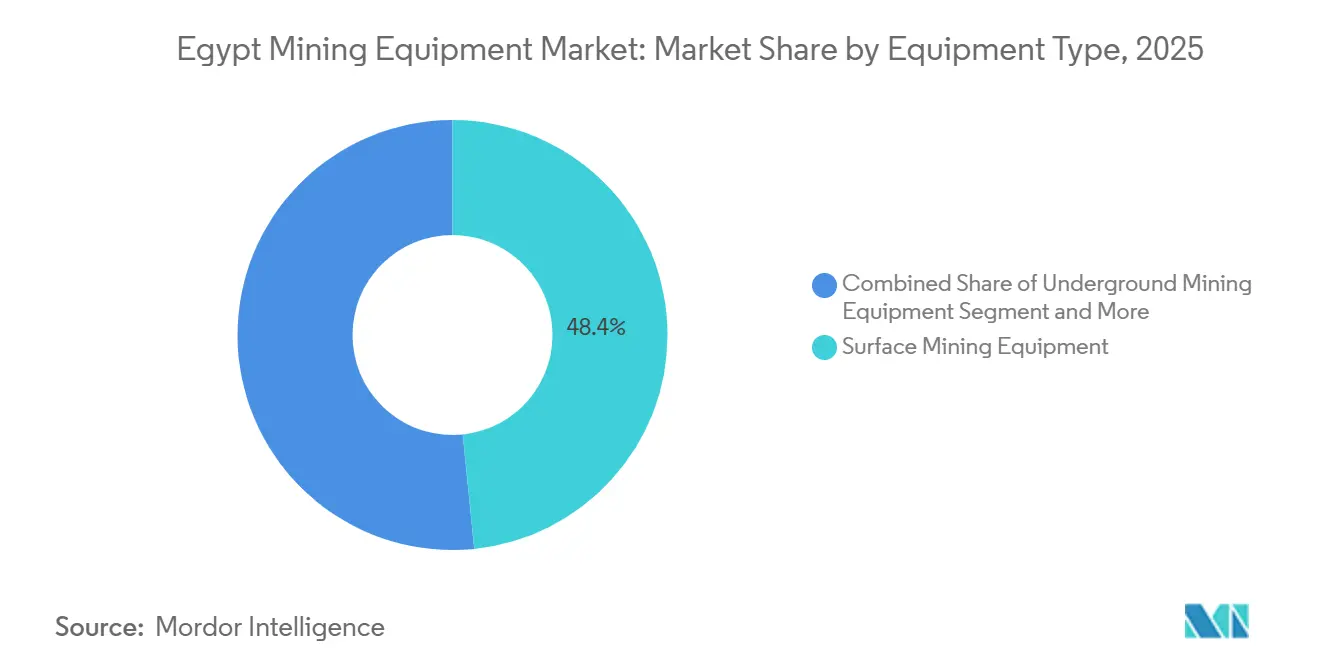
Surface mining equipment is projected to account for 48.38% of the Egyptian mining equipment market share in 2025 and record the fastest CAGR of 14.28% through 2031. Egypt’s phosphate, limestone, gold, and copper deposits continue to support open-pit mining, which depends on loaders, haul trucks, drills, and support units. Surface equipment often becomes the 1st major requirement as projects move from exploration to construction. Replacement demand remains significant, while dealer support and parts availability strongly influence buyer decisions.
Underground mining equipment plays a smaller role than surface machinery in the supply market structure, but its relevance may rise as gold deposits extend below current surface workings. Underground projects require specialized drilling, loading, ventilation, and safety practices, making supplier technical support critical. Battery-electric drills are becoming commercially available, allowing operators to assess lower-emission options for new underground areas. Crushing, pulverizing, and screening units remain necessary for ore preparation, supporting demand beyond extraction equipment in the Egyptian mining equipment market.


By Automation Level: Manual Operations Continue While Digital Tools Expand
Manual equipment is expected to account for 72.84% of the Egyptian mining equipment market share in 2025, while fully autonomous equipment is projected to record the fastest CAGR of 16.25% through 2031. Manual operation remains common because many mining sites in Egypt are small or mid-sized and prioritize mechanical simplicity, practical maintenance, and local service access. The Egyptian mining equipment market continues to rely on operator-controlled equipment, especially where changing mine plans or limited digital infrastructure make higher automation difficult to justify.
Semi-autonomous equipment offers a practical bridge between manual control and full autonomy. Fleet management, fatigue detection, and grade control tools can improve visibility, safety, and material handling while sites build technical capability. Fully autonomous systems are better suited to large surface mines with repeatable routes, reliable connectivity, formal procedures, and skilled personnel. The Egyptian mining equipment market is likely to see autonomy adopted first in larger gold and phosphate operations. At the same time, smaller sites can benefit from modular digital tools that match local operating conditions.
By Powertrain Type: Conventional Fleets Remain Established as Electrification Gains Support
ICE equipment accounted for 84.17% of the Egyptian mining equipment market share in 2025, while battery-electric vehicles are projected to record the fastest CAGR, at 16.68%, through 2031. Diesel equipment remains well established across mine fleets, supported by fuel storage, maintenance routines, and technician expertise. Replacing these systems requires planning beyond purchasing a new machine. Charging infrastructure costs and the reliability of the power supply will influence adoption, making electrification gradual. Conventional equipment will remain important at sites with limited grid access.
Battery-electric equipment has a stronger commercial case when operators pair it with suitable energy systems. The El Shaghab project in Aswan showed that solar generation and storage can support off-grid mining loads. Mine operators must assess charging schedules, battery support, workforce skills, and duty cycles together. Hybrid vehicles offer an intermediate option for reducing diesel use while retaining backup capability. As manufacturers offer conventional and electric models, buyers can align equipment choices with site plans, infrastructure readiness, and operating needs.
By Power Output: Mid-Range Machines Support Established Mine Operations
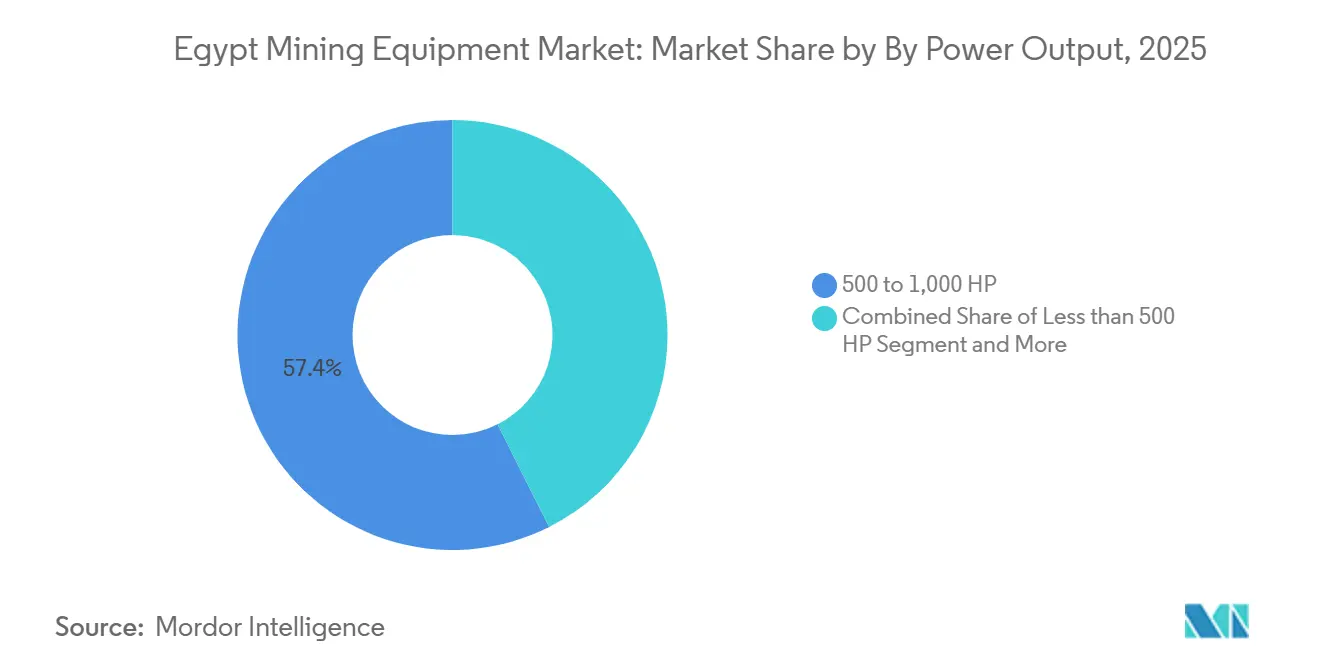
Equipment in the 500–1,000 HP range accounted for 57.43% of the Egyptian mining equipment market share in 2025, while equipment below 500 HP is projected to record the fastest CAGR of 10.64% through 2031. Mid-range machines remain critical in large phosphate and gold operations because they support daily hauling and drilling. Buyers weigh productivity, availability, fuel use, dealer support, material type, and mine layout. The Egyptian mining equipment market relies on these machines to ensure the reliable movement of ore and overburden in open-pit operations.
Equipment above 1,000 HP serves the largest surface operations and remains strategically important despite a narrow customer base. Demand can follow large phosphate sites and major gold projects, where machines require specialized logistics, maintenance planning, and trained personnel. Equipment below 500 HP supports quarrying, aggregates, and smaller extraction work, especially in constrained areas. Construction activity can support demand through quarry material needs. The Egyptian mining equipment market spans a range of operating scales, with dealers needing to match machine size, financing, and service support to site conditions.
By Application: Mineral Extraction Provides the Main Base for Demand
Mineral mining is expected to hold 50.27% of the Egyptian mining equipment market share in 2025, while metal mining is projected to record the fastest CAGR of 9.67% through 2031. Phosphate, limestone, and silica sand anchor mineral mining in Egypt, supporting extraction and industrial applications. Phosphate’s link with domestic fertilizer production supports demand for extraction and processing equipment. Limestone and silica sand operations require reliable equipment for loading, hauling, crushing, and material preparation. Coal mining remains limited due to Egypt’s restricted coal resource base.
Gold exploration in the Eastern Desert and copper and zinc prospects in Sinai support metal mining. Projects moving from exploration to construction can require drilling, loading, hauling, and processing equipment. The pace at which exploitation agreements are converted into operating mines affects the Egyptian mining equipment market. Metal projects may need longer planning timelines because companies must address geology, infrastructure, permitting, and processing routes together. Green hydrogen plans in the Suez Canal Economic Zone can also create interest in upstream mineral inputs if related industrial projects proceed.
Geography Analysis
The Cairo and Suez Canal Zone is projected to hold 62.84% of the Egyptian mining equipment market share in 2025. The area serves as Egypt’s main industrial, logistics, financing, and dealer-service center, with Greater Cairo leading commercial support activities. The Suez Canal Economic Zone also supports industrial planning, while green hydrogen proposals may require mineral inputs such as iron ore and phosphate. The market benefits when suppliers, financiers, and service networks support mining operations from a central commercial base.
Upper Egypt and the Sinai and Red Sea corridor contain several active mineral deposits, including phosphate resources around El Sebaeya and Abu Tartur. The El Shaghab site in Aswan provides a local reference for off-grid solar and storage use in mining. Gold activity in the Eastern Desert and at Sukari reinforces this corridor’s role in demand for resource-side equipment. Remote sites require durable machinery, strong parts planning, and responsive field support because access to power and services varies by location.
The Nile Delta is projected to record the fastest CAGR of 9.88% through 2031. Demand in the region is more closely tied to construction aggregates and industrial minerals than to large hard-rock extraction. The Delta-Alexandria corridor and Northern Coast ports support equipment distribution, quarrying, processing, and the movement of materials to other regions. Planned logistics corridors may ease the movement of bulk minerals and heavy machinery, while customers may include quarry operators, construction-material suppliers, and industrial mineral processors.
Competitive Landscape
The Egyptian mining equipment market is moderately consolidated, with Caterpillar, Komatsu, Sandvik, Epiroc, and Liebherr holding leading positions. These companies rely on broad product coverage and strong aftermarket capabilities, as operators need equipment availability beyond the initial purchase. Mantrac Egypt supports Caterpillar equipment through local service, fleet management tools, financing products, and ongoing technical assistance. Sandvik’s 2026 releases of battery-electric and electric drilling solutions highlight the importance of technology, parts availability, and lifecycle support.
Chinese manufacturers are creating competitive pressure, especially in surface machinery and haul trucks, where upfront pricing can shape purchasing decisions. Their success in Egypt depends on building local service, parts availability, and technical support that meet uptime expectations. Customers may test new suppliers in lower-risk applications, but may hesitate to switch for equipment tied to established maintenance systems. Rental, leasing, financing, and clear lifetime support commitments can help established vendors respond while retaining operator confidence.
Mineral processing has a distinct competitive structure because operators often select crushing, screening, and related equipment within broader plant and engineering designs. Metso, FLSmidth, and Weir remain relevant in this niche, where switching equipment can be difficult after a plant is built around a specific flowsheet. As projects move toward domestic beneficiation, suppliers may become involved earlier in the planning process. Buyers will continue to compare pricing, availability, energy requirements, financing options, and service quality.
Egypt Mining Equipment Industry Leaders
-
Caterpillar Inc.
-
Komatsu Ltd.
-
Sandvik AB
-
Epiroc AB
-
Liebherr-International AG
- *Disclaimer: Major Players sorted in no particular order

Recent Industry Developments
- August 2026: MaxMine announced the launch of MAXI, its new AI assistant designed specifically for fleet management systems in the mining sector. MAXI uses detailed analytics from MaxMine’s Pulse and Impact systems to identify performance issues, including operational gaps and equipment malfunctions.
- April 2026: Epiroc launched a new generation of charging solutions tailored to address the specific challenges of underground mining and heavy-duty electrification.


Egypt Mining Equipment Market Report Scope
The Egyptian mining equipment market is segmented by equipment type, automation level, powertrain type, power output, application, and region. By Equipment Type, the market is segmented into Surface Mining Equipment, Underground Mining Equipment, Mineral Processing Equipment, Drills and Breakers, Crushing, Pulverizing and Screening Equipment, and Loaders and Haul Trucks. By Automation Level, the market is segmented into Manual, Semi-Autonomous, and Fully Autonomous Equipment. By Powertrain Type, the market is segmented into Internal-Combustion Engine, Battery-Electric Vehicles, and Hybrid Vehicles. By Power Output, the market is segmented into Less than 500 HP, 500 to 1,000 HP, and above 1,000 HP. By Application, the market is segmented into Metal Mining, Mineral Mining, and Coal Mining. By Region, the market is segmented into Cairo and Suez Canal Zone, Alexandria and Northern Coast, Upper Egypt, Sinai and Red Sea, and Nile Delta. Market forecasts are provided in terms of Value (USD) and Volume (Units).
| Surface Mining Equipment |
| Underground Mining Equipment |
| Mineral Processing Equipment |
| Drills and Breakers |
| Crushing, Pulverizing and Screening |
| Loaders and Haul Trucks |
| Manual Equipment |
| Semi-Autonomous Equipment |
| Fully Autonomous Equipment |
| Internal-Combustion Engine Vehicles |
| Battery-Electric Vehicles |
| Hybrid Vehicles |
| Less than 500 HP |
| 500 to 1,000 HP |
| Above 1,000 HP |
| Metal Mining |
| Mineral Mining |
| Coal Mining |
| Cairo and Suez Canal Zone |
| Alexandria and Northern Coast |
| Upper Egypt |
| Sinai and Red Sea |
| Nile Delta |
| By Equipment Type | Surface Mining Equipment |
| Underground Mining Equipment | |
| Mineral Processing Equipment | |
| Drills and Breakers | |
| Crushing, Pulverizing and Screening | |
| Loaders and Haul Trucks | |
| By Automation Level | Manual Equipment |
| Semi-Autonomous Equipment | |
| Fully Autonomous Equipment | |
| By Powertrain Type | Internal-Combustion Engine Vehicles |
| Battery-Electric Vehicles | |
| Hybrid Vehicles | |
| By Power Output | Less than 500 HP |
| 500 to 1,000 HP | |
| Above 1,000 HP | |
| By Application | Metal Mining |
| Mineral Mining | |
| Coal Mining | |
| By Geography | Cairo and Suez Canal Zone |
| Alexandria and Northern Coast | |
| Upper Egypt | |
| Sinai and Red Sea | |
| Nile Delta |


Key Questions Answered in the Report
What will be the size of the Egyptian mining equipment market, and how fast will it grow?
The Egypt mining equipment market size stood at USD 176.53 million and is expected to reach USD 301.97 million by 2031, up from USD 193.05 million in 2026, registering a CAGR of 9.36% during the forecast period (2026-2031).
What is driving the demand for mining equipment in Egypt?
Fleet replacement, exploration activity, mining policy changes, and demand linked to phosphate and gold projects support equipment purchasing decisions.
Which equipment category leads demand in Egypt?
Surface mining equipment led with 48.38% share in 2025, reflecting the country’s reliance on open-pit extraction.
Why are mining equipment suppliers focused on service networks in Egypt?
Mine sites need dependable access to parts, maintenance, and technical support, particularly in remote operating locations.
Page last updated on:


 Your data is secure and never sold or shared.


