
Market Overview
| Study Period | 2020 - 2031 |
|---|---|
| Forecast Data Period | 2026 - 2031 |
| Base Year Market Size (2025) | 377.70 Million liters |
| Market Volume (2026) | 391.11 Million liters |
| Market Volume (2031) | 465.67 Million liters |
| Growth Rate (2026 - 2031) | 3.55 % |
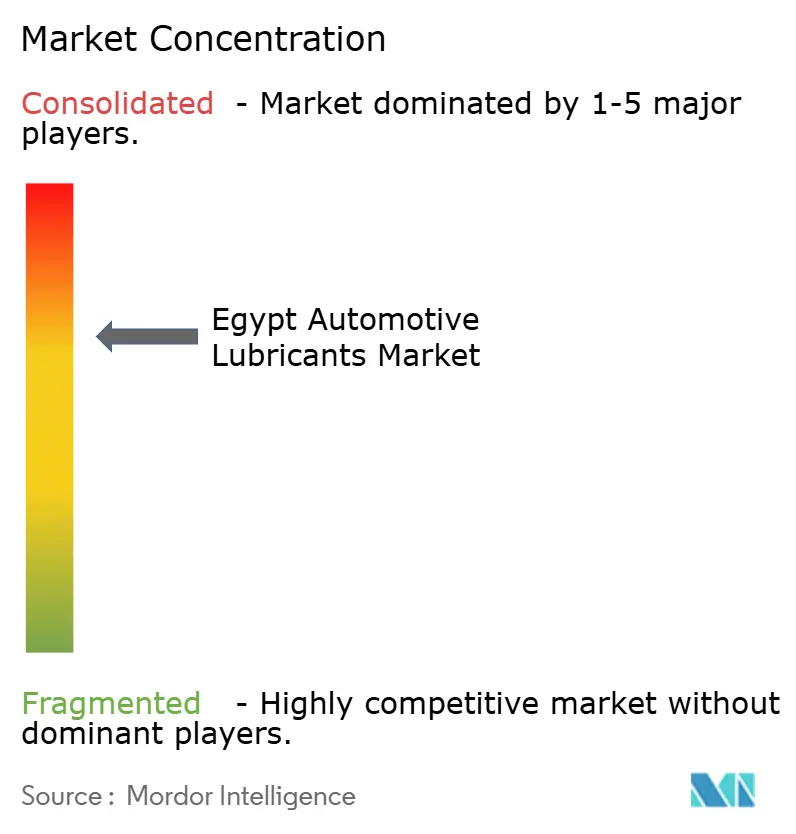
| Market Concentration | Medium |
Major Players *Disclaimer: Major Players sorted in no particular order Image © Mordor Intelligence. Reuse requires attribution under CC BY 4.0. | |
Egypt Automotive Lubricants Market Analysis by Mordor Intelligence
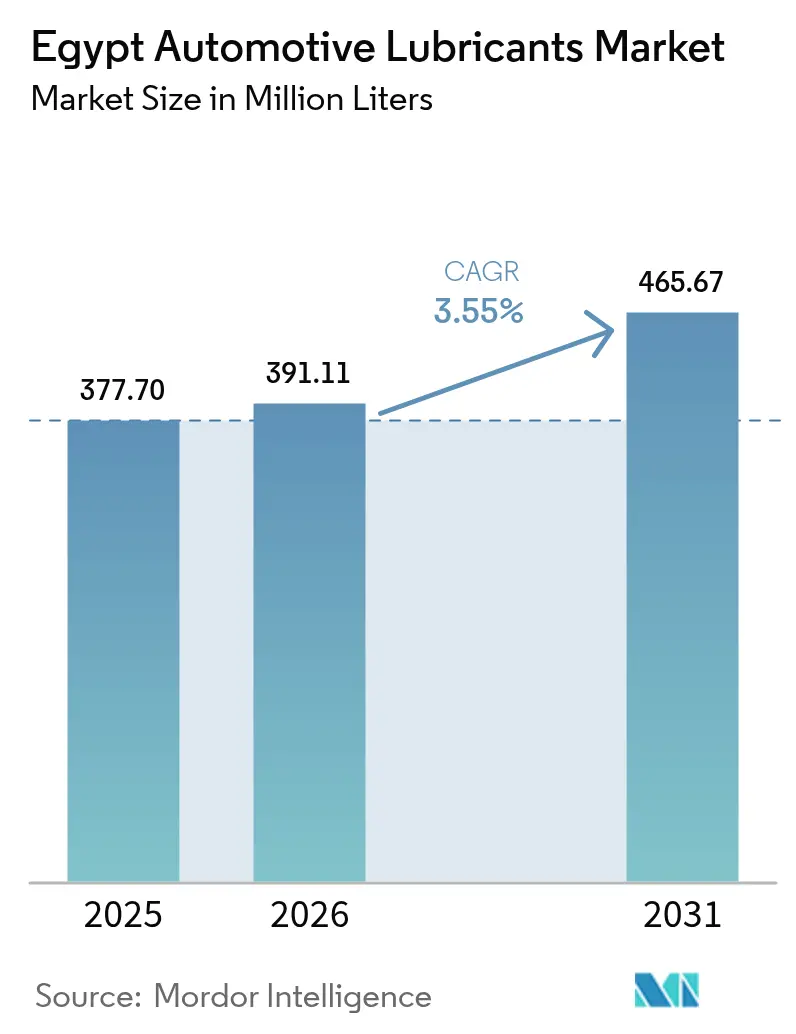
The Egypt Automotive Lubricants Market size is expected to grow from 377.70 million liters in 2025 to 391.11 million liters in 2026 and is forecast to reach 465.67 million liters by 2031 at 3.55% CAGR over 2026-2031. Egypt’s expanding vehicle parc, ambitious infrastructure program, and the OEM-led shift toward higher-spec multigrade and synthetic blends are the chief volume drivers. Multinationals are investing in local blending to counter currency-driven import cost inflation and to tailor products for Egypt’s hot climate and heavy-duty operating cycles. Digital channels, both e-commerce storefronts and app-based mechanic platforms, continue to open fresh retail corridors for premium products, especially among tech-savvy urban consumers. Regulatory enforcement by the Egyptian Organization for Standardization (EOS) is lifting baseline quality and gradually squeezing counterfeit supply, a trend expected to reinforce consumer trust in branded lubricants.
Key Report Takeaways
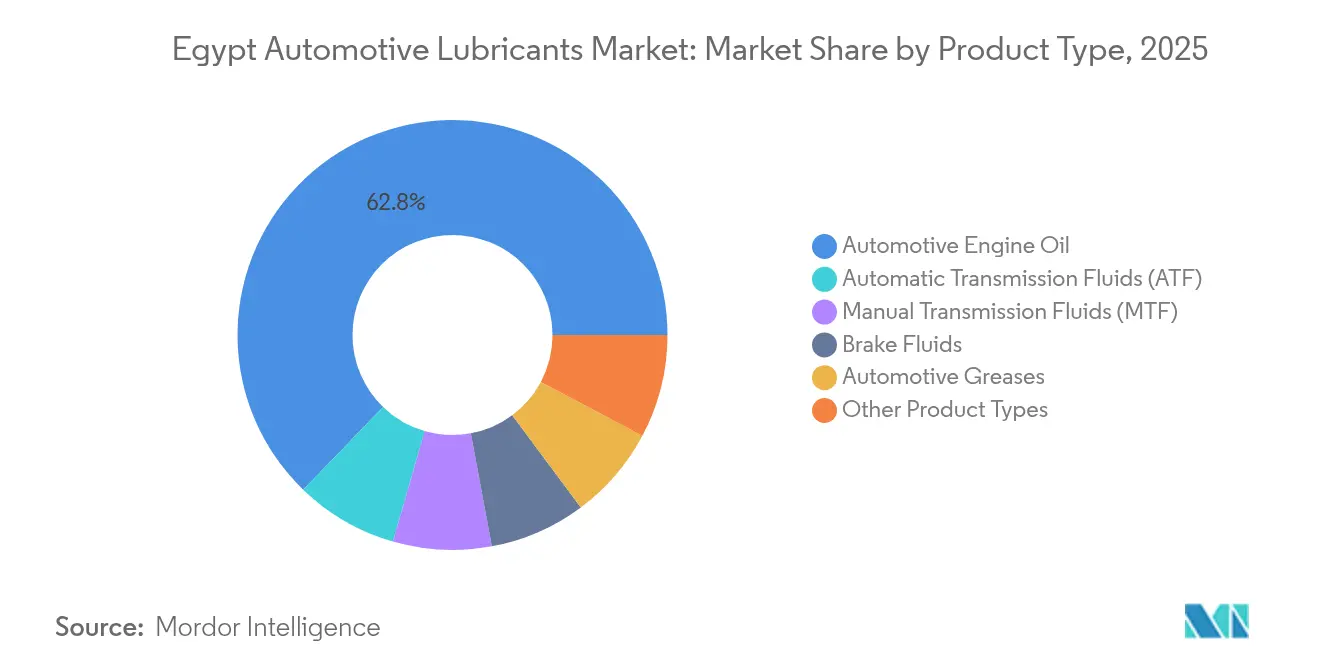
- By product type, automotive engine oils held 62.78% of the Egypt automotive lubricants market share in 2025, while automatic transmission fluids are forecast to expand at a 3.82% CAGR through 2031.
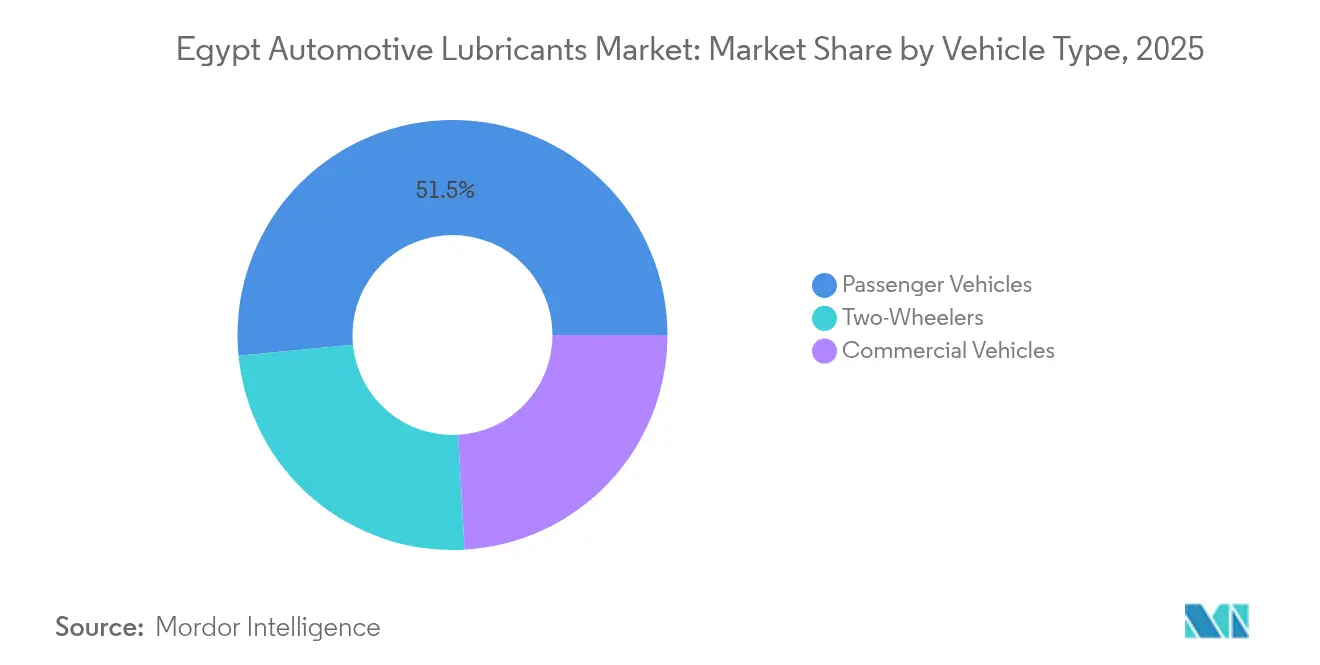
- By vehicle type, passenger cars led the Egypt automotive lubricants market with a 51.54% share in 2025; two-wheelers are projected to post the highest CAGR of 3.68% from 2026 to 2031.
Note: Market size and forecast figures in this report are generated using Mordor Intelligence’s proprietary estimation framework, updated with the latest available data and insights as of 2026.
Egypt Automotive Lubricants Market Trends and Insights
Drivers Impact Analysis*
| Drivers | (~) % Impact on CAGR Forecast | Geographic Relevance | Impact Timeline |
|---|---|---|---|
| Rising vehicle parc and ownership expansion | +1.2% | National, concentrated in Greater Cairo, Alexandria, Giza | Medium term (2-4 years) |
| Infrastructure boom driving commercial-fleet oil demand | +0.8% | National, with early gains in New Administrative Capital, Suez Canal Economic Zone | Long term (≥ 4 years) |
| OEM shift to higher-spec multigrade and synthetic oils | +0.6% | Global OEM influence, strongest in urban centers | Medium term (2-4 years) |
| Local blending capacity upgrades by multinationals | +0.5% | Concentrated in Cairo, Alexandria, Suez industrial zones | Short term (≤ 2 years) |
| E-commerce and digital mechanic platforms pushing retail volumes | +0.4% | Urban centers, expanding to secondary cities | Short term (≤ 2 years) |
| Source: Mordor Intelligence | |||
Rising Vehicle Parc and Ownership Expansion
Egypt operated more than 5 million internal-combustion vehicles in 2024, a base that now requires regular engine oil and drivetrain fluid service intervals that average 6,000 kilometers for passenger cars. Middle-class households in Cairo and Alexandria benefit from accessible financing and locally assembled models that qualify for lower customs duties, encouraging first-time car ownership. Government incentives for assembly plants spur OEM-approved factory fills, which then lock consumers into branded aftermarket choices. Fleet renewals toward newer models with tighter tolerances further accelerate demand for low-viscosity multigrades that meet API SN Plus or ACEA C3 guidelines. Commercial truck registrations linked to megaproject construction increase heavy-duty engine oil consumption, and workshop operators increasingly recommend semi-synthetics for extended drain intervals. This convergence of private and fleet demand highlights the long-term growth trajectory of the Egyptian automotive lubricants market.
Infrastructure Boom Driving Commercial-Fleet Oil Demand
The USD 58 billion New Administrative Capital alone engages thousands of dump trucks, concrete mixers, and cranes that consume high-TBN diesel oils every 250 operating hours. The deepening of the Suez Canal port and berth extensions requires marine-grade trunk piston engine oils with enhanced detergency under high-sulfur fuel conditions. Highway upgrades that connect Upper Egypt to coastal hubs increase demand for lubricants for asphalt pavers, graders, and maintenance fleets that rely on multi-purpose hydraulic fluids. Mining and oil exploration in the Eastern Desert require extreme-pressure gear oils for rigs operating in abrasive sand environments. The national roads agency mandates equipment service records, which fuels consumption of OEM-backed lubricants from Shell, TotalEnergies, and Misr Petroleum. Infrastructure, therefore, injects sustained commercial-fleet volumes into the Egyptian automotive lubricants market.
OEM Shift to Higher-Spec Multigrade and Synthetic Oils
Local assembly lines for BMW, Mercedes-Benz, and Hyundai specify 5W-30 and 0W-20 synthetic oils that conform to ACEA C3 and API SP standards, thereby reducing fuel consumption while extending oil-change intervals to 15,000 kilometers. Transmission builders now endorse full synthetic ATFs compatible with GM DEXRON VI and Volvo 97342, exemplified by Mobil ATF Multi-Vehicle. Workshops follow OEM service bulletins, driving retail upsell from monogrades to premium multigrades. Synthetic penetration of passenger-car engine oil is expected to rise, a trend that boosts the value per liter in the Egyptian automotive lubricants market. Tribology research from the Egyptian Society of Tribology suggests that the addition of 20% solid additives can reduce wear scar diameters by 18%, encouraging domestic formulators to explore additive innovation[1]Journal of the Egyptian Society of Tribology, “Effect of Solid Additives,” ekb.eg.
Local Blending Capacity Upgrades by Multinationals
ADNOC Distribution and TotalEnergies operate a blending plant in Borg El Arab, which supplies Voyager-branded products to 240 fuel stations and independent retailers. Misr Petroleum and Al-Manar provide base-stock flexibility for API Group I and Group II formulations. Currency devaluation in 2024 and 2025 widened the cost gap between imported finished lubricants and locally blended alternatives, making Egypt a hub for exporting lubricants to North Africa. Multinationals install in-line blending control and bulk additive dosing to deliver OEM-approved batches quickly, shortening lead times to local distributors. These upgrades anchor supply security and improve margins in the Egyptian automotive lubricants market.
Restraints Impact Analysis*
| Restraints | (~) % Impact on CAGR Forecast | Geographic Relevance | Impact Timeline |
|---|---|---|---|
| Currency devaluation inflating imported base-oil costs | -0.9% | National, affecting all import-dependent operations | Short term (≤ 2 years) |
| Counterfeit and low-grade lubricants eroding premium share | -0.6% | National, concentrated in rural and price-sensitive segments | Medium term (2-4 years) |
| Gradual CNG/EV penetration reducing engine-oil volume | -0.3% | Urban centers, government fleets, public transportation | Long term (≥ 4 years) |
| Source: Mordor Intelligence | |||
Currency Devaluation Inflating Imported Base-Oil Costs
Base-oil imports account for a major portion of Egypt’s requirements, so a decline in the pound's value increases the landed cost per barrel, thereby squeezing blender margins. Formulators respond by renegotiating long-term supply contracts and switching to Group I stocks sourced from local refineries, including the Assiut hydrocracker expansion. Some brands employ cost-down reformulations that blend Group I with synthetic base stocks yet retain OEM approvals. Others pass along cost increases, causing retail prices on 4-liter packs to rise. Persistent volatility threatens volume in low-income segments and tempers short-term growth prospects for the Egyptian automotive lubricants market.
Counterfeit and Low-Grade Lubricants Eroding Premium Share
Regulators seized counterfeit lubricant containers in 2024, indicating the presence of an illicit market. Counterfeits are sold at up to 50% discounts compared to genuine products, attracting price-sensitive consumers in rural governorates. Substandard oil can shorten engine life, but detecting it remains difficult for untrained buyers. EOS mandates conformity testing, yet spot checks cover only 15% of retail outlets each quarter, allowing counterfeit channels to regroup quickly[2]Egyptian Organization for Standardization and Quality, “EOS,” iso.org. Brand owners deploy tamper-evident seals and QR code authentication, yet awareness remains uneven. These factors dilute demand for verified premium brands, shaving 0.6 percentage points from the projected CAGR of the Egyptian automotive lubricants market.
*Our forecasts treat driver/restraint impacts as directional, not additive. The impact forecasts reflect baseline growth, mix effects, and variable interactions.
Segment Analysis
By Product Type: Engine Oils Remain Dominant Amid ATF Acceleration
Automotive engine oils accounted for 62.78% of 2025 consumption. Multigrade formulations, such as 5W-30 and 10W-40, combine shear stability with high detergent levels, supporting drain intervals of up to 15,000 kilometers in passenger cars operating under Egypt’s dusty conditions. Synthetic penetration has increased as OEM warranties increasingly require API SN Plus or ACEA C3 oils. Group III base-oil availability from regional import hubs linked to the Suez Canal underpins this trend, and local blenders have added nitrogen blanketing and in-line viscosity control to meet tighter specifications. Semi-synthetic blends attract mass-market buyers while still meeting OEM requirements.
Automatic transmission fluids are projected to register a 3.82% CAGR through 2031, the fastest pace among products and a significant contributor to the growth of the Egyptian automotive lubricants market. OEM factories fill demand for low-viscosity, friction-modified ATF compatible with wet-clutch systems, increasing value per liter. Manual transmission fluids and gear oils continue to serve commercial fleets that prefer 80W-90 viscosities for durability under high load. Brake fluids, greases, power steering fluids, and coolants are rising steadily in line with vehicle counts and maintenance schedules. EOS mandates the use of DOT 4 brake fluid on new cars, fueling incremental demand. Across product types, counterfeit penetration is highest in monograde engine oils and lowest in ATF, due to the more complex packaging and product-level strategies required within the Egyptian automotive lubricants market.


By Vehicle Type: Passenger Vehicles Lead, Two-Wheelers Accelerate
Passenger cars accounted for 51.54% of the 2025 volume in the Egyptian automotive lubricants market. Urban middle-income consumers favor branded engine oils endorsed by OEM manuals, reinforcing multinationals’ premium positioning. Service frequency averages twice a year because desert dust and stop-and-go traffic can quickly cause oil oxidation. Workshops are increasingly installing sticker reminders and SMS alerts to support lubricant pull-through. Consumer preference for extended-warranty packages sold by dealerships drives the adoption of synthetic blends, further increasing the value per service.
Logistics, construction, and intercity transport corridors primarily drive commercial vehicle demand. Fleet managers weigh lubricant choice against total cost of ownership and downtime risk, often opting for high-base-number diesel oils with 25,000-kilometer drain intervals. Bulk supply contracts linked to fuel-station networks allow tiered pricing based on monthly volume, stabilizing revenue streams for suppliers in the Egyptian automotive lubricants market.
Two-wheelers are projected to grow at a 3.68% CAGR through 2031. Food delivery and ride-hailing apps like Mrsool and Talabat add thousands of motorcycles monthly, which operate in hot-idle cycles that rapidly degrade their oil. Two-stroke demand declines as four-stroke models dominate sales, aligning with OEM calls for JASO MA2-certified 10W-40 oils that protect wet clutches. Assemblers such as Benelli Egypt require factory-fill lubricants, forging direct supplier agreements that widen market access. Together, the vehicle-mix dynamics help maintain balanced volume growth and reinforce the resilience of the Egyptian automotive lubricants market.
Geography Analysis
The Nile Delta and Valley account for a major share of the lubricant volume, thanks to their dense population, industrial clusters, and the highest vehicle ownership rates. Alexandria’s port and logistics operations support commercial-vehicle lube demand, while tourism traffic to the North Coast bolsters seasonal sales of passenger-car oils. Suez Canal Economic Zone attracts tanker fleets and container traffic that rely on marine and heavy-duty engine oils, adding incremental barrel volumes and enhancing geographic diversity inside the Egyptian automotive lubricants market.
Upper Egypt, stretching from Assiut to Aswan, is outpacing the national average thanks to mining and agricultural mechanization projects that operate fleets of excavators, harvesters, and irrigation pumps. The Assiut hydrocracker expansion improved local base-oil access, reducing freight cost to blenders serving nearby governorates. Workshop density remains low, so oil change intervals often exceed OEM recommendations, creating an opportunity for awareness programs led by suppliers. New urban communities such as the New Administrative Capital and New Alamein consume high volumes of construction equipment lubricants during build-out phases, then transition to passenger-car and commercial-fleet service demand post completion.
Sinai Peninsula and Red Sea coastal towns experience niche but strategic demand, primarily from tourism buses, fishing fleets, and heavy equipment servicing mineral extraction projects. Suppliers route deliveries through the Suez corridor, leveraging bonded warehouses for duty-free marine lubricants. Retail footprint is thinner, so e-commerce channels bridge gaps by delivering engine-oil packs to end consumers in Sharm El-Sheikh and Hurghada within 48 hours. This digital penetration illustrates the omnichannel evolution of the Egypt automotive lubricants market.
Regulatory Landscape
Automotive lubricants in Egypt are governed by product quality and conformity requirements led by the Egyptian Organization for Standardization and Quality (EOS), with compliance pathways that often reference global specifications such as API, SAE, and JASO where applicable. Ministerial Decree No. 102/2022 supports the use of recognized international standards when an Egyptian standard is not established, while EOS standards also continue to be updated for specific lubricant categories (for example, ES 514/2025 covering lubricating oils for transport mechanism gear sets, excluding ATF). Enforcement actions against counterfeit lubricants, combined with conformity testing requirements, reinforce baseline quality expectations at retail and workshop levels.
On the trade and licensing side, the Egyptian General Petroleum Corporation (EGPC) is an approval gate for the import and export of petroleum products including lubricating oils, aligning with the Import and Export Law framework (Law No. 118/1975 and its executive regulations). For imports intended for trading, the General Organization for Export and Import Control (GOIEC) requires importer compliance and registration of foreign factories/companies under Ministerial Decree No. 43/2016. Imports for manufacturing purposes involve Industrial Development Authority (IDA) approvals at the shipment level. This multi-agency structure puts documentation, factory registration status, and conformity evidence at the center of market access and supply planning for both finished lubricants and key inputs.
Value Chain Analysis
Egypts automotive lubricants value chain starts with base oils (primarily imported, complemented by domestic refinery streams) and additive packages. It then moves through local blending and packaging, distribution, and finally workshop, dealership, fuel-station, and retail/e-commerce endpoints, where product choice is influenced by OEM specifications and mechanic recommendations. EGPC oversight of petroleum-product imports, GOIEC requirements for trading imports, and EOS conformity expectations shape procurement and inbound logistics, particularly for finished lubricants and higher-performance additive chemistries used in synthetic and low-viscosity multigrades.
Blending and supply hubs are concentrated around Alexandria and the Suez corridor, supporting import intake and national redistribution. State-linked channels, such as Misr Petroleum networks, coexist with multinational brands and local licensed operators. Distribution typically runs through fuel-station networks, regional distributors, and fleet accounts (construction, logistics, and public-sector fleets), while workshop-level pull-through is supported by OEM endorsements, service contracts, and anti-counterfeit packaging and authentication tools. Periodic logistics variability affecting imported raw materials increases the operational value of multi-sourcing base oils and additives, and it elevates the role of local blending and inventory positioning near major consumption centers.
Competitive Landscape
Egypt Automotive Lubricants is moderately consolidated. Shell, TotalEnergies, ExxonMobil, and BP collectively held a major share of premium-segment volume in 2024, supported by their fuel-station networks, OEM endorsements, and technical service teams. Local champions offer competitive pricing and secure government contracts, serving both rural and industrial customers through their filling stations. They tap into the domestic base-oil supply, which partly insulates them from foreign currency swings and enables them to make aggressive tenders for public-sector fleets. Regional entrants seek footholds through partnerships with independent retailers. White-space opportunities exist in EV fluids, biodegradable hydraulic oils, and factory-fill agreements for new assembly plants, with early pilots underway. Competitive strategy now extends into digital territory. ExxonMobil collaborates with fintech firm Octane to integrate Mobil lubricant purchase rewards into a fleet-management wallet. TotalEnergies promotes QR-code authentication to fight counterfeits, while Shell pilots on-site lubricant condition monitoring via IoT sensors in haul-truck fleets. Vendors also sponsor mechanic training through EOS-approved curricula, cementing mindshare at the point of service. These initiatives collectively elevate switching costs and consolidate loyalty within the Egyptian automotive lubricants market.
Egypt Automotive Lubricants Industry Leaders
Exxon Mobil Corporation
Shell plc
TotalEnergies
BP plc
Misr Petroleum
- *Disclaimer: Major Players sorted in no particular order

Market Opportunities and Future Outlook
An opportunity exists to widen organized distribution coverage beyond Greater Cairo and Alexandria into Upper Egypt and the Delta, where workshop density and authentic-product access are more uneven and where counterfeit discounting has been more pronounced. Recent moves by major brands validate this whitespace. Castrol Egypt signed three distribution agreements in April 2026 (with Nacita Mobility, Qebaa Trading and Distribution, and Al Mansour for Trading and Distribution) to expand national reach, and FUCHS Egypt Lubricants formed a distributor partnership in May 2026 with Dynamic Distribution Co. to serve Upper Egypt. These shifts create room for suppliers that can pair regional availability with mechanic training, QR-code or tamper-evident authentication, and consistent stocking of OEM-specified multigrades, ATFs, and brake fluids.
Product-side, the most actionable focus is higher-spec lubricants that match newer vehicle requirements (API SP/SQ-aligned engine oils, ACEA-aligned passenger car oils, and multi-vehicle ATFs), alongside premium greases and specialty fluids for fleets operating under high-heat, high-dust, and heavy-duty cycles. Government actions also strengthen a more formal manufacturing and supply base: the revised National Automotive Industry Development Programme (AIDP) criteria implemented in July 2025 emphasizes higher local value-added and compliance with environmental requirements, which aligns with local blending and certified production footprints. At the same time, ExxonMobil discussions in May 2026 with the Ministry of Petroleum and Mineral Resources on expanding high-performance synthetic greases and premium lubricants using existing Alexandria and 10th of Ramadan City facilities highlight active capacity and capability upgrading that can support both domestic demand and export-oriented supply.
Recent Industry Developments
- May 2026: ExxonMobil met with Egypts Minister of Petroleum and Mineral Resources Karim Badawi to discuss expanding production, distribution, and marketing of high-performance synthetic greases and premium lubricants, leveraging existing facilities in Alexandria and 10th of Ramadan City. The engagement signals continued investment interest in higher-margin specialties and local capability that can reduce exposure to imported finished products. It also supports broader availability of OEM-oriented products in a market shifting toward higher-spec multigrades and synthetics.
- October 2025: ExxonMobil Egypt signed a five-year strategic cooperation agreement with Abou Ghaly Motors to supply Mobil lubricants across its network of eight main and 23 authorized service centers. The deal strengthens captive aftermarket access through an established after-sales channel and reinforces OEM-service-aligned product pull-through. Long-term agreements of this type can increase switching costs at the point of service and concentrate premium demand among fewer brand partners.
- May 2025: ADNOC Distribution and TotalEnergies Marketing Egypt launched locally manufactured ADNOC Voyager lubricants in Egypt, produced at a TotalEnergies facility in Borg El Arab. The launch marked ADNOCs entry into broader retail channels and added locally produced supply that can better match price points under currency volatility. Local production also shortens lead times and can support expansion into independent retail sites beyond major fuel-station networks.


Research Methodology Framework and Report Scope
Market Definition and Coverage
For this study, the Egypt automotive lubricants market is defined as finished lubricants consumed in vehicles operating in Egypt, measured as demand in liters across OEM fill and aftermarket top-ups and drain-and-fill replacements.
Scope exclusions: Industrial lubricants, marine oils, aviation lubricants, and process oils are excluded even if they share similar base oils or additive chemistry.
Segmentation Overview
- By Product Type
- Automotive Engine Oil
- 0W-XX
- 5W-XX
- 10W-XX
- 15W-XX
- Monogrades
- Other Grades
- Manual Transmission Fluids (MTF)
- Automatic Transmission Fluids (ATF)
- Brake Fluids
- Automotive Greases
- Other Product Types (Power Steering Fluid etc.)
- Automotive Engine Oil
- By Vehicle Type
- Passenger Vehicles
- Commercial Vehicles
- Two-Wheelers
Data Sources, Market Sizing, and Validation
Desk Research
Desk work starts by anchoring the vehicle-side demand pool, and we map it to lubricant usage patterns that can be verified. Public sources such as CAPMAS releases, Egypt Customs trade statistics, UN Comtrade, World Bank macro series, and publications from entities like the Egyptian Organization for Standardization help us understand vehicle activity, imports exposure, and quality rules that shape what is sold.
We also review company annual reports, investor presentations, port and logistics updates, and credible local business press to track blending expansions, distribution changes, and packaging shifts that affect apparent consumption. Where needed, we reference paid database subscriptions for company financials and intelligence, news and financials, and lubricants-specific market information to cross-check market structure signals that are harder to see in public data alone. The desk sources listed here are illustrative, and many other references were used to collect data, validate assumptions, and clarify open questions.
Primary Interviews and Surveys
Primary work focuses on validating how lubricant demand forms in Egypt across passenger vehicles, commercial vehicles, and two-wheelers, and how it splits across OEM channels and the aftermarket. We interview and survey lubricant blenders, distributors, workshops, fleet operators, and retail decision makers so we can fill gaps on drain intervals, pack-size mix, and grade migration, and then test those points against what we learned from desk research.
Distribution of primary research fieldwork respondents
| Company type | Respondent position |
|---|---|
| Top tier: 35% | CXOs: 13% |
| Mid tier: 44% | Functional/Unit leaders: 27% |
| Smaller Players: 21% | Managers: 60% |
Market-Sizing & Forecasting
Market sizing follows a top-down and bottom-up logic, where the demand pool is rebuilt from vehicle parc and usage signals, and then adjusted using real-world lubricant consumption behavior. The top-down side uses indicators such as in-use vehicle parc by type, average annual kilometers, oil drain intervals, sump capacities, and the split between workshop servicing and do-it-yourself top-ups, which are translated into liters demanded by product families.
To keep totals realistic, we corroborate them with selective bottom-up approximations based on sampled brand and channel checks, typical pack-size ladders, and price ladders by viscosity grade, then close gaps using conservative ranges agreed with interviewees. Because the market is reported in liters, we avoid overcounting when higher-spec grades replace older ones without increasing total volumes. Forecasting is built mainly through scenario analysis, where vehicle parc growth, import availability, maintenance behavior, and grade upshifts are varied within expert-validated bands, and the final path is selected after the assumptions look consistent across vehicle types and product groups.
Data Validation & Update Cycle
Validation is done in multiple passes so a single weak input does not distort the full market. We compare modeled demand with independent signals such as vehicle fleet trends, lubricant trade flows, and major channel developments, and then investigate outliers before sign-off.
When the variance is large, we re-check the input logic, revisit the conversion steps, and re-contact sources if the topic is material to the final number. Reports are refreshed annually, and interim updates are made when meaningful events occur, such as major currency moves, supply disruptions, or regulation-led quality shifts. Before delivery, we review the latest public indicators again so the output reflects the most current Egypt market conditions rather than an older snapshot.
Mordor Intelligence's Egypt Automotive Lubricants Market Sizing Compared With Other Published Estimates
Published market values for Egypt automotive lubricants often look inconsistent because the scope and counting unit are not always aligned, and pricing and currency timing can shift the picture quickly. Differences also come from whether estimates track finished lubricant consumption, supplier sales, or a mix of lubricants and adjacent automotive fluids.
The main gap is volume versus value reporting and how non-lubricant automotive fluids are treated, where Mordor Intelligence keeps the scope tied to finished automotive lubricants demand in liters and counts items like engine oils, transmission fluids, brake fluids, greases, and power steering fluid based on vehicle-side usage rather than revenue expansion. Some published figures also apply aggressive price progression without re-testing pack-size mix and channel discounts, and they may not revalidate drain intervals and grade migration after regulatory or quality-enforcement changes.
Benchmark comparison
| Source | Market Size | Gaps in Research Methodology |
|---|---|---|
| Mordor Intelligence | USD 377.70 M (2025) | |
| Industry Research Publisher A | USD 586.38 M (2024) | Reported as revenue, which can rise sharply with inflation and currency shifts, and the scope and conversion from liters to USD are not shown, making it hard to separate real demand growth from price effects. |
| Global Consultancy B | USD 361.27 M (2023) | Uses an older base year and appears to apply narrower product and channel assumptions, and it does not clearly state how vehicle parc, drain intervals, and top-up behavior were rechecked for Egypt conditions. |
The spread in the table is mainly explained by unit choice (liters versus USD) and by what each publisher includes as automotive fluids versus lubricants. By keeping inputs traceable to vehicle activity and service behavior, and cross-checking them through channel feedback, we keep the estimate repeatable and easier to reconcile when market conditions change.


Key Questions Answered in the Report
What is the current volume of Egypt’s automotive lubricants consumption?
The Egypt automotive lubricants market size stands at 391.11 million litres in 2026.
How fast is demand expected to grow over the next five years?
Volume is forecast to reach 465.67 million litres by 2031, reflecting a 3.55% CAGR.
Which product category dominates sales?
Engine oils account for 62.78% of 2025 volume, far ahead of other lubricant types.
Which vehicle class contributes the most lubricant demand?
Passenger cars held 51.54% of 2025 consumption and remain the largest contributor.
What major factor could restrain near-term growth?
Ongoing currency devaluation inflates imported base-oil costs, pressuring margins and prices.
Page last updated on:


 Your data is secure and never sold or shared.


