
Market Overview
| Study Period | 2020 - 2031 |
|---|---|
| Forecast Data Period | 2026 - 2031 |
| Base Year Market Size (2025) | USD 1.00 Billion |
| Market Size (2026) | USD 1.06 Billion |
| Market Size (2031) | USD 1.41 Billion |
| Growth Rate (2026 - 2031) | 5.95 % |
| Market Concentration | High |
Major Players *Disclaimer: Major Players sorted in no particular order Image © Mordor Intelligence. Reuse requires attribution under CC BY 4.0. | |
Germany E-Brokerage Market Analysis by Mordor Intelligence
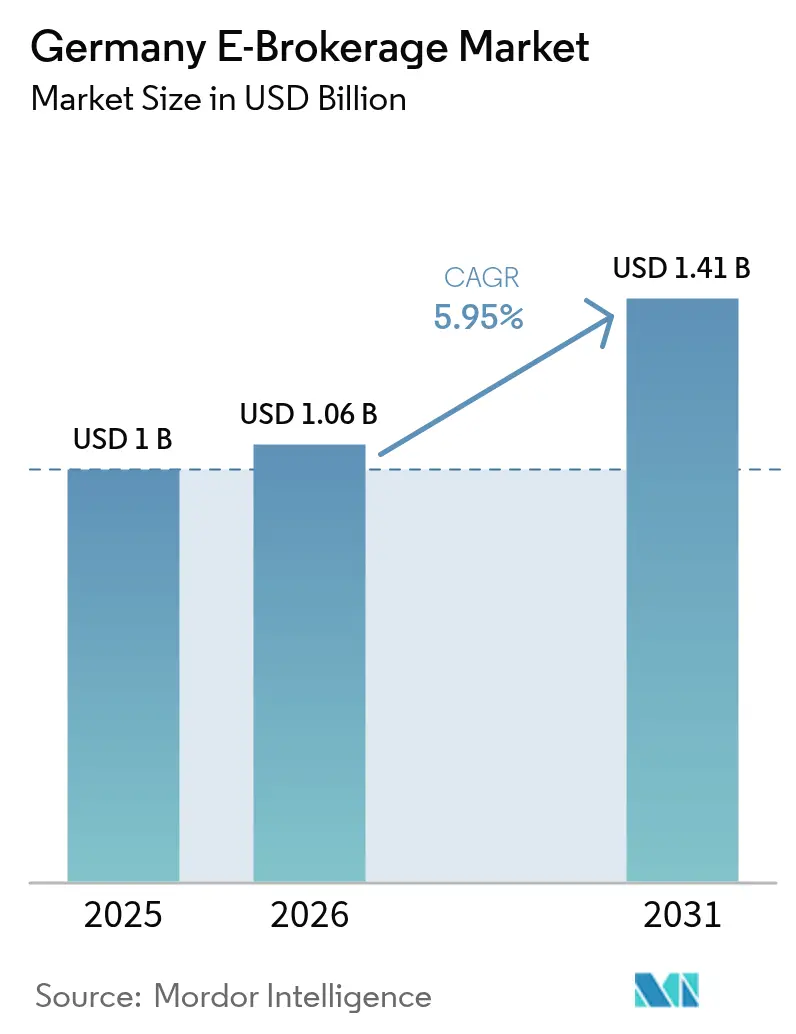
The Germany e-brokerage market size was valued at USD 1.00 billion in 2025 and estimated to grow from USD 1.06 billion in 2026 to reach USD 1.41 billion by 2031, at a CAGR of 5.95% during the forecast period (2026-2031). A surge of mobile-first platforms, an accelerating shift toward zero-commission trading, and supportive regulatory initiatives are driving sustained uptake among retail investors. Competitive intensity is rising as traditional banks digitalize their offerings while fintech entrants introduce fractional investing and high-yield cash accounts that attract deposits away from legacy institutions. The market’s resilience is being tested by the impending European Union ban on payment-for-order-flow (PFOF) revenue, yet leading brokers are diversifying into subscription models, proprietary trading venues, and embedded brokerage APIs to offset the lost income. Platform reliability, cybersecurity, and talent availability remain critical success factors as BaFin tightens oversight under the Digital Operational Resilience Act. Regional growth differentials persist, with West Germany contributing the largest volumes, while East Germany records the strongest momentum thanks to rapid digital adoption and lower traditional-bank penetration.
Key Report Takeaways
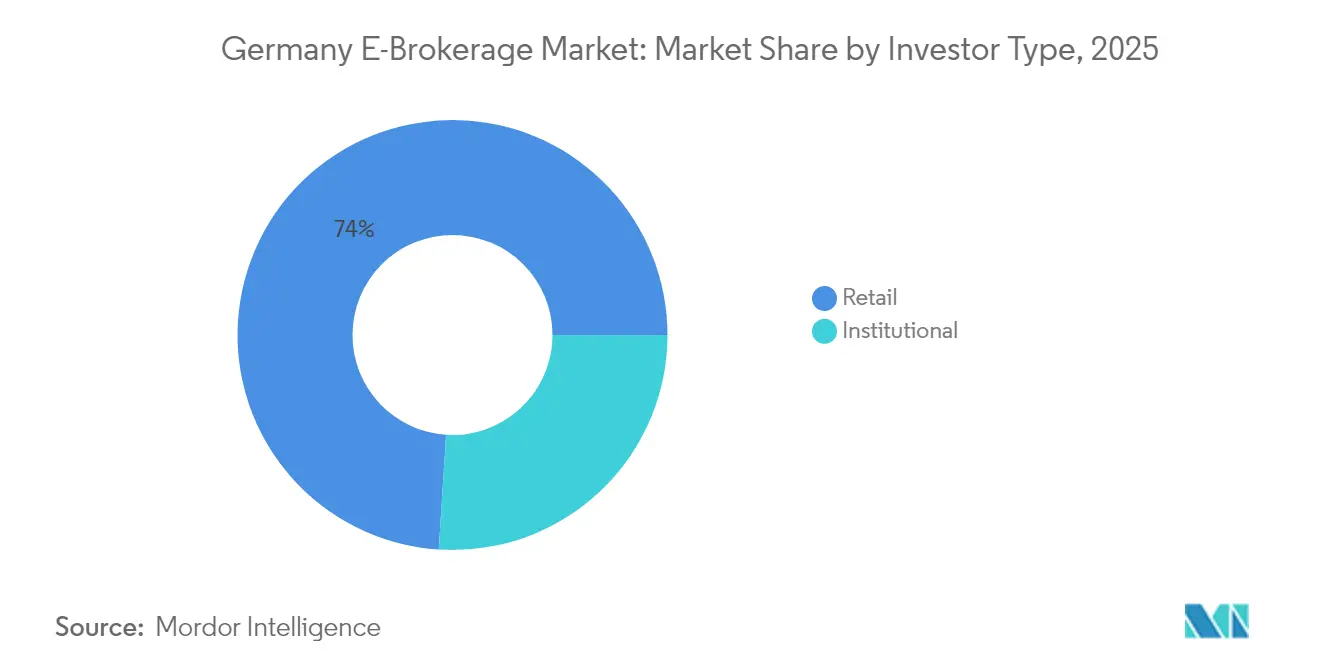
- By investor types, retail investors accounted for 73.98% of the German e-brokerage market share in 2025, while the German e-brokerage market size for retail investors under 35 years is projected to expand fastest at a CAGR of 16.05% between 2026 and 2031.
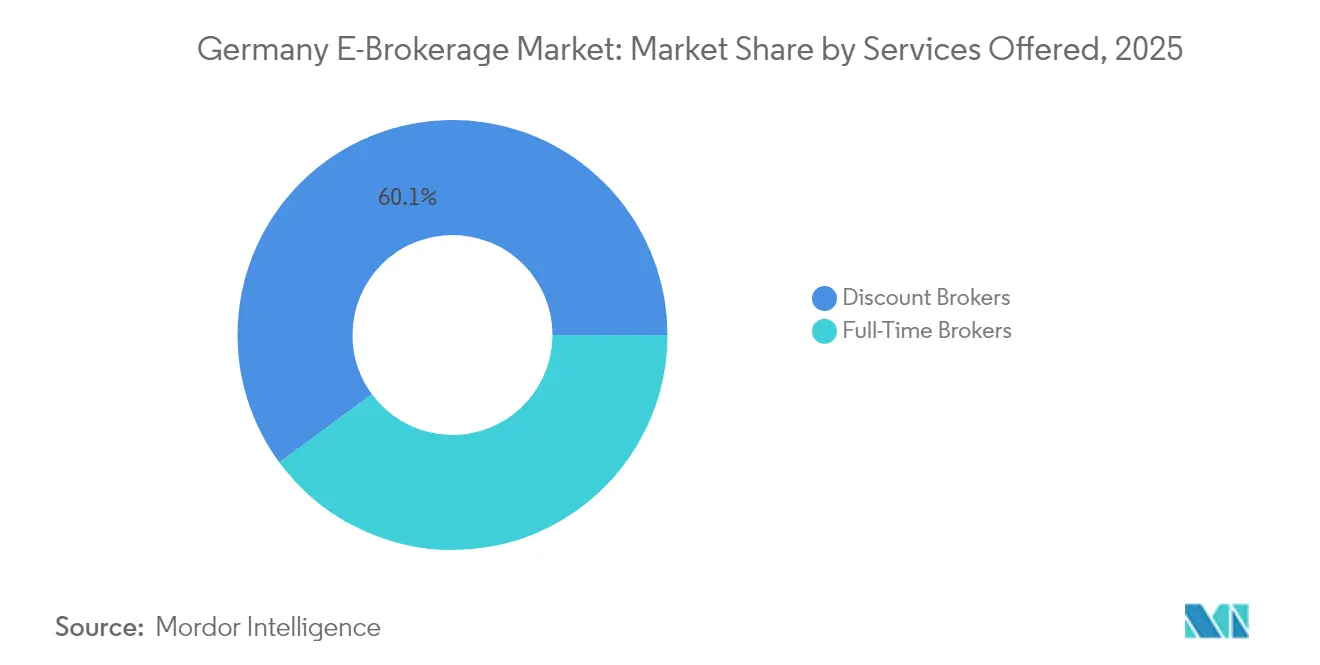
- By services offered, discount brokers captured 60.10% of the German e-brokerage market share in 2025, with the German e-brokerage market size for embedded-broker API (BaaS) offerings forecast to grow at the highest CAGR of 17.85% over 2026–2031.
- By operation, domestic players held 82.65% of the German e-brokerage market share in 2025, while the German e-brokerage market size for foreign-operated apps is anticipated to post a CAGR of 13.95% through 2031.
- By region, West Germany led with 28.05% of the German e-brokerage market share in 2025, with the German e-brokerage market size in East Germany expected to grow fastest at a CAGR of 6.20% during 2026–2031.
Note: Market size and forecast figures in this report are generated using Mordor Intelligence’s proprietary estimation framework, updated with the latest available data and insights as of 2026.
Germany E-Brokerage Market Trends and Insights
Drivers Impact Analysis*
| Driver | (~) % Impact on CAGR Forecast | Geographic Relevance | Impact Timeline |
|---|---|---|---|
| Surge in zero-commission models | +1.2% | National, urban hubs | Short term (≤ 2 years) |
| Generational shift to mobile-first apps | +0.9% | Berlin, Munich, Hamburg | Medium term (2-4 years) |
| BaFin proportionality initiative | +0.7% | Nationwide | Medium term (2-4 years) |
| Cash-interest offers above 2.25% | +0.8% | Competitive urban areas | Short term (≤ 2 years) |
| Fractional-share APIs enabling €1 trades | +0.6% | Tech-savvy demographics | Long term (≥ 4 years) |
| Pension reform equity pillar | +1.1% | Nationwide | Long term (≥ 4 years) |
| Source: Mordor Intelligence | |||
Surge in Zero-Commission Models Attracting First-Time Investors
Zero-commission trading eliminated entry barriers and pulled millions of price-sensitive Germans into the capital markets. Brokers that relied on PFOF revenue must now replace lost income ahead of the 2026 ban, prompting moves such as Scalable Capital’s proprietary exchange launch that captures spreads directly. The transition introduces pricing uncertainty but also incentivizes innovation in subscription tiers and cash-management products. BaFin studies indicate that PFOF gave favourable execution for small orders, yet larger trades faced quality concerns. Platforms able to pivot quickly are positioned to capture share once commissions resurface, while late movers risk margin compression.
Generational Shift to Mobile-First Investing Apps
Younger users trade more frequently, diversify faster, and show a greater appetite for crypto and derivatives than older cohorts. BaFin has warned that behavioural nudges in app design can distort decision-making, pushing brokers to refine interfaces that prioritize investor protection[1]Bundesministerium der Finanzen, “Das Generationenkapital: für eine moderne Rente,” BMF.de . Traditional banks are facing ongoing challenges in addressing usability gaps, which continues to bolster the competitive advantage of digital-native players. In Germany, the aging population is expected to serve as a key driver of transformation within the e-brokerage market. Their shifting preferences are projected to influence platform design standards significantly, setting new industry benchmarks. This demographic trend is also likely to impact market strategies, compelling service providers to innovate and adapt to meet the evolving demands of this growing consumer segment.
BaFin's Proportionality Initiative Cutting Compliance Costs for Small Brokers
BaFin now tailors supervisory intensity to firm size, trimming reporting demands for roughly 950 small institutions, thereby lowering fixed compliance expenses. The relief lets startups channel resources into product innovation rather than regulatory overheads. The measure aligns with Basel Committee guidance on proportionality and encourages a vibrant field of specialized brokers[2]Basel Committee, “Proportionality in bank regulation and supervision,” bis.org . Leading market participants continue to comply with stringent prudential standards, creating a stratified framework that is likely to drive future consolidation trends. This strategic approach enhances competitive diversity within the market while fostering sustained growth and development in Germany's e-brokerage sector.
Pension Reform Introducing Equity-Fund Retirement Pillar
The Generationenkapital program earmarks EUR 200 billion for capital-market investments by the mid-2030s, supplementing Germany’s pay-as-you-go pension system[3]BaFin, “DORA: the countdown has begun,” bafin.de . Upvest, in collaboration with other stakeholders, promotes the adoption of a custody account model designed to allocate contributions directly into diversified investment portfolios. Brokerages that offer a wide range of ETFs, competitive fee structures, and comprehensive educational support are well-positioned to capitalize on this development. While the extended implementation timeline indicates that inflows will increase progressively, the reform establishes equity ownership as a foundational component of retirement planning. This initiative is expected to expand the addressable market for e-brokerages in Germany, creating new opportunities for growth and market penetration.
Restraints Impact Analysis*
| Restraint | (~) % Impact on CAGR Forecast | Geographic Relevance | Impact Timeline |
|---|---|---|---|
| EU ban on payment-for-order-flow | -1.8% | EU-wide, Germany focus | Short term (≤ 2 years) |
| Cyber-incidents and platform outages | -0.6% | Nationwide | Medium term (2-4 years) |
| Rising retail risk-aversion | -0.4% | Nationwide | Short term (≤ 2 years) |
| Shortage of cloud and IT talent | -0.7% | Tech hubs | Long term (≥ 4 years) |
| Source: Mordor Intelligence | |||
EU Ban on Payment-for-Order-Flow Shrinking Revenue Pools
From 2026, brokers in the German e-brokerage market will face the elimination of Payment for Order Flow (PFOF) as a revenue source, which has historically supported zero-commission trading models. This regulatory shift is prompting firms to explore alternative strategies to offset the financial impact. For instance, Scalable Capital has launched its own exchange, demonstrating a proactive approach to recapturing lost revenue streams. Such initiatives reflect a broader trend within the industry toward innovation and adaptation in response to regulatory changes. However, market makers have expressed concerns that integrated trading venues may replicate the conflicts of interest previously associated with PFOF, potentially attracting stricter regulatory oversight. This development highlights the growing urgency for brokers to diversify their revenue models to maintain competitiveness and ensure long-term financial stability in an increasingly regulated market environment.
Cyber-Incidents & Platform Outages Triggering Regulatory Scrutiny
Trade Republic’s April 2025 outage drew more than 7,000 complaints and spurred BaFin to stress platform-availability standards[4]The Munich Eye, “Trade Republic Experiences Service Disruptions Amid Market Decline,” themunicheye.com . From 2025 onward, the Digital Operational Resilience Act (DORA) is set to enforce stringent ICT control requirements, leading to a notable increase in compliance costs. This regulatory shift is likely to exert significant pressure on smaller brokerage firms, which may face difficulties in managing these additional financial and operational burdens. In 2023, BaFin reported that 7.12 million users were impacted by payment-service-related incidents, underscoring the sector's susceptibility to operational risks. The implementation of enhanced governance frameworks is expected to favor firms with robust technological infrastructure and strong capital reserves, positioning them to navigate the regulatory changes more effectively and maintain a competitive edge in the market.
*Our forecasts treat driver/restraint impacts as directional, not additive. The impact forecasts reflect baseline growth, mix effects, and variable interactions.
Segment Analysis
By Investor Type: Retail Dominance Drives Market Evolution
Retail investors held 73.98% of Germany's e-brokerage market size in 2025 as digital platforms removed cost and knowledge barriers. The segment is projected to rise at 16.05% CAGR through 2031, buoyed by fractional investing and intuitive mobile design that encourages first-time participation. Younger users conduct more trades and adopt a broader array of products, including crypto and derivatives, than institutional clients. Brokers meet their needs with gamified interfaces and real-time educational content, although regulators scrutinize possible behavioural manipulation. The institutional segment remains stable, leveraging e-brokerage for cost-efficient execution and accessing alternative asset classes outside traditional prime brokerage. MiFID II best-execution rules drive venue diversification, ensuring the continued relevance of electronic brokers.
The evolving dynamics of retail growth are driving a strategic shift in product development, with a heightened focus on integrating micro-investment functionalities and recurring ETF plans designed to accommodate smaller, consistent monthly contributions. Concurrently, institutional clients are demonstrating a growing demand for sophisticated capabilities, including advanced order-routing mechanisms, comprehensive analytics, and access to exclusive liquidity pools. These requirements are fostering the creation of premium service tiers tailored to meet the complex needs of institutional participants. Although institutional trading volumes are relatively lower, their flows contribute significantly to enhancing market depth and stabilizing bid-ask spreads, thereby improving overall market efficiency and quality. Additionally, regulatory frameworks aimed at safeguarding retail investors are exerting a considerable influence on platform design, particularly in areas such as disclosure practices and risk management protocols. These regulatory considerations are shaping architectural decisions that address the distinct requirements of both retail and institutional customer segments.


By Services Offered: Discount Models Reshape Industry Economics
Discount brokers captured 60.10% of the German e-brokerage market size in 2025 as investors gravitated toward low-fee, self-directed execution. Zero-commission pricing now faces sustainability pressures from the PFOF ban, prompting diversification through subscription bundles, interest income, and proprietary trading venues. Embedded broker APIs exhibit the fastest growth at 17.85% CAGR, enabling fintechs and non-financial brands to integrate turnkey trading modules without building infrastructure. Full-service brokers retain a niche among affluent clients who value advice and specialized strategies but must defend margins against digital challengers.
Lemon.markets represents a prominent example of the brokerage-as-a-service trend, providing BaFin-licensed trading infrastructure to partners that emphasize enhancing user experience and optimizing distribution channels. Discount brokerage platforms, such as Scalable Capital, address the challenge of margin compression by internalizing order flow through EIX, enabling them to retain spread income that was previously allocated to external trading venues. Meanwhile, full-service brokers are diversifying their offerings by incorporating value-added services such as tax optimization, estate planning, and alternative investment strategies to justify their fee structures and remain competitive. This increasing fragmentation of services within the German e-brokerage market is driving greater customer choice and fostering a higher degree of innovation across the industry.
By Operation: Domestic Focus Amid Cross-Border Growth
Domestic brokers controlled 82.65% of Germany's e-brokerage market share in 2025, reflecting investor trust in local supervision and tax handling. Foreign-operated apps, however, are expanding at 13.95% CAGR on the back of EU passporting and differentiated product offerings such as crypto and thematic portfolios. German clients appreciate native language support and clear tax statements, giving domestic incumbents an edge in ease of use. Yet platforms like Kraken extend reach via partnerships with BaFin-licensed custodians, narrowing the experiential gap.
Domestic brokerage firms capitalize on their established relationships with banks and their ability to integrate local payment systems, thereby optimizing the client onboarding process. On the other hand, foreign market entrants often differentiate themselves by excelling in specialized market segments or leveraging cost advantages derived from economies of scale across multiple markets. Regulatory requirements imposed by BaFin, including the necessity for a substantial local presence and adherence to stringent investor-protection standards, create significant compliance barriers. These regulations discourage opportunistic competitors while favoring operators with long-term commitments to the market. Consequently, the competitive landscape is transitioning toward a strategic equilibrium, characterized by robust domestic players maintaining market leadership and agile international challengers introducing competitive dynamics.
Geography Analysis
West Germany delivered 28.05% of 2025 revenues owing to the concentration of wealth around Frankfurt, Düsseldorf, and Munich. Established banks, fintech hubs, and deep talent pools underpin sophisticated demand for capital-market services. Nonetheless, platform saturation and intense rivalry cap growth rates, pushing brokers to seek incremental users elsewhere. East Germany’s 6.20% CAGR through 2031 underscores its potential as smartphone penetration and financial inclusion programs advance digital investing. Lower historical engagement with traditional banks means fewer switching frictions for app-based services.
North and South Germany present diverse opportunities shaped by maritime trade wealth and technology cluster affluence, respectively. Central Germany’s university centres generate tech-savvy cohorts that anchor steady adoption. BaFin’s uniform regulatory regime ensures consistent investor protections nationwide, enabling platforms to scale features efficiently across regions. As digital infrastructure gaps close, regional differences in adoption rates are expected to narrow, further integrating the Germany e-brokerage market.
Regulatory Landscape
Germany's e-brokerage activity operates under the Securities Institutions Act (WpIG) and the Securities Trading Act (WpHG), reflecting MiFID II conduct-of-business and authorization requirements under BaFin supervision. A major rule change is the EU-wide prohibition of payment for order flow (PFOF), which becomes fully applicable in Germany on July 1, 2026 after the national transition period, directly affecting zero-commission monetization models.
Alongside inducement and best-execution expectations, transparency and operational-resilience obligations are tightening. Key MiFIR transparency review provisions under Delegated Regulation (EU) 2025/1246 apply from March 2, 2026, and BaFin issued a general order on April 16, 2026 concerning post-trade transparency requirements for German sovereign debt. BaFin has also emphasized system capacity and emergency management in supervisory communications, reinforcing availability and control requirements for app-based brokers as ICT risk oversight increases under DORA-related expectations.
Value Chain Analysis
The Germany e-brokerage value chain begins with customer acquisition and onboarding (KYC/AML and account opening), then moves into trading UX (mobile and web apps), order routing and execution (venues and market makers), custody and settlement (including links into European post-trade infrastructure), and finally client reporting and tax documentation. Revenue capture spans commissions or subscription tiers, spread and venue economics where applicable, interest income from cash balances, and value-added services (research, analytics, and portfolio tools). With the PFOF prohibition effective July 1, 2026, monetization shifts toward transparent pricing and non-PFOF income streams.
Enabling layers include BaFin-regulated brokerage and custody providers and a growing ecosystem of B2B wealthtech and brokerage infrastructure. API-driven and platform suppliers such as Upvest and aixigo (Amundi Technology) support embedded brokerage and digital wealth workflows for banks, insurers, and distributors, while portfolio and tooling providers (for example iComps, The Double Alpha Factory, and Xaver) contribute advisory, portfolio construction, and digital sales capabilities. Key bottlenecks remain regulatory compliance under WpIG/WpHG (authorization, inducements, and client-asset safeguards) and operational resilience requirements, which raise the bar for systems, controls, and peak-load stability.
Competitive Landscape
The top five brokers control a significant share of assets under custody, creating a concentrated yet dynamic field. Trade Republic commands more than 10 million users and USD 156.2 billion (EUR 150 billion) in assets, leveraging a full banking license to bundle payments, savings, and investments. FlatexDEGIRO follows with 2.96 million customers and USD 67.28 billion (EUR 64.6 billion) AuC through a dual-brand strategy targeting value-seekers and active traders. Scalable Capital leverages its proprietary exchange, EIX, as a strategic differentiator, positioning itself to adapt effectively to the evolving market landscape in the post-Payment for Order Flow (PFOF) era. This approach underscores the company's focus on innovation and its commitment to addressing regulatory and operational shifts within the financial services industry.
Emerging players such as lemon. Markets pursue brokerage-as-a-service opportunities, allowing non-financial brands to embed trading without direct licensing burdens. Traditional banks like Deutsche Bank’s MaxBlue and DKB revamp interfaces and lower fees to protect their share, but legacy systems hamper agility. The EU PFOF ban is the principal catalyst of strategic change, redistributing economics toward brokers able to internalize execution or monetize cash and subscription services. Operational resilience rose to the forefront after Trade Republic’s outage drew BaFin scrutiny, turning IT robustness into a crucial differentiator. Talent shortages and rising compliance costs further favour well-capitalized incumbents, yet proportionality rules preserve room for niche specialists that address underserved segments.
Germany E-Brokerage Industry Leaders
Trade Republic GmbH
flatexDEGIRO AG
Scalable Capital Broker GmbH
finanzen.net ZERO (Gratisbroker AG)
Smartbroker Plus (wallstreet:online)
- *Disclaimer: Major Players sorted in no particular order


Market Opportunities and Future Outlook
Embedded brokerage and B2B2C distribution is emerging as a clear area of demand as non-broker brands and financial institutions accelerate digital wealth modernization by using licensed infrastructure rather than building full stacks. Supply is already visible, with lemon.markets providing BaFin-licensed brokerage-as-a-service, and infrastructure providers such as Upvest and aixigo (Amundi Technology) supporting fractional investing, recurring ETF plans, and integrated custody and reporting for partners targeting new retail segments.
In the post-PFOF environment, and with BaFin increasing attention to outages and emergency management, there is demand for institutional-grade execution, resilience engineering, and transparent pricing structures that support low-cost investing without relying on inducement-driven routing. At the product level, the opportunity extends to regulated crypto brokerage setups (for example Kraken working with BaFin-licensed DLT Finance) and retirement-linked investment account propositions signaled by providers preparing for Altersvorsorgedepot features. In the broader DACH digital wealth ecosystem, consolidation activity such as Finaplus Group acquiring Wealthpilot (December 2025) points to continued appetite for scaled platforms and integrated capabilities that can be paired with brokerage front ends.
Recent Industry Developments
- July 2026: Trade Republic introduced a new trading technology stack featuring an aggregated order book across 30 global exchanges and direct best-price execution. The rollout aligns the platform with the post-PFOF execution environment and increases competitive pressure on peers to match multi-venue routing and active-investor tooling.
- July 2026: Smartbroker introduced a corporate brokerage account (Firmendepot) for GmbHs and single-person companies through a partnership with comdirect. The offering widens Smartbroker's addressable customer base beyond retail and reinforces its product positioning through a bank partner with established custody and brokerage operations.
- March 2024: lemon.markets secured investment-firm licensing from BaFin and launched its brokerage-as-a-service platform in collaboration with BNP Paribas and Deutsche Bank. This expanded the supply of compliant embedded-broker infrastructure in Germany and supported faster go-to-market for third parties seeking to integrate trading into their digital channels.


Research Methodology Framework and Report Scope
Market Definition and Coverage
We size Germany's e-brokerage market as the value created from electronically enabling investors to buy and sell listed financial instruments through digital brokerage platforms, including the core brokerage services tied to account activity and execution.
Scope exclusions: The sizing does not count non-broker financial products that are not linked to brokerage execution and custody, such as pure banking deposit products sold outside an e-broker account.
Segmentation Overview
- By Investor Type
- Retail
- Institutional
- By Services Offered
- Full-Time Brokers
- Discount Brokers
- By Operation
- Domestic
- Foreign
- By Region
- North Germany
- South Germany
- East Germany
- West Germany
- Central Germany
Data Sources, Market Sizing, and Validation
Desk Research
Desk work started with public market signals that explain how many people are investing and how activity is changing in Germany, and then those signals were translated into a revenue pool that brokers can realistically capture. We reviewed official and public sources such as BaFin publications, Deutsche Bundesbank statistics, Deutsche Boerse Group market information, and Eurostat datasets to ground the regulatory setting and capital market participation.
Next, we cross-checked structural inputs using sources such as annual reports and investor presentations, exchange and clearing disclosures, and reputable financial press. In places where public reporting did not provide clean splits, we used paid subscriptions for company financial intelligence, patent lookups (for platform capabilities), and shipment-level import export views only when it helped validate adjacent fintech activity assumptions. These desk research sources are illustrative, and many other public documents and datasets were also used for data collection, validation, and clarification.
Primary Interviews and Surveys
Primary discussions were used to test what is actually monetized in Germany e-brokerage today, and how pricing and product mixes are moving as business models shift. We spoke with a mix of brokerage executives, product and operations leaders, and managers involved in onboarding, trading operations, compliance, and customer acquisition, with coverage across major German regions so local adoption patterns did not get missed.
Distribution of primary research fieldwork respondents
| Company type | Respondent position |
|---|---|
| Top tier: 33% | CXOs: 15% |
| Mid tier: 50% | Functional/Unit leaders: 32% |
| Smaller Players: 17% | Managers: 53% |
Market-Sizing & Forecasting
The main build is a top-down model, where we reconstruct the addressable brokerage revenue pool using investor participation signals and market activity indicators, and then apply realistic monetization rates for Germany. Inputs that shaped the model include the growth in securities custody accounts, changes in self-directed investor counts, shifts in fee structures (including the move toward low or zero commissions), and the rising role of interest income in broker economics.
Once the total pool is formed, results are corroborated with selective bottom-up approximations such as sampled pricing checks, service mix splits by investor type, and a limited roll-up of observable financial disclosures for a set of brokers. When public financials were not granular, gaps were handled by using primary feedback on typical revenue per active account ranges and by applying conservative shares to smaller operators so the totals did not get overstated.
For forecasting, scenario analysis was used so growth paths could be linked to practical drivers such as retail trading activity normalization, ETF savings plan penetration, and expected regulatory and operational cost impacts. Assumptions were reviewed with interviewees, and then the scenario outputs were converted into the annual market values used for the forecast period.
Data Validation & Update Cycle
We run cross-checks so the model output matches independent signals such as account growth, observed activity trends, and the implied revenue per client that industry participants describe as feasible. Outliers are flagged, reviewed, and corrected only after the driver behind the variance is clearly identified, which is then documented in the model notes.
Before sign-off, the sizing is reviewed in more than one analyst pass, and respondents are re-contacted when there is a large mismatch between desk indicators and interview feedback. Reports are refreshed annually, and interim updates are made when material events occur that can change brokerage monetization or demand. Prior to delivery, we do a final pass so clients receive the most current view available at that time.
Mordor Intelligence's Germany E Brokerage Market Size Compared With Other Published Estimates
Published market sizes for Germany e-brokerage often do not match because each publisher chooses different boundaries for what counts as brokerage value, and they also rely on different activity and pricing signals. Year alignment also matters since fee models can change quickly, which then moves the revenue pool even if investor counts look stable.
Evidence like the reported buildup in securities custody accounts, the share of transactions executed through neobrokers, and the revenue mix shift toward interest income are the checks that tie Mordor Intelligence's estimate to what is being monetized inside e-brokerage accounts in Germany. Other estimates may expand the scope to broader trading platforms and platform services, or they may treat ETF savings plans and adjacent fintech revenues differently, which can lift or reduce the stated market value.
Benchmark comparison
| Source | Market Size | Gaps in Research Methodology |
|---|---|---|
| Mordor Intelligence | USD 1.00 B (2025) | |
| Trade Advisory A | USD 0.88 B (2025) | Uses a narrower online trading platform lens, which can undercount full brokerage monetization such as custody-linked revenues and broader service models that sit inside e-brokerage accounts. |
| Industry Study B | USD 2.17 B (2023) | Anchors sizing on annual industry revenues in euros and can include added revenue streams like crypto transactions and interest surplus, which makes the figure less comparable to a pure e-brokerage scope and to a 2025 base year. |
The spread across published values mainly comes from scope and revenue line choices, followed by the base year used and how fee and interest income shifts are treated. By keeping the market boundary tied to brokerage-enabled execution and account-linked monetization, and then validating it against observable participation and activity signals, the estimate stays traceable and repeatable for planning.


Key Questions Answered in the Report
How large is the German e-brokerage market today?
The German e-brokerage market size stands at USD 1.06 billion in 2026 and is forecast to reach USD 1.41 billion by 2031.
What CAGR is expected for German e-brokerage platforms through 2031?
Overall sector revenues are projected to rise at a 5.95% CAGR between 2026 and 2031.
Which customer group drives the most transaction volume on German trading apps?
Retail investors account for 73.98% of market activity and are expanding fastest due to mobile-first platforms and fractional investing.
How will the EU PFOF ban affect German brokers?
From 2026, brokers must replace PFOF income, prompting moves toward subscription pricing, proprietary venues, and higher interest on cash balances.
Which region in Germany is growing the fastest for e-brokerage adoption?
East Germany shows the highest momentum with a 6.20% CAGR to 2031 as digital infrastructure and smartphone use rise.
Who are the leading players in German e-brokerage?
Trade Republic, flatexDEGIRO, and Scalable Capital dominate, collectively controlling a significant share of assets under custody.
Page last updated on:


 Your data is secure and never sold or shared.


