
Draught Beer Market Size and Share
Market Overview
| Study Period | 2021 - 2031 |
|---|---|
| Market Size (2026) | USD 40.38 Billion |
| Market Size (2031) | USD 53.18 Billion |
| Growth Rate (2026 - 2031) | 5.66 % |
| Fastest Growing Market | Europe |
| Largest Market | Asia-Pacific |
| Market Concentration | Low |
Major Players
*Disclaimer: Major Players sorted in no particular order Image © Mordor Intelligence. Reuse requires attribution under CC BY 4.0. |
|
Draught Beer Market Analysis by Mordor Intelligence
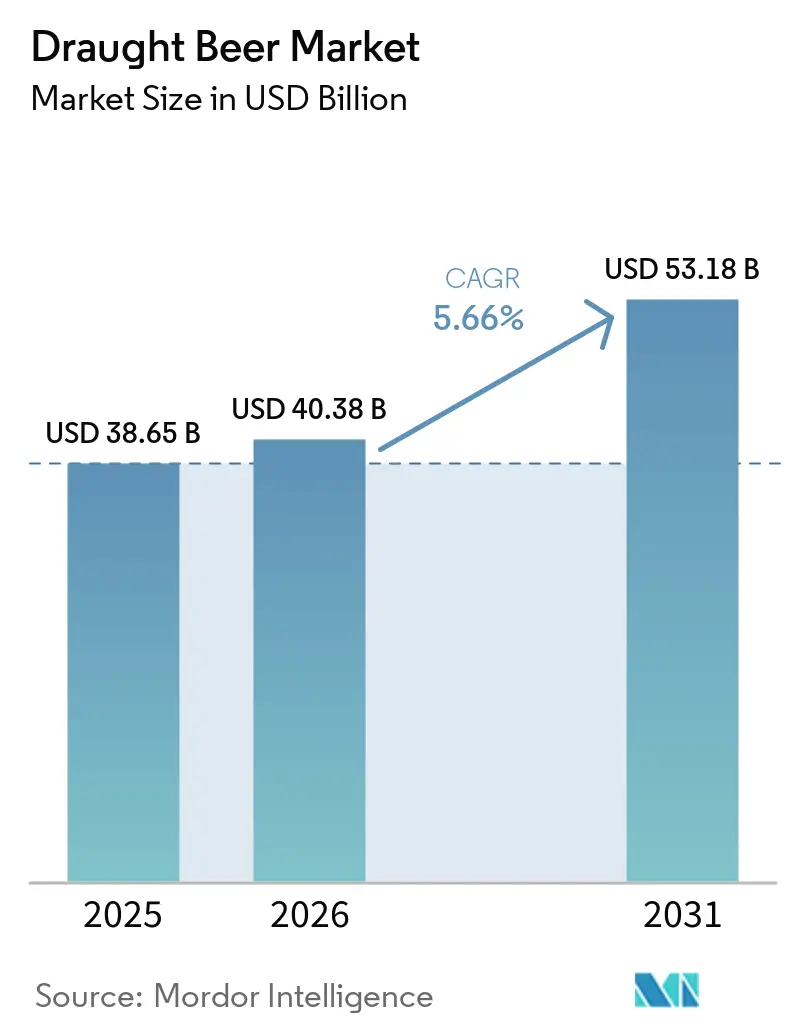
The draught beer market size was valued at USD 38.65 billion in 2025 to USD 40.38 billion in 2026, and is forecast to reach USD 53.18 billion by 2031 at a 5.66% CAGR over 2026-2031. The market continues to expand steadily, supported by increasing consumer demand for freshly poured premium beer, higher on-trade consumption, and the growing footprint of pubs, bars, brewpubs, and microbreweries. Breweries are deploying advanced dispensing systems and strengthening their premium draught offerings to improve product quality and enhance the consumer experience. For instance, Carlsberg’s DraughtMaster system improves beer quality and reduces waste, while Heineken continues to scale its Blade countertop draught system for small hospitality venues. In addition, breweries are broadening their premium and craft draught portfolios to address evolving consumer preferences and reinforce their presence across on-premise channels. Rising demand for draught beer and experience-led drinking occasions continues to support market growth.
Key Report Takeaways
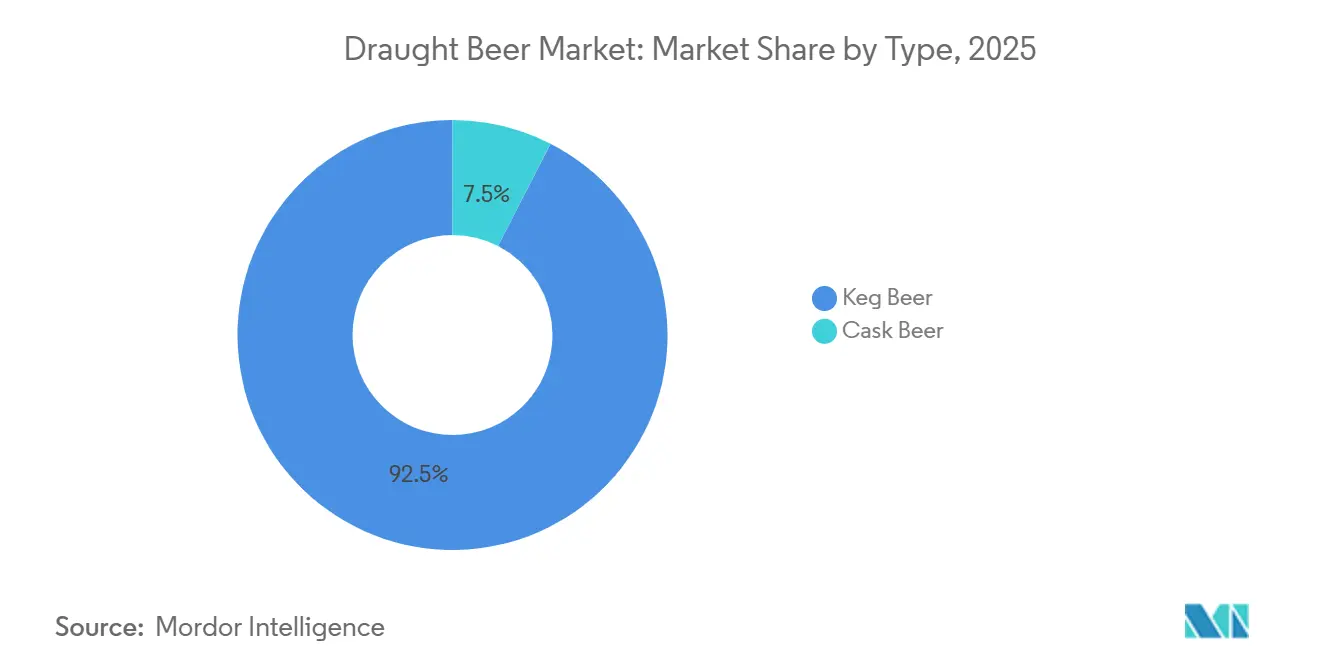
- By type, keg beer led the draught beer market with a share of 92.46% in 2025, while cask beer is anticipated to register the fastest CAGR of 6.23% during 2026-2031.
- By product type, lager retained a 71.83% share in 2025, whereas ales are forecast to expand at a 5.98% CAGR through 2031.
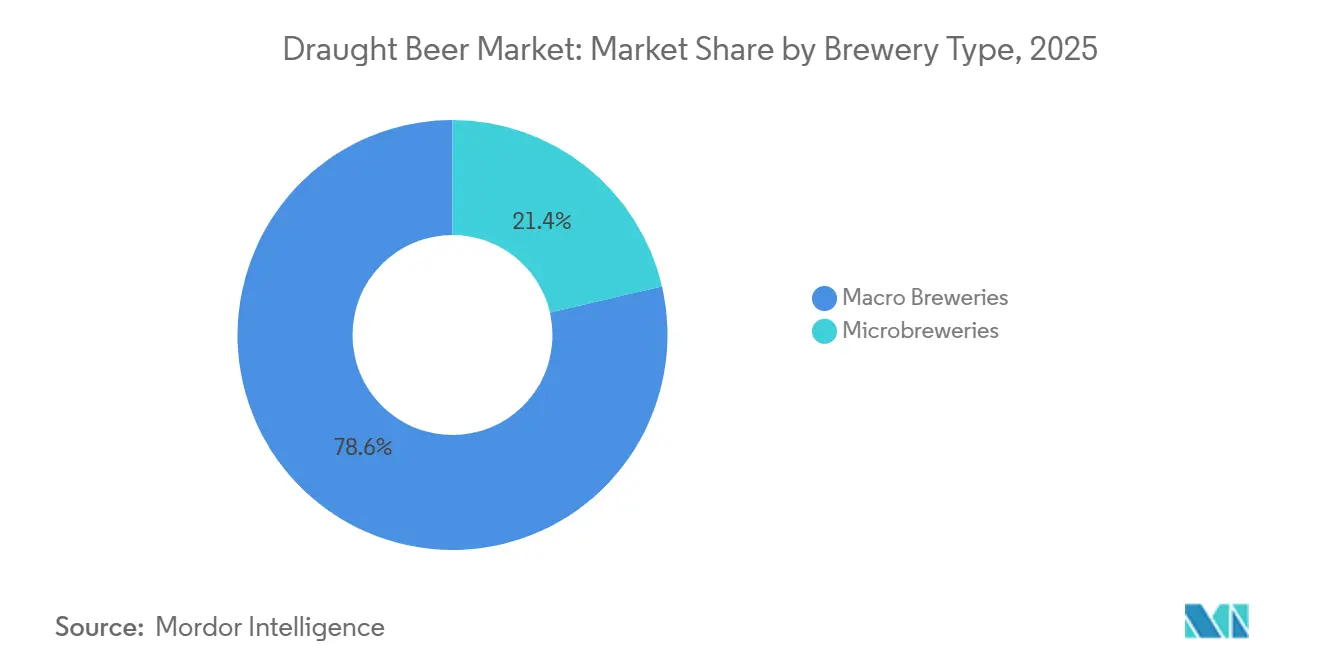
- By brewery type, macro breweries retained a 78.62% share in 2025, while microbreweries are anticipated to expand at a 6.55% CAGR through 2031.
- By distribution channel, on-trade retained a 93.47% share in 2025, while off-trade is anticipated to expand at a 6.36% CAGR through 2031.
- By geography, Europe led the draught beer market in 2025 with a 37.58% share, while Asia-Pacific is projected to advance at a 6.12% CAGR through 2031.
Note: Market size and forecast figures in this report are generated using Mordor Intelligence’s proprietary estimation framework, updated with the latest available data and insights as of January 2026.
Global Draught Beer Market Trends and Insights
Drivers Impact Analysis*
| Driver | (~) % Impact on CAGR Forecast | Geographic Relevance | Impact Timeline |
|---|---|---|---|
| Premiumisation of on-trade alcoholic beverage consumption | +1.2% | Global, led by United Kingdom, Germany, United States, and Australia | Short term (≤ 2 years) |
| Rising experiential dining and social drinking culture | +0.9% | Global; concentrated in North America, Europe, and Asia-Pacific urban centres | Medium term (2–4 years) |
| Expansion of craft breweries enhancing draught beer availability | +0.7% | North America and European Union; growing in Asia-Pacific | Medium term (2–4 years) |
| Higher profit margins encouraging tap system installations | +0.6% | Global; particularly mid-tier hospitality chains in United States, United Kingdom, and India | Short term (≤ 2 years) |
| Consumer preference for fresher and unpasteurized beer formats | +0.8% | Global; strongest in European Union and premium Asia-Pacific segments | Medium term (2–4 years) |
| Beer tourism and brewery taprooms strengthening on-premise sales | +0.5% | European Union (Belgium, Germany, Czech Republic), United States, Japan | Long term (≥ 4 years) |
| Source: Mordor Intelligence | |||
Premiumisation of On-Trade Alcoholic Beverage Consumption
The shift from volume-oriented drinking to value-oriented consumption support the draught beer market in the near term. Consumers are increasingly choosing premium and craft draught beers, prompting pubs and bars to expand their premium tap offerings and improve the overall drinking experience. For instance, Guinness continued to strengthen its premium draught presence across United Kingdom pubs, while Heineken expanded premium draught brands, such as Birra Moretti and Beavertown, in the on-trade channel. This premiumization trend enables venues to increase revenue per serving while encouraging breweries to invest in premium draught portfolios and advanced dispensing systems, supporting long-term market growth.
Rising Experiential Dining and Social Drinking Culture
Draught beer benefits as consumers choose restaurants and bars for social occasions instead of purchasing more alcohol for home consumption. The format adds an immediate service element for venues, as staff pour the drink at the point of consumption and can pair it with food, music, sports, or group events. Taste and freshness remain key reasons consumers choose draught beer, supporting premium menu positioning in busy urban venues. This trend also explains why operators are investing in certified dispensing systems and more consistent cleaning practices. A well-managed system helps venues deliver the product quality consumers expect when ordering beer on tap. As a result, tap systems are gaining opportunities in hospitality chains that previously relied more heavily on packaged products. In August 2025, Albanese Labor Government froze the indexation on draught beer excise for two years, in a win for beer drinkers, brewers and hospitality businesses[1]Source: The Albanese labor Government, " Albanese Labor Government to freeze draught beer excise," pm.gov.au.
Expansion of Craft Breweries Enhancing Draught Beer Availability
The expansion of craft breweries is increasing the availability and diversity of draught beer, as independent brewers often use taprooms, brewpubs, and keg-based distribution to offer freshly brewed and locally produced beers. The Brewers Association reported 9,344 breweries operating as of June 2026 in the United States[2]Source: Brewers Association, " Annual Craft Brewing Industry Production Report," brewersassociation.org. These venue-focused formats maintain the link between brewing and direct draught service, even as packaged sales face pressure. Unlike large-scale commercial brewers, which rely heavily on packaged formats, craft breweries generate a significant share of sales through keg distribution and direct draught dispensing. This approach encourages consumers to seek fresher, small-batch, and style-diverse beer experiences. In January 2024, the Organisation for Economic Co-operation and Development reported that all member countries levy VAT and/or excise duties on beer, while many also offer reduced excise rates for small and independent breweries. Such tax policies support craft brewery development, which represents a major supplier base for draught beer worldwide[3]Source: Organisation for Economic Co-operation and Development, " Consumption Tax Trends," oecd.org.
Consumer Preference for Fresher and Unpasteurized Beer Formats
The draught beer market benefits from the perception that freshly served beer offers a different drinking experience than packaged beer. Many draught formats preserve attributes linked to live yeast, hop aroma, and recently poured products. As of 2025, Heineken reported that 55% of beer drinkers in the United Kingdom said they would pay more for quality, supporting the commercial role of freshness in on-trade menus. Consumer interest in these products encourages operators to rotate taps and make their ranges more distinctive. It also supports premium venues that want to offer choices beyond standard lager. Consumer reorientation toward fresh, venue-served draught beer over off-trade packaged alternatives partly drove this stabilization. This preference shift is measurable, as draught formats’ superior flavor perception is converting package-loyal consumers who try craft draught beer for the first time at brewery taprooms and premium gastropubs.
Restraints Impact Analysis*
| Restraint | (~) % Impact on CAGR Forecast | Geographic Relevance | Impact Timeline |
|---|---|---|---|
| High capital investment for draught dispensing infrastructure | -0.8% | Global; particularly acute in emerging Asia-Pacific and Middle East and Africa markets | Short term (≤ 2 years) |
| Limited shelf life requiring stringent cold chain management | -0.6% | Global; most acute in Southeast Asia, South America, and Middle East and Africa | Medium term (2–4 years) |
| Stringent alcohol licensing and serving regulations | -0.4% | North America, Europe, India, Southeast Asia | Long term (≥ 4 years) |
| Rising operational costs across hospitality establishments | -0.5% | Global; led by Germany, United Kingdom, and Western Europe | Short term (≤ 2 years) |
| Source: Mordor Intelligence | |||
High Capital Investment for Draught Dispensing Infrastructure
Draught dispensing infrastructure requires investment in cellar cooling, gas supply, tap fonts, lines, and cleaning equipment. These costs can delay installation decisions among small pubs, independent restaurants, and new hospitality operators. Cold chain logistics can account for up to 30% of beer supply chain costs, as operators must maintain temperature control from the brewery to the point of pour. For smaller operators, refrigerated distribution can cost 40% to 60% more than ambient shipping. Additionally, operators must conduct periodic cleaning, technical servicing, and staff training to maintain beer quality, which further increases the total cost of ownership. In high-growth markets such as India and Vietnam, fragmented cold chain infrastructure physically limits draught market penetration, even where consumer demand exists.
Limited Shelf Life Requiring Stringent Cold Chain Management
Draught beer’s freshness proposition makes temperature management essential. Keg beer can lose quality after exposure to poor temperature conditions, particularly in non-pasteurized formats. Maintaining a continuous 2-7°C cold chain remains more challenging in tropical and subtropical markets, where refrigeration is energy-intensive. This requirement places a heavier cost burden on smaller distributors and independent venues. Cold chain spending can account for 15% to 20% of total brewery logistics expenditure for well-equipped operators, while inadequate systems can lead to product losses of 3% to 5%. Furthermore, once a keg is tapped, the beer has a limited serving life, requiring rapid inventory turnover and precise demand forecasting to avoid spoilage. Therefore, the draught beer market is more difficult to develop in locations where refrigeration, reliable transport, and stable energy supply remain limited.
*Our forecasts treat driver/restraint impacts as directional, not additive. The impact forecasts reflect baseline growth, mix effects, and variable interactions.
Segment Analysis
By Type: Keg Beer Dominates While Cask Builds a Premium Position
Keg beer held 92.46% of the draught beer market size in 2025, as sealed and pressurized systems support high-volume commercial service. The format enables bars, restaurants, stadiums, and pub groups to deliver consistent products across multiple outlets. Kegs also align with the distribution systems of large brewers, as companies can fill and transport them through organized cold chains. They reduce the need for specialist cellar-conditioning skills at the venue level. This reliability supports operators seeking lower product waste and predictable service during peak trading periods. Keg beer’s large installed base is keep it as the leading format in the draught beer market over the forecast period.
Cask beer is forecast to grow at a 6.23% CAGR from 2026 to 2031. The format offers a distinct sensory profile through lower carbonation, cellar temperature service, and living yeast characteristics. These attributes give cask beer a clear role in premium pubs, gastropubs, and venues that emphasize service expertise. Smaller producers can use cask beer to differentiate their ranges from standardized keg offerings. Although the segment remains much smaller than keg beer, its growth indicates sustained demand for authenticity and choice in selected on-trade settings.


By Product Type: Lager Retains Scale as Ale Gains Momentum
Lager accounted for 71.83% of the global draught beer market in 2025, supported by broad consumer familiarity and its compatibility with commercial dispensing systems. Filtered and temperature-stable lager suits industrial keg filling and fast service. Its large installed base also secures a prominent position across mainstream bars, restaurants, hotels, and sports venues. The category continues to provide the volume foundation for the draught beer market. In mature markets, its value growth increasingly depends on premium products rather than lower pint prices.
Ale is projected to grow at a CAGR of 5.98% from 2026 to 2031, making it the fastest-growing product type. This growth shows how richer flavor profiles and strong visual presentation can support higher-value draught occasions. Other styles, including wheat beer, sour beer, fruit-forward products, and stout, add variety to tap lists. These products help operators create menus that address broader consumer preferences and food occasions. Lager and ale are therefore likely to play complementary roles, with lager providing scale and ale supporting menu differentiation.
By Brewery Type: Macro Breweries Lead While Microbreweries Add Variety
Macro breweries hold 78.62% of the draught beer market size in 2025, supported by their ability to manage large keg volumes and global cold chain systems. Their scale helps maintain consistent product quality across extensive outlet networks. Large producers also maintain established relationships with hotel groups, restaurant chains, stadium operators, and national pub accounts. The business model near-zero cold chain transportation costs, full control over tap distribution, and premium on-site pricing gives microbreweries stronger unit economics than packaged-beer distribution counterparts.
Microbreweries are forecast to expand at a CAGR of 6.55% from 2026 to 2031, making them the fastest-growing brewery type in the draught beer industry. Their taproom-first model can reduce distribution requirements while giving operators greater control over product quality and pricing. Medusa Beverages installed draught taps in 25 Delhi outlets in early 2026 and targets 100 locations by year-end. The company’s planned production capacity reached nearly 300,000 hectoliters across Karnataka and Jharkhand. Microbrewery growth is therefore concentrated in venues and urban areas where distinctive beer, local production, and direct service are key differentiators.
By Distribution Channel: On-Trade Remains Central While Off-Trade Develops
On-trade accounts for 93.47% of the draught beer market share in 2025, as draught service requires pressurized dispensing lines, refrigeration systems, CO₂ equipment, and trained personnel to maintain consistent beer quality. Pubs, bars, restaurants, hotels, breweries, and stadiums remain the primary venues equipped with this infrastructure. Globally, breweries prioritize keg distribution through on-trade channels because draught beer offers superior freshness, better presentation, and a premium drinking experience that packaged formats cannot easily replicate. In addition, on-trade venues provide brewers with greater opportunities for premiumization, brand engagement, and the introduction of seasonal or craft beer offerings, reinforcing the channel’s strategic importance.
Off-trade is forecast to grow at a 6.36% CAGR through 2031. Home draught appliances and mini-kegs allow consumers to bring some elements of the tap experience into residential settings. AB InBev reported that its direct-to-consumer solutions served 12 million active consumers and generate USD 139 million in revenue in the first quarter of 2026. PerfectDraft, Heineken Blade, and other home-keg systems show how suppliers are pursuing this opportunity. The channel is unlikely to replace on-trade consumption, as homes do not require commercial-scale dispensing infrastructure. However, it can extend the category to premium home occasions and create another route for keg-based brands.
Geography Analysis
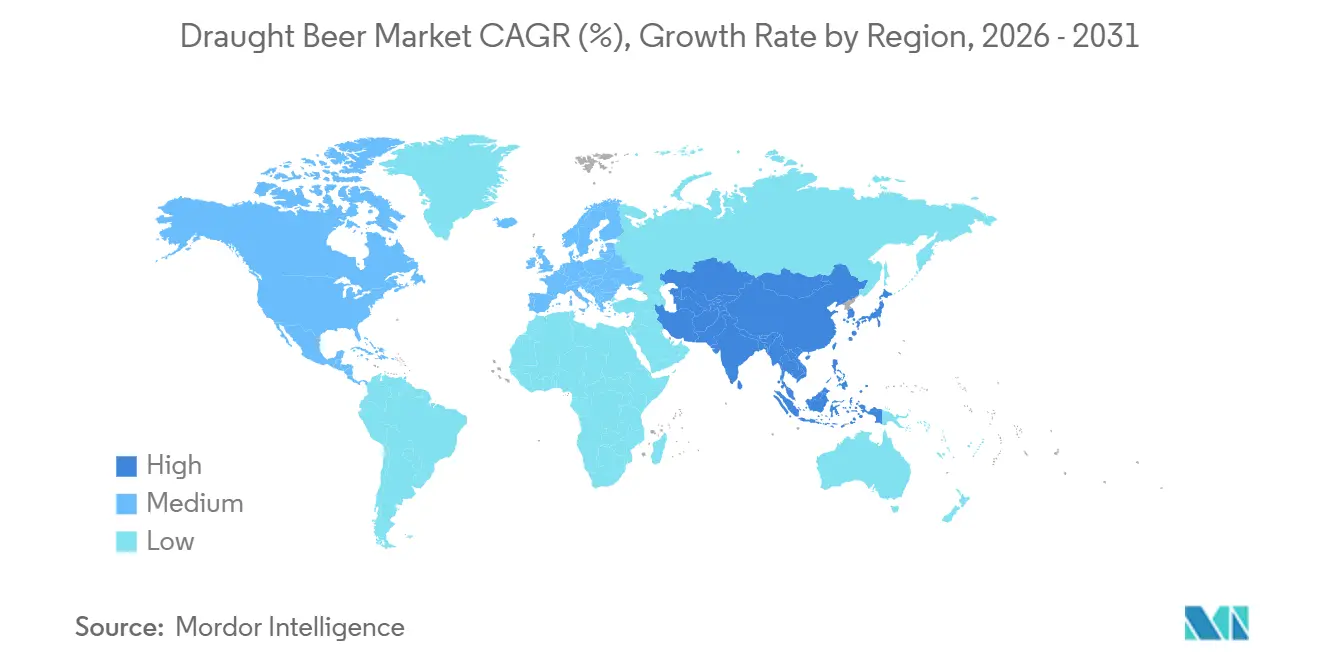
Europe holds 37.58% of the global draught beer category share in 2025, supported by its established pub culture, beer halls, and strong brewer relationships with hospitality operators. The region benefits from a mature on-trade ecosystem, where draught beer remains deeply embedded in social drinking traditions and accounts for a significant share of beer consumption outside the home. Spain is one of the major markets in Europe, supported by a resilient foodservice environment. Belgium and the Netherlands continue to outperform their population share in draught beer value, supported by specialty and abbey ale formats that command premium tap-handle prices across domestic and tourist hospitality settings.
North America remains a major regional market for draught beer, supported by its large base of bars, restaurants, and craft-focused taprooms. The region also benefits from a well-developed keg distribution network and the widespread adoption of premium and craft draught offerings across independent breweries, sports venues, and casual dining chains. Rising consumer demand for locally brewed beers continues to encourage hospitality operators to expand their draught beer portfolios. In Mexico, Grupo Modelo started constructing a USD 760 million brewing and bottling complex in Apan, Hidalgo, in July 2026. The facility is designed for an initial annual capacity of up to 12 million hectoliters and forms part of a USD 3.6 billion investment program through 2027.
Asia-Pacific is projected to grow at a CAGR of 6.12% from 2026 to 2031, making it the fastest-growing geography in the draught beer market. Rising urban spending, new brewery investments, and expanding hospitality venues support demand across China, India, and Southeast Asia. India is adding taps across major urban venues through domestic brewery expansion. Japan’s new experiential brewery facility indicates that tourism is emerging as another source of demand for draught service. The Carlsberg-Sapporo joint venture, established with a USD 643 million investment in July 2026, aims to expand premium beer access across Southeast Asia and Hong Kong.

Competitive Landscape
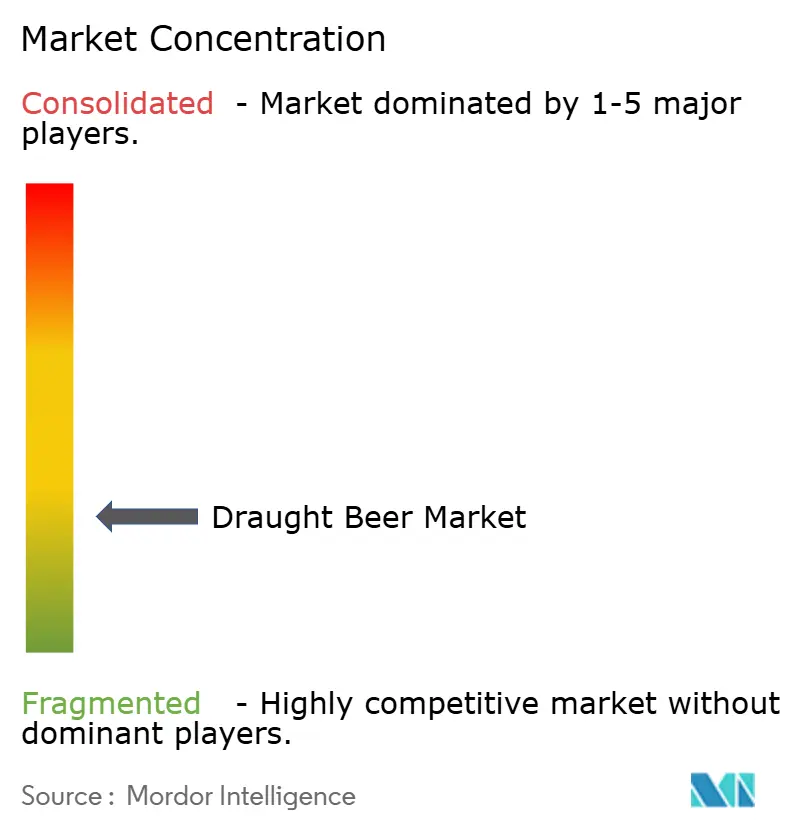
The global draught beer market is highly fragmented. Leading multinational brewers, including AB InBev, Heineken International B.V., Carlsberg Group, and Molson Coors Beverage Company, compete with numerous regional breweries, independent craft brewers, and taproom operators. Large brewers retain an advantage in keg supply, distribution, marketing resources, and outlet relationships. AB InBev’s USD 7.4 billion allocation to sales and marketing in 2025 highlights the financial gap between global leaders and smaller breweries. Local preferences for styles, regional brands, and craft offerings also keep the competitive environment diverse. As a result, the draught beer market includes global suppliers, national brewers, regional specialists, and small taproom-led companies.
Heineken has SmartDispense technology to help operators reduce waste, simplify line cleaning, and improve product stability. This move reflects competition through dispensing infrastructure, not beer products alone. AB InBev has the BEES platform as a channel tool that integrates hardware procurement, line management, and order fulfillment into a single operator relationship. Competitive opportunities are also emerging in home draught systems, developing Asian markets, and low- and no-alcohol draught formats.
Smaller brewers, such as Duvel Moortgat, Royal Swinkels, and The Brooklyn Brewery, compete through distinctive styles and premium venue listings. Their approach focuses on flavor, provenance, and a differentiated tap offering rather than price. Craft quality guidelines and line-cleaning standards are also becoming more relevant for mid-tier operators in North America and Europe. Consistent quality can determine whether a brand retains its tap position after the initial listing period.
Draught Beer Industry Leaders
-
Carlsberg Breweries A/S
-
Heineken International B.V.
-
New Belgium Brewing Company
-
AB InBev
-
Duvel Moortgat
- *Disclaimer: Major Players sorted in no particular order

Recent Industry Developments
- July 2026: Sapporo Breweries announced a USD 643 million investment for a 25% stake in a Singapore-based joint venture with Carlsberg Breweries, targeting the beer markets in Southeast Asia and Hong Kong. Sapporo aims to increase the volume of its flagship brand tenfold from 2025 levels by 2035, leveraging Carlsberg’s established distribution networks across Malaysia, Singapore, Hong Kong, Vietnam, Laos, and Cambodia.
- July 2026: Japan’s Yaho Brewing, formally known as Yo-Ho Brewing Company, opened the Yaho Brewing Osaka Brewery Yona Yona Beer Rise in Izumisano, a city in southwestern Osaka Prefecture. The project marks the start of a strategic move in Yaho Brewing’s evolution from a Karuizawa beer producer into what it describes as a “beer-centered entertainment” business. Operating under the concept of “Peaceful surprises through beer!”, the facility allows customers to pour fresh, unfiltered Yona Yona Ale from “KURADASHI TAP” lines connected directly to brewery tanks. A second bar, “YORIDORI TAP,” serves up to 14 beers, including established products and site-exclusive offerings.
- June 2026: Stella Artois introduced its new Strawberries and Cream beer at the 2026 Wimbledon Championships. The 3.4% ABV beer will offer tennis fans a new way to experience the classic strawberries and cream flavors served at the venue, with a light hoppy twist. The drink will feature a blush pink hue and a nitro-infused, “aromatic and creamy” foam. It will be available on draught at all bars across the venue and throughout the Championships at select SW19 sites, including All Bar One, the Dog and Fox, and the Alexandra.
- November 2025: HEINEKEN opened a state-of-the-art brewery in Passos, Minas Gerais, Brazil. This strategic milestone underscores the company’s commitment to further strengthening its globally advantaged footprint. The facility represents one of HEINEKEN’s largest investments in the region, totaling more than EUR 400 million.


Global Draught Beer Market Report Scope
Draught beer is beer served directly from a keg or cask through a tap system, rather than from bottles or cans. Operators typically store it under controlled pressure and temperature to preserve freshness, carbonation, and flavor.
The draught beer market is segmented by type, product type, brewery type, distribution channel, and geography. By type, the market is segmented into keg beer and cask beer. By product type, the market is segmented into lager, ale, and others. By brewery type, the market is segmented into macrobreweries and microbreweries. By distribution channel, the market is segmented into on-trade and off-trade. Based on geography, the market is classified into North America, Europe, South America, Asia-Pacific, and the Middle East and Africa. The market forecasts are provided in terms of value (USD) and volume (Litres).
| Keg Beer |
| Cask Beer |
| Lager |
| Ale |
| Others |
| Macro Breweries |
| Microbreweries |
| On-Trade |
| Off-Trade |
| North America | United States |
| Canada | |
| Mexico | |
| Rest of North America | |
| Europe | Germany |
| United Kingdom | |
| Italy | |
| France | |
| Spain | |
| Netherlands | |
| Poland | |
| Belgium | |
| Sweden | |
| Rest of Europe | |
| Asia-Pacific | China |
| India | |
| Japan | |
| Australia | |
| Indonesia | |
| South Korea | |
| Thailand | |
| Singapore | |
| Rest of Asia-Pacific | |
| South America | Brazil |
| Argentina | |
| Colombia | |
| Chile | |
| Peru | |
| Rest of South America | |
| Middle East and Africa | South Africa |
| Saudi Arabia | |
| United Arab Emirates | |
| Nigeria | |
| Egypt | |
| Morocco | |
| Turkey | |
| Rest of Middle East and Africa |
| By Type | Keg Beer | |
| Cask Beer | ||
| By Product Type | Lager | |
| Ale | ||
| Others | ||
| By Brewery Type | Macro Breweries | |
| Microbreweries | ||
| By Distribution Channel | On-Trade | |
| Off-Trade | ||
| By Geography | North America | United States |
| Canada | ||
| Mexico | ||
| Rest of North America | ||
| Europe | Germany | |
| United Kingdom | ||
| Italy | ||
| France | ||
| Spain | ||
| Netherlands | ||
| Poland | ||
| Belgium | ||
| Sweden | ||
| Rest of Europe | ||
| Asia-Pacific | China | |
| India | ||
| Japan | ||
| Australia | ||
| Indonesia | ||
| South Korea | ||
| Thailand | ||
| Singapore | ||
| Rest of Asia-Pacific | ||
| South America | Brazil | |
| Argentina | ||
| Colombia | ||
| Chile | ||
| Peru | ||
| Rest of South America | ||
| Middle East and Africa | South Africa | |
| Saudi Arabia | ||
| United Arab Emirates | ||
| Nigeria | ||
| Egypt | ||
| Morocco | ||
| Turkey | ||
| Rest of Middle East and Africa | ||


Key Questions Answered in the Report
What is the projected size of the draught beer market by 2031?
The draught beer market is projected to reach USD 53.18 billion by 2031, growing from USD 40.38 billion in 2026 at a CAGR of 5.66% during 2026–2031.
Which type segment held the largest share of the draught beer market in 2025?
Keg beer was the leading type segment, accounting for 92.46% of the market in 2025.
Which product type dominated the draught beer market in 2025?
Lager dominated the market with a 71.83% share in 2025, making it the most consumed product type.
Which brewery type held the largest market share in 2025?
Macro breweries led the market with a 78.62% share in 2025, reflecting their strong production and distribution capabilities.
Which distribution channel accounted for the largest share of the market in 2025?
The on-trade channel dominated the market, holding 93.47% of total revenue in 2025.
Which region led the draught beer market in 2025?
Europe was the largest regional market, accounting for 37.58% of draught beer revenue in 2025.
Page last updated on:


 Your data is secure and never sold or shared.


