
Dosing System Market Size and Share
Market Overview
| Study Period | 2021 - 2031 |
|---|---|
| Market Size (2026) | USD 6.71 Billion |
| Market Size (2031) | USD 9.24 Billion |
| Growth Rate (2026 - 2031) | 6.61 % |
| Fastest Growing Market | Asia Pacific |
| Largest Market | Asia Pacific |
| Market Concentration | Medium |
Major Players *Disclaimer: Major Players sorted in no particular order Image © Mordor Intelligence. Reuse requires attribution under CC BY 4.0. | |
Dosing System Market Analysis by Mordor Intelligence
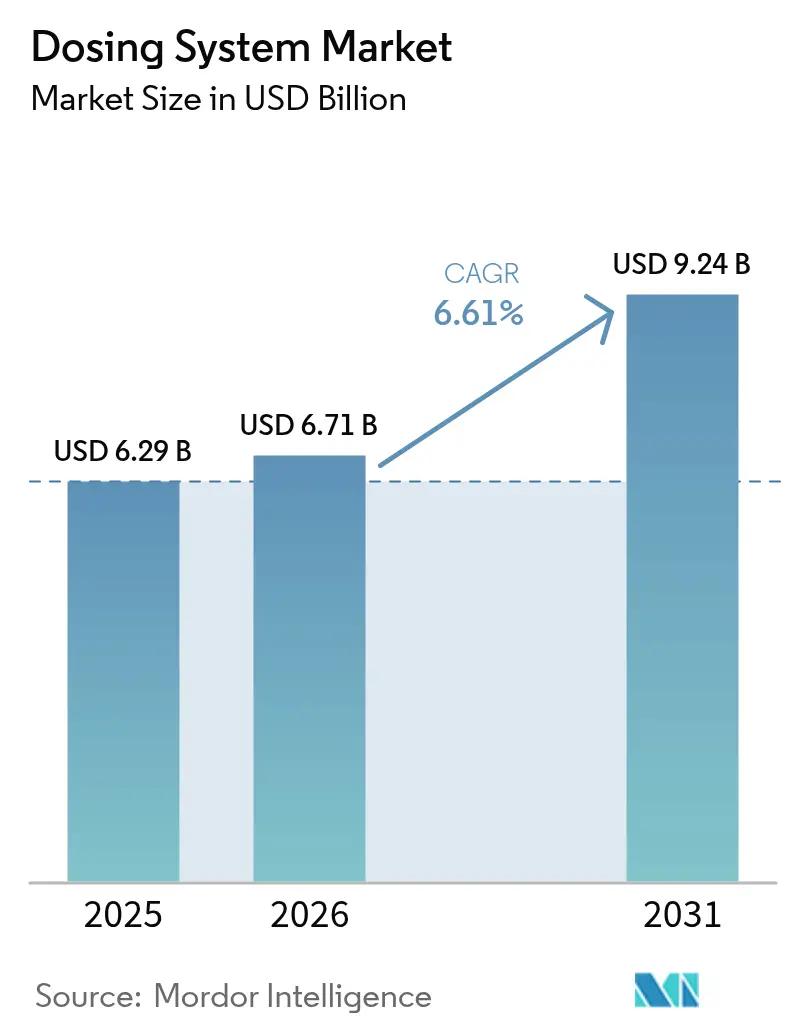
Dosing System Market size in 2026 is estimated at USD 6.71 billion, growing from 2025 value of USD 6.29 billion with 2031 projections showing USD 9.24 billion, growing at 6.61% CAGR over 2026-2031.
Surging infrastructure upgrades in water treatment, stricter environmental regulations, and rising demand for precision chemical injection in the pharmaceutical and oil & gas industries are the primary growth catalysts. Automation and industrial IoT (IIoT) continue to reshape equipment specifications, while government-backed water security programs ensure steady capital outlays for utilities. Energy companies are also allocating larger budgets to enhanced-recovery chemical injection, and biologics producers require micro-dosing accuracy that conventional pumps cannot deliver. Supply-chain exposure in specialty polymer diaphragms remains a pricing risk, and cybersecurity worries could temper the pace of connected-pump adoption.
Key Report Takeaways
- By pump type, diaphragm technology held 47.68% of the dosing system market share in 2025, whereas peristaltic (hose) pumps are projected to rise at a 6.78% CAGR between 2026 and 2031.
- By application, water and wastewater treatment accounted for 37.85% of the dosing system market size in 2025, while the pharmaceuticals and biotechnology segment is forecast to grow the fastest at 7.62% through 2031.
- By geography, the Asia-Pacific region led with a 39.02% revenue share in 2025 and is projected to advance at a 7.08% CAGR through 2031.
Note: Market size and forecast figures in this report are generated using Mordor Intelligence’s proprietary estimation framework, updated with the latest available data and insights as of 2026.
Market Trends and Insights
Drivers Impact Analysis of Dosing System Market*
| Driver | (~) % Impact on CAGR Forecast | Geographic Relevance | Impact Timeline |
|---|---|---|---|
| Rising investments in water & wastewater treatment infrastructure | +1.0% | Global, with strongest impact in APAC and MEA emerging markets | Medium term (2-4 years) |
| Expansion of oil & gas enhanced-recovery chemical injection | +0.8% | North America, Middle East, with spillover to South America | Short term (≤ 2 years) |
| Stricter global hygiene standards in F&B processing | +0.6% | Global, with early adoption in Europe and North America | Medium term (2-4 years) |
| Environmental regulations tightening effluent limits | +0.7% | Europe, North America, with gradual expansion to APAC | Long term (≥ 4 years) |
| IIoT-enabled smart dosing & remote monitoring adoption | +1.0% | Global, led by developed markets with APAC manufacturing integration | Medium term (2-4 years) |
| Micro-dosing needs in biologics & cell-therapy production | +0.6% | North America, Europe, with emerging presence in APAC hubs | Long term (≥ 4 years) |
| Source: Mordor Intelligence | |||
Rising Investments in Water & Wastewater Treatment Infrastructure
Record public-utility spending is fueling the dosing system market. Australia’s National Water Grid Fund is allocating USD 2.5 billion for new plants, while Missouri American Water earmarked more than USD 500 million in 2024 to replace aging pipes and upgrade chemical feed stations [1]Missouri American Water, “Missouri American Water Announces 2024 Infrastructure Investment,” amwater.com. Utilities favor automated metering pumps that reduce chemical overuse, and real-time control platforms help operators comply with increasingly stringent discharge permits. In drought-prone regions, fine-tuned dosing ensures every liter is safeguarded, making precision pumping integral to long-term water security strategies.
Expansion of Oil & Gas Enhanced-Recovery Chemical Injection
Operators extend field life by injecting polymers, surfactants, CO₂, and nanoscale additives that mobilize trapped hydrocarbons, thereby increasing production. Chevron and Halliburton’s ZEUS IQ system now automates stage execution and adjusts chemical blends in real-time [2]Chevron, “ZEUS IQ™ Intelligent Fracturing,” chevron.com. Metering accuracy directly influences incremental recovery, so producers specify high-pressure diaphragm pumps with accuracy tolerances of ±1% or less. Growing investment in North American shale restimulation and mature-field projects in the Middle East underpins short-term pump demand.
Environmental Regulations Tightening Effluent Limits
The U.S. Environmental Protection Agency’s first national PFAS drinking-water limits since 1996 will channel USD 9 billion into remediation by 2026 [3]United States Environmental Protection Agency, “National Primary Drinking Water Regulation for PFAS,” epa.gov. Canada’s updated Wastewater Systems Effluent Regulations adopt risk-based compliance pathways that favor advanced chemical treatment. Industries face lower parts-per-trillion discharge caps and must dose multiple reagents with milliliter-level precision to stay within permit thresholds. Regulatory audits also require digital dosing logs, reinforcing the shift toward connected metering systems.
IIoT-Enabled Smart Dosing & Remote Monitoring Adoption
Cloud dashboards and predictive maintenance analytics enable operators to identify seal wear before catastrophic failure. ProMinent’s DULCONNEX platform streams real-time flow data, cutting unplanned outages and chemical wastage. Hospitals and bioprocess plants are deploying similar architectures to safeguard sterile production suites. Yet every new data node enlarges the cyber-attack surface, prompting pump OEMs to embed secure-by-design firmware and authenticated device gateways.
Restraints Impact Analysis of Dosing System Market*
| Restraint | (~) % Impact on CAGR Forecast | Geographic Relevance | Impact Timeline |
|---|---|---|---|
| Availability of low-cost alternative pump technologies | -0.6% | Global, with strongest impact in price-sensitive APAC and MEA markets | Short term (≤ 2 years) |
| High maintenance & energy cost of high-pressure systems | -0.4% | Global, with particular impact in energy-intensive applications | Medium term (2-4 years) |
| Cyber-security risks in connected dosing equipment | -0.3% | Developed markets with high IIoT adoption rates | Medium term (2-4 years) |
| Supply volatility of specialty polymer diaphragms | -0.3% | Global, with concentration risk in key manufacturing regions | Short term (≤ 2 years) |
| Source: Mordor Intelligence | |||
Availability of Low-Cost Alternative Pump Technologies
Regional suppliers are marketing centrifugal and gear pumps equipped with rudimentary stroke-control kits at discounts of up to 30% compared to precision metering units. For basic chlorine or pH adjustment, many municipal plants in South Asia opt for these low-spec alternatives, thereby squeezing margins for premium OEMs. Established brands, therefore, emphasize life-cycle cost, tighter volumetric accuracy, and after-sales service to justify higher capital prices.
Cyber-Security Risks in Connected Dosing Equipment
IIoT gateways expose critical infrastructure to ransomware. Manufacturing ranked among the top three most-attacked sectors in 2024, and compromised chemical feeds could trigger regulatory shutdowns [4]World Economic Forum, “Global Cybersecurity Outlook,” weforum.org. Utilities weigh the benefits of remote monitoring against liability: a successful breach might poison water supplies or halt vaccine batches. The resulting caution can slow adoption of cloud-enabled pumps, especially in North America and the European Union, where data-protection statutes impose steep penalties for cyber lapses.
*Our forecasts treat driver/restraint impacts as directional, not additive. The impact forecasts reflect baseline growth, mix effects, and variable interactions.
Dosing System Market Segment Analysis
By Pump Type:
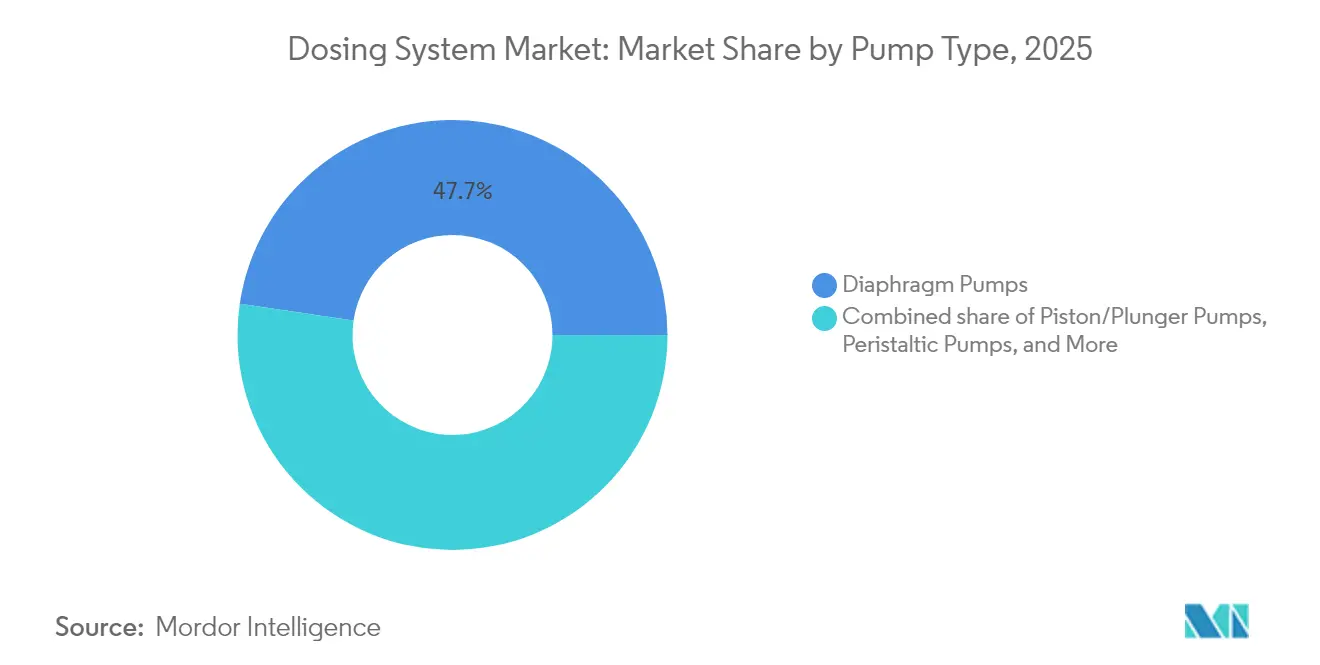
Diaphragm Experience Underpins Market LeadershipDiaphragm units captured 47.68% of the dosing system market share in 2025, reflecting their leak-proof membranes and corrosion resistance, which are vital for handling aggressive acids and alkalis. The dosing system market size for diaphragm technology continues to expand in tandem with municipal disinfection projects and refinery desulfurization lines. Peristaltic designs are gaining traction at a 6.78% CAGR because single-use tubing eliminates cross-contamination, a decisive factor in biologics fill-finish suites. Progressive-cavity pumps remain the choice for shear-sensitive slurries in biogas digesters, an area bolstered by Atlas Copco’s purchase of Wangen Pumpen. Piston and plunger models meet niche demand in high-pressure offshore wells, where pulseless flow is critical.
Innovation centers on compact, servo-driven motors that hold flow variance below 0.5%. Watson-Marlow’s latest peristaltic portfolio delivers bidirectional accuracy, suited to continuous manufacturing skids. OEMs also integrate ceramic heads and PTFE diaphragms to overcome shortages of specialty polymers. These material advances insulate buyers from supply swings and help stabilize the dosing system market.


By Application:
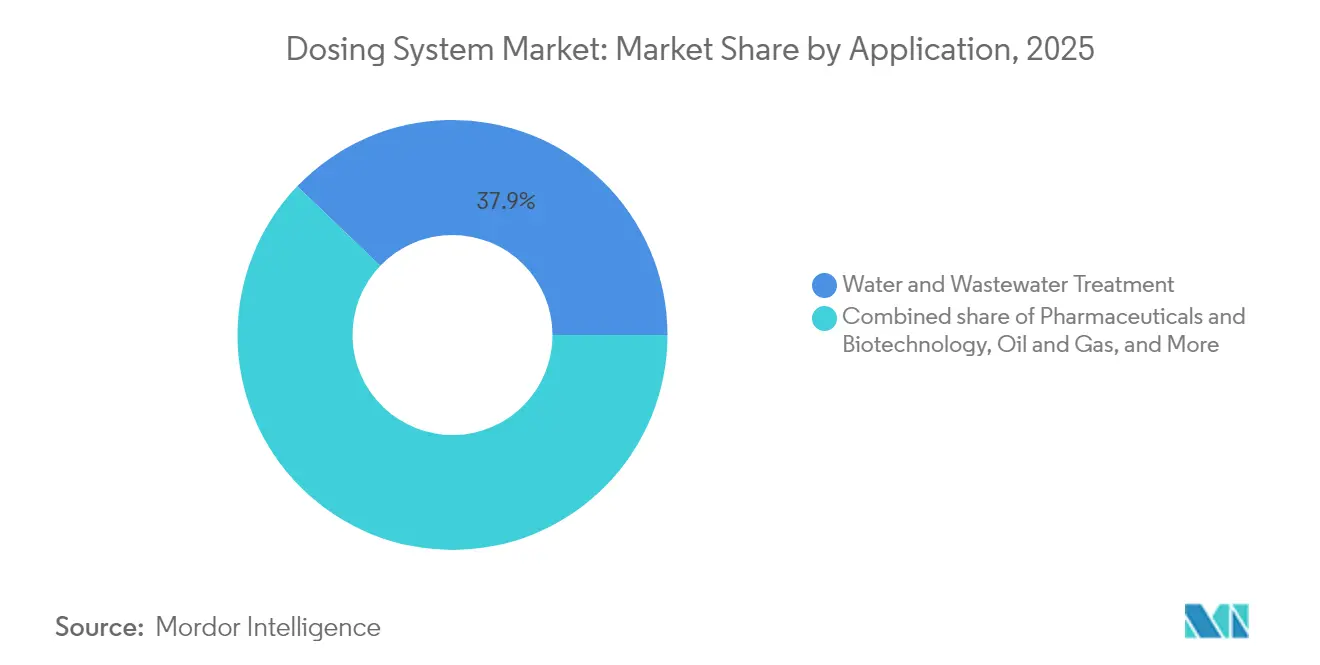
Water Treatment Volume Meets Pharmaceutical PrecisionWater & wastewater treatment contributed 37.85% of the dosing system market size in 2025, thanks to large-scale demand for coagulants, flocculants, and disinfectants. Chloramine feed lines often run 24/7, rewarding pumps with low maintenance intervals and integrated chlorine-vacuum relief. Pharmaceuticals & biotechnology is the fastest-growing application, with a 7.62% CAGR, as micro-batch biologics migrate toward single-use reactors. Cell-therapy producers routinely program pumps to dispense sub-milliliter boluses during upstream inoculation, a task that exceeds the capabilities of traditional centrifugal devices.
The core sectors include oil and gas, chemical injection, food and beverage, sanitation, and pulp and paper bleaching. FDA’s 21 CFR 117 rule pushes food processors to validate every sanitizer dose. Meanwhile, modular RNA-production “biofoundries” such as Quotient Sciences’ GMP Biofoundry-in-a-Box™ rely on high-precision pumps to make 1 million vaccine doses daily. These emerging use cases diversify the dosing system market across industries and economic cycles.
Geography Analysis
APAC Dosing System Market
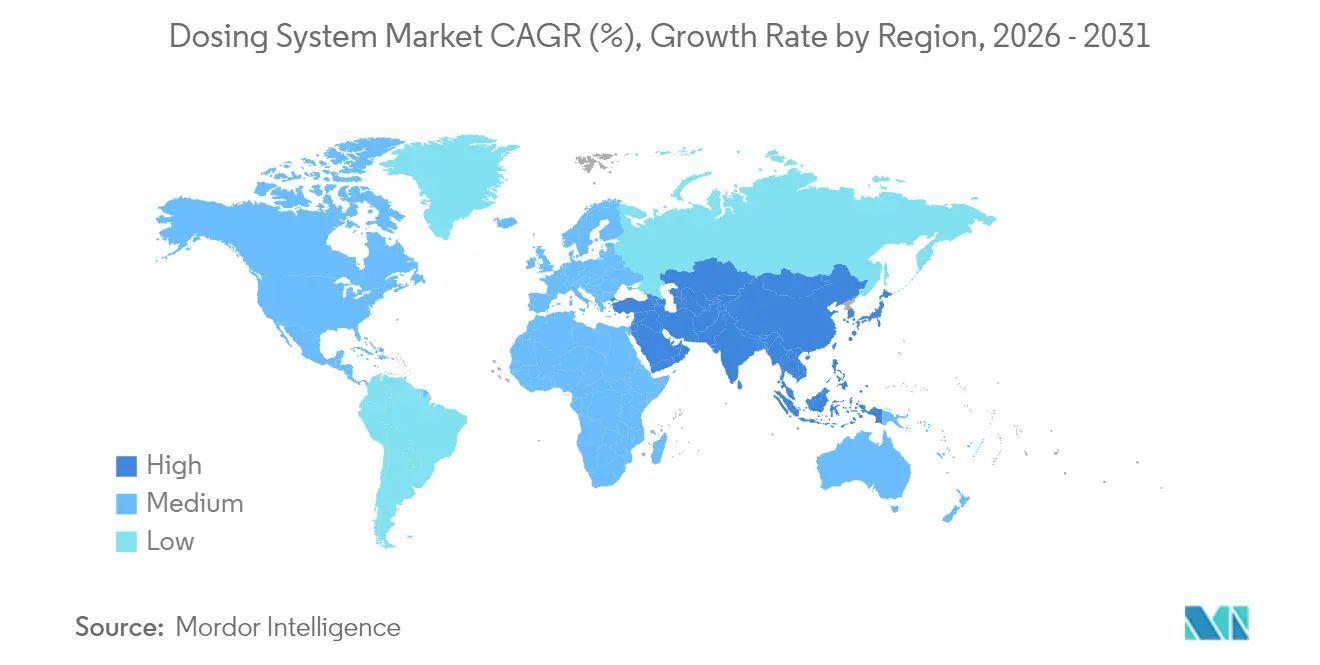
The Asia-Pacific region generated the largest share of the dosing system market in 2025, at 39.02%, and is poised for a 7.08% CAGR through 2031. China's fast-tracked drug registration reforms, including a 45-day batch release for seasonal flu shots, encourage domestic biotech expansion and turbocharge smart pump demand. India's Jal Jeevan Mission finances chlorine-dosing skids for new rural water plants, while Southeast Asia's chemical industry is projected to reach USD 448 billion by 2030, deepening the regional customer base.
North America Dosing System Market
North America remains a technology bellwether as the EPA's PFAS standards unlock USD 9 billion for remediation through 2026. Utilities are retrofitting treatment trains with multi-channel metering pumps that handle coagulants, powdered-activated carbon, and ion-exchange resins in a single frame. Canada's new risk-based wastewater rules are driving automation in secondary plants, with digital pump logs streamlining compliance audits.
EMEA and South America Dosing System Market
Europe records stable replacement demand, anchored in the Green Deal's sustainability goals. German and Nordic municipalities are shifting toward low-energy pumps that reduce power draw by up to 20%. The Middle East utilizes dosing systems for enhanced oil recovery and desalination brine conditioning, whereas key growth pockets include South African mining and Egyptian fertilizer production. Brazilian pulp mills and Argentine irrigators invest selectively in South America, but currency volatility tempers capital imports. Local assembly partnerships help international brands navigate tariff barriers and expand their market footprint in the dosing system market across emerging regions.

Regulatory Landscape
Regulatory requirements for dosing systems are tightening around functional safety, leak control, and digitally verifiable compliance, particularly for installations handling hazardous chemicals and for connected equipment. In the United States, the EPA finalized amendments in April 2026 for Chemical Manufacturing Area Source (CMAS) categories under NESHAP, increasing emphasis on equipment-leak control, including annual leak monitoring expectations for pumps in light liquid service using EPA Method 21. This is reinforcing demand for leak-resistant pump designs and maintenance-ready configurations.
In Europe, the Machinery Regulation (EU) 2023/1230 replaces the Machinery Directive framework and becomes applicable on 20 January 2027, with clearer obligations covering cybersecurity and safety for machinery with digital and software-enabled functions. It also affects smart dosing skids integrated into plant controls. Standards are moving in parallel: CEN published BS EN 15848:2026 for adjustable chemical dosing systems in buildings (updating the 2010 edition), while IEC updates to functional safety and process automation references include IEC 62061 amendments in 2026 and the IEC 61511:2026 series for safety instrumented systems. For dosing equipment OEMs, this points to tighter documentation of safety functions, validated control architectures, and traceable testing routines.
Competitive Landscape
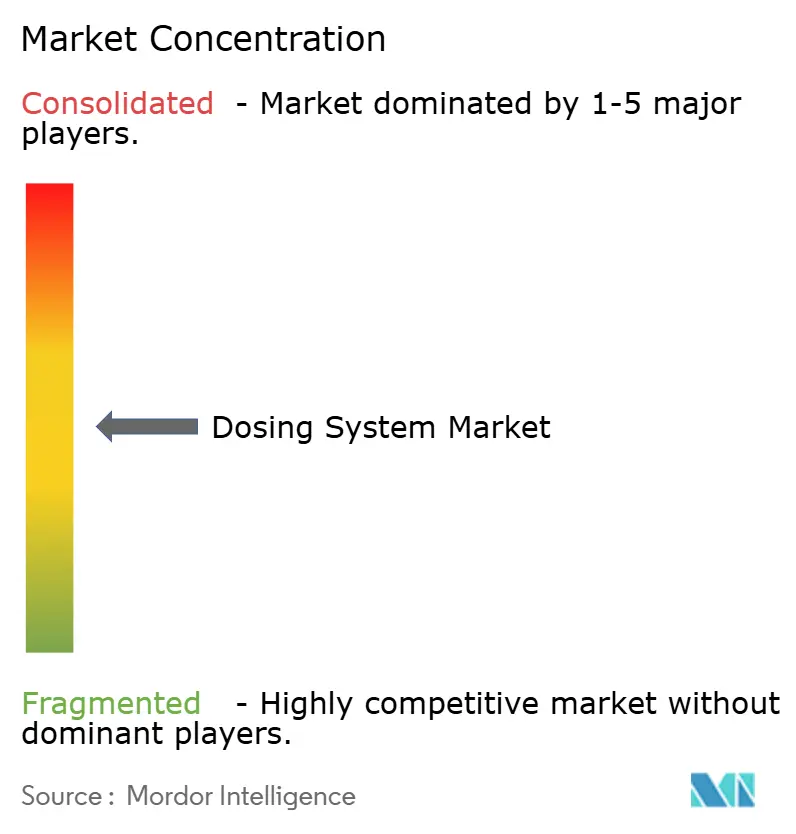
The dosing system market is moderately fragmented. Dover Corporation broadened its scope with the 2025 acquisition of Cryo-Mach, adding cryogenic centrifugal competencies that complement its PSG metering lines. Grundfos invested DKK 1.8 billion in 2023 R&D to refine energy-efficient motors and IoT firmware. ProMinent’s DULCONNEX ecosystem differentiates through predictive-maintenance analytics, while niche makers focus on application depth: Watson-Marlow dominates peristaltic solutions for sterile fluids, and Ingersoll Rand’s 2025 purchase of UT Pumps expands its reach in biogas and carbon-capture dosing.
Supply-side challenges center on shortages of fluoro-polymer diaphragms and extended chip lead times for smart controllers. Players mitigate risk through dual-sourcing and vertical integration—Dover’s Carter Day asset buy boosts in-house pelletizer parts, lessening reliance on external vendors. Aftermarket service has become a key profit pillar; OEMs bundle remote diagnostics, cartridge kits, and operator training to secure annuity revenues. Emerging disruptors experiment with AI-guided flow tuning and green-hydrogen-ready materials, setting the stage for next-generation differentiation within the dosing system industry.
Dosing System Industry Leaders
Grundfos Holding A/S
Dover Corporation (PSG)
IDEX Corporation
ProMinent GmbH
Nikkiso Co., Ltd.
- *Disclaimer: Major Players sorted in no particular order
Dosing System Market Companies Covered in this Report
- Dover Corporation
- Grundfos Holding A/S
- ProMinent GmbH
- IDEX Corporation
- Nikkiso Co., Ltd.
- SPX FLOW, Inc.
- Milton Roy LLC
- Verder Group
- SEKO S.p.A.
- Watson-Marlow (Spirax-Sarco)
- Flowserve Corporation
- LEWA GmbH
- Wanner Engineering (Hydra-Cell)
- Blue-White Industries
- Lutz-JESCO GmbH
- Neptune Chemical Pump Company
- SEEPEX GmbH
- NETZSCH Pumps & Systems
- Xylem Inc.
- Sulzer Ltd.

Market Opportunities and Future Outlook
Utilities and industrial operators are pursuing chemical-use reduction and tighter process control, which is creating demand for automated dosing solutions that combine metering hardware with sensors, advanced control logic, and plant integration. In March 2026, EOSi deployed Nitrack automated carbon dosing using real-time process monitoring to optimize external carbon usage (MicroC), providing a direct, measurable route to lower chemical consumption in nutrient-removal processes. That makes algorithm-enabled dosing a procurement lever beyond basic PID-based setups. Interest is also showing up as research moves from lab concepts to applied designs, such as the June 2026 E3S Web of Conferences study on an intelligent coagulant dosing system (LQG-controlled), which reported improved dosing accuracy and higher coagulant efficiency, reinforcing buyer focus on algorithm-assisted dosing for dewatering and solids-handling upgrades.
A second opportunity area is faster deployment and repeatable quality for water and wastewater projects through standardized, modular dosing skids and offsite manufacturing. Colloide cited delivery of 154 dosing rigs to Severn Trent using an advanced delivery model with a materially reduced turnaround time versus traditional site-built approaches, which fits utilities looking to standardize chemical feed stations across multiple assets. On the OEM side, product roadmaps are aligning with connected operations and wider turndown needs, including Grundfos DDA SMART Digital Dosing pump launch in July 2026 with integrated fieldbus connectivity and remote management features. Capacity for higher-viscosity and broader process use cases is also expanding, with Elmet TOP 7000 Cast (January 2026) targeted for casting and coating applications, where precise profiling and repeatability are part of the purchase criteria.
Recent Industry Developments in Dosing System Market
- July 2026: Grundfos launched the DDA SMART Digital Dosing pump, adding a wide 1:3000 turndown ratio and built-in connectivity aimed at remote operation and integration with plant control environments. The release raises the specification baseline for smart dosing in water treatment and industrial process lines, where tighter control and documentation are increasingly tied to compliance and cost-of-chemicals.
- January 2025: Dover Corporation integrated petrochemical drying assets from Carter Day into its MAAG business. This strengthened Dover’s plastics dewatering and drying offering, supporting more complete packaged solutions where chemical dosing and fluid handling are procured alongside upstream and downstream process equipment.
- October 2024: Ingersoll Rand acquired APSCO, Blutek, and UT Pumps for a total of USD 135 million. The transactions expanded Ingersoll Rand’s pump portfolio and global reach, strengthening its ability to serve dosing and chemical-injection adjacencies across industrial applications.


Dosing System Market Report Scope and Research Methodology
Market Definition and Coverage
This market covers dosing systems used to store, meter, and inject controlled amounts of fluids into a process, typically through a combination of tanks, metering pumps, valves, and related piping and controls across industrial and municipal operations.
Scope exclusions: We exclude general transfer pumps and non-metering fluid handling equipment that does not provide controlled, repeatable dosing.
Segments Covered in This Report
- By Pump Type
- Diaphragm Pumps
- Piston/Plunger Pumps
- Peristaltic (Hose) Pumps
- Progressive Cavity Pumps
- Gear and Other Positive-Displacement Pumps
- By Application
- Water and Wastewater Treatment
- Oil and Gas
- Chemicals and Petrochemicals
- Food and Beverage
- Pharmaceuticals and Biotechnology
- Power Generation
- Pulp and Paper
- By Geography
- North America
- United States
- Canada
- Mexico
- Europe
- Germany
- United Kingdom
- France
- Italy
- Spain
- Russia
- Rest of Europe
- Asia-Pacific
- China
- India
- Japan
- South Korea
- ASEAN Countries
- Australia and New Zealand
- Rest of Asia-Pacific
- South America
- Brazil
- Argentina
- Rest of South America
- Middle East and Africa
- Saudi Arabia
- United Arab Emirates
- South Africa
- Egypt
- Rest of Middle East and Africa
- North America
Data Sources, Market Sizing, and Validation
Desk Research
Desk research starts with mapping where dosing systems are most used and how demand usually moves, then we align it with reported activity levels by end users. For context on water and wastewater, we refer to public sources such as the US EPA and USGS, and for Europe we use Eurostat indicators that help proxy industrial and municipal conditions. We also use the World Bank for infrastructure and industrial output signals, and UN Comtrade for trade flows of relevant pump and dosing-related equipment.
To size and sanity-check the supplier side, we also review public company filings, annual reports, investor presentations, and reputable press releases that describe revenue mix, capacity additions, and order commentary tied to metering and dosing applications. Where needed, we use paid subscriptions for company financials and intelligence, patent databases, and shipment-level trade data to fill gaps in private-company visibility and to cross-check directional momentum. The desk sources listed above are illustrative only, and many other references were used for data collection, validation, and clarification.
Primary Interviews and Surveys
Primary work is used to test how dosing system demand is behaving in the field, especially where public datasets do not separate metering duty from broader pumping. We speak with a mix of manufacturers, distributors, system integrators, and end-user maintenance and procurement teams across APAC, EMEA, and the Americas, so assumptions on pricing, replacement cycles, and project timing can be confirmed.
Distribution of primary research fieldwork respondents
| Company type | Respondent position | Region |
|---|---|---|
| Top tier: 33% | CXOs: 17% | APAC: 42% |
| Mid tier: 50% | Functional/Unit leaders: 35% | EMEA: 37% |
| Smaller Players: 17% | Managers: 48% | Americas: 21% |
Market-Sizing & Forecasting
For sizing, we use a top-down build that starts from end-use demand pools where dosing is a repeatable requirement, and then we apply adoption and intensity factors to reconstruct spend on dosing systems by region. In practice, this means wastewater treatment activity, chemical and petrochemical throughput, pharma capacity additions, and pulp and paper operating rates are used as anchors, followed by adjustments for modernization and automation (such as skid-based dosing and digital controls).
The totals are then checked using selective bottom-up approximations, for example sampling typical system prices by pump type, combining them with observed shipment and replacement patterns, and validating the split between new projects and aftermarket demand through channel checks. When supplier disclosures are not available, gaps are handled with peer-based ranges and distributor feedback, and then results are normalized so they stay consistent with the end-use demand signals.
For forecasting, we lean on scenario analysis supported by a light multivariate structure, where drivers like municipal capex cycles, industrial production, chemical output, and regulatory tightening around water discharge shape the outlook. Expert inputs help keep assumptions realistic, including ASP movement and the timing of large treatment projects.
Data Validation & Update Cycle
Outputs are validated by comparing model results with independent indicators, including trade movement, reported capex in key end-use sectors, and the pace of equipment upgrades mentioned in public disclosures. If unusual spikes appear by region or end use, the underlying drivers and conversion steps are re-checked, and follow-up conversations are triggered to confirm whether the change is real or reflects modeling noise.
Before sign-off, the work goes through multi-step analyst review, where assumptions, calculations, and unit consistency are inspected and stress-tested against alternate inputs. Reports are refreshed annually, and interim updates are made when material events shift demand, pricing, or supply. Right before delivery, a final pass is completed so clients receive the most current view available at that time.
Mordor Intelligence's Dosing System Market Estimate Compared With Other Published Estimates
Published market numbers for dosing systems can vary a lot, even when they appear to cover the same theme, because the included equipment and the measurement year are often not aligned. Differences also come from how pricing is treated, what end uses are emphasized, and whether totals are anchored to process-demand signals or to broad equipment groupings.
Chemical dosing packages for municipal and industrial water treatment sit inside Mordor Intelligence's scope, but general-purpose pumping and non-metering transfer equipment does not, which is one reason the spread shows up across publications. In addition, some estimates lean heavily on shipment-based classifications that can over-include adjacent pump categories, or they apply a single average price curve without checking it against mix shifts across diaphragm, piston/plunger, and peristaltic designs. Currency timing and refresh cadence also matter, since a model updated after large project awards or resin and metal price moves will land at a different current-year value.
Benchmark comparison
| Source | Market Size | Gaps in Research Methodology |
|---|---|---|
| Mordor Intelligence | USD 6.71 B (2026) | |
| Global Consultancy A | USD 6.58 B (2024) | Uses an earlier reference year and a broader type taxonomy, which can blend dosing systems with adjacent pumping categories, and then applies a uniform growth path without clearly separating aftermarket versus project demand. |
| Industry Data Publisher B | USD 5.45 B (2024) | Leans on shipment and revenue reporting structures that may under-capture higher-value packaged systems and controls, and the slower CAGR assumption can reflect conservative ASP progression and less emphasis on regulatory-driven water treatment upgrades. |
The comparison shows that year selection and what gets counted as a dosing system explain most of the gap, more than any single growth assumption. By keeping demand anchors tied to end-use activity and then checking the totals against observed pricing and channel feedback, the final number stays traceable to clear inputs and repeatable steps.


Key Questions Answered in the Report
What is the current value of the dosing system market?
The dosing system market size is USD 6.71 billion in 2026.
Which pump type dominates global demand?
Diaphragm pumps lead with 47.68% revenue share thanks to their leak-proof construction and chemical compatibility.
Why is Asia-Pacific the largest regional market?
Rapid industrialization, water-infrastructure projects and expanding pharmaceutical manufacturing give Asia-Pacific 39.02% share and the fastest 7.08% CAGR.
How are environmental regulations influencing equipment design?
Stricter PFAS and wastewater limits push utilities to adopt high-precision, digitally logged metering pumps to guarantee compliance.
What role does IIoT play in future growth?
Smart dosing platforms that enable remote monitoring and predictive maintenance add 1.0% to forecast CAGR by cutting downtime and chemical waste.
Which application is growing the fastest?
Pharmaceuticals & biotechnology is projected to expand at a 7.62% CAGR as micro-dosing for biologics and cell-therapy becomes mainstream.
Page last updated on:


 Your data is secure and never sold or shared.


