
Disposable Medical Supplies Market Size and Share
Market Overview
| Study Period | 2020 - 2031 |
|---|---|
| Market Size (2026) | USD 0.68 Trillion |
| Market Size (2031) | USD 1.28 Trillion |
| Growth Rate (2026 - 2031) | 13.52 % |
| Fastest Growing Market | Asia-Pacific |
| Largest Market | North America |
| Market Concentration | Low |
Major Players *Disclaimer: Major Players sorted in no particular order Image © Mordor Intelligence. Reuse requires attribution under CC BY 4.0. | |
Disposable Medical Supplies Market Analysis by Mordor Intelligence
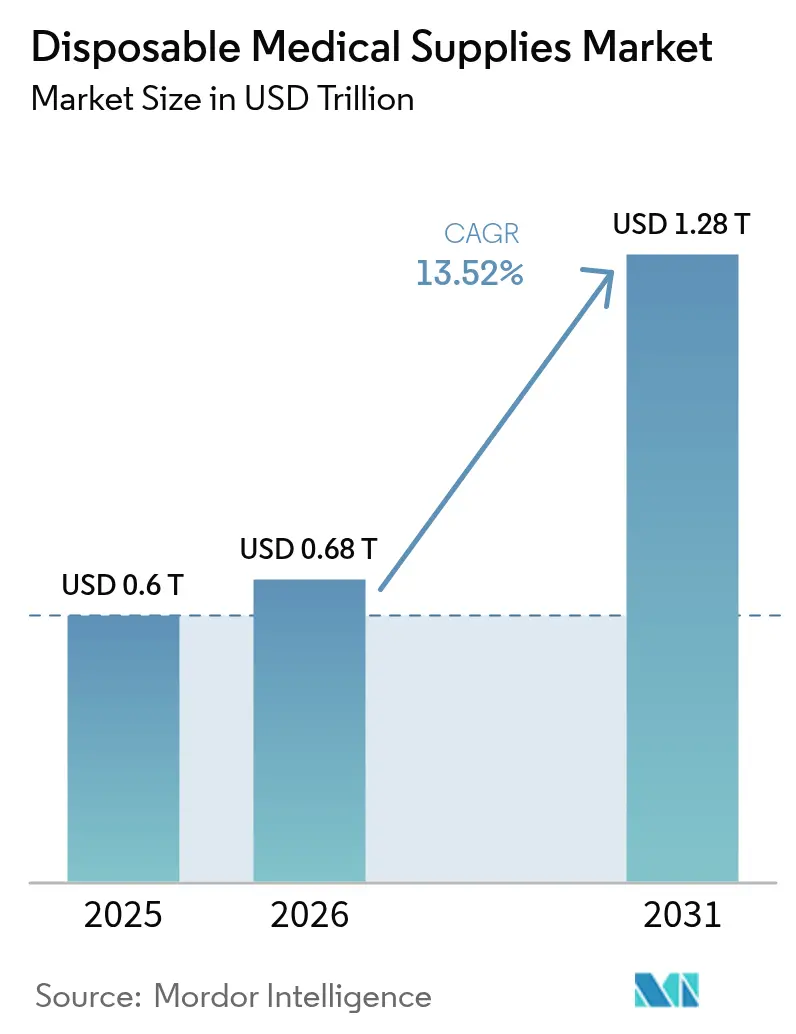
The disposable medical supplies market size was valued at USD 0.60 trillion in 2025 and estimated to grow from USD 0.68 trillion in 2026 to reach USD 1.28 trillion by 2031, at a CAGR of 13.52% during the forecast period (2026-2031). Growth is fueled by stringent infection-control requirements introduced after COVID-19, accelerating a long-term pivot from reusable to single-use products. Revised Joint Commission standards that took effect in July 2024 shifted procurement decisions toward infection prevention rather than unit price. Hospital decision-makers now weigh total cost of ownership, including sterilization labor, equipment depreciation, and liability when favoring disposables. Simultaneously, Extended Producer Responsibility (EPR) rules in major regions reward biopolymers and recyclable formats, pushing manufacturers to overhaul material portfolios. On the supply side, tariffs on Chinese gloves and masks rising to 100% and 50% respectively by 2026 are prompting the United States to reshore investments that reinforce regional supply assurance.
Key Report Takeaways
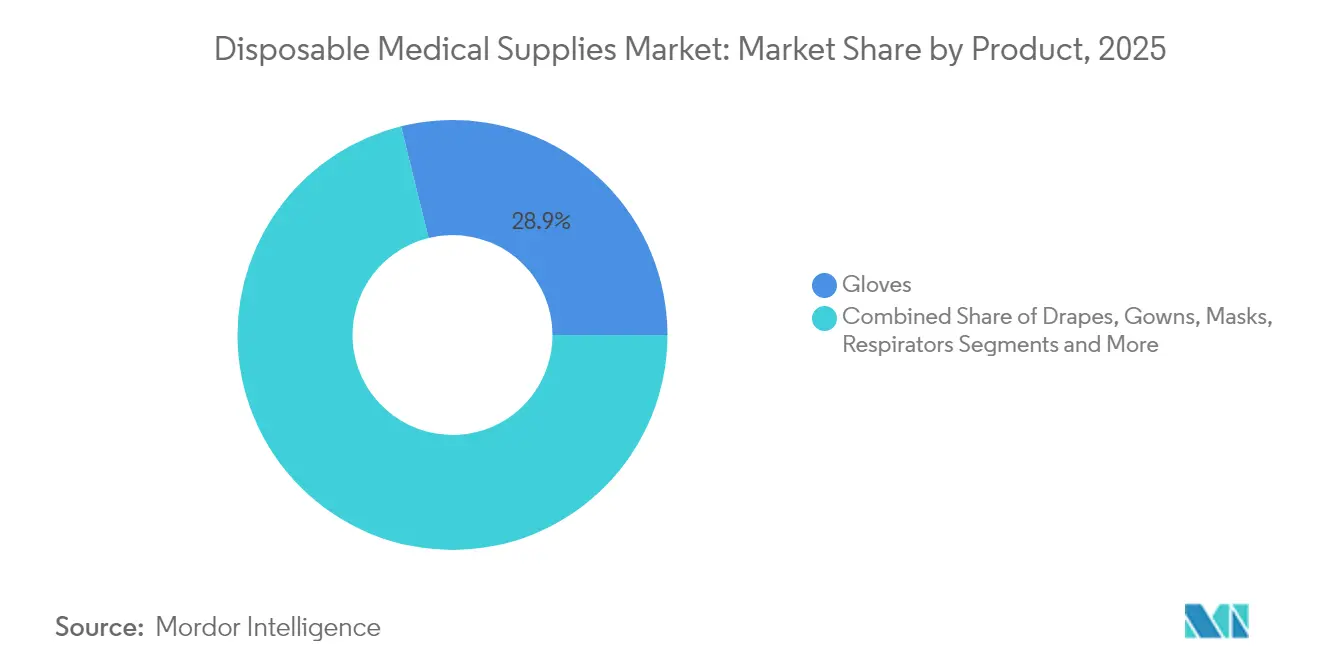
- By product type, gloves led the disposable medical supplies market with 28.85% share in 2025, while biodegradable gloves are on track for an 11.52% CAGR to 2031.
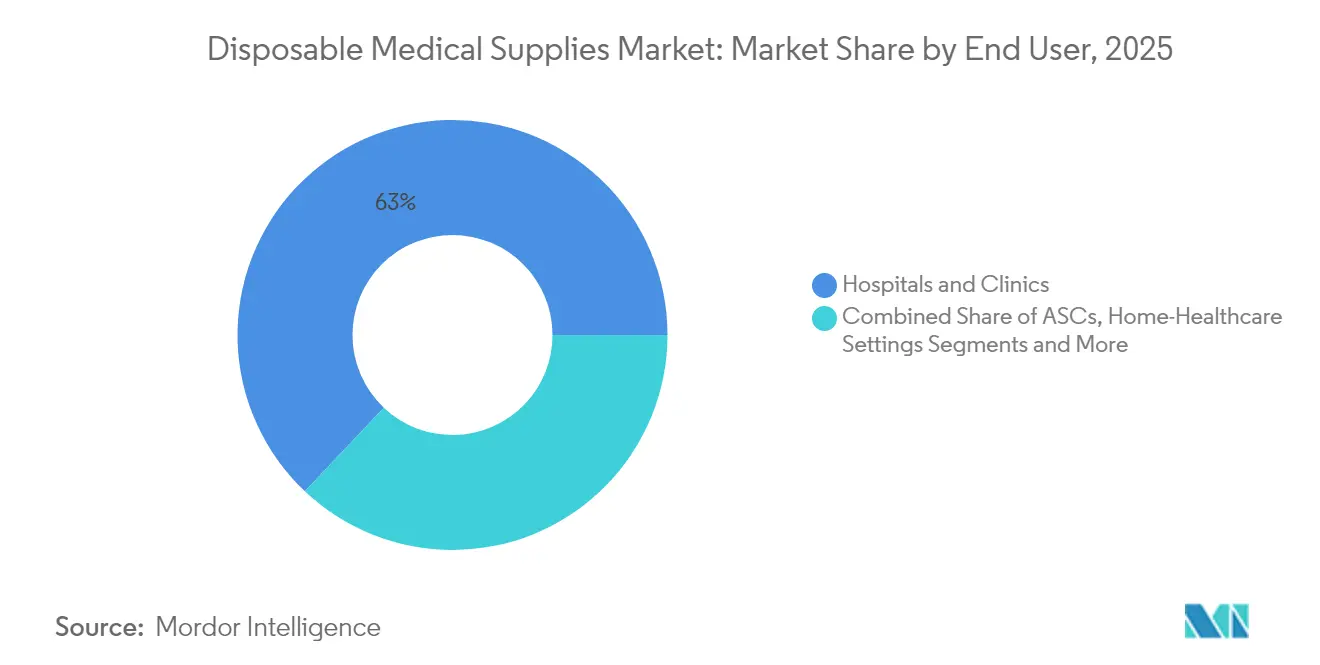
- By end user, hospitals and clinics accounted for 62.95% of the disposable medical supplies market in 2025; home health care is expanding at 9.38% CAGR through 2031.
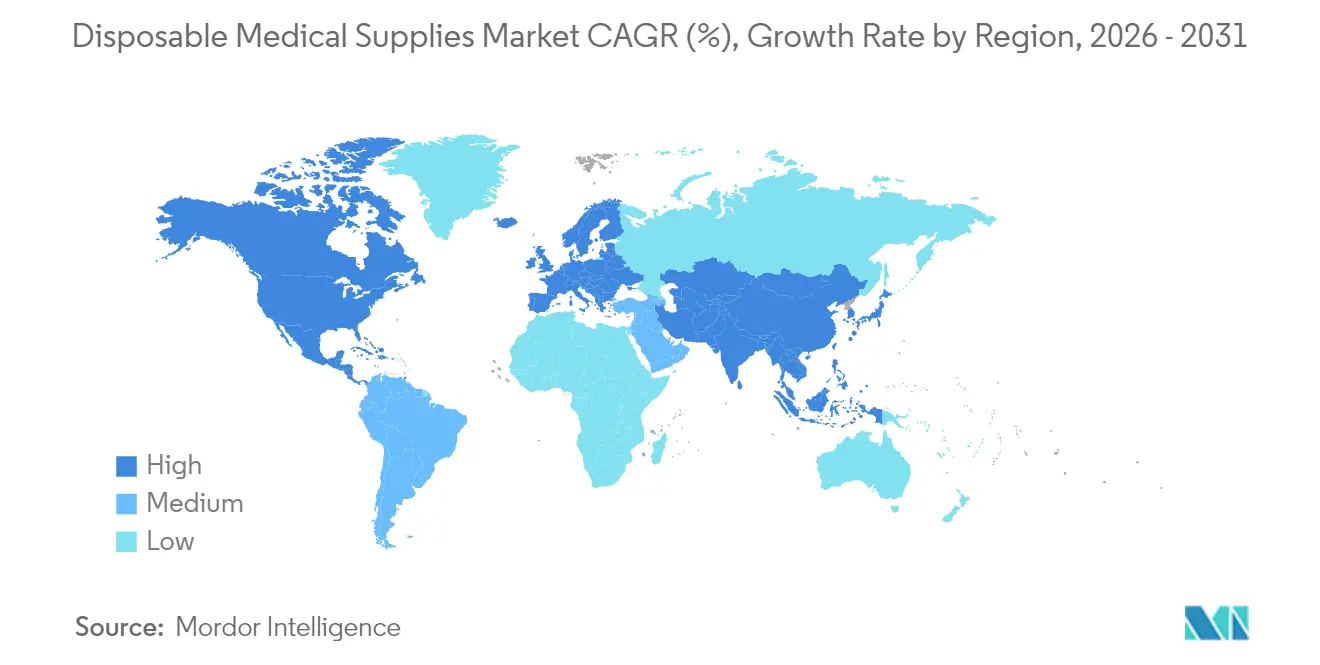
- By region, North America commanded 37.05% revenue share in 2025, whereas Asia-Pacific is forecasting a 7.62% CAGR to 2031.
Note: Market size and forecast figures in this report are generated using Mordor Intelligence’s proprietary estimation framework, updated with the latest available data and insights as of 2026.
Market Trends and Insights
Drivers Impact Analysis of Disposable Medical Supplies Market*
| Driver | (~) % Impact on CAGR Forecast | Geographic Relevance | Impact Timeline |
|---|---|---|---|
| Tightening Infection-Control Norms In Post-COVID Healthcare Systems | +2.80% | Global, with highest impact in North America & Europe | Medium term (2-4 years) |
| Rapid ASC (Ambulatory Surgery Center) Expansion In OECD Countries | +2.10% | OECD countries, particularly North America | Medium term (2-4 years) |
| Home-Based Chronic-Care Boom Driving Single-Use Kits | +1.90% | Global, with emphasis on developed markets | Long term (≥ 4 years) |
| Growth Of Point-Of-Care Diagnostics Using Disposable Sensors | +1.40% | Global, with early adoption in North America & Europe | Long term (≥ 4 years) |
| Biodegradable Bio-Polymer Breakthroughs Lowering Eco-Concerns | +1.20% | Europe leading, expanding to North America & APAC | Long term (≥ 4 years) |
| Reshoring Of Med-Tech Manufacturing In US & EU Boosting Demand For Sterile Packaging | +0.90% | North America & Europe | Medium term (2-4 years) |
| Source: Mordor Intelligence | |||
Tightening Infection-Control Norms
Healthcare organizations have locked in post-pandemic protocols that prioritize disposable supplies to curb cross-contamination. The Joint Commission cut 70% of process checks but tightened surface-cleaning outcomes, driving hospitals to replace reusable items with single-use equivalents.[1]The shift now extends to general wards where disposable gowns, drapes, and diagnostics are routine. Budget holders factor avoidance of sterilization downtime and litigation costs when justifying higher per-unit spending. Compliance scores tied to patient satisfaction further anchor demand for disposables across the disposable medical supplies market.
Rapid ASC Expansion
Ambulatory surgery centers continue to gain payer support for orthopedics and cardiology procedures. Lean staffing and rapid case turnover require pre-sterile kits that eliminate reprocessing delays. ASCs typically lack in-house sterilizers, so disposable kits speed room turnover and minimize overhead. Reimbursement shifts that incentivize outpatient care strengthen volume, boosting specialized packs containing drapes, catheters, and single-use instruments. The disposable medical supplies market gains a lasting tailwind as ASC footprints widen across OECD nations.
Home-based Chronic-Care Boom
Home settings lack sterile processing, so caregivers favor single-use wound dressings, injection devices, and monitoring kits. “Hospital at Home” programs extend the complexity of services delivered in residences, demanding ready-to-use disposable kits. Caregiver shortages boost demand for intuitive devices that reduce training time. This migration underpins long-term growth across the disposable medical supplies market.
Growth of Point-Of-Care Diagnostics
Miniaturized sensors now deliver laboratory-quality tests bedside through single-use cartridges.[2] BD’s MiniDraw capillary collection system matches venous-draw accuracy, letting pharmacies and clinics deploy rapid diagnostics. Eliminating transport and batching delays justifies per-test disposable costs. Retail clinics and home users are adopting these devices, expanding the disposable medical supplies market into new care venues.
Restraints Impact Analysis of Disposable Medical Supplies Market*
| Restraint | (~) % Impact on CAGR Forecast | Geographic Relevance | Impact Timeline |
|---|---|---|---|
| Land-Fill Taxes & EPR Laws Escalating Disposal Costs | -1.80% | Europe leading, expanding to North America | Medium term (2-4 years) |
| Price Compression From Bulk GPO Tenders In North America | -1.20% | North America, with spillover to other regions | Short term (≤ 2 years) |
| Sterilization Capacity Bottlenecks Delaying Product Launches | -1.50% | Global, with highest impact in North America & Europe | Short term (≤ 2 years) |
| Volatility In Nitrile & Latex Prices Impacting Margins | -1.10% | Global, with manufacturing concentration in APAC | Medium term (2-4 years) |
| Source: Mordor Intelligence | |||
Landfill Taxes & EPR Laws Escalating Disposal Costs
The EU Packaging and Packaging Waste Regulation mandates recyclability by 2030 and shifts disposal fees to producers from August 2026. Healthcare already generates nearly 6 million tons of waste annually, of which fewer than 1% of plastics are recycled.[3]Manufacturers of traditional PVC gloves face rising levies that erode margins. Providers add waste charges into purchasing decisions, tempering the adoption of non-sustainable disposables in cost-sensitive segments of the disposable medical supplies market.
Price Compression from Bulk GPO Tenders in North America
Group Purchasing Organizations handle more than 85% of U.S. hospital procurement and deliver 13.1% average savings that are extracted directly from supplier pricing. Contracts often lock prices for up to three years, limiting inflation pass-through. This environment favors incumbents with scale while raising barriers for innovative newcomers who lack volume discounts. Margin pressure can slow R&D spending and dampen premium product uptake within the disposable medical supplies market.
*Our forecasts treat driver/restraint impacts as directional, not additive. The impact forecasts reflect baseline growth, mix effects, and variable interactions.
Disposable Medical Supplies Market Segment Analysis
By Product Type:
Gloves Sustain Leadership While Bio-Based Variants SurgeThe gloves segment generated 28.85% of the disposable medical supplies market revenue in 2025 and remains central to everyday clinical routines. Usage frequency rose sharply after COVID-19, and elevated volumes have normalized at higher baselines. Biodegradable gloves are scaling quickly, registering an 11.52% CAGR that outpaces all other sub-categories. Their momentum reflects imminent EPR fees on traditional nitrile and latex waste. Procedure kits and trays also benefit from ambulatory surgery center growth, as pre-pack builds streamline room turnover. Drapes and gowns ride the same efficiency trend, whereas masks and respirators, though moderating from pandemic peaks, still post healthy demand given occupational safety standards. Needles and syringes post stable gains, tied to chronic-care injections migrating into homes. Catheter makers face PTFE supply constraints, prompting capacity investments and alternative materials development.
Innovators are advancing nanofiber wound dressings and connected single-use sensors that report data to electronic records, broadening the category. Evonik’s RESOMER polymer platform illustrates how material science responds to dual performance and sustainability targets. As more hospitals link purchasing to waste disclosure, bio-based lines gain shelf space. Consequently, the disposable medical supplies market size for biodegradable gloves is projected to log visible share gains by 2031.

By End User:
Institutional Volume Dominates, but Home-Care Races AheadHospitals and clinics accounted for 62.95% of 2025 sales across the disposable medical supplies market. Procedure intensity, combined with stringent compliance audits, drives constant restocking cycles. Providers absorb higher unit prices, citing savings from avoided reprocessing labor and infection-related penalties. Ambulatory surgery centers run leaner but fast-growing platforms that require turnkey kits and have been expanding at a 6.72% CAGR. Diagnostic laboratories depend on bulk consumables and now integrate point-of-care devices to decentralize testing.
Home-healthcare stands out with a 9.38% CAGR to 2031 as an aging population and payer policies shift chronic care delivery into residences. Limited sterile infrastructure in homes raises reliance on pre-sterile packs. Retail drugstores and urgent clinics represent further nodes that boost distributed consumption. These channels collectively expand the disposable medical supplies market footprint outside hospital walls. In turn, suppliers must adjust packaging sizes and distribution models to support small-batch, rapid-replenishment orders.
Geography Analysis
North America Disposable Medical Supplies Market
North America retained a 37.05% share of the disposable medical supplies market in 2025, thanks to strict infection-control oversight and fresh capital investments in local manufacturing. Tariffs that climb to 100% on certain Chinese gloves by 2026 spur companies such as Kimberly-Clark to pump USD 2 billion into Ohio and South Carolina plants, creating more than 900 skilled roles. Group Purchasing Organizations standardize specifications, accelerating product turnover and ensuring steady volume across the network.
Europe Disposable Medical Supplies Market
Europe remains committed to sustainable healthcare procurement. EPR legislation that compels recyclable packaging by 2030 has amplified interest in bio-polymer disposable lines. Hospitals in Germany and the Nordics publish annual waste metrics, and suppliers able to lower disposal fees gain bidding advantages. While the continent’s population growth is muted, aging demographics sustain procedural volumes and drive continuous demand within the disposable medical supplies market.
APAC Disposable Medical Supplies Market
Asia Pacific is expected to chart a 7.62% CAGR up to 2031, the fastest among all regions. Urbanization and rising healthcare funding expand bed capacity across China, India, Indonesia, and Vietnam. Although trade tensions redirect some export orders away from China, regional manufacturers in Malaysia and Thailand seize glove contracts to backfill U.S. demand. Meanwhile, emerging private hospitals in India adopt Western infection-control norms, boosting average per-patient disposable consumption.
MEA and South America Disposable Medical Supplies Market
Middle East and Africa, along with South America, contribute modest but rising demand as governments invest in hospital infrastructure and seek to reduce healthcare-acquired infections. Multilateral funding programs often include clauses for single-use kits to meet global accreditation benchmarks. Collectively, these developing territories add incremental volume and diversify revenue streams for suppliers active in the disposable medical supplies market.
Regulatory Landscape
Compliance requirements for disposable medical supplies tightened across major markets through quality-system harmonization and increased digital traceability. In the United States, the FDA Quality Management System Regulation (QMSR) became effective on February 2, 2026. The rule incorporates ISO 13485:2016 by reference into 21 CFR Part 820, which raises documentation, supplier-control, and CAPA expectations for manufacturers of single-use devices and consumables.
In Europe, implementation under the Medical Device Regulation (MDR) continued to formalize notified-body and post-market infrastructure. Commission Implementing Regulation (EU) 2026/977 (adopted May 4, 2026) set uniform quality management and procedural requirements for notified-body conformity assessment activities under MDR/IVDR. Mandatory use of core EUDAMED modules, including actor registration and UDI/device registration, took effect on May 28, 2026. Together, these shifts increase the operational premium on traceable labeling, validated packaging/sterilization documentation, and regulatory-ready product master data across global disposable supply portfolios.
Value Chain Analysis
The value chain for disposable medical supplies runs from petrochemical and bio-polymer feedstocks to conversion into films/nonwovens and molded components. It then covers device assembly, including kitting and sterile barrier packaging, followed by sterilization and distribution through manufacturers, distributors, and GPO-driven hospital channels. For high-volume categories such as gloves, drapes, gowns, procedure kits, and IV-related consumables, upstream reliance on naphtha-derived inputs and specialized packaging materials ties costs and continuity to energy and chemical markets. Downstream demand is consolidated through large institutional buyers that standardize specifications and contract terms.
Recent supply-side signals show how disruptions move from component availability and quality events into provider access. In May 2026, the U.S. FDA added neurosurgical patties, sponges, and strips (product code HBA) to its medical device shortage list, with disruption anticipated through Q4 2026. This followed Medline initiating a recall of neurosurgical patties in March 2026 due to elevated endotoxin levels. Such cases increase the need for multi-sourcing, tighter incoming inspection and endotoxin controls, redundant sterilization and packaging capacity, and distributor inventory buffers, often held in multi-week ranges, to limit procedure-level stockouts.
Competitive Landscape
The disposable medical supplies market shows moderate fragmentation. Cardinal Health, Medtronic, and 3M continue to exploit scale and GPO relationships, yet none commands more than 10% individual share. BD earmarked USD 2.5 billion for U.S. expansion, underscoring the pivot toward domestic capacity. Ansell’s USD 640 million buyout of Kimberly-Clark’s PPE unit highlights ongoing consolidation aimed at portfolio breadth.
Technology is emerging as a separator. Medline collaborates with Microsoft to infuse AI into inventory platforms that predict stock-outs and automatically reorder, helping hospitals minimize emergency buys. Medtronic is paring its supplier list from 65,000 to a few strategic partners and shuttering older plants, positioning for leaner operations. Sustainability is another battleground. Only 1% of medical plastics today derive from bio-based feedstocks, giving first movers reputational currency and bidding leverage, especially in Europe.
Regulatory science is shaping product pipelines. The U.S. FDA confirmed vaporized hydrogen peroxide as a validated sterilant, opening doors for suppliers that can package devices in materials compatible with that process. Meanwhile, uncertainty over ethylene oxide restrictions poses launch risks for catheter and kit lines that still rely on legacy sterilization—firms hedge by qualifying multiple modalities to secure uninterrupted supply to the disposable medical supplies market.
Disposable Medical Supplies Industry Leaders
-
Cardinal Health, Inc.
-
3M
-
Molnlycke Health Care AB
-
Medtronic
-
Owens and Minor
- *Disclaimer: Major Players sorted in no particular order

Disposable Medical Supplies Market Companies Covered in this Report
- Cardinal Health
- Medtronic
- 3M
- Owens & Minor
- Molnlycke Health Care
- Medline Industries
- Semperit
- Ansell
- Nipro
- Mckesson
- Top Glove
- Beckton Dickinson
- Baxter
- B. Braun
- Halyard Health
- Kimberly-Clark Worldwide
- Terumo
- Smiths Group
- Coloplast
- Hartalega Holdings
Market Opportunities and Future Outlook
Localized manufacturing and capacity additions are opening whitespace for suppliers that can sustain continuity of sterile consumables while meeting material and compliance shifts. In July 2026, Otsuka ICU Medical LLC announced a USD 500 million expansion of IV solutions manufacturing in Austin, Texas, including a new 500,000-square-foot facility linked to supply-chain resilience and non-DEHP product development. At the same time, Winner Medical broke ground in May 2026 on a USD 60 million manufacturing base in Vietnam for advanced medical dressings and operating room consumables, pointing to a broader move toward regionalized production footprints that shorten lead times for hospitals and ambulatory surgery centers.
Sustainability and traceability requirements are also pushing product design and procurement toward recyclable formats and improved device registration data quality. In Europe, mandatory use of core EUDAMED modules from May 28, 2026 increases the value of clean UDI/device master data and compliant labeling across disposable portfolios. It is also encouraging manufacturer investment in higher-performance wound care and infection-prevention products. For example, in June 2026, Mölnlycke Health Care confirmed a combined EUR 40 million investment to expand manufacturing capacity in Mikkeli (Finland) and Oldham (UK), adding 100 million units of annual capacity to support health systems as they integrate sustainability criteria and tighter infection-prevention controls into tenders.
Recent Industry Developments in Disposable Medical Supplies Market
- July 2026: Cardinal Health signed definitive agreements to acquire the Diabetes Health business of AdaptHealth Corp. and Strive Medical for about USD 360 million in cash. The tuck-in acquisitions expand Cardinal Health's home-care footprint and strengthen distribution reach into chronic-care consumables. This broadens direct-to-patient channels that consume single-use supplies outside acute-care settings.
- June 2026: Mölnlycke Health Care announced a combined EUR 40 million investment to expand manufacturing capacity in Mikkeli, Finland and Oldham, UK, adding 100 million units of annual capacity. The expansion reinforces localized supply for wound care and infection-prevention disposables and helps reduce lead-time exposure from cross-border logistics. Additional capacity also supports higher-volume tender participation where continuity commitments are weighted heavily.
- May 2025: BD confirmed USD 2.5 billion of U.S. capacity investments over five years. The program strengthens domestic manufacturing capability and supply assurance for high-throughput disposable categories used daily across hospitals and clinics. It also supports tighter quality-system and sterilization readiness requirements as regulatory expectations increase.
Disposable Medical Supplies Market Report Scope and Research Methodology
Market Definition and Coverage
For this study, the market covers single use consumable products used during diagnosis, treatment, and routine patient care to reduce cross contamination and support basic clinical hygiene across healthcare settings.
Scope exclusions: We exclude durable or reusable medical equipment and capital devices, along with non medical consumer hygiene items.
Segments Covered in This Report
- By Product Type
- Gloves
- Drapes & Gowns
- Masks & Respirators
- Needles & Syringes
- Procedure Kits & Trays
- Catheters
- Wound Dressings
- Diagnostic & Sampling Disposables
- Other Types
- By End User
- Hospitals & Clinics
- Ambulatory Surgery Centers
- Home-Healthcare Settings
- Diagnostic Laboratories
- Other End Users
- By Geography
- North America
- United States
- Canada
- Mexico
- Europe
- Germany
- United Kingdom
- France
- Italy
- Spain
- Rest of Europe
- Asia Pacific
- China
- Japan
- India
- South Korea
- Australia
- Rest of Asia Pacific
- Middle East & Africa
- GCC
- South Africa
- Rest of Middle East & Africa
- South America
- Brazil
- Argentina
- Rest of South America
- North America
Data Sources, Market Sizing, and Validation
Desk Research
Desk work starts with mapping what counts as disposable medical supplies in real purchasing and usage, and then tying that to measurable healthcare activity. We leaned on public sources such as the World Health Organization (WHO), the World Bank, OECD health statistics, and the US CDC for infection prevention context, plus broad healthcare demand signals.
To ground volumes and category movement, we reviewed sources such as UN Comtrade for trade flows, national health ministry publications, and peer reviewed clinical and materials research that clarifies usage patterns for key single use items. On the commercial side, we checked company annual reports, investor presentations, and reputable media coverage for capacity expansions and portfolio changes. Where helpful, we used a paid subscription for company financials and a patent database to cross check product emphasis and innovation direction. These are illustrative sources, and we used additional public and paid references for data collection, validation, and clarification.
Primary Interviews and Surveys
Primary inputs were used to confirm what is actually being purchased and consumed across hospitals, outpatient settings, and distributors, especially when categories are bundled or sold as kits. We spoke with a mix of manufacturers, channel partners, and procurement or infection control stakeholders across APAC, EMEA, and the Americas, and then the feedback was used to adjust share splits, price ranges, and adoption assumptions where desk signals looked inconsistent.
Distribution of primary research fieldwork respondents
| Company type | Respondent position | Region |
|---|---|---|
| Top tier: 26% | CXOs: 12% | APAC: 42% |
| Mid tier: 53% | Functional/Unit leaders: 30% | EMEA: 33% |
| Smaller Players: 21% | Managers: 58% | Americas: 25% |
Market-Sizing & Forecasting
Sizing starts from a top-down demand pool that is reconstructed using healthcare activity and care delivery intensity, and then translated into disposable consumption using typical use-per-case patterns. We used a bottom-up cross check through selective roll ups of supplier revenue exposure, channel checks with distributors, and sampled average selling price ranges multiplied by estimated volumes, which helped us correct for areas where reported category labels vary.
Inputs used in the model include procedure volumes and inpatient and outpatient utilization, PPE and infection prevention protocols that affect per encounter usage, raw material and input cost direction that influences pricing, tendering and reimbursement pressure that limits pass through, and capacity additions or constraints that change availability across regions. Where a product category is commonly bundled (for example, single use packs), we handled gaps by converting bundles into equivalent unit demand using interview based norms and then rechecked totals against total hospital purchasing patterns.
Forecasting uses scenario analysis supported by expert views on how infection control baselines normalize, how elective procedure backlogs move, and how pricing behaves when resin and nonwoven costs change. The final path is built by combining the scenario outputs with the year to year trajectory seen in the most consistent activity indicators, so we can keep the story understandable and repeatable.
Data Validation & Update Cycle
We validate outputs by comparing the modeled totals against independent signals such as broad healthcare spending direction, trade movement for high volume disposable categories, and reported utilization trends, and then we rework any large variances that do not match field feedback. Outliers are reviewed in more than one analyst pass, and assumptions are revisited when a region shows price or volume jumps that cannot be explained by utilization or supply changes.
Reports are refreshed annually, and interim updates are triggered when there are material events such as major regulatory changes, large capacity expansions, or sharp input cost swings. Before delivery, we run a fresh review so clients receive an updated view that reflects the latest public information and the most recent expert checks.
Mordor Intelligence's Disposable Medical Supplies Market Size Compared Against Other Published Estimates
Published market values for disposable medical supplies can look far apart because the counted items are not always the same, and because different studies handle pricing, bundling, and geography timing in their own ways. It is also common to see a mismatch between what is called a market size and what is actually a growth amount shown for a multi year window.
The biggest gap drivers tend to be whether only PPE basics are counted or whether broader single use supplies used in diagnosis and treatment are included, how average selling prices are trended when input costs move, and whether currency conversion is done using a single year rate or blended rates. Another difference comes from refresh cadence, where fast changing post pandemic consumption baselines can shift the current year more than the long term trend.
Benchmark comparison
| Source | Market Size | Gaps in Research Methodology |
|---|---|---|
| Mordor Intelligence | USD 0.68 T (2026) | |
| Trade Publication A | USD 0.60 T (2028) | This figure is presented as a growth amount across 2024-2028 in some summaries, which can be misread as a single year market size, and the product set is often narrowed to core PPE and a few high volume items. |
| Global Consultancy B | USD 0.48 T (2023) | The scope is broader in labels but is frequently built from mixed categories (including adjacent disposable product groups) with slower price progression, and the base year anchoring is earlier, which reduces the captured post-2020 usage uplift. |
The table shows that the spread is mainly about scope labeling, year alignment, and how pricing and usage normalization are treated. By tying demand to procedure and care activity, and then checking the implied price-volume mix with interviews and public signals, the estimate stays traceable to clear steps, a modeling choice applied by Mordor Intelligence.
Key Questions Answered in the Report
What is the current size of the disposable medical supplies market?
The market is valued at USD 0.68 trillion in 2026 and is projected to reach USD 1.28 trillion by 2031.
Which product category holds the largest disposable medical supplies market share?
Gloves dominate with 28.85% share in 2025, reflecting universal clinical use and strict infection-control norms.
How quickly is the home-healthcare segment growing?
Home-healthcare demand for disposables is expanding at a 9.38% CAGR through 2031 as chronic care shifts into residences.
What region is growing the fastest?
Asia-Pacific is forecast to record a 7.62% CAGR to 2031 on the back of infrastructure expansion and rising care standards.
How are sustainability regulations affecting the market?
EPR laws such as the EU Packaging and Packaging Waste Regulation effective in 2026 are driving investment into biodegradable materials and recyclable packaging, influencing product design and procurement decisions.
Why are manufacturers reshoring production?
Escalating tariffs on Chinese gloves and masks alongside pandemic-era supply shocks have spurred U.S. and European firms to build domestic plants, improving resilience despite higher operating costs.