
Disposable IV Therapy Products Market Size and Share
Market Overview
| Study Period | 2020 - 2031 |
|---|---|
| Market Size (2026) | USD 23.79 Billion |
| Market Size (2031) | USD 31.09 Billion |
| Growth Rate (2026 - 2031) | 5.50 % |
| Fastest Growing Market | Asia-Pacific |
| Largest Market | North America |
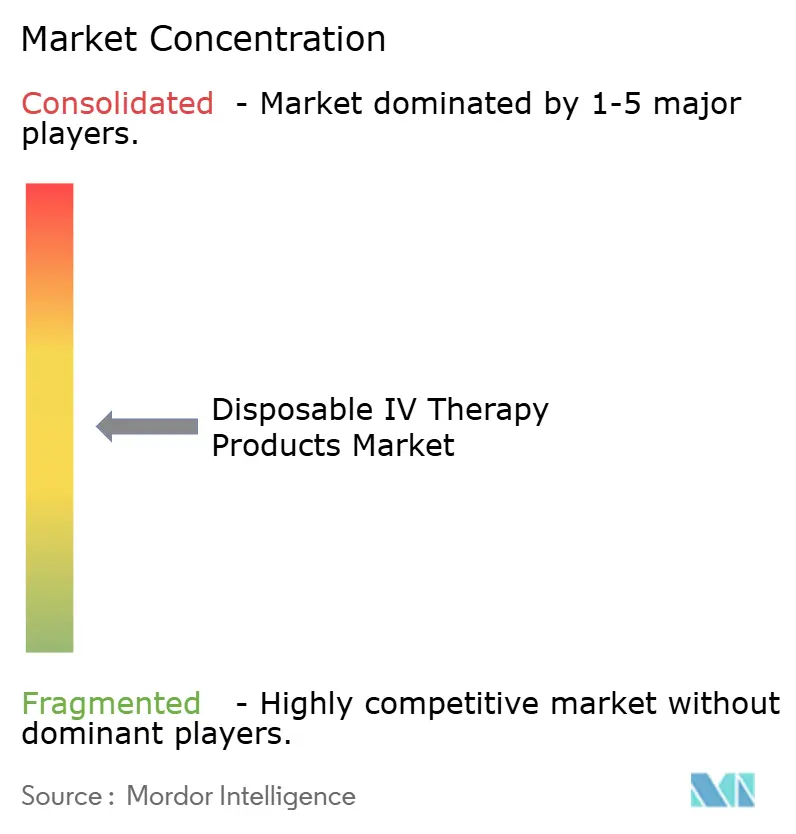
| Market Concentration | Medium |
Major Players *Disclaimer: Major Players sorted in no particular order Image © Mordor Intelligence. Reuse requires attribution under CC BY 4.0. | |
Disposable IV Therapy Products Market Analysis by Mordor Intelligence
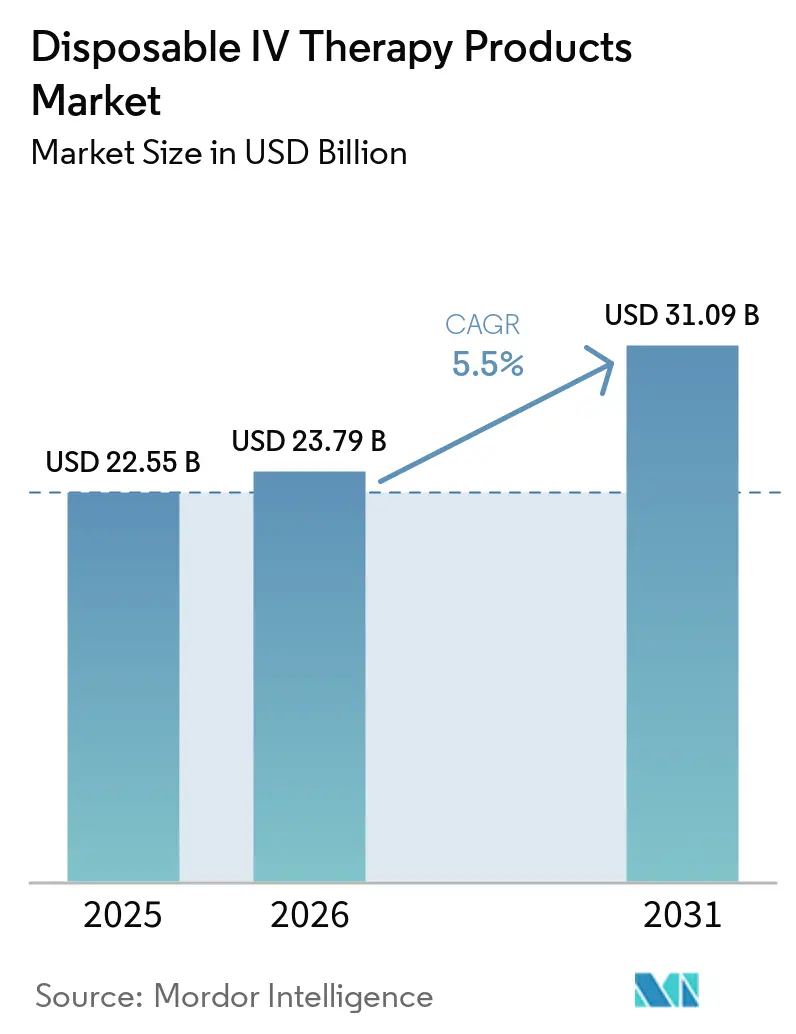
The Disposable IV Therapy Products Market size is expected to increase from USD 22.55 billion in 2025 to USD 23.79 billion in 2026 and reach USD 31.09 billion by 2031, growing at a CAGR of 5.5% over 2026-2031.
Intravenous access remains critical for fluid resuscitation, medication administration, oncology infusions, nutrition support, and critical care. Repeated treatment cycles in oncology, renal care, and parenteral nutrition drive the use of single-use administration sets and catheters. The shift of selected infusion services from hospital outpatient departments to ambulatory and home care settings supports demand for user-friendly administration sets. Infection-prevention requirements also favor needleless connectors and closed-system catheters, while manufacturers manage tender pricing, recalls, and the transition from DEHP-containing materials ahead of European restrictions.
Key Report Takeaways
- By product type, IV catheters and cannulas held 45.67% of the disposable IV therapy products market share in 2025, while infusion pumps are projected CAGR at 7.76% through 2031.
- By usability, disposable and single-use products held 76.55% of the disposable IV therapy products market share in 2025 and are projected CAGR at 8.20% through 2031.
- By application, medication administration accounted for 34.89% of the disposable IV therapy products market size in 2025, while fluid replacement and hydration are projected CAGR at 6.56% through 2031.
- By end user, hospitals held 55.67% of the revenue share in 2025, while ambulatory surgical centers are projected CAGR at 6.97% through 2031.
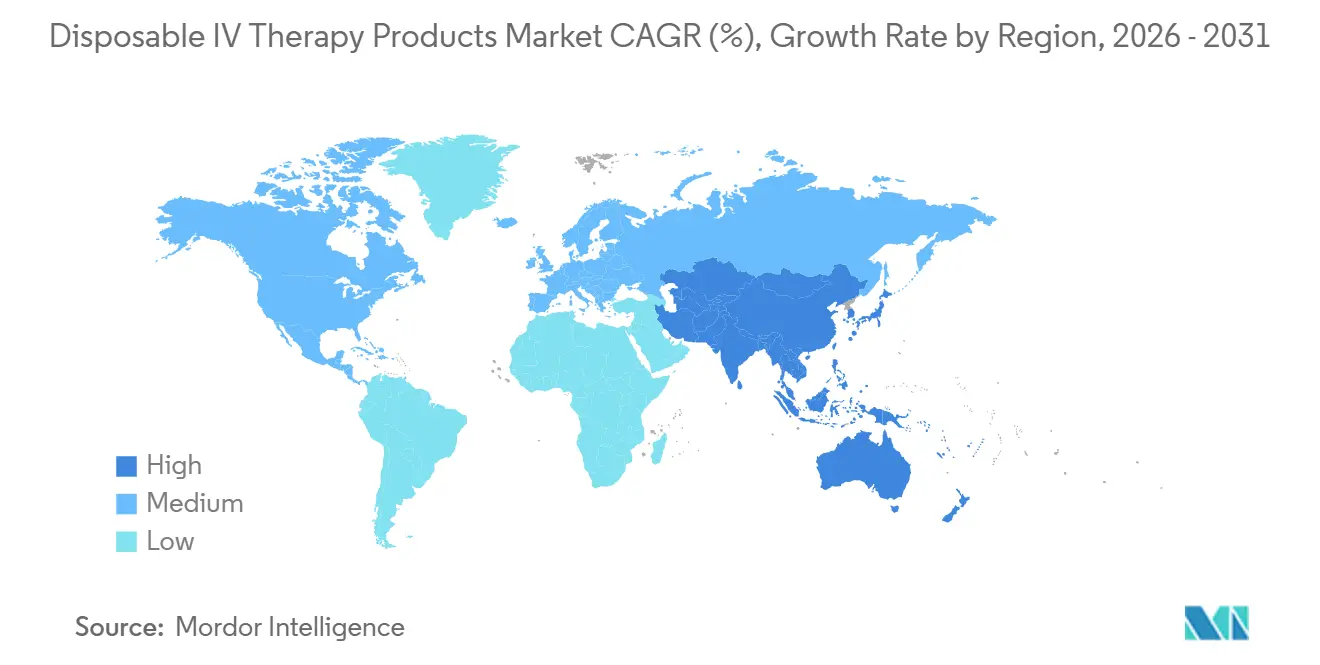
- By geography, North America held 40.56% of revenue in 2025, while Asia-Pacific is projected CAGR at 7.77% through 2031.
Note: Market size and forecast figures in this report are generated using Mordor Intelligence’s proprietary estimation framework, updated with the latest available data and insights as of January 2026.
Market Trends and Insights
Drivers Impact Analysis of Disposable IV Therapy Products Market*
| DRIVER | (~) % IMPACT ON CAGR FORECAST | GEOGRAPHIC RELEVANCE | IMPACT TIMELINE |
|---|---|---|---|
| Rising IV medication and nutrition use | +1.4% | Global, with a pronounced effect in North America, Europe, and the Asia-Pacific | Medium term (2-4 years) |
| Chronic disease, surgery, and critical care growth | +1.2% | Global, with the highest volume effect in North America, Europe, and China | Long term (≥ 4 years) |
| Home and ambulatory infusion care expansion | +0.9% | North America and Europe, with expansion into Asia-Pacific, the Middle East, and Africa | Medium term (2-4 years) |
| Dedicated set demand from installed infusion pumps | +0.7% | Global, concentrated in hospital upgrade markets in North America and East Asia | Short term (≤ 2 years) |
| Needleless access and infection prevention requirements | +0.8% | North America and the European Union, with increasing relevance in the Asia-Pacific | Medium term (2-4 years) |
| Closed-loop traceability of sets, drugs, and patient identity | +0.5% | North America and highly digitized European markets | Long term (≥ 4 years) |
| Source: Mordor Intelligence | |||
Rising Intravenous Medication and Nutrition Utilization
Intravenous administration remains essential for high-acuity medications, as it enables immediate delivery and continuous dose adjustment. It remains critical in intensive care, oncology, and nutritional support, where alternative routes may not meet clinical requirements. Fresenius Kabi reported more than 170 IV drug products in its portfolio and 15 new U.S. IV drug launches during fiscal year 2025. These launches continue to support demand for compatible administration sets and disposable IV therapy products.
Growth in Chronic Disease, Surgery, and Critical Care
Chronic diseases, surgical procedures, and critical care continue to increase the need for IV access across care settings. Australia recorded 12.8 million hospitalizations and 43.6 million outpatient services in 2024-2025.[1] India’s AB PM-JAY scheme had authorized 11.69 crore hospital admissions across 1,961 procedures by February 2026. Longer treatment cycles, including chemotherapy, dialysis, and IV diuretic therapy, support demand for catheters, connectors, and administration sets.[2]
Expansion of Home and Ambulatory Infusion Care
Infusion therapy is shifting from hospital outpatient departments to home and ambulatory care settings. In March 2026, the National Home Infusion Association stated that home infusion therapy was evolving across treatment categories and managing increasingly complex care needs.[3] Home-compatible sets support simple priming and administration by patients or caregivers and may work with elastomeric or wearable pump platforms. Ambulatory surgical centers also drive demand for single-use IV consumables.
Needleless Access and Infection Prevention Requirements
Bloodstream infection prevention is increasing the importance of safety features in IV consumables purchasing decisions. The World Health Organization guides the prevention of infections associated with peripheral and central intravascular catheters and supports needleless access systems for safe catheter care. In March 2025, ICU Medical received FDA 510(k)-cleared labeling claims for its Clave portfolio, citing a statistically significant reduction in bloodstream infection risk compared with non-Clave connectors. These factors strengthen demand for safety-engineered connectors and closed systems.
Restraints Impact Analysis of Disposable IV Therapy Products Market*
| RESTRAINT | (~) % IMPACT ON CAGR FORECAST | GEOGRAPHIC RELEVANCE | IMPACT TIMELINE |
|---|---|---|---|
| Tendering and volume-based procurement pressure | -0.8% | Global, with the sharpest effect in Europe, China, and government-led payer systems | Short term (≤ 2 years) |
| Material, sterility, and chemical compatibility qualification burden | -0.5% | Global, particularly for newer entrants using North American and European Union pathways | Medium term (2-4 years) |
| PVC, DEHP, and other material restriction risk | -0.4% | European Union, with relevance spreading to the United Kingdom, Australia, and the Asia-Pacific | Long term (≥ 4 years) |
| Procedure volume, volatility, and hospital inventory destocking | -0.3% | North America, with periodic effects in markets exposed to natural disasters and supply shocks | Short term (≤ 2 years) |
| Source: Mordor Intelligence | |||
Pricing Pressure From Tendering and Volume-Based Procurement
Group purchasing organizations and public tenders place persistent pricing pressure on IV consumables. In China, volume-based procurement has extended to medical devices and sets price expectations for standard IV products. Domestic suppliers can often meet these expectations more easily than multinationals with higher cost structures. Commodity administration sets and basic peripheral catheters face the most direct pressure, while manufacturers are investing in antimicrobial coatings, closed systems, and connectivity features to support product differentiation. Longer hospital payment cycles also increase working capital pressure across the disposable IV therapy products market.
Transition Risk From PVC, DEHP, and Other Material Restrictions
European Union Regulation 2023/2482 set July 1, 2030, as the sunset date for DEHP use in medical devices and January 1, 2029, as the latest application date for authorization. Manufacturers of PVC-plasticized IV sets and catheters must accelerate reformulation and requalification plans. Alternative plasticizers require assessment for chemical compatibility, extractables, sterility, product performance, and drug compatibility with polyolefin- or EVA-based alternatives. Companies with large PVC-based portfolios must choose between reformulation, substitution, or withdrawal, increasing costs for producers focused on PVC processing rather than polymer materials development.
*Our forecasts treat driver/restraint impacts as directional, not additive. The impact forecasts reflect baseline growth, mix effects, and variable interactions.
Disposable IV Therapy Products Market Segment Analysis
By Product Type:
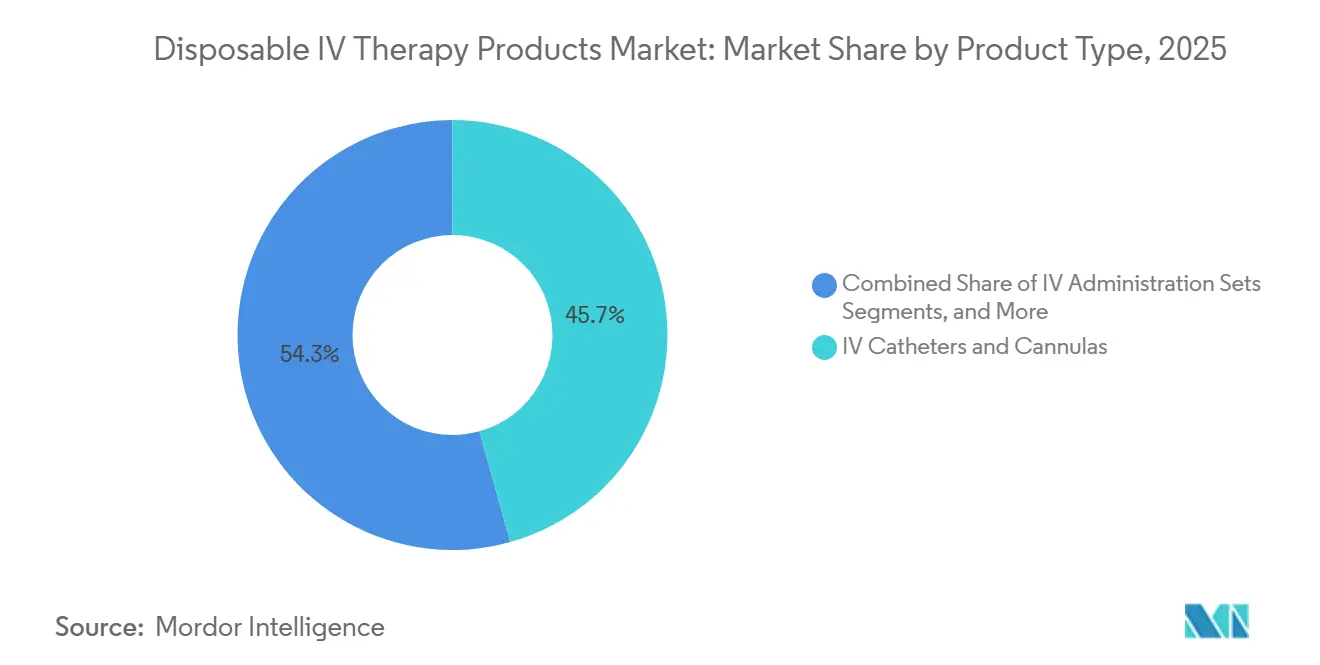
IV Catheters Lead, While Infusion Pumps Grow FasterIV catheters and cannulas accounted for 45.67% of the disposable IV therapy products market size in 2025, reflecting the widespread need for peripheral IV access in acute-care settings. In April 2026, BD launched the BD CentroVena One Insertion System following FDA 510(k) clearance and acceptance into the FDA Safer Technologies Program for Medical Devices. The system reduced insertion steps by 30% and simulation insertion time by 50%. BD also received FDA 510(k) clearance for its Insyte IV Catheter, supporting workflow efficiency and insertion safety.
Infusion pumps are forecast to grow at a 7.76% CAGR through 2031, the highest rate among product types. Pump replacement cycles drive recurring demand for compatible administration and extension sets, while needleless connectors and disinfection caps require frequent replacement. In 2025, B. Braun reported that 106 hospitals converted to its Introcan Safety catheter family and that it trained more than 31,000 clinicians. Specialty access sets, anti-siphon extension sets, and flow-regulation accessories are gaining relevance as home and ambulatory therapy protocols become more complex.

By Usability:
Single-Use Products Remain the Standard for Infection ControlDisposable and single-use products held 76.55% of revenue in 2025 and are forecast to grow at an 8.20% CAGR through 2031. This category remains the largest and fastest-growing usability segment as providers move away from reusable products in specialty applications and emerging markets. Infection prevention supports this shift by eliminating cleaning and reprocessing requirements. A 2025 peer-reviewed review highlighted catheter-related infection prevention and the clinical consequences of catheter-related complications.
On July 22, 2026, Nipro began domestic sales of its ORCHID IV line connector in Japan. The connector disconnects safely when tubing is exposed to excessive pulling force, reducing accidental extubation and skin damage in nursing settings with reduced use of physical restraints. Reusable products retain relevance in cost-constrained locations with adequate sterilization infrastructure. However, declining single-use product costs and the focus on consistent infection-control practices continue to strengthen demand for disposable products.
By Application:
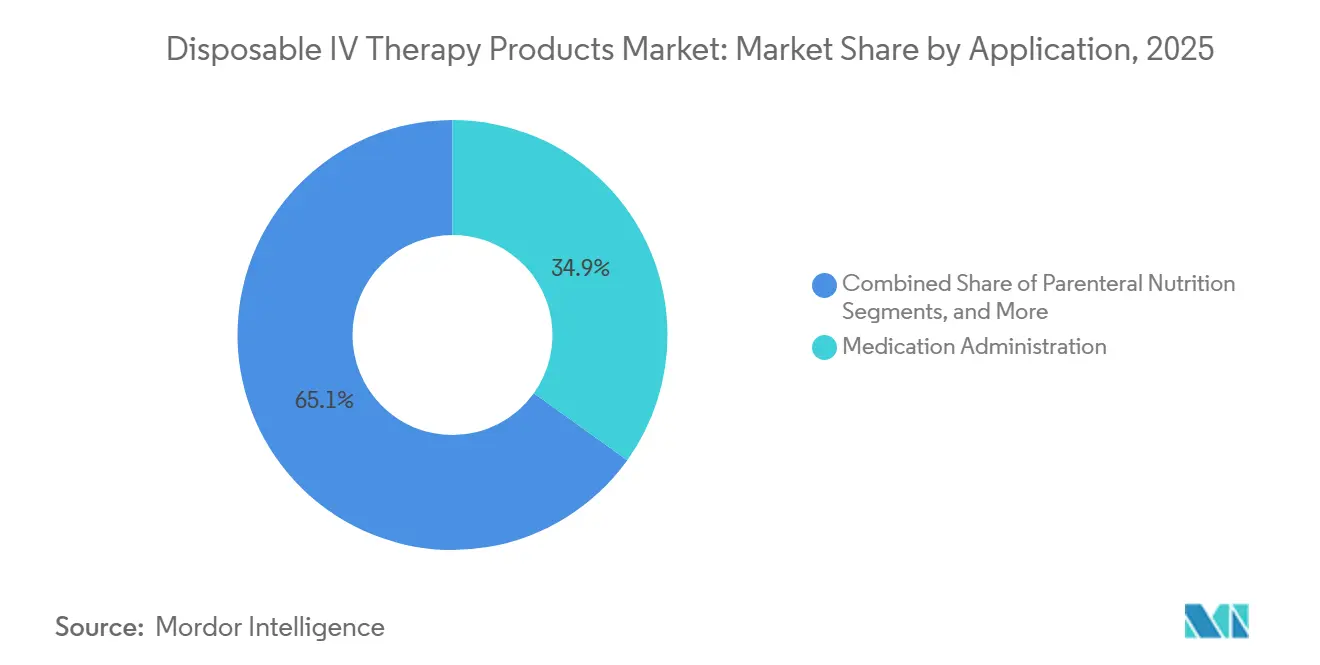
Medication Administration Leads, While Fluid Replacement Gains GroundMedication administration represented 34.89% of the disposable IV therapy products market size in 2025, supported by the IV delivery of antibiotics, analgesics, anticoagulants, chemotherapy, and biologics. This application creates sustained demand for administration sets, connectors, and catheters. In April 2025, ICU Medical received FDA 510(k) clearance for its Plum Solo and Plum Duo precision IV pumps. The pumps delivered ±3% accuracy under real-world conditions, including variations in temperature and pump placement.
Fluid replacement and hydration are forecast to grow at a 6.56% CAGR through 2031. Surgical care requires perioperative fluid management, sepsis protocols require rapid fluid resuscitation, and home hydration supports selected patients receiving chemotherapy or recovering from gastrointestinal illness. Parenteral nutrition remains a stable application because it requires specialized multi-lumen access and lipid-compatible sets. Chemotherapy, dialysis and renal care, pain management, and specialty infusion require distinct product specifications and clinical handling practices.
By End User:
Hospitals Hold Volume, While Ambulatory Surgical Centers Grow FasterHospitals held 55.67% of revenue in 2025 due to high inpatient volumes, broad IV applications, and centralized procurement systems. Baxter’s Infusion Therapies and Technologies division reported USD 1,745 million in revenue in the second quarter of 2026. The division includes IV solutions, drug compounding, and administration sets, highlighting the importance of the hospital channel. Specialty clinics and long-term care facilities also generate demand, particularly oncology clinics using protocol-specific chemotherapy sets.
Ambulatory surgical centers are forecast to grow at a 6.97% CAGR through 2031 as selected procedures shift from hospitals. Each procedure requires a new peripheral IV setup and may require arterial lines, central access, or specialized fluid sets. Home healthcare also supports demand for gravity sets, elastomeric pump sets, and portable-compatible catheters. In 2025, Fresenius Kabi introduced software upgrades for the Ivenix smart infusion platform covering cybersecurity, workflow optimization, and electronic medical record connectivity.
Geography Analysis
North America Disposable IV Therapy Products Market
North America held a 40.56% revenue share in 2025, supported by robust acute-care infrastructure, high procedure volumes, and established adoption of safety-oriented IV consumables. On January 14, 2026, Health Canada cleared ICU Medical’s Plum Solo and Plum Duo precision IV pumps, expanding access for Canadian healthcare organizations. The shift toward ambulatory and home-based care is increasing demand for specialized consumables with appropriate usability and pump compatibility.
Europe and APAC Disposable IV Therapy Products Market
Europe remained the second-largest regional market, led by Germany, the United Kingdom, and France. In September 2025, Fresenius Kabi secured a EUR 400 million loan from the European Investment Bank to expand medical product and biosimilar manufacturing capacity. The funding supported administration-set and infusion-system capacity, while the Medical Device Regulation and the DEHP sunset continued to reshape PVC-dependent portfolios. Asia-Pacific is forecast to grow at a 7.77% CAGR through 2031, supported by India’s AB PM-JAY program, which had authorized 11.69 crore admissions across 1,961 procedures by February 2026.
APAC, MEA, South America and Oceania Disposable IV Therapy Products Market
China strengthened standards for single-use gravity-feed infusion sets through T/CAMDI 154-2025, aligning with the GB 8368 framework and ISO 8536-4. BD launched its Nexiva Closed IV Catheter System in Indonesia in December 2025. The Middle East and Africa expanded from a lower base as GCC countries developed tertiary-care facilities, while South America remained divided between larger hospital markets in Brazil and Argentina and price-constrained markets elsewhere. In 2025, Baxter and the Australian Government announced a AUD 40 million joint investment, equivalent to USD 25.8 million, to expand IV fluid manufacturing in Old Toongabbie, Western Sydney.
Competitive Landscape
The global disposable IV therapy products market is moderately consolidated, with BD, Baxter International, B. Braun, Fresenius Kabi, ICU Medical, and Teleflex holding significant positions. Their strengths include integrated manufacturing, proprietary safety designs, and distribution relationships with large purchasing organizations. Teleflex secured a national central venous access agreement with Premier, Inc., effective July 1, 2026, covering Arrow antimicrobial catheters, arterial catheter systems, and intraosseous access solutions. Such agreements provide pre-negotiated pricing and streamline purchasing across acute care portfolios.
Leading suppliers use software and platform connectivity to reduce switching between systems. ICU Medical’s LifeShield™ safety software is intended to work across Plum Solo, Plum Duo, future Medfusion syringe pumps, and CADD pain-pump products, while BD uses connectivity in its Alaris system. Fresenius Kabi applies a similar approach with Ivenix in European and Latin American channels. Baxter launched IV Verify in March 2026 to automate IV line labeling through barcode-based label printing. Many mid-tier companies have limited offerings in automated labeling and closed-loop medication administration.
Asian suppliers, including Lepu Medical Technology, Zhejiang Kindly Medical Devices, WEGO Holding, and Poly Medicure, compete on price in tender markets across Asia-Pacific, the Middle East and Africa, and South America. Their gains are most visible in standard peripheral catheters and gravity administration sets, where product differentiation and clinical switching resistance are lower. BD’s CentroVena One acceptance into the FDA Safer Technologies Program supported positioning beyond price. CODAN, Vygon, and JMS retain specialist positions in oncology infusion sets, pediatric IV systems, and Japanese domestic distribution, respectively.
Disposable IV Therapy Products Industry Leaders
-
B. Braun Melsungen SE
-
Baxter International Inc.
-
Becton, Dickinson and Company
-
Fresenius SE & Co. KGaA
-
Terumo Corporation
- *Disclaimer: Major Players sorted in no particular order
Disposable IV Therapy Products Market Companies Covered in this Report
- AngioDynamics
- B. Braun Melsungen SE
- Baxter
- Beckton Dickinson
- Cardinal Health
- CODAN Medizinische Gerate GmbH
- Convatec
- Edward Lifesciences
- Fresenius
- ICU Medical
- JMS Co., Ltd.
- KORU Medical Systems, Inc.
- Lepu Medical Technology (Beijing) Co., Ltd.
- Merit Medical Systems
- Nipro
- Poly Medicure
- Smiths Group
- Teleflex
- Terumo
- Vygon
- WEGO Holding Company Limited
- Zhejiang Kindly Medical Devices Co., Ltd.
Recent Industry Developments in Disposable IV Therapy Products Market
- July 2026: Teleflex secured a national purchasing agreement with Premier Inc. for central venous access products, offering pre-negotiated pricing to U.S. acute-care facilities.
- July 2026: Nipro, in collaboration with Linear Health Sciences, launched the ORCHID IV line connector in Japan, expanding its patient-safety-focused IV connection portfolio.
- April 2026: BD launched the CentroVena One Insertion System in the United States, integrating key insertion components into a single platform to reduce procedural steps.
- March 2026: Baxter launched the IV Verify Line Labeling System in the United States, enabling barcode-based, color-coded IV labels to improve clinical workflow and compliance.
- January 2026: ICU Medical received Health Canada clearance for its Plum Solo and Plum Duo IV pumps and LifeShield infusion safety software, expanding its IV Performance Platform into Canada.
Global Disposable IV Therapy Products Market Report Scope
As per the scope of the report, disposable IV therapy products are sterile, single-use medical devices used to deliver liquids, medicines, or blood straight into a patient's vein. They are thrown away after one use to stop the spread of germs.
The Disposable IV Therapy Products Market is segmented by product type, usability, application, end user, and geography. By product type, the market includes IV catheters and cannulas, IV administration sets, extension sets and accessories, infusion pumps, needleless connectors and disinfection caps, and others. By usability, the market is segmented into disposable/single-use and reusable products. By application, the market is categorized into fluid replacement and hydration, medication administration, parenteral nutrition, blood and blood product administration, chemotherapy, antibiotic administration, pain management, dialysis and renal care, home and specialty infusion, and others. By end user, the market is segmented into hospitals, specialty clinics, ambulatory surgical centers, home healthcare, long-term care facilities, and other healthcare facilities. By geography, the market is analyzed across North America, Europe, Asia-Pacific, the Middle East and Africa, and South America. The report also covers estimated market sizes and trends for 17 countries across major regions globally. The report provides market sizes and forecasts in terms of value (USD) for the above segments.
| IV Catheters and Cannulas |
| IV Administration Sets |
| Extension Sets and Accessories |
| Infusion Pump |
| Needleless Connectors and Disinfection Caps |
| Others |
| Disposable/Single-use |
| Reusable |
| Fluid Replacement & Hydration |
| Medication Administration |
| Parenteral Nutrition |
| Blood & Blood Product Administration |
| Chemotherapy |
| Antibiotic Administration |
| Pain Management |
| Dialysis and Renal Care |
| Home and Specialty Infusion |
| Others |
| Hospitals |
| Specialty Clinics |
| Ambulatory Surgical Centers |
| Home Healthcare |
| Long-term Care Facilities |
| Other Healthcare Facilities |
| North America | United States |
| Canada | |
| Mexico | |
| Europe | Germany |
| United Kingdom | |
| France | |
| Italy | |
| Spain | |
| Rest of Europe | |
| Asia-Pacific | China |
| India | |
| Japan | |
| Australia | |
| South Korea | |
| Rest of Asia-Pacific | |
| Middle East and Africa | GCC |
| South Africa | |
| Rest of Middle East and Africa | |
| South America | Brazil |
| Argentina | |
| Rest of South America |
| By Product Type | IV Catheters and Cannulas | |
| IV Administration Sets | ||
| Extension Sets and Accessories | ||
| Infusion Pump | ||
| Needleless Connectors and Disinfection Caps | ||
| Others | ||
| By Usability | Disposable/Single-use | |
| Reusable | ||
| By Application | Fluid Replacement & Hydration | |
| Medication Administration | ||
| Parenteral Nutrition | ||
| Blood & Blood Product Administration | ||
| Chemotherapy | ||
| Antibiotic Administration | ||
| Pain Management | ||
| Dialysis and Renal Care | ||
| Home and Specialty Infusion | ||
| Others | ||
| By End User | Hospitals | |
| Specialty Clinics | ||
| Ambulatory Surgical Centers | ||
| Home Healthcare | ||
| Long-term Care Facilities | ||
| Other Healthcare Facilities | ||
| By Geography | North America | United States |
| Canada | ||
| Mexico | ||
| Europe | Germany | |
| United Kingdom | ||
| France | ||
| Italy | ||
| Spain | ||
| Rest of Europe | ||
| Asia-Pacific | China | |
| India | ||
| Japan | ||
| Australia | ||
| South Korea | ||
| Rest of Asia-Pacific | ||
| Middle East and Africa | GCC | |
| South Africa | ||
| Rest of Middle East and Africa | ||
| South America | Brazil | |
| Argentina | ||
| Rest of South America | ||
Key Questions Answered in the Report
What is the current size and projected growth of the Disposable IV Therapy Products Market?
The market is expected to grow from USD 22.55 billion in 2025 to USD 23.79 billion in 2026, and reach USD 31.09 billion by 2031, at a CAGR of 5.50% during 2026–2031.
Which product type holds the largest market share, and which is growing the fastest?
IV catheters and cannulas held the largest share at 45.67% in 2025. Infusion pumps are projected to grow at the highest CAGR of 7.76% through 2031.
How dominant are disposable and single-use products in the market?
Disposable and single-use products accounted for 76.55% of the market share in 2025 and are expected to grow at a strong CAGR of 8.20% through 2031.
Which application segment leads the market, and which is growing the fastest?
Medication administration was the largest application segment with a 34.89% share in 2025. Fluid replacement and hydration is projected to grow at a CAGR of 6.56% through 2031.
Which region dominate the market, and where is the fastest growth expected?
North America held the largest regional share at 40.56% in 2025. Asia-Pacific is expected to grow at the highest regional CAGR of 7.77% through 2031.