
Digital Orthodontics Market Size and Share
Market Overview
| Study Period | 2020 - 2031 |
|---|---|
| Market Size (2026) | USD 4.94 Billion |
| Market Size (2031) | USD 7.79 Billion |
| Growth Rate (2026 - 2031) | 9.53 % |
| Fastest Growing Market | Asia-Pacific |
| Largest Market | North America |
| Market Concentration | Medium |
Major Players *Disclaimer: Major Players sorted in no particular order Image © Mordor Intelligence. Reuse requires attribution under CC BY 4.0. | |
Digital Orthodontics Market Analysis by Mordor Intelligence
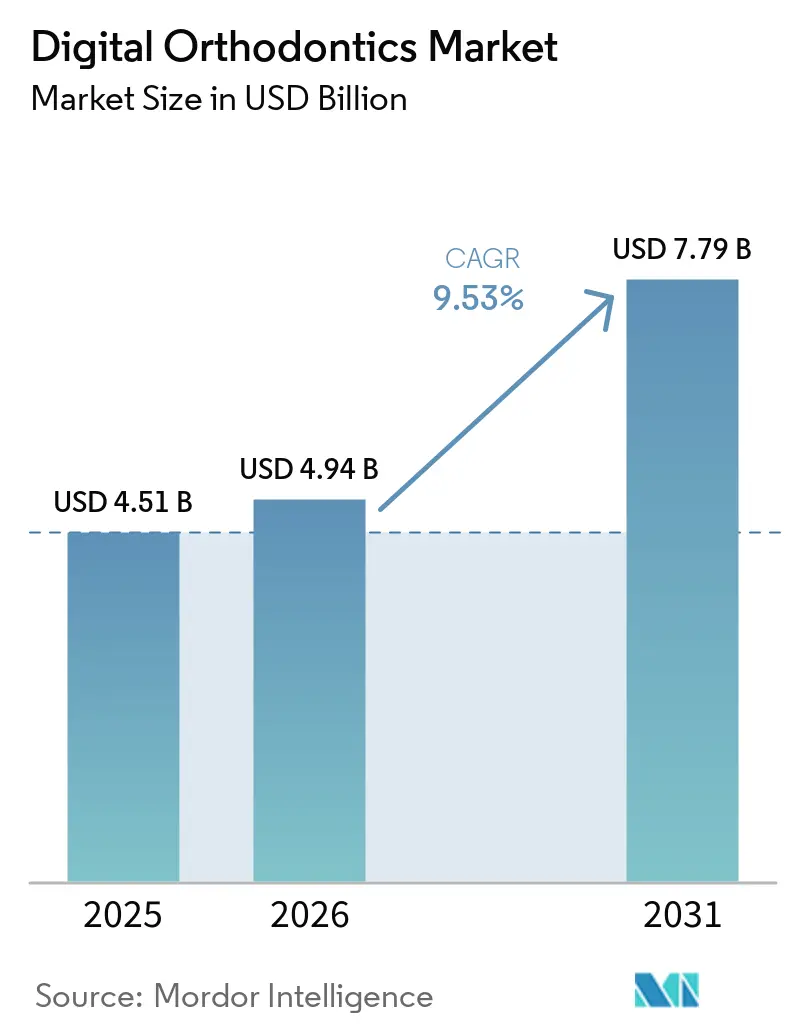
The Digital Orthodontics Market size was valued at USD 4.51 billion in 2025 and is estimated to grow from USD 4.94 billion in 2026 to reach USD 7.79 billion by 2031, at a CAGR of 9.53% during the forecast period (2026-2031).
The digital orthodontics market is moving from plaster models toward connected scan-to-manufacture workflows that reduce impression errors and shorten clinical timelines. Clear aligners, intraoral scanning, treatment-planning software, and direct printing are becoming more closely linked within the same clinical workflow. This shift gives multi-site dental groups a clearer path to standardize treatment steps across locations. Smaller clinics can access more digital tools, although capital requirements and training needs still shape the pace of adoption. Competition increasingly depends on how well vendors connect scanning, planning, diagnostics, appliance design, and monitoring rather than on scanner hardware alone.
Key Report Takeaways
- By product type, clear aligners held 49.88% of the digital orthodontics market share in 2025, while intraoral scanners are projected to grow at a CAGR of 10.55% through 2031.
- By technology, optical intraoral scanning accounted for 34.55% of the digital orthodontics market size in 2025, while CAD/CAM is projected to expand at a CAGR of 11.56% through 2031.
- By patient group, adults held 56.76% of revenue in 2025, while older adults are projected to grow at a CAGR of 11.74% through 2031.
- By end user, orthodontic clinics accounted for 53.24% of revenue in 2025, while dental service organizations are projected to grow at a CAGR of 11.34% through 2031.
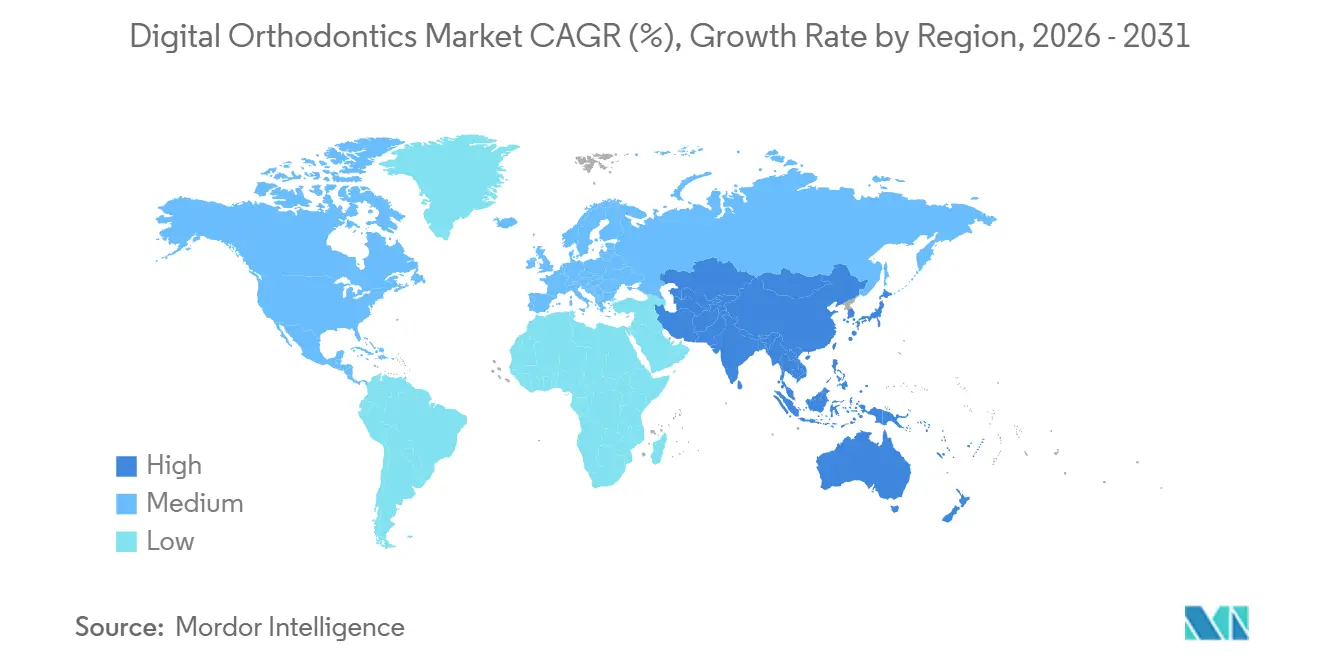
- By geography, North America held 39.56% of revenue in 2025, while Asia-Pacific is projected to grow at a CAGR of 12.98% through 2031.
Note: Market size and forecast figures in this report are generated using Mordor Intelligence’s proprietary estimation framework, updated with the latest available data and insights as of January 2026.
Market Trends and Insights
Drivers Impact Analysis of Digital Orthodontics Market*
| Driver | (~) % Impact on CAGR Forecast | Geographic Relevance | Impact Timeline |
|---|---|---|---|
| Clear aligner treatment adoption | +3.2% | Global, with the highest velocity in North America and East Asia | Medium term (2-4 years) |
| Intraoral scanner penetration | +2.1% | North America and Europe are at the core, with Asia-Pacific emerging | Short term (≤ 2 years) |
| Faster and more comfortable digital impressions | +1% | Global | Short term (≤ 2 years) |
| In-office and direct 3D-printed appliance production | +0.9% | North America, Europe, and the core Asia-Pacific markets | Medium term (2-4 years) |
| Reusable patient data across workflows | +0.6% | Global, with early gains in digitally mature markets | Long term (≥ 4 years) |
| AI-assisted detection and treatment simulation | +1.2% | Global, initially concentrated in North America and Europe | Medium term (2-4 years) |
| Source: Mordor Intelligence | |||
Growing Adoption of Clear Aligner Treatment
The digital orthodontics market expanded as clear aligner treatment reached broader patient groups. Align Technology shipped 935.8 thousand Invisalign cases for teens and growing children in 2025, up 7.8% from 2024, while adult case volume increased by 8% in the fourth quarter of 2025. More than 70% of UK orthodontists reported increased adult demand over the previous three years.[1] General dentists expanded access through orthodontist-supervised programs, and Align Technology reported 5.3% year-over-year growth in its GP-dentist channel during the fourth quarter of 2025. Remote monitoring, AI-supported treatment design, and subscription-based delivery reduced the infrastructure required to manage aligner cases.
Increasing Intraoral Scanner Penetration
The market benefited as intraoral scanners became standard practice infrastructure in developed countries. Global scanner adoption reached 35% in 2025, leaving substantial opportunities for expansion in emerging markets, while 3Shape documented 26.5 million patient scans and a 39% increase in scan case volume from 2024. Lower-priced Korean and Chinese scanners with open STL exports improved access to digital workflows while increasing competition in premium tiers.[2] Digital impressions reduced dependence on conventional methods, and reusable scan data supported diagnosis, treatment planning, monitoring, and subsequent treatment decisions.
Expansion of In-Office and Direct 3D-Printed Appliance Production
The market advanced as in-office additive manufacturing reduced the time between appliance design and delivery. LuxCreo and Graphy held FDA-cleared resins for directly printed clear aligners. At the same time, LuxCreo received Europe’s first MDR Class IIa CE certification for its 4D Aligner in March 2025, enabling same-day direct-print production. A 2026 Scientific Reports study found that directly printed shape-memory polymer aligners achieved a vertical control ratio of 1.19 and lower periodontal ligament stress than thermoformed alternatives.[3] Formlabs named Henry Schein as its preferred North American reseller for the Form 4B and Form 4BL dental printers in February 2025, supporting standardized workflows across dental service organization locations.
AI-Assisted Detection and Treatment Simulation in Routine Scans
AI became an integrated feature in scanning and treatment-planning workflows in the digital orthodontics market. A 2025 systematic review reported statistically higher accuracy for AI than manual methods in cephalometric landmark detection and tooth segmentation. DentalMonitoring reported 93.2% sensitivity and 86.2% specificity for aligner seating detection across 623 patients, helping high-volume practices reduce office visits while maintaining clinical oversight. Convolutional neural network models achieved 82% to 94% accuracy in predicting extraction protocols; however, clinician oversight remained essential.
Restraints Impact Analysis of Digital Orthodontics Market*
| Restraint | (~) % Impact on CAGR Forecast | Geographic Relevance | Impact Timeline |
|---|---|---|---|
| Cost of scanners, software, and 3D printing infrastructure | -1.1% | Emerging markets and solo practices in mid-tier cities globally | Medium term (2-4 years) |
| Training needs and uneven digital competence | -0.6% | Global, with greater pressure in South and Southeast Asia and Sub-Saharan Africa | Long term (≥ 4 years) |
| Limited predictability for complex tooth movement | -0.4% | Global | Medium term (2-4 years) |
| Material validation, data governance, and interoperability risks | -0.5% | Europe and North America, where compliance needs are intensive | Long term (≥ 4 years) |
| Source: Mordor Intelligence | |||
High Initial Cost of Scanners, Software and 3D Printing Infrastructure
The digital orthodontics market faces an adoption barrier due to the high initial cost of a complete digital workflow. A scanner, treatment-planning software license, in-office 3D printer, and validated materials require an upfront investment of USD 30,000 to USD 50,000, particularly affecting single-doctor practices in secondary cities across South Asia, Southeast Asia, and Latin America. Regulatory compliance with the EU Medical Device Regulation or the FDA 510(k) process further increases costs. Modular adoption models allow clinics to begin with scanning and cloud-based planning before investing in in-office printing.
Training Requirements and Uneven Digital Competence
The market depends on practitioners’ ability to use scanners, treatment-planning software, and appliance-design tools effectively. In China, orthodontic specialists are concentrated in Beijing, Shanghai, Guangzhou, and Shenzhen, limiting access in central and western regions despite hardware availability. Nearly half of respondents in the AAO’s 2025 survey expected to change their practice model within five years. Ongoing training, guided scanning, AI-supported workflow prompts, and teleconsultation modules can reduce the learning curve and support treatment consistency across multi-site networks.
*Our forecasts treat driver/restraint impacts as directional, not additive. The impact forecasts reflect baseline growth, mix effects, and variable interactions.
Digital Orthodontics Market Segment Analysis
By Product Type:
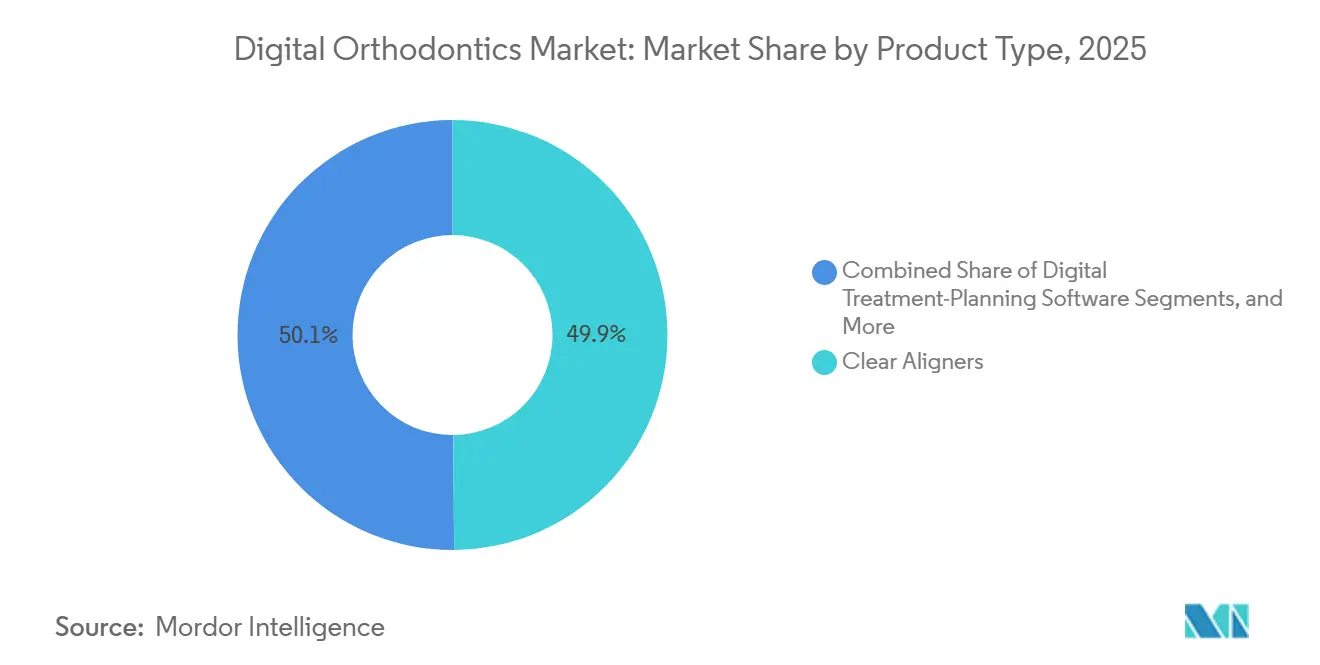
Clear Aligners Anchor Revenue as Scanner Growth AcceleratesClear aligners held 49.88% of product-type revenue in 2025, making them the leading category in the Digital orthodontics market. Align Technology reported USD 3.245 billion in clear aligner net revenue, supported by a record 2.611 million Invisalign case shipments and more than 22 million lifetime patients. Integrated platforms linking scanning, treatment planning, and appliance delivery continue to strengthen the segment’s position.
Intraoral scanners are forecast to be the fastest-growing product subsegment, at a CAGR of 10.55% through 2031. Medit, 3Shape, and Dentsply Sirona introduced or upgraded scanner models at IDS 2025, enhancing installed-base capabilities. Digital treatment-planning software, CAD/CAM appliances, and manufacturing systems provide additional revenue streams. FDA-cleared direct-print aligner resins from LuxCreo and Graphy support 3D printer demand, while LuxCreo’s October 2025 partnership with Angelalign Technology combined material development with clinical scale and data.

By Technology:
Optical Intraoral Scanning Leads While CAD/CAM Rapidly ExpandsOptical intraoral scanning captured 34.55% of technology revenue in 2025, establishing it as the leading data-capture layer in the Digital orthodontics market. 3Shape introduced TRIOS 6 at IDS 2025 with up to 110% higher scan resolution than earlier TRIOS models and integrated hyperspectral imaging. Medit launched the i900 Classic with greater scan depth and improved speed and accuracy, while Dentsply Sirona reported 50% lower bandwidth use and a 90% improvement in SureSmile simulation speed for Primescan 2.
CAD/CAM is forecast to be the fastest-growing technology subsegment, at a CAGR of 11.56% through 2031. In-office milling, cloud-based design platforms, and direct-print system integration support this growth. Cone-beam computed tomography, 3D facial scanning, and AI-supported landmark detection reduce manual interpretation requirements. In February 2026, 3Shape enabled full hyperspectral imaging for eligible TRIOS 6 scanners in the EU and EEA, including AI-assisted visualization of caries, wear, gingival recession, and plaque.
By Patient Group:
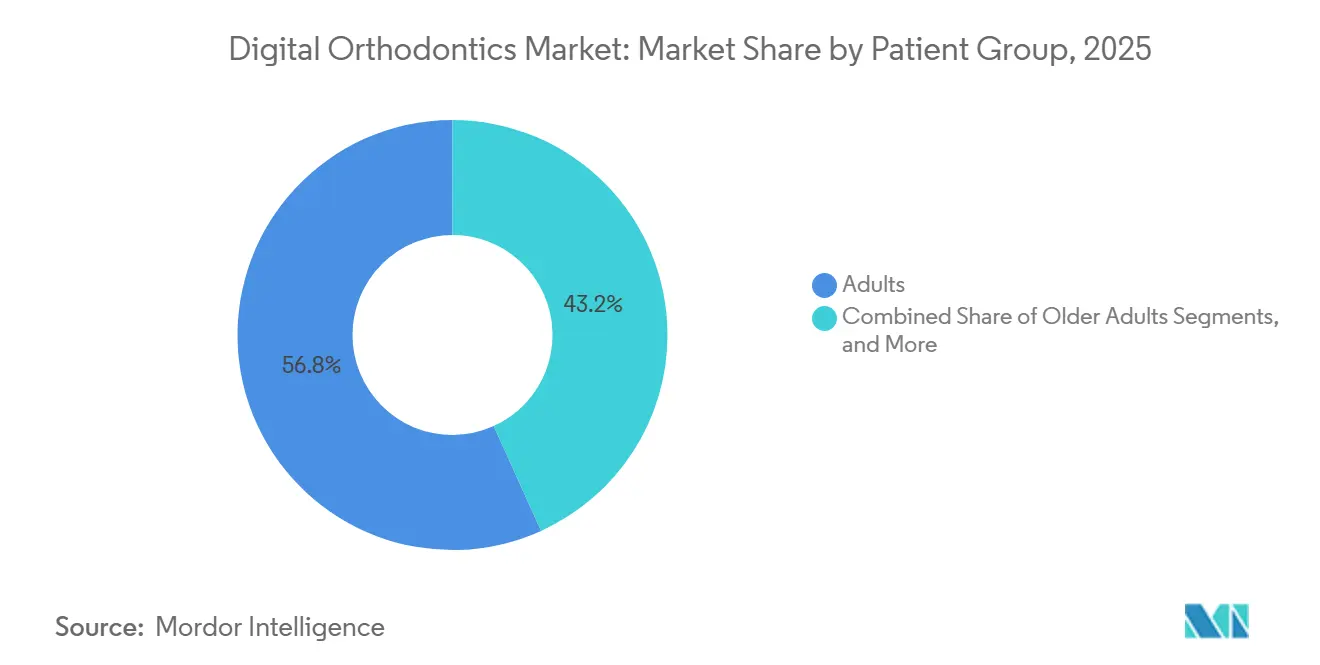
Adults Dominate While Older Adults Represent the Fastest Structural ShiftAdults held 56.76% of revenue in 2025, driven by demand for discreet and removable appliances. The AAO estimated that 1.9 million adults were in active orthodontic treatment in the United States during 2024. Aesthetic concerns remained the primary treatment driver, while scan-based planning and remote review improved case management. Adult demand also supported investment in aligner design and monitoring capabilities.
Older adults are forecast to grow faster than other patient groups, at a CAGR of 11.74% through 2031. This cohort may experience secondary crowding from periodontal bone loss, spacing after tooth loss, and requirements related to restorative procedures. A European cross-national study identified adults aged 56 and older as the smallest but fastest-emerging group seeking clear aligner care. Ormco launched Spark Junior in September 2025 for younger patients, beginning with Phase One mandibular advancement.
By End User:
Orthodontic Clinics Lead as DSOs Redefine Practice Scale EconomicsOrthodontic clinics held 53.24% of end-user revenue in 2025, reflecting their role in managing complex cases and integrated clinical workflows. Dental service organizations are forecast to be the fastest-growing end-user segment, at a CAGR of 11.34% through 2031. Smile Doctors had more than 580 locations across 36 states at the end of 2025, after adding more than 100 locations through affiliations and acquisitions. These organizations support standardized workflows across expanding clinic networks.
General dental clinics are expanding orthodontic services through clear aligner programs supported by orthodontist clinical oversight. Dental laboratories increasingly process digital scan files and offer direct-print aligner services. Direct-to-consumer platforms face consolidation as hybrid models using scans conducted by licensed clinicians replace fully remote approaches. Regulatory and treatment-outcome concerns have restricted models without an in-person clinical component, increasing the importance of interoperability and clinical governance in the Digital orthodontics industry.
Geography Analysis
North America Digital Orthodontics Market
North America held 39.56% of revenue in 2025, supported by mature orthodontic demand and a well-developed dental service organization network. The AAO reported 696 active patients per member in 2024, the highest patient census in its survey history. Canada maintained stable specialist demand, while Mexico advanced through greater private-pay access and urban awareness of clear aligners. The Digital orthodontics market in the United States remained competitive, as Align Technology guided for mid-single-digit clear aligner volume growth in 2026. Ormco expanded Digital Bonding to additional bracket systems at the AAO Annual Session in May 2026.
Europe and South America Digital Orthodontics Market
Europe continued to provide consistent demand, with Germany, the United Kingdom, France, and Italy serving as key markets for premium scanners and planning systems. The EU Medical Device Regulation raised entry requirements for digital device suppliers while reinforcing safety and interoperability standards. LuxCreo’s 4D Aligner received MDR Class IIa CE certification in March 2025, marking a direct-print aligner milestone in Europe. DentalMonitoring secured USD 100 million in February 2026 to support expansion and AI product development. Southern Europe adopted digital workflows more slowly due to lower dental spending and fragmented private practices, while Brazil supported South American demand as private dental access expanded.
APAC and MEA Digital Orthodontics Market
Asia-Pacific was forecast to be the fastest-growing geography, with a CAGR of 12.98% through 2031. China combined high malocclusion prevalence, low treatment penetration, and a concentration of specialists in first-tier coastal cities, supporting remote models that extended specialist reach. The Digital orthodontics market also benefited from South Korean innovation in scanning and direct-print materials. Medit began shipping its i900 Mobility scanner in September 2025 with the iPad-native Medit Link Express application. India’s infrastructure expanded into tier-2 and tier-3 cities, while the Middle East and Africa attracted private investment in hospitals and dental clinics, particularly in the GCC.
Competitive Landscape
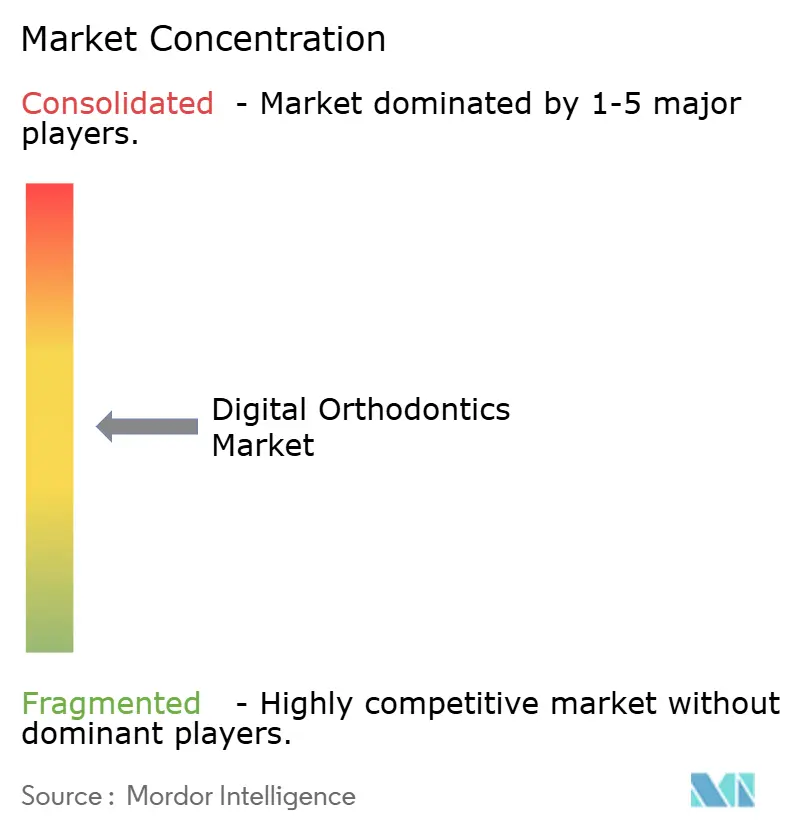
The digital orthodontics market is moderately concentrated at the ecosystem level, with leading suppliers integrating scanner hardware, CAD/CAM design, treatment planning, and aligner manufacturing. Align Technology, 3Shape, Dentsply Sirona, Medit, and Institut Straumann are leading ecosystem participants. Align Technology stated that iTero Lumina represented 86% of full-system scanner units shipped in the fourth quarter of 2025. Medit and Shining 3D offer open STL exports, enabling practices to separate scanning from planning and manufacturing. The Digital orthodontics market is shaped by the choice between proprietary platform integration and open workflow flexibility.
Remote monitoring has emerged as a distinct competitive category alongside hardware and treatment planning. DentalMonitoring secured USD 100 million in February 2026 after achieving operational profitability in 2025 and serving more than 2 million monitored patients. LuxCreo received an investment from Angelalign Technology in October 2025 to develop 3D-printing materials for clear aligner treatment. In February 2026, 3Shape expanded its clinical offering by activating hyperspectral imaging and AI-supported oral-condition visualization for TRIOS 6 in the EU and EEA. These developments highlight competition in connected data, materials, monitoring, and clinical software beyond hardware.
Opportunities remain for scanner configurations priced below USD 15,000 for practices in emerging markets and diagnostic tools compatible across scanner brands. Older-adult cases require consistent management of crowns, implants, bone loss, and restorative complexity. Direct-print specialists target aligner production costs of USD 12 to USD 16 per case through in-office manufacturing. The Digital orthodontics market has also seen increased patent activity in AI tooth segmentation, 4D simulation, and shape-memory resins. Published AI benchmarks can favor platforms that demonstrate reliable performance and support clinical protocol standardization.
Digital Orthodontics Industry Leaders
-
Align Technology, Inc.
-
DENTSPLY SIRONA Inc.
-
Institut Straumann AG
-
Carestream Dental LLC
-
Envista Holdings Corporation
- *Disclaimer: Major Players sorted in no particular order
Digital Orthodontics Market Companies Covered in this Report
- 3 Shape
- Align Technology
- Carbon, Inc.
- Carestream Dental
- ClearCorrect AG
- DentalMonitoring SAS
- Dentsply Sirona
- Desktop Metal
- Envista
- Formlabs Inc.
- Graphy Inc.
- Straumann Group
- Ivoclar Vivadent
- LuxCreo, Inc.
- Medit Corp.
- Ormco Corporation
- Planmeca
- Shofu Inc.
- Solventum Corporation
- uLab Systems Inc.
Recent Industry Developments in Digital Orthodontics Market
- May 2026: Ormco expanded its Digital Bonding platform to support Damon Clear, Mini Diamond, Orthos, Titanium Orthos, and Mini-Twin bracket systems, extending digitally planned indirect bonding workflows across most of its bracket portfolio.
- February 2026: DentalMonitoring secured USD 100 million in funding, led by Lazard Elaia Capital and ISALT, to expand in Brazil, Turkey, Southeast Asia, and the Middle East and advance AI product development.
- February 2026: 3Shape activated the full hyperspectral imaging package for eligible TRIOS 6 scanners in the European Union, enabling AI-assisted detection of multiple oral conditions through a single intraoral scan.
- October 2025: LuxCreo received a strategic investment from Angelalign Technology to co-develop 3D printing materials for clear aligner therapy and expand its materials research ecosystem in the Asia-Pacific.
- September 2025: Medit began shipping the i900 Mobility intraoral scanner with its iPad-native Medit Link Express application, eliminating the need for cart-mounted hardware.
Global Digital Orthodontics Market Report Scope
As per the scope of the report, digital orthodontics uses advanced computer technology, 3D scanning, and virtual simulation software to diagnose, plan, and treat misaligned teeth and jaws. It replaces messy physical molds and guesswork with precise digital workflows for custom clear aligners and braces.
The digital orthodontics market is segmented by product type, technology, patient group, end user, and geography. By product type, the market includes intraoral scanners, clear aligners, digital treatment planning software, CAD/CAM orthodontic appliances, 3D printers and manufacturing systems, orthodontic materials and resins, and others. By technology, the market is segmented into optical intraoral scanning, cone beam computed tomography, 3D facial scanning and stereophotogrammetry, CAD/CAM, additive manufacturing, subtractive manufacturing, artificial intelligence and machine learning, and others. By patient group, the market is categorized into pediatric patients, adult patients, and older adult patients. By end user, the market is segmented into orthodontic clinics, general dental clinics, dental service organizations, dental laboratories, hospitals, academic institutions, and direct-to-consumer platforms. By geography, the market is analyzed across North America, Europe, Asia-Pacific, the Middle East and Africa, and South America. The report also covers the estimated market sizes and trends for 17 countries across major regions globally. The report offers market sizes and forecasts in terms of value (USD) for the above segments.
| Intraoral Scanners |
| Clear Aligners |
| Digital Treatment-Planning Software |
| CAD/CAM Orthodontic Appliances |
| 3D Printers and Manufacturing Systems |
| Orthodontic Materials and Resins |
| Others |
| Optical Intraoral Scanning |
| Cone-Beam Computed Tomography |
| 3D Facial Scanning and Stereophotogrammetry |
| CAD/CAM |
| Additive Manufacturing |
| Subtractive Manufacturing |
| Artificial Intelligence and Machine Learning |
| Others |
| Pediatrics |
| Adults |
| Older Adults |
| Orthodontic Clinics |
| General Dental Clinics |
| Dental Service Organizations |
| Dental Laboratories |
| Hospitals and Academic Institutions |
| Others |
| North America | United States |
| Canada | |
| Mexico | |
| Europe | Germany |
| United Kingdom | |
| France | |
| Italy | |
| Spain | |
| Rest of Europe | |
| Asia-Pacific | China |
| India | |
| Japan | |
| Australia | |
| South Korea | |
| Rest of Asia-Pacific | |
| Middle East and Africa | GCC |
| South Africa | |
| Rest of Middle East and Africa | |
| South America | Brazil |
| Argentina | |
| Rest of South America |
| By Product Type | Intraoral Scanners | |
| Clear Aligners | ||
| Digital Treatment-Planning Software | ||
| CAD/CAM Orthodontic Appliances | ||
| 3D Printers and Manufacturing Systems | ||
| Orthodontic Materials and Resins | ||
| Others | ||
| By Technology | Optical Intraoral Scanning | |
| Cone-Beam Computed Tomography | ||
| 3D Facial Scanning and Stereophotogrammetry | ||
| CAD/CAM | ||
| Additive Manufacturing | ||
| Subtractive Manufacturing | ||
| Artificial Intelligence and Machine Learning | ||
| Others | ||
| By Patient Group | Pediatrics | |
| Adults | ||
| Older Adults | ||
| By End User | Orthodontic Clinics | |
| General Dental Clinics | ||
| Dental Service Organizations | ||
| Dental Laboratories | ||
| Hospitals and Academic Institutions | ||
| Others | ||
| By Geography | North America | United States |
| Canada | ||
| Mexico | ||
| Europe | Germany | |
| United Kingdom | ||
| France | ||
| Italy | ||
| Spain | ||
| Rest of Europe | ||
| Asia-Pacific | China | |
| India | ||
| Japan | ||
| Australia | ||
| South Korea | ||
| Rest of Asia-Pacific | ||
| Middle East and Africa | GCC | |
| South Africa | ||
| Rest of Middle East and Africa | ||
| South America | Brazil | |
| Argentina | ||
| Rest of South America | ||
Key Questions Answered in the Report
What is the forecast for digital orthodontics through 2031?
The market is projected to grow from USD 4.94 billion in 2026 to USD 7.79 billion by 2031 at a CAGR of 9.53%.
Which product category led digital orthodontics in 2025?
Clear aligners led product revenue with a 49.88% share in 2025.
Which technology is growing fastest in digital orthodontics?
CAD/CAM is projected to grow at a CAGR of 11.56% through 2031, supported by cloud design, milling, and direct-print integration.
Why are dental service organizations important to digital orthodontics?
They are the fastest-growing end-user group at a CAGR of 11.34% through 2031 and can standardize purchasing, training, and production across clinics.
Which region will grow fastest through 2031?
Asia-Pacific is forecast to grow at a CAGR of 12.98%, supported by demand in China, India, and South Korea.
What limits wider adoption of digital orthodontic workflows?
A full workflow can require USD 30,000 to USD 50,000 in upfront spending, while training needs and uneven digital capability can slow adoption.