
Market Overview
| Study Period | 2020 - 2031 |
|---|---|
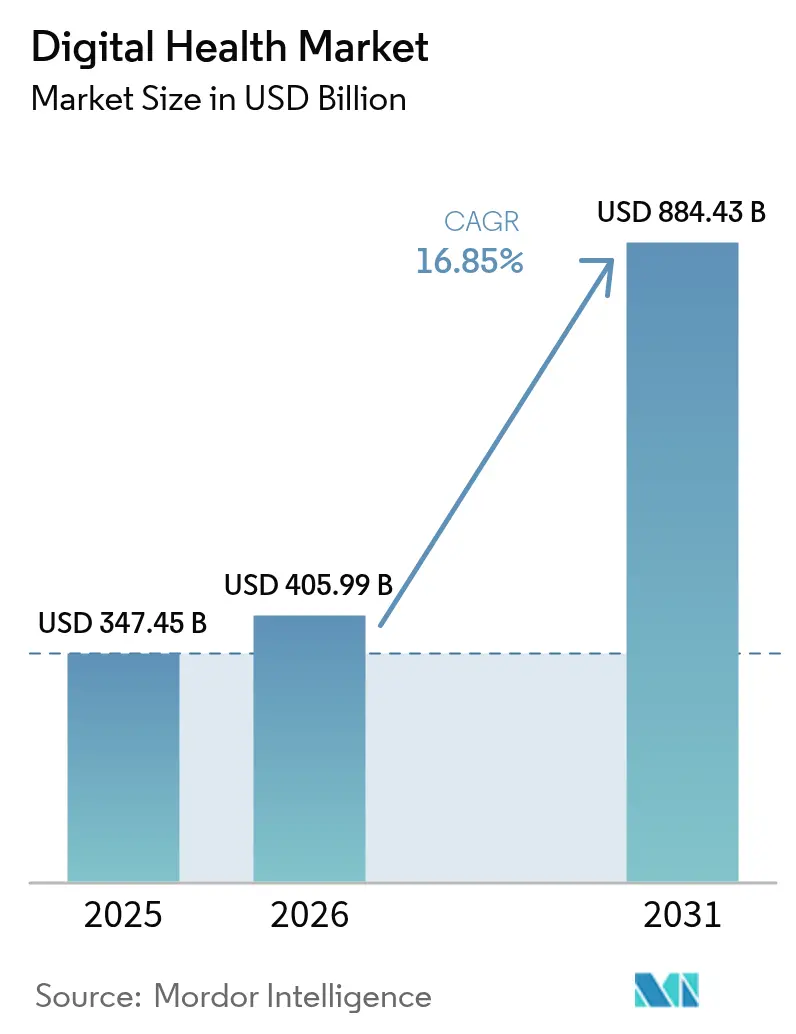
| Market Size (2026) | USD 405.99 Billion |
| Market Size (2031) | USD 884.43 Billion |
| Growth Rate (2026 - 2031) | 16.85 % |
| Fastest Growing Market | Asia-Pacific |
| Largest Market | North America |
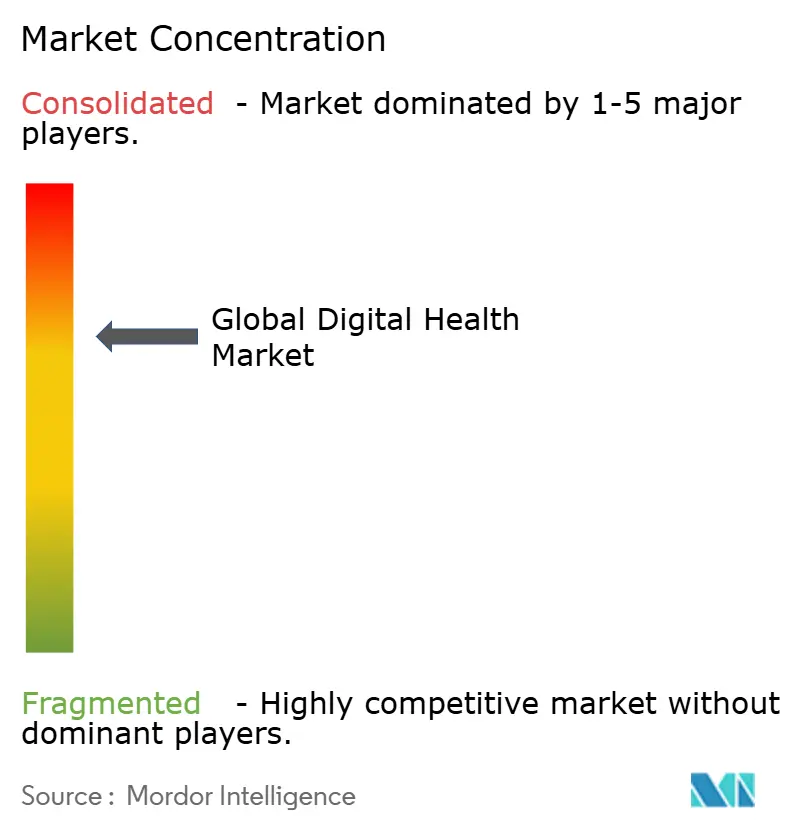
| Market Concentration | Medium |
Major Players *Disclaimer: Major Players sorted in no particular order Image © Mordor Intelligence. Reuse requires attribution under CC BY 4.0. | |
Digital Health Market Analysis by Mordor Intelligence
The Digital Health market size is expected to grow from USD 347.45 billion in 2025 to USD 405.99 billion in 2026 and is forecast to reach USD 884.43 billion by 2031 at 16.85% CAGR over 2026-2031.
Momentum reflects a global pivot from episodic treatment toward continuous, data-driven care supported by artificial intelligence, Internet-of-Things sensors, and advanced analytics. Regulatory agencies are keeping pace: the United States Food and Drug Administration has already given Breakthrough Device designation to 1,041 solutions and cleared 128 of them for commercial use, opening more pathways for evidence-backed digital therapeutics FDA. Wider telehealth reimbursement, national digital health strategies, and demand for remote monitoring from aging populations add further lift. At the same time, the sector remains fragmented because providers, payers, pharmaceutical firms, and big-tech entrants prefer partnership models over outright M&A, resulting in an ecosystem rich in alliances rather than consolidation. Cybersecurity threats and data-sharing barriers temper expansion but have not derailed investment, as vendors continue to embed end-to-end encryption, adopt FHIR standards, and certify cloud environments to win stakeholder trust.
Key Report Takeaways
- By technology, telehealth led with 46.78% revenue share in 2025, while mHealth applications are projected to compound at 17.62% through 2031.
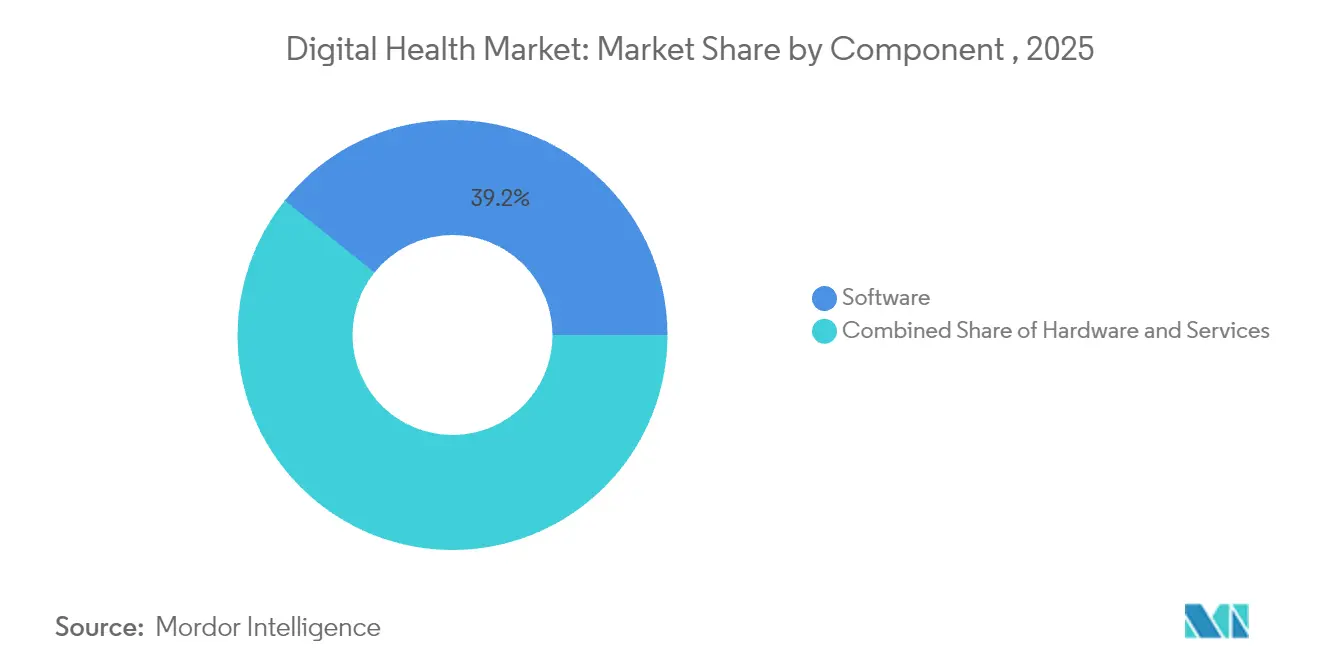
- By component, services held 38.62% of digital health market share in 2025; software is expected to advance at an 17.74% CAGR to 2031.
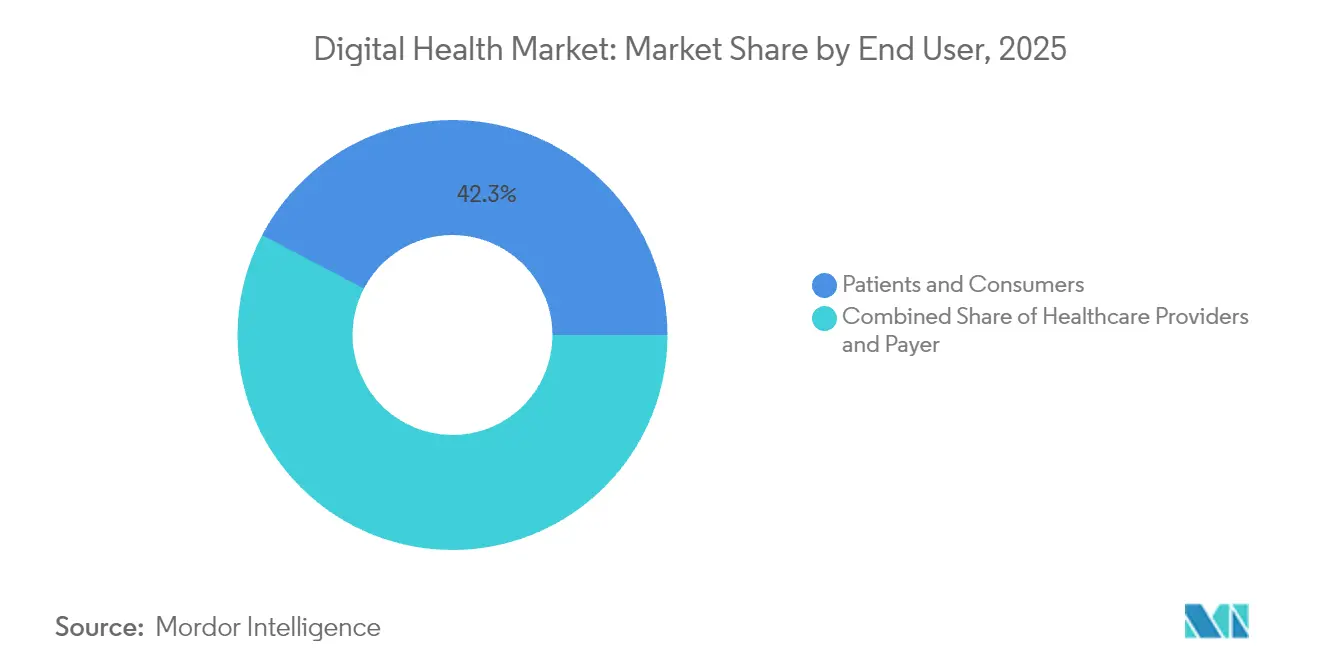
- By end user, patients & consumers commanded 42.31% of digital health market size in 2025, whereas the payer segment is set to grow 17.35% annually through 2031.
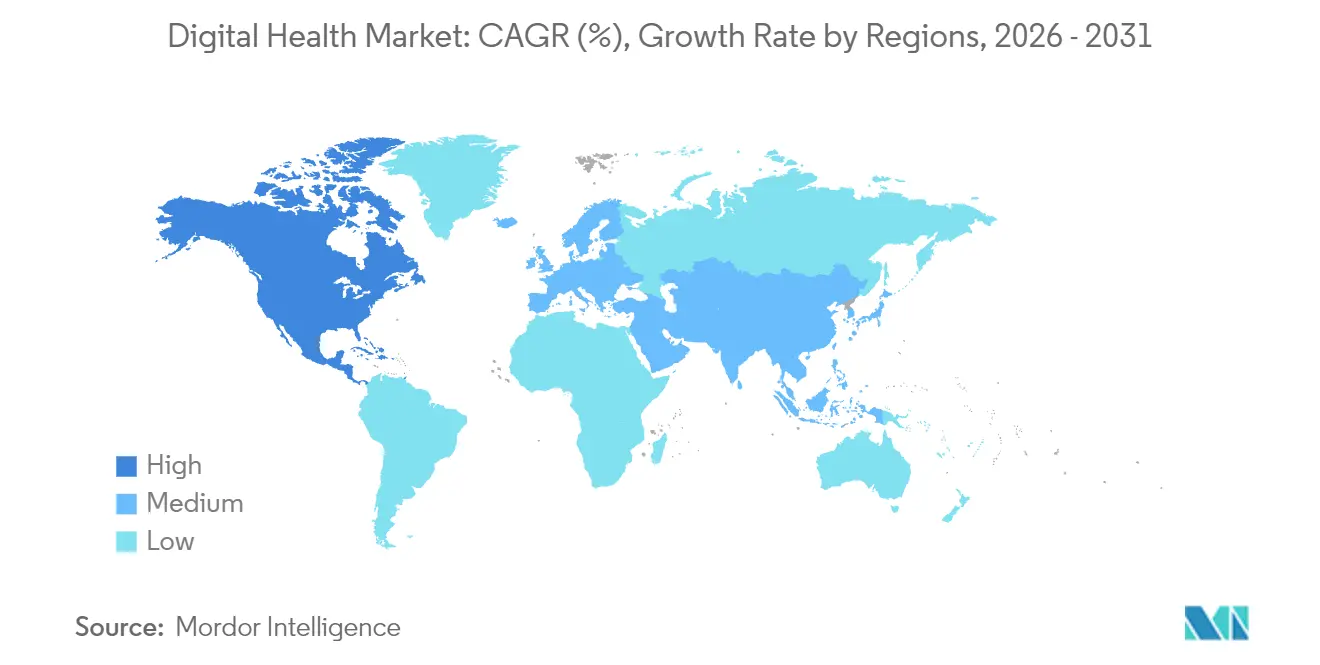
- By geography, North America captured 43.21% of digital health market share in 2025; Asia-Pacific is on track for an 18.02% CAGR between 2026 and 2031.
Note: Market size and forecast figures in this report are generated using Mordor Intelligence’s proprietary estimation framework, updated with the latest available data and insights as of 2026.
Market Trends and Insights
Drivers Impact Analysis of Digital Health Market*
| Driver | (~) % Impact on CAGR Forecast | Geographic Relevance | Impact Timeline |
|---|---|---|---|
| Increasing adoption of digital healthcare | +4.2% | Global | Medium term (2-4 years) |
| Rise in AI, IoT & Big Data integration | +3.8% | North America & EU, APAC core | Short term (≤ 2 years) |
| Growing mHealth penetration & smartphone usage | +3.1% | APAC core, spill-over to MEA | Medium term (2-4 years) |
| Expansion of telehealth for aging & rural populations | +2.7% | Global, with early gains in North America, Europe | Long term (≥ 4 years) |
| Regulatory sandboxes accelerating digital therapeutics approval | +1.9% | North America & EU | Short term (≤ 2 years) |
| Generative-AI clinician copilots boosting productivity | +1.5% | Global | Short term (≤ 2 years) |
| Source: Mordor Intelligence | |||
Increasing adoption of digital healthcare
Health systems are moving from reactive service delivery to preventive, always-on care models that embed remote monitoring, electronic health records, and AI-assisted diagnostics in routine practice. Pandemic-era urgency jump-started investment, but budgets have held steady because chief executives now treat digital infrastructure as essential rather than optional. Network effects surface when more institutions connect to shared data platforms, raising the utility of each additional node. This virtuous cycle encourages hospitals to procure interoperable solutions and nudges clinicians to incorporate patient-generated data into care plans, tightening the feedback loop between in-person and virtual services. As the digital health market expands, direct-to-consumer wellness apps further normalize digital interactions, creating a foundation of patient familiarity that spills over into formal medical settings.
Rise in AI, IoT & big-data integration
Artificial intelligence now underpins core hospital operations such as imaging triage, medical coding, and virtual scribing. High-fidelity IoT sensors feed continuous data streams into cloud analytics engines capable of forecasting acute events hours before they manifest at the bedside. Vendor road maps highlight synthetic-data generation, autopilot quality assurance, and multimodal reasoning, signalling a future where ambient intelligence follows patients across settings. Administrative leaders accept short-run implementation costs because returns show up in productivity gains, fewer claim denials, and lower readmission penalties. As datasets scale, predictive algorithms grow more accurate, creating a self-reinforcing improvement loop that widens the performance gap between digital leaders and laggards.
Growing mHealth penetration & smartphone usage
Asia-Pacific’s smartphone penetration passed 51% in 2024 and keeps climbing, turning the handset into the primary access node for health services [1]. Rural users adopt menstruation tracking, diabetes coaching, and mental-wellness apps that fill gaps left by clinician shortages. Personalization engines adjust content and dosing reminders based on real-time behavior, lifting adherence and generating richer datasets for research. Younger demographics treat mobile channels as the default entry point, so insurers and providers follow suit, integrating claims, teleconsultations, and pharmacy delivery into unified super-apps. Payment reforms that reimburse app-based interventions further accelerate diffusion, especially across India, Indonesia, and Vietnam.
Expansion of telehealth for aging & rural populations
Demographic aging amplifies demand for low-cost, continuum-of-care models. Virtual visits and remote patient monitoring help older adults avoid specialist travel and prolonged hospital stays. Veterans’ health networks and public payers report drops in unscheduled emergency visits after scaling tele-geriatrics programs. Rural broadband initiatives shrink bandwidth constraints, and user-interface redesigns address age-related cognitive or vision limitations. Family care-giver portals invite daughters, sons, and spouses into the care loop, boosting virtual-consult follow-through and medication adherence. Over time, accumulated engagement data supports risk-stratification programs that tailor outreach intensity, improving resource allocation for overstretched primary-care teams. These developments reinforce the central role of telehealth in the digital health market, especially in regions facing clinician shortages.
Restraints Impact Analysis of Digital Health Market*
| Restraint | (~) % Impact on CAGR Forecast | Geographic Relevance | Impact Timeline |
|---|---|---|---|
| Cybersecurity & privacy concerns | -2.1% | Global | Short term (≤ 2 years) |
| Interoperability & data-silo challenges | -1.8% | Global, with acute impact in North America & EU | Medium term (2-4 years) |
| Algorithmic bias & clinician trust deficit | -1.3% | Global | Medium term (2-4 years) |
| Digital divide limiting rural & elderly access | -0.9% | Global, with concentrated impact in emerging markets | Long term (≥ 4 years) |
| Source: Mordor Intelligence | |||
Cybersecurity & privacy concerns
Ransomware attacks on hospital networks expose sensitive patient files and erode public trust just as virtual care volumes hit new highs. Regulatory penalties under HIPAA and GDPR inflate breach-response costs, nudging boards to prioritize security spending even when margins tighten. Implementation teams juggle the trade-off between bullet-proof encryption and clinician usability, because stricter log-in protocols can slow workflows. Insurers now request cyber-readiness certifications before underwriting liability policies, making resilience a market requirement rather than a differentiator. Vendors who can guarantee rapid threat detection and zero-trust architectures gain an edge in procurement cycles, underscoring how cybersecurity readiness is becoming a foundational expectation across the digital health market.
Interoperability & data-silo challenges
Competing electronic health-record vendors and legacy departmental systems still trap critical data behind proprietary interfaces, undermining the promise of seamless, longitudinal patient views. Although regulators mandate FHIR-compliant data exchange, integration gaps persist because hospitals lack skilled staff, and incentives to share remain weak. Middleware platforms grow in popularity, yet they add subscription costs that smaller clinics struggle to absorb. Health-information exchanges pilot shared governance models, but uptake varies by state and region. Until payer, provider, and pharmacy datasets flow freely, clinical decision support will rely on incomplete inputs, limiting the full value of advanced analytics.
*Our forecasts treat driver/restraint impacts as directional, not additive. The impact forecasts reflect baseline growth, mix effects, and variable interactions.
Digital Health Market Segment Analysis
By Component:
Services Strengthen While Software AcceleratesServices accounted for 38.62% of digital health market revenue in 2025 as health-system executives relied on external partners to deploy complex solutions and manage regulatory compliance. Engagements often bundle implementation, change-management, and cybersecurity, helping organizations launch tele-ICU programs or chronic-disease apps without overloading internal IT teams. Demand stays robust in markets where shortages of specialized data engineers and informaticians slow do-it-yourself rollouts. Yet the spotlight is shifting to software, which registers the fastest 17.74% CAGR to 2031. Cloud-native platforms that automate charting, surface care-gap alerts, and synthesize multimodal data scale faster than hardware-centric models, letting mid-size hospitals compete with academic centers.
The shift favors subscription pricing and continuous feature releases instead of large, one-time license deals. Vendors emphasize modular APIs that plug into existing systems, reducing rip-and-replace anxiety. As algorithms mature, user experience improves, shortening clinician onboarding curves. These benefits translate into higher renewal rates and rising average revenue per user, reinforcing the software growth arc and signaling a long-term structural shift in the digital health market.

By Technology:
Telehealth Dominance Meets mHealth MomentumTelehealth represented 46.78% of 2025 spending thanks to relaxed reimbursement rules and patients’ comfort with video visits after pandemic-era exposure. Specialists use digital stethoscopes, otoscopes, and ultrasound probes that stream high-definition images to remote hubs, extending care to under-served areas. Payers track lower readmissions and shorter length-of-stay metrics, feeding more reimbursement codes into fee schedules. mHealth grows fastest at an 17.62% rate as handset sensors, AI voice assistants, and gamified behavior-change modules transform phones into full-service clinics. Investors back app portfolios that span fertility, oncology navigation, and cardiometabolic coaching, betting on direct-to-consumer engagement and employer uptake as the digital health industry expands.
Intersections between the two segments multiply: hospital groups integrate app-generated vitals into teleconsult dashboards, while apps embed physician on-demand buttons to escalate care. Competitive positioning therefore hinges on ecosystem integration rather than stand-alone feature counts.
By End User:
Consumer Empowerment Spurs Payer InnovationPatients & consumers captured the largest 42.31% of the digital health market share in 2025, reflecting widespread comfort with self-tracking, direct-ordering lab tests, and asynchronous chat with clinicians. The proliferation of application-programming-interface gateways ensures individuals can port their data between health plans, fitness apps, and electronic health records, reinforcing user agency. Payers, however, chart the highest 17.35% CAGR to 2031 as insurers deploy digital front-doors to lower claims costs. Remote monitoring kits and medication-adherence nudges feed real-time risk scores, enabling proactive outreach before costly exacerbations occur.
Value-based contracts reward this shift. Plans issue premium credits for sustained engagement and link deductible thresholds to verified wellness milestones. Employers latch on, embedding app bundles into benefit offerings to hold down premiums. The payer-provider-patient triad thus converges around outcome-driven, tech-enabled delivery.
Geography Analysis
North America Digital Health Market
North America controlled 43.21% of 2025 spending, backed by generous payer reimbursement schedules, an installed base of electronic health records, and an active innovation pipeline. The FDA’s Breakthrough Devices Program provided 1,041 designations, with 128 commercial clears by September 2024, cementing the United States as the reference market for clinical validation and investor signalling, reinforcing its central role in the digital health market. Cross-border telehealth compacts between Canada and the United States improve specialist access, while Mexico’s social-security expansion integrates mobile triage tools to manage urban-rural resource gaps.
APAC Digital Health Market
Asia-Pacific posts the fastest 18.02% CAGR through 2031 as governments fold telemedicine into universal-coverage strategies and handset adoption unlocks massive addressable user pools. Mobile economy value reached USD 880 billion in regional GDP during 2023. India’s Ayushman Bharat Digital Mission links personal health records to national IDs; Indonesia’s JKN scheme covers remote islands with virtual clinics; and Japan subsidizes AI-based home-care robots to offset nursing shortages. Local language interfaces and lightweight data protocols accelerate adoption among first-time users, positioning the region as a rising anchor of the digital health market.
EMEA and South America Digital Health Market
Europe, South America, and the Middle East & Africa advance at mid-single-digit rates as policymakers negotiate the balance between innovation and privacy. Germany’s DiGA framework reimburses certified apps, France deploys nationwide e-prescription services, and Saudi Arabia’s Vision 2030 earmarks tele-ICU funds. Regulatory heterogeneity slows multinational rollouts, yet early movers find growth pockets in cross-border mental-health platforms and rare-disease registries.
Regulatory Landscape
Regulation is tightening around interoperability, health-data governance, and AI-enabled clinical decision support, while also carving out lighter-touch paths for low-risk consumer-facing functionality. In the United States, the FDA updated final guidance in January 2026 for Clinical Decision Support (CDS) software and General Wellness: Policy for Low Risk Devices, clarifying boundaries for software and certain non-invasive monitoring features when positioned as wellness rather than diagnosis or treatment.
In Europe, Regulation (EU) 2025/327 (European Health Data Space, EHDS) sets a common legal framework for electronic health record systems and secondary use of health data, increasing compliance stakes for platforms operating across member states. Separately, the EU AI Act timeline has been a moving target, with a Digital Omnibus on AI signed on 8 July 2026 that shifts some deadlines for high-risk AI systems, including AI embedded in medical devices, creating a transitional window for vendors aligning quality-management, clinical evidence, and post-market monitoring obligations.
Value Chain Analysis
The digital health value chain runs from component suppliers (connected devices, cloud infrastructure, cybersecurity tooling) through software development (EHR-adjacent apps, telehealth platforms, analytics and AI models), integration and implementation services, and distribution through provider networks, payer channels, employers, and direct-to-consumer acquisition. A critical midstream layer is interoperability and data-access enablement, where standards alignment and certification (for example, CMS-aligned health-technology ecosystem initiatives) shape procurement, contracting, and time-to-deploy.
Bottlenecks cluster around fragmented data sources, manual workflow exceptions, and limited supplier and asset visibility, which create operating friction for providers scaling remote monitoring and AI-assisted administration. Recent ecosystem moves reinforce the shift toward platform-centric delivery and multi-year partnerships: CVS Healths March 2026 launch of Health100 with Google Cloud reflects retailer-payer alignment around consumer engagement infrastructure, while GE HealthCares 10-year USD 500 million partnership with Catholic Health and Optums July 2026 partnership with Anthropic (within a USD 3 billion AI program) point to capital flowing into AI-enabled clinical and revenue workflows delivered through long-horizon managed collaborations rather than isolated point solutions.
Competitive Landscape
Consolidation Agility: Thriving Amid Industry Realignment
The dramatically slowed pace of mergers and acquisitions—with only 21 M&A deals in Q3 2024 compared to the previous year's quarterly average of 37—signals a critical competitive reset in how digital health trends are reshaping industry structure and competitive positioning. This consolidation slowdown, coupled with the overall investment decline to $8.2 billion across 379 investments so far in 2024 (compared with $10.8 billion across 500 deals in full-year 2023), indicates a market shifting from rapid expansion to strategic integration. For connected health providers, this environment rewards those with agile partnership strategies that can navigate industry realignment without relying solely on acquisition-based growth. Forward-thinking companies are restructuring their approach to market expansion through strategic alliances that enhance service offerings and extend market reach without the capital requirements of outright acquisition—similar to how transformation partners like HIMSS have built networks serving over 65,000 centers in more than 50 countries. This emerging competitive dynamic favors global digital health players who demonstrate excellence in partnership orchestration, interoperability leadership, and ecosystem integration, enabling them to achieve network effects and scalability advantages without the financial and operational burden of numerous acquisitions. Companies mastering this collaborative approach can maintain growth momentum despite constrained M&A options, while simultaneously positioning themselves as attractive partners or acquisition targets when market digital health industry conditions evolve.
Digital Health Industry Leaders
-
Allscripts Healthcare Solutions Inc.
-
Koninklijke Philips N.V.,
-
OTH.IO
-
AMD Global Telemedicine Inc.
-
International business Machinery Corporation (IBM)
- *Disclaimer: Major Players sorted in no particular order
Digital Health Market Companies Covered in this Report
- AdvancedMD
- Allscripts
- AT&T
- Athenahealth
- Oracle Corp. (Cerner)
- AMD Global Telemedicine
- Cisco Systems
- iHealth Labs
- IBM
- Koninklijke Philips
- Mckesson
- OTH.IO
- Teladoc Health
- Amwell
- Apple
- Google Health
- Qualcomm
- GE Healthcare
- Siemens Healthineers
- Epic Systems
- Medtronic
Market Opportunities and Future Outlook
Regulatory and standards programs are creating immediate whitespace for vendors that can operationalize interoperability, auditability, and trusted data exchange across care settings. In the United States, the Office of the National Coordinator for Health IT (ONC) 2026 Standards Version Advancement Process (SVAP) enables certified Health IT developers to voluntarily update certified modules to newer standards beginning August 29, 2026, supporting commercial room for integration services, FHIR-based connectors, and upgrade toolkits. Canada adds another anchor point with Bill S-5 (Connected Care for Canadians Act) passing third reading in the Senate in May 2026, targeting interoperability and prohibiting data blocking, which raises the premium for vendor-neutral data portability, consent tooling, and defensible information governance.
National infrastructure and capacity builds also expand opportunity beyond software licensing, particularly when digital health is linked to diagnostics and distributed care delivery. Australias My Health Records Regulations 2026 commenced on April 1, 2026 and designate the Australian Digital Health Agency as system operator, reinforcing demand for compliant onboarding, identity and access management, and secure exchange services around a national record spine. On the private-sector side, Naterras May 2026 expansion plan for Austin, Texas (described by the company as the worlds largest sequencing facility) and Hims and Hers December 2025 announcement of a USD 200 million facility investment in New Albany, Ohio for fulfillment, lab testing, and pharmacy operations highlight scaling digitally orchestrated testing and treatment pathways, which in turn supports demand for digital front doors, longitudinal patient engagement, and integration between lab workflows, telehealth, and medication management.
Recent Industry Developments in Digital Health Market
- July 2026: Koninklijke Philips N.V. launched the Alturion ultrasound system with AI-powered workflows for high-volume clinical environments, supported by FDA 510(k) clearance and CE marking. The launch extends AI-enabled imaging into routine throughput-driven settings, strengthening vendor positioning where radiology and cardiology departments are standardizing workflow automation and consistency.
- June 2026: Koninklijke Philips N.V. and WellSpan Health formed a seven-year strategic research and innovation alliance to deploy advanced imaging, diagnostics, and AI-driven technologies across WellSpans 11 hospitals and multiple diagnostic centers in Central Pennsylvania and Northern Maryland. The long-term structure reinforces a shift toward lifecycle partnerships where providers pair technology refresh cycles with co-development and clinical adoption programs.
- May 2026: UniDoc Health Corp. reported completion of full integration of AMD Telemedicine and AGNES Connect software into its platform ecosystem, citing deployment across more than 800 sites in 48 countries and integration support for more than 400 medical devices. The integration consolidates telemedicine assets into a broader interoperability-led offering, improving cross-site scalability for virtual-care operators using mixed device fleets.
Digital Health Market Report Scope and Research Methodology
Market Definition and Coverage
For this study, the digital health market covers digital tools and services used to prevent, diagnose, monitor, treat, and manage health. Care delivery or engagement must be enabled through software, connected devices, health data, or virtual interaction across patients, providers, and payers.
Scope exclusions: We exclude stand-alone hospital IT that is limited to back-office finance or HR administration and does not directly support clinical or patient-facing workflows.
Segments Covered in This Report
- By Component
- Hardware
- Software
- Services
- By Technology
- Telehealth
- mHealth
- Health Analytics
- Digital Health Systems
- By End User
- Healthcare Providers
- Payers
- Patients & Consumers
- By Geography
- North America
- United States
- Canada
- Mexico
- Europe
- Germany
- United Kingdom
- France
- Italy
- Spain
- Rest of Europe
- Asia-Pacific
- China
- Japan
- India
- Australia
- South Korea
- Rest of Asia-Pacific
- Middle East & Africa
- GCC
- South Africa
- Rest of Middle East & Africa
- South America
- Brazil
- Argentina
- Rest of South America
- North America
Data Sources, Market Sizing, and Validation
Desk Research
We start by mapping the market boundary and demand signals using public sources that show how care is being digitized and paid for. Useful inputs come from sources such as the World Health Organization, the US FDA (digital health and software-related clearances), the US Centers for Medicare and Medicaid Services, the OECD health statistics, and the World Bank population and health-spend indicators.
To translate those signals into a usable model, we also review company annual reports, investor decks, earnings call transcripts, reputable press coverage, and relevant association updates (for example, around telehealth adoption and remote patient monitoring). Where needed, we supplement this with paid database subscriptions for company financials and intelligence, patent databases, and shipment-level import and export indicators for selected connected-device categories. This helps us validate scale assumptions and the direction of pricing. These desk sources are not exhaustive, and many other references were also used for data collection, validation, and clarification during the research process.
Primary Interviews and Surveys
Primary work was used to pressure-test assumptions that are not consistently visible in public datasets, especially pricing, reimbursement impact, and real adoption behavior by care setting. We spoke with a mix of solution providers, healthcare delivery organizations, payers, channel partners, and domain experts across major regions so that gaps from desk inputs could be filled and then cross-checked before finalizing the market model.
Distribution of primary research fieldwork respondents
| Company type | Respondent position | Region |
|---|---|---|
| Top tier: 29% | CXOs: 20% | APAC: 40% |
| Mid tier: 51% | Functional/Unit leaders: 27% | EMEA: 33% |
| Smaller Players: 20% | Managers: 53% | Americas: 27% |
Market-Sizing & Forecasting
Sizing is built using a top-down and bottom-up logic. We first reconstruct the spend pool from healthcare digitization signals, then validate totals with selective supplier and channel checkpoints. The top-down view relies on adoption and intensity indicators, such as telehealth visit penetration, remote patient monitoring enrollment patterns, connected-device shipment trends, reimbursement and policy expansion, and software and service pricing movement tied to contract types.
Once the macro totals are shaped, we corroborate them with bottom-up approximations where data is available, such as sampled revenue roll-ups for representative vendors, regional channel checks on average selling prices, and sanity checks on device units multiplied by attach rates for monitoring or app subscriptions. Where company disclosures are limited, gaps are handled through peer-based benchmarking anchored to user base, typical pricing bands, and regional mix, and then adjusted based on interview feedback. For forecasting, we use scenario analysis, since policy shifts, funding cycles, and provider capacity constraints can change adoption speed quickly. The scenarios are guided by what interviewees expect for reimbursement stability, utilization normalization, and enterprise buying cycles.
Data Validation & Update Cycle
Results are validated through triangulation across independent signals, including healthcare spending direction, utilization indicators for virtual care, device shipment momentum, and reported revenue trends for key solution types. Outliers are flagged and reviewed in a multi-step analyst check. When a variance cannot be explained by a clear scope or timing reason, respondents are re-contacted to confirm assumptions.
The report is refreshed annually, and interim updates are triggered when major policy changes, pricing resets, or step-changes in adoption occur in large countries. Before delivery, an analyst runs a fresh review of inputs and key calculations so the client receives an up-to-date view aligned to the latest available data.
Mordor Intelligence's Digital Health Market Size Compared With Other Published Estimates
Published digital health market numbers often differ because the boundary between care-delivery tools and general healthcare IT is not drawn the same way, and because some studies mix consumer wellness spend with reimbursed clinical workflows. Differences also show up when one estimate assumes a faster price increase for software and services, or when currency timing and base-year selection are handled differently.
By checking clinical-use inclusion rules and refreshing scope filters, Mordor Intelligence keeps the total focused on patient-facing and care-enabling digital health, and it leaves out stand-alone back-office hospital IT, which explains why some broader totals come out higher. Another common driver is how device revenue is treated. Some approaches count full hardware value even when only a portion is tied to ongoing remote monitoring services, and that can inflate the market in years with strong shipment growth.
Benchmark comparison
| Source | Market Size | Gaps in Research Methodology |
|---|---|---|
| Mordor Intelligence | USD 347.45 B (2025) | |
| Global Consultancy A | USD 420.08 B (2025) | Uses a wider definition that can fold in broader healthcare IT and adjacent administrative software, and it may also apply a different currency timing and inflation path for software and services. |
| Industry Publisher B | USD 318.01 B (2025) | Applies a narrower commercial boundary that can undercount connected health devices and service layers, and it often relies more on limited vendor sampling that misses long-tail deployments in emerging markets. |
The spread across estimates is mainly explained by what is counted as digital health versus general healthcare IT, and by how device value and recurring services are separated. Our approach is designed to be repeatable with clear inclusion rules, practical demand indicators, and cross-checks that keep the final number tied to observable adoption and spending behavior.
Key Questions Answered in the Report
How big is the Global Digital Health Market?
The Global Digital Health Market size is expected to reach USD 405.99 billion in 2026 and grow at a CAGR of 16.85% to reach USD 884.43 billion by 2031.
Which technology segment leads the market?
Telehealth holds 46.78% of 2025 spending, reflecting its role as the backbone for remote care
Which is the fastest growing region in Global Digital Health Market?
Asia-Pacific is estimated to grow at the highest CAGR over the forecast period (2026-2031).
Which region has the biggest share in Global Digital Health Market?
In 2026, the North America accounts for the largest market share in Global Digital Health Market.