
Digital Audio Workstation Market Size and Share
Market Overview
| Study Period | 2020 - 2031 |
|---|---|
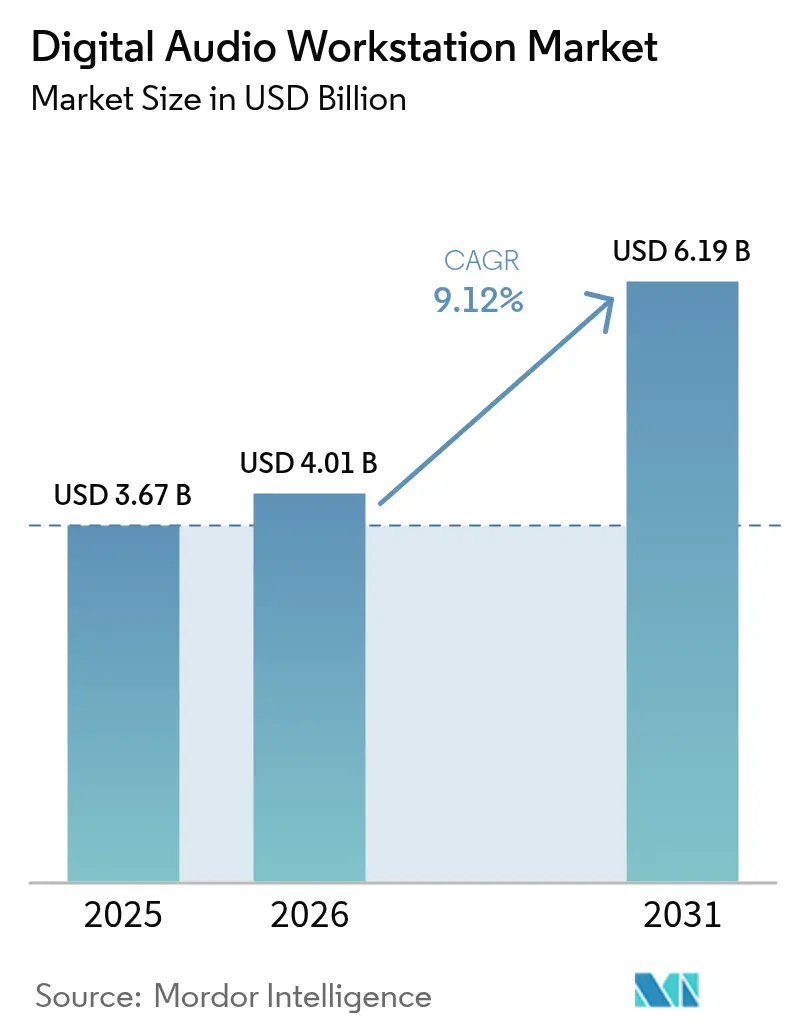
| Market Size (2026) | USD 4.01 Billion |
| Market Size (2031) | USD 6.19 Billion |
| Growth Rate (2026 - 2031) | 9.12 % |
| Fastest Growing Market | Asia Pacific |
| Largest Market | North America |
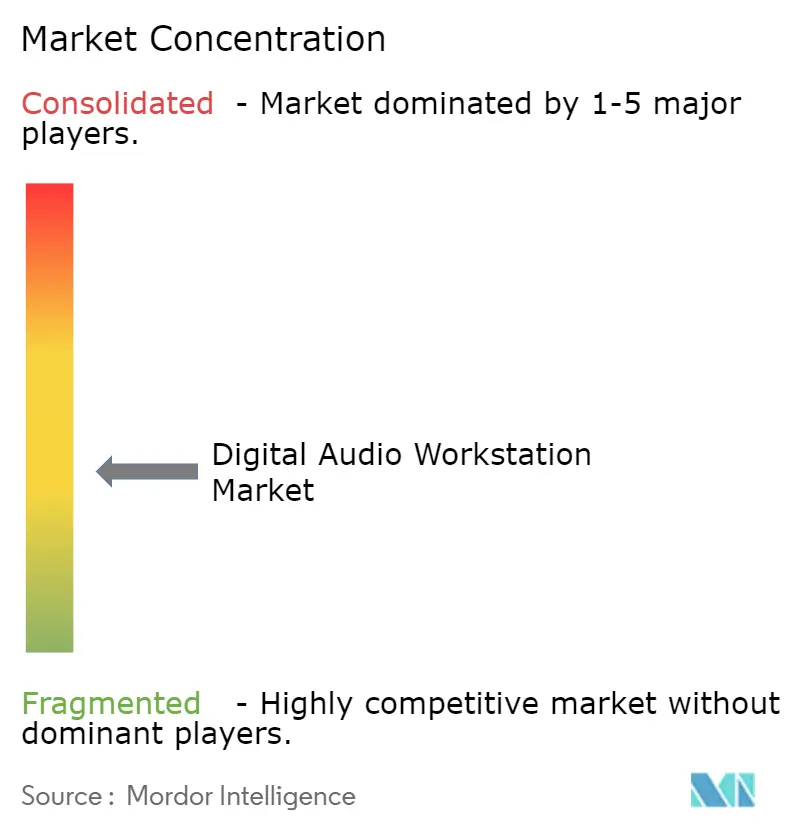
| Market Concentration | Medium |
Major Players *Disclaimer: Major Players sorted in no particular order Image © Mordor Intelligence. Reuse requires attribution under CC BY 4.0. | |
Digital Audio Workstation Market Analysis by Mordor Intelligence
Digital audio workstation market size in 2026 is estimated at USD 4.01 billion, growing from 2025 value of USD 3.67 billion with 2031 projections showing USD 6.19 billion, growing at 9.12% CAGR over 2026-2031. Cloud-native production, AI-assisted composition, and spatial-audio workflows are expanding the addressable user base while lifting spending among seasoned professionals. Subscription models have lowered up-front costs, bringing new hobbyists into paid ecosystems even as freemium rivals intensify price sensitivity. Remote collaboration-once a pandemic workaround-has become standard practice, accelerating migration to SaaS architectures and cross-platform toolchains. Meanwhile, spatial-audio demand from film, OTT, and gaming studios is forcing vendors to embed Dolby Atmos, binaural rendering, and object-based mixing natively. Competitive intensity is rising as suppliers bundle marketplaces, sample libraries, and AI utilities to deepen platform stickiness and defend against open-source alternatives.
Key Report Takeaways
- By component, software controlled 84.40% of the digital audio workstation market share in 2025, while services are on track for 11.32% CAGR through 2031.
- By operating system, Windows led with 56.40% of the digital audio workstation market share in 2025; other OS platforms are set to expand at 12.18% CAGR to 2031.
- By deployment mode, on-premise solutions held 69.20% of the digital audio workstation market share in 2025, whereas cloud and SaaS offerings are forecast to grow 13.65% CAGR.
- By end user, professional audio engineers and mixers accounted for 39.30% of the digital audio workstation market share in 2025; podcast and content creators record the fastest CAGR at 13.08% to 2031.
- By application, music production commanded 59.10% of the digital audio workstation market share in 2025, and podcasting/live-streaming is advancing at 12.84% CAGR.
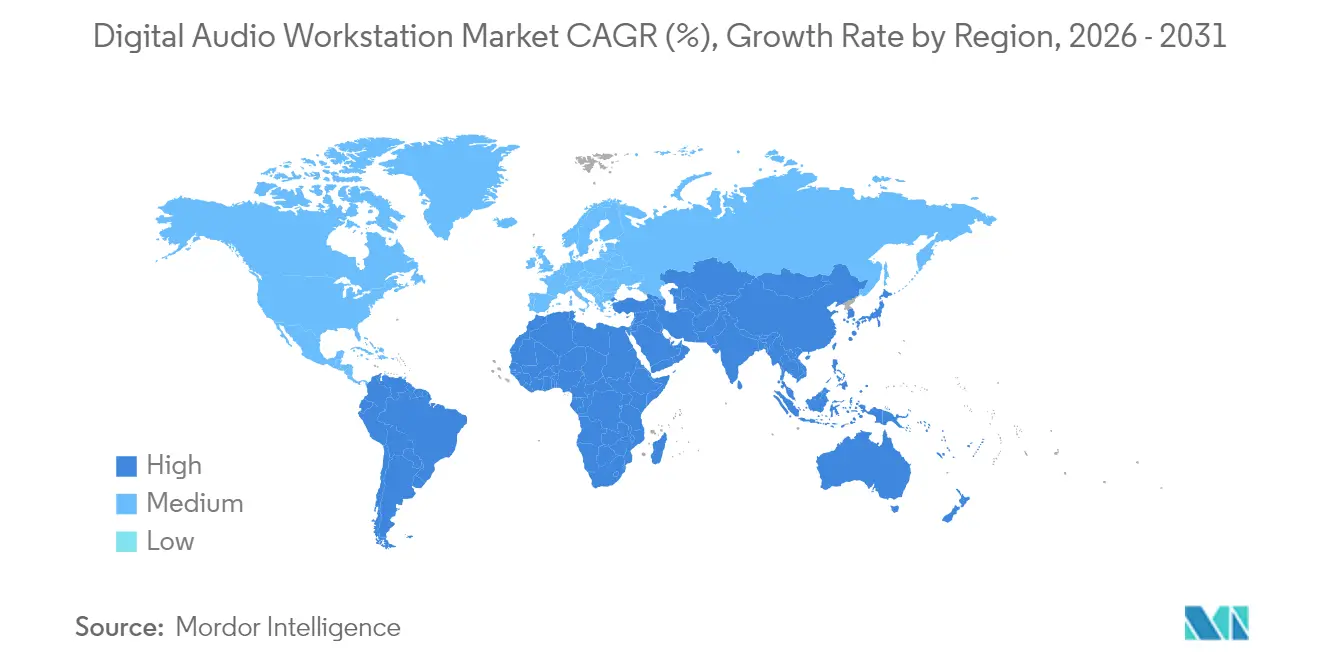
- By geography, North America captured 34.70% of the digital audio workstation market share in 2025; Asia-Pacific is the fastest-growing region at 11.32% CAGR.
Note: Market size and forecast figures in this report are generated using Mordor Intelligence’s proprietary estimation framework, updated with the latest available data and insights as of 2026.
Market Trends and Insights
Drivers Impact Analysis of Digital Audio Workstation Market*
| Driver | (~) % Impact on CAGR Forecast | Geographic Relevance | Impact Timeline |
|---|---|---|---|
| Growing shift toward cloud-based DAWs among independent music producers | +2.1% | Global (early adoption in North America and EU) | Medium term (2-4 years) |
| Demand surge for immersive spatial-audio production driven by OTT and gaming studios | +1.8% | North America, Europe, Asia-Pacific | Long term (≥ 4 years) |
| Adoption of AI-assisted composition tools by home-studio creators | +1.5% | Global (developed markets) | Short term (≤ 2 years) |
| Rising podcast monetization creating need for turn-key editing suites | +1.3% | North America, Europe, Asia-Pacific | Medium term (2-4 years) |
| 5G roll-outs enabling low-latency remote collaboration workflows | +0.9% | Asia-Pacific, North America, select EU | Long term (≥ 4 years) |
| Proliferation of subscription-based pricing expanding paid user base | +0.7% | Global (mature markets) | Medium term (2-4 years) |
| Source: Mordor Intelligence | |||
Growing Shift Toward Cloud-Based DAWs Among Independent Music Producers
Cloud adoption is climbing as creators seek affordable workstations that run on modest hardware and sync sessions across devices. Image-Line’s FL Cloud introduced tiered subscriptions that bundle 69 instruments and effects, illustrating how SaaS offerings replace one-time licenses while cutting storage and update overhead.[1] Automatic versioning, real-time collaboration, and device-agnostic access resonate with mobile-first musicians. Reduced piracy risk and recurring revenue also encourage vendors to prioritize cloud roadmaps. For users, the ability to co-produce from different cities with minimal latency has turned cloud workflows from novelty to necessity, reinforcing a medium-term boost to the digital audio workstation market.
Demand Surge for Immersive Spatial-Audio Production Driven by OTT and Gaming Studios
Streaming platforms now mandate Dolby Atmos mixes for flagship releases, while flagship games rely on object-based audio for realism. Steinberg Nuendo’s native Dolby Atmos renderer and Netflix loudness presets demonstrate vendor responses. L-Acoustics’ L-ISA Studio extends object mixing to 16 outputs, broadening access for smaller facilities.[2] As immersive experiences become an expectation, DAWs that simplify channel-based authoring, head-tracking monitoring, and automated down-mixing gain competitive advantage, adding long-term momentum to the digital audio workstation market.
Adoption of AI-Assisted Composition Tools by Home-Studio Creators
Apple Logic Pro 11’s AI virtual bandmates generate rhythm tracks, bass lines, and keyboard parts on demand soundonsound.com. Similar tools inside FL Studio supply chord progressions and automated mastering. These assistants reduce skill barriers, letting hobbyists craft polished demos without session musicians. Stem-separation engines speed remixing, while intelligent arrangement features facilitate rapid experimentation. As AI moves from novelty to workflow staple, entry-level creators join the paid tier, expanding the digital audio workstation market and pressuring vendors to refine machine-learning pipelines.
Rising Podcast Monetization Creating Need for Turn-Key Editing Suites
Podcast ad revenue growth has elevated production quality expectations, prompting editors to adopt DAWs that automate noise reduction, loudness normalization, and transcript alignment. Adobe added interactive fade handles and AI audio-category tagging to streamline episode assembly.[3] Soundtrap’s user surge during the pandemic showed how simplified interfaces entice non-engineers into multi-track editing.[4] As podcasters diversify into video, integrated audio-video workflows become essential, expanding medium-term growth for the digital audio workstation market.
Restraints Impact Analysis of Digital Audio Workstation Market*
| Restraint | (~) % Impact on CAGR Forecast | Geographic Relevance | Impact Timeline |
|---|---|---|---|
| Prevalence of freemium and open-source DAWs eroding paid licenses | -1.4% | Global (higher in emerging markets) | Medium term (2-4 years) |
| High GPU/CPU requirements limiting mobile and emerging-market adoption | -1.1% | Asia-Pacific emerging, Latin America, MEA | Long term (≥ 4 years) |
| Complex IP and sample-clearance regulations increasing compliance costs | -0.8% | North America, Europe, developed Asia-Pacific | Medium term (2-4 years) |
| Hardware supply-chain volatility causing audio-interface shortages | -0.6% | Global (manufacturing hubs) | Short term (≤ 2 years) |
| Source: Mordor Intelligence | |||
Prevalence of Freemium and Open-Source DAWs Eroding Paid Licenses
Reaper’s low-cost plan and Audacity’s no-cost feature set force commercial publishers to prove added value beyond basic tracking and editing. Browser-based tools further lower switching barriers, particularly in price-sensitive regions. Vendors counter with subscription tiers that amortize costs yet still face resistance from users familiar with perpetual licenses. This competitive tug reduces near-term monetization potential for the digital audio workstation market.
High GPU/CPU Requirements Limiting Mobile and Emerging-Market Adoption
AI mastering, real-time convolution, and high-track counts strain entry-level devices. Apple Silicon’s M-series chips double plug-in headroom over legacy Intel builds, but those processors ship mainly in premium hardware. Budget-conscious creators in Asia-Pacific and Latin America often defer upgrades, slowing penetration. Thermal, battery, and storage constraints on smartphones add complexity for mobile DAW design, tempering long-term growth in the digital audio workstation market.
*Our forecasts treat driver/restraint impacts as directional, not additive. The impact forecasts reflect baseline growth, mix effects, and variable interactions.
Digital Audio Workstation Market Segment Analysis
By Component:
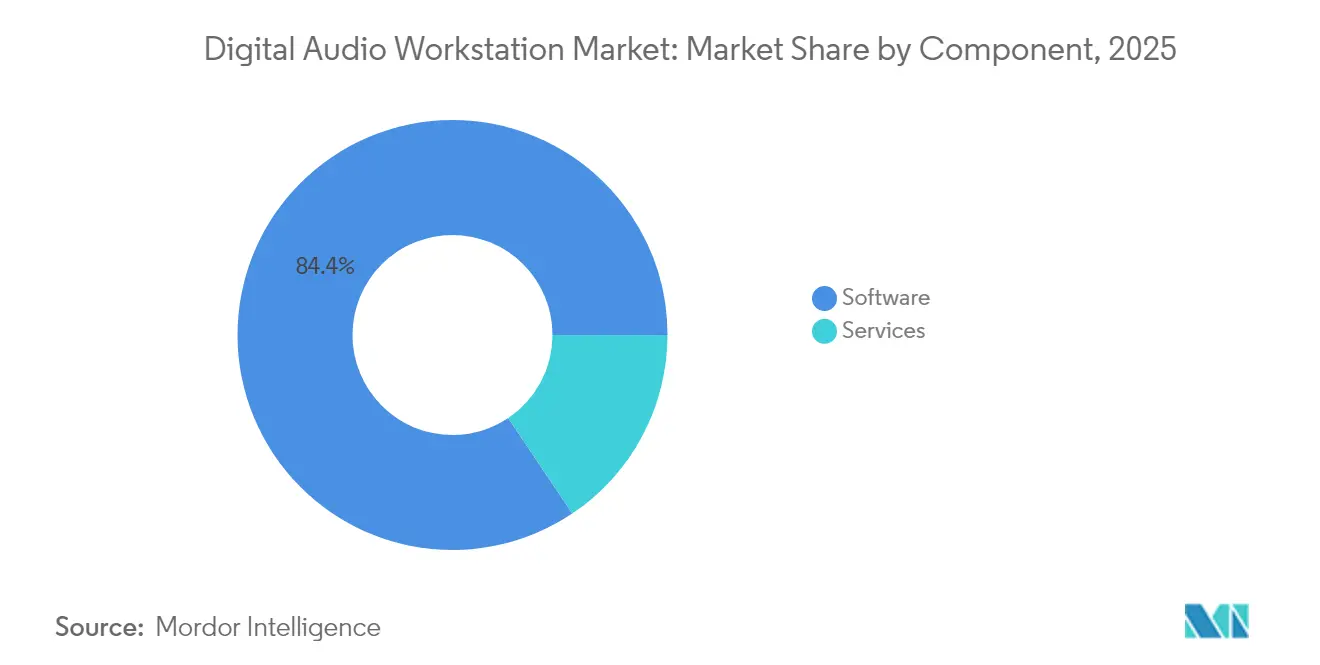
Software Dominance Drives InnovationSoftware accounted for 84.40% of 2025 revenue, underscoring its centrality to end-to-end workflows and ecosystem control. Services, though smaller, are expanding 11.32% CAGR as creators pay for cloud storage, AI mastering, and collaboration hubs. Software captured 84.40% of the digital audio workstation market share in 2025, while value-added services such as FL Cloud’s tiered plug-in bundles deepen vendor lock-in. As creators migrate sessions among devices, integrated cloud libraries and automated backups transform one-time purchasers into recurring subscribers. The resulting annuity revenue encourages rapid feature rollouts that keep the digital audio workstation market growing.
Service uptake also reflects skill-set gaps among hobbyists who outsource mastering or stem separation to online engines. Apple's dual-pricing-USD 199.99 perpetual on Mac or USD 4.99 monthly on iPad-illustrates how vendors flex price to match device use cases. By 2031, higher-margin services will cushion software commoditization, reinforcing a mixed-model approach across the digital audio workstation market.

By Operating System:
Windows Leadership Faces Platform DiversificationWindows retained a 56.40% foothold thanks to broad audio-interface driver support and entrenched studio workflows. Yet mobile-first creators and Arm-based laptops are chipping away, pushing other OS platforms to a 12.18% CAGR. Windows machines controlled 56.40% of the digital audio workstation market size in 2025, but native Arm builds like Steinberg SpectraLayers 12 hint at a multi-architecture future. Smartphones and tablets expand content creation moments, requiring touch-optimized UIs and cloud sync.
Cross-platform parity now shapes buying decisions; users expect the same session to open on desktop and handheld devices without compromise. Vendors that deliver seamless migrations will capture incremental spend, spreading adoption across device ecosystems and lifting the digital audio workstation market.
By Deployment Mode:
Cloud Transition Accelerates Despite On-Premise DominanceOn-premise deployments still generated 69.20% of 2025 revenue, favored by studios demanding deterministic latency and absolute data ownership. Nevertheless, cloud models are compounding at 13.65% CAGR as 5G coverage and zero-install browsers redefine collaboration. BandLab’s browser-based DAW showcases frictionless onboarding, while Avid’s price re-alignment reflects infrastructure cost recovery. Software captured 69.20% of the digital audio workstation market size in on-premise environments, yet every major vendor now offers session syncing or full SaaS tiers, signaling inevitable cloud ascendancy.
For independents, cloud saves eliminate catastrophic data loss and enable ad-hoc co-production. For enterprises, hybrid stacks combine local DSP acceleration with remote asset management. As internet reliability improves, more workloads will shift off the desktop, reshaping revenue mix in the digital audio workstation market.
By End User:
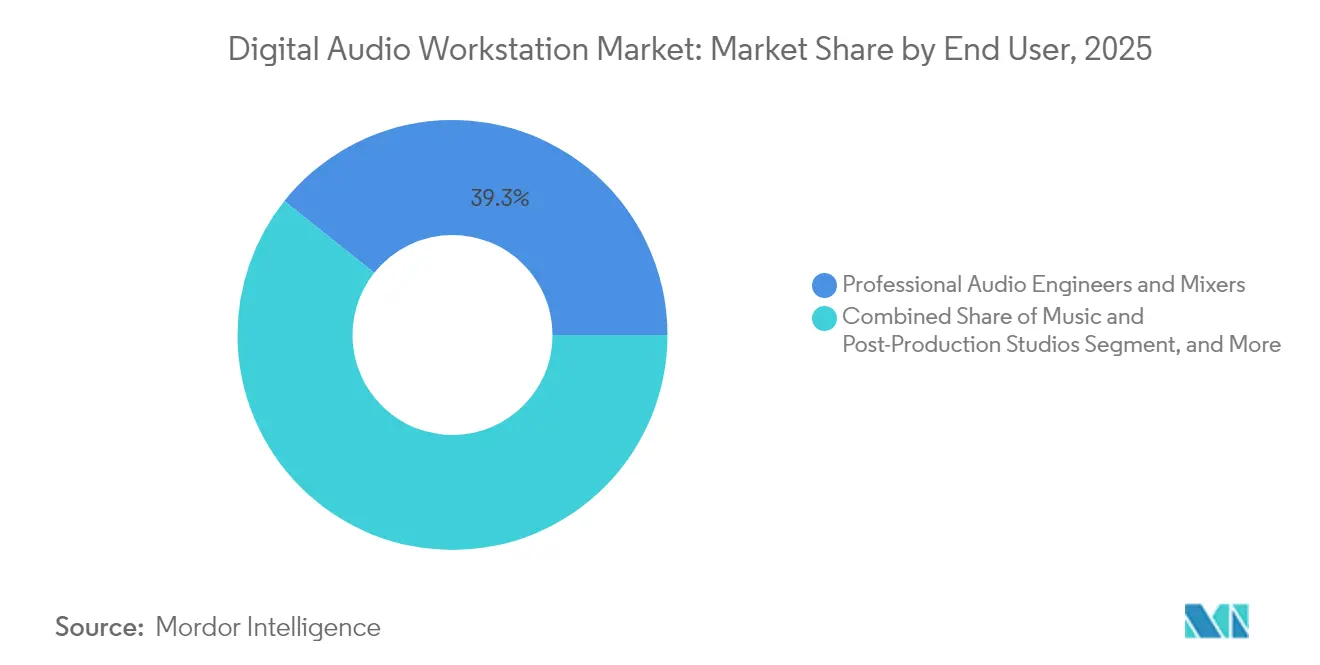
Professional Segments Lead While Creator Economy ExpandsProfessional engineers and mixers contributed 39.30% of 2025 spend, valuing high-track counts, surround routings, and certification programs. Their loyalty anchors predictable yearly upgrades and plugin bundles. Conversely, podcast and content creators post a 13.08% CAGR, pulled by ad-supported business models and the need for turnkey editing. As monetization pathways multiply, hobbyists migrate from freemium apps to mid-tier subscriptions, enlarging the digital audio workstation market.
Educational institutions also uptick, embedding production curricula to meet rising creative-tech career interest. Vendors respond with site licenses and simplified modes that hide advanced routing until learners need it. Such stratification keeps entry affordable while creating up-sell paths as skills mature, sustaining momentum across the digital audio workstation market.
By Application:
Music Production Dominance Faces DiversificationMusic production and mastering held 59.10% revenue in 2025, rooted in album workflows and virtual instrument demand. Still, podcasting and live-streaming are scaling fastest at 12.84% CAGR as audiences seek on-demand talk and real-time creator interactions. Podcasting is projected to claim a 13.05% slice of the digital audio workstation market size by 2031. Film and OTT post-production, buoyed by spatial-audio mandates, require tight integration with video timelines and loudness meters, presenting upsell prospects.
Game developers crave adaptive music stems and low-latency middleware bridges, spurring specialized toolkits. Meanwhile, live streamers prioritize CPU efficiency and quick presets that publish directly to social platforms. This widening spectrum ensures no single use case dominates future product roadmaps, keeping the digital audio workstation market diversified.
Geography Analysis
North America Digital Audio Workstation Market
North America commanded 34.70% of 2025 revenue, supported by Hollywood, Nashville, and a dense network of game and OTT studios. Stable broadband, early 5G rollouts, and high per-capita spending on creative software underpin premium adoption. However, market saturation and pushback against rising subscription fees temper incremental growth.
APAC Digital Audio Workstation Market
Asia-Pacific is the growth engine with 11.32% CAGR, led by China’s USD 3 billion digital-music sector and mobile-first creator culture. Smartphone penetration and short-form-video ecosystems push cross-device workflow demand, enlarging the digital audio workstation market. Government-backed 5G coverage and youth demographics accelerate cloud adoption, though hardware affordability remains a friction point in emerging economies.
EMEA and LATAM Digital Audio Workstation Market
Europe occupies a balanced profile-mature yet innovative. Strong IP enforcement supports premium pricing, while public arts funding sustains niche DAWs tailored to classical and broadcast markets. Latin America and MEA log lower absolute spend but exhibit high creator enthusiasm. Freemium and mobile-only apps dominate entry, positioning vendors with localized payment models to capture future upgrades. Collectively, geographic diversity insulates the digital audio workstation market from single-region downturns and encourages differentiated go-to-market tactics.
Regulatory Landscape
Digital audio workstation (DAW) vendors operate under a mix of copyright, privacy, and technical-compliance regimes that influence product design, licensing, and workflow features. In the United States, provisions tied to the Audio Home Recording Act, including requirements around digital audio recording device controls under 17 USC 1002 and the associated licensing and royalty-accounting mechanisms (including filings referenced by the U.S. Copyright Office under 37 CFR 201.28), set compliance expectations that can carry into DAW ecosystems when workflows involve protected recordings and copying controls.
Across major markets, data protection and interoperability standards increasingly shape how cloud and collaboration-led DAWs handle telemetry, account systems, and cloud session syncing. EU General Data Protection Regulation (GDPR) obligations influence the way DAW vendors and adjacent tooling providers design data flows. At the same time, industry-led standards bodies such as the MIDI Association (MIDI 2.0 and MIDI-CI) and the Audio Engineering Society (AES standards catalog) set interoperability baselines that reduce friction between software, controllers, and plug-ins, particularly as cross-platform and hybrid (local plus cloud) workflows expand.
Competitive Landscape
The field is moderately concentrated: Apple, Avid, Steinberg, and Adobe anchor professional workflows, while Image-Line, BandLab, and Ableton court indie creators. Continuous AI infusion, spatial-audio compliance, and real-time collaboration differentiate offerings. Apple’s vertical integration across macOS, iPadOS, and silicon chips deepens lock-in, evidenced by Logic Pro’s device-specific pricing. Avid’s Splice tie-up injects a 100-million-sample library directly into Pro Tools, tightening its grip on post facilities.
Emergent challengers focus on niche pain points: Udio’s visual song editor targets AI-assisted arrangement, while Soundtrap leverages classroom workflows. Vendors also hedge against supply-chain risk; software-only innovations mitigate hardware interface shortages caused by chip constraints. As AI commoditizes core features, community ecosystems, content marketplaces, and educational modules will define competitive edges in the digital audio workstation market.
Digital Audio Workstation Industry Leaders
-
Apple Inc.
-
Adobe Inc.
-
Avid Technology Inc.
-
Steinberg Media Technologies GmbH
-
Native Instruments GmbH
- *Disclaimer: Major Players sorted in no particular order
Digital Audio Workstation Market Companies Covered in this Report
- Apple Inc.
- Avid Technology Inc.
- Adobe Inc.
- Steinberg Media Technologies GmbH
- Ableton AG
- Native Instruments GmbH
- Image-Line BV (FL Studio)
- PreSonus Audio Electronics Inc.
- MAGIX Software GmbH
- Propellerhead Software AB (Reason Studios)
- BandLab Technologies (Cakewalk)
- Harrison Consoles Inc.
- Cockos Inc. (REAPER)
- MOTU Inc.
- iZotope Inc.
- Bitwig GmbH
- Tracktion Software Corporation
- Acoustica Inc.
- Soundtrap (Spotify AB)
- Ohm Force
Market Opportunities and Future Outlook
Interoperability is a visible whitespace area as creators move between hosts, plug-ins, and devices across music, podcasting, and post-production. Two concrete technical anchors support commercialization around portability and tighter integration: Celemony ARA (Audio Random Access), which extends established plug-in APIs (VST3, Audio Units, AAX, CLAP) to pass musical context and enable deeper editing integration, and DAWproject, an open exchange format used for session import/export across multiple DAWs (with named implementations including Bitwig Studio, PreSonus Studio One, and Steinberg Cubase). Vendors and ecosystem partners can differentiate by improving cross-DAW handoffs, including project exchange, stem workflows, and plug-in state handling, and by packaging interoperability as a paid service layer for teams that frequently move sessions between tools.
Hybrid collaboration and cloud-adjacent production infrastructure also open room for professional workflows that need both deterministic performance and remote access. Avid frames Avid NEXIS shared storage and related remote capabilities (including documented cloud storage deployment patterns on AWS S3) as a backbone for multi-contributor work, creating an enterprise anchor that DAW vendors and services providers can build around for shared assets, versioning, and distributed review. As DAWs add AI-assisted features such as composition, stem separation, tagging, and speech-to-text, the practical requirement shifts toward governance-ready implementations, including privacy-aware processing, clear data handling for cloud features, and predictable interchange of edits and metadata across applications and storage layers.
Recent Industry Developments in Digital Audio Workstation Market
- June 2026: Apple announced updates to Apple Creator Studio with enhancements tied to Logic Pro, including improvements such as Chord ID updates and a new Producer Project feature. The announcement reinforces Apple's strategy of bundling DAW-adjacent workflow utilities into its creator stack, supporting faster idea-to-arrangement iteration for Mac and iPad users.
- May 2026: inMusic announced a definitive agreement to acquire Native Instruments. The transaction brings a major virtual-instruments and music software portfolio under inMusic, strengthening end-to-end ecosystem bundling across software and hardware that can influence how DAW users source instruments, effects, and integrated workflows.
- April 2026: Avid entered a multi-year strategic partnership with Google Cloud to integrate generative and agentic AI capabilities (including Gemini and Vertex AI) into media production tools. The collaboration deepens Avid's cloud and AI roadmap for professional creation environments, accelerating automation and connected workflows that can reshape how DAW users handle editing, organization, and production tasks at scale.
Digital Audio Workstation Market Report Scope and Research Methodology
Market Definition and Coverage
For this methodology, the digital audio workstation (DAW) market is defined as revenue generated from DAW software and related DAW services used to record, edit, mix, and master audio across professional and creator workflows, sold via perpetual or subscription deployments.
Scope exclusions: We exclude physical audio hardware (such as audio interfaces and controllers), musical instruments, and general-purpose consumer audio players.
Segments Covered in This Report
- By Component
- Software
- Services
- By Operating System
- macOS
- Windows
- Other Operating System
- By Deployment Mode
- On-Premise/Perpetual License
- Cloud/SaaS
- By End User
- Professional Audio Engineers and Mixers
- Music and Post-Production Studios
- Electronic and Independent Musicians
- Education and Music Schools
- Podcast and Content Creators
- By Application
- Music Production and Mastering
- Film/TV/OTT Post-Production
- Game-Audio and Immersive Media
- Podcasting and Live-Streaming
- By Geography
- North America
- United States
- Canada
- Mexico
- South America
- Brazil
- Argentina
- Rest of South America
- Europe
- Germany
- United Kingdom
- France
- Italy
- Spain
- Rest of Europe
- Asia-Pacific
- China
- Japan
- South Korea
- India
- Australia
- Rest of Asia-Pacific
- Middle East and Africa
- Middle East
- United Arab Emirates
- Saudi Arabia
- Turkey
- Israel
- Africa
- South Africa
- Nigeria
- Egypt
- Middle East
- North America
Data Sources, Market Sizing, and Validation
Desk Research
Desk research was used to set clear demand signals and to avoid counting adjacent audio software that does not function as a DAW. We reviewed public sources such as US Census and BEA datasets for digital economy context, OECD digital trade indicators, Eurostat ICT and creative-industry statistics, WIPO patent publications for music software trends, and US Copyright Office releases on music and sound recording activity.
Along with these, we referenced company filings and earnings notes, product documentation, public pricing pages, reputable press coverage, and association websites tied to audio engineering and music education. Where needed, we also used paid subscriptions for company financials and intelligence, news and financials, and patent databases to cross-check timelines and normalize company-reported software revenue where it is not broken out cleanly. The desk sources mentioned here are illustrative only, and several other public documents and datasets were also used to validate specific data points and clarify assumptions.
Primary Interviews and Surveys
Primary work was used to test adoption and pricing realities that are not visible in public statistics, especially for subscription tiers, education licensing, and creator bundles. We spoke with a mix of software publishers, channel partners, studio and post-production buyers, independent creators, and music educators to confirm what gets purchased as a DAW versus adjacent plug-ins and sample tools.
The respondent coverage was balanced across major regions, so assumptions on cloud usage, collaboration needs, and paid-seat behavior could be aligned with how accounts actually buy before totals were finalized.
Distribution of primary research fieldwork respondents
| Company type | Respondent position | Region |
|---|---|---|
| Top tier: 29% | CXOs: 19% | APAC: 43% |
| Mid tier: 49% | Functional/Unit leaders: 40% | EMEA: 33% |
| Smaller Players: 22% | Managers: 41% | Americas: 24% |
Market-Sizing & Forecasting
Sizing was built using a top-down and bottom-up approach where the addressable software spend pool is reconstructed from creative and media software demand, and then narrowed using DAW-specific adoption rates by end-user groups and deployment types. To keep the totals practical, we used selective bottom-up checks, such as sampled price points by license type, channel checks on typical seats per studio or education lab, and a sanity check using a small roll-up of visible vendor revenue where disclosure exists.
Key inputs used in the model included the split between software and services, the mix of perpetual versus subscription deployments, operating system preferences, creator activity (such as podcast and content creation intensity), and workflow shifts like remote collaboration and spatial-audio projects that can lift seat counts and upgrade cycles. When a bottom-up visibility gap showed up, the missing portion was treated through ranges anchored to interview feedback on average users per account and typical renewal behavior.
Forecasts were prepared using scenario analysis supported by short time-series smoothing on the base-year signals, followed by expert-led adjustments for subscription penetration, cloud collaboration uptake, and education licensing trends. The final path was chosen only after the driver movements matched what respondents described as realistic for budgets and production needs.
Data Validation & Update Cycle
Outputs were checked through triangulation across independent signals, including spend pool reasonableness, per-seat pricing logic, and region-level adoption consistency. Outliers were flagged and reviewed, and then assumptions were re-tested through follow-up questions when a variance was too large to explain through mix or currency timing.
Before sign-off, the model and inputs went through a multi-step internal review so calculation errors and double counting risks could be caught early. Reports are refreshed annually, with interim updates triggered by material events such as major pricing changes, licensing model shifts, or sudden demand spikes tied to creator tools. Right before delivery, a fresh pass is completed so clients receive the most current view available at that time.
Mordor Intelligence's Digital Audio Workstation Market Size Compared With Other Published Estimates
Published market sizes for DAWs often do not match because the counted scope varies, the split between software and services is handled differently, and the timing of currency conversion or pricing refresh is not the same. Some estimates also treat creator tools as a single bucket, which can blur what is truly a DAW purchase versus a supporting add-on.
The main gap comes from whether audio plug-ins, virtual instruments, and bundled sample libraries are counted inside the DAW total, where Mordor Intelligence counts only DAW software plus DAW-related services and keeps those adjacent add-ons outside the market value even when they are sold in the same storefront.
Benchmark comparison
| Source | Market Size | Gaps in Research Methodology |
|---|---|---|
| Mordor Intelligence | USD 4.01 B (2026) | |
| Trade Journal A | USD 3.18 B (2025) | This figure is closer to a software-only view and often follows a conservative pricing path, which can understate subscription tiering and services tied to DAW usage. |
| Regional Consultancy B | USD 4.99 B (2025) | This figure appears to fold in adjacent creator revenue streams (such as add-on audio tools and content bundles) and may apply a faster assumed shift to cloud subscriptions, which lifts totals earlier. |
The spread in the table mostly traces back to what gets included alongside the DAW license and how quickly subscription pricing is assumed to expand. By keeping scope rules explicit and then cross-checking adoption, deployment mix, and practical pricing, our estimate stays traceable to repeatable steps that can be re-tested when market conditions shift.
Key Questions Answered in the Report
What is the current value of the digital audio workstation market?
The market generated USD 4.01 billion in revenue in 2026 and is projected to reach USD 6.19 billion by 2031.
Which segment holds the largest digital audio workstation market share?
Software components led with an 84.40% share in 2025, reflecting their central role in production workflows.
Why is Asia-Pacific the fastest-growing region in the digital audio workstation market?
Smartphone penetration, a USD 3 billion Chinese digital-music sector, and rapid 5G expansion drive an 11.32% CAGR in Asia-Pacific.
How is AI influencing digital audio workstation adoption?
AI virtual bandmates, stem-separation tools, and auto-mix engines lower skill barriers and speed workflows, attracting new creators into paid tiers.
What challenges could slow digital audio workstation market growth?
Freemium competition, high CPU/GPU requirements for advanced features, and hardware supply-chain volatility may temper revenue expansion.
Which deployment mode is expanding the quickest?
Cloud and SaaS deployments are growing at 13.65% CAGR as creators prioritize remote collaboration and subscription affordability.