
Diaphragm Pump Market Size and Share
Market Overview
| Study Period | 2021 - 2031 |
|---|---|
| Market Size (2026) | USD 7.81 Billion |
| Market Size (2031) | USD 10.35 Billion |
| Growth Rate (2026 - 2031) | 5.81 % |
| Fastest Growing Market | Asia Pacific |
| Largest Market | Asia Pacific |
| Market Concentration | Medium |
Major Players *Disclaimer: Major Players sorted in no particular order Image © Mordor Intelligence. Reuse requires attribution under CC BY 4.0. | |
Diaphragm Pump Market Analysis by Mordor Intelligence
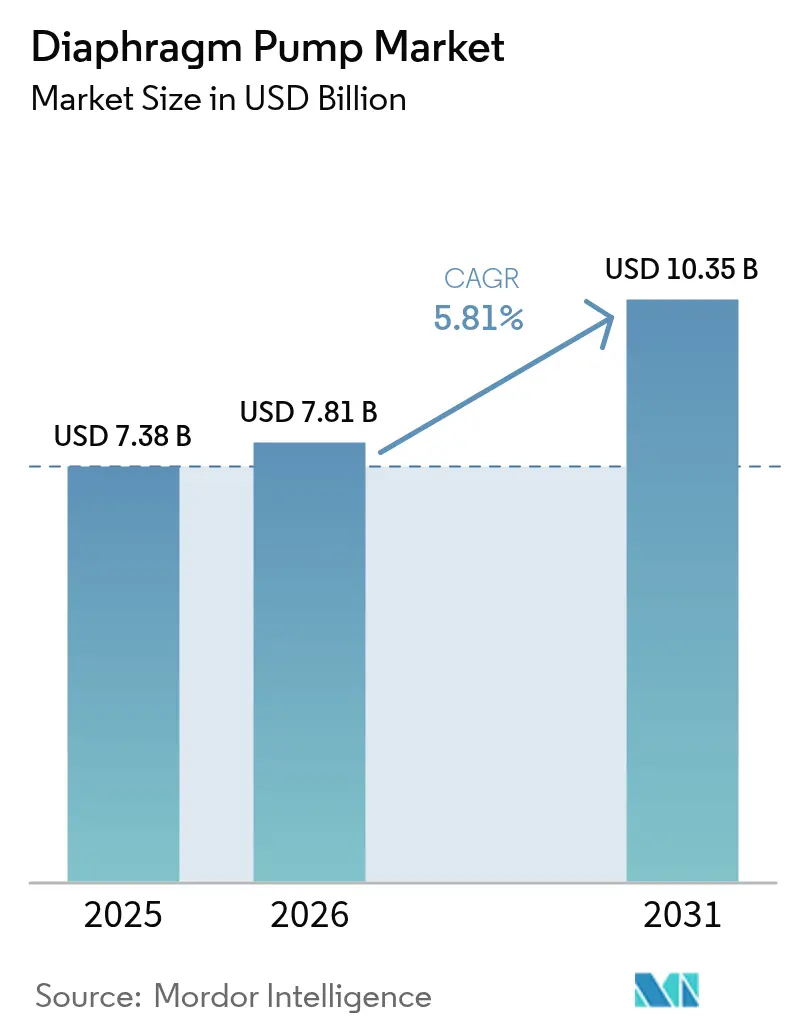
Diaphragm Pump market size in 2026 is estimated at USD 7.81 billion, growing from 2025 value of USD 7.38 billion with 2031 projections showing USD 10.35 billion, growing at 5.81% CAGR over 2026-2031.
Moderate growth is supported by rising industrial automation, tightening environmental regulations that favor leak-free pumping solutions, and a progressive shift toward electrically driven designs that reduce energy use. Rising project activity in water and wastewater treatment, capacity additions in chemicals and battery materials, and demand for shear-sensitive transfer in advanced manufacturing are widening the application base. Technology upgrades around IoT-enabled condition monitoring and predictive maintenance are shortening replacement cycles. Mid-sized players continue to enter niche segments, yet strategic acquisitions by global incumbents are consolidating product portfolios. Collectively, these forces signal a resilient outlook for the diaphragm pump market.
Key Report Takeaways
- By mechanism, air-operated double diaphragm pumps led with 46.40% revenue share in 2025; electrically driven diaphragm pumps are projected to expand at a 6.89% CAGR to 2031.
- By body material, metal housings held 52.30% of the diaphragm pump market share in 2025, while plastic and composite constructions are advancing at a 7.12% CAGR through 2031.
- By discharge pressure, applications below 80 bar captured 54.60% of the diaphragm pump market size in 2025; duties above 200 bar are forecast to grow at a 6.65% CAGR over the forecast period.
- By end-user, chemical and petrochemical processes accounted for a 22.60% share of the diaphragm pump market size in 2025, whereas water and wastewater treatment is expanding at a 6.78% CAGR between 2026-2031.
- By geography, Asia-Pacific commanded 36.70% of the diaphragm pump market size in 2025 and is progressing at a 5.95% CAGR to 2031.
Note: Market size and forecast figures in this report are generated using Mordor Intelligence’s proprietary estimation framework, updated with the latest available data and insights as of 2026.
Market Trends and Insights
Drivers Impact Analysis of Diaphragm Pump Market*
| Driver | (~)% Impact on CAGR Forecast | Geographic Relevance | Impact Timeline |
|---|---|---|---|
| Water and wastewater build-outs in emerging economies | +1.20% | Asia-Pacific core, spill-over to Middle East & Africa | Medium term (2-4 years) |
| Expansion of chemical and petrochemical capacity | +1.00% | Global, with focus in Asia-Pacific and Middle East | Long term (≥ 4 years) |
| Tightening fugitive-emission rules that favor leak-free pumps | +0.80% | North America and EU, expanding into Asia-Pacific | Short term (≤ 2 years) |
| Battery-grade electrolyte plants requiring shear-sensitive transfer | +0.60% | Early adoption in China, South Korea, Germany | Medium term (2-4 years) |
| IoT-enabled predictive-maintenance retrofits | +0.50% | North America and EU, selective uptake in Asia-Pacific | Long term (≥ 4 years) |
| Craft-beverage boom driving sanitary AODD installations | +0.30% | North America and EU, emerging in urban Asia-Pacific | Short term (≤ 2 years) |
| Source: Mordor Intelligence | |||
Water & Wastewater Build-outs in Emerging Economies
Large-scale infrastructure programs across Asia-Pacific and parts of the Middle East are boosting demand for robust fluid-transfer equipment in municipal and industrial treatment plants. The Asian Development Bank approved a USD 41.6 million project in the Philippines that includes a 30 million L per day surface-water facility relying heavily on diaphragm pumps for varied fluid viscosities and leak-free operation(1)Asian Development Bank, “Philippines Water District Development Project,” adb.org. Government funding and stricter discharge guidelines accelerate specification of diaphragm pumps because they offer dry-running capability, clog resistance, and chemical compatibility. Cities upgrading legacy plants treat diaphragm pumps as a life-cycle cost hedge against fines that stem from effluent leaks.
Expansion of Chemical & Petrochemical Capacity
New olefins, polymers, and specialty-chemical complexes continue to surface across China, India, Saudi Arabia, and the United Arab Emirates. LEWA reports rising installations of hydraulically actuated diaphragm metering pumps for hydrocracking, polymerization, and catalyst injection, where precise flow control safeguards product yield(2)LEWA GmbH, “Petrochemical Pump Solutions,” lewa.com. Operators also value hermetic separation between drive and process chambers that prevents hazardous spills. The trend aligns with broader investments in high-purity intermediates and value-added derivatives, ensuring long-run pull for the diaphragm pump market.
Tightening Fugitive-Emission Rules Favoring Leak-Free Pumps
The U.S. Environmental Protection Agency’s methane and VOC regulations now require closed-vent routing and 95% emission reduction from pump stations(3)Environmental Protection Agency, “Standards of Performance for Crude Oil and Natural Gas Facilities,” epa.gov. European regulators mirror these limits under the Industrial Emissions Directive. Compressed-air models remain compliant, yet many operators transition to electric diaphragm pumps that eliminate pneumatic exhaust. Viking Pump’s GB-410 series meets zero-emission provisions, giving early movers an advantage in securing regulatory approval. Compliance costs bolster demand for diaphragm pumps over packed-shaft centrifugal alternatives.
Battery-Grade Electrolyte Plants Demanding Shear-Sensitive Transfer
Lithium-ion cell makers increasingly adopt shear-sensitive diaphragm pumps for cathode-slurry and electrolyte transfer. SANDPIPER notes that AODD designs avoid metal-to-fluid contact, protect slurry particle size, and resist aggressive solvents used in nickel-rich chemistries(4)SANDPIPER Pump, “Battery Production White Paper,” sandpiperpump.com. As plants scale beyond 100 GWh per year, operators standardize on PTFE-lined wetted paths to preserve electrolyte purity. Corresponding capital outlays widen the addressable diaphragm pump market.
Restraints Impact Analysis of Diaphragm Pump Market*
| Restraint | (~)% Impact on CAGR Forecast | Geographic Relevance | Impact Timeline |
|---|---|---|---|
| Raw-material price volatility impacting ASPs | -0.70% | Global, acute where steel costs spike | Short term (≤ 2 years) |
| Substitution by centrifugal or peristaltic pumps in low-viscosity duties | -0.50% | Global, focused on cost-sensitive industries | Medium term (2-4 years) |
| Compressed-air energy penalties for AODD units | -0.40% | Global, highest in high-power-cost regions | Long term (≥ 4 years) |
| Urban noise-vibration ordinances hindering plant siting | -0.20% | Densely populated manufacturing hubs | Medium term (2-4 years) |
| Source: Mordor Intelligence | |||
Raw-Material Price Volatility Impacting ASPs
Stainless steel, aluminum, and high-grade elastomer prices have moved erratically since 2024, compressing margins for smaller manufacturers that lack hedging mechanisms. Quarterly list-price adjustments propagate into capital budget uncertainty, delaying customer orders for projects not under schedule pressure. Regions with thin specialty alloy supply chains, including parts of Latin America and Africa, feel cost spikes more acutely because freight surcharges compound volatility.
Substitution by Centrifugal / Peristaltic Pumps in Low-Viscosity Duties
For water-thin fluids that do not require leak-free containment, centrifugal or low-maintenance peristaltic solutions can outcompete diaphragm pumps on upfront cost. Operators in paints, resins, or agricultural chemicals sometimes switch technologies when performance differences are negligible. This competitive pressure is strongest in markets with limited regulatory oversight on fugitive emissions, causing occasional share attrition in the diaphragm pump market.
*Our forecasts treat driver/restraint impacts as directional, not additive. The impact forecasts reflect baseline growth, mix effects, and variable interactions.
Diaphragm Pump Market Segment Analysis
By Mechanism:
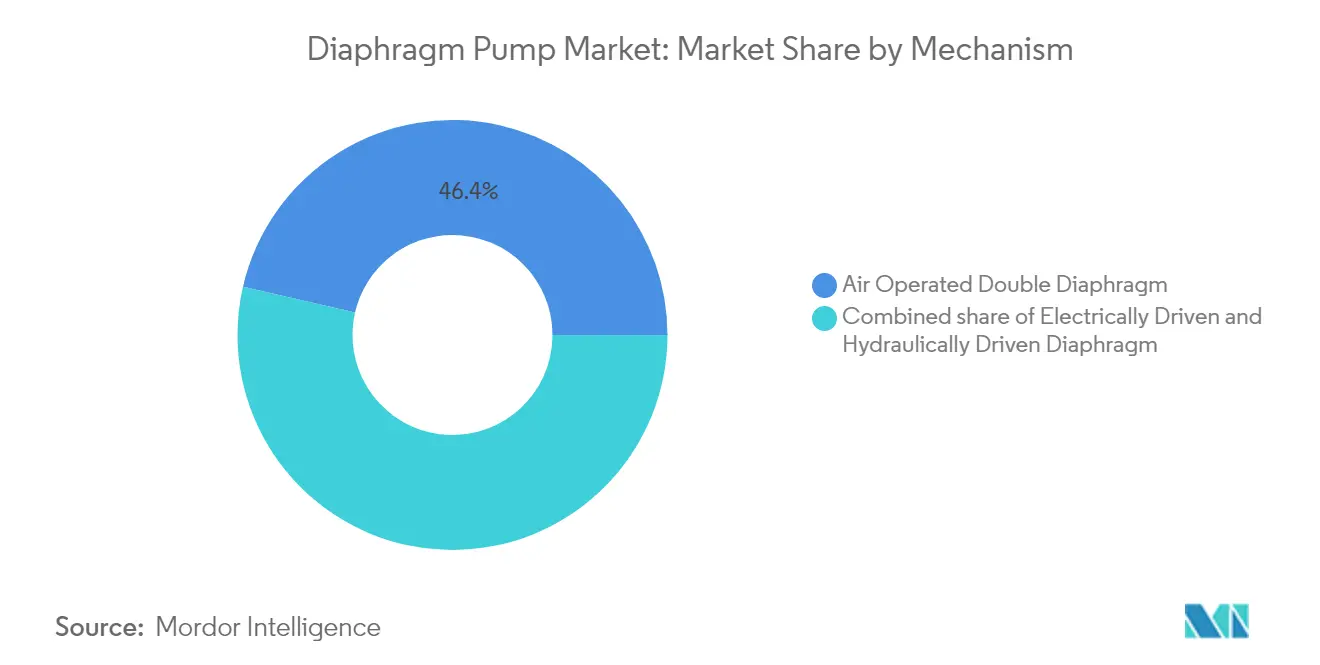
Electric Drives Challenge AODD DominanceThe diaphragm pump market size for air-operated double diaphragm units stood at USD 3.42 billion in 2025, or 46.40 % of global revenue, largely due to intrinsic safety and ease of start-up. Electrically driven diaphragm pumps, though smaller in base, are forecast to post a 6.89 % CAGR, outpacing all other mechanisms. Energy-audit data show these models cut operating costs by as much as 80 % and curb compressor-related CO₂ emissions, aligning with corporate net-zero pledges. Integration with variable-frequency drives allows finer dosing accuracy, especially in chemical injection and bioprocess fermenters. Against this backdrop, the diaphragm pump market share of electric models is expected to cross 27.60 % by 2031, supported by grid-connected plants where hazardous-location certification is feasible. AODD designs still dominate in solvent recovery, paint circulation, and explosion-prone zones because they run on shop air and stall without overheating.
A similar pattern emerges in hydraulically driven diaphragm pumps, which retain pockets of demand in high-pressure transfer above 200 bar, such as offshore injection skids and testing rigs. Despite slower growth, vendors enhance hydraulic frames with leak-detection sensors and magnetites to capture metal debris. Tier-two producers differentiate through integrated accumulator dampening that steadies pulsation, offering users an alternative when compressed air is scarce and high voltage is impractical.


By Body Material:
Plastic Composites Gain GroundMetal casings—stainless steel, cast iron, and aluminum—represented USD 3.86 billion of diaphragm pump market size in 2025, equal to a 52.30 % revenue share. They remain dominant for abrasion resistance, thermal stability, and high-pressure integrity in mining leachate and refinery units. Yet plastic and composite pumps are expanding at 7.12 % CAGR. Polypropylene housings coupled with PTFE heads mitigate corrosion in acid-transfer circuits, notably in battery-grade phosphate lines. Lightweight builds ease installation on elevated pipe racks and reduce freight bills for export-oriented chemical plants. Some pharmaceutical users prefer PVDF constructions that meet ASME-BPE electropolish criteria, shrinking validation time.
Metal users respond by upgrading surface treatments, such as duplex stainless alloys and ceramic coatings, to fend off corrosive sludge and extend mean time between failures. Additive manufacturing also gains traction for complex valve plates, slashing lead time on custom low-volume orders. This dual track keeps both material categories viable, yet the shift underscores how application-specific corrosion resistance shapes procurement.
By Discharge Pressure:
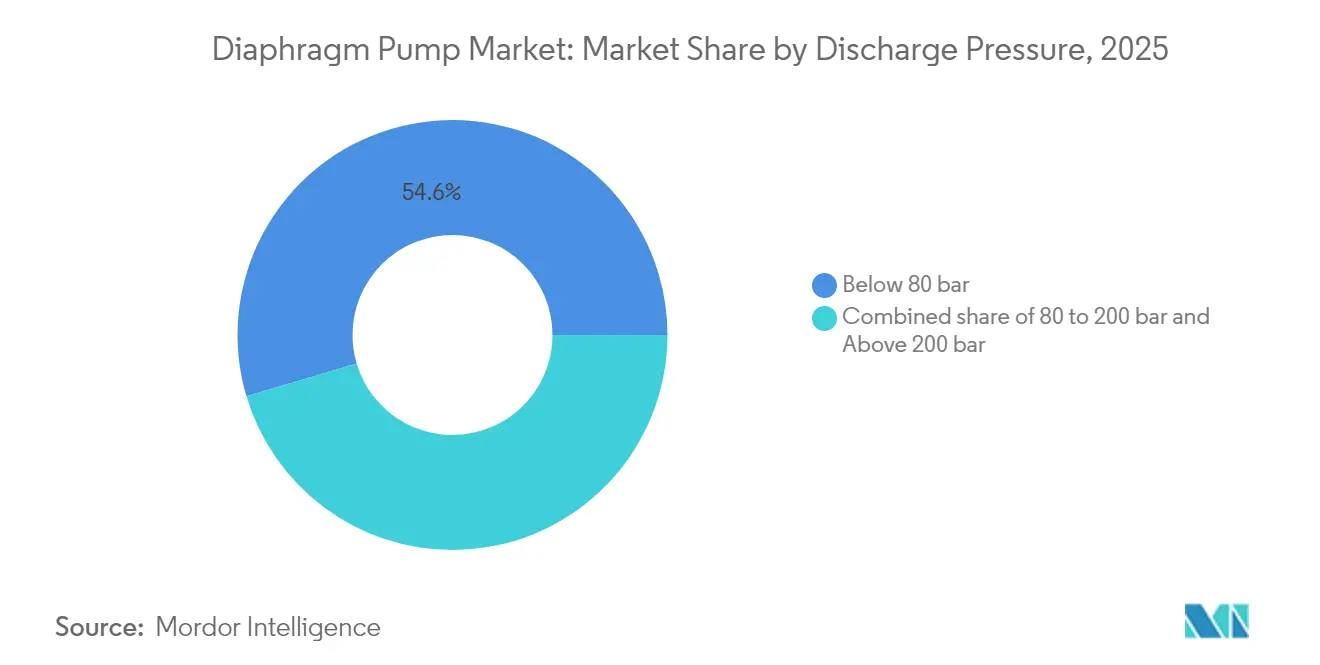
High-Pressure Applications AccelerateBelow 80 bar duties generated 54.60 % of 2025 global revenue, serving potable-water dosing, paint recirculation, and dairy CIP circuits. However, above-200 bar applications, while less than 14.90 % of current diaphragm pump market size, are projected to rise at 6.65 % CAGR because chemical plants push toward intensified reactions and higher solid concentrations. Operators gravitate to triplex and quintuplex pump heads with PTFE composites to endure cyclical stress. Battery-recycling hydrometallurgy plants and supercritical CO₂ extraction systems exemplify niche pockets driving the high-pressure uptick.
Design innovations such as floating diaphragms with fiber reinforcement curtail compression set, boosting service life from 8,000 to 14,000 hours. Vendors widen aftermarket kits that bundle valves, gaskets, and diaphragms, minimizing downtime when operating above 200 bar. The 80-to-200 bar cohort maintains steady uptake in tailings transfer, metal finishing, and brine desalting, aided by regulatory pushes for zero-liquid discharge infrastructure.
By End-User:
Water Treatment Outpaces ChemicalsThe chemical and petrochemical sector consumed USD 1.67 billion worth of pumps in 2025, equal to a 22.60 % slice of diaphragm pump market size. Precise metering of catalysts and caustics preserves margin amid volatile feedstock prices. Nonetheless, the water and wastewater segment is on track for a 6.78 % CAGR to 2031, underpinned by UN Sustainable Development Goal investments targeting safe water access. Municipal utilities retrofit diaphragm pumps for lime slurry dosing, polymer flocculant injection, and high-solids sludge transfer. The sector further benefits as desalination plants adopt leak-free hermetic designs to protect downstream membranes.
Oil and gas retains mid-single-digit growth, buoyed by produced-water reinjection, well-stimulation chemical blends, and vapor-recovery mandates for leak-free equipment. Pharmaceutical and biotechnology users prefer compact hygienic pumps that pass validation audits and minimize cross-batch cleaning labor. Food and beverage processors install sanitary AODD units to transfer viscous syrups and brewer’s mash without shear, supporting flavor consistency. Mining and metals depend on diaphragm pumps for solvent-extraction electrowinning; their cyclical expansions translate to lumpy but significant volumes. Pulp and paper mills deploy chemical feed systems for bleaching and pH control, delivering stable replacement demand.
Geography Analysis
APAC Diaphragm Pump Market
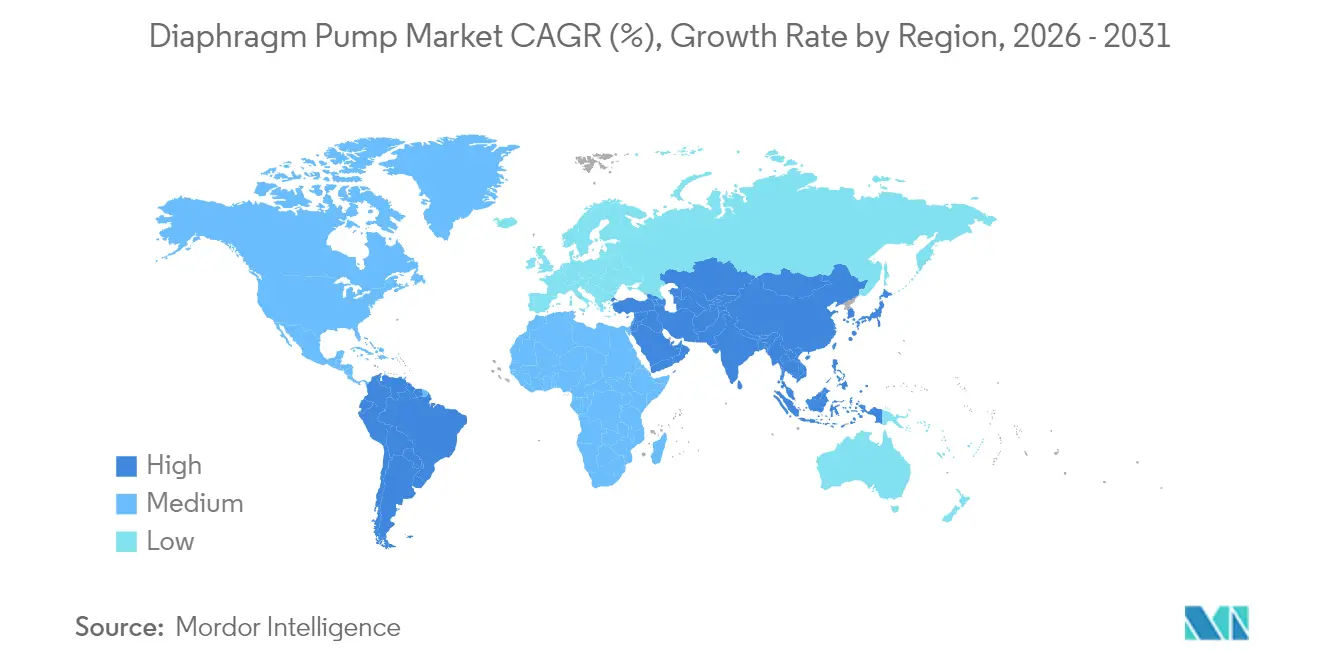
Asia-Pacific held USD 2.71 billion of diaphragm pump market size in 2025 and is expected to reach USD 3.83 billion by 2031, equivalent to a 5.95 % CAGR [1]. China’s rising battery and petrochemical complexes, India’s Smart Cities Mission, and Southeast Asia’s wastewater programs reinforce momentum. Provincial subsidies for pollution-control equipment amplify uptake of leak-free units. Mature producers in Japan and South Korea focus on compact electric designs compatible with heavily automated factories.
North America Diaphragm Pump Market
North America contributed USD 1.89 billion in 2025. The EPA’s ban on methane-venting pneumatic pumps prompts midstream operators to adopt electric ranges, while the craft-beverage surge, mainly in the United States, elevates 3-A sanitary demand. Canada benefits from brownfield oil sands retrofits where low-temperature reliability steers users toward PTFE diaphragm constructions.
Europe Diaphragm Pump Market
Europe generated USD 1.46 billion in 2025. Germany’s specialty-chemicals growth sustains high-pressure metering projects, whereas EU Industrial Emissions Directive upgrades in Italy, Spain, and the Netherlands encourage replacement of packed-gland centrifugal units with diaphragm technology. Regional grants linked to energy-efficiency drive adoption of smart electric pumps integrated with factory analytics.
MEA Diaphragm Pump Market
The Middle East and Africa surpassed USD 0.73 billion in 2025 fueled by water reclamation and oil-field injection. Saudi Arabia’s seawater cooling mega-plants and the United Arab Emirates’ battery-precursor ventures stimulate demand for duplex-stainless and alloy-20 pumps capable of high chloride resistance. Sub-Saharan Africa’s mining sector remains intermittent but promising.
South America Diaphragm Pump Market
South America reached USD 0.59 billion, led by Brazil’s petrochemical restart initiatives and Argentina’s lithium brine extraction. Local OEM assemblers partner with global licensors to shorten lead times, but currency volatility restrains capex schedules, tempering near-term expansion.

Regulatory Landscape
Diaphragm pump selection and design increasingly reflect safety and emissions compliance requirements across industrial machinery and process industries. In the European Union, Regulation (EU) 2023/1230 provides a key framework for machinery health and safety requirements, shaping conformity expectations for pump OEMs and system integrators selling into the region. In the United States, OSHA workplace-safety rules, including machine guarding expectations (for example, guarding rotating components), influence installation and retrofit practices at plants using diaphragm pumps.
China introduced product-specific requirements in 2026 via Ministry of Industry and Information Technology-linked standards, including JB/T 8697-2026 for mobile diaphragm pumps (published February 2026) and JB/T 9806-2026 for diaphragm pumps for sprayers (superseding the 2014 version). These standards set out manufacturing, testing, and inspection requirements, with an implementation timing of September 1, 2026. For suppliers serving mobile and agricultural-use pump categories, this raises compliance workload and increases the need for clearer quality documentation and inspection traceability.
Competitive Landscape
The diaphragm pump industry hosts a mix of diversified conglomerates and focused specialists, resulting in moderate fragmentation. Dover Corporation deepened its portfolio by adding Cryogenic Machinery Corp. and Marshall Excelsior Company for a combined USD 690 million, expanding vertical reach in liquefied gas and clean-energy components. Graco’s QUANTM line leverages XTREME TORQUE motors that cut weight and enable 480 V compatibility, widening addressable retrofits. IDEX Corporation booked record orders of USD 872 million in Q1 2025 and acquired Mott Corporation for USD 1 billion, introducing micro-porous filtration synergies to Warren Rupp diaphragm offerings.
Flowserve reached USD 816.4 million in Q4 2024 pump bookings, highlighting resilient utility and power-generation demand. Meanwhile, mid-tier regional players emphasize localized service centers and faster lead times to stay competitive. Internet-of-Pumps connectivity, life-cycle contract models, and material science improvements remain the central battlegrounds as customers evaluate total ownership costs over upfront price.
Diaphragm Pump Industry Leaders
Idex Corporation
Graco Inc.
Tapflo Group
Dover Corporation
Ingersoll-Rand PLC
- *Disclaimer: Major Players sorted in no particular order

Diaphragm Pump Market Companies Covered in this Report
- Ingersoll Rand PLC (ARO)
- Dover Corporation (PSG/Wilden)
- Idex Corporation (Banjo, Warren Rupp)
- Flowserve Corporation
- Graco Inc.
- Xylem Inc.
- SPX FLOW Inc.
- Grundfos A/S
- Verder Group
- Tapflo Group
- LEWA GmbH
- Yamada Corporation
- KNF Neuberger
- Atlas Copco (Edwards)
- PCM SA
- Schwarzer Precision
- AERZEN Group
- Thomas Pumps
- Gorman-Rupp
- Iwaki Co. Ltd
- Murzan Inc.
- Viking Pump

Market Opportunities and Future Outlook
Energy-efficiency retrofits and reduced exposure to compressed-air penalties are creating room for electrically operated diaphragm pump (EODD) conversions in continuous-duty industrial settings. Company activity in 2026 reflects that direction, including DEPA's IonTec electrically operated double diaphragm pump launch (May 2026) and LEWA's ecoflow LDH Boxer range update for high-duty metering, with a stated 20% hydraulic power increase (May 2026). As end users standardize on plantwide automation, integrated control and monitoring features are becoming a procurement lever, as shown by KNF introducing diaphragm pumps with integrated closed-loop control for flow, pressure, and vacuum (March 2026). This approach reduces reliance on external sensors and simplifies system integration.
Capacity expansion and supply-chain resilience are also relevant to near-term delivery lead times and regional service models, particularly in Asia-Pacific and North America. In India, NETZSCH opened a new pump production facility in Goa (March 2026) to support regional industrial demand. Grundfos began construction of a 143,000-square-foot production expansion at its Brookshire, Texas site (June 2026), with stated capacity of 75,000 units per year and completion targeted for Q3 2027. Alongside ongoing water and wastewater build-outs and tighter fugitive-emission compliance needs in regulated regions, these launches and manufacturing investments support more competitive total-cost-of-ownership propositions for electric and digitally enabled diaphragm pump platforms across chemical dosing, utilities, and hygienic transfer applications.
Recent Industry Developments in Diaphragm Pump Market
- June 2026: Grundfos commenced construction of a 143,000-square-foot production expansion at its Brookshire, Texas campus, with an estimated annual capacity of 75,000 units and completion targeted for Q3 2027. The additional manufacturing footprint is intended to support shorter lead times and regional supply resilience for pump deliveries into the Americas, as utilities and industrial users increase replacement and retrofit activity.
- April 2025: Graco unveiled enhancements to its QUANTM electric double diaphragm pump line, adding 480V input power compatibility and XTREME TORQUE motor technology. The update expands drop-in retrofit options for plants operating higher-voltage infrastructure and reinforces the market shift toward electric diaphragm pumps centered on energy efficiency and simplified maintenance.
- May 2024: The Asian Development Bank approved a USD 41.6 million loan for a water district development project in the Philippines that includes a 30 million liters-per-day surface-water facility. Such funded municipal programs translate into project-driven demand for robust chemical dosing and sludge-handling equipment, supporting diaphragm pump specifications where leak-free operation and solids tolerance are required.


Diaphragm Pump Market Report Scope and Research Methodology
Market Definition and Coverage
For this study, the diaphragm pump market covers revenue generated from pumps that move fluids using a flexible diaphragm action, including units used for transfer, dosing, and metering duties across industrial and utility settings.
Scope exclusions: We exclude downstream service revenue (installation labor, long-term maintenance contracts), and we do not count unrelated pump technologies that do not use a diaphragm mechanism.
Segments Covered in This Report
- By Mechanism
- Air-Operated Double Diaphragm (AODD)
- Electrically Driven Diaphragm
- Hydraulically Driven Diaphragm
- By Body Material
- Metal (Al, SS, CI)
- Plastic and Composite
- By Discharge Pressure
- Below 80 bar
- 80 to 200 bar
- Above 200 bar
- By End-User
- Water and Wastewater
- Oil and Gas
- Chemical and Petrochemical
- Pharmaceutical and Biotechnology
- Food and Beverage
- Mining and Metals
- Pulp and Paper
- Others (Paints, Electronics, etc.)
- By Geography
- North America
- United States
- Canada
- Mexico
- Europe
- Germany
- United Kingdom
- France
- Italy
- Russia
- Rest of Europe
- Asia Pacific
- China
- India
- Japan
- South Korea
- ASEAN Countries
- Rest of Asia Pacific
- South America
- Brazil
- Argentina
- Rest of South America
- Middle East and Africa
- Saudi Arabia
- United Arab Emirates
- South Africa
- Egypt
- Rest of Middle East and Africa
- North America
Data Sources, Market Sizing, and Validation
Desk Research
Desk work starts by mapping where diaphragm pumps are typically demanded, then collecting public signals that explain how that demand changes by geography and end use. We refer to sources such as the US Census Bureau and Bureau of Labor Statistics for industrial output indicators, the USGS and national energy agencies for activity markers in mining and energy, and the US EPA plus other public water and wastewater dashboards for treatment capacity trends.
To keep assumptions grounded, trade and shipment direction is checked using public customs and tariff schedules. We also review technical standards and safety references published by recognized bodies, along with peer reviewed papers on diaphragm materials and chemical compatibility. Company annual reports, investor presentations, and reputable press releases are used to understand product mix language, regional exposure, and pricing commentary. A paid subscription for company financials and patent databases is used selectively to fill gaps on smaller entities and to track technology cadence. The sources listed here are illustrative only, and many other public references were used during data collection, validation, and clarification.
Primary Interviews and Surveys
Primary discussions are used to confirm how diaphragm pumps are selected and priced in real projects, and to sanity check split assumptions by mechanism, body material, and pressure class. We speak with a mix of manufacturers, distributors, EPC and plant maintenance stakeholders, and end users across APAC, EMEA, and the Americas. This helps close gaps from desk research, such as replacement cycles and discounting behavior, before totals are finalized.
Distribution of primary research fieldwork respondents
| Company type | Respondent position | Region |
|---|---|---|
| Top tier: 38% | CXOs: 21% | APAC: 50% |
| Mid tier: 41% | Functional/Unit leaders: 34% | EMEA: 30% |
| Smaller Players: 21% | Managers: 45% | Americas: 20% |
Market-Sizing & Forecasting
The core model is built using a top-down approach where industrial activity and capex signals are used to reconstruct the addressable demand pool for diaphragm pumps, and then adoption and replacement assumptions are applied by end use. After the main totals are produced, we corroborate them using selective bottom-up approximations, such as sampled supplier revenue roll ups, channel feedback on volumes, and a reasonableness check of average selling price by pressure class and material.
Inputs that matter in this market are kept practical, including wastewater treatment spending and plant additions, chemical processing output trends, oil and gas project timing, mining activity, and the share shift between air operated and electric driven units as operating cost priorities change. Where public data is not detailed enough, like for aftermarket replacement frequency by duty cycle, gaps are handled through interview anchored ranges and then tested for sensitivity so one assumption does not drive the whole curve. Forecasts are developed using scenario analysis supported by short series trend smoothing, where the scenario weights are adjusted based on what industry participants expect for capex cycles, energy costs, and regulation driven compliance investments.
Data Validation & Update Cycle
Validation is done in layers, where model outputs are compared against independent signals like trade direction, industrial output movement, and region level investment indicators. Any large variance is flagged, and then the underlying drivers are reviewed, followed by a second analyst check before final sign off.
If a material event occurs, such as a sharp change in industrial production, a major regulation update in water treatment, or a sudden input cost swing that impacts pump pricing, we re contact relevant respondents to retest the key assumptions. Reports are refreshed annually, and before delivery we run a fresh pass on the latest available public data so clients receive an updated view, not an older frozen snapshot.
Mordor Intelligence's Diaphragm Pump Market Sizing Compared With Other Published Estimates
Published market sizes for diaphragm pumps often differ even when they claim to cover the same product category. Each publisher chooses its own base year, currency timing, and inclusion rules for what counts as diaphragm pump revenue. The spread is also affected by how quickly pricing is assumed to change, and whether aftermarket and adjacent dosing equipment are blended into the total.
Key gap drivers in this market usually come down to scope and how demand is tied back to industrial activity. Some estimates appear to rely more on broad pump families and then allocate shares, which can overstate the addressable pool when non diaphragm technologies are mixed in, or when high growth assumptions are used for water and chemical capex. In our work, the total is kept anchored to mechanism level splits, pressure class mix, and region level industrial signals. The 2026 reference year choice and the exclusion of service revenue are applied consistently across the model steps, which is a modeling choice applied by Mordor Intelligence.
Benchmark comparison
| Source | Market Size | Gaps in Research Methodology |
|---|---|---|
| Mordor Intelligence | USD 7.81 B (2026) | |
| Global Consultancy A | USD 7.18 B (2025) | Uses a different base year and can include broader pump revenue allocation logic, which shifts the total when diaphragm pump mechanism splits and pressure class pricing are not rebuilt from activity indicators. |
| Industry Research Group B | USD 6.45 B (2024) | Earlier valuation year and a forecast period structure that can bake in a different price progression path, and the definition may blend distribution and manufacturing revenue treatment differently across regions. |
Taken together, the table shows that year selection and scope decisions explain most of the gap, and then pricing and mix assumptions widen it further. By using clear inclusions, observable demand drivers, and repeatable checks against external signals, we keep the estimate transparent enough to be audited and reused when planning capacity, channel strategy, and regional prioritization decisions.


Key Questions Answered in the Report
What is the current diaphragm pump market size?
The diaphragm pump market size stands at USD 7.81 billion in 2026, with expectations to reach USD 10.35 billion by 2031 at a 5.81 % CAGR.
Which mechanism segment is growing fastest?
Electrically driven diaphragm pumps are the fastest-expanding mechanism, projected to advance at 6.89 % CAGR through 2031 on the back of energy-efficiency gains and IoT readiness.
Why is Asia-Pacific the largest regional market?
Asia-Pacific commands 36.70 % of global revenue because of large-scale investments in water treatment, chemical capacity expansions, and battery manufacturing that all specify diaphragm pumps.
How do environmental regulations influence adoption?
Tightening fugitive-emission rules in the United States and EU encourage leak-free diaphragm pump installations, particularly electric models that eliminate methane or VOC venting.
Which end-user application is expanding fastest?
Water and wastewater treatment registers the highest growth at 6.78 % CAGR thanks to infrastructure modernization and strict effluent-quality targets worldwide.
What technologies enhance pump reliability?
IoT-enabled predictive maintenance, advanced motor drives in electric pumps, and composite diaphragms with fiber reinforcement collectively extend service life and cut downtime.
Page last updated on:


 Your data is secure and never sold or shared.


