
Diameter Firewall Software Market Size and Share
Market Overview
| Study Period | 2020 - 2031 |
|---|---|
| Market Size (2026) | USD 1.39 Billion |
| Market Size (2031) | USD 2.5 Billion |
| Growth Rate (2026 - 2031) | 12.46 % |
| Fastest Growing Market | North America |
| Largest Market | Asia-Pacific |
| Market Concentration | Medium |
Major Players *Disclaimer: Major Players sorted in no particular order Image © Mordor Intelligence. Reuse requires attribution under CC BY 4.0. | |
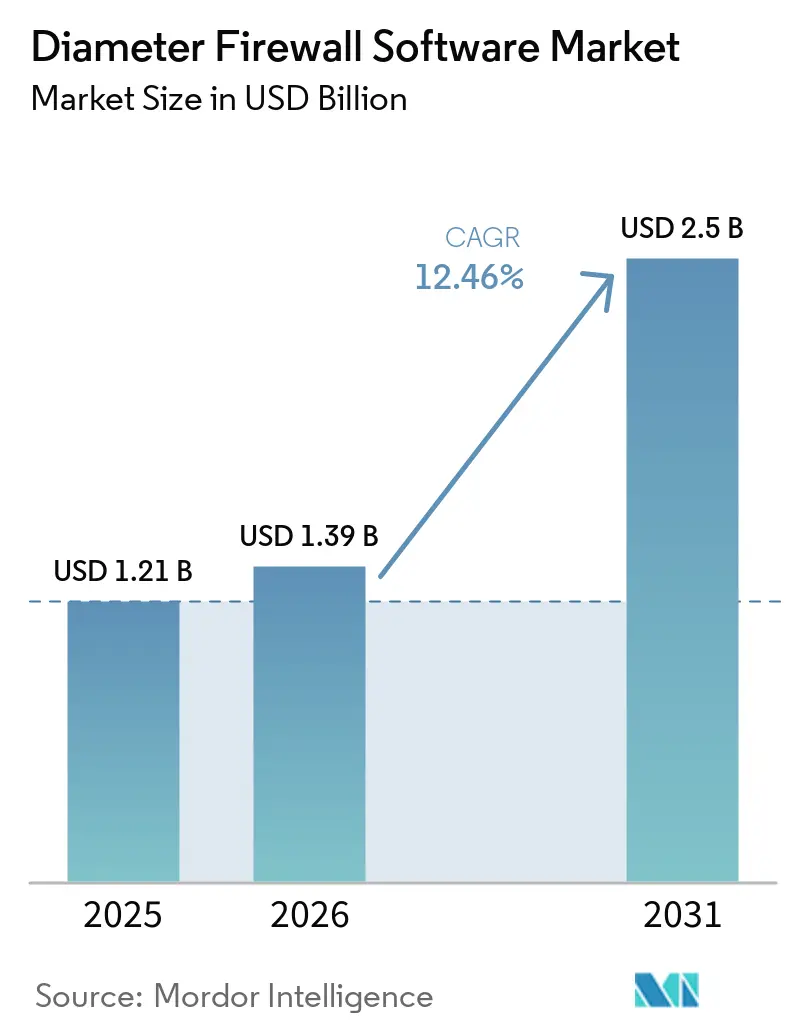
Diameter Firewall Software Market Analysis by Mordor Intelligence
The diameter firewall software market size is projected to expand from USD 1.21 billion in 2025 and USD 1.39 billion in 2026 to USD 2.5 billion by 2031, registering a CAGR of 12.46% between 2026 and 2031. Signaling-based attacks on 4G LTE and 5G core networks are making perimeter security a more immediate operating priority for mobile operators because compromised signaling can expose subscriber data, location information, authentication processes, and roaming relationships. The transition to 5G standalone architecture is extending the period during which Diameter and HTTP/2 interfaces operate together, increasing the importance of cross-protocol protection and coordinated security policies at network boundaries. Compliance expectations under GSMA security frameworks and roaming agreements are moving security decisions closer to network planning and interconnect governance, particularly where operators must demonstrate controls to partners and service providers. Managed security services are gaining relevance as smaller operators and mobile virtual network operators seek specialist support rather than build scarce in-house signaling expertise, while larger operators use external teams to extend continuous monitoring and policy management. Cellular IoT connections are increasing authentication, location, and session-management traffic, placing greater demands on firewall inspection capacity and prompting vendors to offer platforms that support established networks alongside cloud-native core environments.
Key Report Takeaways
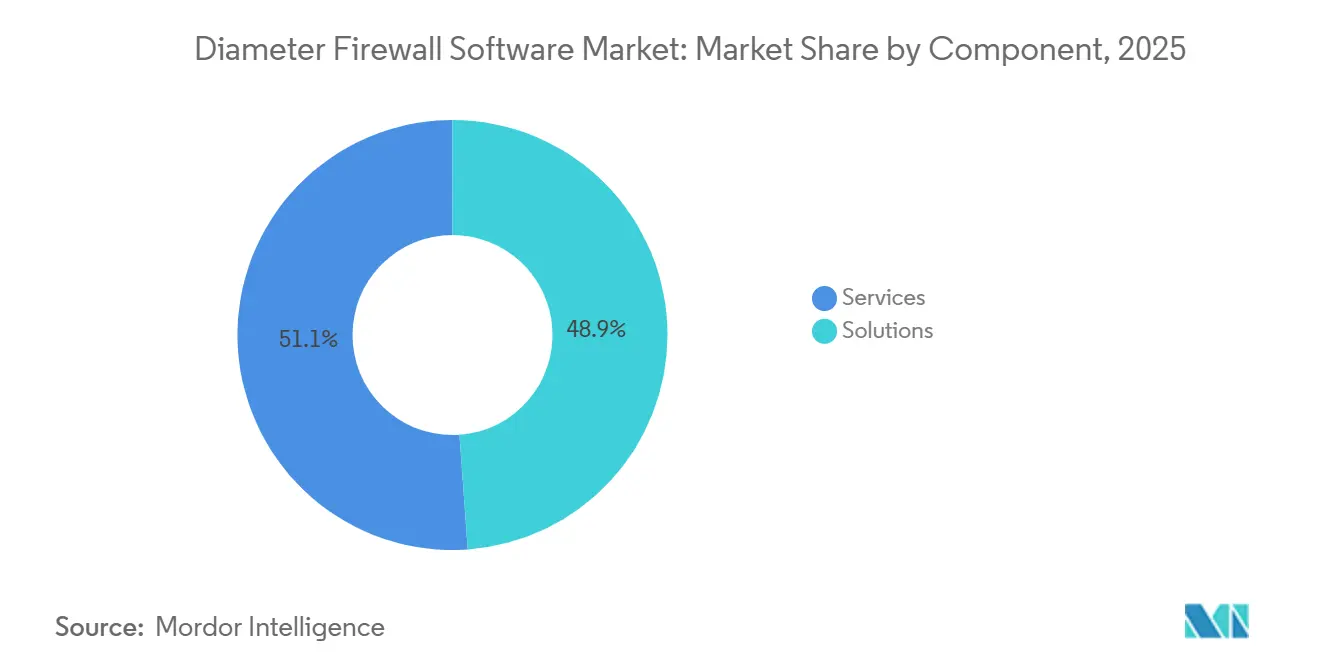
- By component, solutions held 48.87% of component demand in 2025, while services are projected to expand at a 14.11% CAGR through 2031 in the diameter firewall software market.
- By deployment mode, on-premises deployment held 38.98% of demand in 2025, while cloud-based deployment is projected to expand at a 13.87% CAGR through 2031.
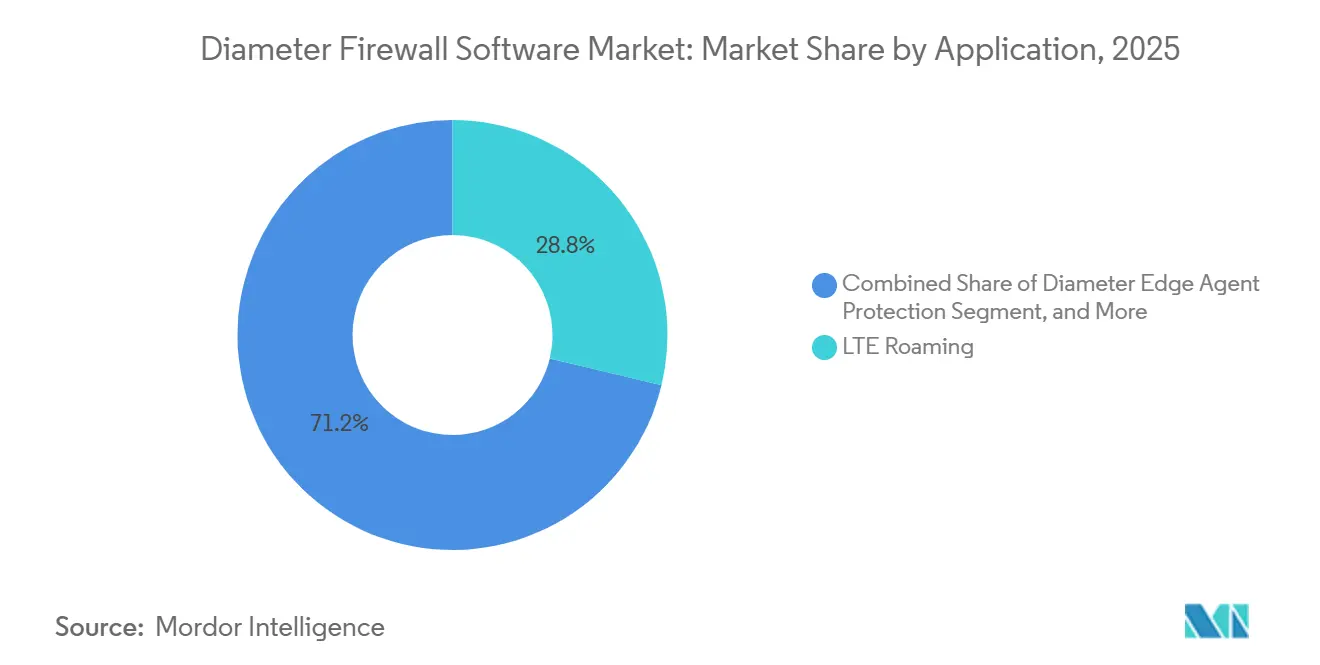
- By application, LTE roaming accounted for 28.76% of demand in 2025, while IoT and machine-to-machine communications are projected to expand at a 14.76% CAGR through 2031 in the diameter firewall software market.
- By network generation, 4G LTE accounted for 47.87% of demand in 2025, while 5G is projected to expand at a 13.54% CAGR through 2031.
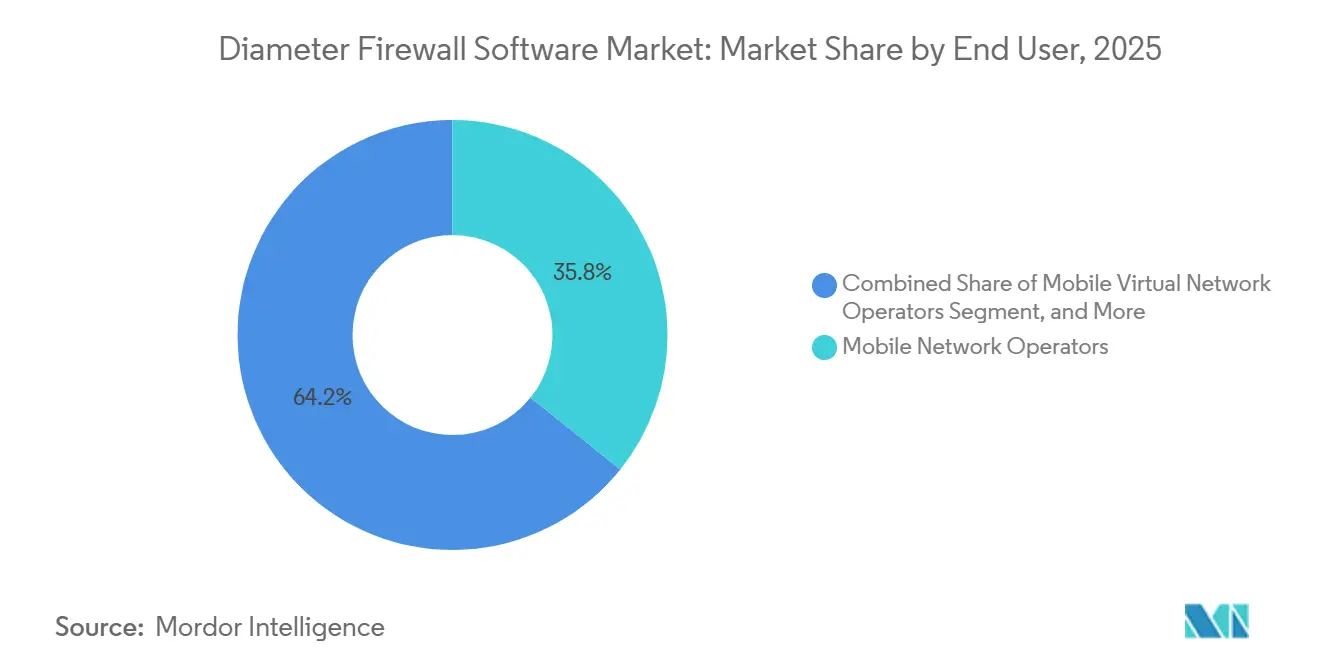
- By end user, mobile network operators held 35.76% of demand in 2025, while mobile virtual network operators are projected to expand at a 14.43% CAGR through 2031 in the diameter firewall software market.
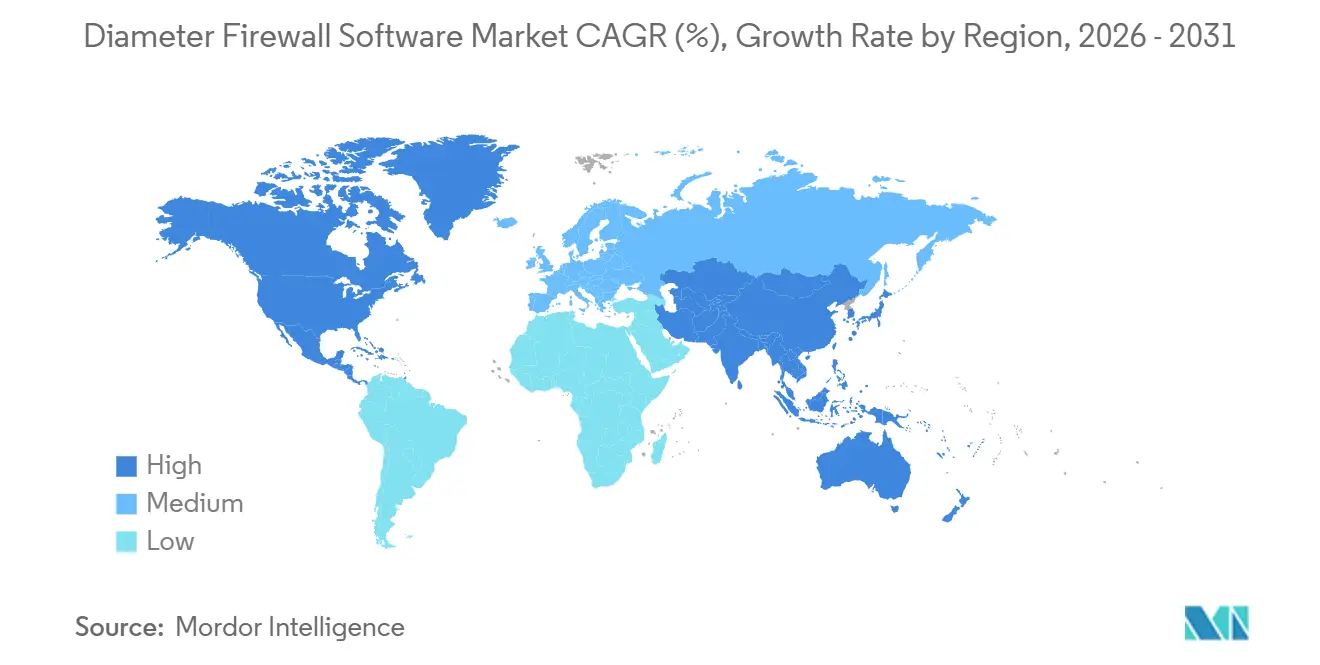
- By geography, Asia-Pacific held 33.21% of demand in 2025, while North America is projected to expand at a 13.65% CAGR through 2031.
Note: Market size and forecast figures in this report are generated using Mordor Intelligence’s proprietary estimation framework, updated with the latest available data and insights as of January 2026.
Global Diameter Firewall Software Market Trends and Insights
Drivers Impact Analysis*
| DRIVER | (~) % IMPACT ON CAGR FORECAST | GEOGRAPHIC RELEVANCE | IMPACT TIMELINE |
|---|---|---|---|
| Rising Signaling-Based Attacks on Mobile Core Networks | +3.5% | Global | Short term (≤ 2 years) |
| Expansion of 5G Standalone and Inter-PLMN Roaming | +2.8% | Global, concentrated in Asia-Pacific, North America, and Europe | Medium term (2-4 years) |
| GSMA Signaling Security Compliance Requirements | +2.2% | Global, anchored in EMEA and Asia-Pacific | Short term (≤ 2 years) |
| Growth of IoT and Machine-to-Machine Signaling | +1.8% | Asia-Pacific core, with spillover to North America and Europe | Medium term (2-4 years) |
| AI-Assisted Cross-Protocol Threat Correlation | +1.4% | Global | Medium term (2-4 years) |
| Monetization of Managed Signaling Security Services | +1.2% | Global, led by North America and Europe | Long term (≥ 4 years) |
| Source: Mordor Intelligence | |||
Rising Signaling-Based Attacks on Mobile Core Networks
Signaling attacks pose an active operational risk for operators that use Diameter in their 4G LTE networks and maintain roaming connections with a broad group of partners. Enea stated that Diameter attacks persisted throughout 2024, often targeting subscriber location data and Home Subscriber Server information.[1] The company also described cross-protocol sequences that combined Diameter with SS7 to bypass single-protocol controls. This changes procurement timing because a known exposure may require action before a planned network refresh and may require a review of existing firewall policy at the same time. A diameter firewall software purchase can therefore shift from a deferred technology project to a network-risk requirement when the operator must demonstrate the ability to identify suspicious messages and prevent unauthorized requests. Multi-protocol inspection is becoming more important where an operator must protect legacy and newer interfaces at the same boundary, without creating a separate operational process for each protocol.
Expansion of 5G Standalone and Inter-PLMN Roaming
5G standalone deployment is widening the security scope rather than removing Diameter from operator networks, because 4G and 5G functions continue to interact during the transition. The Global Mobile Suppliers Association reported 95 commercial 5G standalone launches in April 2026, up 42% from the level recorded in the first quarter of 2025. It also reported that 29% of 5G services globally were running on a standalone architecture at that time.[2] Operators must protect 4G EPC Diameter interfaces while introducing 5G service-based interfaces based on HTTP/2, often while keeping roaming, subscriber management, and policy functions continuously available. This mixed environment increases the need for a coordinated security policy across roaming boundaries and for operating teams that can investigate events that cross protocol domains. The diameter firewall software market benefits when standalone deployments create a longer interworking phase instead of a single replacement event, because protection requirements remain active across both network generations.
GSMA Signaling Security Compliance Requirements
GSMA security guidance gives operators a defined framework for Diameter interconnect protection. FS.19 specifies controls, including mutual TLS, Mobile Management Entity whitelisting at the Diameter Edge Agent, and per-origin-host message-rate limits.[3] These requirements connect a security platform with practical evidence needed for roaming discussions and provider reviews. The ITU-T work program also classified signaling attacks into 4 categories, covering simple requests, multi-request activity, multi-protocol attacks, and cross-generational attacks.[4] This classification helps operators assess whether their controls cover more than isolated protocol events. Saudi Arabia's stc achieved 100% compliance with GSMA signaling protection guidelines in 2025 after testing cross-protocol attack scenarios with Enea. The case shows why compliance evidence can influence procurement across the diameter firewall software market.
Growth of IoT and Machine-to-Machine Signaling
Cellular IoT is increasing the volume and frequency of signaling transactions in operator cores, especially where fleets use repeated registration, authentication, and session requests. Ericsson forecast that cellular IoT connections will approach 8 billion by the end of 2031. Each device can require authentication, location registration, and session management during its operating life, even when it transmits little application data. Large device fleets can therefore raise inspection demand even when individual connections produce limited traffic, because the aggregate number of recurring signaling events can be substantial. Unattended IoT devices may also receive less direct fraud monitoring than consumer subscribers, making abnormal location or session activity harder to detect without network-level controls. This creates a reason to strengthen protection for location requests, credentials, and session activity, while maintaining reliable service for legitimate devices. The diameter firewall software market is responding to this workload with greater emphasis on scalable inspection and multi-protocol visibility across established and newer network functions.
Restraints Impact Analysis*
| RESTRAINT | (~) % IMPACT ON CAGR FORECAST | GEOGRAPHIC RELEVANCE | IMPACT TIMELINE |
|---|---|---|---|
| Complexity of Legacy and Multi-Vendor Integration | -1.8% | Global, more acute in developing markets | Medium term (2-4 years) |
| Shortage of Telecom Signaling Security Specialists | -1.5% | Global | Long term (≥ 4 years) |
| Latency and Availability Sensitivity in Core Networks | -0.8% | Global | Short term (≤ 2 years) |
| Fragmented Accountability Across Roaming Interconnects | -0.6% | Global, particularly Africa and South America | Medium term (2-4 years) |
| Source: Mordor Intelligence | |||
Complexity of Legacy and Multi-Vendor Integration
Many operator networks combine 2G and 3G signaling assets, 4G Diameter Routing Agents, and early 5G service-based elements. A firewall deployment in this environment may require coordination across several equipment suppliers, separate operating teams, different change-control processes, and several testing windows. The central issue is often the lack of standardized security insertion interfaces between incumbent signaling infrastructure and third-party platforms. Each network topology can require a different implementation plan, a tailored traffic-routing design, and careful validation of existing roaming connections. The challenge is greater in markets where multiple network generations remain active, and modernization budgets are limited. This can lengthen deployment schedules and encourage pilot-and-expand buying models within the diameter firewall software market, even when security priorities are clear.
Shortage of Telecom Signaling Security Specialists
Signaling security requires knowledge of SS7, Diameter, GTP-C, HTTP/2, core network design, and the operational processes for managing interconnect partners. This skill set differs from broader cybersecurity work because it also requires operational familiarity with mobile interconnect behavior, traffic flows, and protocol-specific failure risks. Formal telecommunications programs do not always include signaling security in their curricula. The limited number of practitioners with multi-protocol testing experience can delay internal deployment programs and reduce the number of suppliers able to offer fully managed coverage. Managed services can reduce this burden by providing access to specialist teams. This staffing constraint supports services demand but can limit the speed of direct software adoption in the diameter firewall software market.
*Our forecasts treat driver/restraint impacts as directional, not additive. The impact forecasts reflect baseline growth, mix effects, and variable interactions.
Segment Analysis
By Component: Solutions Anchor Demand While Services Scale Faster
Solutions are expected to hold 48.87% of the Diameter firewall software market in 2025, supported by the installed base of standalone and integrated platforms among mobile network operators. Standalone Diameter firewall software focuses on perimeter inspection at the interconnect boundary, where platforms apply rules to messages exchanged with external networks. Integrated systems combine firewall capabilities with signaling controllers for operators that prefer consolidated policy and routing management, reducing the number of tools required for daily operations. Multi-protocol signaling firewalls remain relevant where SS7, Diameter, and GTP-C traffic operate in parallel and operators require a unified view of risks across these protocols. These products enable operators to incorporate multiple protocol controls into a common security architecture. They also support compliance checks at roaming interfaces, testing activities, and policy updates as network usage evolves.
Services are projected to expand at a 14.11% CAGR through 2031, making them the fastest-growing component segment. Managed security services cover monitoring, incident reviews, policy updates, and specialized operational support. These services can benefit internal network teams that must also manage core network modernization projects. Enea is expected to report a five-year managed messaging and signaling security agreement with a global CPaaS provider in the first quarter of 2026, valued at USD 3.4 million. The agreement illustrates the recurring contract structures associated with managed delivery and the ability of service providers to distribute specialist costs across multiple customers. Implementation and integration services support initial deployment, while support and maintenance services generate recurring revenue after installation. This service mix enables vendors to support operators that require protection but lack in-house signaling security capabilities, while allowing customers to retain oversight of critical security decisions.
By Deployment Mode: Cloud-Native Transition Changes Operator Deployment Choices
On-premises deployment is expected to account for 38.98% of demand in 2025, reflecting carrier-grade availability requirements and data sovereignty considerations. Appliance-based core infrastructure also follows long replacement cycles, supporting continued local deployment and limiting disruptive changes to established signaling paths. Operators managing latency-sensitive 4G LTE traffic may prefer to retain inspection capabilities close to the existing core network. This approach can simplify operational control in established Diameter environments, particularly when teams already follow familiar software update and incident-response procedures. It can also meet internal requirements for handling subscriber and signaling data. On-premises systems remain important as operators sequence investments across multiple network generations and assess how cloud-native security can operate alongside existing network assets.
Cloud-based deployment is projected to expand at a CAGR of 13.87% through 2031, the fastest rate among deployment modes. Cloud-native core migration creates new deployment locations for containerized security functions and enables operators to adopt more flexible capacity management to signal demand changes across network domains. Nokia’s Cloud Signaling Director functions are expected to become operational at Rakuten Mobile on Rakuten Cloud in March 2026, supporting inter-network confidentiality and security during roaming. Hybrid deployment offers operators a practical transition path between on-premises and cloud-based models. It can retain local inspection for sensitive 4G LTE traffic while using cloud-managed instances for selected 5G inter-PLMN functions. This flexibility supports broader consideration of cloud delivery across the Diameter firewall software market, particularly for operators who need to modernize without replacing every legacy signaling function at once.
By Application: LTE Roaming Leads While IoT and M2M Communications Accelerate
LTE roaming is expected to account for 28.76% of application demand in the diameter firewall software market in 2025, reflecting sustained cross-border Diameter message exchanges among the 4G subscriber base. Roaming connections require controls that validate messages received from partner networks and help prevent unauthorized requests from reaching sensitive core functions. Diameter Edge Agent inspection supports this process by screening requests at the interconnect perimeter. VoLTE and IMS protection represent adjacent use cases because voice establishment relies on subscriber identity and signaling exchanges that require consistent policy enforcement. Insufficient inspection can expose subscriber information during call setup. LTE roaming, therefore, remains a core installed-base application in the Diameter firewall software market and will continue to require support as operators introduce 5G interfaces and cloud-native core functions.
IoT and machine-to-machine (M2M) communications are projected to expand at a CAGR of 14.76% through 2031. Connected devices generate recurring authentication and session-management activity that can create unfamiliar attack patterns at scale, particularly when devices operate across numerous locations with limited direct supervision. Ericsson expects cellular IoT connections to approach 8 billion by the end of 2031. Diameter Edge Agent protection and 5G interworking are relevant applications for operators that need to manage both legacy and newer protocol domains without creating security gaps during the network transition. Security Edge Protection Proxy deployment can operate alongside Diameter firewall controls during the transition from 4G to 5G. These use cases expand the operational role of signaling security beyond traditional roaming traffic and increase the need for inspection capabilities that can scale with larger device populations.

By Network Generation: 4G LTE Supports the Installed Base While 5G Changes Procurement
4G LTE is expected to account for 47.87% of demand in 2025, reflecting the scale of the global EPC installed base. Diameter supports subscriber authentication, mobility management, and policy enforcement across these networks. Long replacement cycles sustain demand for perimeter security even as operators deploy 5G networks. Existing 4G roaming agreements also maintain the need for interconnect controls. The 4G LTE installed base provides a stable platform for firewall capability upgrades and remains a material source of business for vendors in the Diameter firewall software market.
5G is projected to expand at a CAGR of 13.54% through 2031. The Global Mobile Suppliers Association is expected to record 95 commercial standalone launches in April 2026, with standalone services accounting for 29% of global 5G services. China’s GB/T 46462-2025 is expected to take effect in February 2026 and establish technical requirements for 5G mobile communication security. China Mobile, ZTE, Nokia Shanghai Bell, and CAICT participated in the development of the standard. National requirements can create greater consistency in security procurement as operators shift from voluntary guidance to formal technical baselines. Operators also require coordinated protection while 4G and 5G networks remain interconnected.
By End User: MNOs Hold the Base While MVNOs Expand Their Security Role
Mobile network operators (MNOs) are expected to account for 35.76% of demand in the Diameter firewall software market in 2025, supported by their direct responsibility for core networks and roaming relationships. These operators must manage compliance requirements and partner reviews across a limited number of large national networks. Their demand remains predictable but concentrated among established carriers. Procurement frequently encompasses platform capacity, integration, and long-term operational support, making MNO contracts strategically important for suppliers. The MNO segment continues to form the installed base of the Diameter firewall software market.
Mobile virtual network operators (MVNOs) are projected to expand at a CAGR of 14.43% through 2031. Some MVNOs are moving beyond fully hosted security arrangements as enterprise IoT customers request clearer evidence of independent signaling protection. International roaming hubs and signaling service providers also manage traffic across multiple operator relationships. Their investment per organization can be substantial because they aggregate signaling activity from several partners. In 2024, Mobileum and Syniverse announced a collaboration under which Syniverse resells Mobileum’s signaling firewall, while Mobileum resells Syniverse’s Diameter signaling and SS7 services. This arrangement illustrates why bundled service delivery can appeal to intermediaries in this segment.
Geography Analysis
Asia-Pacific is expected to account for 33.21% of global demand in 2025, giving it the largest share of the Diameter firewall software market. China, India, South Korea, and Japan combine dense mobile ecosystems with active 5G programs, significant roaming activity, and a broad range of operators that must coordinate security across complex interconnect environments. China is expected to publish YD/T 6807-2026 in April 2026 for 5G core network inter-carrier roaming security protection and detection. The standard is scheduled to take effect on August 1, 2026, and will cover roaming interconnect protection requirements. China Mobile, Huawei, ZTE, and CAICT are participating in its drafting. India’s 5G rollout and inter-operator arrangements are increasing the scale of Diameter-based policy enforcement, while its large subscriber base makes consistent security operations an ongoing priority. Japan and South Korea are also generating demand through standalone-focused network strategies and layered requirements across MNO and MVNO operations.
North America is projected to expand at a CAGR of 13.65% through 2031, representing the fastest regional growth rate in the Diameter firewall software market. Large-scale 5G standalone commercialization and a growing MVNO base are supporting regional demand, while operators are also assessing the resilience of established 4G roaming and subscriber management systems. Federal focus on telecom core security reinforces the need for controls at sensitive network boundaries and elevates discussions of signaling security among senior operational decision-makers. Europe remains a significant market, as GSMA FS.19 and FS.21 requirements continue to influence roaming assessments and IPX provider expectations. Deutsche Telekom is expected to launch Europe’s first commercial 5G RedCap service in Germany in September 2025, creating an additional IoT connectivity tier. In February 2026, BICS is expected to partner with Anapaya to deploy SCION-based secure internet technology across its backbone, with planned points of presence in Belgium, France, Singapore, and the United States. This initiative demonstrates how roaming hubs are extending security measures beyond conventional Diameter perimeter controls and treating interconnect protection as a broader network design consideration.
The Middle East is advancing as operators expand 5G networks and assess coverage of signaling control. Saudi Arabia’s stc is expected to achieve 100% compliance with GSMA signaling protection guidelines in 2025 following a program that uses cross-protocol Diameter and SS7 attack simulations. This outcome could provide a reference point for operators in the UAE and Kuwait as they review their coverage and the evidence required for roaming and security assurance. South America and Africa remain earlier-stage markets, where 4G LTE remains more prevalent, and capital availability can constrain investment. Mobile money services in sub-Saharan Africa rely on SIM-based authentication, increasing the need for protection against location tracking and account takeover. Brazil represents a near-term opportunity in South America, as it combines multiple LTE carriers with cross-border roaming activity. Nigeria and South Africa are supporting African demand through IoT deployments and rising inter-carrier traffic, although deployment models may need to accommodate older core infrastructure and limited technical resources.
Competitive Landscape
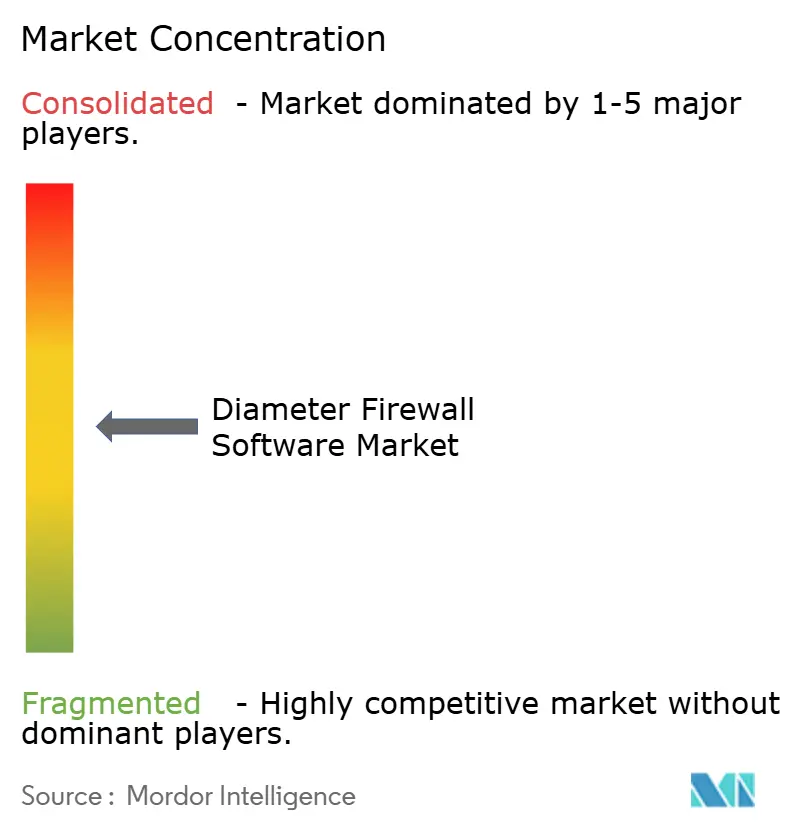
The Diameter firewall software market is moderately concentrated, with specialist vendors competing for managed service and licensed software contracts with MNOs, MVNOs, and roaming hubs. Enea, Mobileum, Nokia, Oracle, Cellusys, Tata Communications, and SecurityGen are among the vendors active in signaling security. Their offerings range from standalone software to multi-protocol platforms and managed services. Enea’s Adaptive Signaling Firewall supports SS7, Diameter, GTP-C, HTTP/2, SIP, and ISUP, enabling a unified approach to protocol inspection. The company’s technology leadership also participates in the GSMA Mobile Threat Intelligence Framework working group. Oracle offers its Diameter Security Application through the Oracle Communications Diameter Signaling Router. This integrated approach can eliminate the need for a separate procurement step for operators already using Oracle signaling infrastructure, making the existing network supplier relationship an important factor in vendor selection.
Managed security services represent an important competitive area, as vendors can differentiate through threat intelligence, policy updates, operational support, and their ability to respond to newly identified protocol-specific risks. Mobileum is expected to present its Signal to Value strategy at MWC Barcelona 2026, positioning real-time signaling data as a source of revenue protection and fraud mitigation. This approach positions signaling security as a component of both commercial protection and network compliance. The MVNO segment remains an opportunity, as smaller operators may require independent controls without the cost of a full enterprise deployment or a large specialized operations team. Compact, cloud-delivered platforms can address this need when host-MNO arrangements no longer meet enterprise customer requirements. The Diameter firewall software industry is also being shaped by suppliers that combine firewall capabilities with routing, roaming, and managed services, simplifying procurement decisions for customers seeking a single operational partner.
Cellusys and Ribbon Communications are expected to enter a source-code licensing arrangement that integrates the Ribbon STP and Diameter Signaling Controller with Cellusys’ firewall and roaming stack. This arrangement demonstrates how signaling controller suppliers can bring security closer to the native network layer and provide customers with a more integrated approach to managing routing and protection. It could reduce the addressable need for standalone products while increasing demand for integrated solutions. Nokia’s planned commercial deployment at Rakuten Mobile in March 2026 is also expected to demonstrate a cloud-native signaling architecture for a live 4G and 5G core. Enea’s anticipated five-year CPaaS agreement in the first quarter of 2026 indicates continued interest in multi-year managed security contracts. These developments indicate that service depth, protocol coverage, and deployment flexibility are becoming as important as software features, particularly for operators managing multiple network generations. The Diameter firewall software market continues to favor vendors that can support both legacy and cloud-native core environments, as well as the operational teams responsible for managing them.
Diameter Firewall Software Industry Leaders
-
Cisco Systems, Inc.
-
Enea AB
-
Nokia Corporation
-
AMD Telecom SA
-
Cellusys Limited
- *Disclaimer: Major Players sorted in no particular order
Recent Industry Developments
- April 2026: China’s Ministry of Industry and Information Technology published industry standard YD/T 6807-2026 for 5G core network inter-carrier roaming security protection and detection, effective August 1, 2026. Co-drafted by China Mobile, Huawei, ZTE, and CAICT, the standard establishes mandatory security requirements for Diameter signaling in inter-carrier roaming deployments across China.
- March 2026: Mobileum showcased its “Signal to Value” strategy at MWC Barcelona 2026, demonstrating the capabilities of its Active Intelligence platform to convert real-time signaling events across SS7, Diameter, GTP, and 5G core protocols into revenue-protection and fraud-mitigation actions, serving over 1,000 operator clients globally.
- March 2026: Nokia’s cloud-native IMS, Subscriber Data Management, and Cloud Signaling Director functions went live in commercial operations at Rakuten Mobile on Rakuten Cloud. The deployment validates Nokia’s cloud-native signaling security architecture, including inter-network confidentiality during roaming, in a live 5G core environment.
- March 2026: Netcracker Technology and BICS agreed to a strategic upgrade of BICS’s Netcracker Digital OSS platform, covering Resource Inventory, Service Inventory, Service Problem Management, and Network Planning and Design, to enhance the stability and security of the OSS platform underpinning BICS’s wholesale roaming, 5G, IoT IPX, and signaling services.
Global Diameter Firewall Software Market Report Scope
The Diameter Firewall Software Market Report is Segmented by Component (Solutions, [Standalone Diameter Firewall Software, Diameter Firewall Integrated With Signaling Controllers, and Multi-Protocol Signaling Firewall Software] and Services [Implementation and Integration Services, Managed Security Services, and Support and Maintenance Services]), Deployment (On-Premises, Cloud-Based, and Hybrid), Application (LTE Roaming, VoLTE and IMS, Diameter Edge Agent Protection, IoT and Machine-to-Machine Communications, 5G Interworking, and Other Applications), Network Generation (3G, 4G LTE, and 5G), End User (Mobile Network Operators, Mobile Virtual Network Operators, International Roaming Hubs and Signaling Service Providers, and Othe End User), and Geography (North America, South America, Europe, Asia-Pacific, and Middle East and Africa). The Market Forecasts are Provided in Terms of Value (USD).
| Solutions | Standalone Diameter Firewall Software |
| Diameter Firewall Integrated With Signaling Controllers | |
| Multi-Protocol Signaling Firewall Software | |
| Services | Implementation and Integration Services |
| Managed Security Services | |
| Support and Maintenance Services |
| On-Premises |
| Cloud-Based |
| Hybrid |
| LTE Roaming |
| VoLTE and IMS |
| Diameter Edge Agent Protection |
| IoT and Machine-to-Machine Communications |
| 5G Interworking |
| Other Applications |
| 3G and Legacy Interworking |
| 4G LTE |
| 5G |
| Mobile Network Operators |
| Mobile Virtual Network Operators |
| International Roaming Hubs and Signaling Service Providers |
| Other End Users |
| North America | United States |
| Canada | |
| Mexico | |
| South America | Brazil |
| Argentina | |
| Rest of South America | |
| Europe | United Kingdom |
| Germany | |
| France | |
| Italy | |
| Rest of Europe | |
| Asia-Pacific | China |
| India | |
| Japan | |
| South Korea | |
| Rest of Asia-Pacific | |
| Middle East | Saudi Arabia |
| United Arab Emirates | |
| Rest of Middle East | |
| Africa | South Africa |
| Nigeria | |
| Rest of Africa |
| By Component | Solutions | Standalone Diameter Firewall Software |
| Diameter Firewall Integrated With Signaling Controllers | ||
| Multi-Protocol Signaling Firewall Software | ||
| Services | Implementation and Integration Services | |
| Managed Security Services | ||
| Support and Maintenance Services | ||
| By Deployment Mode | On-Premises | |
| Cloud-Based | ||
| Hybrid | ||
| By Application | LTE Roaming | |
| VoLTE and IMS | ||
| Diameter Edge Agent Protection | ||
| IoT and Machine-to-Machine Communications | ||
| 5G Interworking | ||
| Other Applications | ||
| By Network Generation | 3G and Legacy Interworking | |
| 4G LTE | ||
| 5G | ||
| By End User | Mobile Network Operators | |
| Mobile Virtual Network Operators | ||
| International Roaming Hubs and Signaling Service Providers | ||
| Other End Users | ||
| By Geography | North America | United States |
| Canada | ||
| Mexico | ||
| South America | Brazil | |
| Argentina | ||
| Rest of South America | ||
| Europe | United Kingdom | |
| Germany | ||
| France | ||
| Italy | ||
| Rest of Europe | ||
| Asia-Pacific | China | |
| India | ||
| Japan | ||
| South Korea | ||
| Rest of Asia-Pacific | ||
| Middle East | Saudi Arabia | |
| United Arab Emirates | ||
| Rest of Middle East | ||
| Africa | South Africa | |
| Nigeria | ||
| Rest of Africa | ||
Key Questions Answered in the Report
What is the diameter firewall software market size?
The diameter firewall software market size is USD 1.39 billion in 2026 and is projected to reach USD 2.5 billion by 2031 at a 12.46% CAGR. The outlook reflects continuing demand for protection at 4G LTE and 5G core network boundaries, where subscriber authentication, roaming messages, and policy requests require consistent screening.
What is driving demand for Diameter firewall platforms?
Persistent signaling attacks, 5G standalone migration, roaming requirements, and higher IoT signaling volumes are driving demand. The Diameter firewall software market also benefits when operators need coordinated policies across Diameter, SS7, and newer 5G interfaces, rather than separate controls that can leave protocol gaps during interworking.
Which component leads demand for Diameter firewall software?
Solutions led with 48.87% of demand in 2025, while services are projected to expand at a 14.11% CAGR through 2031. Services address specialist needs for monitoring, policy changes, implementation, and ongoing operational support, helping customers maintain protection when their internal network teams have limited expertise in security signaling.
Why is cloud deployment becoming more important for signaling security?
Operators are introducing cloud-native core functions and need deployment options that support 5G inter-PLMN security. Cloud-based deployment is projected to expand at a 13.87% CAGR, while hybrid designs can preserve local control for established 4G LTE inspection and introduce containerized functions in selected parts of the core.
Which application is expanding fastest?
IoT and machine-to-machine communications are projected to expand at a 14.76% CAGR through 2031 as connected devices increase authentication and session activity. The diameter firewall software market must support scalable inspection as device fleets generate more recurring signaling events, including requests that are difficult to monitor directly at the device level.
Which region is expanding fastest?
North America is projected to expand at a 13.65% CAGR through 2031, supported by the commercialization of 5G standalone and an expanding MVNO ecosystem. The diameter firewall software market in the region also reflects attention to sensitive telecom core network boundaries and the need to protect legacy interfaces while 5G deployments become more extensive.