
Dental Veneers Market Size and Share
Market Overview
| Study Period | 2020 - 2031 |
|---|---|
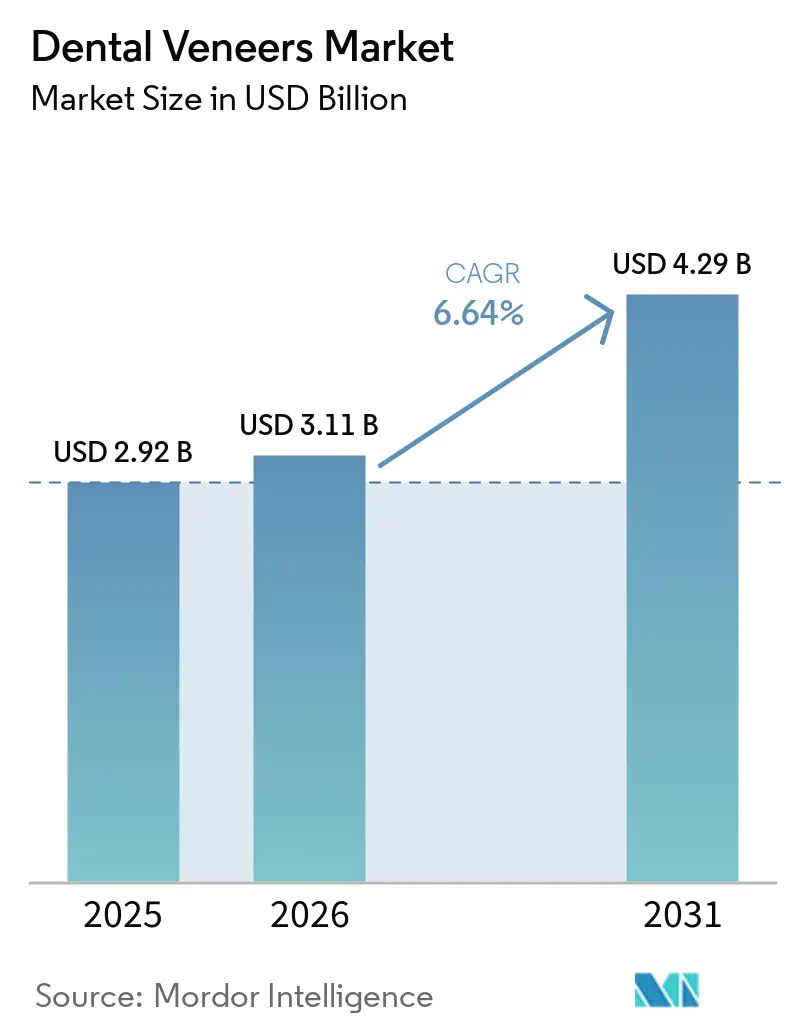
| Market Size (2026) | USD 3.11 Billion |
| Market Size (2031) | USD 4.29 Billion |
| Growth Rate (2026 - 2031) | 6.64 % |
| Fastest Growing Market | Asia-Pacific |
| Largest Market | North America |
| Market Concentration | Low |
Major Players *Disclaimer: Major Players sorted in no particular order Image © Mordor Intelligence. Reuse requires attribution under CC BY 4.0. | |
Dental Veneers Market Analysis by Mordor Intelligence
The Dental Veneers Market size is projected to be USD 2.92 billion in 2025, USD 3.11 billion in 2026, and reach USD 4.29 billion by 2031, growing at a CAGR of 6.64% from 2026 to 2031.
The dental veneers market is moving beyond demand tied only to weddings, celebrations, and other events, because video-based communication has made dental appearance more visible in routine professional settings. This pattern supports more consistent consultation activity across routine care cycles and gives clinics a wider opportunity to discuss multi-unit treatment plans before patients face a time-sensitive event. Rising middle-class populations in Southeast Asia and Latin America are expanding the patient base in markets where treatment fees are lower, while private clinics build their aesthetic service capacity. Competitive strategies increasingly center on workflow integration, material performance, and the ability to shorten the time between consultation and placement, because providers who explain treatment clearly and deliver predictable results can protect patient confidence in a discretionary procedure. The dental veneers market also faces pressure from imported material costs and from patient expectations shaped by curated online images, which can complicate clinical consent and satisfaction management.
Key Report Takeaways
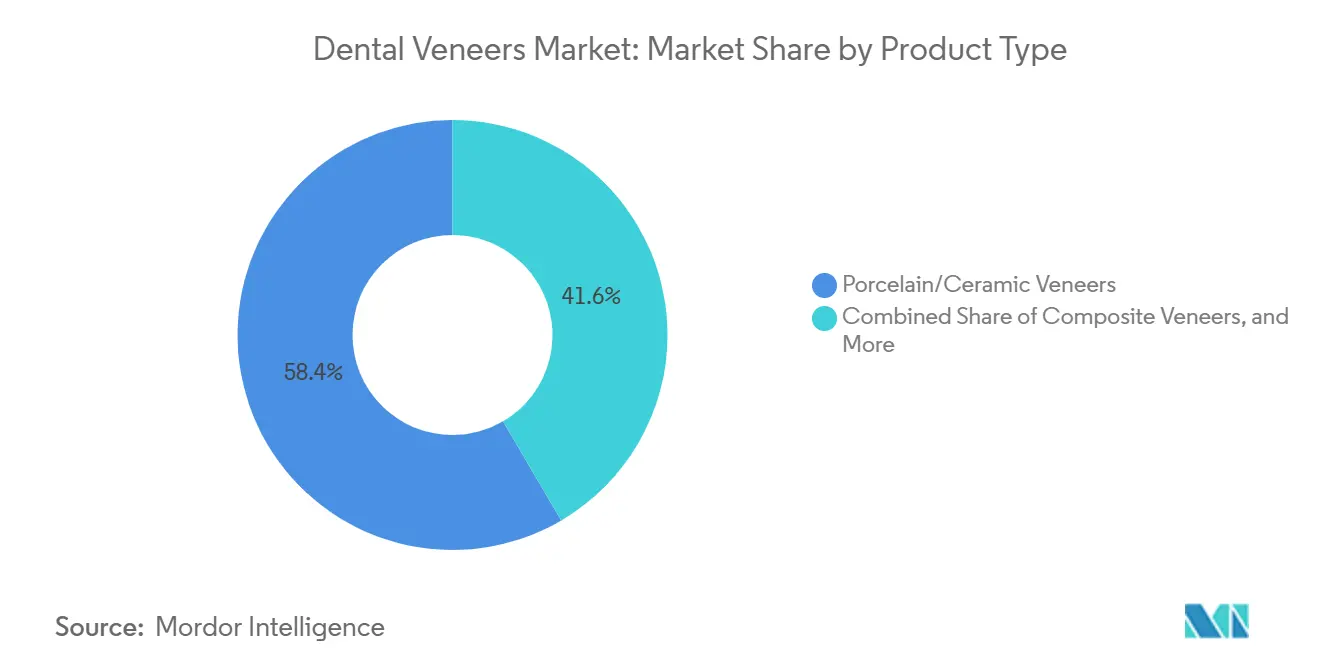
- By product type, porcelain and ceramic veneers held 58.43% of the dental veneers market share in 2025, while ultra-thin and no-prep systems are forecast to expand at an 8.12% CAGR through 2031.
- By application, cosmetic smile enhancement accounted for 72.38% of the dental veneers market size in 2025, while restorative and functional correction is projected to grow at a 7.04% CAGR through 2031.
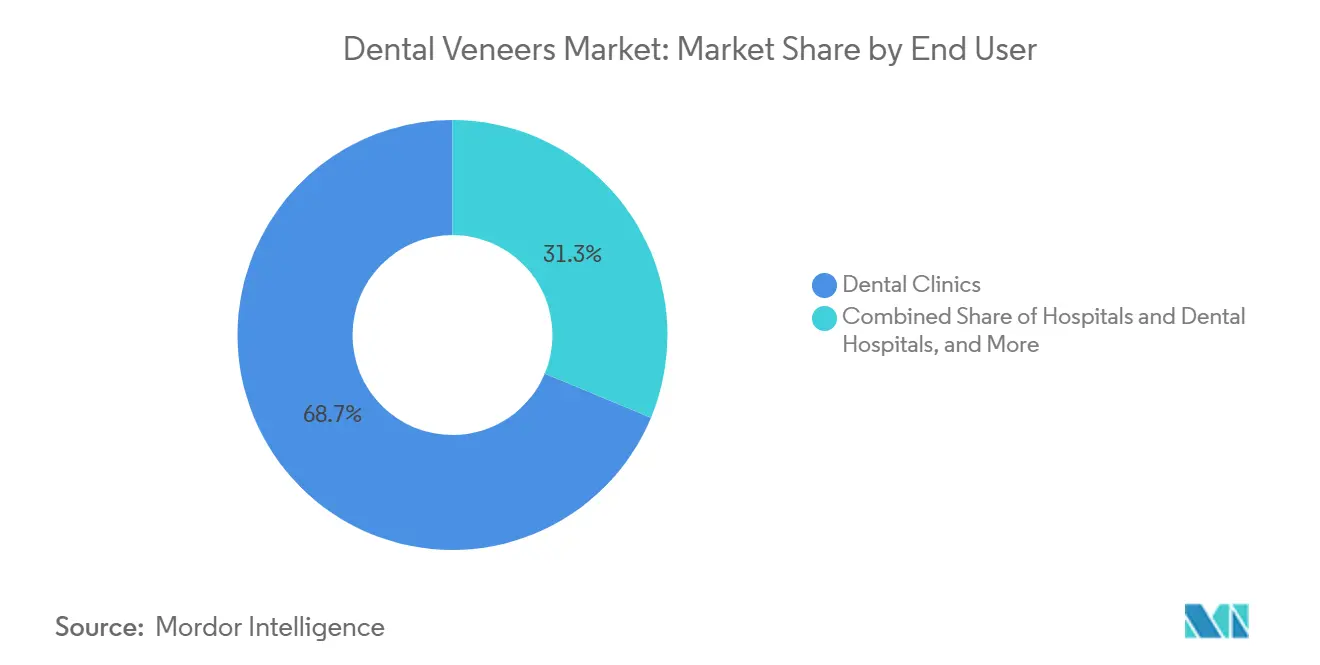
- By end user, dental clinics held 68.72% of the dental veneers market share in 2025, while hospitals and dental hospitals are forecast to expand at a 7.89% CAGR through 2031.
- By geography, North America accounted for 41.57% of the dental veneers market in 2025, while Asia-Pacific is projected to grow at an 8.21% CAGR through 2031.
Note: Market size and forecast figures in this report are generated using Mordor Intelligence’s proprietary estimation framework, updated with the latest available data and insights as of January 2026.
Market Trends and Insights
Drivers Impact Analysis of Dental Veneers Market*
| Driver | (~) % Impact on CAGR Forecast | Geographic Relevance | Impact Timeline |
|---|---|---|---|
| Rising Demand for Smile Aesthetics | +1.8% | Global, with the highest concentration in North America and Western Europe | Medium term (2-4 years) |
| Preference for Minimally Invasive Veneer Procedures | +1.3% | Global | Short to medium term (1-3 years) |
| Digital Smile Design and Chairside CAD/CAM Adoption | +1.2% | North America, Western Europe, urban Asia-Pacific | Medium term (2-4 years) |
| Dental Tourism and Cross-Border Cosmetic Care | +0.9% | Asia-Pacific, Latin America, the Middle East, and Africa | Medium to long term (2-5 years) |
| Social-Media-Led Appearance Consciousness | +0.7% | Global, strongest in the 18-40 age demographic | Short term (≤2 years) |
| Low-Cost Direct Composite Workflows Expanding Access | +0.5% | Asia-Pacific, Latin America, the Middle East, and Africa | Short term (≤2 years) |
| Source: Mordor Intelligence | |||
Rising Demand for Smile Aesthetics
Smile aesthetics have become a routine consideration for many working-age adults, especially where video calls and online profiles affect professional visibility. A 2024 Scientific Reports study found that 29.37% of participants said social media influenced their decision to seek esthetic dental treatment, and 33.33% used social platforms to find information about their latest procedure.[1] Patients are therefore more likely to reach a consultation with an initial understanding of the procedure, its visual outcome, and the choices that clinicians may need to explain. That preparation can reduce the time required to explain basic treatment choices and may support acceptance of multi-unit cases. Urbanization and higher disposable income in secondary and tertiary cities in Southeast Asia and Latin America are adding demand in lower-fee settings, where patient volumes can offset lower average treatment fees. The dental veneers market benefits when clinics can convert this awareness into realistic treatment plans that address both aesthetic goals and clinical suitability.
Preference for Minimally Invasive Veneer Procedures
No-prep and ultra-thin systems extend veneer treatment to patients who are concerned about irreversible tooth preparation or have limited enamel available for a conventional procedure. A 2025 clinical evaluation of Prettau no-prep zirconia veneers reported a 0.5% fracture rate, 96.0% of restorations rated very good for color match, and retention of anatomical form in all restorations assessed. These results give clinicians evidence to discuss a more conservative option with patients who might otherwise defer treatment because they remain unsure about preparation and future maintenance needs. The systems can lower the psychological barrier for first-time patients because they reduce concern around permanent enamel alteration and make consultation discussions feel less irreversible. ISO 10477:2025 also sets updated benchmarks for polymer-based crown and veneering materials, giving laboratories and clinicians a common frame for assessing permanent veneer materials. The dental veneers market is likely to gain from wider use of protocols that balance preparation, bond strength, and long-term maintenance.
Digital Smile Design and Chairside CAD/CAM Adoption
Digital smile design and chairside CAD/CAM systems reduce the time between assessment, design, and fabrication for cases that can be completed without complex laboratory coordination. Research published in BMC Oral Health in 2025 found that dental photography and visual content used before treatment improved patient understanding and supported consent for planned aesthetic outcomes.[2] The visual preview gives patients a clearer basis for discussing tooth shape, shade, and expected changes before treatment begins, while allowing the clinician to record preferences and explain whether they are clinically achievable. Chairside workflows can also reduce reliance on external laboratories for suitable cases and limit delays caused by repeated physical transfers, shipping, and changes to a physical model. Kuraray Noritake Dental introduced its CERABIEN MiLai micro-layering porcelain system for zirconia and lithium disilicate substrates, supporting thin porcelain application in high-aesthetic restorations. The dental veneers market will increasingly favor clinics and laboratories that can combine digital planning with controlled finishing and shade management.
Dental Tourism and Cross-Border Cosmetic Care
Dental tourism redirects some price-sensitive cosmetic cases from higher-cost countries to destinations with lower treatment fees and established dental capacity. BBC Mundo documented the concentration of dental services in Los Algodones, Mexico, which serves patients from the United States seeking lower-cost dental care. These patient flows support procedure volume without requiring clinics in origin markets to reduce their own private-pay pricing or alter the level of service offered to local patients. Thailand, India, Mexico, Colombia, and South Korea remain relevant destinations because of their clinical infrastructure, international accessibility, or established aesthetic dentistry base. The model also develops clinical capabilities in destination countries, where providers can progress from simpler cosmetic cases to more complex restorative work as training, laboratories, and patient demand develop. The dental veneers market, therefore, gains from cross-border care, while providers must maintain clear quality controls, follow-up arrangements, and patient communication.
Restraints Impact Analysis of Dental Veneers Market*
| Restraint | (~) % Impact on CAGR Forecast | Geographic Relevance | Impact Timeline |
|---|---|---|---|
| High Out-of-Pocket Treatment Cost and Limited Reimbursement | -0.7% | North America and Western Europe | Long term (≥ 4 years) |
| Enamel Removal and Long-Term Complication Concerns | -0.4% | Global | Long term (≥ 4 years) |
| Shade-Matching and Replication Variability Across Digital Workflows | -0.2% | Global | Medium term (2-4 years) |
| Imported Ceramic and Resin Input Cost Volatility | -0.2% | Asia-Pacific and Latin America | Short term (≤ 2 years) |
| Source: Mordor Intelligence | |||
High Out-of-Pocket Treatment Cost and Limited Reimbursement
Private-pay pricing limits veneer treatment for many patients, even where awareness is broad, and interest has been reinforced by online dental imagery. This effect is strongest where elective aesthetic procedures receive little or no reimbursement and household budgets remain the main determinant of access, rather than clinical need alone. In Germany and France, public coverage focuses on functional restoration, leaving cosmetic veneer expenditure in the private-pay category. The resulting gap between interest and purchasing power can lead patients to postpone care, choose direct composite work, or seek treatment abroad without access to a familiar local provider. Discounted care may create added concern when color replication, bonding, or post-treatment review is inconsistent. The dental veneers market will remain constrained in price-sensitive patient groups unless financing options and lower-cost alternatives develop sufficient clinical credibility, reliable color performance, and a clear maintenance pathway for patients.
Enamel Removal and Long-Term Complication Concerns
Conventional porcelain veneer procedures can require enamel reduction of 0.3-1.5 mm, which may concern younger patients who anticipate future replacement cycles. A 2025 randomized trial comparing zirconia veneers bonded with MDP-containing adhesives and lithium disilicate alternatives found comparable 12-month survival, but recorded early debonding in 1 zirconia case and fracture in 1 lithium disilicate case. The findings support continued monitoring rather than a simple claim that any material removes long-term risk, particularly when the patient may need future repair or replacement. Online aesthetic content can heighten this concern when it presents appearance outcomes more often than maintenance needs, repair requirements, or potential complications over time. A 2025 systematic review on aesthetic dentistry ethics described growing demand for clinically unnecessary or irreversible procedures and associated professional concerns. The dental veneers market depends on careful assessment, informed consent, and follow-up protocols that protect both patient expectations and clinical standards.
*Our forecasts treat driver/restraint impacts as directional, not additive. The impact forecasts reflect baseline growth, mix effects, and variable interactions.
Dental Veneers Market Segment Analysis
By Product Type:
Ceramics Lead as No-Prep Systems Widen the Eligibility PoolPorcelain and ceramic veneers accounted for 58.43% of the dental veneers market size in 2025. Their position reflects established clinical use, high translucency, stain resistance, and a broad evidence base for longevity in appropriate cases. Ivoclar's IPS e.max lithium disilicate portfolio remains an important reference point for anterior restorations, with an October 2025 scientific report summarizing more than 20 international studies and survival rates above 95%.[3] Ceramic materials are suited to patients who place a premium on stable appearance and durable surface properties, especially when several anterior teeth require a consistent visual result. Composite veneers remain important in cost-sensitive settings because they can be placed chairside in a single visit, use lower-cost materials, and provide an accessible starting point for selected patients. Tokuyama Dental's OMNICHROMA has continued to support direct chairside workflows through its single-shade composite approach, although material selection still depends on the clinical case.
Ultra-thin and no-prep systems are the fastest-growing product category, with the dental veneers market size for this segment projected to grow at an 8.12% CAGR from 2026 to 2031. Their appeal comes from the ability to preserve more tooth structure and serve patients who are hesitant about conventional preparation. Kuraray Noritake Dental's CERABIEN MiLai system supports thin porcelain layering on zirconia and lithium disilicate substrates, which can help technicians achieve a refined finish in conservative restorations. The Prettau clinical study also indicated that wall thicknesses of 0.3-0.4 mm can produce clinically acceptable outcomes in selected cases. Palatal and occlusal veneers remain smaller by volume but are gaining acceptance in full-mouth rehabilitation. A 2025 BMC Oral Health study found clinically acceptable marginal fit and fracture resistance for CAD/CAM glass ceramic occlusal veneers using butt joint and hollow chamfer preparation designs. Removable cosmetic veneers continue to serve a separate nonclinical group seeking reversible, low-cost aesthetic options.

By Application:
Cosmetic Volume Dominates; Restorative Function AcceleratesCosmetic smile enhancement accounted for 72.38% of the dental veneers market share in 2025. Patients commonly seek this application for discoloration, shape irregularities, minor alignment concerns, and diastema closure. Digital photography and smile simulation can help patients understand the planned result before preparation or placement, while allowing clinicians to discuss limits in shade, contour, and symmetry. The 2025 BMC Oral Health research on dental photography found that visual materials affect dentist selection and can shape expectations around aesthetic treatment. Clinics with clear visual planning may be better placed to turn self-referred interest into informed treatment acceptance. Cosmetic demand remains closely connected to social-media visibility, though clinical assessment must determine whether veneers are appropriate for the patient.
Restorative and functional correction is forecast to expand at a 7.04% CAGR through 2031 within the dental veneers market. This application benefits from demand related to enamel erosion, dietary acids, gastric reflux, bruxism, and tooth wear in older populations. Veneers can offer a more conservative option than full crowns when the clinical condition allows it. A 2025 systematic review found strong clinical evidence for both milled and pressed lithium disilicate veneers in anterior restoration, with workflow preference and digital integration increasingly guiding material choice.[4] This overlap between cosmetic and functional needs gives clinicians a broader discussion with patients who are not seeking appearance changes alone. Other applications, including tooth structure protection, pediatric use, and trauma correction, remain smaller but may gain relevance as conservative protocols become more established.
By End User:
Clinics Command Volume While Hospitals and Dental Hospitals Drive Unit Value GrowthDental clinics held 68.72% of the dental veneers market share in 2025, reflecting their role as the first point of contact for cosmetic consultations. Many clinics are investing in intraoral scanners, digital smile design software, and in-office CAD/CAM equipment to improve case planning and delivery. Integrated design-and-mill workflows can improve processing speed for suitable cases and reduce reliance on external laboratory schedules. These capabilities can distinguish digitally equipped clinics from practices that depend entirely on laboratory fabrication, particularly when patients value shorter appointments and more immediate visual communication. Dental laboratories nonetheless remain essential for complex multi-unit, multi-arch, and high-characterization cases. Academic and research institutions also provide clinical evidence that guides material selection and professional practice across the dental veneers industry.
Hospitals and dental hospitals are forecast to grow at a 7.89% CAGR through 2031 in the dental veneers market. Their growth is linked to restorative cases that require multidisciplinary planning, access to dental specialists, and coordination with broader oral health treatment needs. These facilities are integrating intraoral scanning, CAD/CAM systems, and digital treatment planning to improve procedural coordination. Higher incidence of tooth wear, enamel erosion, and complex dental conditions can direct patients toward hospital-based departments. Hospitals can also support treatment where broader clinical review is needed before a veneer-based plan is selected. Continued investment in digital dentistry infrastructure should improve access to aesthetic and restorative options within institutional care settings.
Geography Analysis
North America Dental Veneers Market
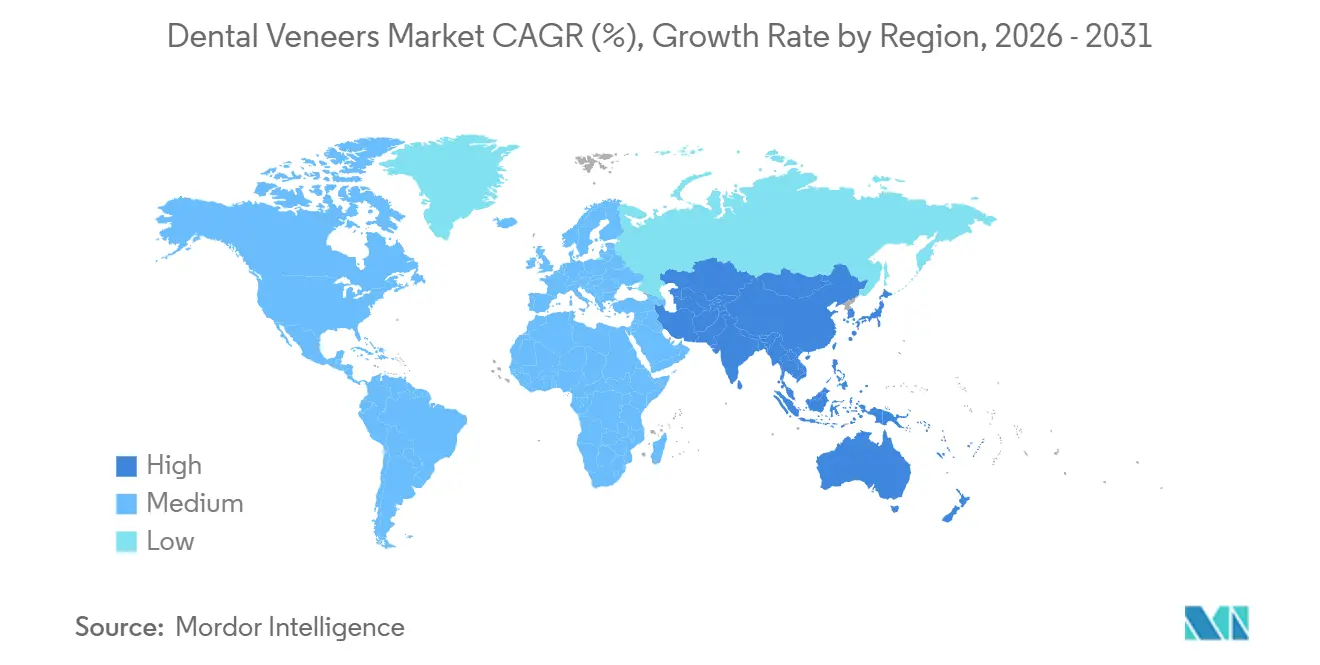
North America held 41.57% of the dental veneers market size in 2025. The region combines high dental spending, established private-pay cosmetic care, and a wide network of practices that focus on aesthetic dentistry. The United States supports much of the regional revenue through patient self-referral, private-pay consultation, and multi-unit porcelain veneer placement in practices that have developed visible esthetic service offerings. Digital smile design platforms support consultation discussions and can shorten the time from assessment to treatment acceptance. Canada is a mature market with premium demand characteristics, while Mexico serves both a growing domestic urban patient base and cross-border visitors from the United States.
Europe Dental Veneers Market
Europe has varied demand patterns because reimbursement policies and interest in aesthetic dentistry differ by country. Germany, the United Kingdom, France, Italy, and Spain all have distinct private-pay dynamics for elective procedures. In Germany, the exclusion of cosmetic treatment from statutory insurance keeps veneer care concentrated among private-pay patients. In the United Kingdom, a growing private dental backlog has increased attention to aesthetic services. Southern European markets show stronger appearance-led demand among younger patients. Europe also remains an important center for material innovation, with providers developing faster and more controlled finishing methods for thin ceramic work.
APAC, South America and MEA Dental Veneers Market
Asia-Pacific is forecast to grow at an 8.21% CAGR from 2026 to 2031, the highest regional rate in the dental veneers market. China and India contribute through rising middle-class dental expenditure, while South Korea has an established aesthetic dentistry culture. Thailand remains a regional hub for dental tourism, and Australia is a premium market with high dental spending and strong digital adoption. South America is emerging as a growth corridor led by Brazil and Colombia. Brazil exported USD 136 million in dental products in 2024, 11.7% higher than in 2023, and had more than 441,000 registered dentists, according to industry reporting that cited national dental data. The Middle East and Africa are also developing through luxury cosmetic dentistry infrastructure in GCC countries, including Saudi Arabia and the UAE, which attracts patients to Dubai and Abu Dhabi.
Competitive Landscape
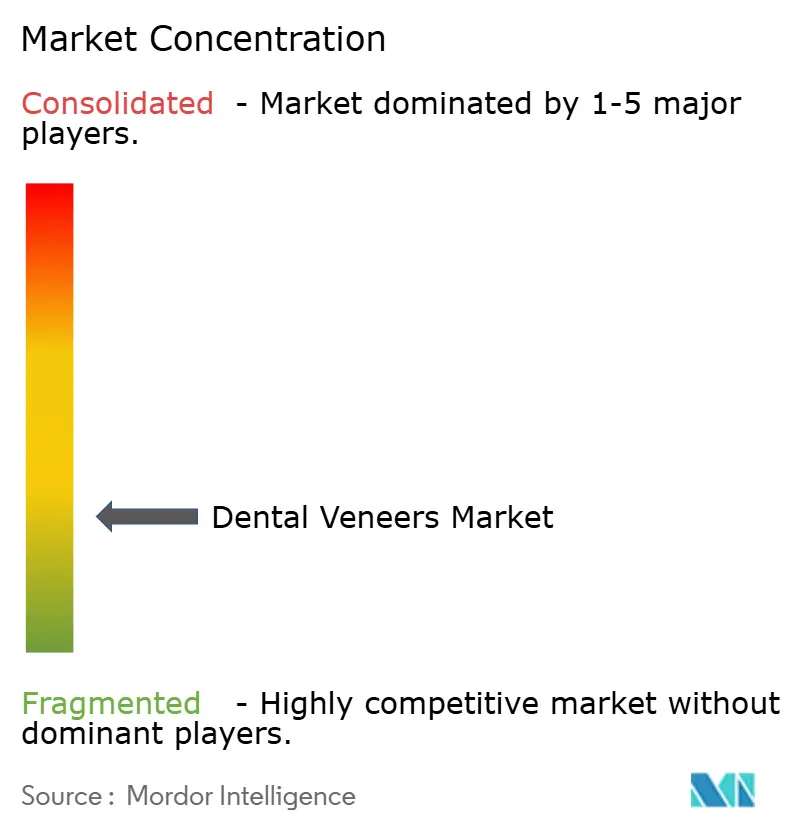
The dental veneers market is fragmented because no 1 company holds a dominant position across materials, fabrication, distribution, and clinical delivery. Upstream material suppliers such as Ivoclar AG, Kuraray Noritake Dental, VITA Zahnfabrik, and Dentsply Sirona compete through ceramic formulations, clinical evidence, and regulatory portfolios. Fabrication and distribution groups, including Modern Dental Group, Glidewell Laboratories, National Dentex, and Apex Dental Laboratory Group, compete through case throughput, digital case management, turnaround time, and service coverage. This structure gives dental practices several sourcing choices. Still, it makes workflow compatibility a key purchasing factor, since the scanner, software, material, and fabrication route must work together reliably in daily use. Material suppliers can strengthen their position when their products work reliably within widely used scanning, milling, and finishing systems.
Chairside fabrication is changing the role of the traditional laboratory intermediary. Straumann Group and SprintRay launched Straumann Signature Midas by SprintRay in March 2025 as a chairside 3D printing solution for single-visit dentistry. The company states that the platform supports veneers alongside crowns and inlays or onlays, with printing time under 10 minutes, depending on the material and restoration type. This type of capability can shift certain fabrication tasks closer to the clinic and reduce total case turnaround time. Laboratories that focus on complex esthetic cases, digital automation, and high-volume case management retain an important role where chairside production is not suitable. The dental veneers market will continue to reward providers that align materials, design software, and production capacity.
Leading companies are also using distribution partnerships to strengthen their place in digital workflows. Ivoclar and Benco Dental expanded their partnership in 2026 to make Ivoclar's complete CAD/CAM block portfolio for Dentsply Sirona CEREC users available through Benco Dental. The portfolio includes IPS e.max CAD, a lithium disilicate material used for aesthetic restorations. Kuraray Noritake Dental has focused on micro-layering materials that support thin ceramic applications and controlled aesthetic finishing. Opportunities remain in better shade matching, affordable composite systems for general dentists in secondary cities, and laboratory network development in Latin America and Southeast Asia, where service coverage and digital capacity are still uneven. The competitive structure remains dispersed across material providers, fabrication groups, distributors, and dental practices, with no dominant company identified in the supplied information.
Dental Veneers Industry Leaders
-
Dentsply Sirona Inc.
-
Ivoclar AG
-
GC Corporation
-
Kuraray Noritake Dental Inc.
-
Glidewell Laboratories
- *Disclaimer: Major Players sorted in no particular order
Dental Veneers Market Companies Covered in this Report
- Amann Girrbach
- Apex Dental Laboratory Group
- BISCO, Inc.
- COLTENE Group
- Dentsply Sirona
- DMG Chemisch-Pharmazeutische Fabrik
- Envista
- GC Corporation
- Glidewell Laboratories
- Ivoclar AG
- Kulzer
- Kuraray Noritake Dental Inc.
- Modern Dental Group Limited
- National Dentex, LLC
- Planmeca
- Shofu Dental
- Solventum Corporation
- Straumann Group
- Sun Dental Labs
- Tokuyama Dental
- Ultradent Products, Inc.
- VITA Zahnfabrik H. Rauter GmbH & Co. KG
- VOCO
- Zirkonzahn GmbH
Recent Industry Developments in Dental Veneers Market
- March 2026: VOCO GmbH received FDA 510(k) clearance, K252606, for Bifix Veneer LC and Bifix Veneer Try-In. The dental cement system is used for veneer luting, and VOCO identifies Bifix Veneer LC for the permanent luting of ceramic and composite veneers, inlays, and onlays.
- March 2026: Ivoclar and Benco Dental expanded their partnership to make Ivoclar’s complete CAD/CAM block portfolio available to Dentsply Sirona CEREC users through Benco Dental. The portfolio includes IPS e.max CAD, a lithium disilicate glass-ceramic used for esthetic restorations, including veneers.
- March 2025: Straumann Group and SprintRay launched Straumann Signature Midas by SprintRay, a chairside 3D printing solution for single-visit dentistry. The official product page lists crowns, inlays, onlays, and veneers among supported restorations and states that printing can take less than 10 minutes, depending on the material and restoration type
- January 2025: Modern Dental Group completed the acquisition of Hexa Ceram, Thailand’s largest dental laboratory. The acquisition added fabrication capacity in a key Asia-Pacific dental market and supports Modern Dental Group’s dental prosthetics and digitalization strategy.
Global Dental Veneers Market Report Scope
According to the report's scope, dental veneers are thin custom-made shells placed over the front surface of teeth to improve dental appearance, correct discoloration, repair minor chips or gaps, and support cosmetic or restorative smile enhancement procedures.
The dental veneers market is segmented by product type, application, end user, and geography. By Product Type, the market is segmented into Porcelain/Ceramic Veneers, Composite Veneers, Ultra-Thin/No-Prep Veneer Systems, Palatal and occlusal veneers, Removable Cosmetic Veneers, and Other Product Types. By Application, the segmentation includes Cosmetic Smile Enhancement, Restorative and Functional Correction, and Other Applications. By End User, the market is segmented into Dental Clinics, Hospitals and Dental Hospitals, Academic and Research Institutions, and Dental Laboratories. Geographically, the market is analyzed across North America, Europe, the Asia-Pacific region, the Middle East & Africa, and South America. The market report also covers the estimated market sizes and trends for 17 countries across major regions globally. For each segment, the market size and forecast are provided in terms of value (USD).
| Porcelain/Ceramic Veneers |
| Composite Veneers |
| Ultra-Thin/No-Prep Veneer Systems |
| Palatal and Occlusal Veneers |
| Removable Cosmetic Veneers |
| Other Product Types |
| Cosmetic Smile Enhancement |
| Restorative and Functional Correction |
| Other Applications |
| Dental Clinics |
| Hospitals and Dental Hospitals |
| Academic and Research Institutions |
| Dental Laboratories |
| North America | United States |
| Canada | |
| Mexico | |
| Europe | Germany |
| United Kingdom | |
| France | |
| Italy | |
| Spain | |
| Rest of Europe | |
| Asia-Pacific | China |
| Japan | |
| India | |
| Australia | |
| South Korea | |
| Rest of Asia-Pacific | |
| Middle East and Africa | GCC |
| South Africa | |
| Rest of Middle East and Africa | |
| South America | Brazil |
| Argentina | |
| Rest of South America |
| By Product Type | Porcelain/Ceramic Veneers | |
| Composite Veneers | ||
| Ultra-Thin/No-Prep Veneer Systems | ||
| Palatal and Occlusal Veneers | ||
| Removable Cosmetic Veneers | ||
| Other Product Types | ||
| By Application | Cosmetic Smile Enhancement | |
| Restorative and Functional Correction | ||
| Other Applications | ||
| By End User | Dental Clinics | |
| Hospitals and Dental Hospitals | ||
| Academic and Research Institutions | ||
| Dental Laboratories | ||
| By Geography | North America | United States |
| Canada | ||
| Mexico | ||
| Europe | Germany | |
| United Kingdom | ||
| France | ||
| Italy | ||
| Spain | ||
| Rest of Europe | ||
| Asia-Pacific | China | |
| Japan | ||
| India | ||
| Australia | ||
| South Korea | ||
| Rest of Asia-Pacific | ||
| Middle East and Africa | GCC | |
| South Africa | ||
| Rest of Middle East and Africa | ||
| South America | Brazil | |
| Argentina | ||
| Rest of South America | ||
Key Questions Answered in the Report
What is the dental veneers market size in 2026?
The dental veneers market was valued at USD 3.11 billion in 2026 and is forecast to reach USD 4.29 billion by 2031 at a 6.64% CAGR.
Which dental veneer product category leads demand?
Porcelain and ceramic veneers led with 58.43% of value in 2025, supported by translucency, stain resistance, and clinical longevity.
What is the fastest-growing dental veneer type?
Ultra-thin and no-prep veneers are projected to grow at an 8.12% CAGR through 2031 because they support more conservative treatment options.
Which application accounts for the greatest demand for dental veneers?
Cosmetic smile enhancement held 72.38% of demand in 2025, while restorative and functional correction is expected to grow at a 7.04% CAGR.
Which region is growing fastest for dental veneers?
Asia-Pacific is forecast to expand at an 8.21% CAGR through 2031, supported by dental tourism and growing dental spending.
Why are digital dental workflows important for veneers?
Digital planning, chairside CAD/CAM, and visual previews can improve patient communication, reduce fabrication time, and support efficient case delivery.