
Dental Syringes Market Size and Share
Market Overview
| Study Period | 2020 - 2031 |
|---|---|
| Market Size (2026) | USD 168.93 Million |
| Market Size (2031) | USD 217.52 Million |
| Growth Rate (2026 - 2031) | 5.18 % |
| Fastest Growing Market | Asia Pacific |
| Largest Market | North America |
| Market Concentration | Medium |
Major Players
*Disclaimer: Major Players sorted in no particular order Image © Mordor Intelligence. Reuse requires attribution under CC BY 4.0. |
|
Dental Syringes Market Analysis by Mordor Intelligence
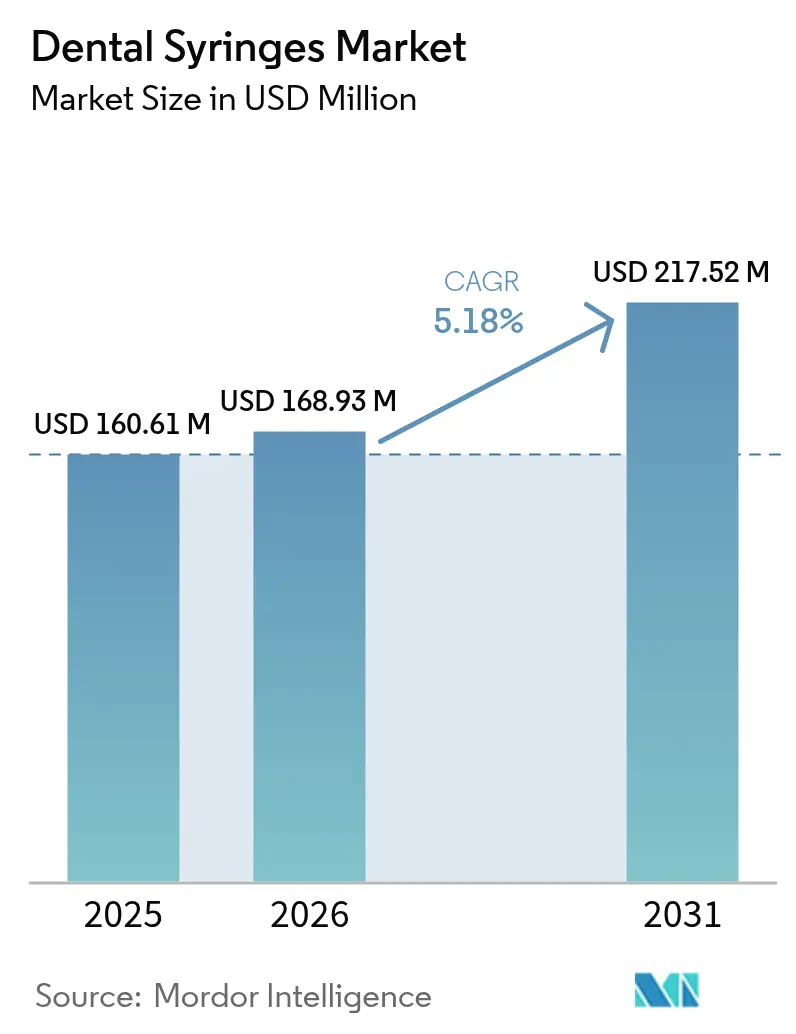
The dental syringes market size is expected to grow from USD 160.61 million in 2025 to USD 168.93 million in 2026 and is forecast to reach USD 217.52 million by 2031 at 5.18% CAGR over 2026-2031. Growth reflects tighter infection-control requirements, a wider older-adult population needing prosthodontic care, and the steady roll-out of computer-controlled local anesthetic delivery systems. Heightened awareness after recent global health events has moved dentists toward single-use devices and RFID-tracked instruments that simplify compliance with CDC sterilization rules. Insurers are also influencing demand: 65% of U.S. adults held dental coverage in 2024 and 91% now view dental check-ups as essential preventive care. On the supply side, manufacturers are redesigning products around biodegradable plastics and lightweight metals to meet the upcoming EU Packaging and Packaging Waste Regulation. Tariffs introduced in April 2025 and volatile stainless-steel supply chains are prompting practices to diversify sourcing and accelerate group purchasing.
Key Report Takeaways
- By usability, reusable devices held 58.20% of dental syringes market share in 2025 while disposables are projected to expand at a 6.28% CAGR through 2031.
- By product type, aspirating models led with 61.55% revenue share in 2025 while non-aspirating units are forecast to grow at 6.12% CAGR.
- By material, metallic formats accounted for 56.10% of the dental syringes market size in 2025 and plastics are advancing at a 6.05% CAGR to 2031.
- By end-user, hospitals and clinics commanded 49.10% of the 2025 revenue while laboratories are poised for the fastest 6.01% CAGR.
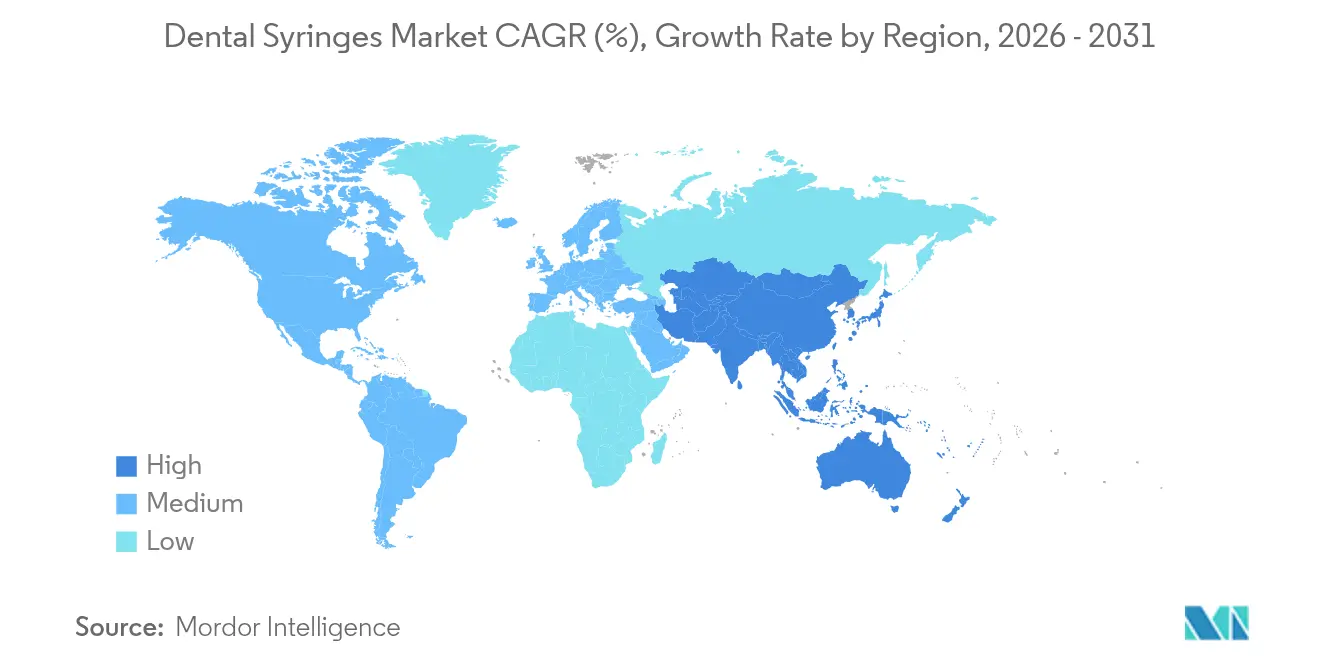
- By geography, North America contributed 43.10% revenue in 2025 while Asia-Pacific is projected to post the highest 6.22% CAGR to 2031.
Note: Market size and forecast figures in this report are generated using Mordor Intelligence’s proprietary estimation framework, updated with the latest available data and insights as of 2026.
Market Trends and Insights
Drivers Impact Analysis of Dental Syringes Market*
| Driver | (~) % Impact on CAGR Forecast | Geographic Relevance | Impact Timeline |
|---|---|---|---|
| Ageing population expanding prosthodontic workload | +1.2% | North America and Europe core, global spill-over | Long term (≥ 4 years) |
| Rising prevalence of caries & periodontal disease | +0.9% | Higher impact across Asia-Pacific and MEA | Medium term (2-4 years) |
| Rapid shift to single-use safety syringes | +1.4% | Led by North America and EU | Short term (≤ 2 years) |
| Growth in dental tourism across APAC & CEE | +0.7% | Asia-Pacific core, Central and Eastern Europe spill-over | Medium term (2-4 years) |
| Chair-side digital anesthesia delivery | +0.8% | North America and EU early adopters, APAC emerging | Medium term (2-4 years) |
| RFID-enabled instrument tracking mandates | +0.3% | High-income clinics in North America and EU | Long term (≥ 4 years) |
| Source: Mordor Intelligence | |||
Ageing Population Expanding Prosthodontic Workload
Adults aged 60 and older already number 1.0 billion and will pass 1.4 billion by 2030. Prosthodontic interventions that dominate this cohort demand precise anesthetic delivery, pushing clinics to adopt advanced dental syringes market solutions such as computer-controlled local anesthetic devices [1]Rakhee Patel, "Healthy ageing and oral health: priority, policy and public health," BDJ Open, nature.com. In Malaysia, adults aged 25-54 form the largest patient group, further straining chair capacity. Dental insurers highlight the link between oral and systemic health, driving preventive visits and reinforcing demand for premium syringes. Practices consequently prefer ergonomic designs that perform multiple injections without user fatigue. As full-arch restorations rise, syringe designs featuring high barrel clarity and controlled aspiration are becoming standard [2]Delta Dental Plans Association, “State of America’s Oral Health and Wellness Report 2024,” deltadental.com .
Rising Prevalence of Caries & Periodontal Disease
More than 280 million older adults face untreated caries or gum disease worldwide. Updated CDC guidelines stipulate that cartridge syringes must be sterilized between patients and that needles as well as anesthetic cartridges remain single use [3]Centers for Disease Control and Prevention, “CDC Summary of Infection Prevention Practices in Dental Settings,” cdc.gov . Emerging economies report faster disease incidence due to sugary diets and limited prophylaxis, opening space for cost-effective yet compliant syringes. Teledentistry is enabling earlier diagnosis among younger adults, creating more occasions for minimally invasive restorations that still need local anesthesia. Early-stage interventions such as drill-free cavity repair delivered by products like Curodont Repair Fluoride Plus lower chair time, but complex cases continue to rely on aspirating devices that confirm safe deposition.
Rapid Shift to Single-Use Safety Syringes for Infection Control
The CDC states that single-use instruments “should not be reprocessed” which is accelerating the switch to disposables. Pac-Dent’s TruTip Plus Colors and NeoTip lines illustrate how manufacturers integrate stainless-steel interiors with color-coded plastic exteriors to maintain stiffness while easing disposal. Studies demonstrate that reusable tips retain bacterial load despite sterilization, reinforcing the move to disposables. The EU regulation that all healthcare packaging must be recyclable by 2030 is catalyzing R&D into PLA and PHA syringes that biodegrade without compromising performance. Dental syringes market suppliers are balancing shelf-life, cost, and sustainability as clinics weigh infection control against waste targets.
Growth in Dental Tourism Across APAC & CEE
Malaysia’s oral-care blueprint positions the country as a dental tourism hub by 2027 and prioritizes premium anesthesia delivery to reassure visiting patients. Romanian clinics partner with travel agencies to extend peak seasons and attract complex restorative cases that rely on high-precision syringes. International clients expect U.S. or EU-level infection protocols, prompting facilities to use single-use aspirating devices packaged in tamper-evident pouches. Clinics also integrate chair-side CAD/CAM workflows, so syringe suppliers bundle disposables with scanners and implant kits to capture downstream revenue within the dental syringes market.
Restraints Impact Analysis of Dental Syringes Market*
| Restraint | (~) % Impact on CAGR Forecast | Geographic Relevance | Impact Timeline |
|---|---|---|---|
| Shortage of skilled dentists in low-income regions | -0.8% | Asia-Pacific, MEA, rural zones worldwide | Long term (≥ 4 years) |
| Up-front cost of electronic & smart syringes | -0.6% | Higher pressure in price-sensitive markets | Medium term (2-4 years) |
| Regulatory crackdown on single-use plastics | -0.4% | EU first movers and eco-focused markets | Medium term (2-4 years) |
| Volatile supply of medical-grade stainless steel | -0.3% | Global manufacturing hubs | Short term (≤ 2 years) |
| Source: Mordor Intelligence | |||
Shortage of Skilled Dentists in Low-Income Regions
Many emerging economies record fewer than one dentist per 10,000 residents. The WHO notes that geographic and economic barriers keep older adults from timely care. Limited training capacity delays the uptake of advanced computer-controlled devices that require instruction on aspiration and flow-rate settings. Governments respond by funding mobile clinics but focus spending on basic instruments. In turn, syringe makers supply simplified metallic formats that tolerate rugged reprocessing and align with thin operating budgets inside the dental syringes industry.
Up-Front Cost of Electronic & Smart Syringes
Systems such as the STA or Wand can cost several thousand dollars, which smaller practices may not recoup quickly. The 10% tariff applied to U.S. imports in April 2025 further inflates equipment price tags. Some clinics arrange vendor financing or group-buy schemes, though rising interest rates raise total ownership costs. Suppliers have introduced modular upgrades so dentists can start with manual aspirating handles and later add digital control boxes without discarding prior investment. These tiered packages shape adoption trajectories in the dental syringes market.
*Our forecasts treat driver/restraint impacts as directional, not additive. The impact forecasts reflect baseline growth, mix effects, and variable interactions.
Dental Syringes Market Segment Analysis
By Usability:
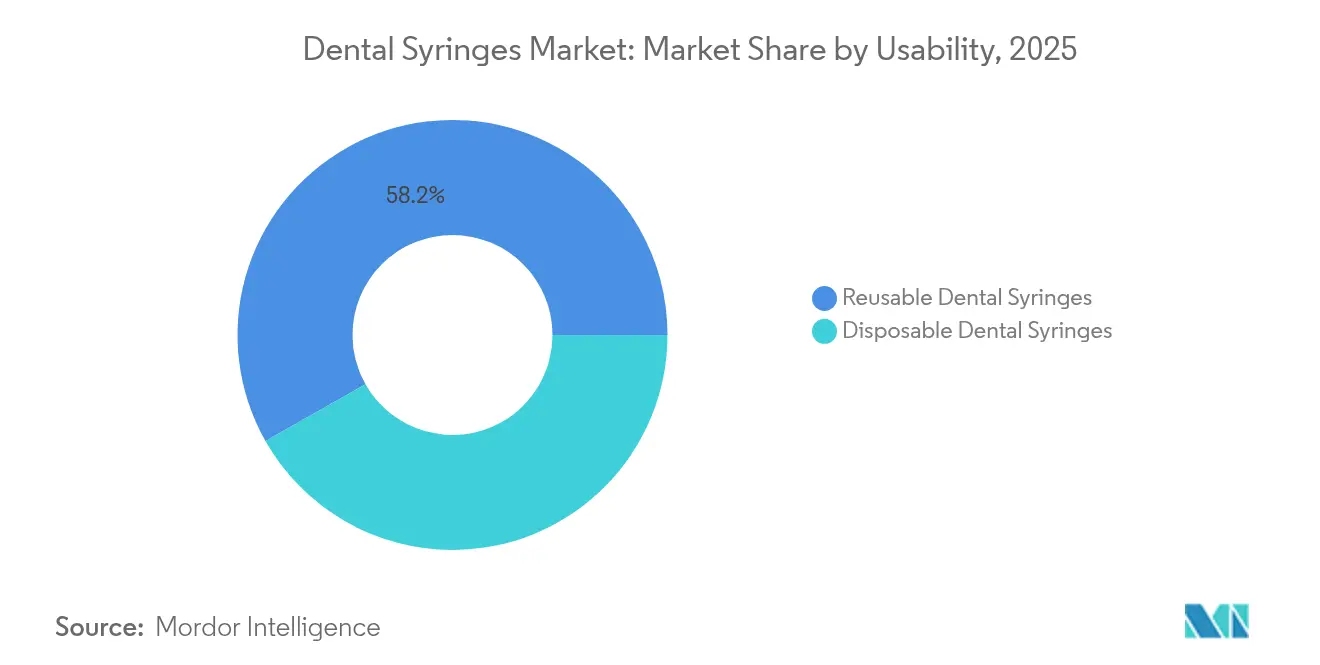
Disposables Gain Infection Control MomentumReusable devices retained 58.20% revenue in 2025, benefiting from well-established autoclave infrastructures. In the same year disposables grew swiftly as the dental syringes market size for single-use formats recorded a 6.28% CAGR, reflecting heightened infection control vigilance. Practices with patient loads exceeding 30 daily injections cite sterilizer bottlenecks, thus preferring color-coded disposable barrels that cut turnaround time.
Disposable adoption faces environmental scrutiny; the EU framework compels recyclable packaging by 2030, prompting suppliers to launch PLA and PHA barrels that meet compostability targets. Large group practices lock in multi-year contracts to stabilize pricing and guarantee supply. Reusables still dominate where capital budgets cover advanced washer-disinfectors and where unit cost savings outweigh staffing constraints. Hybrid strategies emerge, with clinics using metallic aspirating handles paired with single-use needles and cartridges to balance safety and sustainability.


By Product Type:
Aspirating Dominance Faces Digital DisruptionAspirating models captured 61.55% of dental syringes market share in 2025 because they allow clinicians to verify they are not in a blood vessel before injecting. Non-aspirating designs appeal to younger practitioners seeking simpler handling during routine composites and prophylaxis.
Digital CCLAD platforms incorporate pressure sensors that can identify tissue differences without manual aspiration. When paired with narrow-gauge needles, these systems deliver near-painless infiltration which is expanding patient acceptance in elective cosmetic work. Needle-free devices such as LED-based Nuralyte promise further disruption; however, indications remain limited to shallow treatments and adoption hinges on upcoming FDA clearance. Traditional aspirating syringes now integrate silicone coating and reduced plunger friction to maintain relevance within an evolving dental syringes market.
By Material:
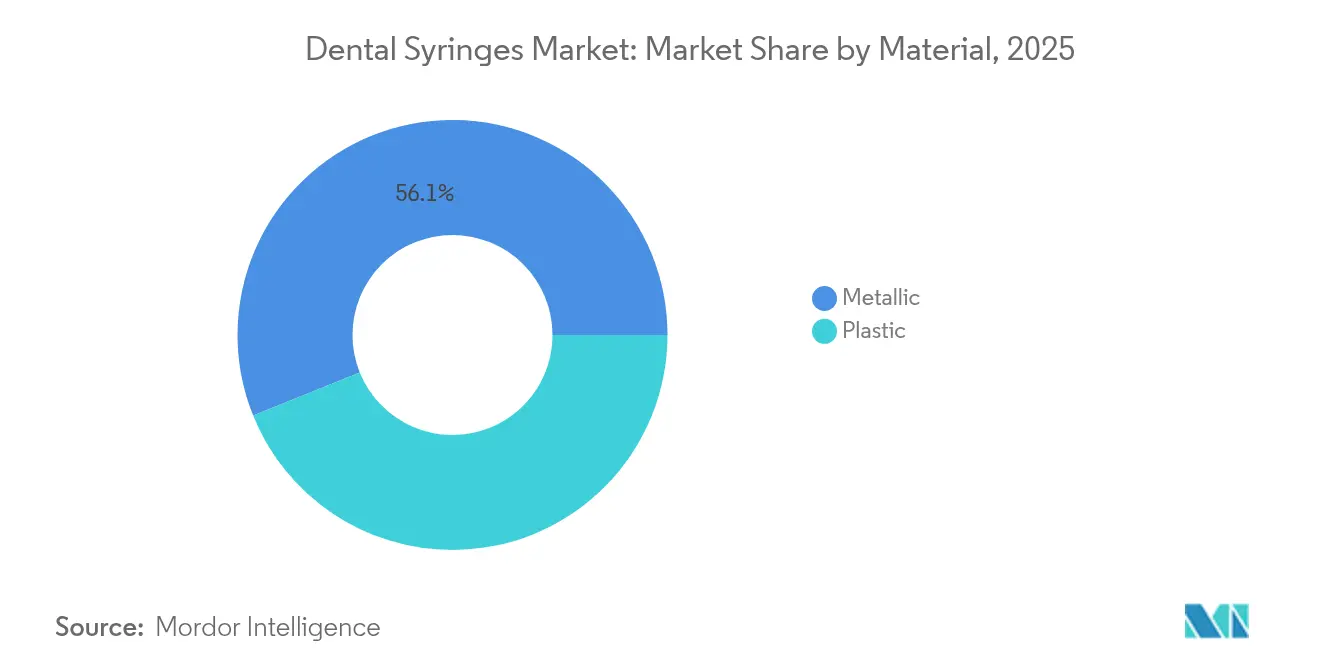
Metallic Strength Versus Plastic InnovationMetallic barrels secured 56.10% revenue in 2025 thanks to their durability and autoclave compatibility. Supply challenges for specialty stainless steel have triggered a switch to hardened aluminum and titanium blends that shave grip weight by 25% without sacrificing rigidity.
Plastics advance at a 6.05% CAGR, lifted by cost advantages and growth in single-use protocols. Bioplastics win regulatory favor yet face output limitations, leading manufacturers to blend PLA with recycled PET for wider availability. Future designs may feature composite interiors lined with thin steel sleeves to deliver metal-like aspiration while reducing raw steel content. Material innovation enables competitive pricing and differentiates brands in the dental syringes market.
By End-User:
Laboratories Emerge as Growth CatalystHospitals and clinics held 49.10% revenue in 2025 due to their direct patient interface. Dental laboratories post the highest 6.01% CAGR because chair-side milling and immediate prosthetic services now demand on-site anesthesia capability.
Lab-integrated digital workflows rely on fast setting times, so staff prefer syringes with pre-threaded needles and calibrated cartridges that minimize interruptions. Academic programs adopt premium aspirating handles for student instruction, fueling baseline demand. The rise of dental service organizations centralizes purchasing which favors vendors able to bundle syringes with burs, imaging sensors, and CAD/CAM blocks leading to consolidated volume within the dental syringes market size for multi-disciplinary institutions.
Geography Analysis
North America Dental Syringes Market
North America generated 43.10% of 2025 revenue as stringent CDC protocols and widespread insurance coverage sustained premium device uptake. Computer-controlled systems are common in large group practices, and 91% of adults equate dental visits with annual physicals which underpins procedure volumes. Tariffs imposed in April 2025 raise equipment costs so distributors diversify toward Mexico and Vietnam sources to maintain catalog breadth. Solventum, spun off from 3M, posted USD 335 million in Q1-2024 dental solutions sales in spite of a 1.8% revenue dip, demonstrating resilience in the regional dental syringes market.
APAC Dental Syringes Market
Asia-Pacific is the fastest-growing territory with a 6.22% CAGR to 2031. Malaysia illustrates the trend: a USD 2.8 billion dental services sector by 2027 with private clinics holding 70% share. Rising middle-class incomes boost demand for cosmetic orthodontics and implantology, both reliant on accurate local anesthesia. Dental tourism blends hotel-style recovery suites with EU-compliant infection protocols, leading facilities to favor single-use aspirating syringes packaged in bar-coded peel pouches. Domestic manufacturers supply cost-efficient polystyrene barrels while importers market premium CCLAD units, creating tiered opportunities inside the dental syringes market.
EMEA and South America Dental Syringes Market
Europe maintains consistent growth as the circular-economy agenda reshapes material selection. The EU Packaging and Packaging Waste Regulation forces producers to redesign components for recyclability by 2030. Germany pilots municipal collection of clinical-grade bioplastics, giving early movers brand advantage. Clinics in France and Scandinavia advertise carbon-neutral restorations which in turn favor PLA or PHA syringe bodies. Eastern Europe gains momentum from inbound dental tourists seeking affordable full-arch implants, driving mid-range aspirating device sales. The Middle East and Africa record accelerating demand, especially in GCC countries that pair medical tourism with luxury hospitality. South America exhibits incremental gains, with Brazil and Argentina leveraging local plastics production to stabilize supply chains within the dental syringes market.

Regulatory Landscape
Dental syringes and related dental hand instruments are regulated as medical devices, with key requirements centered on infection control, performance testing, and quality systems. In the United States, most dental syringes fall under FDA Class I general controls (21 CFR 872.4565) and are commonly exempt from 510(k) submission when not subject to special controls, but manufacturers still must meet labeling, device listing, and CGMP obligations. A notable compliance anchor is the FDA Quality Management System Regulation (QMSR), which became effective on Feb 2, 2026, aligning U.S. quality-system expectations more closely with ISO 13485:2016.
In Europe, market access is governed by EU MDR 2017/745, with classification and conformity assessment shaped by intended use and risk profile; CEN/TR 12401:2025 provides updated technical guidance for applying MDR classification rules to dental products. Product-level performance and interoperability are increasingly anchored to ISO 9997:2020 for dental cartridge syringes (covering aspirating, non-aspirating, and self-aspirating designs), and the American Dental Association advanced harmonization by making updated cartridge-syringe standards available for review in April 2025 based on ISO 9997:2020. Environmental compliance is also influencing materials and packaging choices, particularly in the EU where recyclable healthcare packaging targets by 2030 are driving redesign of packs and components used with disposable syringe formats.
Competitive Landscape
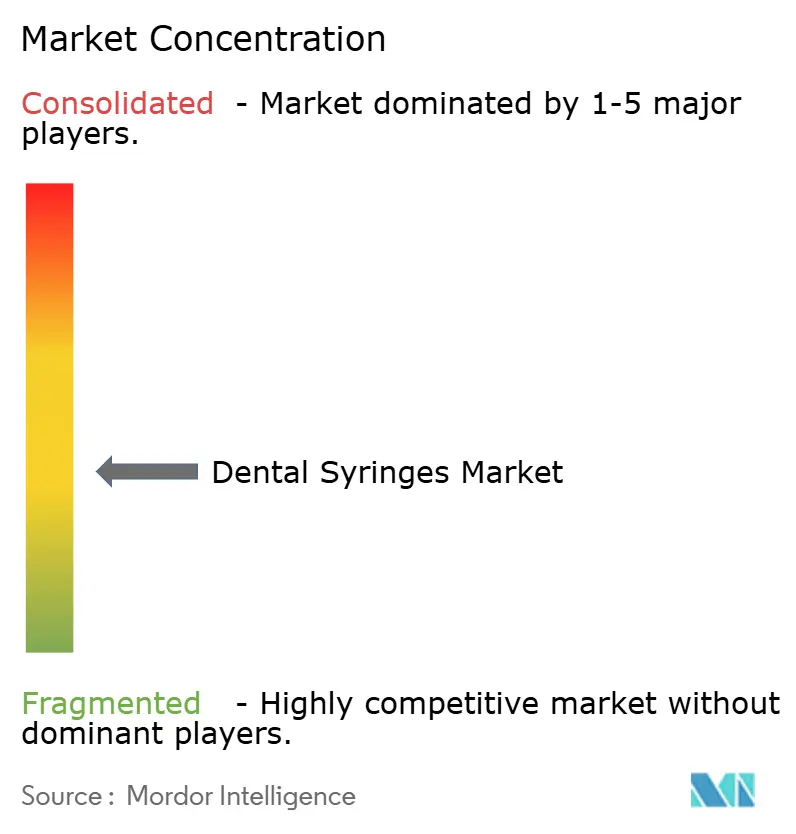
The dental syringes market is moderately fragmented. Global multinationals compete with specialist brands, each vying to differentiate through infection-control features, ergonomic enhancements, and digital integration. Solventum re-entered the segment as an independent healthcare company in April 2024 and now allocates more capital to R&D for biodegradable disposables. Dentsply Sirona leverages its imaging and milling portfolio to cross-sell syringes bundled with CAD/CAM kits, reinforcing ecosystem lock-in.
Manufacturers invest 3–5% of revenue on supply-chain resilience after stainless-steel and resin shortages highlighted vulnerabilities. Additive manufacturing is used to prototype low-friction plungers and lightweight grips that cut material use by 15%. Companies also integrate generative AI to optimize demand forecasts and shrink inventory buffers. Niche firms develop needle-free solutions such as LED or TENS-based anesthesia devices which could cannibalize simple infiltration uses but still coexist with aspirating syringes for surgical work. Regulatory clarity improved after the ADA proposed ANSI/ADA Standard No. 34 aligning cartridge syringes with ISO 9997:2020; conforming early gives suppliers marketing leverage.
Strategic alliances rise as vendors collaborate with packaging converters to co-design recyclable blister packs that pass accelerated aging tests. Some brands pilot pay-per-use contracts where practices pay on injection count rather than upfront equipment purchase. The practice offers predictable cash flow for clinics and deeper user data for suppliers, reinforcing stickiness within the dental syringes market.
Dental Syringes Industry Leaders
-
Dentsply Sirona
-
A. Titan Instrument Inc
-
Septodont
-
Solventum
-
Ultradent Products
- *Disclaimer: Major Players sorted in no particular order
Dental Syringes Market Companies Covered in this Report
- Solventum
- Dentsply Sirona
- Septodont
- Vista Dental Products
- Integra LifeSciences
- A. Titan Instrument
- Ultradent Products
- Power Dental USA
- Accesia
- Anthogyr
- Carl Martin
- Asa Dental
- Faro
- DiaDent
- Milestone Scientific
- Orsing AB
- Kulzer
- Henry Schein
- Coricama S.r.l
- Tillid Dental

Market Opportunities and Future Outlook
Whitespace is forming around devices and consumables that reduce pain variability while simplifying compliance with infection-control workflows. Computer-controlled local anesthetic delivery (CCLAD) and computer-guided injection platforms create room for suppliers to connect console-level precision with chairside ergonomics and a lower training burden, especially for high-throughput practices and dental-service-organization purchasing models. Clinical evidence supporting pain reduction versus manual delivery supports value-based positioning for premium systems and their compatible disposable components (tubing sets, single-use tips, and cartridge interfaces), which in turn reinforces demand for standardized, interoperable syringe designs aligned with ISO 9997:2020.
Named product and market actions point to near-term opportunity areas. Dentalhitec launched the QuickSleeper5 computer-guided local anesthesia delivery system in the United States in September 2025 after FDA clearance, indicating continued commercialization of advanced injection platforms that can pull through procedure-specific disposables and accessories. On the manual segment, Inibsa introduced the Prestoject line in May 2024 (aspirating and intraligamental variants), supporting ongoing demand for ergonomic, autoclavable stainless-steel instruments. In Europe, sustainability-driven procurement creates additional whitespace for manufacturers that pair single-use infection-control formats with recyclable packaging and validated shelf-life, helping clinics manage waste constraints alongside sterilization bottlenecks.
Recent Industry Developments in Dental Syringes Market
- June 2026: Mitsui Chemicals, Inc. entered into a definitive agreement to acquire Ultradent Products, Inc. and make it a wholly owned subsidiary via Mitsui Chemicals America, Inc., with completion targeted for September 2026. The deal strengthens Ultradent's access to a larger chemicals and materials platform, which can influence formulation and packaging choices across dental consumables that are commonly supplied alongside syringe-based delivery workflows.
- June 2026: Septodont announced a global development and commercialization partnership with Australian startup Dentroid to advance non-invasive dental pain management using Dentroid's patented Nuralyte technology. The collaboration broadens competitive focus beyond conventional anesthetic delivery toward device-enabled pain management, which can reshape how practices evaluate traditional syringe-based anesthesia options for selected procedures.
- May 2024: Inibsa launched the Prestoject line of dental syringes, including aspirating and intraligamental variants designed around ergonomic handling and stainless-steel construction. The product introduction reinforces ongoing investment in premium manual instruments alongside the shift toward disposables and digital delivery systems.


Dental Syringes Market Report Scope and Research Methodology
Market Definition and Coverage
This market is defined as revenue from dental-use syringes that deliver local anesthetic and irrigation in dental procedures, across clinics and hospital dental departments. The sizing covers commonly used dental syringe formats sold through standard dental supply and procurement channels.
Scope exclusions: It does not include general medical syringes, oral dosing syringes, training models, or veterinary injectors.
Segments Covered in This Report
-
By Usability
- Reusable Dental Syringes
- Disposable Dental Syringes
-
By Product Type
- Aspirating
- Non-aspirating
-
By Material
- Metallic
- Plastic
-
By End-User
- Dental Hospitals & Clinics
- Dental Laboratories
- Others
-
By Geography
-
North America
- United States
- Canada
- Mexico
-
Europe
- Germany
- United Kingdom
- France
- Italy
- Spain
- Rest of Europe
-
Asia-Pacific
- China
- Japan
- India
- South Korea
- Australia
- Rest of Asia-Pacific
-
Middle East and Africa
- GCC
- South Africa
- Rest of Middle East and Africa
-
South America
- Brazil
- Argentina
- Rest of South America
-
North America
Data Sources, Market Sizing, and Validation
Desk Research
Desk research was used to map the demand pool and the practical boundaries of what gets counted as a dental syringe. We anchored procedure and patient context using public sources such as CDC infection control guidance for dental settings, World Health Organization oral health resources, and national health statistics portals that track dental visits and care access.
We also reviewed trade and customs statistics for relevant medical instrument categories and used patent databases to understand product refresh cycles, including adoption of features like aspiration and computer-controlled delivery. In parallel, we reviewed company filings, investor presentations, and reputable press coverage to understand portfolio mix and distribution footprints, and we used paid subscriptions for company financials and shipment-level import and export checks where needed. The sources listed here are illustrative and not exhaustive, and additional public and paid references were used for data collection, validation, and clarification.
Primary Interviews and Surveys
Primary work focused on interviews and surveys with manufacturers, distributors, and dental-care procurement and clinical users, so assumptions could be tested on dental syringe pricing, replacement cycles, and mix shifts between reusable and single-use instruments. Respondent input was also checked across major regions so differences in sterilization practices and purchasing behavior could be reflected in the final sizing assumptions.
Distribution of primary research fieldwork respondents
| Company type | Respondent position | Region |
|---|---|---|
| Top tier: 28% | CXOs: 13% | APAC: 39% |
| Mid tier: 52% | Functional/Unit leaders: 31% | EMEA: 35% |
| Smaller Players: 20% | Managers: 56% | Americas: 26% |
Market-Sizing & Forecasting
The model starts with a top-down demand reconstruction that links dental procedure activity to syringe usage, which is then converted into value using a realistic price ladder by syringe type and end-user channel. Once the structure is in place, we corroborate totals with selective bottom-up checks, such as supplier and distributor revenue context, sampled average selling prices multiplied by estimated unit movement, and channel checks that flag where the initial math may be too high or too low.
The inputs that mattered most were the mix of anesthetic delivery versus irrigation use, the split between aspirating and non-aspirating formats, replacement frequency for reusable syringes, adoption of single-use devices in infection control programs, and expected pricing movement tied to materials and procurement cycles. When data gaps showed up in smaller countries or in niche formats, we used proxy assumptions from similar markets with comparable care settings, then adjusted them after follow-up validation.
For forecasting, we used scenario analysis, with year-to-year changes guided by consensus from primary discussions on procedure volumes, product mix shifts, and pricing expectations. Where growth rates seemed too steep for a mature clinical workflow, we re-checked the assumptions to keep the forecast aligned with typical purchasing and replacement behavior.
Data Validation & Update Cycle
Outputs are checked against independent signals, including procedure activity direction, procurement and trade movements, and the expected pace of conversion to single-use products, before numbers are finalized. If a region shows an unusual spike or drop, we review the underlying assumptions and trigger interview follow-ups to confirm whether pricing, mix, or volumes changed.
A multi-step analyst review is used so calculation logic, unit conversions, and currency handling remain consistent throughout the model. Reports are refreshed annually, and interim updates are made when material events occur that can move demand or pricing. Before delivery, a final pass is done to capture the latest available public data and any new validation points from the field.
Mordor Intelligence's Dental Syringes Market Size Compared Against Other Published Estimates
Published market sizes for dental syringes can look far apart even when they appear to cover similar products. The main differences typically come from what gets counted as a dental syringe, which care settings are included, and how price and volume are carried forward each year.
When we check procedure-linked syringe usage and refresh the inclusion rules, Mordor Intelligence keeps the dental syringe total tied to anesthetic and irrigation syringes used in dental treatment, instead of folding in broader medical syringe families. Gaps can also come from conversion assumptions for single-use devices that are not validated with procurement behavior, pricing that leans on list rates instead of realized selling prices, and currency timing that does not match the measurement year.
Benchmark comparison
| Source | Market Size | Gaps in Research Methodology |
|---|---|---|
| Mordor Intelligence | USD 0.17 B (2026) | |
| Global Research House A | USD 1.86 B (2024) | Uses a wider scope that likely includes adjacent syringe or dental device revenue beyond dental anesthetic and irrigation syringes, and it is anchored to an earlier base year and pricing set. |
| Specialty Publisher B | USD 0.14 B (2023) | Anchored to an earlier base year and may apply narrower product grouping and conservative mix assumptions, which can reduce captured value when computer-controlled and single-use formats expand. |
Across the three numbers, the spread is mainly explained by scope control and the way prices and mix are carried through the model. When definitions are kept tight and inputs are tied back to dental care usage and purchasing realities, the resulting market size stays easier to audit and repeat over time.


Key Questions Answered in the Report
What is the current size of the dental syringes market?
The dental syringes market was valued at USD 168.93 million in 2026 and is projected to reach USD 217.52 million by 2031 at a 5.18% CAGR.
Which region leads the dental syringes market?
North America leads with 43.10% revenue thanks to strict CDC protocols and widespread insurance coverage.
Why are disposable dental syringes gaining popularity?
Disease-control guidelines from the CDC mandate that single-use devices should not be reprocessed, prompting clinics to adopt disposable syringes that reduce cross-contamination risk.
What share do aspirating syringes hold?
Aspirating models captured 61.55% of dental syringes market share in 2025 because they allow clinicians to verify safe injection sites.
How will environmental regulations influence product design?
EU rules requiring recyclable packaging by 2030 are accelerating the shift toward PLA and PHA bioplastics and motivating manufacturers to redesign components for circularity.
What is the fastest-growing end-user segment?
Dental laboratories are the fastest-growing end-user, expanding at a 6.01% CAGR as chair-side digital workflows integrate anesthesia delivery into lab services.
Page last updated on:


 Your data is secure and never sold or shared.


