
Dental Practice Management Software Market Size and Share
Market Overview
| Study Period | 2020 - 2031 |
|---|---|
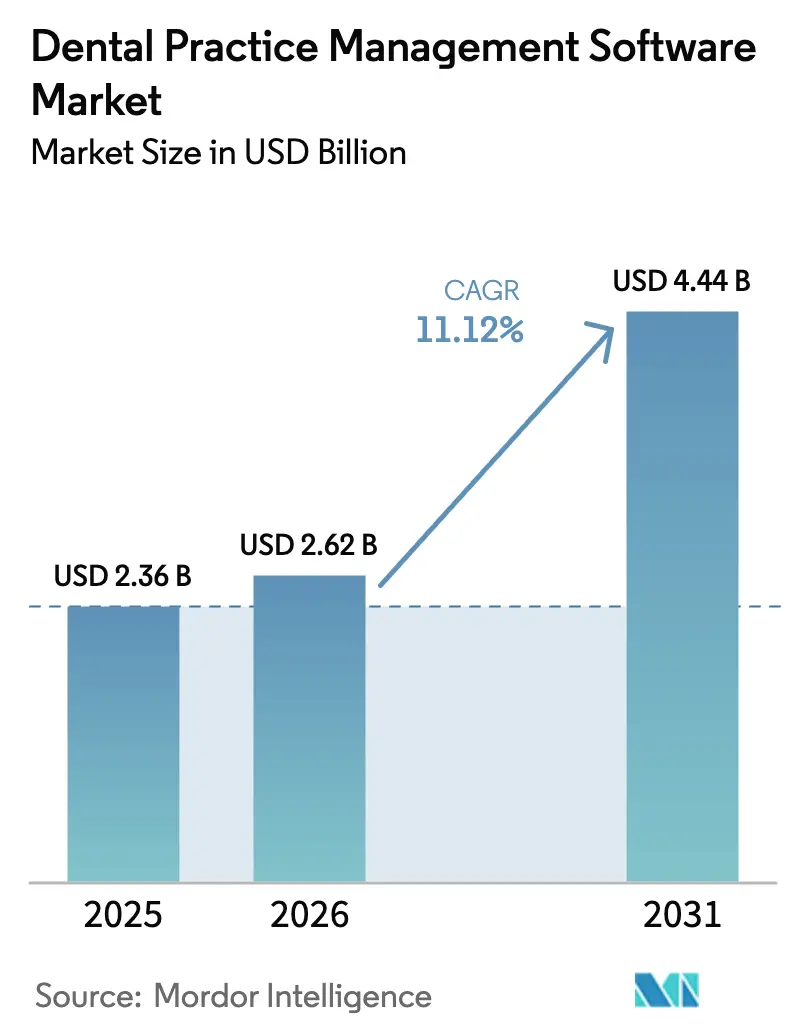
| Market Size (2026) | USD 2.62 Billion |
| Market Size (2031) | USD 4.44 Billion |
| Growth Rate (2026 - 2031) | 11.12 % |
| Fastest Growing Market | Asia Pacific |
| Largest Market | North America |
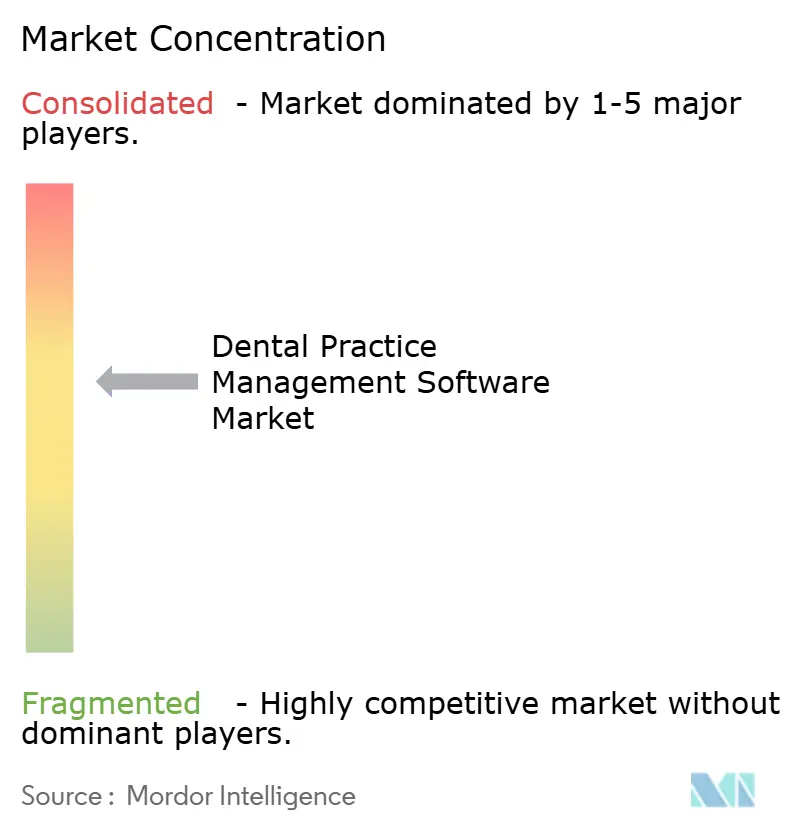
| Market Concentration | Medium |
Major Players *Disclaimer: Major Players sorted in no particular order Image © Mordor Intelligence. Reuse requires attribution under CC BY 4.0. | |
Dental Practice Management Software Market Analysis by Mordor Intelligence
The Dental Practice Management Software Market size is projected to be USD 2.36 billion in 2025, USD 2.62 billion in 2026, and reach USD 4.44 billion by 2031, growing at a CAGR of 11.12% from 2026 to 2031.
Rapid uptake reflects three converging forces: rising oral-disease prevalence that pushes clinics toward digital triage, tighter security and interoperability rules that penalize information blocking, and mature cloud infrastructure that removes capital barriers for small practices. United States HIPAA amendments requiring multi-factor authentication by December 2024 accelerated cloud migrations, while information-blocking complaints from dental clinics fell 41% year-over-year in 2025, signaling effective API-first architecture adoption. Vendors are embedding imaging, CAD/CAM, and AI analytics directly into clinical workflows to unlock new revenue streams such as chronic-care management billing. Moderate competitive intensity persists, yet acquisitions by horizontal software giants are spurring faster feature velocity and platform consolidation.
Key Report Takeaways
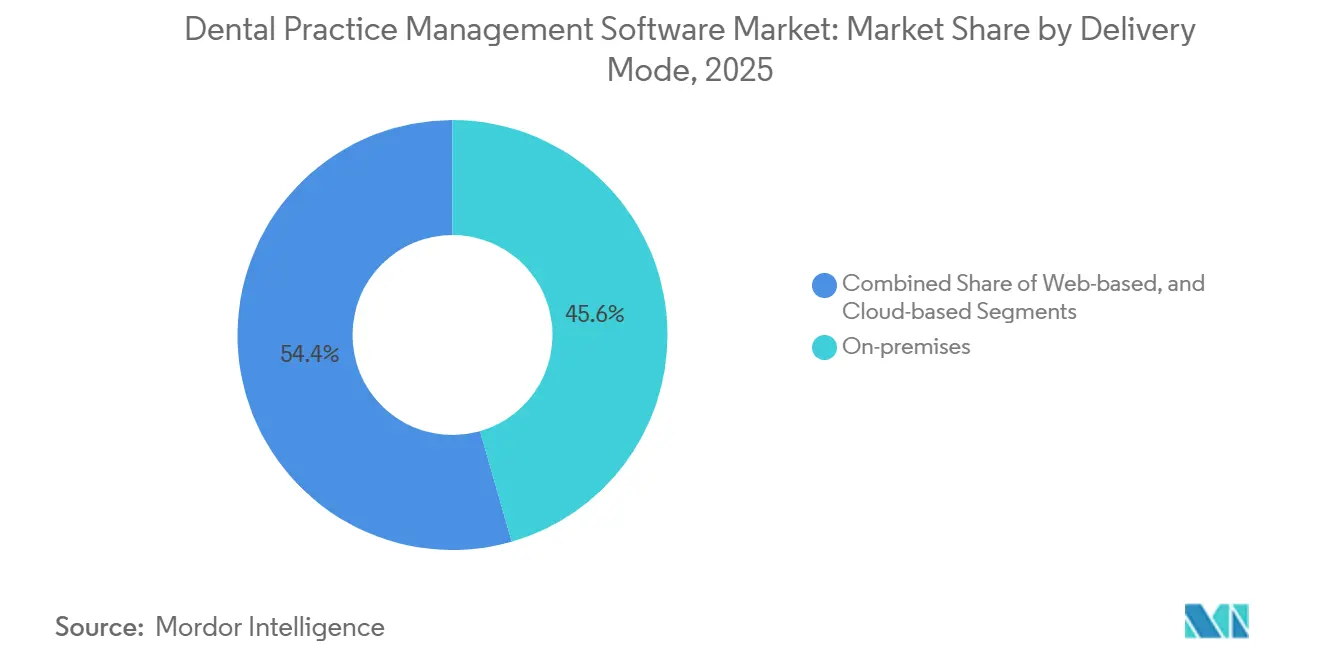
- By delivery mode, on-premises installations led with 45.56% of the dental practice management software market share in 2025; cloud-based deployments are forecast to expand at 14.25% CAGR through 2031.
- By subscription model, SaaS captured 60.53% of revenue in 2025, while subscription revenue is projected to rise at 13.85% CAGR to 2031.
- By functionality, scheduling held 26.63% revenue share in 2025; analytics modules are advancing at 16.17% CAGR through 2031.
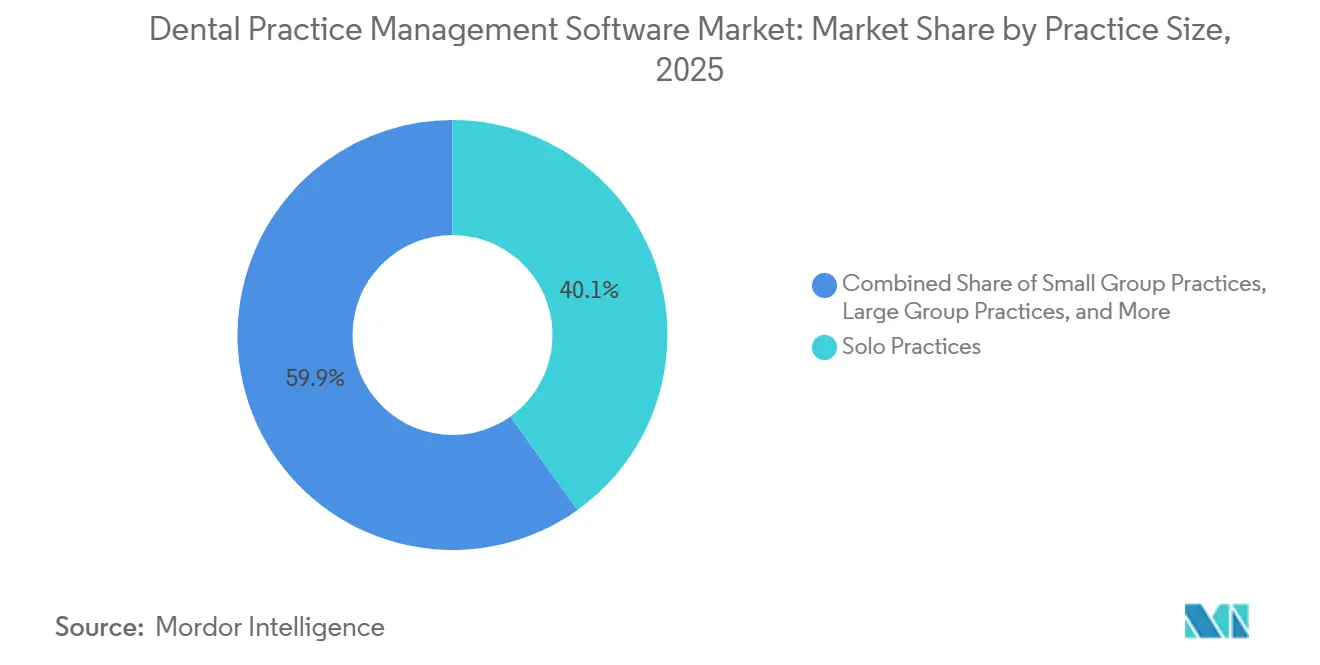
- By practice size, solo clinics represented 40.13% of installations in 2025; dental service organizations are expanding at 18.41% CAGR as private-equity consolidators standardize software platforms.
- By end user, dental clinics accounted for 85.13% of revenue in 2025; hospitals and specialty centers are growing at 13.51% CAGR on chronic-disease integration initiatives.
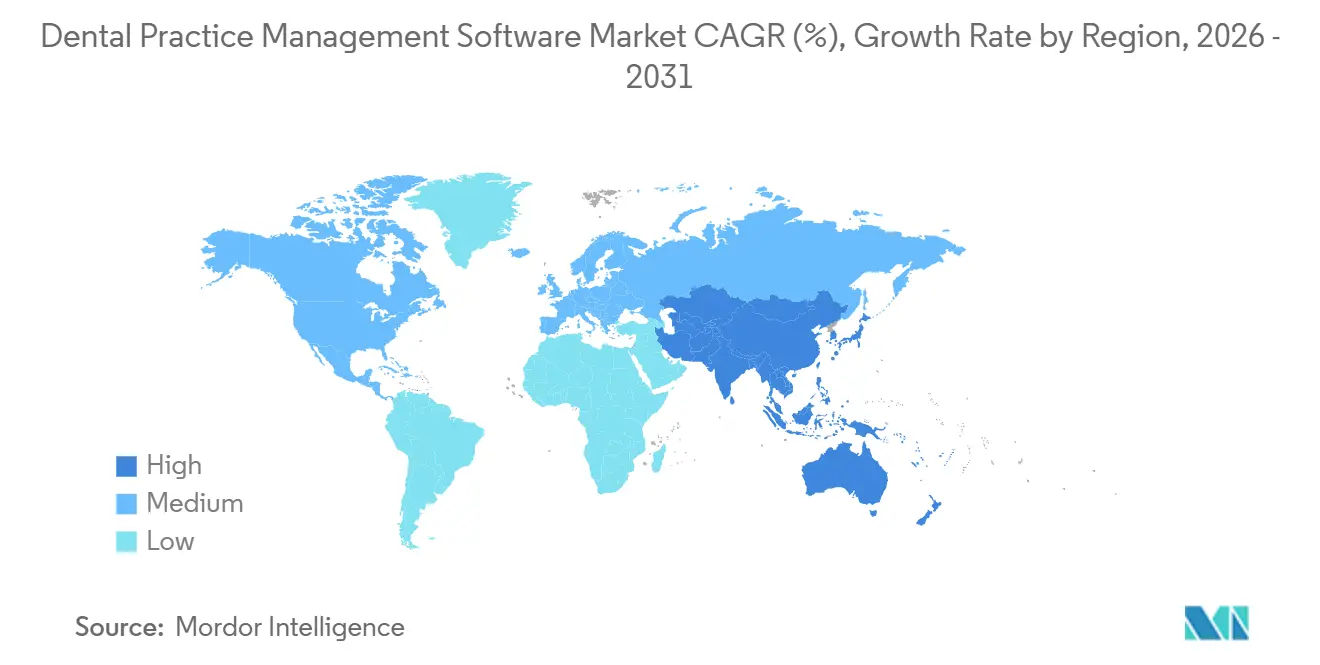
- By geography, North America commanded 45.13% revenue share in 2025, but Asia-Pacific is the fastest-growing region at 15.52% CAGR through 2031.
Note: Market size and forecast figures in this report are generated using Mordor Intelligence’s proprietary estimation framework, updated with the latest available data and insights as of January 2026.
Market Trends and Insights
Drivers Impact Analysis of Dental Practice Management Software Market*
| Driver | (~) % Impact on CAGR Forecast | Geographic Relevance | Impact Timeline |
|---|---|---|---|
| Rising global burden of oral diseases | +2.1% | Global, high in South Asia & Sub-Saharan Africa | Medium term (2-4 years) |
| Adoption of digital health records & interoperability standards | +2.4% | North America & EU, spillover to APAC urban centers | Short term (≤ 2 years) |
| Expansion of cloud-based SaaS models with lower CapEx | +1.9% | Global, led by North America & Western Europe | Medium term (2-4 years) |
| Integration with imaging, CAD/CAM & chair-side systems | +1.6% | North America, Germany, Japan, South Korea | Long term (≥ 4 years) |
| AI-powered clinical decision add-ons & predictive analytics | +1.8% | North America, select EU markets, China pilot zones | Long term (≥ 4 years) |
| API marketplaces enabling third-party app ecosystems | +1.4% | North America, UK, Australia | Medium term (2-4 years) |
| Source: Mordor Intelligence | |||
Rising Global Burden of Oral Diseases
Untreated dental caries affects 2.5 billion adults worldwide, while periodontal disease impacts 1 billion people, yet only 23% of low- and middle-income countries integrate oral health into primary care[1]. Governments now tie reimbursement to electronic dental records, illustrated by India’s mandate that all district hospitals adopt digital charting by March 2025. U.S. practices use embedded screening protocols to bill chronic-care codes worth USD 340 per patient annually. Teledentistry visits rose from under 50,000 in 2019 to 4.1 million in 2024, helped by payers reimbursing virtual assessments at 85% of the in-office rate. Demand for remote triage elevates patient-communication modules from optional add-ons to core purchase criteria. Vendors that embed risk-assessment workflows gain preference among value-based care contracts.
Adoption of Digital Health Records & Interoperability Standards
Civil monetary penalties of up to USD 1 million for blocking data exchange took effect in October 2023[2]. By mid-2025, 68% of U.S. dental practices could transmit structured treatment plans to medical EHRs, up from 12% in 2022. Acceptance of SNODENT-coded claims by Medicare Advantage from 2027 removes translation friction and pushes vendors to support the expanded terminology set. Europe’s GDPR reinforces the need for regional data residency, making certified cloud providers the default for multi-site groups. Interoperability has shifted from technical nicety to existential requirement, dictating vendor roadmaps and purchase decisions.
Expansion of Cloud-Based SaaS Models with Lower CapEx
Cloud deployments replace USD 15,000–25,000 server investments with monthly fees of USD 300–600 that bundle updates, redundancy, and support. The U.S. SBA found that 81% of solo practices adopted cloud solutions when offered monthly billing, despite earlier cash-flow concerns. Vendors release security patches within 72 hours of vulnerability disclosure, far faster than on-premises cycles. As broadband access exceeds 100 Mbps for 94% of U.S. clinics, connectivity fears recede. The economic logic now favors subscription revenue, and perpetual licenses are projected to fall below 30% of sales by 2031.
Integration with Imaging, CAD/CAM & Chair-Side Systems
RESTful APIs published in 2024 let imaging hardware push DICOM and STL files straight into the patient chart. Dentsply Sirona’s CEREC Primemill auto-populates restoration data into leading platforms, cutting documentation time by 4.2 minutes per crown. Same-day crown acceptance rates rise 18% when patients view 3D renderings chairside, boosting production. Unified data models around imaging, milling, and scheduling deepen vendor lock-in, raising switching costs for practices that invest in integrated hardware-software stacks.
Restraints Impact Analysis of Dental Practice Management Software Market*
| Restraint | (~) % Impact on CAGR Forecast | Geographic Relevance | Impact Timeline |
|---|---|---|---|
| Data-privacy & cyber-security compliance complexities | -1.3% | Global, acute in EU and North America | Short term (≤ 2 years) |
| Lack of standardized clinical coding & workflow harmonization | -0.9% | Global, most severe in emerging markets | Medium term (2-4 years) |
| Rising vendor lock-in risk as ecosystems consolidate | -0.7% | North America, Western Europe | Medium term (2-4 years) |
| Limited IT budgets among small independent practices | -1.1% | Global, rural and underserved areas | Short term (≤ 2 years) |
| Source: Mordor Intelligence | |||
Data-Privacy & Cyber-Security Compliance Complexities
Dental breaches exposed 1.2 million records in 2024, with average HIPAA settlements of USD 475,000[3]. Ransomware incidents rose sharply; 41% of affected practices paid attackers due to inadequate backups. EU GDPR fines can reach 4% of global turnover, demonstrated by a EUR 1.2 million penalty issued in 2024 for misconfigured cloud storage. Draft FDA guidance now requires multi-factor authentication and six-year audit logs for diagnostic software, squeezing small vendors without security engineering depth. Compliance burdens push clinics toward certified cloud providers but force retraining and workflow redesign.
Lack of Standardized Clinical Coding & Workflow Harmonization
Only 340 of 875 CDT procedure codes map cleanly to ICD-10-CM, delaying medical-dental coordination. Fewer than 30% of U.S. practices had adopted SNODENT by mid-2025, and dual-coding increased charting time by up to 20%. Patient-matching errors reach 12% in U.S. interoperability exchanges, consuming more than six minutes of staff time per reconciliation. Emerging markets face localization challenges across multiple languages, slowing rollout in six Indian states. Lack of harmonization dampens adoption among clinics serving multilingual populations.
*Our forecasts treat driver/restraint impacts as directional, not additive. The impact forecasts reflect baseline growth, mix effects, and variable interactions.
Dental Practice Management Software Market Segment Analysis
By Delivery Mode:
Cloud Ascends as On-Premises PersistsOn-premises deployments retained 45.56% revenue in 2025, largely from clinics that purchased perpetual licenses before 2020. Migrating this installed base can cost a five-operatory practice USD 18,000 in data conversion and training. Yet cloud solutions are projected to grow 14.25% annually, propelled by dental service organizations standardizing multi-tenant architectures for centralized billing and analytics. Subscription economics appeal to solo practices lacking IT staff because cybersecurity, redundancy, and updates are bundled. The HHS multi-factor authentication deadline made modernization urgent, accelerating conversions in 2024–2025. Rural bandwidth constraints are easing as federal infrastructure funds extend >100 Mbps access to 94% of clinics. Automatic update cycles mitigate vulnerabilities within 72 hours of disclosure, a level unattainable for most on-premises users. While a minority of practices still cite internet outages and subscription fatigue, the total cost of ownership has tilted decisively toward cloud platforms.
Web-based hybrids that run in browsers without dedicated installers fill a transitional niche but lack offline resilience. Vendors position edge-caching or local-sync features to win cautious adopters. As feature parity improves, the dental practice management software market size for cloud offerings is set to surpass on-premises revenue before 2029, driven by regulatory compliance and lower CapEx. Competitive strategies now focus on migration tools and white-glove onboarding to minimize clinic downtime. Vendors that streamline legacy database conversion and staff training gain accelerated share.

By Subscription Model:
Predictable Fees Overturn Perpetual LicensesSaaS captured 60.53% revenue in 2025 and is forecast to rise at 13.85% CAGR as practices favor predictable monthly spending aligned with cash flow. Perpetual licenses once priced at USD 8,000–15,000 plus 18-22% maintenance are declining because CFOs discount the value of slower innovation and higher upgrade friction. Patterson Companies reported 27% subscription revenue growth in fiscal 2024 while perpetual sales dropped 11%, prompting a pivot to subscription-only pricing for Eaglesoft beginning 2026.
Tiered SaaS packaging lets vendors upsell AI analytics, imaging integration, and API access. Open Dental’s USD 199-399 per-provider tiers illustrate how clinics self-select functionality without lengthy sales cycles. For enterprise DSOs, volume pricing unlocks 22% software savings and centralizes data lakes for benchmarking. As subscription renewals concentrate bargaining power, vendors emphasize customer success teams and low churn. Analysts expect the dental practice management software market size stemming from perpetual licenses to fall below USD 1 billion by 2030, signaling structural revenue model realignment.
By Functionality:
Analytics Surges Beyond Mature Scheduling ToolsScheduling and calendar modules held 26.63% revenue in 2025, but growth has plateaued because feature sets have commoditized. Predictive analytics modules are projected to expand 16.17% annually to 2031, drawing demand from clinics seeking to identify no-show risks and optimize chair utilization. Machine-learning add-ons now score patient lifetime value and treatment-plan acceptance likelihood within the workflow. Billing modules are automating denial management by resubmitting corrected claims within 24 hours, shrinking accounts-receivable days outstanding.
Real-time insurance eligibility verification reduces claim denials up to 18%, encouraging integration of X12 270/271 transactions. Imaging and diagnostics integration continue to narrow the gap between CBCT units, intraoral scanners, and the patient chart. Vendors embedding imaging thumbnails reduce documentation time and visually boost same-day case acceptance. As practices adopt intraoral scanners, the dental practice management software market size linked to imaging add-ons is projected to outpace legacy charting revenue by 2029. Treatment planning now spans chairside 3D modeling, enabling instantly milled crowns and higher production per visit.
By Practice Size:
DSOs Accelerate Enterprise Platform DemandSolo clinics comprised 40.13% of installations in 2025, emphasizing ease of use and minimal setup. Small groups adopt mid-tier packages that add imaging and basic analytics. Large groups require multi-location scheduling, centralized revenue-cycle management, and granular role-based permissions under HIPAA’s minimum-necessary rule. Dental service organizations, expanding at 18.41% CAGR, standardize enterprise platforms to extract procurement discounts and unify compliance reporting. Heartland Dental finished migrating 1,800 sites to a single cloud solution in 2024, reducing IT tickets 37% and license costs 22%.
DSOs use consolidated data lakes to benchmark hygiene utilization, case acceptance, and recall compliance across networks, driving iterative performance gains. Their buying power steers vendor roadmaps toward scalable, API-rich platforms. The shift from fragmented ownership to corporate affiliation is the pivotal structural trend underpinning the dental practice management software market. Vendors courting DSOs invest in dedicated account teams and enterprise-grade support to secure multi-year contracts that protect against churn.
By End User:
Hospitals and Academic Centers Embrace Integrated Oral HealthDental clinics generated 85.13% of 2025 revenue, but hospital and specialty centers are climbing at 13.51% CAGR as academic medical hubs integrate oral health within chronic-disease pathways. The American Heart Association urges dental evaluations before invasive cardiac procedures, requiring bidirectional EHR connectivity. By mid-2025, 68% of practices could send structured treatment plans to medical EHRs, up from 12% in 2022.
Hospital-based urgent-care dental clinics lowered emergency-department dental visits 41% in their first year, highlighting the value of integrated records. Federated data networks funded by the National Institute of Dental and Craniofacial Research allow researchers to query de-identified patient data without centralization, accelerating AI model training. As medical-dental integration deepens, the dental practice management software industry must support advanced interoperability, specialty coding, and population-health analytics.
Geography Analysis
North America Dental Practice Management Software Market
North America contributed 45.13% of global revenue in 2025, supported by Medicare Advantage reimbursement for teledentistry and state Medicaid e-prior authorization mandates. HIPAA security updates requiring encryption and multi-factor authentication accelerated cloud migrations across clinics. Canada’s phased dental-care expansion obliges electronic claims via the national EDI standard, spurring adoption among 11,000 practices. Mexico’s social-security network added 340 clinics in 2024, with MXN 1.2 billion (USD 70 million) earmarked for software subsidies. Broadband penetration exceeding 100 Mbps coverage for 94% of U.S. dental offices removes a lingering technical barrier.
APAC Dental Practice Management Software Market
Asia-Pacific is the fastest-growing region at 15.52% CAGR through 2031, anchored by China’s CNY 12 billion (USD 1.7 billion) rural-clinic digitization fund and India’s 340 million-citizen digital-health identifier rollout. Japan’s mandate for 100% electronic dental claims accelerated digitization among holdouts, while South Korea reimburses AI-assisted caries detection at 90% of manual rates, incentivizing software upgrades. Australia’s My Health Record grants of AUD 5,000 (USD 3,300) per clinic reduce integration costs. Regional localization, including multi-language SNOMED extensions and cloud data-sovereignty zones, is critical for vendor success.
EMEA and South America Dental Practice Management Software Market
Europe advances at a steadier pace due to Medical Device Regulation hurdles, which add up to two years to product certification and concentrate share among vendors with seasoned regulatory teams. Germany enforces reimbursement penalties for non-compliant clinics, prompting rapid software upgrades. The United Kingdom funds GBP 120 million (USD 150 million) to digitize 11,000 NHS dental practices, covering training and migration costs. Mobile-first solutions gain traction in Middle East, Africa, and South America, where tablet-based workflows bypass desktop infrastructure. Vendors that localize Arabic, Portuguese, and Swahili interfaces capture early-mover advantage.
Mordor Intelligence provides coverage of the dental practice management software market across other key regional markets, including Asia, each with their regulatory frameworks and demand patterns.
Regulatory Landscape
Regulation affecting dental practice management software increasingly focuses on privacy, cybersecurity, interoperability, and governance for AI-enabled functionality. In the United States, HIPAA requirements and enforcement led by the HHS Office for Civil Rights continue to drive encryption, auditability, and multi-factor authentication into baseline product design. The Office of the National Coordinator for Health IT (ONC) has also advanced API and transparency expectations through updates to the Health Data, Technology, and Interoperability certification program (finalized in a January 2024 Federal Register rule), reinforcing API-first architectures and discouraging information blocking.
Oversight for AI-enabled modules embedded in practice workflows has tightened in major regions. The EU Artificial Intelligence Act (approved March 13, 2024) introduces risk-based obligations that affect dental diagnostic and decision-support features. The UK updated medical device rules with post-market surveillance measures in force from June 16, 2025 under the UK MDR 2002 framework. In the United States, the FDA issued final guidance on January 6, 2026 clarifying when certain clinical decision support software can be excluded from the medical device definition under the 21st Century Cures Act, which shapes how vendors scope, document, and position AI-enabled capabilities in clinical workflows.
Competitive Landscape
The top vendors, Henry Schein (Dentrix), Patterson (Eaglesoft), Carestream Dental, and Planet DDS, hold significant share, producing moderate concentration. Henry Schein’s March 2024 acquisition of Jarvis Analytics embeds predictive models within Dentrix, increasing switching costs for existing users. Patterson’s January 2025 partnership with Weave bundles communications and payments into Eaglesoft, lowering total ownership costs and solidifying customer loyalty. Dentsply Sirona’s vertical integration of imaging, CAD/CAM, and software tightens its hardware-driven ecosystem.
Open Dental spearheads the platform approach with a certified marketplace that doubled integrations in eight months and now exceeds 12,000 practice installs. API transparency and FHIR compliance differentiate emerging entrants such as CareStack and tab32, which target DSOs with multi-tenant architectures and rapid release cycles. Vendors deploy security certifications, ISO 27001, SOC 2 Type II, to mitigate escalating ransomware risks and comply with draft FDA cyber-guidance.
Strategic white space centers on AI-driven diagnostics, blockchain-based consent, and federated analytics spanning multi-site data lakes. Horizontal software conglomerates are expected to pursue additional roll-ups, intensifying feature convergence. Vendors unable to deliver open APIs, AI roadmaps, and certified security frameworks risk marginalization as DSOs consolidate purchasing power.
Dental Practice Management Software Industry Leaders
-
Henry Schein Inc. (Dentrix)
-
Carestream Dental LLC
-
Planet DDS Inc. (Denticon)
-
Patterson Companies Inc. (Eaglesoft)
-
Curve Dental Inc.
- *Disclaimer: Major Players sorted in no particular order
Dental Practice Management Software Market Companies Covered in this Report
- ABELDent Inc.
- ACE Dental Software
- CareStack (Good Methods Global)
- Carestream Dental
- ClearDent
- Curve Dental
- DentiMax LLC
- Dovetail Dental Software
- Exan Software (axiUm)
- iDentalSoft
- MOGO
- NextGen Healthcare
- Open Dental Software
- Patterson Companies Inc. (Eaglesoft)
- Planet DDS Inc. (Denticon)
- Practice-Web Inc.
- RxNT Inc.
- Software of Excellence Intl.
- tab32
- Henry Schein Inc. (Dentrix)
Read Analysis of Dental Practice Management Software Companies
Market Opportunities and Future Outlook
Security-driven modernization creates whitespace for vendors that can package compliance into turnkey cloud offerings, particularly for small practices without dedicated IT teams and for DSOs standardizing controls across multi-site networks. The HHS Office for Civil Rights HIPAA Security Rule NPRM (published January 6, 2025) signals more prescriptive requirements under discussion, including universal encryption, multi-factor authentication, and routine testing, which favors platforms with mature security engineering, standardized audit trails, and rapid patching processes.
Interoperability and workflow automation also broaden use cases beyond core scheduling and billing, particularly when dental data needs to connect into broader care pathways. Adoption of HL7 FHIR-aligned exchange and API marketplaces supports linkages between dental PMS and medical EHRs, and vendor activity points to demand for AI-enabled front-office and clinical documentation workflows. In 2026, Henry Schein One expanded Dentrix Ascend with an AI-enabled clinical workflow built with AWS, and Planet DDS added predictive intelligence partnerships and DSO wins (for example, Smile Partners USA selecting Denticon across 120 locations), reinforcing demand for enterprise-ready platforms that combine eligibility verification, revenue-cycle tools, and AI-driven patient engagement within a single operating environment.
Recent Industry Developments in Dental Practice Management Software Market
- July 2026: Planet DDS partnered with Truro AI to integrate predictive intelligence into the Denticon ecosystem, targeting scheduling optimization and collections gap analysis. The partnership strengthens Denticon's analytics layer for DSOs that manage capacity and revenue across multi-location networks.
- June 2026: Carestream Dental and Vyne Dental expanded their collaboration to support practice workflows with simplified claims attachments and real-time eligibility verification. This adds revenue-cycle functionality that reduces manual payer follow-up and tightens integration between clinical workflows and reimbursement processes.
- April 2026: Henry Schein One introduced a voice-driven, AI-enabled next-generation clinical workflow in Dentrix Ascend built with Amazon Web Services. Embedding AI-assisted documentation and workflow orchestration inside a cloud PMS improves platform stickiness and raises the competitive bar for legacy systems focused mainly on scheduling and billing.
Dental Practice Management Software Market Report Scope and Research Methodology
Market Definition and Coverage
This market covers software platforms used by dental clinics and dental groups to run day-to-day practice operations, including patient scheduling, charting and notes, billing and claims workflows, and related administrative reporting, across on-premise and cloud deployments.
Scope exclusions: Standalone dental imaging, CAD/CAM, or basic invoicing tools are excluded when they are sold without core practice management functionality.
Segments Covered in This Report
- By Delivery Mode
- On-premises
- Web-based
- Cloud-based
- By Subscription Model
- Perpetual License
- Subscription / SaaS
- By Functionality
- Patient Communication & Engagement
- Appointment Scheduling & Calendar
- Billing & Invoicing
- Insurance & Claims Management
- Treatment Planning & Charting
- Imaging & Diagnostics Integration
- Analytics & Business Intelligence
- By Practice Size
- Solo Practices (1-2 ops)
- Small Group Practices (3-9 ops)
- Large Group Practices (10+ ops)
- Dental Service Organizations (DSOs)
- By End User
- Dental Clinics
- Hospitals & Specialty Dental Centers
- Academic & Research Institutes
- Geography
- North America
- United States
- Canada
- Mexico
- Europe
- Germany
- United Kingdom
- France
- Italy
- Spain
- Rest of Europe
- Asia-Pacific
- China
- Japan
- India
- South Korea
- Australia
- Rest of Asia-Pacific
- Middle East & Africa
- GCC
- South Africa
- Rest of Middle East & Africa
- South America
- Brazil
- Argentina
- Rest of South America
- North America
Data Sources, Market Sizing, and Validation
Desk Research
Desk research was used to set the market boundaries, build the starting demand pool, and pressure-test assumptions before interviews. We relied on public sources such as the US Centers for Medicare and Medicaid Services for dental spending context, the US Centers for Disease Control and Prevention for oral health indicators, and World Bank and OECD data for healthcare expenditure and macro trends that influence clinic software budgets.
To translate activity into software demand, we also reviewed sources such as the American Dental Association for practice and workforce signals, as well as peer-reviewed and open access dental informatics literature for digitization and workflow adoption patterns. On the supply side, we referenced company filings, investor presentations, product documentation, and reputable press coverage to map pricing structures and common feature bundles. Where needed, paid subscriptions for company financials and intelligence, news and financials, and patent databases were used to cross-check vendor exposure and product direction. These examples are not exhaustive, and many other public sources were used for data collection, validation, and clarification.
Primary Interviews and Surveys
Primary work focused on validating what clinics actually pay and how they buy, since list prices can differ from contracted pricing and bundled add-ons. We spoke with a mix of software providers, dental clinic administrators, IT managers, and dental group decision makers across major regions so the model reflects deployment preferences, renewal behavior, and switching timelines.
Inputs from interviews were used to confirm adoption by practice size, the typical split between subscription and one-time licensing, and the pace of cloud migration. Those interview outcomes then helped fine-tune assumptions that were initially estimated from desk research.
Distribution of primary research fieldwork respondents
| Company type | Respondent position | Region |
|---|---|---|
| Top tier: 31% | CXOs: 20% | APAC: 44% |
| Mid tier: 49% | Functional/Unit leaders: 32% | EMEA: 37% |
| Smaller Players: 20% | Managers: 48% | Americas: 19% |
Market-Sizing & Forecasting
Market sizing was built using a top-down demand reconstruction that starts from the count of dental practices and dental chairs by region, then applies software adoption and paid seat (or location) penetration to arrive at the active paying installed base. After that, pricing is modeled using a blended annual contract value that reflects cloud subscription tiers, on-premise licensing plus maintenance, and common paid modules.
To keep the model grounded, we used practical inputs that can be checked year to year, such as the number of practicing dentists and clinic density, patient visit volumes as a proxy for scheduling intensity, cloud versus on-premise mix, average users per site, and typical retention and upgrade cycles. Where data gaps existed, we created ranges using interview-based benchmarks and then narrowed them by comparing against the revenue scale implied by public financial disclosures.
For forecasting, scenario analysis was used so different adoption and pricing paths could be reflected without overfitting the data. The forward view was shaped by expected clinic consolidation, cloud migration pace, reimbursement and claims digitization needs, and inflation effects on subscription pricing, and then validated through follow-up expert checks before final sign-off.
Data Validation & Update Cycle
Totals were checked through triangulation across demand signals, supplier revenue indications, and independent trend markers, then reviewed for any region that looked out of line with dentist counts or software adoption patterns. When large variances showed up, assumptions were revisited, and selected respondents were re-contacted to confirm whether the change came from pricing, mix shift, or an adoption step-up.
Before publication, the full model goes through multi-step analyst review so that inputs, calculations, and outputs are consistent across all cuts. The report is refreshed annually, and interim updates are made when material events occur, such as major pricing changes, regulatory shifts affecting claims workflows, or notable product delivery changes. Right before delivery, we conduct a final pass so clients receive the latest updated view.
Mordor Intelligence's Dental Practice Management Software Market Size Versus Other Published Estimates
Published market sizes for dental practice management software can look far apart because firms do not always count the same revenue streams, and they often start from different demand pools. Differences also come from how pricing is treated over time, and whether the year used as the base is updated with newer signals.
The benchmark table shows a visible spread in 2025 values, and in Mordor Intelligence's model the market is limited to software with core practice management functions, which leaves out standalone imaging, CAD/CAM, and invoicing tools that can inflate totals when bundled into a broader dental software bucket. Another driver is how subscription pricing is progressed, where some estimates apply faster uplift without checking it against renewal behavior and module attach rates that were validated in interviews.
Benchmark comparison
| Source | Market Size | Gaps in Research Methodology |
|---|---|---|
| Mordor Intelligence | USD 2.36 B (2025) | |
| Industry Publisher A | USD 1.96 B (2025) | Uses a narrower revenue capture based on a defined base year set, and may treat some modules and services as out of scope, which can pull down the 2025 total versus a broader paid feature bundle view. |
| Industry Publisher B | USD 3.09 B (2025) | Appears to include a wider set of dental software revenue lines by mixing adjacent application tools with practice management, and it can apply higher blended pricing assumptions that are not consistently tied back to user counts and retention cycles. |
Looking across the three numbers, most of the gap is explained by what is counted as practice management versus adjacent dental software, followed by how pricing and paid user intensity are assumed. Our approach keeps the estimate traceable to a clear paying practice base and a realistic pricing mix, which makes it easier to reconcile updates when new adoption or pricing signals emerge.
Key Questions Answered in the Report
What is the current dental practice management software market size?
It is USD 2.62 billion in 2026 with a forecast to reach USD 4.44 billion by 2031.
How fast is the sector growing?
The segment is registering an 11.12% CAGR between 2026 and 2031.
Which delivery mode is expanding the quickest?
Cloud-based deployments are projected to grow 14.25% annually through 2031.
Why are analytics modules gaining traction?
Predictive analytics improve no-show reduction, chair utilization, and treatment acceptance, driving a 16.17% CAGR to 2031.
Which region is the fastest-growing?
Asia-Pacific is advancing at 15.52% CAGR, led by digitization initiatives in China and India.
What are the main compliance challenges for clinics?
Data-privacy rules such as HIPAA and GDPR require encryption, multi-factor authentication, and detailed audit logging, raising security and budget pressures.