
Defoaming Coating Additive Market Size and Share
Market Overview
| Study Period | 2020 - 2031 |
|---|---|
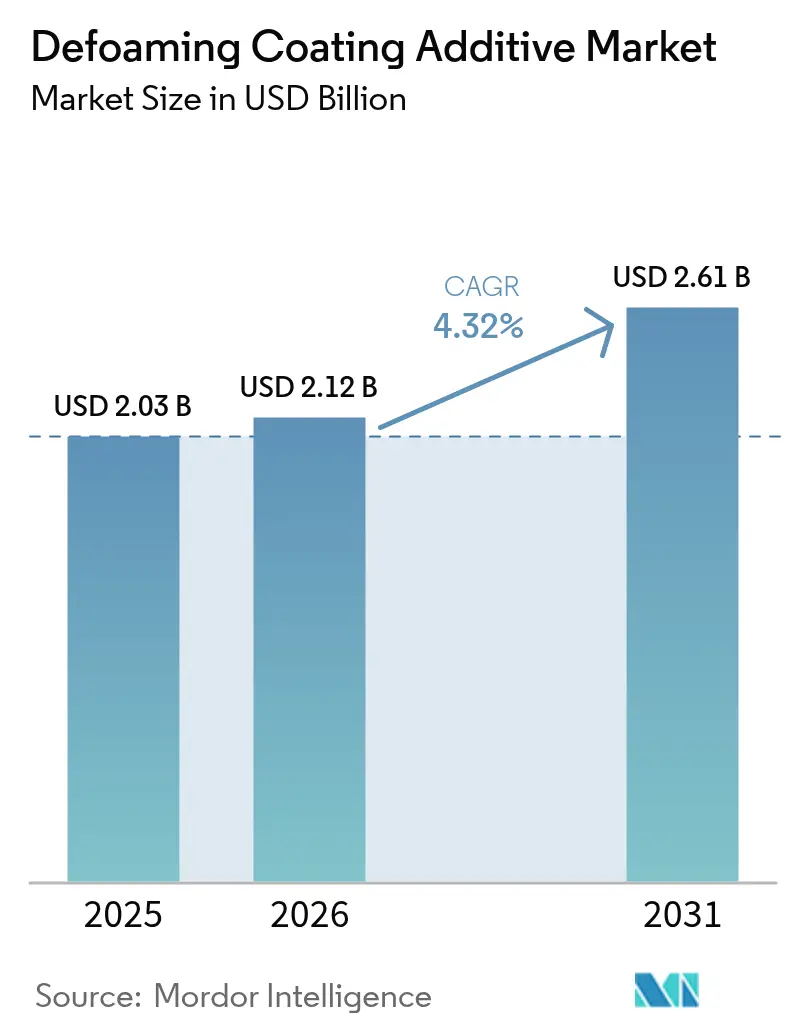
| Market Size (2026) | USD 2.12 Billion |
| Market Size (2031) | USD 2.61 Billion |
| Growth Rate (2026 - 2031) | 4.32 % |
| Fastest Growing Market | Asia Pacific |
| Largest Market | Asia Pacific |
| Market Concentration | Medium |
Major Players *Disclaimer: Major Players sorted in no particular order Image © Mordor Intelligence. Reuse requires attribution under CC BY 4.0. | |
Defoaming Coating Additive Market Analysis by Mordor Intelligence
Defoaming Coating Additive Market size market size in 2026 is estimated at USD 2.12 billion, growing from 2025 value of USD 2.03 billion with 2031 projections showing USD 2.61 billion, growing at 4.32% CAGR over 2026-2031. A steady shift toward water-based, low-VOC formulations is the core driver behind this expansion, with advanced defoamer chemistries ensuring film integrity across architectural, automotive, and industrial lines. Asia-Pacific remains the demand anchor for the defoaming coating additive market as large-scale building activity and vehicle output accelerate additive uptake. Suppliers continue to broaden product lines around silicone emulsions, bio-based polymers, and VOC-free powders, thereby securing resilience against raw-material volatility. On the opportunity side, digital décor printing, battery component coatings, and high-build spray systems generate fresh volume and margin pockets, even as price-sensitive customers demand cost-stable alternatives to traditional silicone oils.
Key Report Takeaways
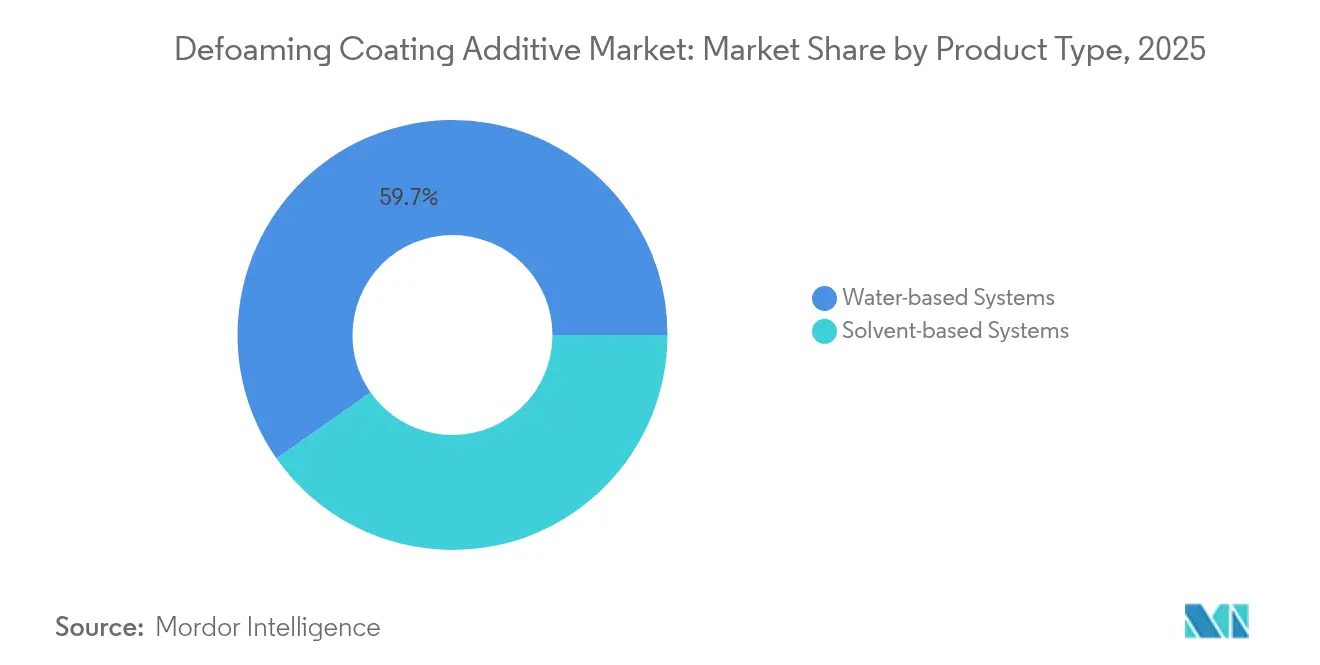
- By product type, water-based systems commanded 59.74% of the defoaming coating additive market share in 2025, while the sub-segment is projected to post a 5.18% CAGR through 2031.
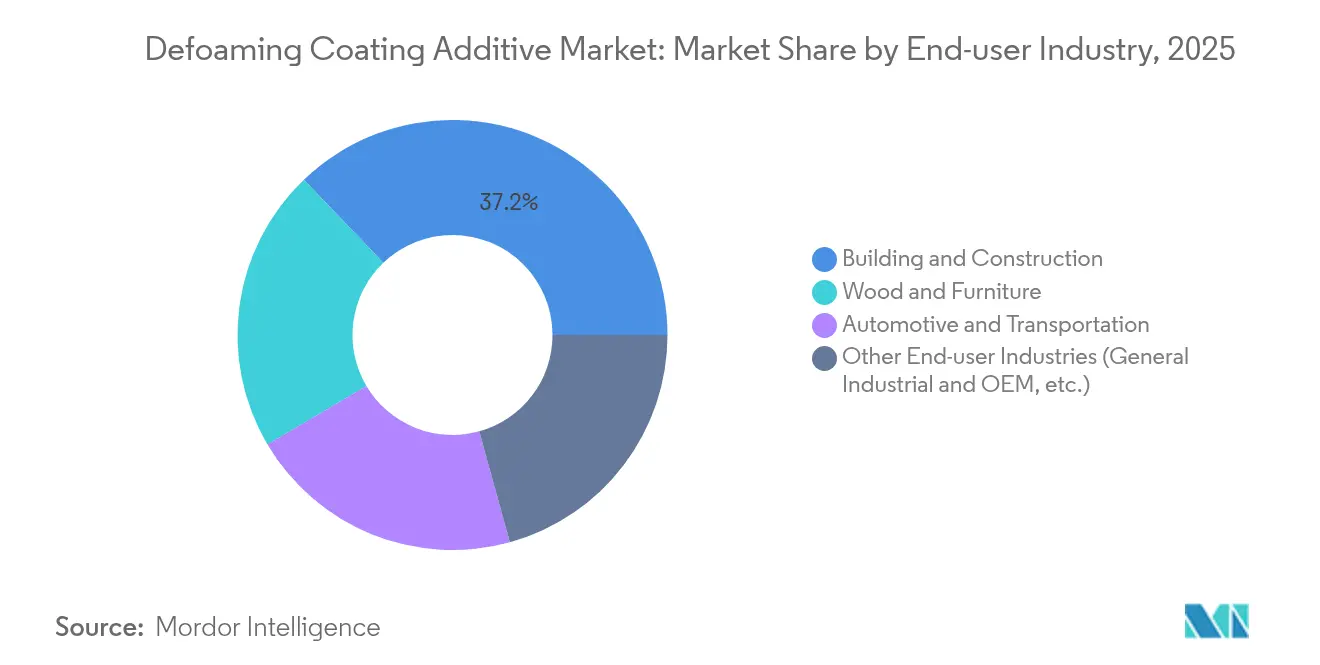
- By end-user industry, building and construction held 37.15% of the defoaming coating additive market size in 2025, whereas wood and furniture is the fastest-growing category with a 5.02% CAGR to 2031.
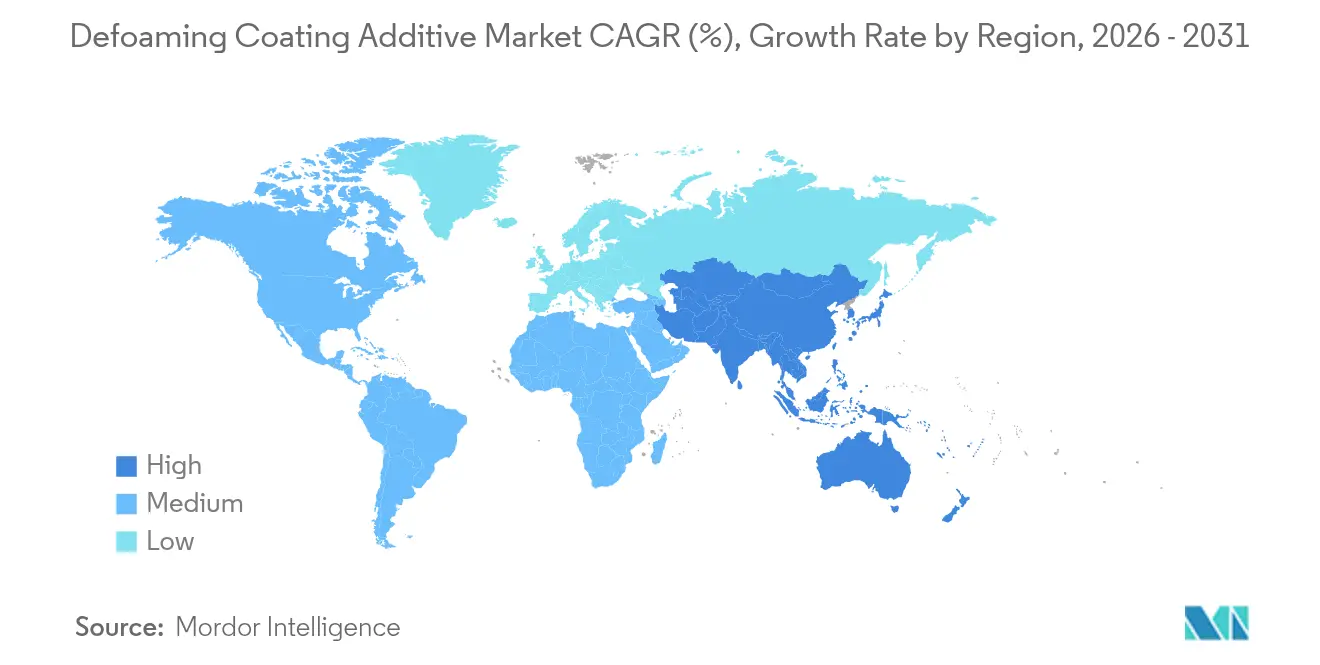
- By geography, Asia-Pacific dominated with 44.10% revenue share in 2025; the region is set to expand at a 5.03% CAGR during the forecast window.
Note: Market size and forecast figures in this report are generated using Mordor Intelligence’s proprietary estimation framework, updated with the latest available data and insights as of 2026.
Market Trends and Insights
Drivers Impact Analysis of Defoaming Coating Additive Market*
| Drivers | (~) % Impact on CAGR Forecast | Geographic Relevance | Impact Timeline |
|---|---|---|---|
| Growing demand from construction coatings | 1.2% | Global, with concentration in Asia-Pacific and the Middle East | Medium term (2-4 years) |
| Increasing requirement in automotive coatings | 0.8% | North America, Europe, Asia-Pacific core markets | Long term (≥ 4 years) |
| Expansion of wood and furniture production | 0.6% | Asia-Pacific, North America, with spillover to Europe | Medium term (2-4 years) |
| Surge in digital decor printing lines | 0.4% | Europe, North America, with adoption in Asia-Pacific | Short term (≤ 2 years) |
| Rising usage in industrial applications | 0.3% | Global, with emphasis on manufacturing hubs | Long term (≥ 4 years) |
| Source: Mordor Intelligence | |||
Growing Demand from Construction Coatings
Rapid urbanization and infrastructure renewal elevate foam-control requirements for architectural finishes worldwide. Spray-applied, high-build systems are now commonplace on commercial facades and civil structures, yet even micro-air entrapment compromises adhesion and long-term durability. The push toward low-VOC paints heightens the technical challenge because water-rich formulations entrain more air than solventborne predecessors. BASF boosted its Nanjing additives output in 2024 to supply water-compatible defoamers that reconcile these issues. Emerging economies, led by China, India, and Indonesia, continue to commission mass housing, transport corridors, and industrial parks, embedding sustained pull for high-efficiency defoamers able to maintain gloss uniformity on concrete, metal, and composite substrates.
Increasing Requirement in Automotive Coatings
Electric-vehicle platforms, lightweight substrates, and multi-layer paint stacks create fresh foam-control pain points. Modern primer-surfacer lines run at elevated line speeds, where improperly dispersed air causes crater, pinhole, and blister defects. Allnex’s solventborne ADDITOL VXL 4951 N illustrates how the defoaming coating additive market now delivers narrow-range surface-tension control to avoid haze without silicone print-transfer risks. Battery housings, e-motor components, and electrode slurries present additional niches that require zero-silicone formulas for voltage-sensitive zones, nudging OEMs to lock in long-term supply contracts with additive vendors able to certify cleanliness.
Expansion of Wood and Furniture Production
Consumers favor sustainably sourced timber and low-odor water-based finishes for cabinetry and flooring. Yet wood grain absorbs air during roller and vacuum coating, forcing operators to dose defoamers precisely. Research on UV-cured polyurethane-acrylate confirms that optimized defoamer loadings at 120 g/m² deliver higher gloss and scratch resistance on oak panels while holding VOCs below legislative thresholds. Asian production clusters around Vietnam and Malaysia add volume, whereas North American mills push for premium matte looks that demand finer microfoam removal. These converging needs explain why the defoaming coating additive market records its fastest segmental CAGR in wood and furniture lines.
Surge in Digital Décor Printing Lines
High-resolution inkjet heads apply decorative patterns on laminates, wall panels, and luxury furniture fronts. Any residual foam in primer or topcoat distorts print quality, leading to banding or color drift. European printers shifted to inline waterborne protective coats, requiring defoamers compatible with pigment dispersants and photoinitiators. Brands supplying wide-format presses now collaborate directly with additive formulators to pre-qualify low-silicone emulsions that leave no surface residue. Adoption waves are visible in Turkey, Poland, and coastal China plants, ensuring short-term growth spurts for niche defoamers tailored to digital décor lines.
Restraints Impact Analysis of Defoaming Coating Additive Market*
| Restraints | (~) % Impact on CAGR Forecast | Geographic Relevance | Impact Timeline |
|---|---|---|---|
| Silicone-oil price volatility | -0.5% | Global, with particular impact on cost-sensitive markets | Short term (≤ 2 years) |
| Rise of UV-powder coatings | -0.3% | Europe, North America, with gradual adoption in Asia-Pacific | Medium term (2-4 years) |
| Stricter food-contact migration limits | -0.2% | Europe, North America, with regulatory spillover globally | Long term (≥ 4 years) |
| Source: Mordor Intelligence | |||
Silicone-Oil Price Volatility
Slim supply chains, purity specifications and energy-intensive synthesis periodically lift silicone-oil costs, unsettling formulators who rely on the material as the cornerstone of high-efficiency defoamers. Coating makers operating on narrow margins, particularly in Southeast Asia, pivot toward lower-priced mineral-oil or polymer alternatives despite minor performance trade-offs. BYK’s silicone-free BYK-1642 caters to this budget-centric cohort while giving additive suppliers a hedge against price spikes.
Stricter Food-Contact Migration Limits
North American and European regulators tighten extraction limits on specific defoamer chemistries such as polyethylene glycol. In parallel, REACH classifies certain cyclic silicones as substances of very high concern, curbing their use in packaging coatings that contact food[1]. Additive suppliers must redesign portfolios around higher-molecular-weight silicones or bio-derived polymers, incurring elevated research and development spends that may pass through to customers as price premiums, thereby tempering uptake in cost-focused converter plants.
*Our forecasts treat driver/restraint impacts as directional, not additive. The impact forecasts reflect baseline growth, mix effects, and variable interactions.
Defoaming Coating Additive Market Segment Analysis
By Product Type:
Water-Based Systems Drive Sustainability TransitionWater-based chemistries secured 59.74% of the defoaming coating additive market in 2025 and are forecast to advance at 5.18% CAGR through 2031 as formulators pursue VOC-compliant architectures. Silicone emulsions remain the workhorse class, combining rapid micro-bubble rupture with negligible surface-defect risk even at dosages below 0.2%. Meanwhile, the push for silicone-free labelling stimulates polymer microemulsions derived from vegetable oils. Allnex’s bio-based ADDITOL VXW 4926 exemplifies this direction, offering equivalent dynamic surface-tension control without triggering substance-of-concern audits.
Solvent-based packages persist where extreme humidity resistance or high-temperature bake cycles make water a liability. Marine topcoats, chemical-plant linings, and specialty refinish fat lines still pick high-flashpoint carriers paired with silicone-polyacrylate defoamers that withstand 200 °C cure schedules. Powder-format defoamers, such as BYK-1693 SD, serve customers migrating to VOC-free zero-flow powder paints. These granules contain 54% bio-carbon, illustrate how the defoaming coating additive market blends sustainability and process convenience without sacrificing efficacy.

By End-User Industry:
Construction Leads While Wood Furniture AcceleratesConstruction retained a 37.15% share of the defoaming coating additive market in 2025, riding infrastructure buildouts across Asia-Pacific mega-cities and refurbishment cycles in Western economies. The segment favors high-build elastomeric walls and low-sheen exterior emulsions that rely on defoamers to avoid pinholes on porous masonry. Builders now specify defect-free finishes to minimize call-backs, encouraging paint makers to tighten additive quality.
Wood and furniture trails in absolute dollar terms yet delivers the highest 5.02% CAGR, reflecting consumer shift toward eco-philic wooden décor across global households. UV-curable clearcoats on cabinetry and flooring demand ultra-fast defoamers to support flash-off times below 60 seconds, ensuring high throughput on automated lines. Automotive and general industrial sectors provide steady baseline volume, hedging suppliers against cyclical swings in housing and furnishings.
Geography Analysis
APAC Defoaming Coating Additive Market
Asia-Pacific captured 44.10% of the defoaming coating additive market in 2025 on the back of construction expansions and vehicle assembly clusters in China, India, and the ASEAN bloc. Regional CAGR of 5.03% reflects government-funded smart-city projects, new metro corridors, and aggressive EV production mandates. Multinational producers operate integrated Verbund sites and local joint ventures to curtail logistics costs and satisfy country-specific compliance audits.
North America and Europe Defoaming Coating Additive Market
Federal infrastructure modernization, battery-plant investments, and resilient housing demand keep coatings factories running near capacity in North America. Regulatory pressure against PFAS drives transfer from fluorinated defoamers to silicone or bio-based families, prompting formulators to fast-track new product qualifications. Europe maintains a similar regulatory tone, further complicated by REACH candidate-listing of additional cyclic silicones in 2025, spurring additive vendors to market PFAS-free, cyclic-siloxane-free lines.
MEA and South America Defoaming Coating Additive Market
South America, and Middle-East and Africa collectively account for a smaller yet rising slice of the defoaming coating additive market. Brazil’s construction stimulus and Saudi Arabia’s giga-projects draw in advanced waterborne coatings that cannot tolerate foam. Coating producers in these regions often license European technology, integrating defoamers sourced from global majors until local capacity matures. These dynamics translate into above-average growth trajectories, albeit from a comparatively low base.
Value Chain Analysis
The value chain starts with upstream feedstocks such as siloxane intermediates (for silicone defoamers), polyethers, mineral oils, and fatty-alcohol derivatives, followed by synthesis and formulation into silicone emulsions, polymeric defoamers, and powder formats for coatings. Large suppliers with broader organosilicon and specialty-chemical platforms (for example, BASF, Dow, Evonik, ALTANA/BYK, and Wacker Chemie) combine process know-how with application labs to tune compatibility, crater risk, and gloss across architectural, automotive, wood, and industrial formulations. Mid-sized specialists (for example, Münzing Chemie and regional formulators) often compete on service agility and cost-optimized blends.
Downstream, defoamers are sold directly to major paint and coating producers and also through specialty-chemical distributors. In these routes, technical service and rapid reformulation support conversion speed in water-based lines that are more foam-prone. Key friction points include feedstock price volatility (notably silicone-oil related inputs) and compliance screening that pushes product redesign toward low-VOC and PFAS-free solutions, which increases the importance of qualified and documented product lines. Product launches such as Evonik's TEGO Foamex 8051 (announced June 2025) show how compliance-ready, waterborne-focused concentrates flow through this chain toward decorative-coatings customers that require validated ecolabel-aligned options.
Competitive Landscape
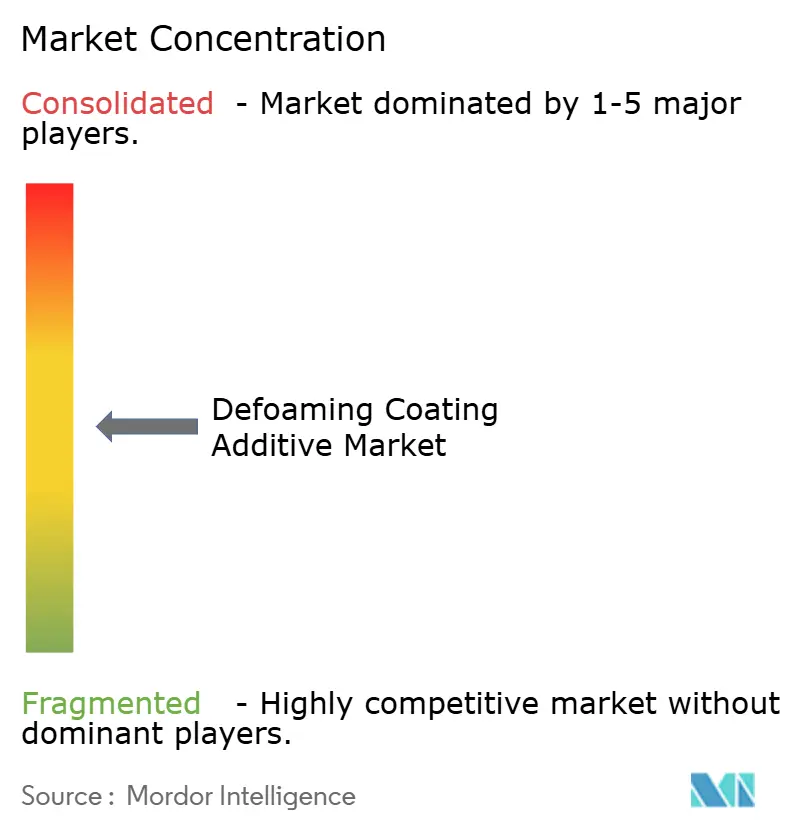
The defoaming coating additive market is moderately fragmented. Large incumbents wield integrated silicone capacity, pilot plants, and application labs that shorten cycle time from concept to customer approval. Mid-tier challengers differentiate via local service, cost-competitive mineral-oil blends, and niche claims such as food-contact compliance. Chinese producers leverage scale and proximity to Asia-Pacific buyers, although their export reach is sometimes capped by Western regulatory gaps. Product roadmaps focus on PFAS-free certification, biogenic carbon content disclosure, and circular feedstock sourcing.
Defoaming Coating Additive Industry Leaders
-
Dow
-
Evonik Industries AG
-
Arkema
-
ALTANA
-
BASF
- *Disclaimer: Major Players sorted in no particular order
Defoaming Coating Additive Market Companies Covered in this Report
- Allnex GMBH
- ALTANA
- Arkema
- Ashland
- BASF
- CLARIANT
- Dow
- Eastman Chemical Company
- Elementis PLC
- Elkem ASA
- Evonik Industries AG
- Momentive
- Münzing Corporation
- Shin-Etsu Chemical Co., Ltd.
- Solvay
- Wacker Chemie AG
Market Opportunities and Future Outlook
White space is most visible where formulators need strong foam control while meeting tighter substance and labeling requirements in waterborne systems, particularly for architectural paints and factory-applied wood coatings. EU Ecolabel-aligned portfolios and PFAS-related restrictions are reshaping additive selection criteria in Europe, with follow-on qualification work at multinational coating producers selling into the region. Within this context, differentiated offerings such as Evonik's TEGO Foamex 8051 (June 2025) target waterborne decorative coatings, while TEGO Airex 901 W N and 902 W N (March 2025) focus on waterborne wood coatings with multiple ecolabel targets.
A further opportunity is in silicone-free or bio-renewable defoamer chemistries, where surface aesthetics, printability, or migration and residue concerns limit conventional silicones. Evidence of active product development includes Evonik's siloxane-free TEGO Foamex 8820 and 8850, launched in March 2025, with high bio-renewable content for ink and related applications, indicating a broader push toward lower-carbon and non-siloxane routes that can translate to coating use-cases facing similar compliance and defect constraints. On the commercial side, portfolio expansion through acquisitions, including Hydrite's September 2025 acquisition of Enterprise Specialty Products and PennWhite India's February 2025 acquisition of Sicagen's defoamer business, highlights continued room for regional penetration and lineup broadening, particularly where local supply, application support, and cost stability influence supplier selection.
Recent Industry Developments in Defoaming Coating Additive Market
- March 2026: BYK (ALTANA) introduced BYK-9740, a silicone- and polymer-based defoamer designed for water-based cutting fluids and lubricants. While not a coatings-specific launch, it adds to BYK's recent defoamer technology stack in water-based systems and can inform adjacent formulation approaches where foam control and surface quality constraints overlap.
- September 2025: Hydrite acquired Enterprise Specialty Products (ESP), effective September 3, 2025, expanding Hydrite's foam control portfolio across paints and coatings and other end markets. The deal strengthens regional reach and broadens product and technical-service depth for customers that value rapid troubleshooting in waterborne and high-shear applications.
- April 2024: Evonik launched TEGO Foamex 16 and TEGO Foamex 11 for architectural coatings at the American Coatings Show. The introductions expanded options for foam control in waterborne decorative paints where defect avoidance and processing stability are key purchasing criteria.
Defoaming Coating Additive Market Report Scope and Research Methodology
Market Definition and Coverage
This market covers defoaming additives used inside coating formulations to prevent, break, or control foam during manufacturing, application, and film formation, and it is sized in value terms across major regions.
Scope exclusions: We exclude defoamers used mainly in non-coating uses such as paper, detergents, wastewater treatment, and upstream industrial process streams where coatings are not the end application.
Segments Covered in This Report
- Product Type
- Water-based Systems
- Silicone
- Emulsion
- Polymer
- Powder
- Others
- Solvent-based Systems
- Polymer
- Silicone
- Water-based Systems
- End-user Industry
- Building and Construction
- Automotive and Transportation
- Wood and Furniture
- Other End-user Industries (General Industrial and OEM, etc.)
- Geography
- Asia-Pacific
- China
- Japan
- India
- South Korea
- ASEAN Countries
- Rest of Asia-Pacific
- North America
- United States
- Canada
- Mexico
- Europe
- Germany
- United Kingdom
- France
- Italy
- Spain
- Russia
- NORDIC Countries
- Rest of Europe
- South America
- Brazil
- Argentina
- Rest of South America
- Middle-East and Africa
- Saudi Arabia
- South Africa
- Rest of Middle-East and Africa
- Asia-Pacific
Data Sources, Market Sizing, and Validation
Desk Research
Desk work starts by building a clean fact base using paints and coatings output and demand signals, then checking additive intensity assumptions. Public sources such as US Census Bureau manufacturing data, Eurostat industrial production, and UN Comtrade trade flows, plus USGS and other government chemicals statistics, help us ground volumes and trade direction for relevant chemical families.
We also review regulatory and standards references that affect formulation choices. For example, we use US EPA and European Chemicals Agency information on VOC and substance classification, along with technical publications (peer reviewed journals and patents) that show chemistry shifts across silicone, mineral oil, and polymer systems. Company annual reports, investor decks, and reputable press releases are used to corroborate commercial context, and selective paid database subscriptions are used for company financials, patent landscapes, and shipment level import or export checks. This list is illustrative, and many other sources were also referred to for data collection, validation, and clarification.
Primary Interviews and Surveys
Primary work is used to pressure-test the sizing logic, especially how often defoamers are used per coating system, and how pricing and reformulation trends are moving. We speak with people across additive supply, coating formulators, distributors, and downstream coating users. The respondent mix is balanced across APAC, EMEA, and the Americas so regional demand patterns for coatings applications are not overgeneralized.
Distribution of primary research fieldwork respondents
| Company type | Respondent position | Region |
|---|---|---|
| Top tier: 33% | CXOs: 17% | APAC: 47% |
| Mid tier: 46% | Functional/Unit leaders: 34% | EMEA: 31% |
| Smaller Players: 21% | Managers: 49% | Americas: 22% |
Market-Sizing & Forecasting
Our sizing model uses a top-down approach where coatings demand by region is reconstructed from production and trade data, then filtered using defoamer usage rates by formulation type (water-based and solvent-based) and key end-use coating demand. After the demand pool is set, value is derived using blended price bands that reflect mix shifts across silicone, polymer, and oil-based chemistries.
To keep the model tied to observed market behavior, we track inputs such as architectural and industrial coatings output, construction and renovation activity indicators, automotive production and refinish trends, the water-based share progression linked to VOC pressure, and observed formulation treat-rate ranges for defoaming. Forecasts are generated using scenario analysis supported by simple trend fitting on the core drivers, and expert feedback is used to adjust for events like raw material tightness or sudden regulatory changes. Results are corroborated using selective bottom-up approximations, including supplier and distributor channel checks and sampled volume-by-price calculations. Where direct data is thin, we handle gaps by proxying from closely comparable coating demand indicators.
Data Validation & Update Cycle
Validation is done through multiple checks so the final number does not depend on a single assumption. We compare outputs against independent signals such as coating additive trade flows, capacity announcements, and demand movements in key coating end-use industries. Any large variance triggers a recheck of treat rates, price bands, and regional mix.
Before sign-off, the model goes through analyst peer review and an outlier pass to catch unit errors, double counting, or unrealistic jumps across years. The report is refreshed annually, and interim updates are made when material events occur, after which the final draft is reviewed again so clients receive the latest view at the time of delivery.
Mordor Intelligence's Defoaming Coating Additive Market Estimate Compared With Other Published Estimates
Published market sizes for defoaming coating additives can differ even when the topic sounds the same, because the underlying scope and the pricing logic are not always aligned. The year selected, the treatment of water-based versus solvent-based coatings, and how chemical mix is translated into an average selling price can all change the total.
Some published estimates appear to stretch the scope into broader antifoam and industrial defoamer use cases, or apply faster growth assumptions across all applications. In Mordor Intelligence, the number is kept specific to coatings-focused demand and is tied back to coating output signals and treat-rate ranges checked through industry interviews. It is then updated with current-year mix and currency timing before finalization.
Benchmark comparison
| Source | Market Size | Gaps in Research Methodology |
|---|---|---|
| Mordor Intelligence | USD 2.03 B (2025) | |
| Industry Publisher A | USD 2.18 B (2025) | Tends to include a wider application set (for example, industrial process antifoams alongside coatings) and uses a longer horizon that can smooth near-term pricing and mix shifts. |
| Global Publisher B | USD 1.67 B (2025) | Often uses a narrower counted value pool by focusing on selected chemistry groups and conservative price bands, which can understate higher-value silicone and specialty polymer defoamer uptake in coatings. |
The spread in the table mainly comes from what gets counted as coatings-only demand and how average pricing is built from the chemistry mix. When scope, year, and the volume-to-value bridge are kept explicit, the estimate stays easier to audit and repeat using the same set of observable coating and formulation indicators.
Key Questions Answered in the Report
How large is the defoaming coating additive market in 2026?
The market is valued at USD 2.12 billion in 2026.
What compound annual growth rate (CAGR) is forecast for the market to 2031?
The market is projected to expand at a 4.32% CAGR, reaching USD 2.61 billion by 2031.
Which product type currently holds the biggest share?
Water-based defoaming systems account for 59.74% of global revenue.
Which end-use industry is expanding the fastest?
Wood and furniture coatings lead growth with a 5.02% CAGR through 2031.
Which region contributes the most demand?
Asia-Pacific dominates with 44.10% market share, supported by ongoing construction and automotive activity.