
Market Overview
| Study Period | 2020 - 2031 |
|---|---|
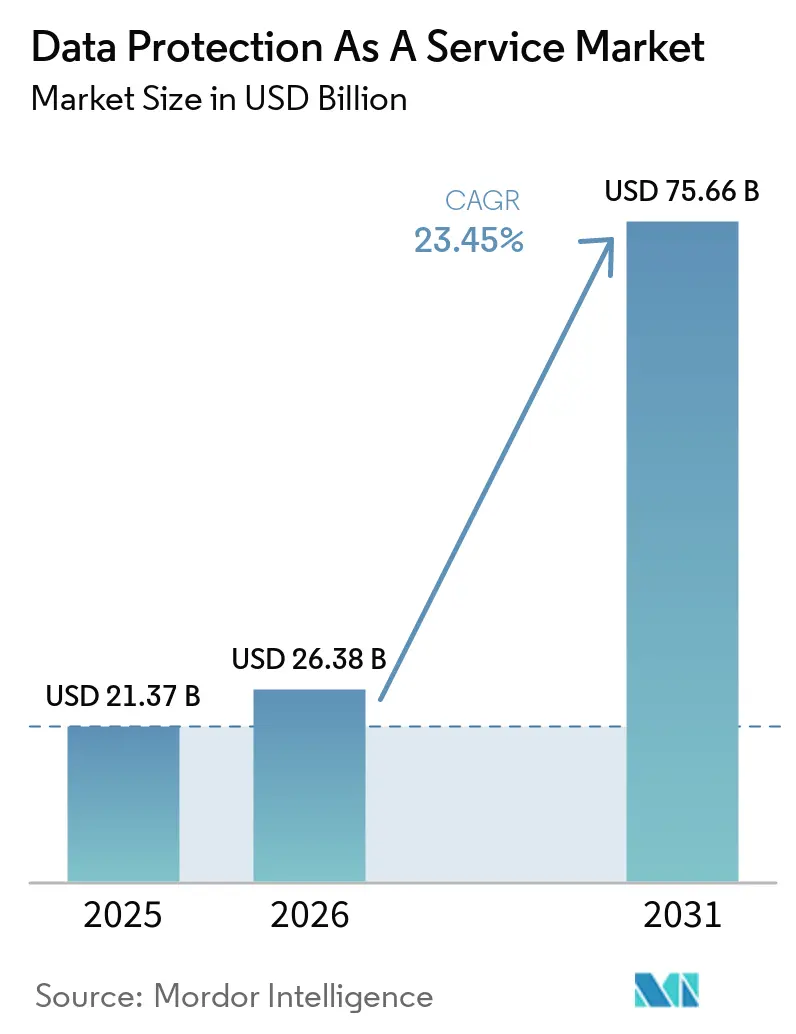
| Market Size (2026) | USD 26.38 Billion |
| Market Size (2031) | USD 75.66 Billion |
| Growth Rate (2026 - 2031) | 23.45 % |
| Fastest Growing Market | Asia Pacific |
| Largest Market | North America |
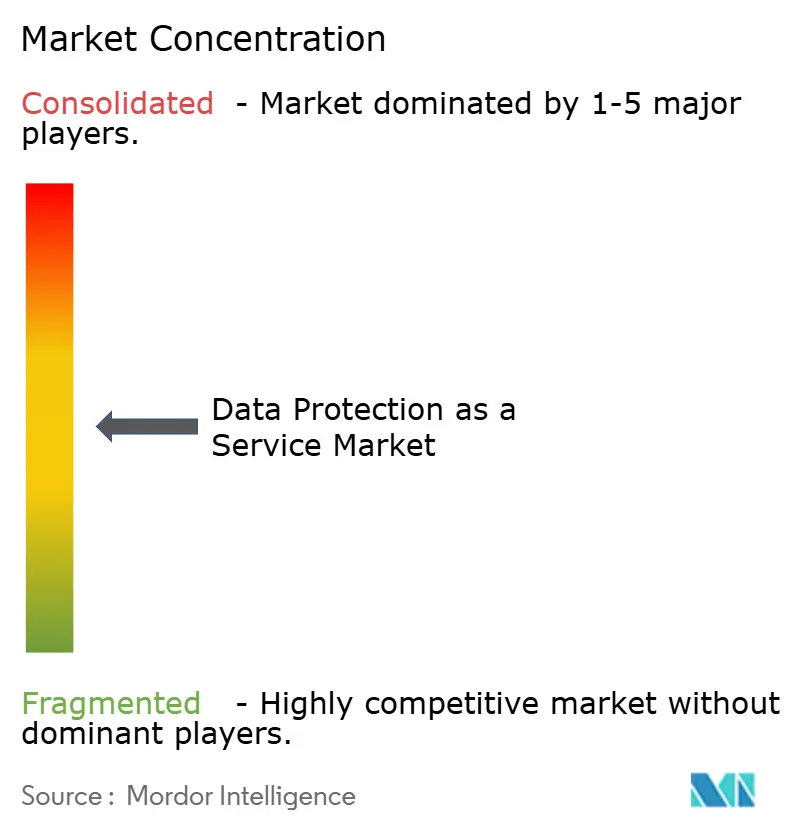
| Market Concentration | Medium |
Major Players *Disclaimer: Major Players sorted in no particular order Image © Mordor Intelligence. Reuse requires attribution under CC BY 4.0. | |
Data Protection As A Service Market Analysis by Mordor Intelligence
Data Protection As A Service Market size in 2026 is estimated at USD 26.38 billion, growing from 2025 value of USD 21.37 billion with 2031 projections showing USD 75.66 billion, growing at 23.45% CAGR over 2026-2031.
Growth is propelled by a surge in unstructured data, zero-trust mandates, and rising board-level concern over ransomware exposure. Enterprises are rapidly replacing capital-intensive, on-premises backup hardware with cloud-delivered subscriptions that offer usage-based pricing and elastic scale. Sovereign-cloud investments, quantum-safe encryption pilots, and cyber-insurance requirements are converging to reshape product roadmaps, while vendor consolidation is compressing market structure and accelerating feature integration.
Key Report Takeaways
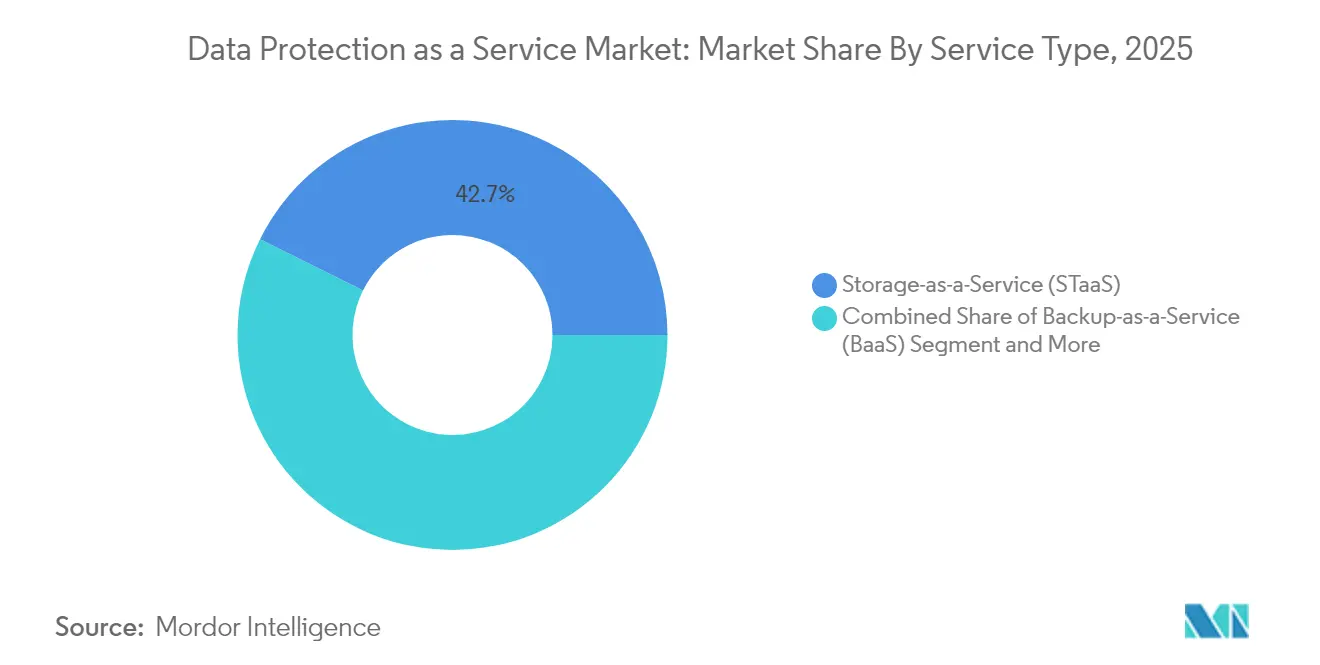
- By service type, Storage-as-a-Service held 42.65% of the data protection as a service market share in 2025; Disaster-Recovery-as-a-Service is projected to grow at a 28.9% CAGR through 2031.
- By deployment model, the private-cloud segment captured 43.05% of the data protection as a service market size in 2025, whereas hybrid-cloud adoption is expected to expand at a 30.6% CAGR between 2026-2031.
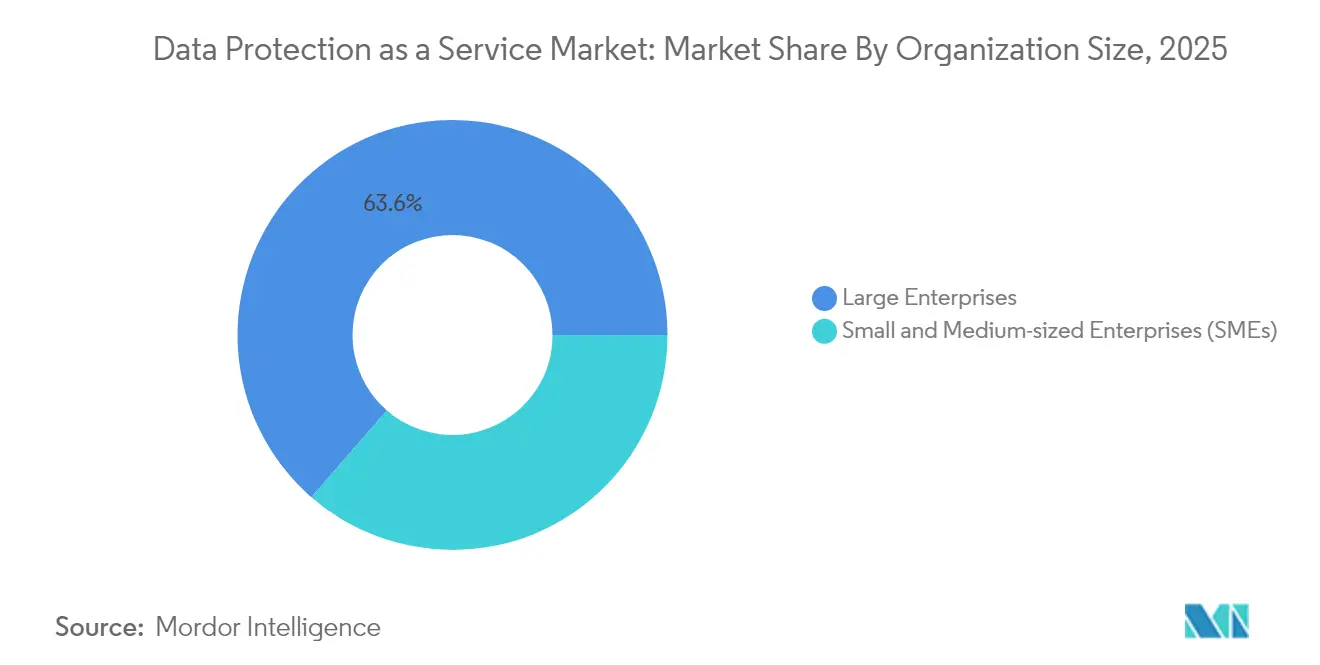
- By organization size, large enterprises retained 63.60% share of the data protection as a service market size in 2025, while SMEs are forecast to advance at a 33% CAGR to 2031.
- By end-use industry, BFSI led with 27.35% revenue share in 2025; healthcare and life sciences are on track for a 29.8% CAGR through 2031.
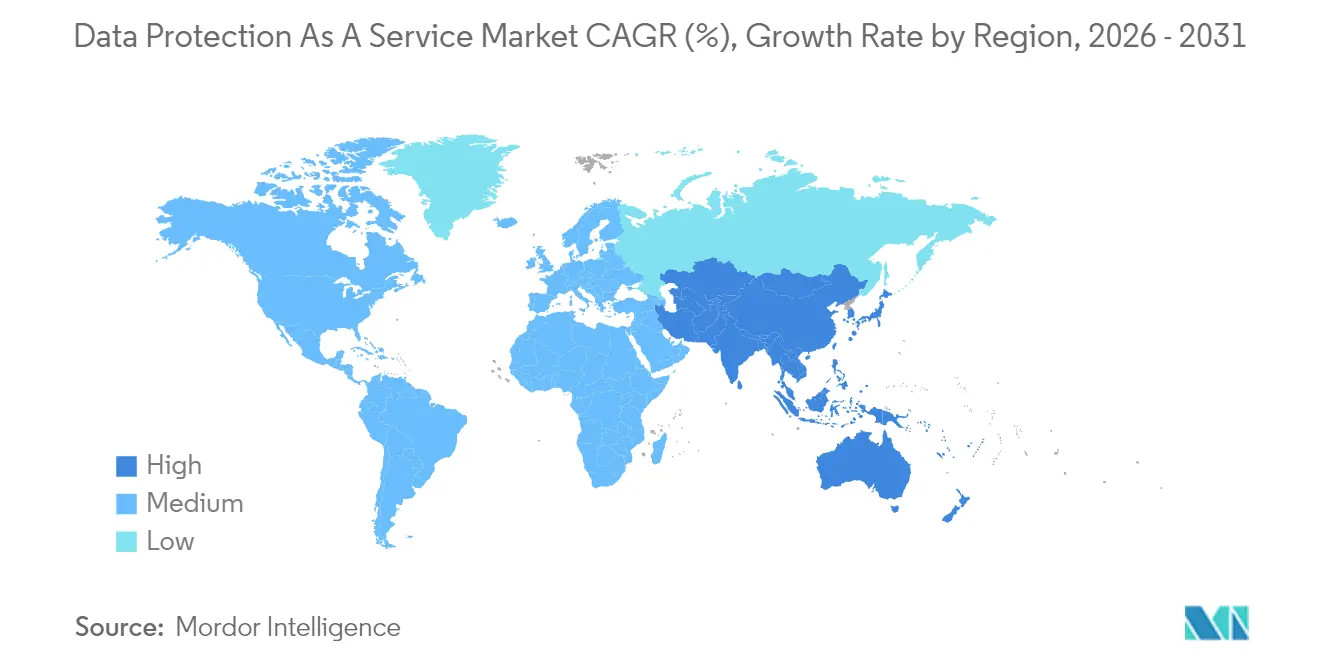
- By geography, North America commanded 37.25% of 2025 revenue, whereas Asia-Pacific is anticipated to register a 30.5% CAGR to 2031.
Note: Market size and forecast figures in this report are generated using Mordor Intelligence’s proprietary estimation framework, updated with the latest available data and insights as of 2026.
Market Trends and Insights
Drivers Impact Analysis of Data Protection As A Service Market*
| Driver | (~) % Impact on CAGR Forecast | Geographic Relevance | Impact Timeline |
|---|---|---|---|
| Data-sovereignty regulations | +5.8% | EU, North America, APAC | Medium term (2-4 years) |
| Unstructured data explosion | +4.6% | Global | Long term (≥ 4 years) |
| Ransomware resiliency focus | +4.2% | North America, Europe, APAC | Short term (≤ 2 years) |
| Recovery vaults linked to cyber-insurance | +3.3% | North America, Europe | Medium term (2-4 years) |
| Sovereign-cloud build-outs | +2.5% | Middle East, APAC, Europe | Medium term (2-4 years) |
| Quantum-safe encryption pilots | +0.8% | North America, Europe, APAC | Long term (≥ 4 years) |
| Source: Mordor Intelligence | |||
Stringent Data-Sovereignty Regulations Reshape Global Protection
The roll-out of GDPR look-alike frameworks from Brazil to India is forcing firms to localize storage, adopt precise data-mapping, and build policy-based controls that govern cross-border flows. The EU Digital Operational Resilience Act took effect in January 2025, mandating near-real-time incident reporting for financial institutions. In the United States, new rules restrict sensitive data transfers to foreign adversaries, adding complexity for multinationals. As a result, procurement teams now rank sovereignty controls alongside RPO/RTO metrics when selecting DPaaS vendors. Providers are responding with region-specific key management, double-encryption options, and in-region recovery vaults that satisfy both national regulators and internal risk committees.
Edge Computing Revolutionizes Protection Architectures
Edge deployments move processing closer to sensor endpoints and branch locations, allowing workloads to meet latency targets without routing traffic back to centralized data hubs. Forty percent of large enterprises plan to run mission-critical applications at the edge by end-2025; that shift necessitates lightweight, policy-driven backup agents capable of executing locally and synchronizing asynchronously. Emerging offerings embed AI-based anomaly detection at edge gateways, reducing dwell time for ransomware incursions. Healthcare systems are piloting these capabilities in hospital campuses to comply with strict patient-data localization rules while ensuring immediate access for clinicians.
Ransomware Resilience Becomes a Board Priority
Ransomware volume doubled during 2024, prompting audit committees to request proof of immutable backups and verified restoration drills. DPaaS roadmaps now center on continuous data protection, air-gapped vaults, and machine-learning classification that prevents reinfection during recovery. Continuous protection and air-gapped vaults are shaping the data protection and recovery solutions market. Insurers are tying premium discounts to the presence of write-once storage and automated failover orchestration. Enterprises adopting these controls report materially lower recovery-time objectives and demonstrable savings on cyber-insurance renewals.
Cloud-Native Recovery Vaults Transform Resilience Economics
Cloud-native recovery vaults provide logically-isolated storage coupled with policy-driven replication. They minimize egress during restore events and give insurers clearer evidence of least-privilege access. Early adopters in financial services attribute double-digit drops in policy premiums to vault certification. Vendors differentiate through zero-trust authentication, generative AI forensic scans, and integration with SOC workflows. As vault adoption broadens, platform convergence across backup, archive, and cyber-recovery is accelerating.
Restraints Impact Analysis of Data Protection As A Service Market*
| Restraint | (~) % Impact on CAGR Forecast | Geographic Relevance | Impact Timeline |
|---|---|---|---|
| Hidden egress and API charges | -2.1% | Global | Medium term (2-4 years) |
| Proprietary backup formats | -1.6% | Global | Long term (≥ 4 years) |
| AI compression delaying upgrades | -1.3% | North America, Europe, APAC | Medium term (2-4 years) |
| Data-residency clauses in trade pacts | -1.0% | Regions with strict sovereignty | Medium term (2-4 years) |
| Source: Mordor Intelligence | |||
Hidden Cloud Costs Undermine Multi-Cloud Strategies
Variable traffic fees and per-API call pricing can inflate budgets, especially for analytics-heavy or regulatory inquiries that require frequent restores. Enterprises with limited negotiation leverage in smaller cloud regions feel the pinch most acutely. FinOps teams are investing in cost-observability dashboards, yet fragmented billing across storage tiers and hot-cold transitions remains a budgetary hazard.
Proprietary Formats Create Vendor Lock-In
Closed backup schemas complicate workload migration after mergers or provider exits. During the 2024 Cohesity-Veritas merger, integration teams faced multi-platform restore testing to preserve SLAs. Regulators are examining whether proprietary metadata structures inhibit competition. Customer RFPs increasingly insist on open-format exports, prompting newer entrants to adopt standardized APIs that promise smoother portability.
*Our forecasts treat driver/restraint impacts as directional, not additive. The impact forecasts reflect baseline growth, mix effects, and variable interactions.
Data Protection As A Service Market Segment Analysis
By Service Type:
DRaaS Accelerates Amid Cyber ThreatsThe Disaster-Recovery-as-a-Service segment recorded a 28.9% CAGR outlook through 2031, outpacing other offerings as leadership teams elevate ransomware readiness to a strategic metric. More than 70% of enterprises intend to integrate DRaaS with SIEM telemetry by 2026, enabling automated failover based on threat scoring. Continuous data protection streams shrink recovery-point objectives to seconds, appealing to finance and healthcare workloads where data loss equates to compliance fines. Storage-as-a-Service, though still capturing 42.65% of the 2025 data protection as a service market share, is evolving toward intelligent tiering and policy-based immutability that aligns with zero-trust architectures. Converged platforms now bundle BaaS, STaaS, and DRaaS under unified policy engines, easing procurement and governance.
While DRaaS enthusiasm rises, storage subscriptions remain foundational. Object-store growth stays strong due to AI model training sets and video analytics that balloon unstructured data volumes. In response, providers are pushing petabyte-scale deduplication and compression to control the footprint. Full-stack offerings from cloud hyperscalers now integrate autonomous threat scanning, meaning that ransomware reels only the affected blocks rather than entire volumes. Such feature alignment signals a longer-term move toward platform-centric purchasing in which recovery automation, data classification, and compliance mapping exist inside a single control plane.

By Deployment Model:
Hybrid Approaches Balance Security and FlexibilityHybrid models show the fastest expansion at 30.6% CAGR. Regulators endorse architectures that keep sensitive datasets on local private clouds while allowing burstable analytics in regulated public regions. These patterns are especially evident among European banks subject to the Digital Operational Resilience Act, which mandates documented contingency arrangements for third-party services. Policy automation selects storage targets based on data-classification labels, optimizing both latency and compliance. The data protection as a service market size for hybrid solutions is forecast to double by 2028 as enterprises modernize legacy tape archives into cloud-connected vaults.
Private-cloud deployments retain a 43.05% share, favored by defense, utilities, and healthcare agencies that must assert custody over encryption keys. Vendors supplying private-cloud appliances increasingly embed FIPS-validated HSMs, role-based access, and air-gapped configuration management. Public-cloud approaches remain popular among digital-native firms that value region diversity over full sovereignty. However, sovereign-cloud initiatives, such as the AWS European Sovereign Cloud, blur lines: they deliver public-cloud agility under local legal control, pulling regulated workloads into environments previously deemed off-limits.
By Organization Size:
SMEs Embrace Cloud-Based ProtectionRising cyber threats and limited IT staff push SMEs toward off-the-shelf SaaS backup portals that include preset compliance templates. Between 2026-2031, the data protection as a service market size revenue from SMEs is projected to climb at 33% CAGR, supported by managed service providers offering turnkey bundles. Simplified onboarding and consumption-based billing resonate with budget-conscious owners. Cyber-insurance questionnaires increasingly list the presence of immutable cloud snapshots as a prerequisite, nudging even micro-enterprises toward entry-level DPaaS tiers.
Conversely, large enterprises retain 63.60% revenue thanks to sprawling workloads, legacy mainframes, and stringent RTO targets. Many overlay DPaaS atop existing tape libraries for phased modernization, reducing forklift upgrades. AI-enhanced anomaly detection flags deviations in snapshot change rates, giving SOC teams early warning of encryption attacks. Vendors court this segment with SLA-backed availability guarantees and dedicated account teams that shepherd regulatory audits.
By End-User Industry:
Healthcare Accelerates Protection InvestmentsHealthcare’s 29.8% CAGR reflects electronic health record mandates, connected devices, and cross-hospital data sharing requirements. Hospitals deploy immutable backups and air-gapped recovery vaults to satisfy HIPAA and EU harmonized patient data directives. Telemedicine expansions drive edge-node deployments inside clinical sites, requiring local snapshotting that synchronizes to sovereign cloud regions. Clinical research teams benefit from policy engine integration that differentiates between identifiable patient information and anonymized study datasets.
BFSI leads overall spending with 27.35% market share, underpinned by high transaction volumes and new breach-notification timelines. DORA obliges European banks to test full-scale disaster recovery at least annually, driving DRaaS adoption. Insurers collaborate with DPaaS vendors to offer premium incentives contingent on completed recovery drills. Government and defense programs invest aggressively as zero-trust strategies dictate continuous verification across classified networks. Finally, manufacturing and telecom firms rely on DPaaS to secure industrial Internet-of-Things telemetry, where downtime directly hits throughput.
Geography Analysis
North America Data Protection As a Service Market
North America preserves a 37.25% revenue share, anchored by robust cloud adoption and federal directives such as CISA Binding Operational Directive 25-01, which compels agencies to apply secure configuration baselines for SaaS. The Protecting Americans' Data from Foreign Adversaries Act restricts cross-border transfers of sensitive personal data, spurring demand for in-country vaults and key escrow. Enterprises prioritize compliance mapping features that generate automated attestation reports for auditors.
APAC Data Protection As a Service Market
Asia-Pacific posts the fastest trajectory at 30.5% CAGR as digital-government programs in Japan, India, and Korea push data-localization rules. The Indian Digital Personal Data Protection Act codifies explicit localization for critical personal information, pressuring cloud providers to launch domestic recovery zones. Hyperscalers partner with domestic telecom carriers to establish sovereign facilities that allow foreign backup services while respecting legal custody constraints. Start-ups in Singapore and Australia roll out DPaaS offerings that combine secure local storage with global failover options, appealing to mid-market exporters balancing trade and compliance.
Europe Data Protection As a Service Market
Europe remains a sophisticated adopter shaped by GDPR, DORA, the Cyber Resilience Act, and the EU Data Act, effective September 2025. National programs such as France’s Cloud de Confiance and Germany’s Gaia-X channel funding into federated, standards-based infrastructure that prizes transparency and vendor portability. Providers differentiate by offering in-region metadata processing, EU resident-only operations staff, and exportable audit trails. Sovereign options reduce regulatory friction, driving higher attach rates among public-sector entities.
LATAM and MEA Data Protection As a Service Market
Emerging markets in Latin America, the Middle East, and Africa register rising adoption from smaller bases. Gulf Cooperation Council governments finance sovereign-cloud platforms to diversify economies and lure fintech start-ups. Brazilian banks pilot quantum-safe encryption on cross-border replication links, anticipating future cryptographic requirements. African telcos deploy SaaS backup to protect rapidly expanding mobile money platforms, offsetting limited local data-center capacity.
Regulatory Landscape
DPaaS procurement is being shaped by tighter guidance on privacy engineering, cloud assurance, and AI data processing. In the EU, GDPR remains foundational while the European Data Protection Board issued Guidelines 02/2026 on Anonymisation (July 2026), raising the bar for demonstrating that anonymisation techniques are effective and verifiable in operational systems used for analytics, archiving, and recovery. In the United Kingdom, The Data Protection Act 2018 (Code of Practice on Artificial Intelligence and Automated Decision-Making) Regulations 2026 require the Information Commissioner to draft a code for AI-related processing, extending compliance scrutiny to automated decision workflows that increasingly intersect with DPaaS discovery, classification, and retention controls.
Cloud assurance frameworks are also becoming more explicit inputs to vendor selection and public-sector eligibility. Germany's Federal Office for Information Security (BSI) published the C5:2026 criteria catalogue, giving cloud providers and DPaaS platforms a concrete mapping mechanism to standards such as ISO 27001/27701 and schemes like SecNumCloud, which supports multi-jurisdiction audit readiness. Sovereignty policies are expanding beyond Europe, with Nigeria's National Cloud Policy (October 2025) mandating a Cloud First posture for federal public institutions with local data residency and data protection requirements aligned to the Nigeria Data Protection Act 2023. This is reinforcing demand for in-country recovery zones, localized key management, and auditable access controls.
Value Chain Analysis
The DPaaS value chain starts with foundational infrastructure, primarily hyperscale and regional cloud compute, storage, and networking, and then moves into security building blocks such as encryption and key management, identity and access management, and telemetry pipelines used for anomaly detection and recovery validation. DPaaS platform vendors layer policy engines for backup, replication, immutability, and recovery orchestration, then distribute through direct enterprise sales, cloud marketplaces, and a large partner ecosystem of managed service providers (MSPs) that deliver implementation, 24x7 operations, and compliance support for regulated buyers.
Downstream, customer value realization depends on integration with existing IT and security operations (for example, SIEM/XDR and SOC workflows), along with governance functions that can produce audit-ready evidence and meet jurisdiction-specific data residency constraints. Interoperability and portability remain friction points where proprietary backup formats and multi-cloud billing constructs (egress and API charges) add switching and operating costs. A parallel services layer is also expanding around sovereign and regulated operations, including competency-led partner programs (for example, T-Systems work around AWS digital sovereignty) and specialist providers offering managed data protection services. This reflects how compliance engineering and run-time assurance have become central to DPaaS delivery, not just add-ons.
Competitive Landscape
Industry consolidation intensifies with the December 2024 absorption of Veritas enterprise assets by Cohesity, forming a USD 7 billion entity serving over 12,000 global customers. Rubrik allies with Cisco to embed backup telemetry inside the Cisco XDR console, illustrating a pivot toward integrated detection-and-response suites. Broadcom’s quantum-resistant host bus adapters foreshadow a hardware-rooted defensive layer that competitors must match. AWS debuts a European Sovereign Cloud, undercutting regional providers by pairing hyperscale economics with local legal control.
Mid-tier specialists such as Druva and Clumio court SMEs by offering agentless, SaaS-native protection that deploys in minutes. N-able’s Adlumin acquisition folds SOC automation into managed-service offerings, signaling MSP channel importance for long-tail growth. Verticalization emerges: providers launch healthcare-specific blueprints featuring HIPAA templates, while BFSI packages integrate PCI-DSS tokenization. Competitive differentiation now hinges on turnkey ransomware recovery guarantees, hourly SLA credits, and automated compliance evidence generation.
Platform convergence is evident as vendors collapse STaaS, BaaS, and DRaaS silos into policy-driven fabrics. Buyer preference trends toward single-pane orchestration that simplifies audit traceability. However, proprietary snapshot formats risk customer lock-in, prompting open API initiatives. Vendors that expose portable metadata and cross-cloud replication options may gain share as regulatory scrutiny of interoperability mounts.
Data Protection As A Service Industry Leaders
-
IBM Corporation
-
Amazon Web Services Inc.
-
Hewlett Packard Enterprise Company
-
Dell Technologies Inc.
-
Cisco Systems Inc.
- *Disclaimer: Major Players sorted in no particular order
Data Protection As A Service Market Companies Covered in this Report
- IBM Corporation
- Amazon Web Services Inc.
- Hewlett Packard Enterprise Company
- Dell Technologies Inc.
- Cisco Systems Inc.
- Oracle Corporation
- VMware Inc.
- Commvault Systems Inc.
- Veritas Technologies LLC
- Asigra Inc.
- Quantum Corporation
- Quest Software Inc.
- NxtGen Datacenter & Cloud Technologies Pvt Ltd
- Hitachi Vantara LLC
- Acronis International GmbH
- Rubrik Inc.
- Druva Inc.
- Cohesity Inc.
- HYCU Inc.
- Backblaze Inc.
- Wasabi Technologies Inc.
- NetApp Inc.
- Zerto LLC
- N-able Inc.
- Arcserve LLC
Market Opportunities and Future Outlook
Sovereign and regulated-cloud operating models create whitespace for DPaaS providers that can deliver jurisdiction-bound controls without giving up hybrid recovery workflows. AWS's European Sovereign Cloud program, positioned around EU-law governance and EU-resident operations, is a concrete reference point that is shifting buyer checklists toward in-region key custody, resident-only access models, and independent assurance mappings. That, in turn, opens opportunities for vendors and MSPs offering vaults, key escrow, and policy automation tuned to European public sector and BFSI requirements.
A second opportunity area is compliance-grade evidence generation that ties together restoration testing, immutability controls, and audit reporting across SaaS, cloud-native, and on-prem workloads. Regulators and guidance bodies are publishing more targeted expectations, including the EDPB Guidelines 02/2026 on Anonymisation (July 2026) and expanded UK attention to AI and automated decision-making processing under the 2026 regulations. This is pushing organizations to operationalize repeatable control validation rather than relying only on static policies. DPaaS platforms that integrate discovery, classification, and recovery vault workflows, and that can present verifiable control evidence across hybrid environments, align with procurement shifts toward audit-ready attestation and reduce friction in cross-border deployments where data mapping and policy-based routing are mandatory.
Recent Industry Developments in Data Protection As A Service Market
- May 2026: IBM released Guardium Multi-Cloud Data Protection V10.1.2 with cloud-tailored licensing and added vulnerability assessment features for DBaaS environments. The update expands DPaaS-adjacent coverage from traditional backup toward continuous risk identification in managed database stacks, supporting governance and recovery requirements in hybrid deployments.
- June 2025: AWS unveiled the AWS European Sovereign Cloud, designed to operate under EU law with EU-resident operations. The move accelerates sovereign-cloud procurement pathways for regulated workloads and increases demand for DPaaS offerings that can meet residency, key custody, and audit-evidence requirements inside sovereign regions.
- December 2024: Cohesity finalized its purchase of Veritas enterprise backup assets, creating a larger pure-play data protection provider serving a broad installed base. The consolidation increased platform convergence pressure across STaaS, BaaS, and DRaaS, raising the competitive bar on integrated policy control planes and migration tooling for customers with mixed-format backup estates.
Data Protection As A Service Market Report Scope and Research Methodology
Market Definition and Coverage
For this study, we define data protection as a service (DPaaS) as outsourced, subscription-based offerings that protect enterprise data through cloud-delivered backup, disaster recovery, and related protection functions, priced as recurring service revenue and delivered across public, private, or hybrid setups.
Scope exclusions: One-time professional services billed separately, stand-alone on-premise backup software licenses, and purely self-built private cloud tools without a DPaaS subscription are excluded.
Segments Covered in This Report
- By Service Type
- Storage-as-a-Service (STaaS)
- Backup-as-a-Service (BaaS)
- Disaster-Recovery-as-a-Service (DRaaS)
- By Deployment Model
- Public Cloud
- Private Cloud
- Hybrid Cloud
- By Organization Size
- Large Enterprises
- Small and Medium-sized Enterprises (SMEs)
- By End-User Industry
- BFSI
- Healthcare and Life Sciences
- Government and Defense
- IT and Telecom
- Retail and E-commerce
- Manufacturing
- Other End-User Industries
- By Geography
- North America
- United States
- Canada
- Mexico
- South America
- Brazil
- Argentina
- Chile
- Rest of South America
- Europe
- Germany
- United Kingdom
- France
- Italy
- Spain
- Russia
- Rest of Europe
- Asia-Pacific
- China
- Japan
- India
- South Korea
- Australia
- Singapore
- Malaysia
- Rest of Asia-Pacific
- Middle East and Africa
- Middle East
- Saudi Arabia
- United Arab Emirates
- Turkey
- Rest of Middle East
- Africa
- South Africa
- Nigeria
- Rest of Africa
- Middle East
- North America
Data Sources, Market Sizing, and Validation
Desk Research
Desk research starts by building a clear demand and policy context for DPaaS adoption, and then mapping the supplier landscape so revenue pools are not double counted. We used public sources such as NIST cybersecurity and resilience guidance, CISA advisories, the US Federal Register and the EU Official Journal for privacy and retention updates, and OECD digital economy indicators to anchor the timing of compliance-driven demand.
To translate demand into spending, we also reviewed cloud adoption and IT spending signals from sources such as the World Bank and the International Telecommunication Union, plus open technical literature on backup immutability, ransomware recovery, and retention practices in peer-reviewed journals. Company filings, investor presentations, product documentation, and credible press interviews were used to cross-check service packaging and pricing logic. In addition, we used paid subscriptions for company financial intelligence, news and financials, and patent databases to confirm business mix and validate product direction. These are illustrative sources, and many other public references were also used to collect, verify, and clarify data points.
Primary Interviews and Surveys
Primary work was used to pressure-test what gets counted as DPaaS revenue and how buyers actually purchase it, especially when backup, storage, and recovery are bundled into broader cloud contracts. We spoke with a mix of providers, channel partners, and enterprise users across APAC, EMEA, and the Americas to confirm adoption patterns, renewal behavior, and the way ransomware preparedness changes budget timing.
Distribution of primary research fieldwork respondents
| Company type | Respondent position | Region |
|---|---|---|
| Top tier: 37% | CXOs: 13% | APAC: 48% |
| Mid tier: 49% | Functional/Unit leaders: 34% | EMEA: 32% |
| Smaller Players: 14% | Managers: 53% | Americas: 20% |
Market-Sizing & Forecasting
Market sizing was built using a top-down approach where cloud and enterprise security spending signals are reconstructed into a DPaaS demand pool, and then filtered by the share that is specifically tied to subscription-based data protection. To keep the totals realistic, we then corroborated results with selective bottom-up approximations such as sampled provider revenue disclosures, channel checks on bundle pricing, and average subscription pricing multiplied by estimated protected workloads.
The model uses practical inputs that can be reviewed and rechecked, including cloud workload migration rates, ransomware incident frequency and recovery readiness, data growth and retention periods, backup and DR policy requirements by regulated industries, and the shift from capital spending to recurring service contracts. Forecasting is handled through scenario analysis supported by expert consensus on variables like compliance intensity, cloud adoption speed, and pricing progression for protected capacity. Where provider revenue splits are not disclosed, gaps are handled through conservative ranges that are then narrowed using interview-based mix assumptions and public product packaging cues.
Data Validation & Update Cycle
Validation is done through several checks that catch outliers early, including variance tests across regions, cross-checks against cloud services revenue trends, and sanity checks using protected workload growth versus subscription revenue movement. When a number does not align with independent signals, we revisit assumptions, re-check definitions, and re-contact sources if the gap looks material.
Before sign-off, the model goes through step-by-step analyst review so calculations, currencies, and year mappings are consistent, and so the final outputs can be traced back to clearly stated inputs. Reports are refreshed annually, and interim updates are made when major events occur such as new data sovereignty rules, a sharp change in ransomware activity, or notable shifts in cloud contract structures. Right before delivery, a fresh review pass is completed so clients receive the latest updated view.
Mordor Intelligence's Data Protection As A Service Market Size Versus Other Published Estimates
Published DPaaS market sizes can differ even when the topic name looks the same, because the service bundles are defined differently and the timing of revenue recognition is not always handled in the same way. Differences also come from how each publisher treats currency conversion timing, the assumed pace of cloud migration, and whether forecasts reflect a base case or a more aggressive adoption scenario.
Some estimates fold in adjacent spend like broader cloud security, stand-alone storage-as-a-service, or large one-time implementation fees that surround a DPaaS rollout. In Mordor Intelligence, the count is limited to subscription-based data protection revenue tied to backup, disaster recovery, and related protection functions, and it excludes stand-alone on-premise licenses and separately billed professional services so totals stay tied to recurring service demand.
Benchmark comparison
| Source | Market Size | Gaps in Research Methodology |
|---|---|---|
| Mordor Intelligence | USD 26.38 B (2026) | |
| Industry Association B | USD 36.80 B (2026) | Often broader packaging is included, with storage and related cloud infrastructure services counted alongside DPaaS, which lifts the value for the same year. |
| Trade Journal A | USD 25.35 B (2024) | Different base year and a faster implied growth curve are used, and some pricing assumptions can reflect aggressive ransomware-driven budget expansion without the same refresh and re-validation cycle. |
The spread in the table is mainly explained by scope and year alignment, not by simple math differences. When subscription-only DPaaS revenue is kept separate from adjacent cloud storage and one-time services, the market size becomes easier to reconcile with adoption indicators and provider revenue mixes, which also makes the forecast path more repeatable.
Key Questions Answered in the Report
What is driving the rapid growth of the data protection as a service market?
Rising ransomware incidents, stricter data-sovereignty laws, and the need to protect expanding edge- and cloud-generated data are key catalysts.
Which service type is expanding the fastest within DPaaS?
Disaster-Recovery-as-a-Service is forecast to grow at 28.9% CAGR between 2026-2031 as firms prioritize ransomware resilience.
How are sovereign clouds influencing deployment decisions?
Sovereign clouds let organizations keep encryption keys and data under local jurisdiction while accessing public-cloud elasticity, boosting hybrid adoption.
Why are SMEs accelerating their DPaaS uptake?
Subscription pricing, minimal upfront infrastructure, and insurer demands for immutable backups make cloud-delivered protection attractive to smaller firms.
What role does quantum-safe encryption play in future DPaaS contracts?
Early pilots suggest quantum-resistant algorithms will become mandatory for critical industries, prompting refresh cycles that favor vendors with compliant offerings.
How do hidden cloud fees affect total DPaaS cost of ownership?
Egress and API charges can inflate budgets; organizations increasingly deploy FinOps tools to monitor and optimize multi-cloud spend.