
Data Clean Room Marketing Services Market Size and Share
Market Overview
| Study Period | 2020 - 2031 |
|---|---|
| Market Size (2026) | USD 1.35 Billion |
| Market Size (2031) | USD 3.61 Billion |
| Growth Rate (2026 - 2031) | 21.74 % |
| Fastest Growing Market | Asia-Pacific |
| Largest Market | North America |
| Market Concentration | Medium |
Major Players *Disclaimer: Major Players sorted in no particular order Image © Mordor Intelligence. Reuse requires attribution under CC BY 4.0. | |
Data Clean Room Marketing Services Market Analysis by Mordor Intelligence
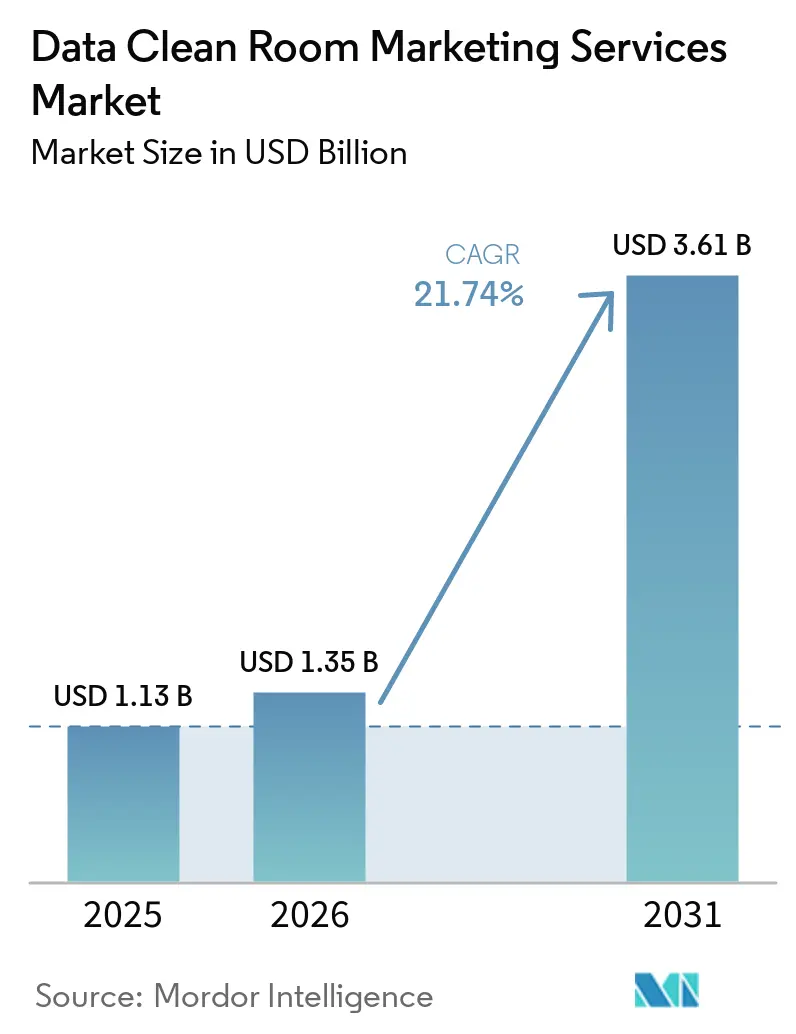
The data clean room marketing services market size is projected to be USD 1.13 billion in 2025, USD 1.35 billion in 2026, and reach USD 3.61 billion by 2031, growing at a CAGR of 21.74% from 2026 to 2031. The data clean room marketing services market is being shaped by reduced access to third-party identifiers, stronger privacy requirements, and demand for closed-loop advertising measurement. Retail media networks are making purchase-signal data more valuable, which increases the need for controlled collaboration between brands, retailers, agencies, and publishers. Providers are responding with cloud-based and guided tools that reduce the need for specialized technical teams. Competition is moving toward recurring analytics, governance support, and interoperable workflows as early infrastructure projects mature across client organizations.
Key Report Takeaways
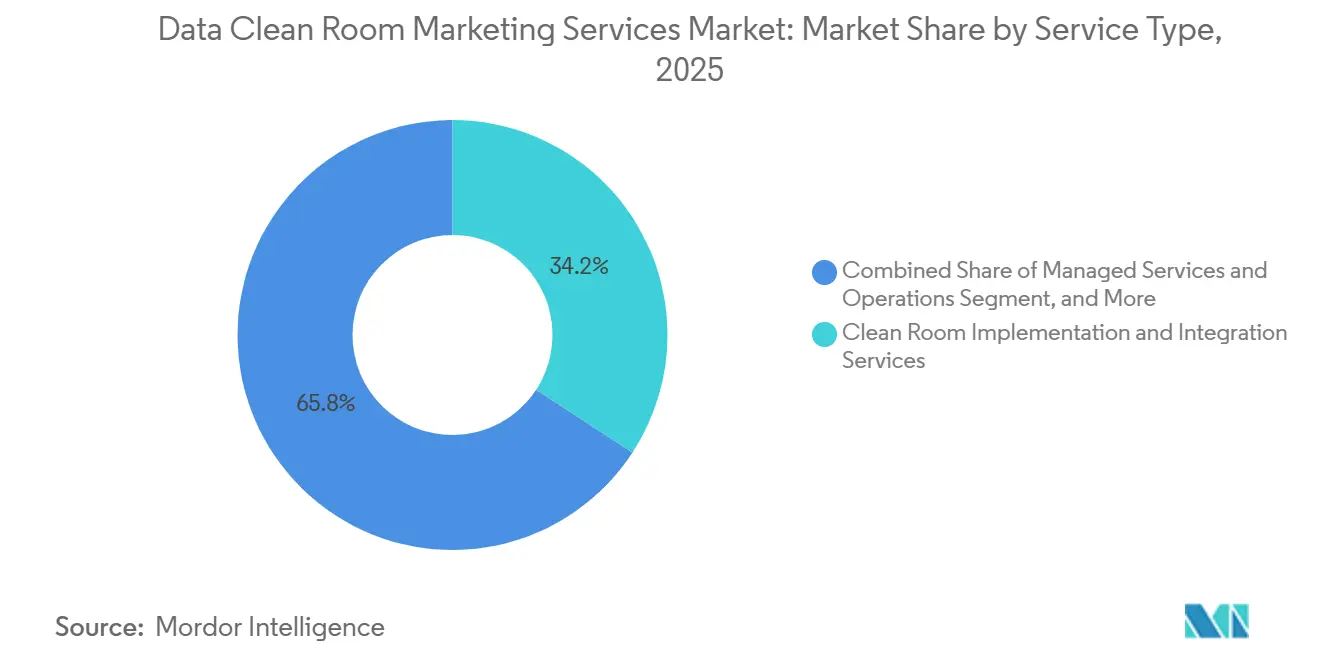
- By service type, Clean Room Implementation and Integration Services held 34.21% of the data clean room marketing services market share in 2025, while Privacy-Safe Analytics, Measurement and Attribution Services is projected to expand at a 22.84% CAGR through 2031.
- By client company size, large enterprises held 82.14% revenue share in 2025, while the Small and Medium Enterprises segment is projected to grow at a 22.67% CAGR through 2031.
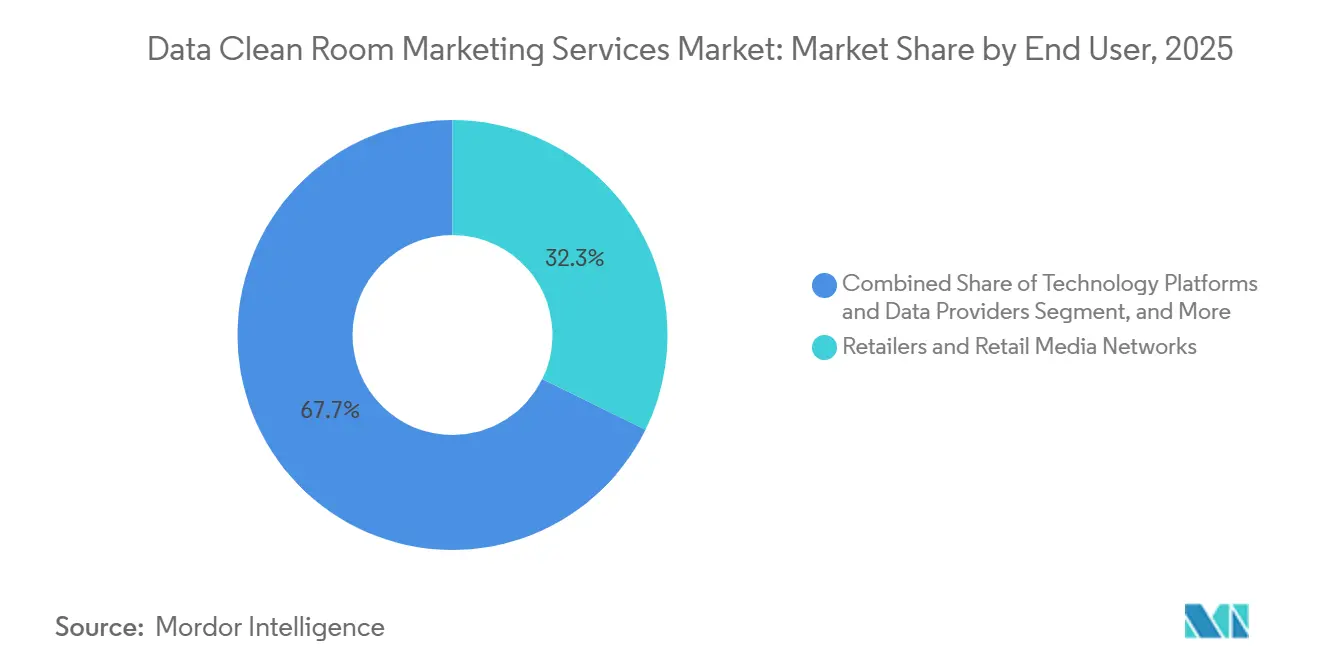
- By end user, retailers and retail media networks held 32.26% revenue share in 2025, while technology platforms and data providers are projected to grow at a 22.73% CAGR through 2031.
- By geography, North America held 47.24% of global revenue in 2025, while Asia-Pacific is projected to expand at a 22.51% CAGR through 2031.
Note: Market size and forecast figures in this report are generated using Mordor Intelligence’s proprietary estimation framework, updated with the latest available data and insights as of January 2026.
Global Data Clean Room Marketing Services Market Trends and Insights
Drivers Impact Analysis*
| Driver | (~) % Impact on CAGR Forecast | Geographic Relevance | Impact Timeline |
|---|---|---|---|
| Third-Party Cookie Deprecation Accelerates First-Party Collaboration | +6.3% | Global, with acute effect in North America and Europe | Short term (≤ 2 years) |
| Privacy Regulation Proliferation Raises Demand for Governed Data Collaboration | +5.4% | North America, Europe, and Asia-Pacific, with spillover to the Middle East and Africa | Medium term (2-4 years) |
| Retail Media Network Expansion Increases Closed-Loop Measurement Demand | +4.2% | North America core, with secondary adoption in Europe, Asia-Pacific, and South America | Medium term (2-4 years) |
| Cloud-Native and No-Code Clean Room Delivery Broadens Mid-Market Adoption | +3.0% | Global, particularly SME-dense markets in Asia-Pacific and South America | Medium term (2-4 years) |
| Amazon Marketing Cloud Self-Service Access Expands Usage Beyond Enterprise Brands | +1.8% | North America primary, expanding across 36 countries | Short term (≤ 2 years) |
| Interoperability Standards Like PAIR and ADMaP Reduce Integration Friction | +1.3% | Global, concentrated in markets with multi-platform advertising ecosystems | Long term (≥ 4 years) |
| Source: Mordor Intelligence | |||
Third-Party Cookie Deprecation Accelerates First-Party Collaboration
Changes in browser-based tracking have reduced the usefulness of established audience measurement workflows. Apple’s App Tracking Transparency framework has limited mobile identifier tracking, while Safari and Firefox have long blocked third-party cookies by default. This environment directs advertisers toward first-party data relationships with publishers, retailers, and platforms. The data clean room marketing services market supports this shift by enabling parties to compare hashed records without releasing raw personal data, while retaining controls over the permitted analytical output. These environments can generate overlap counts, attribution logs, and incrementality analyses that were previously managed through cookie-based processes. Control over matching logic is therefore shifting toward publishers and platforms, affecting brands that relied heavily on open-web retargeting.
Privacy Regulation Proliferation Raises Demand for Governed Data Collaboration
Privacy compliance has become a direct driver for deploying governed data collaboration tools. California’s regulations took effect on January 1, 2026, and require documented risk assessments for specified advertising activities. Intentional violations can carry penalties of USD 7,500, giving legal and marketing teams a clear financial incentive to formalize their data practices. European requirements also place greater focus on the roles and responsibilities of partners that process advertising data together. Japan’s APPI framework similarly increases the importance of consent when data is matched across organizations. The data clean room marketing services market benefits because auditable separation controls can support both analytical and compliance needs across long-running partner relationships.
Retail Media Network Expansion Increases Closed-Loop Measurement Demand
Retail media is extending from e-commerce advertising into travel, financial services, credit card networks, and mobile applications. These businesses hold transaction and purchase data that can link advertising activity to observed outcomes. Brands increasingly expect evidence that retail media spending produced incremental sales rather than only impressions or clicks. This requirement makes controlled ad-to-purchase measurement important for networks seeking advertising budgets. The data clean room marketing services market can help retailers establish the governed workflows needed for such measurement across advertiser, retailer, and agency teams. The opportunity is strongest in the data clean room marketing services market among networks that have monetizable first-party data but have not yet introduced a clean room capability.
Cloud-Native and No-Code Clean Room Delivery Broadens Mid-Market Adoption
Cloud-based products are reducing the initial technical effort required to establish a clean room. AWS Clean Rooms, Snowflake Data Clean Rooms, and Google BigQuery collaborative analytics tools can be configured within existing cloud data environments. This changes data clean room marketing services market deployment work from a long custom build toward a more defined implementation process. Amazon has made 1P paid feature signals available to query in Amazon Marketing Cloud at no charge through December 31, 2026. Dentsu Digital and Dentsu introduced Tobiras Agent in June 2026 to enable business users to issue clean room queries in natural language.[1] The data clean room marketing services market still requires managed analytical and operational support, as an accessible interface does not eliminate the need to interpret outputs, manage partner access, or maintain governance.
Restraints Impact Analysis*
| Restraint | (~) % Impact on CAGR Forecast | Geographic Relevance | Impact Timeline |
|---|---|---|---|
| High Implementation Costs and Engineer-Heavy Workflows | -3.2% | Global, most pronounced in SME-dominant markets in South America and Africa | Short term (≤ 2 years) |
| Interoperability Gaps Across Walled Gardens and Cloud Stacks | -2.0% | Global, particularly in multi-platform advertising markets in North America and Europe | Medium term (2-4 years) |
| Output Thresholds and Match-Rate Leakage Reduce Actionability | -1.2% | Global, with sharper impact in markets with smaller first-party data pools in the Middle East and Africa | Medium term (2-4 years) |
| FTC and State-Law Scrutiny Limits Clean Rooms as a Compliance Shortcut | -0.8% | North America, with secondary relevance in Europe | Short term (≤ 2 years) |
| Source: Mordor Intelligence | |||
High Implementation Costs and Engineer-Heavy Workflows
High implementation costs remain a barrier for data clean room marketing services market buyers without large data and legal teams. A deployment can require identity graph connections, schema alignment, privacy threshold settings, partner approvals, and compliance reviews. These tasks involve the data engineering, legal, and marketing operations teams simultaneously. Small and medium-sized organizations often lack the capacity to coordinate this work internally. This constraint creates demand for fixed-fee managed services that lower the cost and operational burden of adoption. It also gives established integrators an advantage because new service firms must invest in skills and infrastructure before they can serve this buyer group.
Interoperability Gaps Across Walled Gardens and Cloud Stacks
Brands that advertise through Amazon, Google, and Meta may need to use separate environments with proprietary outputs. This makes it difficult for users of data clean room marketing services to create a unified cross-channel attribution view. Neutral operators can support collaboration across publishers, but every participant must still expose agreed signals through defined interfaces. Walled-garden operators have limited incentive to make portability easier when proprietary measurement is part of their value proposition. PAIR and ADMaP provide specifications for privacy-preserving matching and attribution across data clean rooms. Broad adoption remains difficult because advertisers, publishers, and clean room operators must make coordinated technical and commercial commitments.
*Our forecasts treat driver/restraint impacts as directional, not additive. The impact forecasts reflect baseline growth, mix effects, and variable interactions.
Segment Analysis
By Service Type: Analytics Demand Builds on an Implementation-Led Base
Clean Room Implementation and Integration Services accounted for 34.21% of revenue in 2025. This part of the data clean room marketing services industry reflects the initial buildout of data environments, schemas, identity connections, and partner controls. Enterprise projects often combine a walled-garden platform, a neutral environment, and an internal data warehouse, with technical, legal, and operational requirements aligned over a 3- to 6-month delivery cycle. Strategy, Governance, and Use-Case Design Services cover the work that precedes implementation, including selecting use cases, setting privacy-by-design rules, and choosing collaboration partners.
Privacy-Safe Analytics, Measurement, and Attribution Services are projected to grow at a 22.84% CAGR from 2026 to 2031. The data clean room marketing services market size for this service type is supported by recurring incrementality testing, audience sales lift measurement, share-of-wallet analysis, and predictive audience modeling that extend an installed environment beyond a single campaign. Amazon Marketing Cloud expanded its lookback window from 13 to 25 months in November 2025 and introduced Ads Agent to assist with natural-language query generation. Managed Services and Operations is also becoming more important for organizations that outsource query management, interpretation, and compliance monitoring, while training, certification, and platform administration remain smaller ancillary activities.

By Client Company Size: Large Enterprises Lead While SMEs Gain Access
Large enterprises accounted for 82.14% of revenue in 2025. Their position reflects the data engineering capacity, legal resources, cloud infrastructure, and historically higher spending thresholds for Amazon Marketing Cloud required for earlier clean room deployments. Snowflake’s native capabilities also work best for organizations that already operate cloud data infrastructure. OneTrust and Snowflake collaborated in April 2026 to embed consent signal enforcement into the Snowflake Data Clean Room workflow, reducing legal and operational work that had made the data clean room marketing services market less accessible to smaller organizations.
The Small and Medium Enterprises segment is projected to grow at a 22.67% CAGR from 2026 to 2031. AWS Clean Rooms’ pay-per-query model and Amazon’s offer of free queries for specified 1P signals through December 2026 lower entry barriers and reduce the need for an enterprise licensing agreement before testing a use case. No-code tools and AI-assisted query generation also reduce dependence on SQL specialists. The data clean room marketing services market can therefore reach mid-market companies with useful first-party data and limited internal analytics capacity, although these buyers are likely to rely on implementation partners and managed service providers as their capabilities develop.
By End User: Retail Media Networks Lead Adoption
Retailers and retail media networks held 32.26% of revenue in 2025. Their advantage comes from the direct link between advertising exposure and verified purchase data, which allows closed-loop measurement that other advertising settings may not replicate at the same scale. Ad Alliance and OBI First Media Group used Decentriq’s confidential computing infrastructure for CRM-to-media-data matching in Germany, supporting targeted connected TV, video, and display activity while maintaining controlled data access.[2] Walmart Connect’s Luminate Experiments and Instacart’s Data Hub demonstrate the wider move toward standardized retail media measurement environments.
Technology platforms and data providers are projected to grow at a 22.73% CAGR from 2026 to 2031. Streaming services, fintech networks, and mobility applications can use transaction and engagement data to create advertiser-facing collaboration programs, which broadens the data clean room marketing services market beyond traditional retail media. Advertisers and brands remain a large, steady user group that commonly accesses clean rooms through platform or retailer partnerships. Agencies and marketing service providers are building orchestration capabilities across several environments for brand clients, while healthcare systems, financial services businesses, and mobility platforms remain early-stage users that were not structurally significant in the 2025 baseline.
Geography Analysis
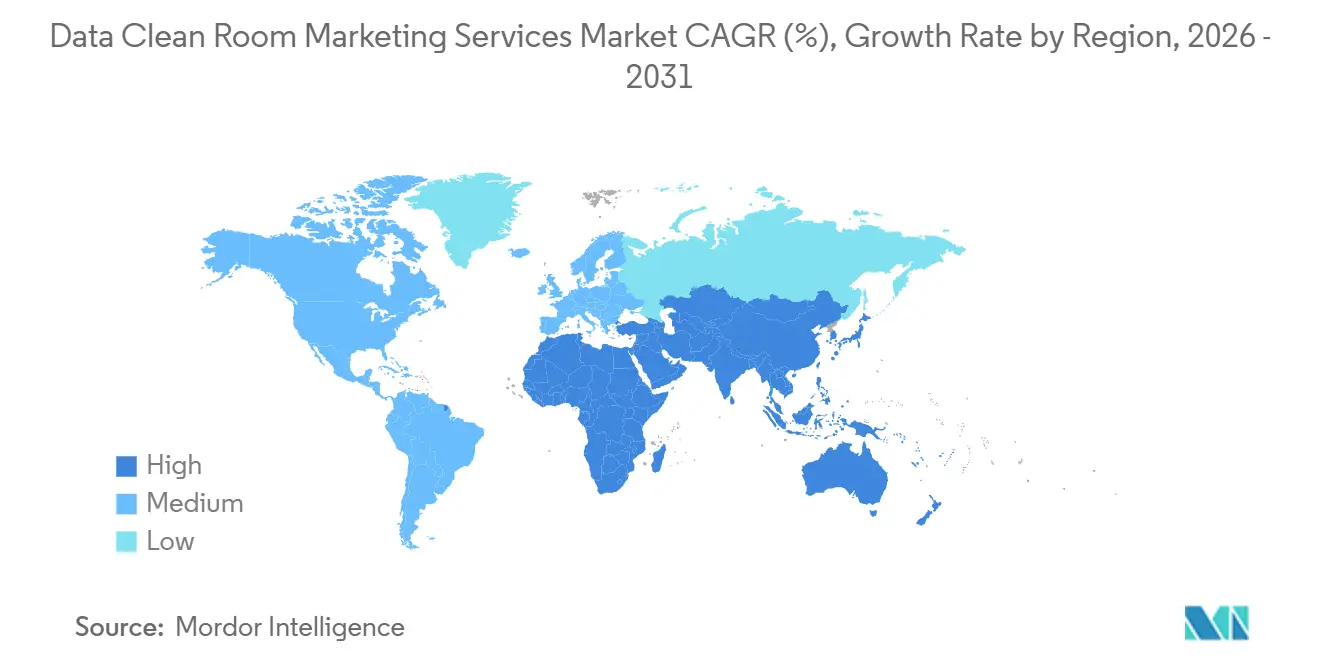
North America held 47.24% of global revenue in 2025. The region combines a high concentration of walled-garden advertising activity, established retail media networks, and enterprises capable of managing multi-party integrations across their own data warehouses and external platforms. California’s expanded regulations became effective on January 1, 2026, increasing attention to risk assessments and data-collaboration practices, while the Delete Act’s centralized data-broker deletion platform added another compliance consideration. Amazon Marketing Cloud’s installed user base and its availability across a large base of eligible sellers support data clean room marketing services market adoption in the United States, while Canada and Mexico provide adjacent growth opportunities through U.S. retail media programs and expanding first-party data activity.
Europe is shaped by GDPR requirements that influence technical design from the outset of a deployment, rather than serving as a review step after implementation. The December 2025 Russmedia judgment increased the importance of clear joint-processing arrangements in advertising partnerships and encouraged partners to clarify data-isolation responsibilities. Germany is an active deployment location, with Unlimitail selecting Snowflake Data Clean Rooms for a Global Retail Media Data Hub that supports Carrefour operations in France, Spain, and Brazil through a zero-copy approach.[3] Asia-Pacific is projected to grow at a 22.51% CAGR through 2031, supported by Japan’s APPI-related adoption, India’s expanding performance advertising activity, South Korea’s mobile-first advertising landscape, and platform-led collaboration models in China.
South America is an emerging area where Brazil is the primary demand anchor, and Carrefour Brazil’s participation in Unlimitail’s deployment provides an early retail media adoption case. Retail media spending is increasing faster than available clean room service infrastructure in parts of the region, creating a gap between demand for closed-loop measurement and available deployment capacity. The Middle East is at an early stage in the data clean room marketing services market, centered on the UAE and Saudi Arabia, where national digital transformation programs are drawing cloud investment that can support future clean room deployments. Africa is in an awareness and pipeline-building phase, led by South Africa and Nigeria, with addressable demand concentrated in telecommunications and financial services organizations that hold subscription and transaction datasets. These markets may require managed service delivery because their first-party data pools, internal engineering capacity, and multi-party collaboration networks are less developed than those in North America and Europe.
Competitive Landscape
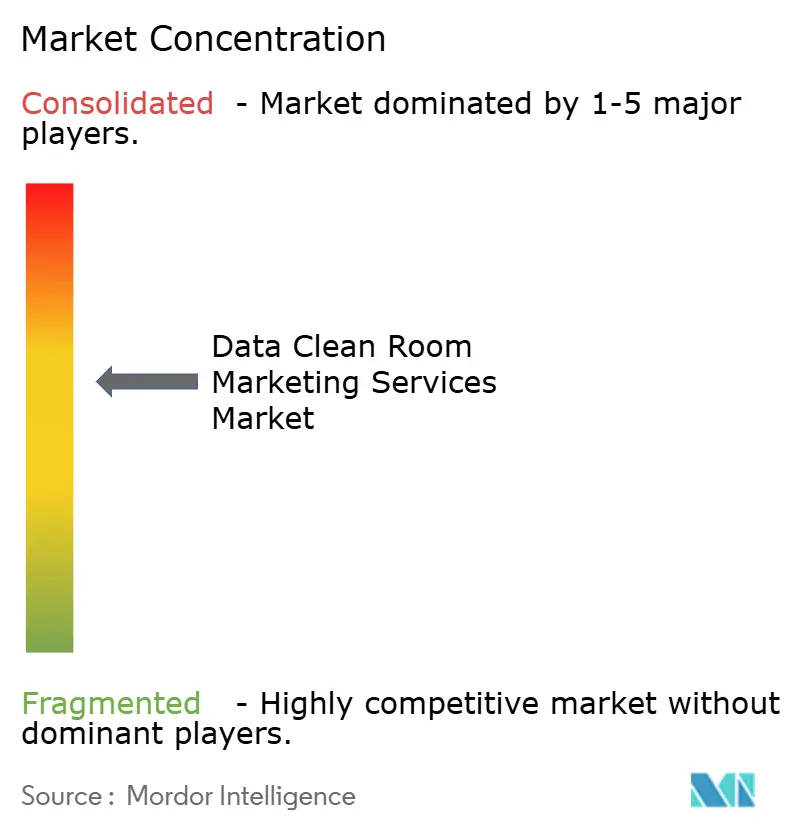
The data clean room marketing services market is moderately concentrated at the platform layer and fragmented across services and integration work, with different providers serving infrastructure, measurement, and operational needs. Hyperscalers such as AWS, Google, and Snowflake provide clean-room infrastructure through broader cloud offerings, while Google, Amazon, and Meta operate proprietary environments for measurement within their advertising ecosystems. Specialists, including InfoSum, Decentriq, LiveRamp, Epsilon, Acxiom, and Merkle, focus on integration, neutral multi-party collaboration, and managed analytics to help clients leverage multiple data sources. Databricks added privacy-safe collaboration workloads to its data intelligence platform in 2025, which extends clean room functions into an established data platform offering.
Compliance-focused architecture is also becoming a consideration in the procurement of data clean room marketing services, where buyers require documented evidence that data was not exposed. Competitive strategies vary by provider type. Hyperscalers are making access more self-service and less costly to expand usage, as shown by Amazon’s no-charge query access for 1P signals through December 2026. Snowflake plans to move to an API-first Collaboration framework beginning in October 2026, replacing legacy web-app clean room creation and shifting more activity into standardized interfaces. These changes may expand the data clean room marketing services market user base while placing pressure on specialist margins at the infrastructure layer.
InfoSum introduced Beacons in November 2025, a cross-cloud collaboration product that runs in customer AWS, Google Cloud, and Microsoft Azure environments and addresses fragmentation without requiring customers to select a single cloud anchor.[4] Agency holding companies are extending their role from analytics advice into infrastructure and service delivery, as illustrated by WPP’s April 2025 acquisition of InfoSum and its integration into WPP Media. This gives the group a direct role in first-party data programs for global clients and places agencies more directly alongside infrastructure vendors in the data clean room marketing services market, where providers are competing for both technical ownership and continuing service revenue. OneTrust’s April 2026 integration with Snowflake Data Clean Rooms applies consent signals inside the collaboration environment rather than treating them only as an input-stage declaration. Confidential computing, federated learning, and differential privacy can differentiate providers when enterprise buyers require audit-ready controls.
Data Clean Room Marketing Services Industry Leaders
-
Google LLC
-
Amazon Web Services, Inc.
-
LiveRamp, Inc.
-
Snowflake Inc.
-
InfoSum Ltd
- *Disclaimer: Major Players sorted in no particular order
Recent Industry Developments
- July 2026: The Bundesverband Digitale Wirtschaft, Germany’s digital industry association, published its Deep Dive whitepaper on the retail media data value chain, designating data clean room technology as a critical but context-specific infrastructure component for publisher-advertiser collaborations, and setting out privacy-by-design criteria for European retail media network deployments.
- June 2026: Dentsu Digital and Dentsu in Japan launched “Tobiras Agent,” an AI-powered natural-language interface for data clean room analytics that supports AWS Summit Japan deployments and removes SQL dependency from clean room querying, addressing the analyst-skill bottleneck that has constrained enterprise-scale clean room utilization in the Asia-Pacific market.
- April 2026: OneTrust announced a collaboration with Snowflake to embed consent signals directly into Snowflake Data Clean Rooms, enabling organizations to enforce consent as a technical constraint within the data collaboration environment rather than solely at the data collection layer, a model designed to satisfy GDPR and CPPA audit requirements.
- March 2026: InfoSum, operating as a WPP company, announced a strategic partnership with Dstillery to enable automated, privacy-first predictive audience activation, combining InfoSum’s decentralized data collaboration technology with Dstillery’s 24-hour audience refresh capability to automate the path from clean room analysis to programmatic activation.
Global Data Clean Room Marketing Services Market Report Scope
Data Clean Room Marketing Services Market refers to solutions that help brands and agencies use privacy-safe environments to combine first-party and partner data for audience insights, measurement, activation, and attribution while protecting personally identifiable information and supporting compliance with evolving data privacy regulations across digital advertising and customer engagement ecosystems.
The Data Clean Room Marketing Services Market Report is Segmented by Service Type (Strategy, Governance and Use-Case Design Services, Clean Room Implementation and Integration Services, Privacy-Safe Analytics, Measurement and Attribution Services, Managed Services and Operations, and Other Service Types), Client Company Size (Large Enterprises, and Small and Medium Enterprises), End User (Advertisers and Brands, Retailers and Retail Media Networks, Agencies and Marketing Service Providers, Technology Platforms and Data Providers, and Other End Users), and Geography (North America, South America, Europe, Asia-Pacific, Middle East, and Africa). The Market Forecasts are Provided in Terms of Value (USD).
| Strategy, Governance and Use-Case Design Services |
| Clean Room Implementation and Integration Services |
| Privacy-Safe Analytics, Measurement and Attribution Services |
| Managed Services and Operations |
| Other Service Types |
| Large Enterprises |
| Small and Medium Enterprises |
| Advertisers and Brands |
| Retailers and Retail Media Networks |
| Agencies and Marketing Service Providers |
| Technology Platforms and Data Providers |
| Other End Users |
| North America | United States |
| Canada | |
| Mexico | |
| South America | Brazil |
| Argentina | |
| Chile | |
| Rest of South America | |
| Europe | Germany |
| United Kingdom | |
| France | |
| Italy | |
| Spain | |
| Rest of Europe | |
| Asia-Pacific | China |
| Japan | |
| India | |
| South Korea | |
| Australia | |
| Rest of Asia-Pacific | |
| Middle East | United Arab Emirates |
| Saudi Arabia | |
| Qatar | |
| Rest of Middle East | |
| Africa | South Africa |
| Egypt | |
| Nigeria | |
| Rest of Africa |
| By Service Type | Strategy, Governance and Use-Case Design Services | |
| Clean Room Implementation and Integration Services | ||
| Privacy-Safe Analytics, Measurement and Attribution Services | ||
| Managed Services and Operations | ||
| Other Service Types | ||
| By Client Company Size | Large Enterprises | |
| Small and Medium Enterprises | ||
| By End User | Advertisers and Brands | |
| Retailers and Retail Media Networks | ||
| Agencies and Marketing Service Providers | ||
| Technology Platforms and Data Providers | ||
| Other End Users | ||
| By Geography | North America | United States |
| Canada | ||
| Mexico | ||
| South America | Brazil | |
| Argentina | ||
| Chile | ||
| Rest of South America | ||
| Europe | Germany | |
| United Kingdom | ||
| France | ||
| Italy | ||
| Spain | ||
| Rest of Europe | ||
| Asia-Pacific | China | |
| Japan | ||
| India | ||
| South Korea | ||
| Australia | ||
| Rest of Asia-Pacific | ||
| Middle East | United Arab Emirates | |
| Saudi Arabia | ||
| Qatar | ||
| Rest of Middle East | ||
| Africa | South Africa | |
| Egypt | ||
| Nigeria | ||
| Rest of Africa | ||
Key Questions Answered in the Report
What is the data clean room marketing services market size?
The data clean room marketing services market size is projected to increase from USD 1.35 billion in 2026 to USD 3.61 billion by 2031, at a 21.74% CAGR.
What is driving demand for data clean room marketing services?
Reduced access to third-party identifiers, privacy requirements, and demand for closed-loop retail media measurement are central demand factors.
Which service type leads data clean room marketing services?
Clean Room Implementation and Integration Services held 34.21% of revenue in 2025, while analytics and attribution services have the fastest projected growth at 22.84% CAGR.
Which organizations are adopting clean room services most actively?
Large enterprises accounted for 82.14% of revenue in 2025, although SMEs are projected to grow at a 22.67% CAGR through 2031.
Why do retail media networks use data clean rooms?
They use controlled data collaboration to connect advertising exposure with verified purchase activity and provide closed-loop measurement.
Which region is growing fastest for data clean room marketing services?
Asia-Pacific is projected to grow at a 22.51% CAGR from 2026 to 2031, supported by adoption in Japan, India, South Korea, and China.