
Dairy Testing Market Size and Share
Market Overview
| Study Period | 2021 - 2031 |
|---|---|
| Market Size (2026) | USD 2.47 Billion |
| Market Size (2031) | USD 3.69 Billion |
| Growth Rate (2026 - 2031) | 8.39 % |
| Fastest Growing Market | Asia Pacific |
| Largest Market | Europe |
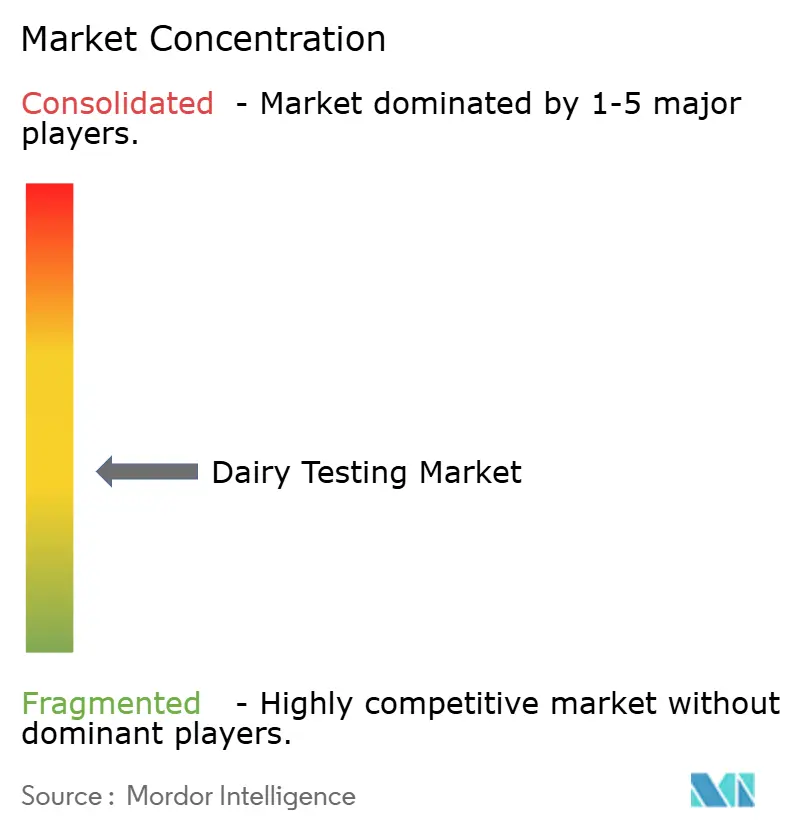
| Market Concentration | Medium |
Major Players
*Disclaimer: Major Players sorted in no particular order Image © Mordor Intelligence. Reuse requires attribution under CC BY 4.0. |
|
Dairy Testing Market Analysis by Mordor Intelligence
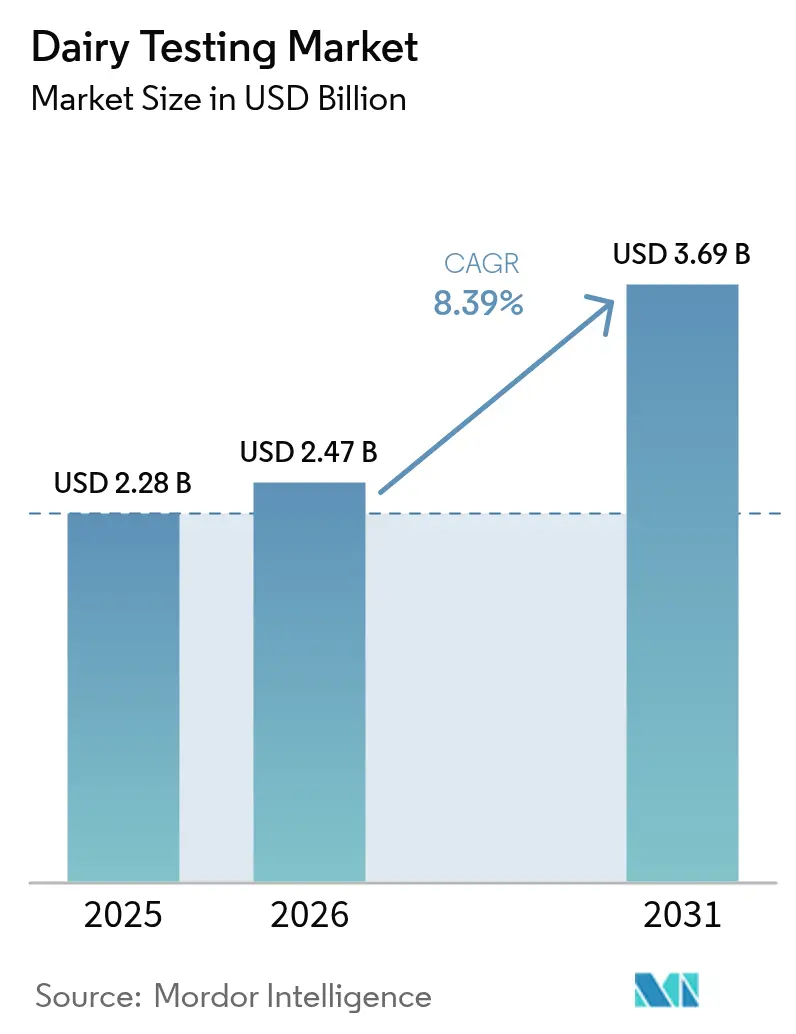
Dairy testing market size in 2026 is estimated at USD 2.47 billion, growing from 2025 value of USD 2.28 billion with 2031 projections showing USD 3.69 billion, growing at 8.39% CAGR over 2026-2031. This growth is driven by heightened global food safety concerns following major contamination incidents and the implementation of stricter regulatory standards, particularly in Europe, North America, and the Asia-Pacific region. The suspension of the United States' milk quality monitoring program in April 2025 prompted dairy processors to seek accredited third-party laboratories, thereby increasing demand for private sector testing. Ongoing listeria and salmonella incidents maintain pathogen detection as the primary testing service, while increased aflatoxin risks due to climate change drive growth in mycotoxin testing. The integration of automation, biosensors, and real-time data analytics reduces testing time and enables predictive quality management, driving adoption among medium and large dairy facilities [1]University of Wisconsin-Madison, “Suspension of FDA’s Grade “A” Milk Proficiency Testing Program,” farms.extension.wisc.edu.
Key Report Takeaways
- By testing type, pathogen screening led with a 38.02% share of the dairy testing market in 2025 and mycotoxin testing is projected to grow at a 9.55% CAGR.
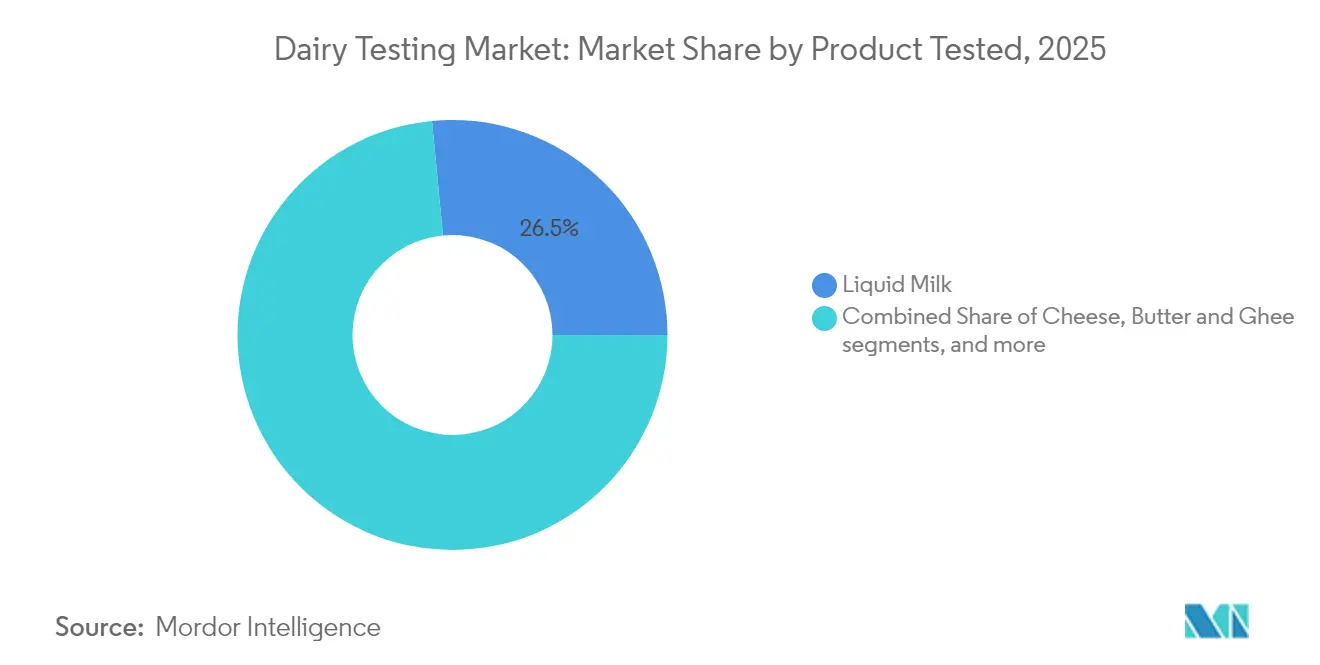
- By product tested, liquid milk held 26.52% share of the dairy testing market in 2025, while the ice-cream and frozen dessert category is poised for a 9.61% CAGR to 2031.
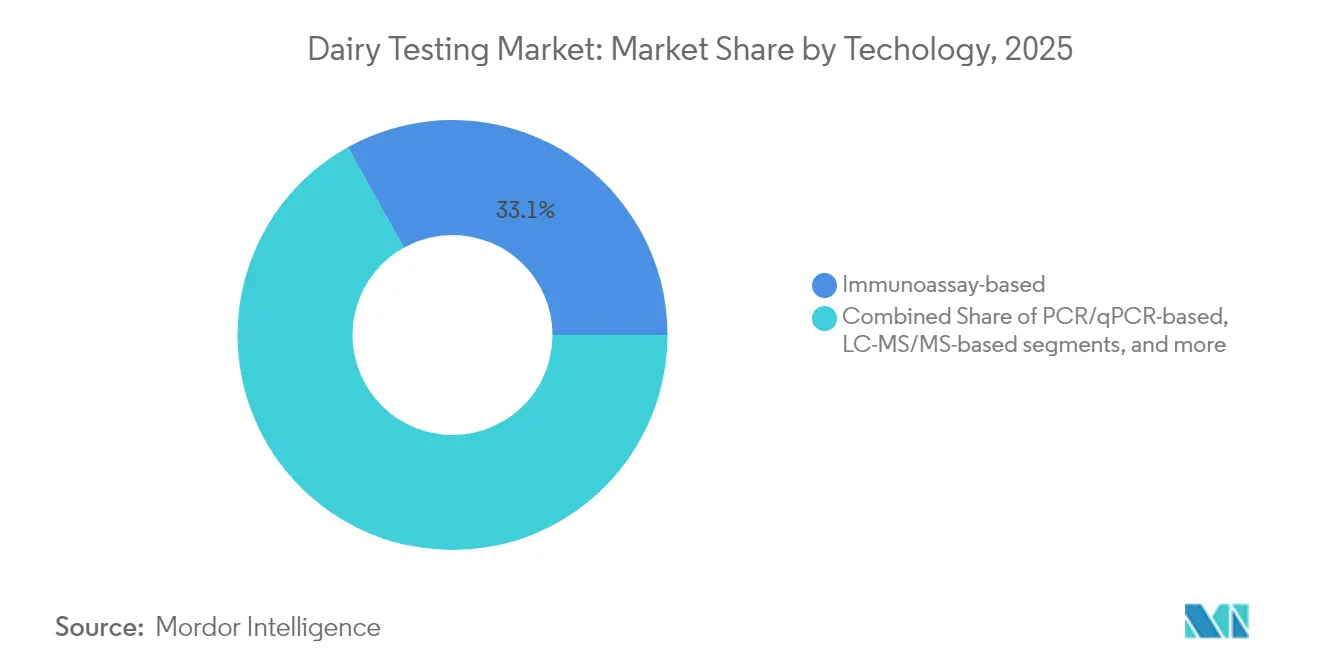
- By technology, immunoassays commanded a 33.10% revenue share in 2025 and will post steady mid-single-digit expansion, whereas biosensor and lab-on-chip platforms are forecast to log a 10.33% CAGR.
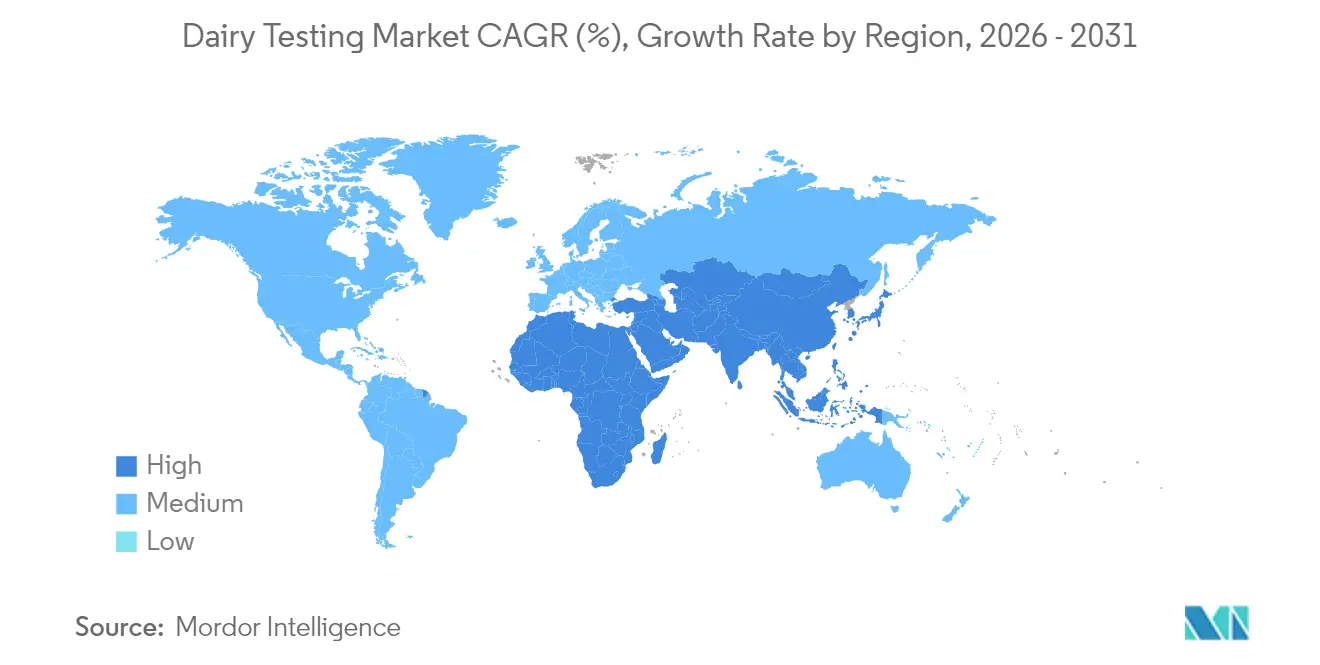
- By geography, Europe retained leadership with a 32.55% share in 2025; Asia-Pacific represents the fastest-growing region at 10.21% CAGR for 2026-2031.
Note: Market size and forecast figures in this report are generated using Mordor Intelligence’s proprietary estimation framework, updated with the latest available data and insights as of 2026.
Global Dairy Testing Market Trends and Insights
Drivers Impact Analysis*
| Driver | (~) % Impact on CAGR Forecast | Geographic Relevance | Impact Timeline |
|---|---|---|---|
| Growing incidences of milk adulteration and contamination | +2.1% | Global, with acute impact in Asia-Pacific and Latin America | Short term (≤ 2 years) |
| Stringent food safety regulations | +1.8% | North America & EU, expanding to Asia-Pacific | Medium term (2-4 years) |
| Rising demand for quality and authentic dairy products | +1.4% | Global, led by developed markets | Long term (≥ 4 years) |
| Technological advancements in testing equipment | +1.2% | Global, with early adoption in North America and Europe | Medium term (2-4 years) |
| Rising demand for processed and packaged dairy products | +0.9% | Global, accelerating in emerging markets | Long term (≥ 4 years) |
| Rise in cross-contamination checks for plant-based dairy products | +0.7% | North America & EU, expanding globally | Medium term (2-4 years) |
| Source: Mordor Intelligence | |||
Growing Incidences of Milk Adulteration and Contamination
The escalating frequency of dairy contamination incidents has fundamentally altered risk management priorities across the global supply chain, with regulatory responses creating mandatory testing requirements that directly expand market demand. The USDA's launch of a national milk testing strategy for bird flu in December 2024, following the detection of H5N1 virus traces in pasteurized milk, demonstrates how emerging pathogen threats rapidly translate into systematic testing protocols [2]United States Department of Agriculture,"USDA Launches National Milk Testing Strategy".usda.gov . China's enforcement of a ban on milk powder in shelf-stable milk products reflects growing consumer awareness of adulteration practices, forcing manufacturers to implement more rigorous authenticity testing to verify compliance with new standards. The FDA's initiation of aged raw milk cheese sampling for bird flu in January 2025 signals regulatory expansion beyond liquid milk into specialty dairy categories, broadening the testing market scope.
Stringent Food Safety Regulations
Regulatory harmonization across major markets is creating standardized testing requirements that eliminate competitive advantages based on lax oversight, forcing universal adoption of advanced testing protocols. The European Commission's implementation of Regulation (EU) 2023/915 establishes maximum contaminant levels that require sophisticated analytical methods, particularly for emerging contaminants not previously regulated. Japan's Consumer Affairs Agency introduced mandatory application processes for dairy products with non-milk ingredients in April 2025, requiring detailed safety documentation and genetic identification for probiotic components, significantly expanding testing requirements for functional dairy products [3]European Commission, “Regulation (EU) 2023/915,” ec.europa.eu. The FDA's Laboratory Accreditation for Analyses of Foods (LAAF) program determination of sufficient laboratory capacity for mycotoxin testing in June 2024, establishes mandatory accreditation requirements for import-related food testing, creating barriers to entry that favor established testing providers [4]The Office of the Federal Register (OFR), "A Rule by the Food and Drug Administration on 06/03/2024", www.federalregister.gov. The Grade 'A' Pasteurized Milk Ordinance's 2023 revision reinforces standardized milk sanitation practices across states, ensuring uniform testing protocols that support interstate commerce while maintaining safety standards. These regulatory developments create predictable, long-term demand for testing services while raising industry standards globally.
Rising Demand for Quality and Authentic Dairy Products
Consumer sophistication regarding dairy product authenticity has reached a tipping point where premium pricing justifies comprehensive testing protocols, particularly for specialty products claiming specific origin or composition characteristics. The development of proteomic technologies combined with artificial neural networks for milk origin identification addresses growing consumer demand for traceability, with MALDI-TOF mass spectrometry achieving high accuracy in distinguishing bovine, ovine, and caprine milk samples. A2 milk authentication has become a critical testing requirement, with ELISA and Lateral Flow Immunoassay methods achieving 100% sensitivity and specificity for detecting β-casein A1 contamination at levels above 10% in fermented milk products. The quality assessment of combined dairy products using cow's and mare's milk with vegetable additives demonstrates expanding testing requirements for innovative dairy formulations that cater to health-conscious consumers. Investment in dairy processing infrastructure exceeding USD 8 billion as of 2025 reflects industry commitment to premium product development, with new facilities requiring sophisticated testing capabilities to justify premium positioning. This trend toward premiumization creates sustained demand for advanced testing services that can verify product claims and support brand differentiation.
Technological Advancements in Testing Equipment
The convergence of miniaturization, automation, and artificial intelligence in testing equipment is enabling real-time quality monitoring that transforms dairy processing from reactive to predictive quality management. Ultrasensitive aptasensor technology for kanamycin residue detection achieves detection limits of 16.56 aM with 60-second analysis times, representing a quantum leap in speed and sensitivity for antibiotic residue screening. Hyperspectral imaging technology for aflatoxin B1 detection in maize silage addresses feed safety concerns that directly impact milk quality, with Chinese regulatory guidelines requiring AFB1 testing every two weeks in spring and weekly during summer and autumn. The ProSpect In-Line Dairy Analyzer provides real-time analysis of fat, protein, moisture, and total solids with laboratory-grade accuracy, enabling continuous process optimization and reducing waste through immediate quality feedback. Development of immunoassays using streptavidin-polymerized horseradish peroxidase (SA-PolyHRP) for pathogen detection achieves limits of detection of 1.4 × 10^4 CFU/mL for E. coli O157:H7, significantly improving sensitivity compared to traditional methods.
Restraints Impact Analysis*
| Restraint | (~) % Impact on CAGR Forecast | Geographic Relevance | Impact Timeline |
|---|---|---|---|
| High cost of advanced testing equipment | -1.6% | Global, acute impact in emerging markets | Short term (≤ 2 years) |
| Skilled labor shortage in food diagnostics | -1.3% | North America & EU, expanding globally | Medium term (2-4 years) |
| Cold-chain logistics challenges in emerging markets | -0.8% | Asia-Pacific, Africa, Latin America | Long term (≥ 4 years) |
| Complexity of multicomponent testing | -0.6% | Global, particularly affecting smaller laboratories | Medium term (2-4 years) |
| Source: Mordor Intelligence | |||
High Cost of Advanced Testing Equipment
The high cost of triple-quadrupole LC-MS/MS platforms for multi-toxin confirmation testing leads many smaller laboratories to outsource their testing. This outsourcing reduces local testing capabilities and increases the time needed to obtain results. The requirement for method life-cycle management in regulatory guidelines increases expenses further, as equipment upgrades necessitate new validation studies. Government laboratories face similar constraints - budget reductions led the FDA to suspend its milk-quality program in April 2025, creating a gap that private laboratories now address. Market growth remains constrained, especially in emerging regions, due to these high capital requirements and instrument costs.
Skilled Labor Shortage in Food Diagnostics
The shortage of skilled labor in food diagnostics poses a significant challenge to the dairy testing market. Dairy testing relies on expertise in microbiology and chemistry. A lack of trained professionals leads to slower testing processes, higher error rates, and reduced capacity. This directly impacts product safety, quality, and operational costs, while also limiting the scalability of testing services. Compliance with strict regulatory standards becomes more difficult, increasing the risk of penalties or market restrictions. The labor shortage further delays the adoption of advanced diagnostic technologies, which require skilled oversight, and slows innovation in testing methods and tools due to insufficient R&D talent. This gap in skilled labor undermines the efficiency, reliability, and growth potential of the global dairy testing market.
*Our forecasts treat driver/restraint impacts as directional, not additive. The impact forecasts reflect baseline growth, mix effects, and variable interactions.
Segment Analysis
By Product Tested: Liquid Milk Leads While Frozen Desserts Accelerate
In 2025, liquid milk accounted for a notable 26.52% of the revenue share, underscoring the global regulatory emphasis on maintaining the integrity of raw milk. Across major jurisdictions, mandatory screenings for antibiotic residues, alkaline-phosphatase activity, and total plate counts uphold a high density of testing. The ice-cream and frozen dessert segment is poised for a robust expansion, projected at a 9.61% CAGR. This growth is largely attributed to premium brands introducing innovative complex inclusions, necessitating heightened allergen and compositional checks.
Cheese testing is witnessing a surge, driven by European Regulation (EC) 2073/2005, which mandates specific microbiological criteria tailored to aging profiles. Testing for powdered milk and infant formulas remains stringent, emphasizing the detection of Cronobacter and the analysis of heavy metals. Furthermore, the testing of butter, ghee, and cultured products is increasingly incorporating fatty-acid profiling. This not only verifies label claims but also helps in identifying potential adulteration with vegetable oils, leading to a surge in the adoption of chromatographic testing methods.


By Testing Type: Pathogen Detection Drives Market Leadership
The pathogen detection segment accounted for 38.02% share of the dairy testing market revenue in 2025. Increased regulatory requirements for surveillance, driven by recurring listeria outbreaks, require consistent testing volumes throughout the year. The implementation of stringent safety protocols and the need for continuous monitoring have reinforced pathogen detection's central role in dairy safety assurance.
Mycotoxin testing, though a smaller segment, is projected to grow at a 9.55% CAGR as expanding aflatoxin risk zones in temperate regions due to wetter climates lead dairy facilities to implement comprehensive mycotoxin testing for feed materials. Pesticide residue and allergen testing contribute to stable baseline demand, while hormone testing demand increases due to growing concerns about veterinary drug residues. The rising awareness of food safety among consumers and regulatory bodies has further emphasized the importance of these testing segments.
By Technology: Immunoassays Dominate While Biosensors Emerge
Immunoassays captured 33.10% of 2025 revenue due to ease of use, reasonable cost and broad regulatory acceptance, but their relative share will taper as real-time biosensor formats mature. The 10.33% CAGR predicted for biosensor and lab-on-chip platforms reflects processor appetite for on-line, high-frequency measurement capable of triggering immediate line adjustments. LC-MS/MS and HPLC remain critical for confirmation and compositional work, anchoring the dairy testing market size for capital-intensive reference labs.
Aptamer-based electrodes now detect antibiotic residues at femtomolar concentrations within one minute, facilitating shift-based release testing. Simultaneously, portable hyperspectral imagers can screen feed silage for aflatoxin at truck-dump points, preventing contamination from entering closed milk loops. Time-resolved fluorescence strips for brucellosis antibody detection, sensitive to 1:12,800 dilutions, illustrate rapid progress in field diagnostics, charting a path for even broader dairy-plant implementation.
Geography Analysis
Europe dominated the dairy testing market with a 32.55% share in 2025, supported by consistent implementation of Regulation (EU) 2023/915 and comprehensive laboratory accreditation. Regional processors integrate rapid microbiology platforms with enterprise resource-planning systems to enhance compliance reporting for cross-border shipments. National reference laboratories collaborate through inter-laboratory proficiency programs to ensure result harmonization and safeguard the region's export interests.
Asia-Pacific demonstrates the highest growth rate at 10.21% CAGR through 2031. China's implementation of 50 new National Food Safety Standards introduces additional pesticide, heavy-metal, and mycotoxin testing requirements, driving investment in mass-spectrometry equipment. Japan's ingredient-notification system includes verification for functional fermented milks, expanding the dairy testing market for molecular-identification assays. India and Southeast Asian nations focus on cold-chain integrity programs, increasing demand for stabilizer, preservative, and shelf-life testing.
North America maintains a strong market position. While the Grade 'A' Pasteurized Milk Ordinance establishes core microbial standards, the April 2025 federal testing pause shifted verification activities to commercial laboratories, increasing dairy testing market share for specialized service providers. Canada's Safe Food for Canadians Regulations require pathogen and antibiotic screening for all dairy imports, increasing testing volume at border inspection facilities. Latin America and the Middle East & Africa exhibit moderate growth, limited by capital constraints and workforce shortages, but present opportunities for mobile laboratories and multinational processor-sponsored capacity-building initiatives.

Regulatory Landscape
Dairy testing demand is shaped by stricter food-safety and animal-health surveillance requirements across major dairy regions. In the United States, USDA APHIS implemented the National Milk Testing Strategy in December 2024 to sample raw milk for influenza A (H5N1), adding routine molecular screening alongside established Grade A Pasteurized Milk Ordinance (PMO) requirements administered through the National Conference on Interstate Milk Shipments (NCIMS) framework.
Regulatory refinement in 2025-2026 is also changing test scope, documentation, and compliance pathways. In July 2025, the FDA proposed revoking 18 dairy Standards of Identity in the context of 21 CFR Part 133, which could increase the need for compositional verification and label-claim substantiation for reformulated or renamed products. In February 2026, the FDA issued an exemption for certain cottage cheese products from the Food Traceability Rule, explicitly recognizing PMO-aligned controls, which indicates that traceability obligations can vary by dairy category when sanitation and recordkeeping are already covered by sector-specific frameworks. Separately, the FDA Human Foods Program 2026 priority deliverables include work on GRAS-related rulemaking, reinforcing the importance of ingredient safety documentation for functional and formulated dairy products.
Value Chain Analysis
The dairy testing value chain begins upstream at sampling and screening points at farms and milk collection sites, covering antibiotic and hormone screening, adulteration checks, and emerging pathogen surveillance. At processing plants, demand then concentrates on receiving and standardization, along with in-process controls such as pathogen testing, somatic cell count proxies, and compositional analysis, before extending to finished-product release and shelf-life verification for liquid milk, cheese, powders, and frozen desserts.
Testing inputs span consumables (media, reagents, immunoassay kits, PCR/qPCR assays) and reference standards, alongside instrumentation from rapid strips and in-line analyzers to LC-MS/MS and HPLC in confirmatory laboratories. Service delivery is handled through in-house plant labs and external ISO/IEC 17025-accredited networks, including large multi-country providers and regional labs, supported by proficiency testing and harmonized methods anchored by Codex Alimentarius and ISO specifications (for example, ISO/TS 23758:2021 for veterinary drug residues and ISO 17678:2019 for milk fat purity). A bottleneck emerged in April 2025 when the US FDA suspended its Grade A milk proficiency testing program, shifting more verification workload to third-party laboratories and increasing the operational value of rapid, validated in-plant screening tools to keep production moving while maintaining defensible compliance records.
Competitive Landscape
The dairy testing market shows moderate fragmentation, with Eurofins Scientific, Intertek, SGS, and Bureau Veritas as the primary market leaders. These companies maintain extensive global networks and hold ISO/IEC 17025 accreditations. Eurofins generated food testing revenue of EUR 5,142 million in the first nine months of 2024, providing the company with financial capacity for strategic acquisitions.
Strategic realignment is underway: Bureau Veritas exited routine food testing in October 2024 through a EUR 360 million divestiture to Mérieux NutriSciences, illustrating a pivot toward specialized providers. Neogen Corporation integrated 3M’s Food Safety Division, broadening pathogen, mycotoxin, and allergen platforms into a single catalog that resonates with large dairy conglomerates seeking one-stop solutions. Technology differentiation remains key; labs deploying AI-driven reporting tools can deliver validated results up to 30% faster, a decisive advantage for fast-moving short-shelf-life categories.
Regional entrants leverage localized knowledge and cost advantages but face accreditation hurdles such as the U.S. LAAF rule set, which now governs import-related mycotoxin tests. Consequently, several mid-sized Asian labs partner with equipment suppliers to attain method-validation support, while Latin American players pursue joint ventures with global majors to share reference-standard libraries. Looking forward, acquisition pipelines are likely to focus on geographies where laboratory density remains low relative to dairy output, permitting multinational chains to expand both capacity and the overall dairy testing market footprint.
Dairy Testing Industry Leaders
-
SGS GROUP
-
Bureau Veritas S. A.
-
Intertek Group plc
-
Neogen Corp.
-
Merieux NutriSciences
- *Disclaimer: Major Players sorted in no particular order

Market Opportunities and Future Outlook
An opportunity area is decentralizing dairy testing from central labs to collection points and production lines, supported by rapid, automated, multi-parameter systems that reduce turnaround time for release decisions. Evidence from 2026 supports this technology shift: a May 2026 study reported a portable, fully automated robotic arm system for real-time milk quality assessment (pH, TDS, temperature, density, and color), achieving 97.1% accuracy and cutting manual workflow time by about 35% in field trials. A March 2026 report also described AI-enabled sensor approaches that detected microbial contamination in milk with 98% accuracy within two hours. These results align with processor needs for higher-frequency screening in short-shelf-life categories, creating whitespace for kit suppliers, instrument vendors, and labs to package validated workflows (sampling, analytics, and digital reporting) that can be deployed in smaller and mid-sized facilities.
Regulatory change is also creating room for commercialization of compliance-oriented testing bundles and data services linked to traceability, identity, and import requirements. In Europe, the Commission updated entry requirements for certain dairy products and animal-derived additives via Delegated Regulation (EU) 2025/637, with further amendments under consideration in 2026, which increases the importance of standardized analytical documentation for cross-border trade. In the United States, FDA actions in 2025-2026, including PMO-recognized traceability exemptions for specific products and 2026 Human Foods Program priorities such as GRAS-related work, reinforce demand for defensible compositional, contaminant, and ingredient-safety substantiation, favoring providers that combine accredited methods, proficiency performance, and audit-ready digital records.
Recent Industry Developments
- March 2026: SGS launched SGS FoodNexus, a global food intelligence platform that combines its Digicomply capabilities with Agroknow analytics. The rollout strengthens data-driven risk monitoring and compliance workflows for food producers and testing clients, supporting faster hazard identification and more standardized reporting across geographies.
- October 2025: SGS signed a global cooperation agreement with Yili Group to provide integrated testing, inspection, and certification solutions across the dairy value chain. The agreement formalizes long-term demand for multi-site laboratory support and reinforces the role of bundled TIC services in building trust for large dairy brands.
- October 2024: Me9rieux NutriSciences acquired Bureau Veritas' food testing business for an enterprise value of EUR 360 million, shifting routine food testing assets to a specialist provider. The transaction expanded Me9rieux NutriSciences' laboratory footprint and increased competitive pressure on global networks serving dairy pathogen, residue, and compositional testing programs.


Research Methodology Framework and Report Scope
Market Definition and Coverage
The dairy testing market, for this methodology, covers the value of testing services and testing-related solutions used to check milk and dairy products for safety, quality, and compliance, from raw milk intake through finished products.
Scope exclusions: We exclude routine on-farm animal health diagnostics that are not performed to qualify milk or dairy products for processing, trade, or retail sale.
Segmentation Overview
-
By Testing Type
- Pathogen Testing
- Pesticide and Residue Testing
- Mycotoxin Testing
- Allergen Testing
- Hormone and Antibiotic Screening
- Nutritional and Composition Analysis
- Others
-
By Product Tested
- Liquid Milk
- Cheese
- Milk Powder and Infant Formula
- Butter and Ghee
- Ice-cream and Frozen Desserts
- Yogurt and Fermented Dairy
- Others
-
By Technology
- Immunoassay-based
- PCR/qPCR-based
- LC-MS/MS-based
- HPLC-based
- Biosensor and Lab-on-Chip
- Others
-
By Geography
-
North America
- United States
- Canada
- Mexico
- Rest of North America
-
Europe
- United Kingdom
- Germany
- Spain
- France
- Italy
- Russia
- Rest of Europe
-
Asia-Pacific
- China
- India
- Japan
- Australia
- Rest of Asia Pacific
-
South America
- Brazil
- Argentina
- Rest of South America
-
Middle East and Africa
- Saudi Arabia
- South Africa
- Rest of Middle East and Africa
-
North America
Data Sources, Market Sizing, and Validation
Desk Research
Desk research starts with public baselines that explain where testing demand comes from and how it is enforced. We review sources such as US FDA food safety and laboratory guidance, USDA dairy and cold chain statistics, European Commission food safety rules and alerts, Codex Alimentarius standards, and FAO dairy production outlooks, because these inform the required test panels and inspection intensity.
Next, we connect those rules to measurable activity, using items like customs trade data for dairy products, peer-reviewed method validation papers on HPLC, LC-MS/MS, and immunoassay performance, and public information from labs and instrument makers (for example, product brochures and investor presentations). Where helpful, paid subscriptions for company financials and news are used to sanity check growth narratives and timing of capacity additions. These sources are illustrative, and many other public references were also used for collection, cross-checking, and clarification.
Primary Interviews and Surveys
Primary work is used to pressure-test the model with people who see testing volumes and pricing in day-to-day operations, such as dairy processors, quality managers, third-party labs, and channel partners for instruments and consumables. To avoid a single-region bias, inputs are balanced across APAC, EMEA, and the Americas, and questions focus on test mix shifts, outsourcing rates, and realistic price movement rather than ideal-case adoption.
Distribution of primary research fieldwork respondents
| Company type | Respondent position | Region |
|---|---|---|
| Top tier: 33% | CXOs: 17% | APAC: 52% |
| Mid tier: 46% | Functional/Unit leaders: 30% | EMEA: 29% |
| Smaller Players: 21% | Managers: 53% | Americas: 19% |
Market-Sizing & Forecasting
Sizing begins with a top-down build where dairy production and processed dairy output by region are translated into a testing demand pool through compliance intensity and typical sampling frequency, followed by an allocation across key test groups. Once the demand pool is established, it is converted to value using realistic price bands by test type and technology, then adjusted for the share of in-house testing versus outsourced labs.
To keep the model tied to real market behavior, we track inputs such as dairy output trends, the share of higher-risk products like infant formula and milk powder, pathogen and residue testing requirements, technology mix shifts between immunoassays and LC-MS/MS, and average turnaround expectations that influence outsourcing decisions. The forecast uses scenario analysis supported by expert views, since regulation changes, contamination events, and lab capacity expansions can shift demand faster than a simple trend line. Bottom-up checks are applied through selective roll-ups, such as sampling a set of labs and suppliers to test implied volumes and average selling prices, with gaps handled using regional proxies and conservative adoption curves until validated.
Data Validation & Update Cycle
Outputs are validated in layers, starting with internal variance checks across regions, test groups, and implied price per sample so outliers are flagged early. When a number looks unusual, we re-check assumptions like sampling rates, outsourcing share, and currency timing, then revisit the related sources or re-contact select respondents for confirmation.
Before sign-off, the model is reviewed by another analyst who compares results against independent signals such as dairy production movements, regulatory activity levels, and visible lab capacity changes. The report is refreshed annually, and interim updates are made when a material event occurs, such as a major rule change or a notable shift in testing technology adoption. Right before delivery, a final pass is completed so clients receive the latest updated view.
Mordor Intelligence's Dairy Testing Market Size Measured Against Other Published Estimates
Published market sizes for dairy testing often vary because firms do not count the same revenue streams, they anchor to different base years, and they apply different pricing and outsourcing assumptions. Differences also come from how each model treats technology scope, such as whether instrument sales, consumables, and third-party lab services are all included.
Key gaps usually show up in three places, which are test basket definition, price logic, and refresh cadence. Some estimates appear to roll broader food safety testing or adjacent quality assurance spend into dairy testing, and others may use a single aggressive adoption curve for rapid tests without checking how quickly labs and processors actually switch methods.
Benchmark comparison
| Source | Market Size | Gaps in Research Methodology |
|---|---|---|
| Mordor Intelligence | USD 2.47 B (2026) | |
| Global Consultancy A | USD 5.97 B (2024) | Uses a wider definition that can pull in more than core dairy product safety and quality testing, and it is anchored to an earlier base year that is not aligned to the same refresh window. |
| Industry Publisher B | USD 6.81 B (2024) | Likely applies a broader testing spend scope across dairy categories and methods, and the forecast build can embed different adoption and price progression assumptions that are not reconciled back to sampling intensity. |
The comparison shows that the biggest swing comes from what is counted as dairy testing value and how the demand pool is constructed from measurable dairy activity. When volumes are built from dairy output linked sampling rates and checked against realistic lab price bands by test group, adjacent spending like broader food safety programs is left out, a scoping difference applied by Mordor Intelligence.


Key Questions Answered in the Report
What is the current size of the dairy testing market?
The market is valued at USD 2.47 billion in 2026 and is projected to reach USD 3.69 billion by 2031.
Which testing type dominates revenue?
Pathogen detection led with a 38.02% share in 2025 due to strict global microbiological safety requirements.
Which region is growing the fastest?
Asia-Pacific is forecast to record a 10.21% CAGR through 2031, driven by new Chinese and Japanese food-safety standards.
What technologies are gaining popularity?
Biosensor and lab-on-chip platforms are expanding at a 10.33% CAGR, offering rapid on-site testing capabilities.
How fragmented is the competitive landscape?
The market shows moderate fragmentation with a concentration score of 4, indicating significant room for mergers and acquisitions.
Page last updated on:


 Your data is secure and never sold or shared.


