Market Overview
| Study Period | 2020 - 2030 |
|---|---|
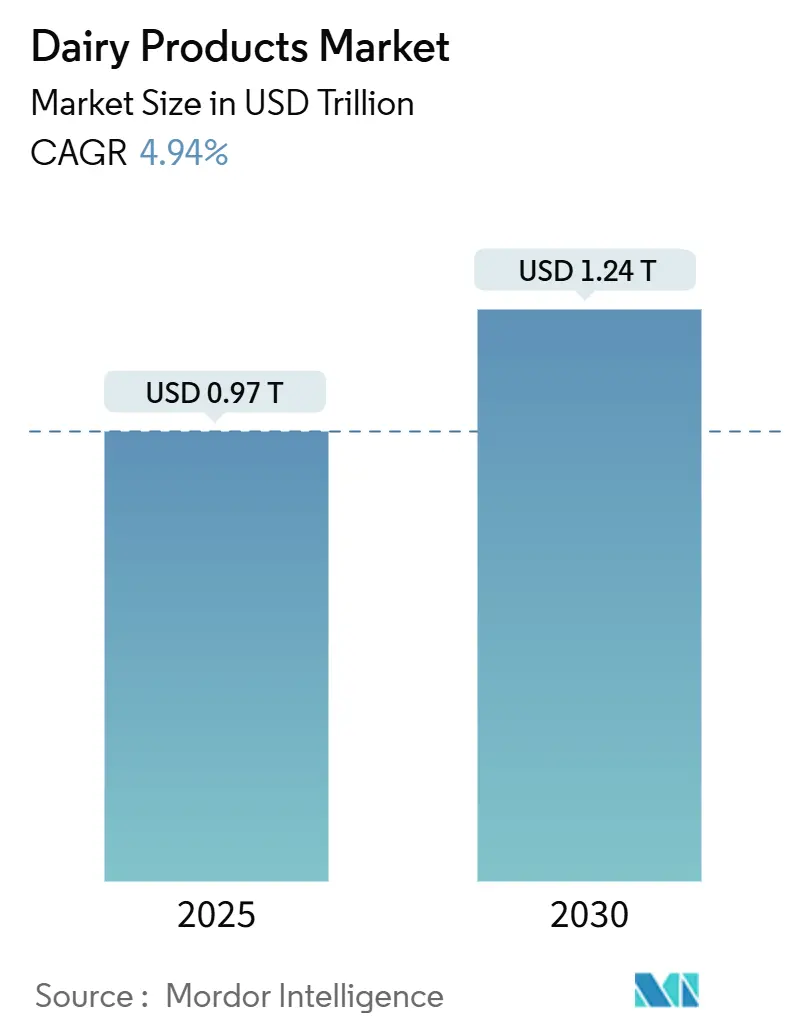
| Market Size (2025) | USD 0.97 Trillion |
| Market Size (2030) | USD 1.24 Trillion |
| Growth Rate (2025 - 2030) | 4.94% CAGR |
| Fastest Growing Market | North America |
| Largest Market | Asia Pacific |
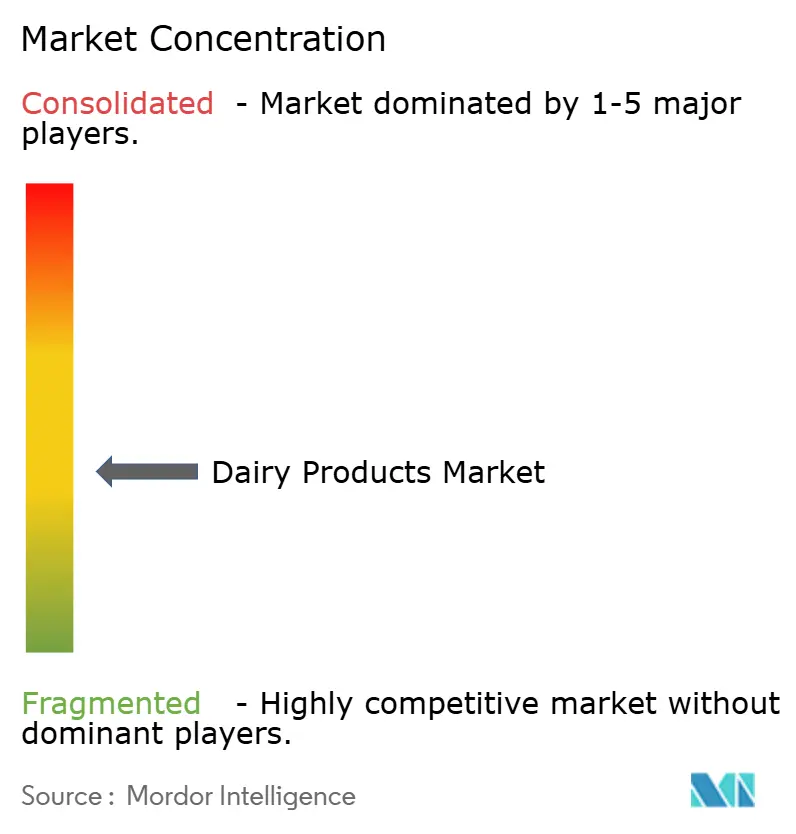
| Market Concentration | Medium |
Major Players
*Disclaimer: Major Players sorted in no particular order Image © Mordor Intelligence. Reuse requires attribution under CC BY 4.0. |
|
Dairy Products Market Analysis by Mordor Intelligence
The dairy products market is expected to grow from USD 0.97 trillion in 2025 to USD 1.24 trillion by 2030, registering a compound annual growth rate (CAGR) of 4.94%. This growth is driven by increasing demand for functional nutrition products, supportive regulatory policies for probiotics, and expanding government initiatives aimed at developing the dairy sector. However, fluctuations in raw milk prices and the growing popularity of plant-based alternatives are challenges that could slow down this growth. The market is witnessing a shift toward fortified products such as premium yogurt, high-protein milk, and value-added whey ingredients, which are gaining popularity among health-conscious consumers. To maintain profitability, dairy processors are focusing on improving cold chain logistics and adopting vertical integration strategies. The demand for lactose-free products is rising, catering to individuals with lactose intolerance. The global dairy products market remains moderately fragmented, with competition among key players continuing to shape the industry landscape.
Key Report Takeaways
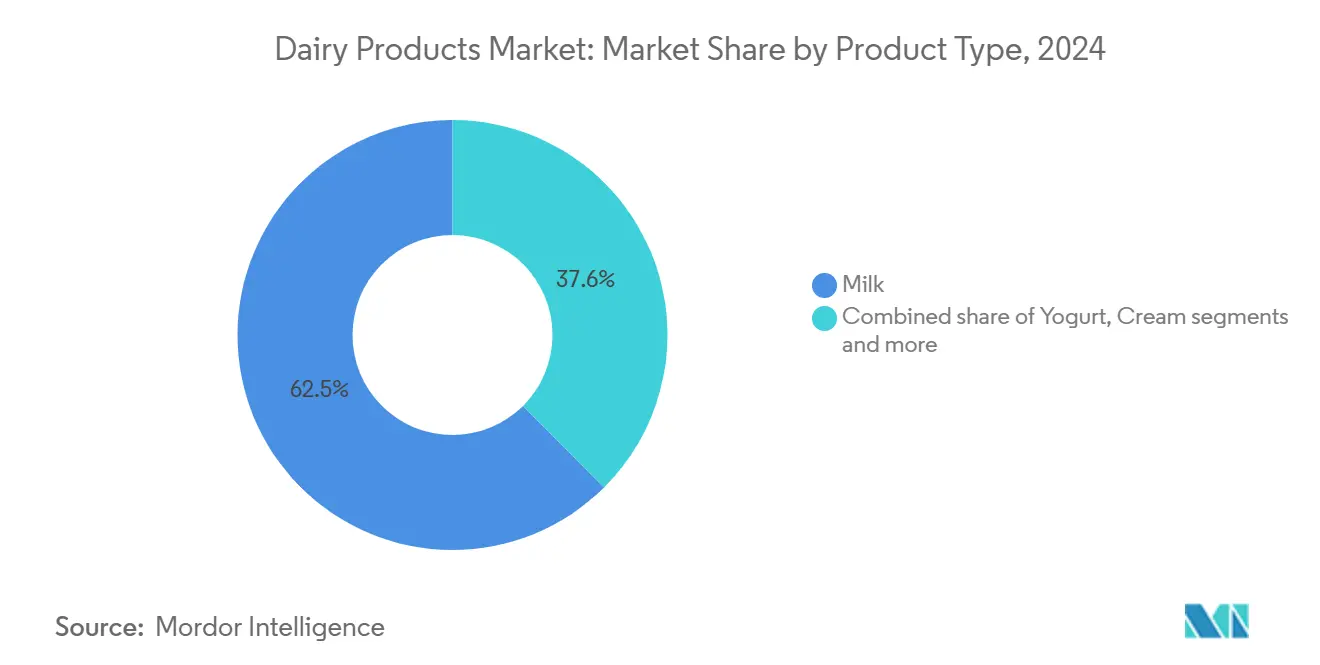
- By product type, milk held 62.45% of the dairy products market share in 2024, while yogurt is advancing at a 5.73% CAGR through 2030.
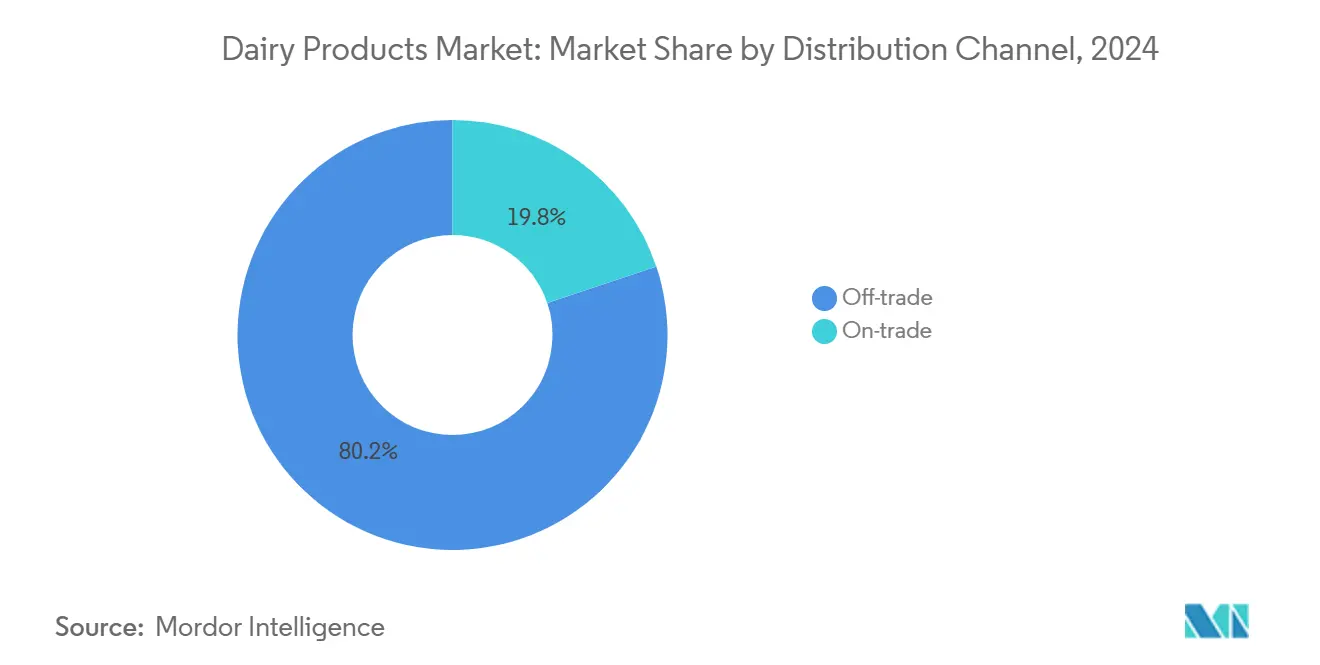
- By distribution channel, off-trade accounted for 80.17% of 2024 revenue; on-trade is forecast to post a 5.81% CAGR to 2030.
- By geography, Asia-Pacific commanded 36.72% of the dairy products market share in 2024; North America is projected to grow fastest at a 6.16% CAGR through 2030.
Global Dairy Products Market Trends and Insights
Drivers Impact Analysis
| Driver | (~) % Impact on CAGR Forecast | Geographic Relevance | Impact Timeline |
|---|---|---|---|
| Increasing demand for probiotic and functional dairy | +1.2% | Global, with North America and Europe leading regulatory approvals | Medium term (2-4 years) |
| Growing availability of dairy variants for dietary needs | +0.9% | North America, Europe, Asia-Pacific urban centers | Short term (≤ 2 years) |
| Rising use of dairy ingredients in packaged foods | +0.8% | Global, particularly North America and Europe for sports nutrition and infant formula | Medium term (2-4 years) |
| Government support for dairy development and supply stability | +0.7% | India, China, United States, European Union | Long term (≥ 4 years) |
| Increasing adoption of sustainable and ethical dairy options | +0.5% | Europe, North America, Australia | Long term (≥ 4 years) |
| Expansion of lactose-digestive aids supporting dairy intake | +0.4% | Asia-Pacific, Latin America, Middle East | Short term (≤ 2 years) |
| Source: Mordor Intelligence | |||
Increasing demand for probiotic and functional dairy
Consumers are increasingly focusing on preventive nutrition, particularly for improving gut health, maintaining metabolic balance, and boosting immunity. This shift is transforming dairy products from being seen as everyday staples to being recognized as functional, health-focused options. In March, 2024, the Food and Drug Administration issued a qualified health claim stating that consuming yogurt regularly at least 2 cups per week may help lower the risk of developing Type 2 diabetes[1]Source: Food and Drug Administration, "FDA Announces Qualified Health Claim for Yogurt and Reduced Risk of Type 2 Diabetes", fda.gov. As a result, manufacturers are reformulating their products to include clinically proven probiotic strains, higher protein content to appeal to health-conscious consumers. For example, Activia plans to launch its Proactive yogurt line in 2025, which will feature live probiotics, prebiotic fiber, and increased protein levels. This innovation reflects how brands are adapting to meet growing consumer interest in products that support digestive health and overall metabolic wellness.
Growing availability of dairy variants for dietary needs
The increasing availability of dairy products designed for specific dietary needs is expanding the global consumer base and driving demand for specialized milk options. Products such as lactose-free milk, A2 milk, grass-fed milk, and protein-fortified milk have become common in supermarkets, offering consumers choices that cater to digestive health, ethical preferences, and targeted nutritional benefits. For instance, while countries like DR Congo, Vietnam, and South Korea show about 1% lactose intolerance, according to World Population Review in 2025, the demand for these specialized dairy products is more influenced by lifestyle choices, perceived health benefits, and premium quality rather than widespread medical necessity[2]Source: World Population Review, "Lactose Intolerance by Country 2025", worldpopulationreview.com. In August 2025, the Karnataka Milk Federation announced the launch of lactose-free buffalo milk under its Nandini brand by September 2025. This marked a significant step in India, combining the traditional richness of buffalo milk with the convenience of lactose-free options.
Government support for dairy development and supply stability
Governments across major dairy-producing regions are actively investing in initiatives to boost dairy development and ensure a stable supply chain. In India, the government allocated INR 2,790 crore to upgrade milk-collection centers in March 2025 according to the Press Information Bureau[3]Source: Press Information Bureau, "Cabinet approves Revised National Program for Dairy Development (NPDD)", pib.gov.in. These efforts aim to strengthen cooperative procurement systems and minimize post-harvest losses, ensuring better efficiency in the supply chain. Similarly, Canada has committed to implement methane digesters and precision-feeding systems in September 2025. These technologies not only improve dairy production efficiency but also align with the country’s climate goals by reducing greenhouse gas emissions. In the European Union, the Common Agricultural Policy now ties payments to pasture preservation. This approach supports cooperatives that share resources for agronomic assistance and compliance with sustainability standards.
Increasing adoption of sustainable and ethical dairy options
Consumers are increasingly focused on environmental sustainability and animal welfare, which is driving dairy producers to adopt more eco-friendly and ethical practices throughout their operations. There is growing demand for products like grass-fed, pasture-raised, and low-carbon-certified dairy. These products are supported by systems that ensure transparency, such as verifying grazing practices, the origin of animal feed, and efforts to maintain biodiversity on farms. To meet stricter climate goals and attract environmentally conscious buyers, companies are investing in renewable energy for farms, technologies to reduce water usage during processing, and methods to lower methane emissions from livestock. Ethical sourcing is becoming more important, with cooperatives working to ensure farmers receive fair compensation and supply chains remain transparent. These efforts not only build consumer trust but also help brands position themselves as premium and socially responsible options in the market.
Restraints Impact Analysis
| Restraint | (~) % Impact on CAGR Forecast | Geographic Relevance | Impact Timeline |
|---|---|---|---|
| Rising lactose intolerance and dairy sensitivities | -0.8% | Asia-Pacific, Latin America, sub-Saharan Africa | Short term (≤ 2 years) |
| High volatility in raw milk prices | -0.6% | Global, with acute effects in North America and Europe | Short term (≤ 2 years) |
| Increasing competition from plant-based alternatives | -0.5% | North America, Europe, urban Asia-Pacific | Medium term (2-4 years) |
| Frequent quality and adulteration issues | -0.3% | India, China, emerging markets in Africa and Southeast Asia | Medium term (2-4 years) |
| Source: Mordor Intelligence | |||
Increasing competition from plant-based alternatives
The growing popularity of plant-based alternatives is posing a significant challenge to the dairy products market. As of June 2025, the global vegan population was estimated to reach approximately 88 million, accounting for about 1.1% of the world’s population, as per the World Animal Foundation[4]Source: World Animal Foundation, "How Many Vegans Are in the World in 2025? Latest Vegan Stats", worldanimalfoundation.org. This expanding demographic is driving increased demand for dairy substitutes. For instance, in October 2024, Maizly introduced a plant-based milk product in the United States, highlighting how new players are intensifying competition in the retail dairy segment. Plant-based options like oat and almond milk, which now offer similar foam stability and texture to traditional dairy, are gaining popularity in cafés and home coffee routines. Hybrid cheese products, which combine dairy with plant-based ingredients, are also attracting flexitarian consumers by delivering the familiar qualities of melt and stretch while offering a lower environmental impact.
Frequent quality and adulteration issues
Quality issues and adulteration remain significant challenges for the dairy products market, as they erode consumer trust and create hurdles for both domestic sales and exports. For instance, a report by The Times of India in August 2024 revealed that nearly 22% of milk and milk product samples tested in the Punjab, Haryana, and Himachal Pradesh region between 2021 and 2024 failed to meet safety standards. This highlights ongoing gaps in quality control measures. Past incidents, such as the melamine contamination in China, continue to affect consumer confidence, particularly in the infant formula segment. To address these concerns, producers are increasingly focusing on improving traceability and conducting independent audits.Risks like aflatoxin contamination from moldy animal feed and antibiotic residues from mastitis treatments pose significant challenges, especially when exporting to countries with strict safety regulations.
Segment Analysis
By Product Type: Yogurt Growth Outpaces a Mature Milk Base
Milk remains the largest segment in the dairy products market in , holding 62.45% of the total market share. Its widespread use in homes, restaurants, and as a key ingredient in various dairy-based products highlights its importance. The demand for milk continues to grow steadily, supported by its availability in both developed and emerging markets. Additionally, government programs and dietary guidelines that emphasize milk as a vital source of protein and essential nutrients further strengthen its position as a staple in the market.
Yogurt is expected to be the fastest-growing segment in the dairy products market, with a projected CAGR of 5.73% through 2030. This growth is driven by increasing consumer focus on health and wellness, particularly as studies have shown that regular yogurt consumption can help reduce the risk of Type 2 diabetes. The availability of a wide range of options, such as probiotic-rich, high-protein, and drinkable yogurts, is attracting more consumers. Advancements in yogurt products, including fortified and shelf-stable varieties,.
Note: Segment shares of all individual segments available upon report purchase
Get Detailed Market Forecasts at the Most Granular Levels
Download PDF
By Distribution Channel: Off-Trade Dominates but On-Trade Accelerates
Off-trade channels, such as supermarkets, hypermarkets, warehouse clubs, convenience stores, and e-commerce platforms, made up 80.17% of the dairy products market in 2024. These channels are popular due to their ability to offer a wide variety of dairy products, competitive pricing, and convenience for consumers. The strong cold-chain infrastructure in these outlets ensures product freshness, making them a preferred choice for regular household purchases. Additionally, the growth of private-label dairy products in these channels has improved affordability and accessibility for a broader customer base.
On-trade channels, including cafés, restaurants, hotels, and institutional catering, are expected to grow at a CAGR of 5.81% through 2030. The revival of dining-out trends post-pandemic has increased the demand for dairy-based items like specialty beverages, artisanal cheeses, and premium desserts. Foodservice operators are focusing on offering high-quality and indulgent experiences, which is driving the use of premium dairy products such as barista-grade milk and gourmet ice creams. This growing emphasis on quality and innovation in menus is likely to fuel steady growth in on-trade dairy consumption during the forecast period.
Get Detailed Market Forecasts at the Most Granular Levels
Download PDF
Geography Analysis
Competitive Landscape
The dairy products market is moderately fragmented, with competition coming from both multinational corporations and regional cooperatives. Large companies like Nestlé SA, Danone SA, and Groupe Lactalis benefit from their extensive marketing capabilities, research and development, and global supply chains. On the other hand, regional cooperatives such as GCMMF, Fonterra, and Dairy Farmers of America rely on their strong local presence and farmer-owned models to build trust. Companies are increasingly focusing on high-value products like whey protein, precision-fermented dairy alternatives, and hybrid blends to cater to changing consumer preferences. For instance, Arla Foods’ acquisition of Volac Whey Nutrition strengthens its position in sports nutrition and infant formula, while Leprino Foods’ partnership with Fooditive to develop animal-free casein highlights the industry's shift toward innovation and sustainability.
Adopting sustainable practices and advanced technologies is becoming a key differentiator in the market. Companies that implement regenerative grazing and monetize carbon credits gain a competitive edge, especially as retailers push for lower supply chain emissions. Larger players are using artificial intelligence to optimize milk collection routes and predict price fluctuations, while smaller farmers in regions like Asia and Africa are adopting mobile-based tools to reduce losses and improve efficiency. Innovations in product development, such as probiotic encapsulation that withstands digestion, shelf-stable lactase enzymes, and recyclable packaging materials, reflect the industry's dual focus on improving nutrition and reducing environmental impact.
Entering the dairy market remains challenging due to high costs associated with processing facilities, maintaining cold-chain logistics, and adhering to strict food safety regulations. However, advancements in precision fermentation are disrupting traditional dairy production. Startups like Remilk, which has received FDA approval for its animal-free whey protein, are creating new opportunities by eliminating the need for cows in the production process. Established dairy companies are responding by investing in these startups or forming partnerships to share in the growth potential without fully committing to the risks. This approach allows legacy players to stay competitive while adapting to evolving consumer demands and technological advancements.
Dairy Products Industry Leaders
-
Danone SA
-
Nestlé SA
-
Dairy Farmers of America
-
Fonterra Co-operative Group
-
Groupe Lactalis
- *Disclaimer: Major Players sorted in no particular order
Need More Details on Market Players and Competitors?
Download PDF
Recent Industry Developments
- August 2025: Country Delight introduced a new high-protein cow milk product, designed to address India's growing demand for enhanced daily nutrition. This product boasted twice the protein content of regular milk, aiming to cater to health-conscious consumers seeking better dietary options.
- August 2025: Danone introduced Oikos yogurt drink specifically designed to cater to GLP-1 users. This product launch reflected the company's strategic focus on addressing the nutritional needs of individuals using GLP-1 receptor agonists, which are commonly prescribed for managing diabetes and weight loss.
- June 2025: Yogurt Factory announced its plans to expand into the Indian market. This move was facilitated through a strategic collaboration with FranGlobal, the international business division of Franchise India.
- March 2025: Paras Dairy, operated by VRS Foods Limited and recognized as a prominent player in India’s dairy industry, introduced its premium cheese brand, Galacia, during the Aahar 2025 exhibition. This launch represented a strategic move to cater to the growing demand for high-quality cheese products in the Indian market.
Global Dairy Products Market Report Scope
The dairy products market is segmented by Product Type, Distribution Channel, and Geography. Based on Product Type, the market is segmented into butter, cheese, cream, dairy desserts, milk, yogurt, sour milk drinks and others. Based on the distribution channel, the market studied is segmented into on-trade and off-trade. Based on geography, the market studied is segmented into North America, South America, Europe, Asia-Pacific, and Middle East and Africa.
By Product Type
| Butter | Salted Butter | |
| Unsalted Butter | ||
| Cheese | Natural Cheese | Cheddar |
| Cottage | ||
| Feta | ||
| Parmesan | ||
| Others | ||
| Processed Cheese | ||
| Cream | Fresh Cream | |
| Cooking Cream | ||
| Whippng Cream | ||
| Others (Clotted, Sour Cream) | ||
| Dairy Desserts | Ice Cream | |
| Cheesecakes | ||
| Frozen Desserts | ||
| Others (Puddings/Desserts, Trifles, Fools) | ||
| Milk | Condensed milk | |
| Flavored Milk | ||
| Fresh Milk | ||
| UHT Milk (Ultra-High Temperature Milk) | ||
| Powdered Milk | ||
| Others | ||
| Yogurt | Drinkable | |
| Spoonable | ||
| Sour Milk Drinks | ||
| Others | ||
By Distribution Channel
| On-trade | |
| Off-trade | Convenience Stores |
| Specialist Retailers | |
| Supermarkets/Hypermarkets | |
| Online Retail | |
| Others (Warehouse Clubs, Gas Stations, etc.) |
By Geography
| North America | United States |
| Canada | |
| Mexico | |
| Rest of North America | |
| South America | Brazil |
| Colombia | |
| Chile | |
| Peru | |
| Argentina | |
| Rest of South America | |
| Europe | United Kingdom |
| Germany | |
| France | |
| Italy | |
| Spain | |
| Poland | |
| Belgium | |
| Sweden | |
| Rest of Europe | |
| Asia-Pacific | China |
| Japan | |
| India | |
| Australia | |
| Indonesia | |
| South Korea | |
| Thailand | |
| Singapore | |
| Rest of Asia-Pacific | |
| Middle East and Africa | South Africa |
| Saudi Arabia | |
| United Arab Emirates | |
| Nigeria | |
| Egypt | |
| Morocco | |
| Turkey | |
| Rest of Middle East and Africa |
| By Product Type | Butter | Salted Butter | |
| Unsalted Butter | |||
| Cheese | Natural Cheese | Cheddar | |
| Cottage | |||
| Feta | |||
| Parmesan | |||
| Others | |||
| Processed Cheese | |||
| Cream | Fresh Cream | ||
| Cooking Cream | |||
| Whippng Cream | |||
| Others (Clotted, Sour Cream) | |||
| Dairy Desserts | Ice Cream | ||
| Cheesecakes | |||
| Frozen Desserts | |||
| Others (Puddings/Desserts, Trifles, Fools) | |||
| Milk | Condensed milk | ||
| Flavored Milk | |||
| Fresh Milk | |||
| UHT Milk (Ultra-High Temperature Milk) | |||
| Powdered Milk | |||
| Others | |||
| Yogurt | Drinkable | ||
| Spoonable | |||
| Sour Milk Drinks | |||
| Others | |||
| By Distribution Channel | On-trade | ||
| Off-trade | Convenience Stores | ||
| Specialist Retailers | |||
| Supermarkets/Hypermarkets | |||
| Online Retail | |||
| Others (Warehouse Clubs, Gas Stations, etc.) | |||
| By Geography | North America | United States | |
| Canada | |||
| Mexico | |||
| Rest of North America | |||
| South America | Brazil | ||
| Colombia | |||
| Chile | |||
| Peru | |||
| Argentina | |||
| Rest of South America | |||
| Europe | United Kingdom | ||
| Germany | |||
| France | |||
| Italy | |||
| Spain | |||
| Poland | |||
| Belgium | |||
| Sweden | |||
| Rest of Europe | |||
| Asia-Pacific | China | ||
| Japan | |||
| India | |||
| Australia | |||
| Indonesia | |||
| South Korea | |||
| Thailand | |||
| Singapore | |||
| Rest of Asia-Pacific | |||
| Middle East and Africa | South Africa | ||
| Saudi Arabia | |||
| United Arab Emirates | |||
| Nigeria | |||
| Egypt | |||
| Morocco | |||
| Turkey | |||
| Rest of Middle East and Africa | |||
Need A Different Region or Segment?
Customize Now
Market Definition
- Butter - Butter is a yellow-to-white solid emulsion of fat globules, water, and inorganic salts produced by churning the cream from cows’ milk
- Dairy - Dairy product include milk and any of the foods made from milk, including butter, cheese, ice cream, yogurt, and condensed and dried milk.
- Frozen Desserts - Frozen dairy dessert means and includes products containing milk or cream and other ingredients which are frozen or semi-frozen prior to consumption, such as ice milk or sherbet, including frozen dairy desserts for special dietary purposes, and sorbet
- Sour Milk Drinks - Sour milk is thick, curdled milk, with a sour taste, obtained from the fermentation of milk. Sour milk drinks such as kefir, laban, buttermilk have been considered in the study
| Keyword | Definition |
|---|---|
| Cultured Butter | Cultured butter is prepared by having the raw butter go through chemical processing and has been added with certain emulsifiers and foreign ingredients. |
| Uncultured Butter | This type of butter is one which has not been processed in any way |
| Natural Cheese | The type of cheese in its most natural form. It is made from natural and simple products and ingredients, including fresh and natural salts, natural colors, enzymes, and high-quality milk. |
| Processed Cheese | Processed cheese undergoes the same processes as natural cheese; however, it requires more steps and many different forms of ingredients. Making processed cheese involves melting natural cheese, emulsifying it, and adding preservatives and other artificial ingredients or colorings. |
| Single Cream | Single cream contains around 18% fat. It’s a single layer of cream that appears over boiled milk. |
| Double Cream | Double cream contains 48% fat, more than double the amount of fat of single cream. It’s heavier and thicker than single cream |
| Whipping Cream | This has a much higher fat percentage than single cream (36%). Used to top cakes, pies, and puddings and as a thickener for sauces, soups, and fillings. |
| Frozen Desserts | Desserts that are meant to be eaten in frozen condition. E.g., sherbets, sorbets, frozen yogurts |
| UHT Milk (Ultra-high temperature milk) | Milk heated at a very high temperature. Ultra-high-temperature processing (UHT) of milk involves heating for 1–8 sec at 135–154°C. which kills the spore-forming pathogenic microorganism, resulting in a product with a shelf-life of several months. |
| Non-dairy butter/Plant-based butter | Butter made from plant-derived oil such as coconut, palm, etc. |
| Non-dairy Yogurt | Yogurt made from typically made from nuts, like almonds, cashews, coconuts, and even other foods like soybeans, plantains, oats, and peas |
| On-trade | It refers to restaurants, QSRs, and bars. |
| Off-trade | It refers to supermarkets, hypermarkets, on-line channels, etc. |
| Neufchatel cheese | One of the oldest kinds of cheese in France. It is a soft, slightly crumbly, mold-ripened, bloomy-rind cheese made in the Neufchâtel-en-Bray region of Normandy. |
| Flexitarian | It refers to a consumer preferring a semi-vegetarian diet, that is centered on plant foods with limited or occasional inclusion of meat. |
| Lactose Intolerance | Lactose intolerance is a reaction in digestive system to lactose, the sugar in milk. It causes uncomfortable symptoms in response to the consumption of dairy products. |
| Cream Cheese | Cream cheese is a soft and creamy fresh cheese with a tangy taste made from milk and cream. |
| Sorbets | Sorbet is a frozen dessert made using ice combined with fruit juice, fruit purée, or other ingredients, such as wine, liqueur, or honey. |
| Sherbet | Sherbet is a sweetened frozen dessert made with fruit and some sort of dairy product such as milk or cream. |
| Shelf stable | Foods that can be safely stored at room temperature, or "on the shelf," for at least one year and do not have to be cooked or refrigerated to eat safely. |
| DSD | Direct Store Delivery is the process in supply chain management wherein the product is delivered from manufacturing plant directly to the retailer. |
| OU Kosher | Orthodox Union Kosher is a kosher certification agency based in New York City. |
| Gelato | Gelato is a frozen creamy dessert made with milk, heavy cream and sugar. |
| Grass-fed Cows | Grass-fed cows are allowed to graze in pastures, where they eat a variety of grasses and clover. |
Need More Details on Market Definition?
Ask a Question
Research Methodology
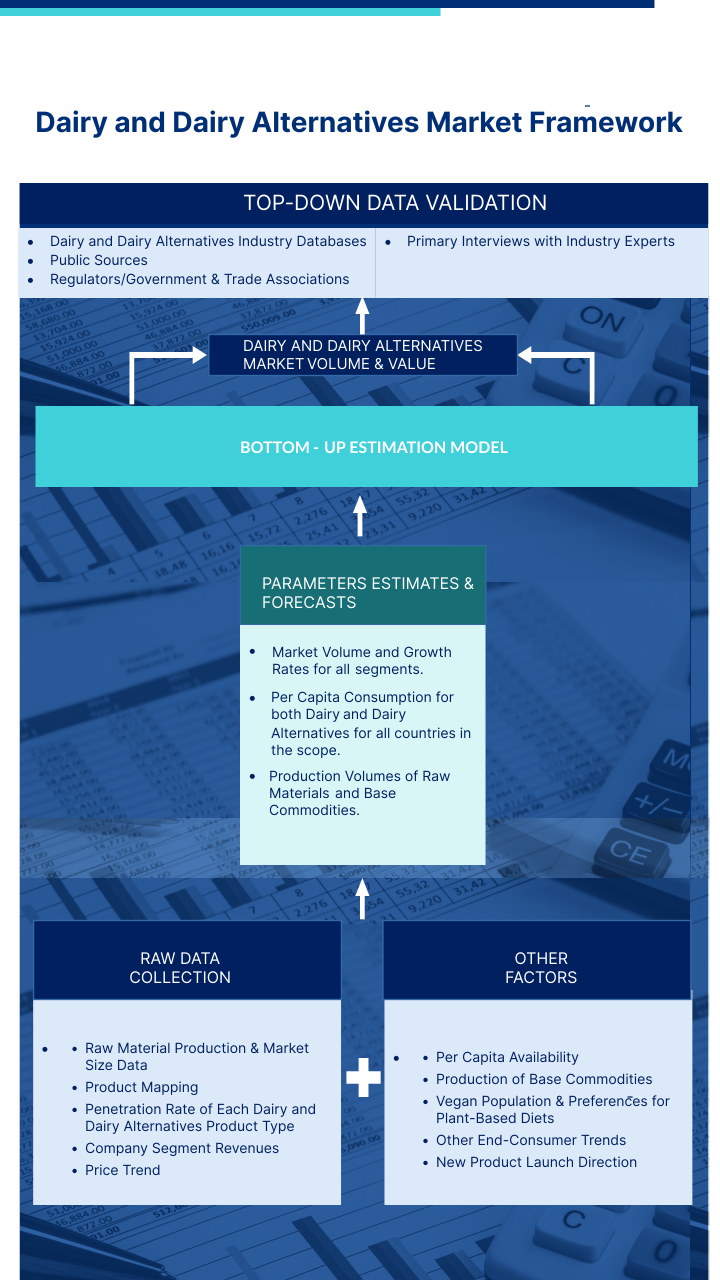
Mordor Intelligence follows a four-step methodology in all our reports.
- Step-1: Identify Key Variables: In order to build a robust forecasting methodology, the variables and factors identified in Step 1 are tested against available historical market numbers. Through an iterative process, the variables required for market forecast are set, and the model is built on the basis of these variables.
- Step-2: Build a Market Model: Market-size estimations for the forecast years are in nominal terms. Inflation is not a part of the pricing, and the average selling price (ASP) is kept constant throughout the forecast period for each country.
- Step-3: Validate and Finalize: In this important step, all market numbers, variables, and analyst calls are validated through an extensive network of primary research experts from the market studied. The respondents are selected across levels and functions to generate a holistic picture of the market studied.
- Step-4: Research Outputs: Syndicated Reports, Custom Consulting Assignments, Databases & Subscription Platforms
Get More Details On Research Methodology
Download PDF