
Market Overview
| Study Period | 2020 - 2031 |
|---|---|
| Forecast Data Period | 2026 - 2031 |
| Base Year Market Size (2025) | 298.77 kilotons |
| Market Volume (2026) | 304.48 kilotons |
| Market Volume (2031) | 334.68 kilotons |
| Growth Rate (2026 - 2031) | 1.91 % |
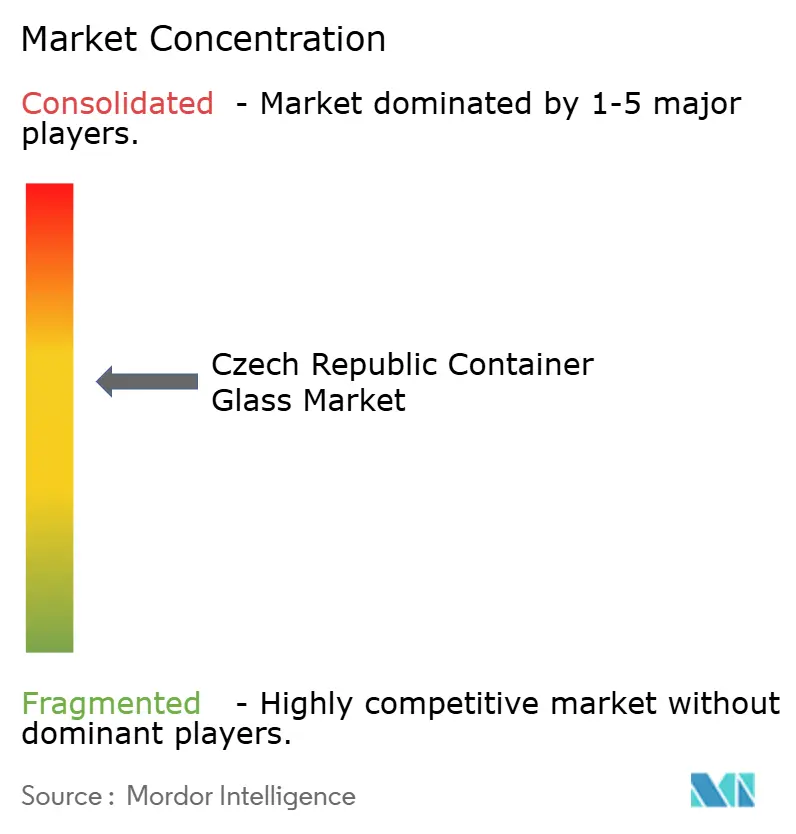
| Market Concentration | Medium |
Major Players *Disclaimer: Major Players sorted in no particular order Image © Mordor Intelligence. Reuse requires attribution under CC BY 4.0. | |
Czech Republic Container Glass Market Analysis by Mordor Intelligence
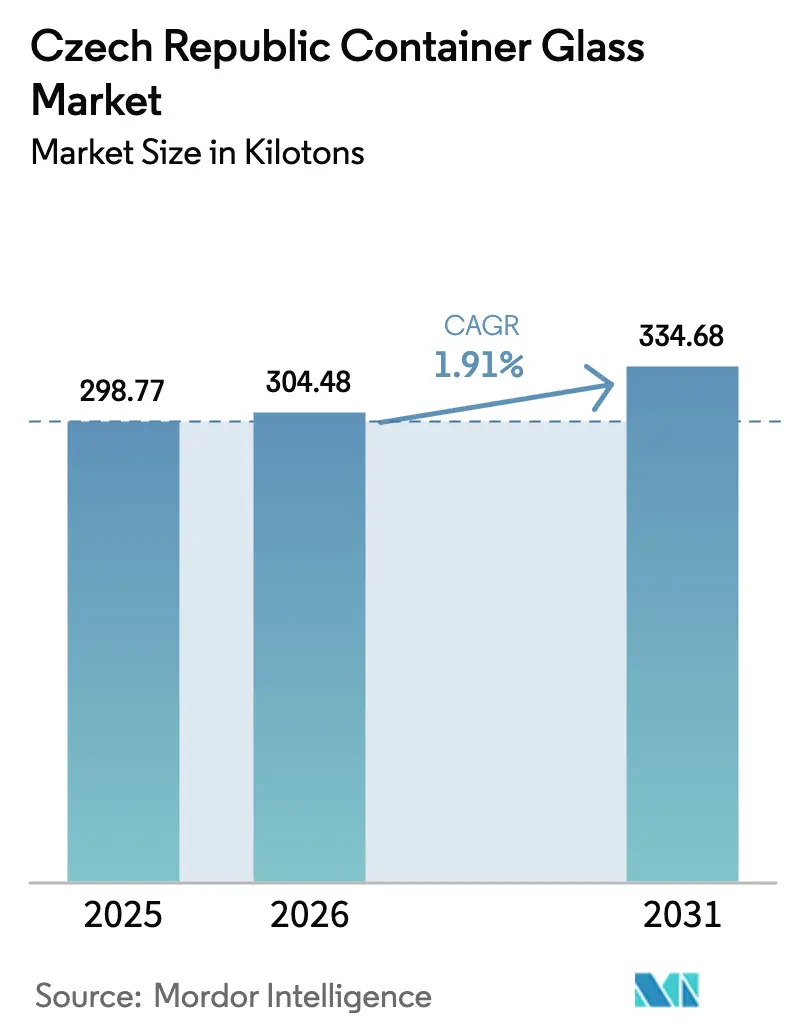
The Czech Republic container glass market size is expected to grow from 298.77 kilotons in 2025 to 304.48 kilotons in 2026 and is forecast to reach 334.68 kilotons by 2031 at 1.91% CAGR over 2026-2031. Consistent domestic beverage demand, a recycling rate of 97.5% for glass packaging, and new premium-product opportunities together anchor the market’s steady trajectory. Brand owners keep favoring glass for its circularity and shelf appeal, while energy-efficiency investments are beginning to lower operating costs for large local producers.[1]Ministry of the Environment, “Ekonomická analýza Plánu odpadového hospodářství 2025–2035,” mzp.gov.cz Even so, competition from lighter metal and plastic formats continues to squeeze margins, motivating manufacturers to differentiate through lightweighting, custom molds, and pharma-grade quality systems. The upcoming deposit return system (DRS) and phased ban on single-use plastics are expected to tilt the packaging mix further toward glass in condiments, food, and niche beverage lines. Competitive pressure intensifies as Western European capacity additions come online, yet Czech plants hold an advantage in proximity to Central European customers and established export channels.
Key Report Takeaways
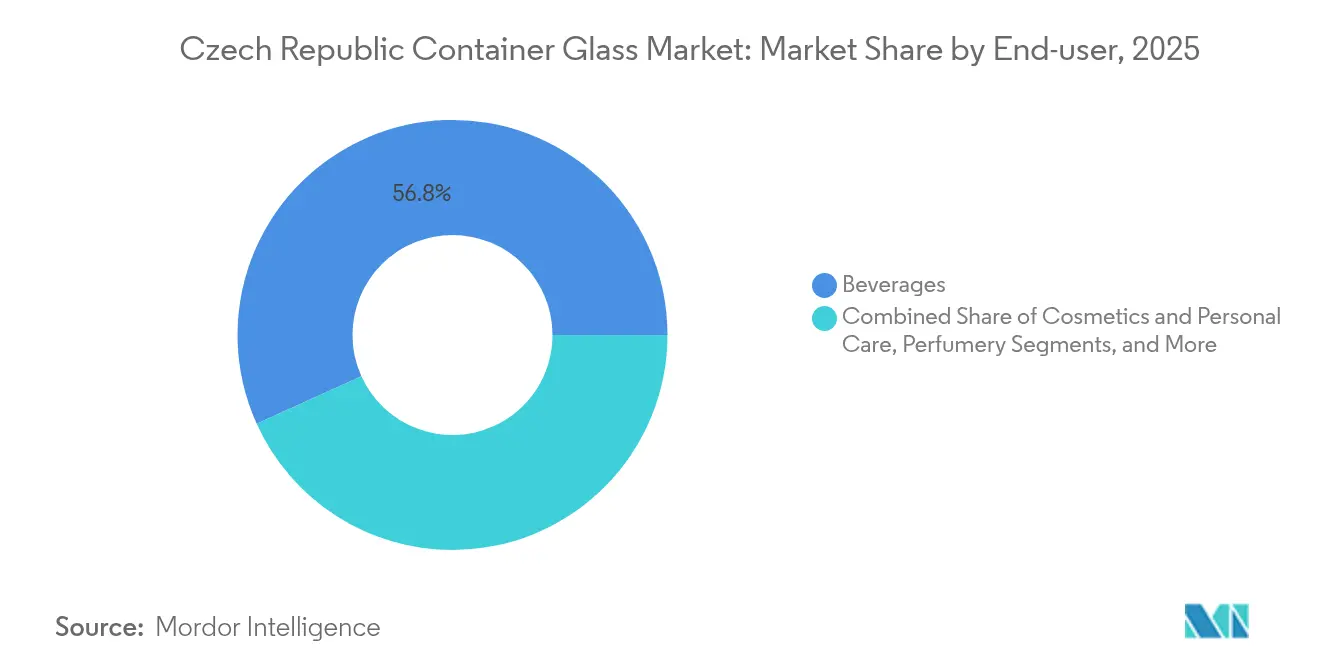
- By end-user, beverages captured 56.77% of the Czech Republic container glass market share in 2025.
- By color, the Czech Republic container glass market size for the amber segment is projected to grow at a 2.92% CAGR between 2026-2031.
Note: Market size and forecast figures in this report are generated using Mordor Intelligence’s proprietary estimation framework, updated with the latest available data and insights as of 2026.
Czech Republic Container Glass Market Trends and Insights
Drivers Impact Analysis*
| Driver | (~) % Impact on CAGR Forecast | Geographic Relevance | Impact Timeline |
|---|---|---|---|
| Eco-Friendly Packaging Demand Rising Rapidly | +0.8% | Global, with strong EU regulatory push | Medium term (2-4 years) |
| Premium Brands Prefer Glass Over Plastic | +0.6% | Czech Republic, Central Europe | Short term (≤ 2 years) |
| Supportive Government Packaging Regulations Help | +0.4% | National, EU-wide influence | Long term (≥ 4 years) |
| Strong Beverage Industry Fuels Glass Demand | +0.5% | Czech Republic, regional export markets | Medium term (2-4 years) |
| Health-Conscious Consumers Choose Safer Glass | +0.3% | Global, urban centers first | Medium term (2-4 years) |
| Custom Designs Boost Brand Shelf Appeal | +0.2% | Czech Republic, premium segments | Short term (≤ 2 years) |
| Source: Mordor Intelligence | |||
Eco-Friendly Packaging Demand Rising Rapidly
EU circular-economy directives banning single-use plastics by 2030 are pushing Czech brand owners to substitute toward glass in food and condiment lines, where producers like ADPACK are scaling output. Municipal waste audits show glass collection costs at CZK 2,018 (USD 97.5) per ton, compared with CZK 9,422 (USD 455.2) for plastics, reinforcing economic incentives for local governments. The Czech Republic’s 97.5% glass material recycling rate underscores infrastructure readiness, and nationwide campaigns targeting plastic-free retail aisles are nudging retailers toward returnable or refillable glass formats. Beverage fillers now run multi-trip glass bottle lines to exploit deposit-loop advantages, and winery cooperatives have begun pooling bottle returns through regional hubs to cut logistics costs. As the DRS takes effect in 2027, glass is poised to retain its position as the most circular rigid-packaging medium in the market.
Premium Brands Prefer Glass Over Plastic
Rising disposable incomes average wages grew 6.7% year over year in Q1 2025 allow Czech shoppers to pay premiums for upscale glass-packaged goods.[2]Czech Statistical Office, “Vývoj ekonomiky České republiky – 1. čtvrtletí 2025,” csu.gov.cz Craft breweries leverage bespoke bottle shapes and deep-colored flint variants to signal authenticity, while cosmetics labels such as Dermacol rely on heavy-base flacons to connote quality in export markets. Retail data shows premium SKUs in 330 ml and 500 ml beer bottles gaining shelf share even as mainstream brands trial lighter PET or can options. On-premise channels further amplify glass positioning, with bars highlighting returnable bottle programs as a sustainability badge. Collectively, these product-upgrade dynamics encourage manufacturers to invest in engraved molds, colored frits, and flexible short-run lines that capture higher margins.
Supportive Government Packaging Regulations Help
Prague’s adoption of EU Packaging and Packaging Waste Regulation standards incorporates mandatory recycled-content targets and eco-modulated fees favoring infinitely recyclable substrates. Glass’s chemical inertness and unlimited recyclability qualify it for lower eco-fee tiers, giving bottlers measurable input-cost advantages versus virgin PET. The National Recovery Plan earmarks funding for furnace electrification and waste-heat recovery, allowing incumbent plants to claim emissions credits while cutting utility bills. These policy levers reinforce a virtuous cycle in which higher recycling quotas secure stable cullet supply and manufacturers monetize energy savings from lower melting temperatures.
Strong Beverage Industry Fuels Glass Demand
The Czech Republic retained its title as Europe’s highest per-capita beer consumer in 2024, exporting USD 385.3 million in beer, up 16.48% year over year, while domestic brewers commissioned additional glass bottling lines for premium lagers. Wine volumes remain lower but are climbing as vintners pursue protected-designation status that favors glass bottle provenance cues. Spirits distillers, buoyed by cocktail-bar culture, increasingly specify engraved flint or matte-black bottles to stand out on back bars. Beverage stability during economic slowdowns, plus export growth to non-EU Asia–Pacific markets, assures base-load demand for Czech glass plants.
Restraints Impact Analysis*
| Restraint | (~) % Impact on CAGR Forecast | Geographic Relevance | Impact Timeline |
|---|---|---|---|
| Plastic and Metal Compete with Glass | -0.7% | Global, cost-sensitive segments | Medium term (2-4 years) |
| Fragility Increases Transport and Handling Costs | -0.4% | Czech Republic, export markets | Short term (≤ 2 years) |
| High Energy Costs Limit New Entrants | -0.5% | Czech Republic, Central Europe | Medium term (2-4 years) |
| Recycling Infrastructure Still Needs Improvement | -0.2% | Regional, rural areas primarily | Long term (≥ 4 years) |
| Source: Mordor Intelligence | |||
Plastic and Metal Compete with Glass
Aluminum cans offer 360-degree decoration, rapid chill, and 76% European recycling rates, capturing share among convenience-driven consumers.[3]Ardagh Metal Packaging, “Annual and Transition Report 20-F,” ardaghmetalpackaging.com Promet SK’s launch of 330 ml and 500 ml can sizes caters directly to craft brewers that once relied solely on glass. PET traction remains in value-priced sauces and ready-to-drink tea, where low bottle weight slashes freight expenses. With several multipack beverage formats migrating to slim cans, glass producers must counter by lightweighting, adopting nucleation technologies for strength, and promoting refillable loops.
High Energy Costs Limit New Entrants
Electricity spot rates eased to EUR 0.17/kWh in December 2024 but remain triple pre-2020 averages, locking in high melt costs for soda-lime glass. Czech corporate income-tax hikes to 21% in 2024 further constrict margins, and forward contracts price in gradual gas-network decarbonization levies. While incumbents tap EU decarbonization grants for oxygen-fueled furnaces and photovoltaic arrays, green-field investors face capex that exceeds regional benchmark returns. Resultant barriers to entry preserve today’s producer roster but slow capacity expansions, thereby tempering supply–side responses to demand spikes.
*Our forecasts treat driver/restraint impacts as directional, not additive. The impact forecasts reflect baseline growth, mix effects, and variable interactions.
Segment Analysis
By End-User: Beverage Stability and an Accelerating Cosmetics Upswing
The beverages segment held 56.77% of 2025 volumes, underpinning 1.74% forecast growth as the Czech Republic container glass market size for beer alone stretches alongside rising export orders. Robust volumes from lager bottlings cushion cyclical swings, and the Czech Republic container glass market share for beverage formats remains well above 50% through 2031. Wine bottlers add incremental gains from terroir-driven marketing that mandates clear provenance, while spirits adopt heavier bottles and embossing to project premium cues in duty-free channels.
Cosmetics and personal care, expanding at a 2.58% CAGR, inject fresh dynamism through glass droppers, jars, and airless pumps. Local labels exploit glass to emphasize clean-beauty claims, and pan-European e-commerce channels broaden addressable audiences. As consumers pivot toward refillable fragrance bottles, specialty flacons with threaded necks attract contract fillers, sharpening volume gains. Food packaging and specialty preserves fill steady niche orders, supported by farmhouse jam and honey artisans who rely on glass for authenticity and extended shelf life. Pharmaceutical uptake, though smaller, secures double-digit growth in injectable vials and Type II bottles as drugmakers qualify Czech lines for EU stainless-steel ampoule replacement programs.


By Color: Flint Versatility Prevails While Amber Surges
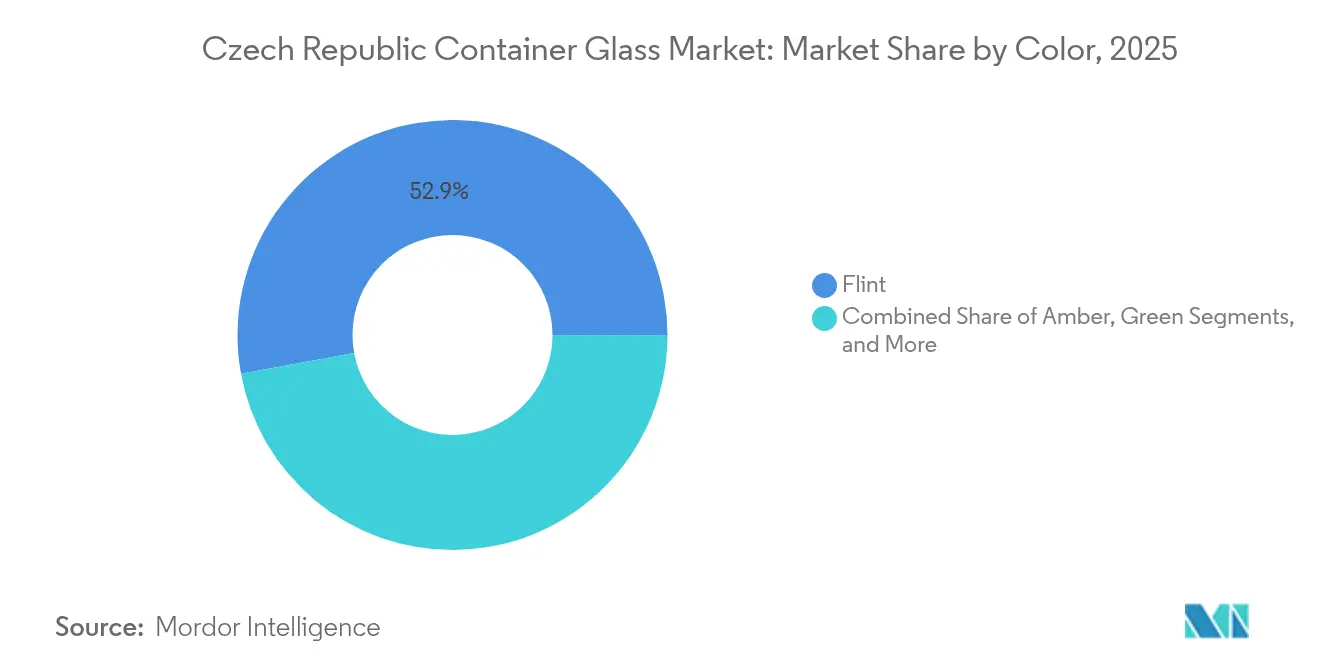
Flint commanded 52.88% of 2025 shipments and is forecast to keep its dominant position thanks to its universal fit across beer, spirits, and condiment shelves. Premium lagers tout the crystal-clear aesthetic to showcase product hue, and cosmetics brands invest in UV-coating additives to mitigate light spoilage without sacrificing transparency. Consequently, the Czech Republic container glass market size tied to flint formulations will remain the core revenue driver for most factories.
Amber glass is on track for a 2.92% CAGR, propelled by pharma’s need for UV-blocking containers and craft brews that seek an artisanal look. Pharmaceutical exports are climbing 10.2% annually, anchoring predictable amber demand, and brewer adoption of retro-style stubby bottles stimulates additional color production runs. Smaller but still relevant, green glass maintains a presence in regional wine lines, while blue and black specialty tones cater to limited-edition cosmetics, essential oils, and liqueurs that command higher average selling prices.
Geography Analysis
The Czech Republic's container glass market is deeply integrated within Central Europe’s packaging network, exporting flint bottles and wide-mouth jars to Germany, Slovakia, and Austria through cost-effective overland routes. In 2024, exports to the United States alone generated USD 64.12 million, underscoring reach beyond the EU’s single market. Domestic volume optimization revolves around two industrial clusters, Moravia in the east and Bohemia in the west, where producers benefit from co-located cullet processors and engineering vendors.
Competition from Western European plants is heating up as Ciner Glass’s EUR 504 million (USD 569.5 million) Belgian facility comes online in 2026, adding 1,300 tons per day to regional supply. Yet Czech makers retain freight-cost edges when serving Central and Eastern Europe, and comparatively lower labor expenses moderate total delivered costs. Government forecasts see GDP growth accelerating to 2.7% in 2025 and holding steady through 2028, fueling domestic demand across food, beverage, and pharma applications.
Cross-border corporate activity signals ongoing consolidation: CANPACK’s sale of Polish glass assets to BA Glass in April 2024 and its planned merger with Giorgi International point to scale-driven strategies. Such transactions can redirect bottle flows and force Czech factories to streamline logistics partnerships. The forthcoming Czech DRS at CZK 4 (USD 0.19) per unit may prompt multinational beverage fillers to harmonize packaging formats across markets, altering regional demand patterns for both one-way and refillable glass.
Regulatory Landscape
Container glass placed on the Czech market is regulated under Act No. 477/2001 Coll. on Packaging. The law sets compliance obligations for packaging materials, including limits such as heavy metals, and requires reporting tied to packaging placed on the market and its recovery. Oversight and implementation sit primarily with the Ministry of the Environment, alongside the Ministry of Industry and Trade, which aligns national rules with EU packaging requirements that inform eco-modulated fee structures and recycling performance expectations.
For glass products outside mainstream packaging, separate rules can apply, including Decree/Directive No. 379/2000 Coll. on marking and conditions for crystal glass nomenclature and labeling. In practice, these frameworks reinforce high-return and recycled-glass use cases already present in the country, while packaging compliance and reporting keep producer responsibility and collection-system participation central to market access for container glass suppliers and brand owners.
Value Chain Analysis
The Czech container glass value chain starts with upstream inputs such as silica sand, soda ash, limestone, and cullet, followed by energy-intensive melting and forming at domestic glassworks. Local production capacity is anchored by manufacturers such as O-I Manufacturing Czech Republic (with plants cited in Nové Sedlo and Dubi) and SKLÁRNY MORAVIA (facility in Usobrno), which supply bottles and jars across beverage, food, and specialty end uses. These producers also coordinate with mold makers, furnace-service providers, and line automation suppliers, which affect yield, changeover speed, and lightweighting.
Downstream, converters and packaging-solution providers add closures, sealing systems, decoration, and packing services before products reach brand owners and fillers (breweries, wineries, spirits, food processors, cosmetics, and pharma packers) for retail and HoReCa channels. Service providers such as ADPACK group complement the chain with packaging development and decoration/closure-related capabilities, while industry bodies like the Asociace sklarskeho a keramickeho prumyslu CR support coordination and representation. Reverse logistics and recycling close the loop through municipal collection and cullet processing, where high glass recovery performance supports cullet availability and furnace batch optimization.
Competitive Landscape
The Czech Republic container glass market consists of a moderate concentration of established manufacturers: Vetropack Moravia Glass, Stoelzle Union, and O-I Czech Republic collectively supply the bulk of domestic demand, while smaller firms such as ADPACK and Galapack serve agile niche orders. Vetropack’s 800 million CZK share capital backs furnace upgrades and lightweighting R&D aimed at shaving glass per bottle without compromising mechanical strength. Stoelzle Union pushes custom embossing and short production runs to secure premium spirits contracts, whereas O-I leverages its global design library for regional brand extensions.
Strategic emphasis centers on energy and emission cuts. Firms invest in oxy-fuel furnace retrofits, batch pre-heaters, and high-recycled-cullet ratios to shrink kilowatt-hour consumption per ton. Sklostroj Turnov’s IS machine controls allow automatic gob weight adjustments, reducing defect rates and easing mold changeovers. Meanwhile, amber and pharma-grade capacity additions safeguard margins in segments less vulnerable to metal and plastic substitution.
Competitive pressure also originates from substitute packaging suppliers. Ardagh Metal Packaging’s 2024 revenue of USD 4.908 billion spotlights the scale of can producers vying for beverage accounts. Glass makers therefore collaborate with brewers and cosmetics firms to develop storytelling around heritage and recyclability, securing brand loyalty despite higher tare weight.
Czech Republic Container Glass Industry Leaders
SKLÁRNY MORAVIA, a.s.
OI Czech Republic as
ADPACK group, s.r.o.
Vetropack Moravia Glass, a. s.
Stoelzle Union s.r.o
- *Disclaimer: Major Players sorted in no particular order

Market Opportunities and Future Outlook
A near-term whitespace for suppliers sits in premium and specialty formats that require customization, short runs, and differentiated decoration, where domestic capabilities are visible. SKLÁRNY MORAVIA highlights bespoke bottles and jars for spirits, food, and pharmacy, including unique shapes produced in series starting from 10,000 units. This production style maps to craft beverages, limited-edition spirits, and niche food preserves that prioritize shelf impact over unit-cost minimization. Adjacent packaging services also create bundle opportunities, with ADPACK group positioning itself around comprehensive packaging development and decoration of closures for European and global export channels, which can reduce complexity for glass suppliers and fillers working on premium SKUs.
Operational efficiency and recycled-content execution remain another opportunity area as energy costs keep furnace economics in focus and brand owners look for measurable circularity. O-I Manufacturing Czech Republics footprint in Nové Sedlo and Dubi, plus the precedent of major capex such as the EUR 40 million furnace reconstruction at Nové Sedlo, supports a pathway for higher-quality and more stable output. It also creates room to optimize cullet-rich recipes and lightweighting programs. With the national deposit return system scheduled for 2027, and the country’s high glass packaging recycling performance already in place, suppliers that can deliver returnable-compatible designs, consistent cullet-based color quality (notably flint and amber), and decoration-ready surfaces are positioned to capture incremental demand from beverage and premium personal-care applications shifting toward circular packaging stories.
Recent Industry Developments
- July 2026: SKLÁRNY MORAVIA a.s. commenced a major full-scale overhaul of its main melting furnace, involving demolition of refractories and installation of new melting structures to improve technical stability. The project tightens production schedules but reinforces long term reliability for premium glass products.
- June 2026: Sklostroj Turnov CZ - The company completed product testing and announced the market launch of its new electronic pusher control system for container glass production lines. The upgrade promises tighter gob weight control and improved line efficiency.
- June 2026: AGC Glass Europe and Saint-Gobain Glass - The companies marked one year of successful continuous operation of their hybrid glass melting furnace at the Barevka plant in Teplice, which demonstrated a 66 percent reduction in fossil fuel consumption. The sustained energy efficiency supports lower operating costs and a smaller carbon footprint in the regional glass sector.


Research Methodology Framework and Report Scope
Market Definition and Coverage
This market covers container glass produced and consumed in the Czech Republic for packaging uses, mainly glass bottles and jars used by beverage, food, personal care, and pharma related customers. Market sizing is expressed in volume terms (kilotons) to reflect real production and consumption movement.
Scope exclusions: Flat glass, fiberglass, laboratory glassware, and other non-container glass products are not counted in this market.
Segmentation Overview
- By End-user
- Beverages
- Alcoholic
- Beer
- Wine
- Spirits
- Other Alcoholic Beverages (Cider and Other Fermented Drinks)
- Non-Alcoholic
- Juices
- Carbonated Drinks (CSDs)
- Dairy Product Based Drinks
- Other Non-Alcoholic Beverages
- Alcoholic
- Food (Jam, Jelly, Marmalades, Honey, Sausages and Condiments, Oil, Pickles)
- Cosmetics and Personal Care
- Pharmaceuticals (excluding Vials and Ampoules)
- Perfumery
- Beverages
- By Color
- Green
- Amber
- Flint
- Other Colors
Data Sources, Market Sizing, and Validation
Desk Research
Desk research is used to build the structure of the model and to anchor it in observable packaging and manufacturing signals in the Czech Republic. We reviewed public statistics and policy indicators that influence glass packaging demand and supply, such as Eurostat manufacturing and trade series, Czech Statistical Office industrial output tables, and environmental reporting from the Ministry of the Environment.
To keep assumptions realistic, we also referred to sources such as the European Commission packaging and waste policy pages, FEVE publications on container glass and recycling, and UN Comtrade for directional trade checks where relevant. Alongside these, company annual reports, investor presentations, and credible press interviews helped verify capacity changes, furnace rebuild timing, and product mix shifts, and then paid subscriptions for company financials and patent databases were used selectively to fill gaps on assets and technology upgrades. The sources listed are illustrative rather than exhaustive, and additional public references were also used for validation and clarification.
Primary Interviews and Surveys
Fieldwork covers packaging producers, beverage and food buyers, pharmaceutical users, distributors, recyclers, and industry specialists operating in the Czech Republic. Interviews and surveys clarify container demand, average selling prices, purchasing patterns, and recycling flows, while also helping reconcile secondary figures that do not align with reported market conditions.
Distribution of primary research fieldwork respondents
| Company type | Respondent position |
|---|---|
| Top tier: 28% | CXOs: 18% |
| Mid tier: 47% | Functional/Unit leaders: 29% |
| Smaller Players: 25% | Managers: 53% |
Market-Sizing & Forecasting
Sizing starts from a top-down reconstruction of container glass volume by linking Czech packaging demand signals with production and trade flows, and then translating those into kilotons for the in-scope container formats. Where the public series is not fully specific, the model is corrected using selective bottom-up checks such as sampled producer capacity and utilization, typical yield loss assumptions, and channel checks on key end-use pull.
Inputs used in the model include beverage fill volumes and packaging mix direction, cullet share and collection performance (because it affects production economics and output stability), furnace rebuild and restart schedules, import and export directionality for bottles and jars, and lightweighting trends that can reduce tons even when the number of containers is stable. Forecasting is done using scenario analysis supported by multivariate regression, where the main drivers are linked to consumption indicators and operating constraints, and then refined using what interviewees expect for rebuild cycles and customer conversions. If a bottom-up datapoint is missing for a smaller pocket of demand, we bridge it using proxy ratios from comparable end uses and then re-check totals against the overall demand pool.
Data Validation & Update Cycle
Outputs are validated through multiple checks so the final numbers remain traceable to real-world signals. We compare modeled kilotons against independent indicators like reported recycling performance, trade balance direction, and known plant downtime, and then investigate any sharp variance before sign-off.
A second analyst review is completed to re-check assumptions, unit conversions, and any step where a proxy was applied, and re-contacts are triggered if key inputs like rebuild timing or end-use pull change materially. Reports refresh annually, with interim updates for material events, and before delivery an analyst performs a fresh pass so clients receive the latest updated view.
Mordor Intelligence's Czech Republic Container Glass Market Sizing Compared With Other Published Estimates
Published market sizes can differ even when the topic looks identical, because the unit of measurement, included product set, and the treatment of imports and exports are not consistent across sources. Differences also appear when one publisher uses revenue proxies, while another sticks to production and consumption signals, and these choices can shift the final number.
The main gap comes from sources that blend total glass packaging with container glass only, where Mordor Intelligence keeps the scope limited to Czech Republic container glass volumes (kilotons) and does not add adjacent glass products like flat glass or fiberglass.
Benchmark comparison
| Source | Market Size | Gaps in Research Methodology |
|---|---|---|
| Mordor Intelligence | USD 298.77 M (2025) | |
| Industry Association A | USD 320.00 M (2025) | Often aggregates broader glass packaging activity and can miss a clean split between bottles and jars used domestically versus export-linked output, which can lift the apparent market size. |
| Trade Journal B | USD 270.00 M (2025) | May apply conservative utilization and lightweighting assumptions without consistent checks against furnace rebuild schedules and downtime, which can understate tonnage in stable operating years. |
Overall, the spread is mostly explained by category inclusions and by how operating rates are treated year to year. By tying the total back to production, trade direction, and rebuild-cycle validation, the final view stays transparent and repeatable for decision-making.


Key Questions Answered in the Report
How fast is the Czech Republic container glass market expected to grow between 2026 and 2031?
Volume is projected to rise from 304.48 kilotons to 334.68 kilotons at a 1.91% CAGR.
Which end-user category contributes the most glass demand?
Beverages account for 56.77% of 2025 shipments, supported by strong beer and growing wine volumes.
Why is amber glass gaining popularity?
Pharma and craft beverage producers value amber’s UV protection, driving a 2.92% CAGR for the color segment.
What upcoming regulation could boost glass packaging adoption?
The deposit return system scheduled for 2027 and the ongoing phase-out of single-use plastics both favor reusable or recyclable glass.
How are energy costs influencing production strategies?
High electricity prices encourage incumbents to retrofit furnaces with oxy-fuel or electric melting technology to reduce kilowatt-hour consumption per ton.
Which new capacity addition will affect regional supply?
Ciner Glass’s 1,300 tons-per-day Belgian plant, scheduled for Q2 2026, will increase competition in Western and Central Europe.
Page last updated on:


 Your data is secure and never sold or shared.


