
Customer Information System Market Size and Share
Market Overview
| Study Period | 2020 - 2031 |
|---|---|
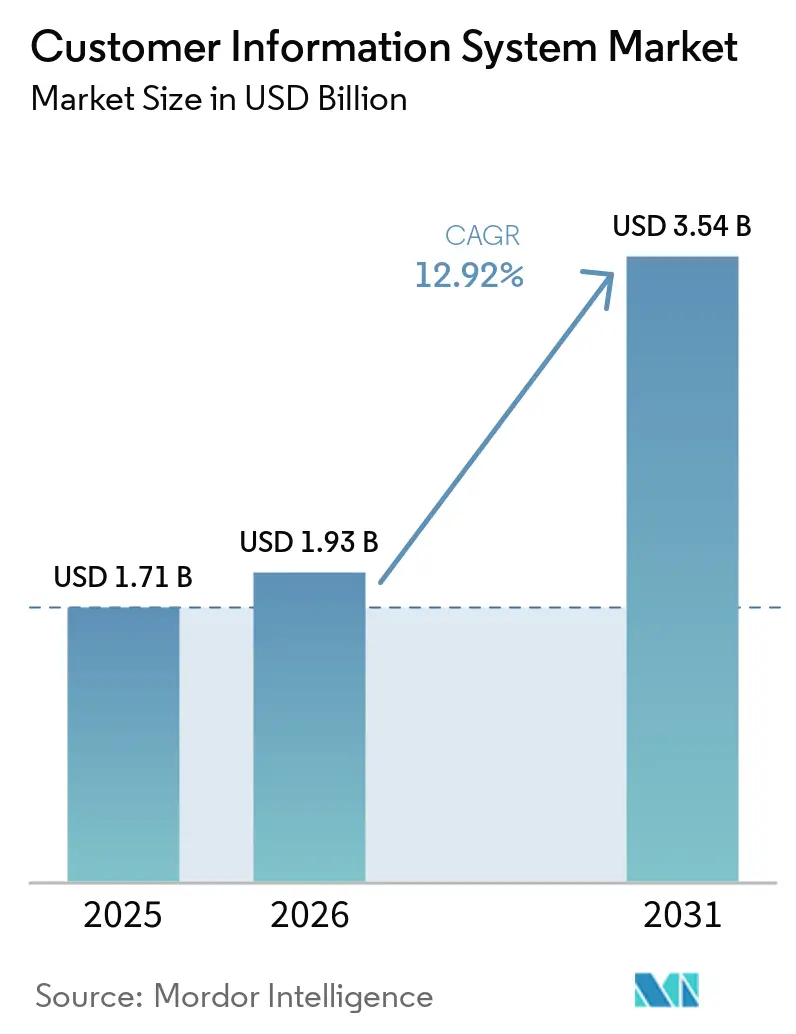
| Market Size (2026) | USD 1.93 Billion |
| Market Size (2031) | USD 3.54 Billion |
| Growth Rate (2026 - 2031) | 12.92 % |
| Fastest Growing Market | Asia Pacific |
| Largest Market | North America |
| Market Concentration | Medium |
Major Players *Disclaimer: Major Players sorted in no particular order Image © Mordor Intelligence. Reuse requires attribution under CC BY 4.0. | |
Customer Information System Market Analysis by Mordor Intelligence
The customer information system market size is expected to grow from USD 1.71 billion in 2025 to USD 1.93 billion in 2026 and is forecast to reach USD 3.54 billion by 2031 at 12.92% CAGR over 2026-2031. Demand is rising because utilities view CIS platforms as the digital core that links metering, billing, and customer engagement. Cloud-native architectures are changing buying behavior, and cloud deployment is projected to expand 18.6% annually by 2031, noticeably faster than the overall customer information system market. Utilities are also deploying CIS to support real-time analytics for distributed energy resources, prepaid billing, and new regulatory mandates on billing accuracy.[1] This evolution is occurring in parallel with cost-conscious migration strategies designed to move away from heavily customized, on-premises software without jeopardizing service continuity.
Key Report Takeaways
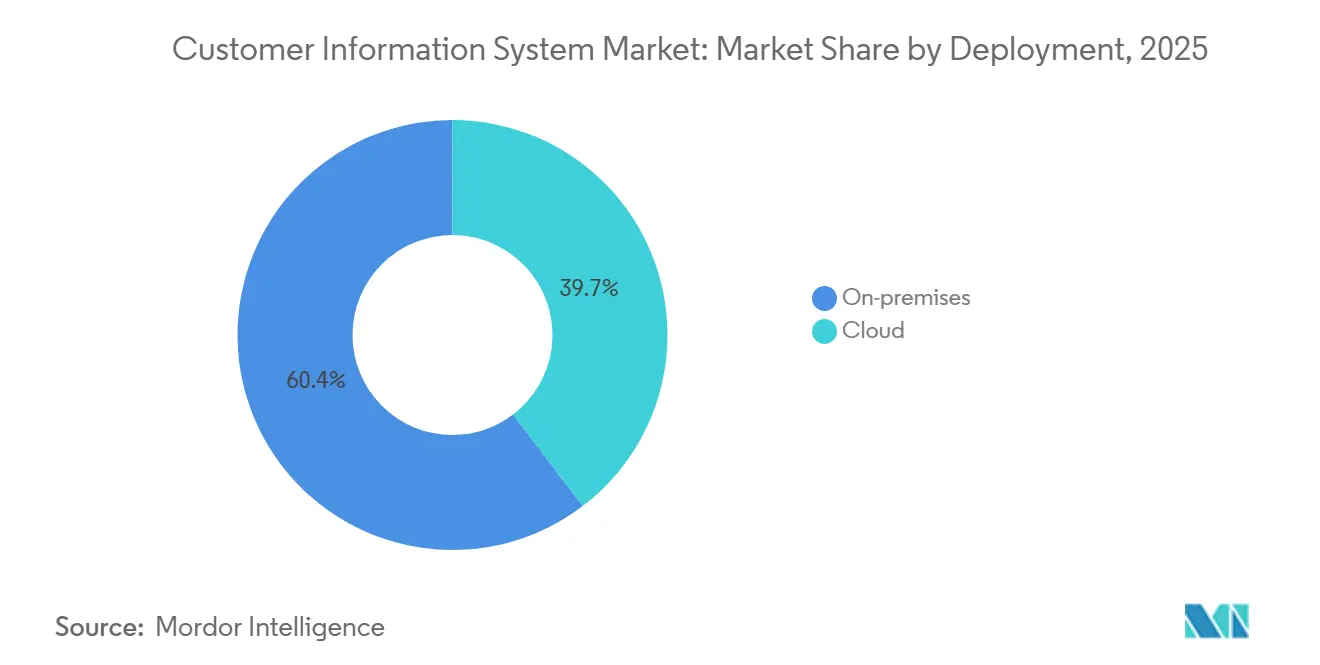
- By deployment, on-premises installations held 60.35% of customer information system market share in 2025, yet cloud models are projected to clock an 18.05% CAGR through 2031.
- By component, solutions commanded 69.85% revenue share of the customer information system market size in 2025, whereas services are forecast to expand at a 14.52% CAGR to 2031.
- By end-user, the energy and utilities segment accounted for 44.78% of the customer information system market size in 2025; retail CRM is expected to post the fastest 16.11% CAGR between 2026-2031.
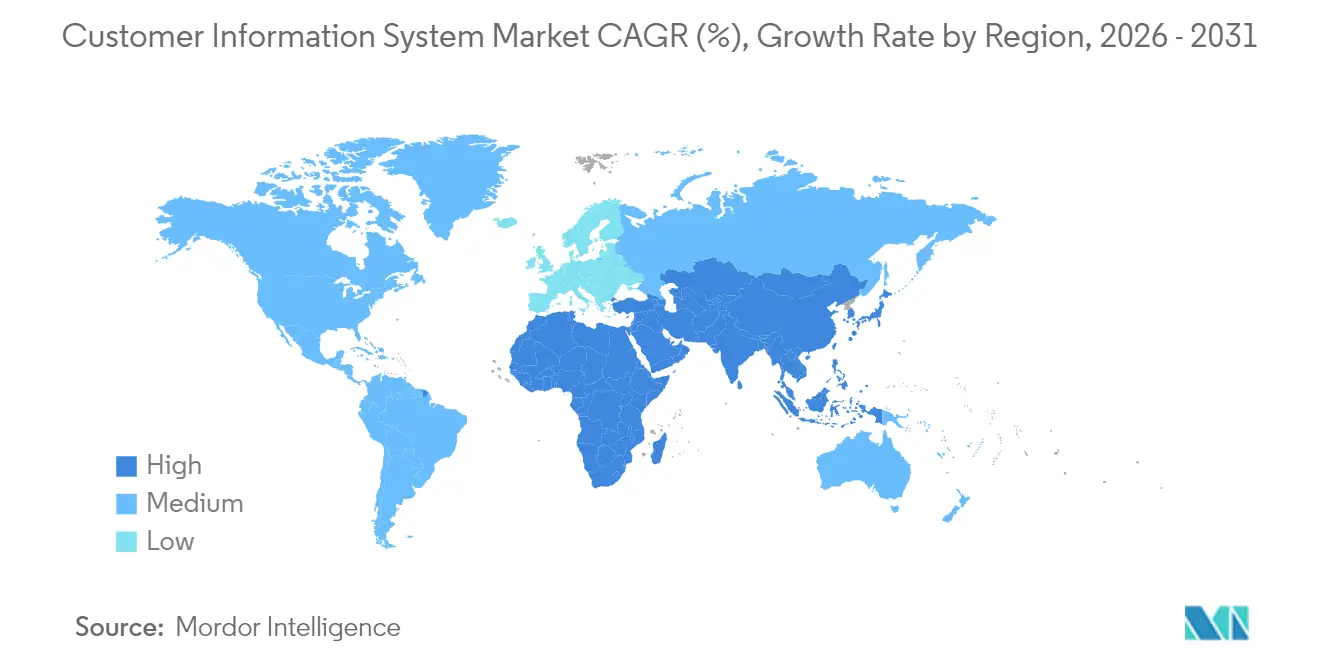
- By geography, North America led with 34.22% of customer information system market share in 2025, while Asia-Pacific is set to grow at a 15.23% CAGR to 2031.
Note: Market size and forecast figures in this report are generated using Mordor Intelligence’s proprietary estimation framework, updated with the latest available data and insights as of 2026.
Market Trends and Insights
Drivers Impact Analysis of Customer Information System Market*
| Driver | (~) % Impact on CAGR Forecast | Geographic Relevance | Impact Timeline |
|---|---|---|---|
| Digital transformation initiatives by utilities | +3.50% | North America, spillover to Europe | Medium term (2-4 years) |
| Real-time customer analytics tied to DER growth | +2.80% | Global, early moves in North America and Europe | Long term (≥4 years) |
| Regulatory mandates for billing accuracy | +2.10% | Europe, influence in North America | Medium term (2-4 years) |
| CIS–AMI integration momentum | +1.90% | Asia-Pacific, spillover to MEA | Medium term (2-4 years) |
| Cloud-native CIS adoption by mid-sized utilities | +1.40% | Global, stronger in North America | Short term (≤2 years) |
| Flexible and prepaid billing in emerging markets | +1.20% | South America, Asia-Pacific, MEA | Medium term (2-4 years) |
| Source: Mordor Intelligence | |||
Digital Transformation Initiatives by Utilities
North American utilities are embedding CIS modernization into broader digital transformation roadmaps to lift customer experience and unlock operational efficiencies. Enhanced self-service portals, integrated workflow engines, and cross-channel communications enable utilities to orchestrate data, assets, and people in real time. Program success is evident in cases where utilities simultaneously raised renewable penetration and customer satisfaction, showing that a next-generation CIS can underpin both sustainability and service goals. Budget allocations increasingly favor modular upgrades that replace billing engines first, then layer on analytics and mobility features to spread capital costs while accelerating benefits.
Real-Time Customer Analytics Demand with DER Growth
As rooftop solar, battery storage, and electric vehicles proliferate, utilities need minute-level insights to balance the grid and engage prosumers. Modern CIS platforms process smart-meter streams, match them to tariff engines, and feed demand-response algorithms that create value for both the grid and end customers. Real-time settlement also underpins new compensation schemes for virtual power plants, tying CIS enrollment records to wholesale-market participation. Utilities adopting AI-enabled CIS modules report tangible improvements in call-center efficiency and lower truck rolls, demonstrating how analytics deliver bottom-line results while meeting rising consumer expectations.
Regulatory Mandates for Billing Accuracy
European directives now obligate utilities to issue timely, transparent bills and disclose consumption data each year. Compliance requirements trigger CIS upgrades capable of handling interval data, complex tariffs, and instant payment flows. Utilities must also reconcile regulatory asset bases and rate-of-return calculations inside billing engines to meet auditing standards.[2] The drive for accuracy expands CIS functionality from invoice creation to full revenue-assurance analytics, ensuring discrepancies are flagged before bills reach consumers. Implementation timelines align with upcoming reporting deadlines, making CIS projects a regulatory priority across the continent.
CIS-AMI Integration Momentum
Rapid smart-meter rollouts across Asia are pressuring utilities to couple AMI data with CIS workflows. Successful integrations route multi-protocol meter reads through edge gateways and IoT hubs before landing in the CIS for validation and billing. Utilities using unified CIS-AMI stacks can detect tampering faster, reduce technical losses, and offer usage alerts via mobile apps.[3] Countries tackling high aggregate technical and commercial losses view integrated CIS as a strategic asset, helping utilities regain revenue while improving service reliability.
Restraints Impact Analysis of Customer Information System Market*
| Restraint | (~) % Impact on CAGR Forecast | Geographic Relevance | Impact Timeline |
|---|---|---|---|
| High legacy migration costs for large utilities | -2.30% | Global, higher in North America and Europe | Medium term (2-4 years) |
| Data privacy and sovereignty concerns | -1.80% | Global, strongest in Europe | Long term (≥4 years) |
| Utility-specific IT-talent shortage | -1.20% | Asia-Pacific, MEA, South America | Medium term (2-4 years) |
| Vendor lock-in risks limiting flexibility | -0.90% | Global | Long term (≥4 years) |
| Source: Mordor Intelligence | |||
High Legacy Migration Costs for Large Utilities
Replacing decades-old, heavily customized CIS installations demands parallel operations, rigorous data cleansing, and complex system integration. Capital programs exceeding USD 200 million highlight the financial hurdle; operating budgets also rise due to dual-running environments during cut-overs. Large utilities therefore phase projects, starting with low-risk billing territories while building reusable migration runbooks to reduce later waves’ costs.
Data Privacy and Sovereignty Concerns
Utilities managing critical infrastructure must protect personal and consumption data under an expanding patchwork of regional laws. Requirements for data residency, encryption, and sovereign-cloud hosting complicate multinational CIS rollouts, elongating vendor evaluations and increasing legal costs.[4] Providers respond with regional data centers, configurable retention policies, and audit-ready security controls, but utilities still face ongoing obligations as regulations evolve.
*Our forecasts treat driver/restraint impacts as directional, not additive. The impact forecasts reflect baseline growth, mix effects, and variable interactions.
Customer Information System Market Segment Analysis
By Deployment:
Cloud adoption outpaces on-premises relianceOn-premises systems retained 60.35% of customer information system market share in 2025 as many large utilities value direct control and established integrations. Yet the customer information system market size for cloud deployments is projected to surge at an 18.05% CAGR, reflecting mid-sized utilities’ drive for agility and cost transparency. Utilities linking cloud CIS with modern CRM and workforce-management tools report faster product launches and fewer unplanned outages, reinforcing cloud’s business case.
Accelerated cloud take-up stems from elastic processing for bill calculations, reduced hardware refresh cycles, and embedded disaster recovery. Financial accounting rules letting cloud fees qualify as operating expense further sweeten adoption, especially in rate-regulated markets where capital budgets are tightly scrutinized. Utilities aiming to future-proof investments increasingly pursue hybrid models-maintaining critical data on-premises while shifting non-sensitive workloads to the cloud-to balance sovereignty and innovation.
By Component:
Services momentum grows amid solution dominanceSolutions captured 69.85% of customer information system market revenue in 2025 and remain the foundation of billing, payment, and customer-engagement processes. Vendors are embedding AI chatbots and advanced analytics to personalize interactions, automate reconciliation, and streamline rate design. The customer information system industry nevertheless sees services rising 14.52% per year as utilities seek migration, integration, and managed-service expertise.
Skills shortages spur outsourcing of data conversion, security hardening, and compliance reporting, giving rise to multi-year managed-service contracts that guarantee service-level outcomes. Advisory firms specializing in CIS-AMI convergence design integration blueprints that limit risk and accelerate payback. As customer expectations shift toward digital self-service, utilities increasingly rely on external partners for continuous UX enhancements, refreshing portals every few months instead of multi-year cycles.
By End-User:
Utilities retain top share while retail CRM acceleratesEnergy and utilities represented 44.78% of customer information system market size in 2025 due to complex tariff structures, regulated billing rules, and the need to process vast smart-meter datasets. Electricity distribution utilities dominate spending, but water utilities now add CIS modules that track consumption anomalies and automate leak notifications.
Retailers are expected to post a 16.11% CAGR to 2031, making them the fastest-growing users of CIS-style CRM capabilities. Omni-channel commerce demands single views of customer transactions, prompting retailers to adopt CIS engines that synchronize product, inventory, and promotion data in near real time. Telecommunications and BFSI organizations trail but adopt similar functionality for usage-based charging and micro-service bundling.
Geography Analysis
North America Customer Information System Market
North America accounted for 34.22% of customer information system market revenue in 2025. Early AMI penetration coupled with stringent billing-accuracy mandates sustains ongoing investment, while virtual power plant pilots require CIS enrollment workflows and near-real-time settlement. Utilities in the region actively integrate chatbots and self-service apps to deflect calls and raise customer-satisfaction metrics. High migration costs and privacy obligations temper project pace, leading many operators to adopt phased cut-over plans.
APAC Customer Information System Market
Asia-Pacific is forecast to expand at a 15.23% CAGR, the fastest of any region, as utilities pair mass smart-meter rollouts with CIS upgrades that support time-of-use tariffs and prepaid functions. National programs to curb technical and commercial losses make meter-to-cash modernization a priority, while rising middle-class expectations boost demand for digital service channels. Regional talent shortages encourage outsourcing, creating opportunities for system integrators offering turnkey CIS-AMI solutions.
EMEA and South America Customer Information System Market
Europe’s customer information system market is shaped by regulation that compels transparent invoicing, instant payments, and rigorous cybersecurity. Utilities align CIS investment schedules with annual reporting deadlines to avoid penalties. Demand-side response directives encourage flexible billing, necessitating engines that manage granular time-block tariffs. Meanwhile, emerging economies in South America and the Middle East and Africa deploy CIS to support prepaid electricity and water programs, improving revenue collection and broadening access.
Europe Customer Information System Market
Europe represents a significant market for customer information systems, demonstrating robust growth with approximately 9.85% CAGR in 2025. The United Kingdom, Germany, France, and Spain are the key countries driving regional market growth. The region's market is characterized by increasing environmental concerns and favorable government policies supporting digital transformation initiatives. European utilities are increasingly focusing on modernizing their customer operations through advanced CIS solutions that combine billing, customer care, and uniform metering with the advantages of a common database and technological stack. The market is witnessing a significant shift towards cloud-based solutions, with many vendors developing mobile applications to offer energy insights and enhanced customer engagement. The region's strong emphasis on data privacy and security regulations has led to the development of more sophisticated and compliant CIS solutions. The integration of renewable energy sources and smart grid technologies has created new opportunities for CIS providers to develop more advanced and flexible solutions.
China and India Customer Information System Market
The Asia Pacific region is emerging as a high-growth market for customer information systems, with a projected CAGR of approximately 13.92% from 2026 to 2031. The market dynamics in this region are shaped by rapid urbanization, population growth, and increasing investments in utility infrastructure modernization. China and India are the primary growth drivers, with both countries making significant investments in smart grid technologies and digital transformation initiatives. The region is witnessing a notable shift from legacy systems to advanced CIS solutions, particularly in the electricity and power supply sectors. The increasing adoption of smart meters and advanced metering infrastructure is creating new opportunities for CIS solution providers. The market is also benefiting from various government initiatives promoting digital transformation and smart city development. The region's utilities are increasingly focusing on improving customer experience through automated billing processes and enhanced customer engagement platforms. The growing emphasis on reducing transmission and distribution losses is driving the adoption of sophisticated CIS solutions.
LATAM Customer Information System Market
The Latin American market for customer information systems is experiencing steady growth, driven by the increasing need to modernize aging power grid infrastructure and enhance customer service capabilities. The region's utilities are focusing on implementing advanced and automated systems to optimize their billing capabilities, manage distribution networks in real-time, and provide consumers with enhanced data accessibility. The market is characterized by growing investments in smart city projects and digital transformation initiatives across major economies. Governments across the region are allocating budgets to modernize existing cities and establish new smart city projects to improve the overall economy. The support from governments is also driving the adoption of technologies supporting the operations of smart grids and systems. The region's utilities are increasingly recognizing the importance of digital engagement channels and customer self-service platforms to improve operational efficiency and customer satisfaction.
MEA Customer Information System Market
The Middle East and Africa region presents unique opportunities for customer information system providers, driven by the increasing focus on energy conservation and expanding deployment of smart grid technologies. The Middle Eastern region, largely an oil-based economy, is witnessing significant investments in commercial, residential, and industrial projects that require energy-efficient and accurate meter solutions. Government initiatives and policies connected with smart meter deployment are creating favorable conditions for market growth. In Africa, the market is driven by the growing need to improve utility infrastructure and reduce non-technical losses. The region is witnessing increasing adoption of smart metering solutions, particularly in urban areas. The market is also benefiting from various digital transformation initiatives aimed at improving utility operations and customer service delivery. The integration of renewable energy sources and the need for efficient billing systems are creating new opportunities for CIS solution providers in the region.
Regulatory Landscape
Customer information systems operate under overlapping utility billing rules, data protection obligations, and critical-infrastructure cybersecurity requirements that vary by region and industry. In Europe, mandated transparency and timeliness in billing and customer consumption disclosures continue to drive CIS functionality upgrades toward interval-data handling, auditability, and revenue-assurance controls. The EU NIS2 Directive (transposition deadline: October 17, 2024) tightens incident reporting and risk-management expectations for essential entities such as telecommunications, shaping CIS security architecture and vendor due diligence.
Security and resilience requirements are also being operationalized through national guidance and international standards. In the United Kingdom, the Telecommunications Security Code of Practice 2026 (version 1.1) was published in July 2026 under the Telecommunications (Security) Act 2021, reinforcing controls that shape how customer data systems are secured and managed for in-scope providers. At the standards layer, ITU-T recommendations approved in 2025, including M.3111.1 (protocol-neutral interfaces between telecom operation systems and e-commerce platforms) and M.3389 (AI-based customer experience management requirements), alongside F.748.71 (December 2025, AI model generalization architecture for intelligent customer service), provide a reference point for interoperable and AI-enabled customer operations that increasingly intersect with CIS roadmaps.
Competitive Landscape
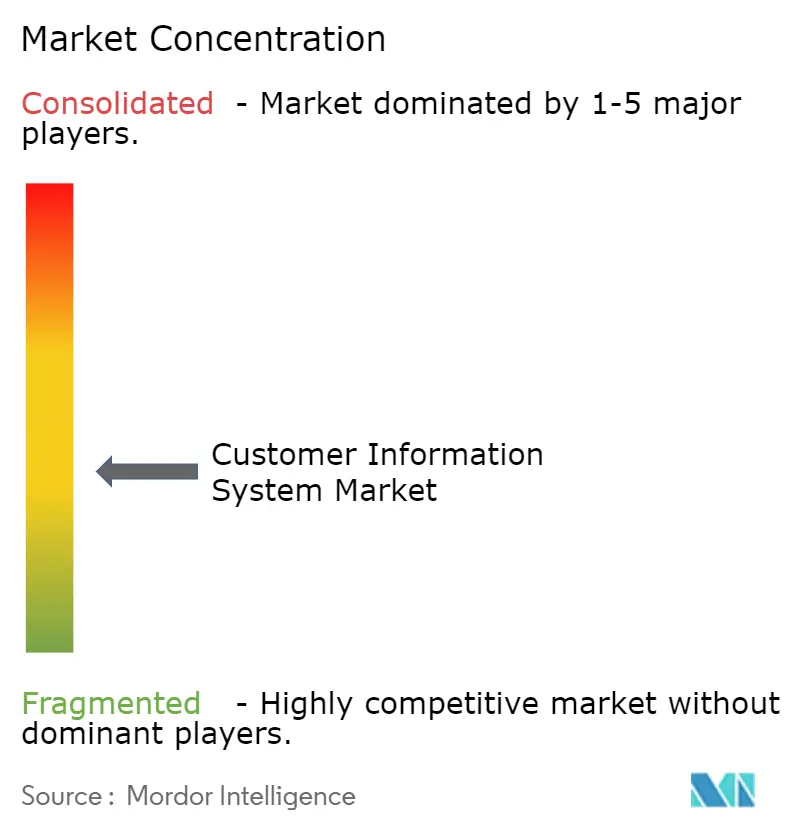
The customer information system market features moderate concentration: global enterprise vendors such as Oracle, SAP, and IBM compete with utility-focused specialists including Fluentgrid, Gentrack, Hansen Technologies, Vertex One, and Open Smartflex. Enterprise providers leverage deep R&D budgets and adjacent ERP suites, appealing to large multi-service utilities seeking platform consistency. Specialized vendors win projects by offering configurable templates tailored to electric, water, and gas workflows, reducing deployment times for mid-sized operators.
Strategic differentiation now centers on cloud readiness, AI-driven insights, and composable architectures that avoid vendor lock-in. Vendors roll out micro-services and open APIs so utilities can swap modules without rewriting core code. Flexible pricing models based on customer count or transaction volume align vendor revenue with utility growth, further influencing selection criteria.
Utilities evaluating suppliers weigh product maturity, cybersecurity certifications, and demonstrated migration frameworks. Reference projects involving large meter counts, successful legacy data conversion, and proven regulatory compliance often tilt awards. As distributed energy resources proliferate, suppliers able to reconcile behind-the-meter generation in billing engines gain further competitive edge.
Customer Information System Industry Leaders
-
Oracle Corporation
-
IBM Corporation
-
SAP SE
-
Gentrack Group Limited
-
Itineris NV
- *Disclaimer: Major Players sorted in no particular order
Customer Information System Market Companies Covered in this Report
- Oracle Corporation
- Fluentgrid Limited
- IBM Corporation
- Wipro Limited
- Cayenta CIS (Harris Computer)
- Gentrack Group Limited
- SAP SE
- Itineris NV
- HydroComp Enterprises Ltd
- Open International LLC
- Hansen Technologies
- Vertex One
- Advanced Utility Systems
- National Information Solutions Co-op (NISC)
- OpenText Corporation
- Milestone Utility Services
- Salesforce Inc.
- SilverBlaze Solutions
- Cayenta
- Open Smartflex
Market Opportunities and Future Outlook
A near-term modernization window is opening around replacement cycles and vendor platform transitions, particularly where utilities and service providers are unwinding heavily customized legacy stacks. One concrete catalyst is the approaching maintenance milestones for SAP IS-U on ECC (mainstream maintenance ending in 2027, extended maintenance in 2030), which places meter-to-cash, billing, and customer-service organizations in a planning position for S/4HANA Utilities paths and alternative CIS platforms, alongside phased migration services. This environment supports offerings that reduce cutover risk, support hybrid data residency, and provide reusable migration runbooks for multi-territory utilities facing high legacy conversion costs.
Product and implementation evidence also points to broader adoption of AI-assisted customer operations and enterprise-wide service platforms that sit adjacent to, or integrate tightly with, CIS. In January 2026, EnBW Energie Baden-Wuerttemberg AG selected BSI Software for a company-wide service platform rollout, illustrating demand for unified customer service layers that consolidate interaction histories, workflows, and service requests across business lines. In July 2026, Microsoft introduced agentic AI capabilities in public preview for Dynamics 365 Customer Insights, expanding the toolkit for automating journey design and outreach optimization that CIS vendors and systems integrators can embed into customer engagement and revenue-assurance processes. Outside utilities, financial services adoption continues to validate CIS-adjacent CRM modernization at scale, such as Alpha Bank Cyprus completing a Salesforce Financial Services Cloud implementation that became fully operational on April 30, 2026, reinforcing opportunities for configurable, cloud-delivered customer master data and orchestration that connect to billing and servicing systems.
Recent Industry Developments in Customer Information System Market
- May 2026: The City of Dallas went live on Itineris UMAX Customer Information System (CIS), marking a completed cutover to a modern meter-to-cash platform. A live deployment at a large municipal utility highlights the shift from legacy CIS estates to configurable platforms with standardized processes and integration patterns. The milestone also reinforces demand for vendor and systems-integrator services around data conversion, testing, and operational stabilization.
- May 2025: Utility Warehouse partnered with Gentrack to evolve its energy platform. The agreement underscores ongoing investment in customer and billing platform upgrades among competitive energy retailers that must manage product agility, digital service journeys, and industry compliance requirements. It also supports the role of specialist CIS vendors in modernizing customer operations without relying solely on general-purpose enterprise suites.
- August 2024: The Water Authority of Fiji completed a deployment and cloud migration of Gentrack on AWS as part of a business transformation program. The project signals that cloud-hosted CIS models are being adopted beyond North America and Europe, including by utilities targeting faster upgrades and improved scalability. It also strengthens the case for packaged cloud accelerators and managed services in emerging-market utility modernization.
Customer Information System Market Report Scope and Research Methodology
Market Definition and Coverage
This market covers paid software and related services used to capture, store, manage, and use customer account information across customer-facing and billing-related workflows, including deployment on cloud or on-premises environments.
Scope exclusions: We exclude generic CRM suites and billing-only products when they are sold without a CIS layer that maintains the customer master and related operating workflows.
Segments Covered in This Report
- By Deployment
- Cloud
- On-Premises
- By Component
- Solutions
- Services
- By End-User
- CRM
- BFSI
- Retail
- Telecommunications
- CIS
- Water and Wastewater Management
- Energy and Utilities
- Other End-Users
- CRM
- By Geography
- North America
- United States
- Canada
- Mexico
- South America
- Brazil
- Argentina
- Chile
- Peru
- Rest of South America
- Europe
- Germany
- United Kingdom
- France
- Italy
- Spain
- Rest of Europe
- Asia-Pacific
- China
- Japan
- South Korea
- India
- Australia
- New Zealand
- Rest of Asia-Pacific
- Middle East
- United Arab Emirates
- Saudi Arabia
- Turkey
- Rest of Middle East
- Africa
- South Africa
- Rest of Africa
- North America
Data Sources, Market Sizing, and Validation
Desk Research
Desk research was used to map the demand pool and to anchor assumptions on utility operations, digital spending patterns, and cloud adoption. We reviewed public utility filings and annual reports, government energy and water statistics, and regulatory documents that shape customer data handling and billing practices. Sources also included standards and policy references from organizations such as the U.S. Energy Information Administration, the U.S. Environmental Protection Agency, Eurostat, and the International Energy Agency, followed by supporting reads from peer-reviewed journals that discuss utility IT modernization.
To translate the context into a sizing model, we also used materials such as product documentation, public pricing cues, case studies, and implementation partner perspectives shared in reputable press and association websites. Select paid subscriptions were used only for company financials and for shipment-level import and export checks where relevant to validate large system deployment activity. This list is illustrative, and many other public sources were consulted to collect data points, validate assumptions, and clarify gaps.
Primary Interviews and Surveys
Primary work focused on validating what buyers actually purchase under a CIS program and how pricing behaves across cloud and on-premises delivery. We spoke with utilities and other CIS users, system integrators, and solution teams, and then we rechecked assumptions on implementation timelines, recurring support intensity, and migration cadence across the Americas, EMEA, and APAC so regional adoption patterns did not get averaged out.
Distribution of primary research fieldwork respondents
| Company type | Respondent position | Region |
|---|---|---|
| Top tier: 35% | CXOs: 14% | APAC: 45% |
| Mid tier: 47% | Functional/Unit leaders: 42% | EMEA: 36% |
| Smaller Players: 18% | Managers: 44% | Americas: 19% |
Market-Sizing & Forecasting
Sizing started with a top-down build where utility and enterprise customer-account footprints were translated into a realistic addressable CIS spend pool, using adoption and replacement cycles as the main bridge from operations to software demand. Once this demand pool was framed, results were corroborated through selective bottom-up checks such as sampled contract values, typical subscription and maintenance ranges, and channel feedback on implementation and support mixes, and then totals were adjusted when large variances showed up.
Key inputs in the model included cloud migration pace for legacy CIS, average implementation duration, typical services-to-software mix, renewal and support attachment rates, and the share of CIS programs tied to billing and customer engagement upgrades. Where evidence was thin for smaller countries or niche end uses, we applied peer-market proxies and then validated them in follow-up calls so gaps did not silently inflate the total. For forecasting, we used scenario analysis supported by expert views on regulatory pressure, utility modernization budgets, and multi-year rollout timing, which helped keep the forecast linked to what can be implemented year by year.
Data Validation & Update Cycle
We ran multiple checks before sign-off so the final numbers stayed consistent with observable market signals. Model outputs were compared with independent indicators such as utility digital spending direction, program announcements, and large replacement cycle timing, and then outliers were investigated back to the assumption level before being accepted.
A second analyst review was used to challenge scope interpretation, arithmetic, and currency treatment, and re-contact was triggered when interview feedback conflicted with desk signals on pricing or adoption. Reports are refreshed annually, with interim updates when material events shift budgets, delivery models, or regulation. Before delivery, a final pass is completed so clients receive the most current view available at that time.
Mordor Intelligence's Customer Information System Market Size Measured Against Other Published Estimates
Published values for this market can differ because firms do not always count the same software and service revenue, and they also vary on what they treat as a true CIS deal versus adjacent platforms. Differences can also come from currency timing, how subscription pricing is annualized, and whether the estimate assumes faster or slower cloud migration.
The main gap comes from whether CRM-led customer data platforms and billing-only applications are rolled into the same bucket, where Mordor Intelligence counts revenue only when it is tied to a CIS that maintains the customer master and supports operating workflows (not just engagement screens or standalone billing).
Benchmark comparison
| Source | Market Size | Gaps in Research Methodology |
|---|---|---|
| Mordor Intelligence | USD 1.93 B (2026) | |
| Trade Journal A | USD 1.79 B (2025) | Uses an earlier base year and a shorter forecast window, and it appears to treat the market as software-centric with limited inclusion of implementation and ongoing support revenue, which compresses the total versus a full program value view. |
| Industry Publisher B | USD 2.18 B (2025) | Looks to use a broader functional definition that can blend CIS with adjacent customer data and engagement tooling, and it may apply smoother ASP escalation assumptions without explicit checks against utility replacement cycles. |
The spread across the table is mainly explained by scope and timing choices rather than math errors. When the counted revenue is tied to a clear CIS purchase decision, and when subscription and services are treated consistently across regions and currency dates, the market total becomes easier to trace and repeat from one update to the next.
Key Questions Answered in the Report
What is the current size of the customer information system market?
The market is valued at USD 1.93 billion in 2026 and is projected to grow to USD 3.54 billion by 2031 on a 12.92% CAGR.
Which region leads the customer information system market?
North America holds the largest share at 34.22% thanks to early AMI adoption and strict billing-accuracy mandates.
Why are utilities shifting to cloud-based CIS?
Cloud deployment offers faster implementation, elastic processing, and OpEx-friendly pricing, supporting an 18.05% CAGR for cloud CIS through 2031.
What segment will grow fastest through 2031?
Retail CRM applications are expected to expand at a 16.11% CAGR as retailers leverage CIS engines for omnichannel personalization.
How do legacy migration costs affect CIS projects?
Large utilities may face capital programs over USD 200 million and dual-running expenses, making phased migrations and managed services attractive mitigation tactics.
What is driving CIS investment in Asia-Pacific?
Rapid smart-meter rollouts and CIS–AMI integration to curb technical losses propel a forecast 15.23% CAGR in the region.