
Curing Agent Market Size and Share
Market Overview
| Study Period | 2020 - 2031 |
|---|---|
| Market Size (2026) | USD 7.92 Billion |
| Market Size (2031) | USD 10.16 Billion |
| Growth Rate (2026 - 2031) | 5.09 % |
| Fastest Growing Market | Asia Pacific |
| Largest Market | Asia Pacific |
| Market Concentration | Medium |
Major Players *Disclaimer: Major Players sorted in no particular order Image © Mordor Intelligence. Reuse requires attribution under CC BY 4.0. | |
Curing Agent Market Analysis by Mordor Intelligence
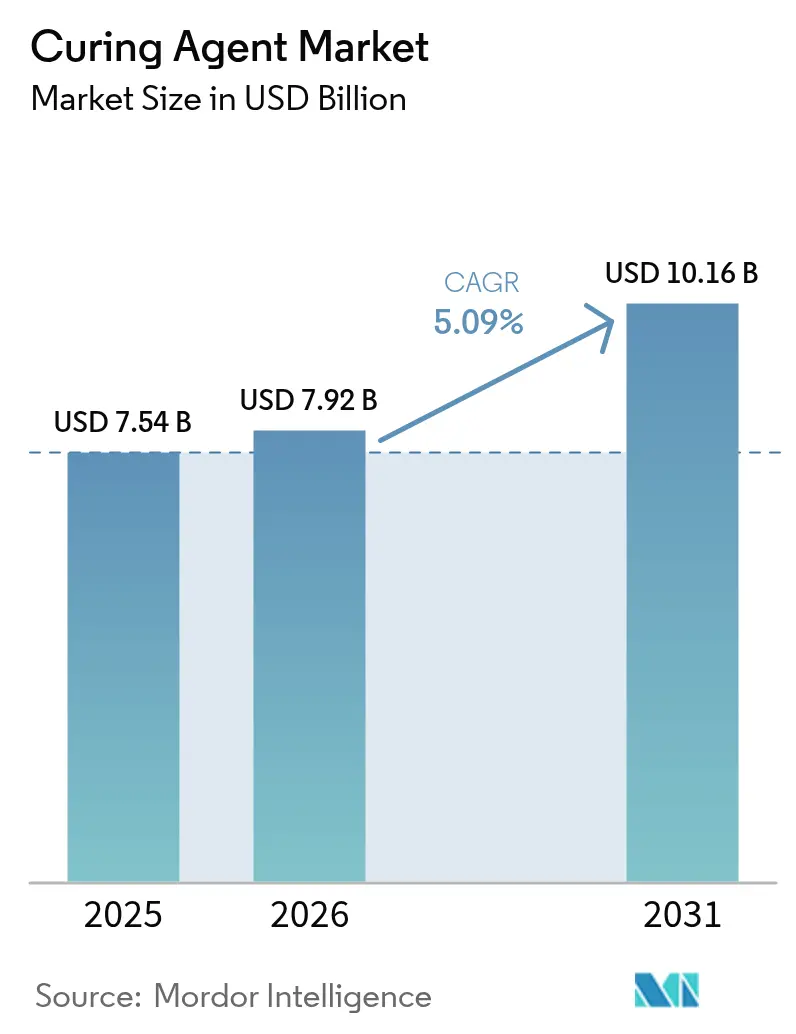
The curing agent market size is expected to grow from USD 7.54 billion in 2025 to USD 7.92 billion in 2026 and is forecast to reach USD 10.16 billion by 2031 at 5.09% CAGR over 2026-2031. Robust construction spending, wind-energy buildouts, and a decisive pivot toward bio-based chemistries keep demand resilient even as regulatory barriers tighten. Manufacturers benefit from expanding infrastructure budgets, electrification of transport, and the need for durable, low-VOC coating systems that meet global environmental mandates. Wind-turbine blade production, battery potting, and 3D-printing resins provide high-value outlets, while supply-chain integration in Asia Pacific continues to influence raw-material availability and pricing. Competitive pressure centers on faster cure cycles, lower emissions, and life-cycle recyclability, pushing incumbents to accelerate research and devlopment and scale up renewable feedstocks to defend margins in the curing agent market.
Key Report Takeaways
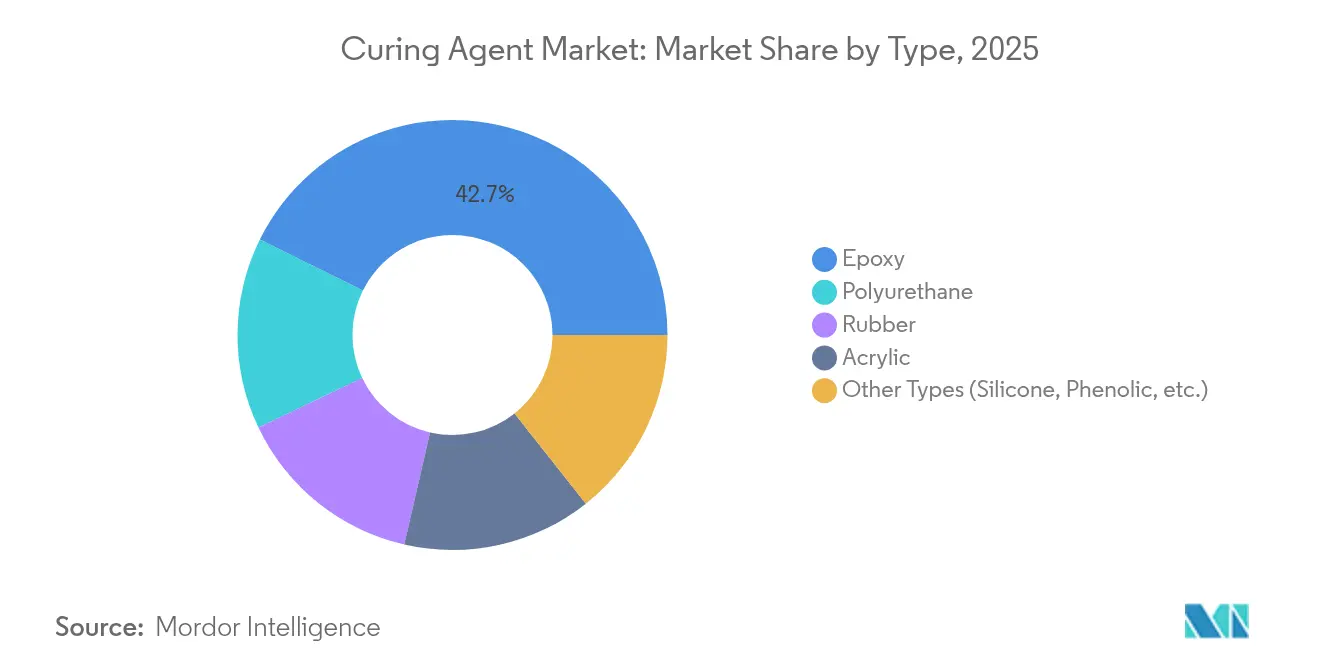
- By type, epoxy curing agents captured 42.68% of the curing agent market share in 2025 and are expanding at a 6.29% CAGR to 2031.
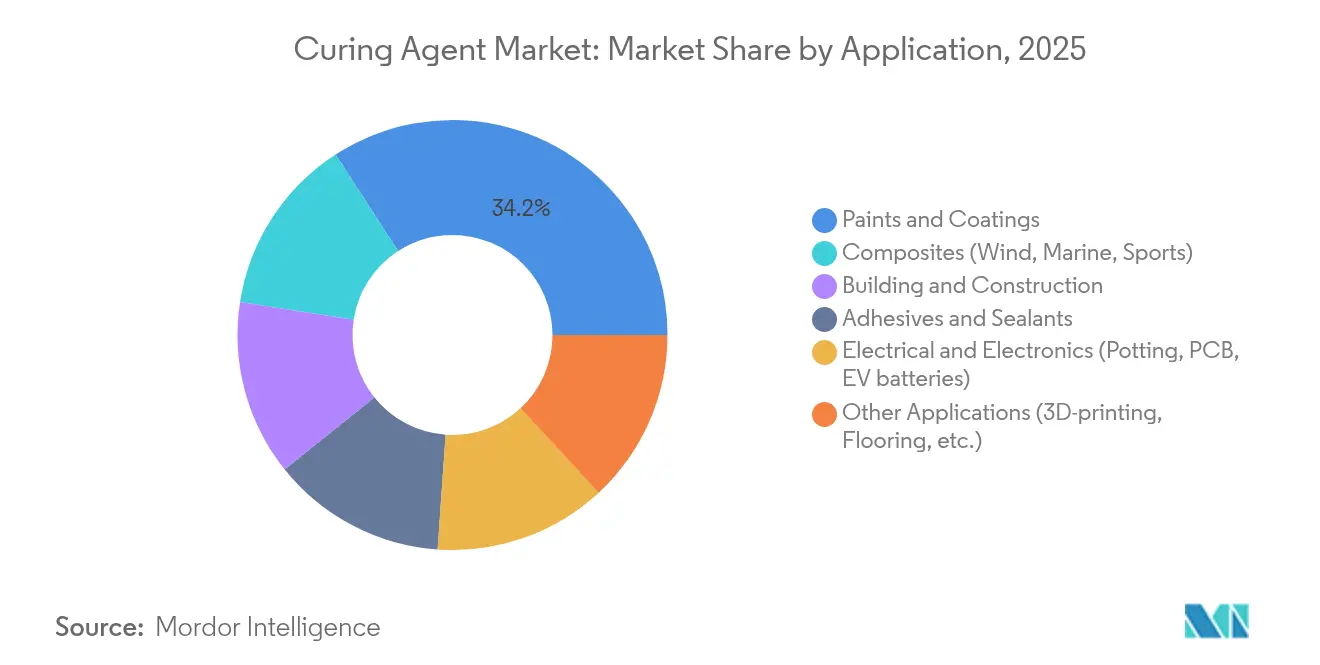
- By application, paints and coatings led with 34.15% of the curing agent market size in 2025, while composites are projected to post the highest 6.12% CAGR through 2031.
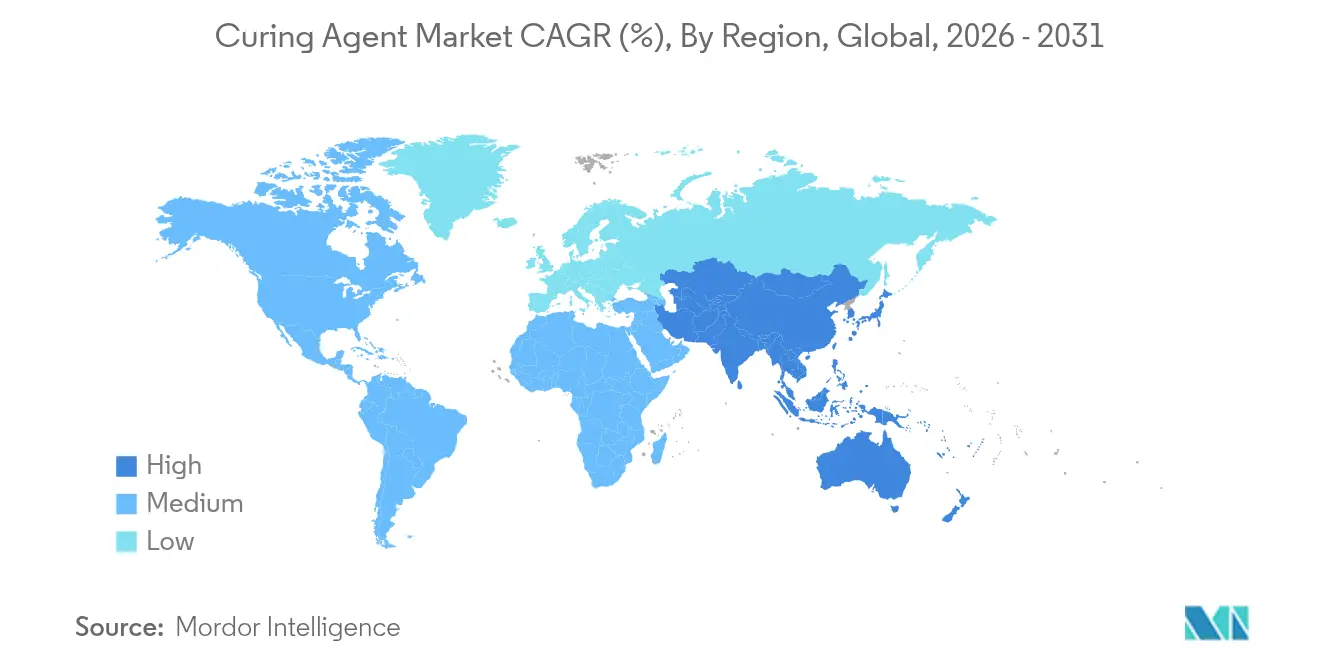
- By geography, Asia Pacific accounted for 44.75% revenue share of the curing agent market in 2025 and is advancing at a 6.46% regional CAGR to 2031.
Note: Market size and forecast figures in this report are generated using Mordor Intelligence’s proprietary estimation framework, updated with the latest available data and insights as of 2026.
Market Trends and Insights
Drivers Impact Analysis of Curing Agent Market*
| Drivers | (~) % Impact on CAGR Forecast | Geographic Relevance | Impact Timeline |
|---|---|---|---|
| Surging demand from paints and coatings | +1.2% | Global, APAC leading growth | Medium term (2-4 years) |
| Infrastructure boom driving building and construction composites | +1.4% | APAC core, spill-over to North America | Long term (≥ 4 years) |
| Rapid expansion of wind-energy blade production | +0.9% | Global, concentrated in China, Europe, and North America | Medium term (2-4 years) |
| Shift to bio-based CNSL and lignin curing chemistries | +0.7% | North America and EU leading, APAC following | Long term (≥ 4 years) |
| Ultra-fast curing agents enabling 3D-printing resins | +0.5% | North America and EU innovation hubs | Short term (≤ 2 years) |
| Source: Mordor Intelligence | |||
Surging Demand from Paints and Coatings
Low-VOC and waterborne coatings now dominate procurement specifications for architectural and protective layers, prompting formulators to specify curing agents that deliver hardness, UV resistance, and corrosion protection without breaching emission caps. New waterborne polyamide chemistries like EPIKURE 6874-WZ-50 simplify dispersion stability while maintaining salt-spray performance[1]. Infrastructure refurbishment raises volumes for anti-corrosion primers, and IoT-enabled surface diagnostics accelerate renovation cycles, driving additional throughput. Growing consumer awareness of sustainability pushes resin producers to leverage bio-based hardeners that match mechanical performance. These factors continue to lift demand across the global curing agent market.
Infrastructure Boom Driving Building and Construction Composites
Government-backed megaprojects in Asia Pacific favor fiber-reinforced polymers for bridge decks, façades, and rebar, as these materials reduce installation labor and mitigate corrosion costs. In the United States, bipartisan infrastructure funding has opened grants for composite girder replacement, increasing purchase orders for reactive amine systems optimized for high-humidity cure schedules. India’s push for USD 300 billion chemical output by 2025 strengthens the domestic supply of specialty amines and accelerators, reinforcing regional self-sufficiency. Rapid urbanization sustains consumption of structural adhesives, further lifting the curing agent market.
Rapid Expansion of Wind-Energy Blade Production
Global onshore and offshore wind capacity additions are raising blade lengths beyond 100 meters, necessitating curing agents that extend pot-life yet develop green strength fast enough for takt-time targets. Huntsman’s polyetheramines permit room-temperature infusion cycles of 90 minutes for 120-meter molds, shortening fabrication bottlenecks. Dow’s polyurethane-carbon fiber spar cap system achieves more than 90% conversion in minutes while hiking modulus, illustrating premium niches inside the curing agent market. Digital twins optimize exotherm profiles, helping blade makers reduce scrap and resin waste. As wind installations accelerate, turbine manufacturers lock in long-term supply contracts, anchoring multi-year volume visibility for curing agent suppliers.
Ultra-Fast Curing Agents Enabling 3D-Printing Resins
Additive manufacturing demands snap-cure photoinitiators to sustain high print throughput and fine resolution. Lawrence Livermore National Laboratory validated microwave volumetric AM that cures centimeter-thick epoxy composites within seconds, lifting productivity for aerospace tooling[2]. Titania quantum-dot catalysts widen the usable spectrum for outdoor-stable photopolymer resins. Renewable lipoate-based systems enable closed-loop recyclability, addressing sustainability checkpoints in the curing agent market. Collectively, ultra-fast solutions expand resin vendor margins and shorten prototyping cycles, enhancing market pull for specialty hardeners.
Restraints Impact Analysis of Curing Agent Market*
| Restraints | (~) % Impact on CAGR Forecast | Geographic Relevance | Impact Timeline |
|---|---|---|---|
| Stringent VOC and REACH regulations on amines and anhydrides | -0.8% | EU primary impact, global compliance ripple effects | Medium term (2-4 years) |
| Volatility in petro-derived raw-material costs | -0.6% | Global, APAC manufacturing is most exposed | Short term (≤ 2 years) |
| Supply chain concentration of specialty amines in Asia | -0.4% | North America and Europe | Medium term (2-4 years) |
| Source: Mordor Intelligence | |||
Stringent VOC and REACH Regulations on Amines and Anhydrides
Europe’s 2025 REACH revision extends PFAS curbs and lowers emission thresholds, compelling formulators to redesign epoxy and polyurethane systems around safer accelerators. Diisocyanate training mandates add indirect cost, and the January 2025 SVHC update tightens documentation for amine derivatives. Similar moves by the U.S. EPA on NMP heighten complexity for coatings exporters. Downstream, automotive OEMs now screen full material disclosures, elevating switching pressure toward bio-based or ultra-low-odor alternatives. Compliance expenses weigh on smaller producers, but integrated majors with green portfolios gradually consolidate share inside the curing agent market.
Volatility in Petro-Derived Raw-Material Costs
Cracker shutdowns across Southeast Asia in 2024 underscored susceptibility to naphtha price swings, shocking spot values for ethyleneamines and phthalic anhydride. Political tensions and freight rate increases exacerbate landed-cost variability, urging procurement teams to lock multi-year index-linked contracts or develop dual sourcing. Some multinationals respond with backward integration into propylene derivatives, while others fast-track bio-route pilots to sidestep crude exposure. The unpredictability compresses margins, yet it also accelerates innovation in renewable feedstocks, adding impetus to structural change in the curing agent market.
*Our forecasts treat driver/restraint impacts as directional, not additive. The impact forecasts reflect baseline growth, mix effects, and variable interactions.
Curing Agent Market Segment Analysis
By Type:
Epoxy Dominance Accelerates Through InnovationEpoxy systems generated the largest revenue within the curing agent market in 2025, and their 6.29% CAGR through 2031 outpaces every other chemistry category. Within this segment, aliphatic amine blends enable thin-film cure at temperatures below 10 °C, while polyamides contribute moisture tolerance for marine primers. Huntsman, BASF, and Evonik combine backward-integrated amine chains with regional mixing plants, sustaining their cost edge and technical support.
Polyurethane hardeners continue to hold strong positions in flexible flooring and spray foams, yet isocyanate regulation encourages hybrid epoxy-polyurethane routes with blocked functionality that releases under heat. Silicone and phenolic curing agents remain indispensable for aerospace and high-temperature electronics, where dielectric stability is critical. Rubber and acrylic formulations address niche sealing, tire, and UV-cure needs, contributing steady but slower growth.

By Application:
Composites Growth Outpaces Traditional SegmentsComposites are forecast to expand at 6.12% through 2031. The steep trajectory reflects surging wind-turbine blade needs, electrified vehicle platforms, and lightweight urban mobility structures. Longer blades necessitate resin systems that remain in workable form for 4 hours while curing overnight at 60 °C, stimulating demand for innovative amine adducts. Battery potting applications require thermally conductive yet electrically insulating epoxies that dissipate heat spikes without compromising dielectric properties. At the same time, paints and coatings keep their top spot in revenue terms, driven by monumental upkeep cycles in infrastructure, maritime shipping decarbonization, and universal incentives for low-solvent architectural finishes.
Electrical and electronics usage rises on the back of 5G rollouts and high-density semiconductor packaging that demands filler-rich, low-CTE epoxy encapsulants. 3D-printing resins, though currently a small slice, post a significant volume growth thanks to digital spare-part programs and on-site construction trials. Collectively, these diverse outlets balance cyclical swings and broaden the demand base for the curing agent market.
Geography Analysis
APAC Curing Agent Market
Asia Pacific dominates on both volume and value, holding 44.75% of global sales in 2025 and riding a 6.46% CAGR to 2031. Regional supply chains feature integrated amine synthesis, competitive labor, and proximity to downstream users, giving local producers agility in pricing and lead time. China’s Made-in-China 2025 initiative upgrades domestic output from commodity epoxy diluents toward specialty crosslinkers, supporting local turbine and semiconductor customers simultaneously. India’s production-linked incentive framework attracts multinational capital into polyetheramine and phenalkamine facilities, cutting import dependency and propelling the curing agent market in South Asia.
North America and Europe Curing Agent Market
North America benefits from shale gas feedstock and high wind-capacity additions, yet stricter VOC proposals and PFAS scrutiny raise research and development outlays. Leading formulators move toward mass-balance bio-attribution models and circular end-of-life options to maintain differentiation and secure grants. Europe confronts elevated electricity prices and evolving REACH thresholds, compelling operators to migrate toward high-margin custom solutions while scaling green hydrogen-powered plants to lower Scope 2 emissions.
Regulatory Landscape
Compliance requirements for curing agents are tightening across major end-use regions, and the EU remains a key reference point for global formulations. The European Chemicals Agency (ECHA) added three new substances to the REACH Candidate List on 3 June 2026, increasing supply-chain communication and potential notification requirements for affected chemistries used in coatings, composites, and construction epoxy systems. ECHA also initiated an urgent 2026 review of REACH Annex XVII Entry 51 covering certain phthalates (DEHP, DBP, BBP, DIBP) in structural epoxy applications, which infrastructure and building-product suppliers are monitoring closely.
In the United States, the Environmental Protection Agency (EPA) issued Significant New Use Rules (SNURs) under TSCA for specific new chemical substances on 24 April 2026, reinforcing the need for upstream screening and documentation when introducing new or modified curing agents. China is also adding technical and administrative compliance layers: the Ministry of Ecology and Environment (MEE) released a draft revision to the Measures for the Environmental Management Registration of New Chemical Substances for public comment on 11 June 2026, while China began enforcing GB 30981.2-2025 under the State Administration for Market Regulation (SAMR). This expands hazardous-substance controls in the industrial coatings chain to include additives such as curing agents alongside putty and paint removers.
Value Chain Analysis
The curing agent value chain begins with petrochemical and bio-based feedstocks that are converted into reactive intermediates (amines, polyamides, anhydrides, and specialty building blocks). These intermediates are then formulated into application-specific curing packages for epoxy, polyurethane, acrylic, rubber, and other resin systems. Large integrated producers (for example BASF, Huntsman, and Evonik) combine upstream intermediates with downstream blending and technical-service laboratories to serve coatings, adhesives and sealants, composites, and electrical and electronics customers, while regional formulators and distributors support local inventory, tinting and formulation, and just-in-time delivery for smaller accounts.
Recent supply-side signals point to both regionalization and exposure to upstream interruptions. Evonik expanded specialty amines production in Nanjing and paired it with fast-cure epoxy curing agent introductions for the Americas in April 2026, consistent with efforts to shorten lead times and tailor performance for cold-weather, high-humidity, and moisture-barrier use cases. At the same time, polyurethane-chain disruptions, including a May 2026 force majeure on MDI products in North America and raw-material shortages affecting MDI operations, illustrate how upstream constraints can tighten availability and pricing for curing-related components across polyurethane systems and hybrid formulations. This dynamic is pushing more multi-sourcing, qualification of alternate chemistries, and closer OEM-supplier collaboration in higher-throughput segments such as wind and industrial coatings.
Competitive Landscape
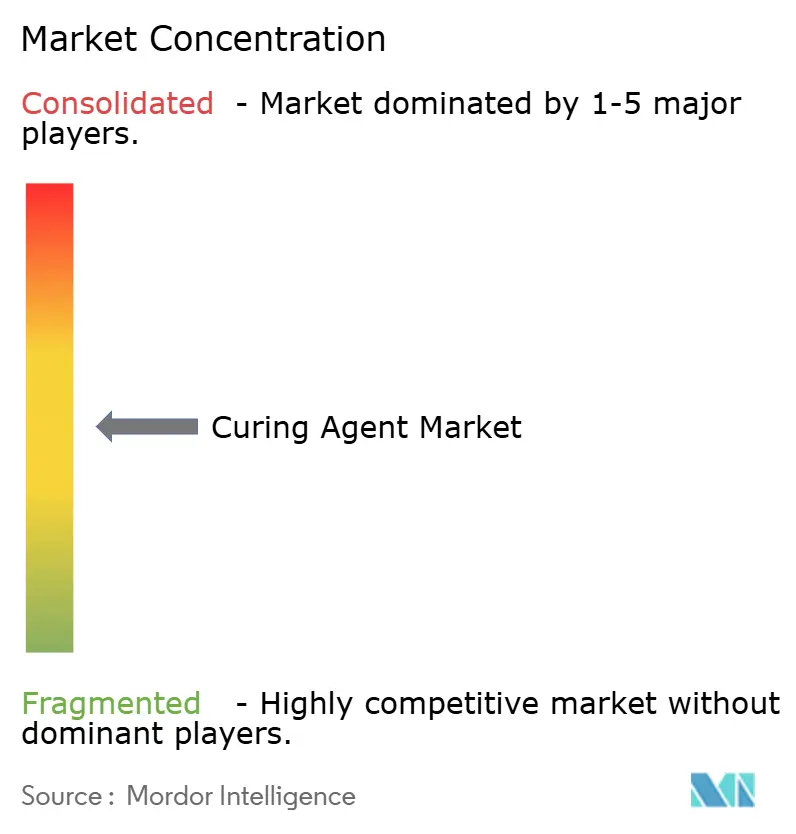
The curing agent market remains moderately fragmented. BASF secures scale advantages from backward-integrated isophorone diamine and has formalized an exclusive North American Baxxodur distribution deal with Univar, enhancing customer reach. Smaller innovators scale cardanol refining and lignin amination, partnering with turbine OEMs and EV start-ups to validate performance.
Curing Agent Industry Leaders
-
Evonik Industries, AG
-
BASF
-
Hexion Inc.
-
Huntsman International LLC
-
Mitsubishi Chemical Corporation
- *Disclaimer: Major Players sorted in no particular order
Curing Agent Market Companies Covered in this Report
- Alfa Chemicals
- Atul Ltd.
- BASF
- Cardolite Corporation
- DIC Corporation
- Evonik Industries, AG
- Hexion Inc.
- Huntsman International LLC
- Incorez Ltd.
- Kukdo Chemical Co.
- Mitsubishi Chemical Corporation
- Olin Corporation
- Palmer International
- Supreme Polytech Pvt Ltd.
- Wanhua Chemical Group
Market Opportunities and Future Outlook
Product-development whitespace is building around ultra-low emission, fast-cure, and application-tolerant curing agents that help coatings and flooring systems meet tightening VOC and hazardous-substance requirements while maintaining cure speed and film performance. Evonik broadened this direction in April 2026 with launches such as Ancamine 2875 for moisture vapor barrier applications and Ancamine 2873 for fast-cure in cold conditions, which are concrete examples of suppliers monetizing performance alongside emissions reduction in protective coatings and construction-adjacent uses.
Asia-based capacity and localization programs are also creating openings for suppliers that can secure intermediates and qualify for electronics and specialty polyurethane standards. BASF started operating expanded DMAPA and polyetheramine capacity at its Nanjing site in July 2025, strengthening availability of key amine building blocks used in epoxy and polyurethane curing systems. Separately, SP Samhwa began mass production of localized optical-grade polyurethane curing agents in April 2026 under South Korea's Materials and Components Technology Development Program, highlighting import substitution and higher-specification end markets in optics and electronics, where consistent quality, traceability, and tailored performance support premium positioning.
Recent Industry Developments in Curing Agent Market
- April 2026: Evonik introduced Ancamine 2875, an ultrafast epoxy curing agent positioned for moisture vapor barrier applications. The launch targets contractors and formulators that need shorter turnaround times and lower emissions in flooring and protective coating systems, supporting higher-value specialty demand in epoxy curing packages.
- July 2025: BASF completed the expansion of its DMAPA and polyetheramine (PEA) plants at the Nanjing site, raising DMAPA capacity by about 20% and PEA capacity by about 25%. The added output strengthens the supply of key amine intermediates used in multiple curing-agent families and reinforces Nanjing as a strategic hub for serving Asia Pacific and export markets.
- September 2024: Evonik introduced Ancamide 2853 and Ancamide 2865 polyamide-based curing agents for the Americas. By expanding options aligned with EH&S and sustainability requirements in coatings, the move improves portfolio breadth for formulators balancing durability, handling, and environmental constraints.
Curing Agent Market Report Scope and Research Methodology
Market Definition and Coverage
The curing agent market covers reactive hardeners added to resins to start or complete cross-linking, converting a liquid system into a solid, durable material. We count sales of curing agents supplied as neat products or as formulated blends used across coatings, adhesives and sealants, construction, composites, and electrical applications.
Scope exclusions: Excludes non-reactive accelerators or thinners sold only for viscosity or speed control, and it also excludes recycled or reclaim material streams.
Segments Covered in This Report
- By Type
- Epoxy
- Polyurethane
- Rubber
- Acrylic
- Other Types (Silicone, Phenolic, etc.)
- By Application
- Paints and Coatings
- Building and Construction
- Adhesives and Sealants
- Composites (Wind, Marine, Sports)
- Electrical and Electronics (Potting, PCB, EV batteries)
- Other Applications (3D-printing, Flooring, etc.)
- By Geography
- Asia-Pacific
- China
- India
- Japan
- South Korea
- Rest of Asia-Pacific
- North America
- United States
- Canada
- Mexico
- Europe
- Germany
- United Kingdom
- France
- Italy
- Rest of Europe
- South America
- Brazil
- Argentina
- Rest of South America
- Middle-East and Africa
- Saudi Arabia
- South Africa
- Rest of Middle-East and Africa
- Asia-Pacific
Data Sources, Market Sizing, and Validation
Desk Research
Desk work starts by mapping demand drivers that consistently move curing agent consumption, then aligning them to end markets where cross-linking chemistry is required. Public sources such as USGS mineral statistics, the US Census Bureau manufacturing series, UN Comtrade trade data, Eurostat, and the International Energy Agency were used as anchors for chemicals output, construction activity, and industrial momentum.
We also screened company annual reports, investor decks, and technical literature, including peer-reviewed polymer and coatings journals, plus association websites tied to coatings, composites, and adhesives. To close gaps around supplier footprints and product positioning, we relied on paid subscriptions for company financials and intelligence, news and financials, patent databases, and an import/export shipment-level database. These examples are not exhaustive, and we checked other public sources to collect, validate, and clarify the specific data points used in the model.
Primary Interviews and Surveys
Primary discussions were used to pressure-test the demand pool and pricing logic by speaking with producers, distributors, formulators, and large end users that purchase curing agents for coatings, adhesives, composites, and construction chemicals. Because this is a global market, the outreach balanced APAC, EMEA, and the Americas so regional differences in resin mix, compliance needs, and supply availability could be reflected in the model assumptions.
Distribution of primary research fieldwork respondents
| Company type | Respondent position | Region |
|---|---|---|
| Top tier: 32% | CXOs: 19% | APAC: 39% |
| Mid tier: 49% | Functional/Unit leaders: 29% | EMEA: 35% |
| Smaller Players: 19% | Managers: 52% | Americas: 26% |
Market-Sizing & Forecasting
Sizing was built using a top-down and bottom-up approach, where resin and end-use activity indicators are first used to reconstruct the demand pool for reactive hardeners, then cross-checked with supplier and channel signals to keep totals realistic. In practice, we start from end-use outputs such as coatings volume growth, construction activity, and composites manufacturing, and then apply curing agent intensity and mix assumptions by chemistry to convert those indicators into market value.
Key model inputs included resin consumption trends, coatings and adhesive production indices, import and export flows for relevant chemical groups, typical dosage rates used in epoxy and polyurethane systems, and average selling price movements linked to feedstock pressure and formulation shifts. Where local data was thin, we used regional proxies and validated ratios, and then adjusted these inputs after interviews. Forecasts were built using scenario analysis supported by simple multivariate relationships between curing agent demand and leading indicators such as construction spending, industrial output, and vehicle and electronics production, followed by a final reasonableness check using sampled price times volume approximations from the supply side.
Data Validation & Update Cycle
Validation is done by comparing model results against independent signals such as trade direction, upstream chemical pricing patterns, and shifts in downstream coating and adhesive output, then investigating the drivers behind any large variances. Numbers are reviewed in steps, where assumptions are checked first, calculations are replicated by another analyst, and final outputs are approved only after inconsistencies are explained in plain terms.
If a new regulation, capacity change, or sharp feedstock move is seen, respondents are re-contacted to confirm whether the market impact is short-lived or structural. Reports are refreshed annually, and interim updates are made when material events occur, followed by a final pre-delivery pass so clients receive the most current view available.
Mordor Intelligence's Curing Agent Market Size Compared Against Other Published Estimates
Different published market sizes for curing agents do not always line up because the included chemistries, end-use mapping, and the year used for pricing can change from one study to another. In our work, we keep the logic traceable so a reader can connect the total market value back to visible demand indicators and interview-based checks.
The biggest gaps usually come from scope choices, especially when some estimates fold in non-reactive cure accelerators, or when recycled streams are counted as fresh supply. Another common driver is pricing, where one number may reflect a peak or trough in feedstocks, while another uses smoothed averages, and currency conversion timing can also add drift. Finally, refresh cadence matters in chemicals markets, because new capacity and construction cycles can shift the balance within a year, and that spread is visible in figures that do not update assumptions frequently.
Benchmark comparison
| Source | Market Size | Gaps in Research Methodology |
|---|---|---|
| Mordor Intelligence | USD 7.92 B (2026) | |
| Global Consultancy A | USD 7.17 B (2026) | Uses a broader type framing by resin family and end use, and it does not clearly state whether non-reactive cure accelerators and reclaimed volumes are excluded, which can compress the counted value when pricing is averaged differently. |
| Industry Publisher B | USD 5.73 B (2024) | Covers epoxy curing agents only and anchors the value to a 2024 base year, so polyurethane and other curing chemistries are left out and the total shifts materially versus an all-curing-agent view. |
The table shows that most of the spread is explained by whether the market is limited to epoxy-only versus all reactive hardeners, and by how additives and reclaim streams are treated. By excluding non-reactive accelerators and recycled streams and tying demand to coatings, construction, adhesives, and composites activity, the baseline stays closer to the true reactive hardener pool, which is the approach applied by Mordor Intelligence.
Key Questions Answered in the Report
What is the current size of the curing agent market?
The curing agent market stands at USD 7.92 billion in 2026 and is projected to reach USD 10.16 billion by 2031.
Which curing agent type holds the largest share?
Epoxy curing agents lead with 42.68% of curing agent market share in 2025, growing at a 6.29% CAGR through 2031.
Why is Asia Pacific pivotal for curing agent suppliers?
Asia Pacific commands 44.75% of global revenue thanks to integrated supply chains, lower production costs, and expanding construction and wind-energy sectors.
How are regulations influencing product development?
Stricter VOC and REACH rules push manufacturers toward bio-based, low-odor chemistries and accelerate research and development for PFAS-free and low-hazard accelerators, reshaping portfolios.
Which application segment is growing fastest?
Composites applications, especially wind-turbine blades and lightweight automotive parts, register the highest 6.12% CAGR through 2031.