
Crypto Insurance Market Size and Share
Market Overview
| Study Period | 2020 - 2031 |
|---|---|
| Market Size (2026) | USD 0.39 Billion |
| Market Size (2031) | USD 1.17 Billion |
| Growth Rate (2026 - 2031) | 24.56 % |
| Fastest Growing Market | Asia-Pacific |
| Largest Market | North America |
| Market Concentration | Low |
Major Players *Disclaimer: Major Players sorted in no particular order Image © Mordor Intelligence. Reuse requires attribution under CC BY 4.0. | |
Crypto Insurance Market Analysis by Mordor Intelligence
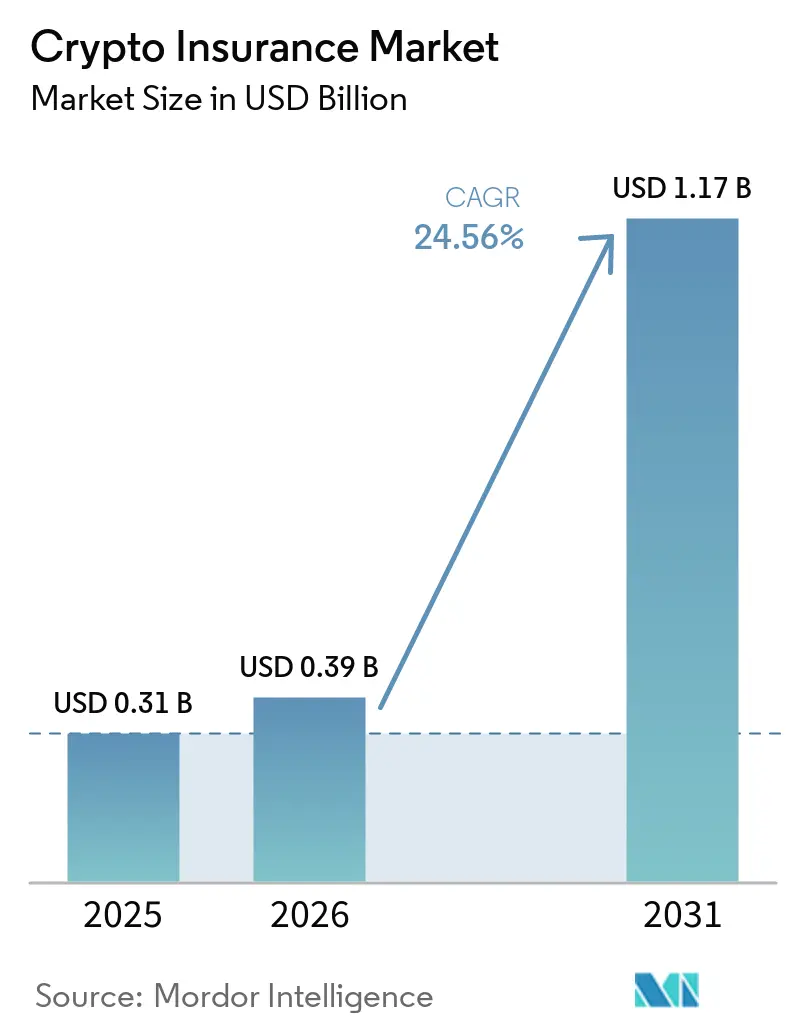
The Crypto Insurance Market size is projected to expand from USD 0.31 billion in 2025 and USD 0.39 billion in 2026 to USD 1.17 billion by 2031, registering a CAGR of 24.56% between 2026 to 2031.
Demand is moving beyond discretionary protection as institutional holders and regulated digital-asset firms place greater weight on custody, operational resilience, and liability coverage. The GENIUS Act established a federal stablecoin framework in 2025 with 100% reserve backing and monthly public reserve disclosure requirements, which strengthens the need to assess uninsured exposures across the digital-asset ecosystem. Theft and cyber losses continue to shape buying decisions, with USD 3.4 billion stolen from cryptocurrency services in 2025, and the Bybit incident alone accounting for USD 1.5 billion. The crypto insurance market is also being shaped by the gradual integration of coverage into wallets, exchanges, and custody platforms, which can reduce the effort required to obtain protection. At the same time, limited underwriting capacity and inconsistent policy wording continue to constrain larger placements and keep the crypto insurance market dependent on specialist capacity.
Key Report Takeaways
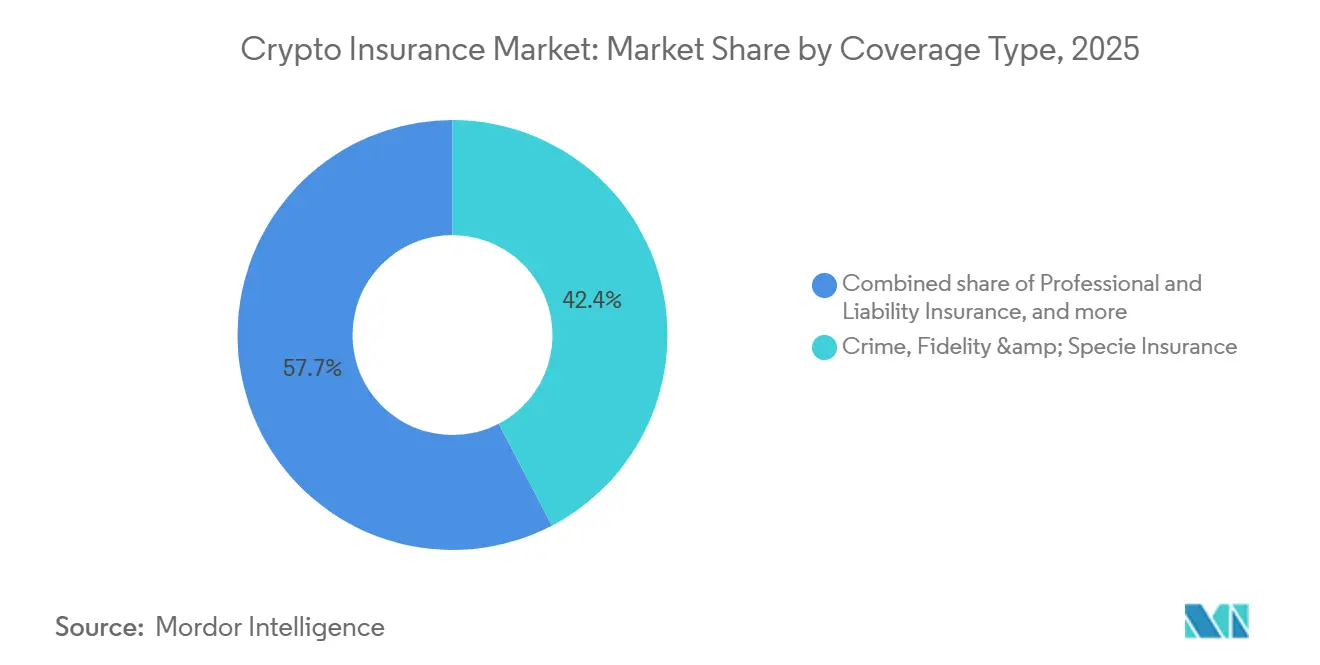
- By coverage type, crime, fidelity, and specie insurance captured 42.4% of the crypto insurance market share in 2025, while cyber liability and technology errors and omissions insurance are projected to grow at a 29.1% CAGR through 2031.
- By insurance model, traditional centralized and regulated insurance accounted for 68.3% of the crypto insurance market share in 2025, while decentralized and on-chain mutual and cover protocols are projected to grow at a 36.3% CAGR through 2031.
- By distribution channel, brokers and specialty intermediaries held 54.7% of the crypto insurance market share in 2025, while embedded and platform distribution is projected to grow at a 32.3% CAGR through 2031.
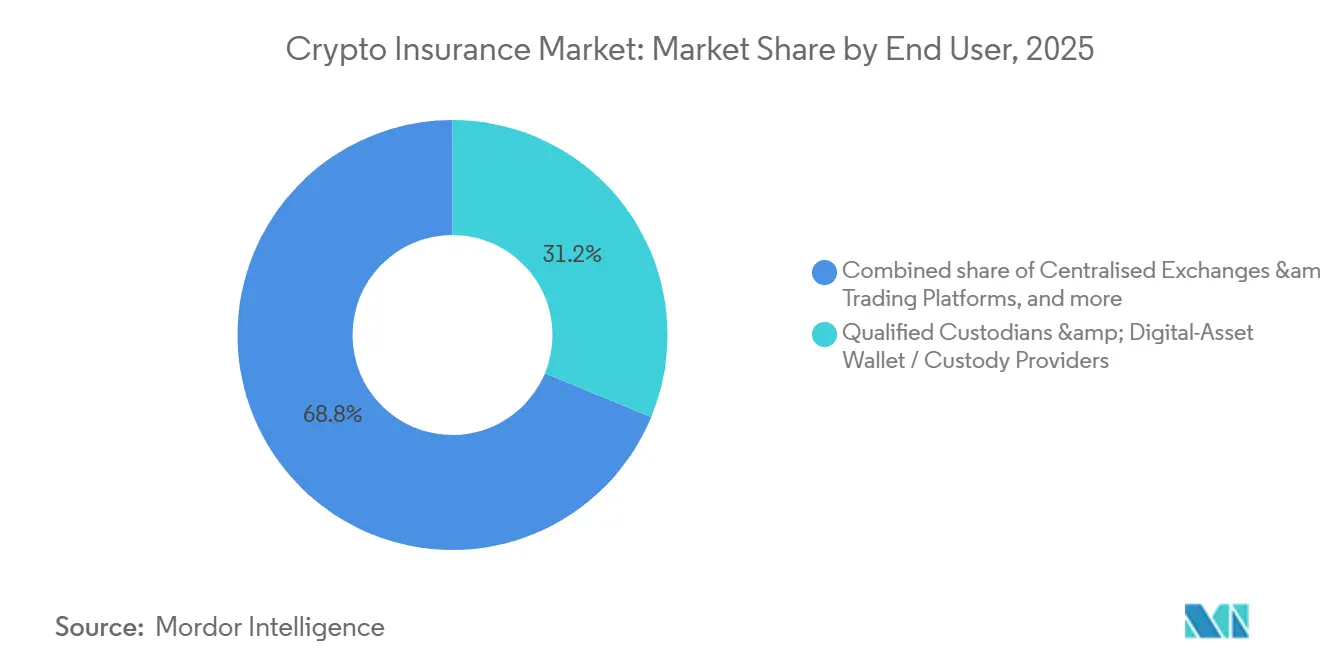
- By end user, qualified custodians and digital-asset wallet and custody providers accounted for 31.2% of the crypto insurance market share in 2025, while institutional investors and asset managers are projected to grow at a 31.2% CAGR through 2031.
- By insured asset and exposure, cryptocurrencies captured 59.1% of the crypto insurance market share in 2025, while other fungible tokens and tokenized assets are projected to grow at a 32.8% CAGR through 2031.
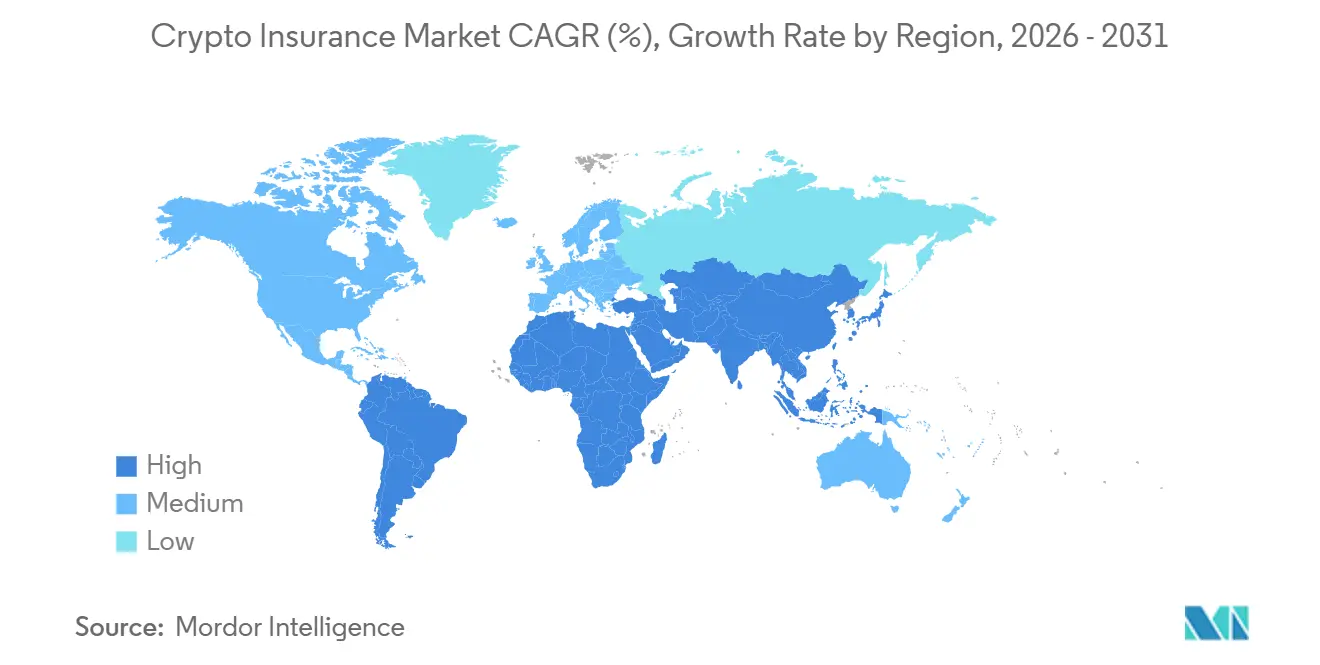
- By geography, North America captured 41.10% of the crypto insurance market share in 2025, while Asia-Pacific is projected to grow at a 29.75% CAGR through 2031.
Note: Market size and forecast figures in this report are generated using Mordor Intelligence’s proprietary estimation framework, updated with the latest available data and insights as of January 2026.
Global Crypto Insurance Market Trends and Insights
Drivers Impact Analysis*
| Driver | (~) % Impact on CAGR Forecast | Geographic Relevance | Impact Timeline |
|---|---|---|---|
| Growing Institutional Adoption of Digital Assets | +6.0% | Global, with concentrated early gains in North America and Europe | Medium term (2-4 years) |
| Rising Demand for Custody, Exchange, and Digital-Asset Liability Coverage | +5.0% | North America and Europe, with spillover to core Asia-Pacific markets | Medium term (2-4 years) |
| DeFi and Tokenized Asset Expansion | +4.5% | Global, led by Asia-Pacific and North America | Long term (≥ 4 years) |
| Rising Crypto Theft, Cyberattacks, and Smart-Contract Exploits | +5.0% | Global | Short term (≤ 2 years) |
| Embedded Insurance Across Digital-Asset Platforms | +3.5% | Asia-Pacific and North America, with emerging European demand | Medium term (2-4 years) |
| Improved Crypto Risk Analytics and Specialist Underwriting | +3.0% | North America and Europe, with progressive adoption in Asia-Pacific | Medium term (2-4 years) |
| Source: Mordor Intelligence | |||
Growing Institutional Adoption Reshapes Demand Composition
Institutional digital-asset holdings are making insured custody more important for firms with fiduciary and oversight responsibilities. Pension funds, sovereign wealth funds, and registered investment advisers face greater pressure to use custody arrangements that can address first-party loss exposure. This shift makes protection a condition for broader institutional participation rather than an optional addition. South Korea’s Virtual Asset User Protection Act, effective from July 2024, requires virtual asset service providers to maintain insurance or reserves equal to at least 5% of the economic value of hot-wallet holdings. Samsung Fire & Marine’s policy for Korea Digital Asset began with a 15% premium rate and was later renewed at 10%, showing how early institutional demand can support price discovery in a new jurisdiction. The Crypto Insurance Market benefits when regulatory obligations and fiduciary standards apply at the same time because coverage demand becomes less tied to cryptocurrency price cycles.
Escalating Crypto Crime Losses Reinforce Structural Insurance Need
The value stolen from cryptocurrency services reached USD 3.4 billion in 2025, and North Korean state-sponsored actors were responsible for at least USD 2.02 billion of that amount[1]Chainalysis, “Crypto Hacking and Stolen Funds in 2025,” Chainalysis, chainalysis.com. The same source reported that these actors accounted for 76% of service compromises, which highlights the concentration of major loss events. Only 4.2% of hacked assets were recovered in the first half of 2025, increasing the importance of first-party financial protection when recovery efforts fail. Smart-contract incidents require blockchain forensics, code review, and on-chain evidence, which differ from conventional cyber claims work. CertiK recorded USD 3.35 billion in losses across 760 on-chain incidents in 2025, a 37.1% increase from 2024. These events support demand in the Crypto Insurance Market but also make underwriters cautious about pricing, accumulation, and available limits.
DeFi and Tokenized Asset Expansion Creates a New Coverage Frontier
DeFi and tokenized assets are creating exposures that do not fit neatly within conventional property or cyber policy structures. Less than 2% of DeFi total value locked carried insurance coverage, and Nexus Mutual represented most of the USD 123.5 million insurance-sector total value locked tracked in 2026[2]Hackers are draining billions from DeFi but almost none of your crypto is insured. BlackRock’s tokenized BUIDL fund exceeded USD 1 billion in assets in 2024, introducing reserve, custody, private-key, and smart-contract exposures in the same product structure. A 2025 Journal of Banking and Finance paper found that parametric on-chain coverage can complement or replace traditional indemnity coverage when basis risk is moderate[3]“Decentralized Finance Risk Transfer and Smart Contract-Based Insurance,” Journal of Banking and Finance, sciencedirect.com. The available evidence gives underwriters a stronger basis to assess DeFi exposure than earlier market models provided. The Crypto Insurance Market can therefore expand beyond custody and crime cover as protocols and tokenized-asset issuers seek more formal risk-transfer arrangements.
Embedded Insurance Integration Reduces Friction and Broadens Penetration
Insurance penetration has remained low because buyers often need to arrange coverage separately from their core digital-asset activities. Embedded distribution places protection inside exchange interfaces, custodial platforms, and DeFi vaults, reducing the separate procurement step. OpenCover’s Covered Vaults offer up to USD 50 million of cover capacity per vault through Nexus Mutual’s underwriting infrastructure[4]OpenCover, “Introducing Covered Vaults The First Primitive for Vault-Native Risk Transfer,” OpenCover, opencover.com. The structure makes coverage part of the underlying product rather than a stand-alone policy layer. Picnic used Covered Vaults in a neobank experience that combined digital-dollar holdings, card spending, on-chain yield, and embedded protection. This approach can extend the crypto insurance market to retail and small-business users who are not well served by a broker-led process.
Restraints Impact Analysis*
| Restraint | (~) % Impact on CAGR Forecast | Geographic Relevance | Impact Timeline |
|---|---|---|---|
| Limited Historical Loss Data and Risk-Modeling Uncertainty | -2.0% | Global | Medium term (2-4 years) |
| Limited Underwriting Capacity for High-Risk Crypto Exposures | -1.5% | Global | Medium term (2-4 years) |
| High Premium Costs and Restrictive Coverage Terms | -1.0% | Asia-Pacific and the Middle East and North Africa, with spillover to emerging markets | Short term (≤ 2 years) |
| Broad Exclusions for Market Losses, User Error, and Systemic Failures | -1.0% | Global | Medium term (2-4 years) |
| Source: Mordor Intelligence | |||
Data Scarcity Constrains Actuarial Confidence
The short history of digital assets limits the availability of stable loss data for underwriting. AM Best stated in 2025 that meaningful crypto-asset loss data remained scarce because of the sector’s short operating history and prior reliance on self-insurance. Large losses also make forecasting difficult because they can distort historical averages and severity assumptions. The USD 1.5 billion Bybit incident was more than 1,000 times the median incident value, according to Chainalysis. Immunefi documented 191 publicly reported incidents across 2024 and 2025, totaling USD 4.67 billion. Until insurers gain a longer record of structured claims, the crypto insurance market is likely to face constrained capacity and higher premiums in several coverage lines.
Structural Underwriting Capacity Gap Limits Market Scaling
Available capacity for high-risk digital-asset exposures remains concentrated among a small group of Lloyd’s syndicates and specialist insurers. This structure can make it difficult to assemble limits for a major exchange, custodian, or hot-wallet exposure. Relm Insurance stated in May 2026 that a Bybit-scale event remained difficult to insure because of global capacity limits and correlated-loss concerns. EIOPA recommended a 100% capital requirement for EU insurers’ crypto-asset holdings in March 2025, increasing the capital burden associated with conventional reinsurance support. Symbiotic’s Core V2 introduced shared collateral for insurance, credit, and tokenized assets in July 2026, with the company stating that the model provided 70% greater capital efficiency than stand-alone pools. Regulatory recognition of such on-chain reinsurance structures remains incomplete, so the capacity constraint will continue to limit the crypto insurance market in the near term.
*Our forecasts treat driver/restraint impacts as directional, not additive. The impact forecasts reflect baseline growth, mix effects, and variable interactions.
Segment Analysis
By Coverage Type: Crime and Fidelity Coverage Leads as Cyber Liability Accelerates
Crime, fidelity, and specie insurance accounted for 42.4% of the crypto insurance market share in 2025. The segment remains the primary cover for institutional custodians, exchanges, and treasury operations that need protection against theft, employee dishonesty, and physical loss. Cold-storage crime cover has drawn more participation from Lloyd’s syndicates because the control environment is easier to assess than hot-wallet exposure. Hot-wallet coverage carries higher premium loading and tighter security requirements because it faces more frequent operational and cyber threats. Mosaic Insurance launched a combined cyber and financial institutions crime product through Lloyd’s Syndicate 1609, offering up to USD 10 million in cyber and technology capacity and USD 5 million in crime capacity. The product reflects the need for integrated cover where a loss can involve both technology failure and financial crime.
Cyber liability and technology errors and omissions insurance is projected to grow at a 29.1% CAGR between 2026 and 2031. MiCA, DORA, and the FCA’s cryptoasset regime are increasing attention to operational resilience and technology liability among licensed entities. These requirements are broadening demand for coverage related to security failures, technology errors, and service interruption. Digital-asset custody and crime insurance, smart-contract and protocol cover, stablecoin and DeFi financial-risk insurance, professional liability, and infrastructure protection remain part of the wider coverage mix. MiCA Article 67 allows crypto-asset service providers to use a qualified insurance policy as an alternative to holding certain financial resources, which directly supports liability coverage demand in the European Union. The crypto insurance market size therefore continues to combine established custody protection with newer policy forms for regulated technology risk.


By Insurance Model: Traditional Carriers Lead but On-Chain Models Accelerate
Traditional centralized and regulated insurance captured 68.3% of the crypto insurance market share in 2025. Lloyd’s syndicates and specialist admitted carriers led institutional placements because regulated exchanges and institutional investors often require rated coverage. Their position also reflects greater capacity, established claims processes, and acceptance within formal compliance programs. Decentralized protocols cannot yet meet all carrier eligibility requirements in most jurisdictions. Native Risk Collective, launched in July 2025, linked premium discounts to verified security controls and brought together Mosaic Insurance, Chaucer, and security technology vendors. The program shows how traditional capacity is using technical controls to improve underwriting confidence.
Decentralized and on-chain mutual and cover protocols are projected to grow at a 36.3% CAGR between 2026 and 2031. These models use smart-contract pooling and community governance to address risks that can fall outside conventional policy wording. Nexus Mutual integrated with Symbiotic in 2025 to create a yield-generating reinsurance layer backed by restaking capital. The arrangement can increase effective capacity without relying solely on dedicated idle reserves. Hybrid and alternative risk-sharing models remain relevant where buyers need both regulated coverage and on-chain risk transfer. Research in the Journal of Banking and Finance supports the role of DeFi insurance where basis risk and default risk remain moderate. The crypto insurance market size is therefore expected to benefit from the gradual adoption of both regulated and on-chain risk-transfer models.
By Distribution Channel: Brokers Remain Central as Platforms Expand Access
Brokers and specialty intermediaries accounted for 54.7% of the crypto insurance market share in 2025. Their role reflects the complexity of placing digital-asset risks and the need to connect specialized buyers with limited underwriting capacity. Marsh McLennan, Aon, Elmore, Howden, and Native have supported institutional placements through risk advisory and access to Lloyd’s and excess and surplus capacity. Brokers also help buyers describe custody controls, governance, and security practices in formats underwriters can evaluate. WTW acquired Redefind in June 2026, adding a platform focused on the cost of tracing and recovering stolen digital assets. The transaction illustrated how intermediaries are adding recovery-related services alongside policy placement.
Embedded and platform distribution is projected to grow at a 32.3% CAGR between 2026 and 2031. This channel allows coverage to be presented within a wallet, exchange, or vault instead of requiring users to start a separate insurance search. The model can reduce procurement friction for DeFi users and retail exchange participants. Direct distribution and digital insurance marketplaces serve customers who prefer online purchasing but do not require complex institutional placement. OpenCover’s vault-based approach demonstrates how product-led distribution can add cover capacity directly to a user’s on-chain activity. The crypto insurance market size may gain broader retail and small-business participation as platform-based products become more common.
By End User: Custodians Lead Revenue While Institutional Investors Drive Growth
Qualified custodians and digital-asset wallet and custody providers accounted for 31.2% of the crypto insurance market share in 2025. Their leading position reflects licensing, compliance, and first-party loss requirements across major digital-asset jurisdictions. Custody providers in the United States, the European Union, Singapore, and Hong Kong are commonly expected to maintain insurance or comparable financial protection. Their assets under management also create a clear need to transfer theft, loss, and operational exposure. Aon completed a stablecoin premium-payment proof of concept in March 2026 for Coinbase and Paxos using USDC on Ethereum and PYUSD on Solana. The event showed that insurance settlement infrastructure is adapting to the operating models of major custody and exchange clients.
Institutional investors and asset managers are projected to grow at a 31.2% CAGR between 2026 and 2031. Pension trustees and investment committees increasingly expect digital-asset allocations to have custody arrangements similar to those used for traditional financial assets. This expectation increases the value placed on coverage that can support fiduciary oversight. LTP Group expanded its digital-asset custody insurance program to USD 100 million in committed capacity in February 2026, with Canopius underwriting the program. Exchanges, DeFi protocols, corporates, and retail investors each have different risk profiles and coverage needs. Retail users remain the largest underserved end-user group because conventional brokered placements are not designed for smaller transactions. The crypto insurance market size is therefore expected to expand as institutional participation and digital-asset custody requirements increase.
By Insured Asset / Exposure: Cryptocurrencies Remain Core as Tokenized Assets Expand
Cryptocurrencies accounted for 59.1% of insured asset exposure in 2025. Bitcoin, ether, and major altcoins held in custodial and exchange settings formed the largest established exposure base. Underwriting practices for cryptocurrency custody are more mature than for newer tokenized products. Cold-storage coverage is easier to support where strong access controls and operational procedures are in place. Hot-wallet placements still require higher premiums and more stringent security requirements because of their greater susceptibility to cyber theft. Non-fungible tokens and digital-asset infrastructure remain smaller parts of the coverage mix, with infrastructure risks often placed alongside broader technology errors and omissions cover.
Other fungible tokens and tokenized assets are projected to grow at a 32.8% CAGR between 2026 and 2031. Tokenized real-world assets and DeFi protocol treasuries create risk profiles that include smart-contract vulnerabilities, private-key compromise, custody failure, and reserve risk. BlackRock’s BUIDL fund surpassed USD 1 billion in assets in 2024, drawing attention to the insurance needs of tokenized financial products. Stablecoins are also becoming more relevant to the crypto insurance market as reserve disclosure and redemption obligations become more formal. BDIC launched StableCover Pro in late 2025 for SEC-compliant stablecoins, targeting reserve failure, redemption guarantee breaches, and custody risks. These developments point to a wider insured asset base as digital-asset products become more institutionalized and support growth in the crypto insurance market size.
Geography Analysis
North America held 41.1% of the crypto insurance market share in 2025. The region benefits from a concentration of institutional digital-asset capital, registered investment advisers, specialist underwriters, and excess and surplus market capacity. The Digital Asset Market Clarity Act was passed by the United States House in 2025 and sought to define SEC and CFTC responsibilities across digital assets. The GENIUS Act also provided a stablecoin framework that reduced uncertainty around reserve standards and disclosures. Canada’s position on crypto exchange-traded funds and exchange registration, together with Mexico’s growing retail activity, adds to regional demand. North America’s advantage also reflects the depth of specialist managing general agents and co-insurance structures that can assemble larger single-risk limits. This depth allows carriers to share larger placements without depending on one balance sheet. The regional structure gives established buyers greater access to specialist underwriting than many other markets.
Europe was the second-largest regional market in 2025. MiCA has been fully effective since December 2024 and has reshaped how insurers engage with regulated crypto-asset service providers. Article 67 allows eligible insurance coverage to support financial-resource requirements across the 27 European Union member states. DORA applied from January 17, 2025, adding operational-resilience requirements that increasingly influence insurance renewal discussions. The United Kingdom remains outside MiCA but contributes capacity through Lloyd’s of London and the FCA’s developing cryptoasset framework. Germany, France, and the Benelux countries are important demand centers as providers complete MiCA authorization and integrate coverage into their operating requirements.
Asia-Pacific is projected to grow at a 29.8% CAGR between 2026 and 2031. Singapore, Hong Kong, and Australia are supporting growth through licensing, institutional inflows, and high digital-asset transaction activity. Hong Kong’s Securities and Futures Commission issued its A-S-P-I-Re roadmap in 2025, expanding the range of regulated virtual-asset activities and encouraging formal insurance arrangements. Singapore activated its Digital Token Service Provider framework on June 30, 2025, requiring offshore providers to obtain licenses and comply with anti-money-laundering and counter-terrorist-financing rules. Canopius selected Hong Kong-based MGA Qubit as its first Lloyd’s Coverholder in Asia-Pacific in February 2025, helping build regional distribution for custody and crime products. The Middle East, South Africa, and South America remain smaller opportunity areas, with the UAE, Brazil, and other active markets generating demand for custody and liability coverage.

Competitive Landscape
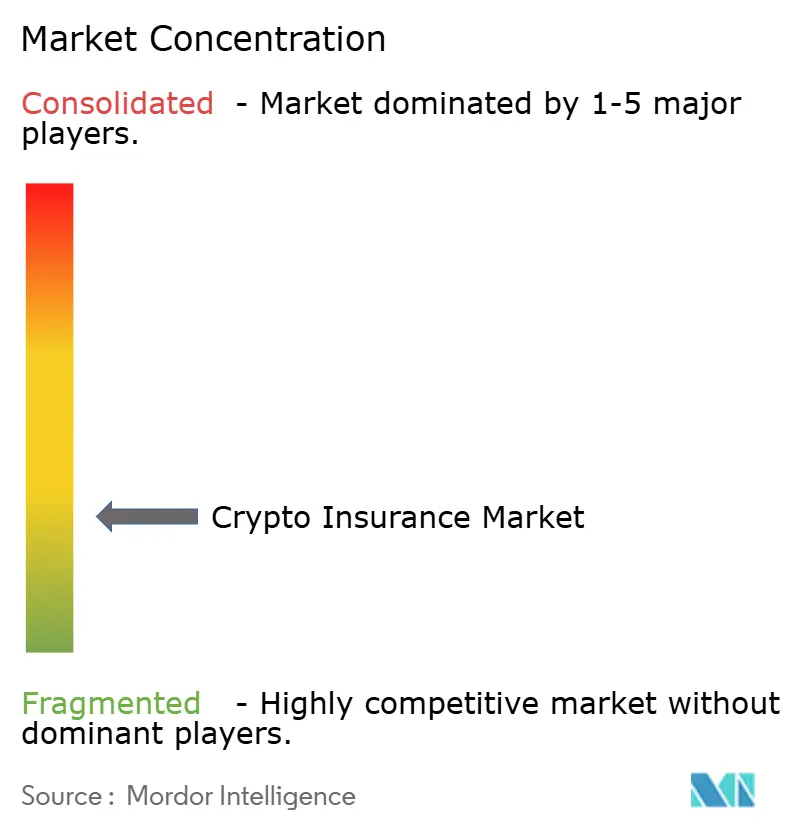
The Crypto Insurance Market has a fragmented carrier base but a concentrated pool of institutional capacity. Canopius, Beazley, Arch Insurance International, Tokio Marine HCC, and other Lloyd’s syndicates and specialist carriers control a large share of available single-risk limits. Chubb and Munich Re generally provide reinsurance capacity behind specialist fronts rather than writing primary policies directly. This market structure makes syndication important when exchanges, custodians, and institutional investors require large limits. Native Risk Collective combined Lloyd’s underwriters Mosaic Insurance and Chaucer with security providers to make verified controls part of the underwriting framework. The arrangement illustrates how insurers are using security partnerships to reduce loss uncertainty before they extend capacity.
Arch Insurance International joined OneInfinity and Evertas in an August 2025 custody insurance arrangement for HashKey Exchange. The placement showed how co-insurance can assemble limits that a single carrier may not be willing to offer. Canopius also partnered with EX.IO in May 2025 to provide custody insurance aligned with Hong Kong Securities and Futures Commission safeguarding standards. These actions focus on regulated exchanges and custody providers that can demonstrate established controls. Opportunities remain limited for hot-wallet and cross-chain bridge exposures above USD 50 million, systemic stablecoin depeg events, and retail or small-business risks. Traditional broker placement remains less economical for smaller policies, leaving space for digitally distributed and on-chain solutions. Insurers continue to favor placements where governance, wallet controls, and incident procedures can be reviewed before binding. That preference keeps the most complex exposures concentrated among firms with mature operating controls.
On-chain reinsurance pools, automated underwriting tools, and parametric settlement mechanisms are seeking to address these gaps. Symbiotic launched Core V2 in July 2026 to enable shared collateral across insurance, credit, and tokenized-asset liquidity. Its model could support greater use of capital across multiple risk pools, though regulatory acceptance remains incomplete. A Bermuda-based platform applied in 2026 for a standalone Luxembourg entity to serve MiCAR-regulated clients directly, showing that regulatory positioning is becoming a competitive consideration. Claims automation based on smart-contract triggers may also shorten traditional loss-adjustment timelines where the insured event can be verified through on-chain data. These models are most relevant where conventional capacity has been limited by capital requirements and aggregation risk. Their wider role will depend on whether regulators accept the structures as reliable forms of insurance or reinsurance capacity.
Crypto Insurance Industry Leaders
Lloyd’s of London syndicate market
Evertas
Canopius Group
Nexus Mutual
Chubb Limited
- *Disclaimer: Major Players sorted in no particular order

Recent Industry Developments
- July 2026: Symbiotic launched Core V2, a shared-collateral infrastructure upgrade enabling capital deployed across insurance, credit, and tokenized asset liquidity simultaneously, with 70% greater capital efficiency than standalone pools. The upgrade addressed the structural capacity ceiling in crypto insurance.
- June 2026: WTW acquired Redefind, a United Kingdom-based insurtech platform that insures the cost of recovering stolen digital assets. The acquisition expanded WTW’s digital-asset advisory practice to include recovery-cost coverage.
- April 2026: Relm Insurance launched Kidnap & Ransom insurance for digital-asset and cannabis executives, providing coverage against kidnapping, extortion, malicious detention, and ransom threats amid rising physical security risks targeting high-profile executives.
- March 2026: Aon completed its first stablecoin insurance premium payment, using USDC on Ethereum and PYUSD on Solana to demonstrate how stablecoins can streamline premium settlement and payments in the commercial insurance market.


Global Crypto Insurance Market Report Scope
| Crime, Fidelity & Specie Insurance |
| Cyber Liability & Technology Errors & Omissions |
| Professional and Liability Insurance |
| Property & Hardware Insurance |
| Other Specialty & Hybrid Covers |
| Traditional Centralized/Regulated Insurance |
| Hybrid & Alternative Risk-Transfer Models |
| Decentralized/On-Chain Mutual & Cover Protocols |
| Direct Distribution |
| Brokers and Specialty Intermediaries |
| Embedded/Platform Distribution |
| Digital Insurance Marketplaces & Online Channels |
| Centralized Exchanges & Trading Platforms |
| Qualified Custodians & Digital-Asset Wallet/Custody Providers |
| DeFi Protocols & Decentralized/Web3 Organisations |
| Institutional Investors and Asset Managers |
| Other Digital-Asset Businesses |
| Retail Investors |
| Cryptocurrencies |
| Stablecoins |
| Other Fungible Tokens & Tokenized Assets |
| Non-Fungible Tokens (NFTs) |
| Digital-Asset Infrastructure & Related Operational Exposures |
| North America | United States |
| Canada | |
| Mexico | |
| South America | Brazil |
| Argentina | |
| Rest of South America | |
| Europe | United Kingdom |
| Germany | |
| France | |
| Italy | |
| Spain | |
| Rest of Europe | |
| Asia-Pacific | China |
| Japan | |
| India | |
| South Korea | |
| Australia | |
| Indonesia | |
| Thailand | |
| Malaysia | |
| Singapore | |
| Vietnam | |
| Rest of Asia-Pacific | |
| Middle East and Africa | Saudi Arabia |
| United Arab Emirates | |
| Turkey | |
| South Africa | |
| Egypt | |
| Rest of Middle East and Africa |
| By Coverage Type | Crime, Fidelity & Specie Insurance | |
| Cyber Liability & Technology Errors & Omissions | ||
| Professional and Liability Insurance | ||
| Property & Hardware Insurance | ||
| Other Specialty & Hybrid Covers | ||
| By Insurance Model | Traditional Centralized/Regulated Insurance | |
| Hybrid & Alternative Risk-Transfer Models | ||
| Decentralized/On-Chain Mutual & Cover Protocols | ||
| By Distribution Channel | Direct Distribution | |
| Brokers and Specialty Intermediaries | ||
| Embedded/Platform Distribution | ||
| Digital Insurance Marketplaces & Online Channels | ||
| By End User | Centralized Exchanges & Trading Platforms | |
| Qualified Custodians & Digital-Asset Wallet/Custody Providers | ||
| DeFi Protocols & Decentralized/Web3 Organisations | ||
| Institutional Investors and Asset Managers | ||
| Other Digital-Asset Businesses | ||
| Retail Investors | ||
| By Insured Asset/Exposure | Cryptocurrencies | |
| Stablecoins | ||
| Other Fungible Tokens & Tokenized Assets | ||
| Non-Fungible Tokens (NFTs) | ||
| Digital-Asset Infrastructure & Related Operational Exposures | ||
| By Geography | North America | United States |
| Canada | ||
| Mexico | ||
| South America | Brazil | |
| Argentina | ||
| Rest of South America | ||
| Europe | United Kingdom | |
| Germany | ||
| France | ||
| Italy | ||
| Spain | ||
| Rest of Europe | ||
| Asia-Pacific | China | |
| Japan | ||
| India | ||
| South Korea | ||
| Australia | ||
| Indonesia | ||
| Thailand | ||
| Malaysia | ||
| Singapore | ||
| Vietnam | ||
| Rest of Asia-Pacific | ||
| Middle East and Africa | Saudi Arabia | |
| United Arab Emirates | ||
| Turkey | ||
| South Africa | ||
| Egypt | ||
| Rest of Middle East and Africa | ||


Key Questions Answered in the Report
What is the projected size of the Crypto Insurance Market by 2031?
The Crypto Insurance Market is projected to reach USD 1,174.9 million by 2031, growing at a 24.6% CAGR from 2026 to 2031. This growth reflects rising demand for custody, cyber, and liability protection among institutional and regulated digital-asset participants.
Which coverage type has the largest share in crypto insurance?
Crime, fidelity, and specie insurance led with 42.4% of revenue in 2025 because custodians and exchanges need protection against theft and dishonesty. It remains the main coverage class for institutional custody operations and treasury risk management.
What is driving demand for digital-asset insurance?
Institutional adoption, custody and liability requirements, cyber losses, tokenized assets, and embedded platform distribution are key demand factors. These factors are increasing the need for more formal risk-transfer arrangements across exchanges, custodians, and protocol operators.
Which insurance model is growing fastest for digital assets?
Decentralized and on-chain mutual and cover protocols are projected to grow at a 36.3% CAGR between 2026 and 2031. The model uses smart-contract-based pooling and community governance to provide alternatives for risks outside conventional wording.
Which region leads crypto insurance demand?
North America led with 41.1% of revenue in 2025, supported by institutional capital, specialist capacity, and regulatory developments. Its co-insurance structures also help assemble larger placements for established exchanges and custodians.
Why is crypto insurance capacity limited?
Limited historical claims data, large loss events, reinsurance constraints, and restrictive terms continue to limit available underwriting capacity. These factors make high-risk placements more difficult to structure and sustain at larger limits.
Page last updated on:





