
Crustaceans Market Analysis by Mordor Intelligence
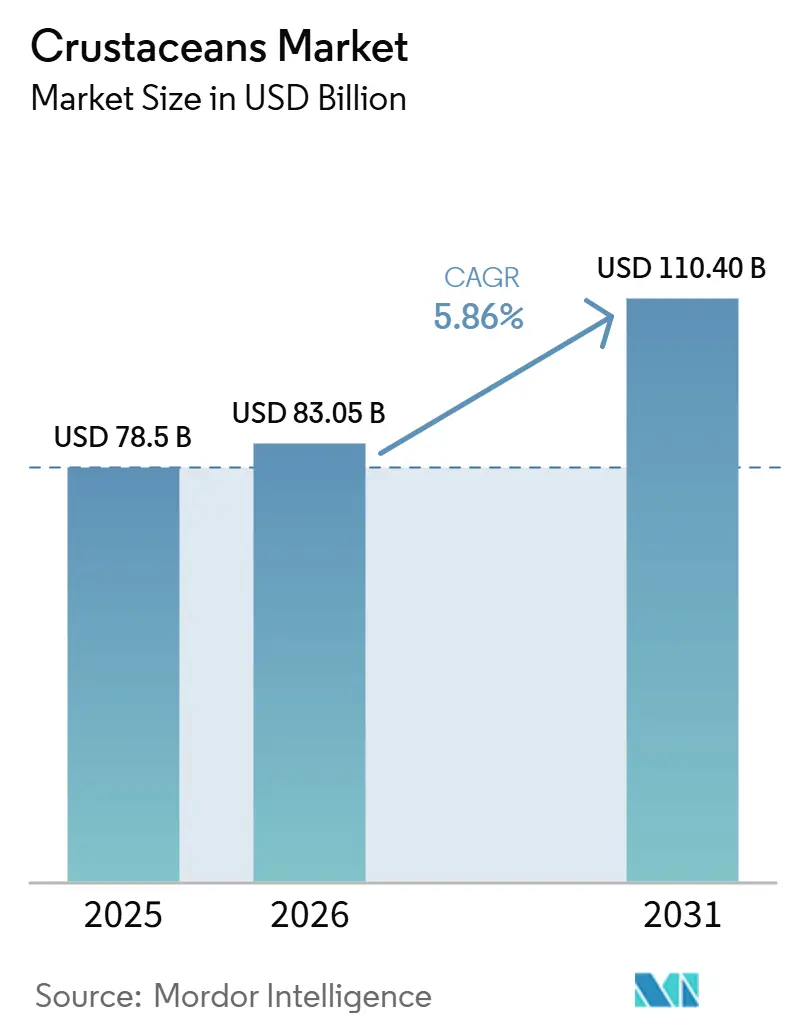
The Crustaceans market size stood at USD 78.50 billion in 2025, USD 83.05 billion in 2026, and is projected to reach USD 110.40 billion by 2031, advancing at a 5.86% CAGR over the forecast period 2026-2031. Expanding flexitarian diets, rapid scaling of Asia-Pacific aquaculture infrastructure, and premiumization trends in live lobster logistics are reshaping competitive dynamics across the crustaceans market. Suppliers are tightening control over hatchery-to-processor flows, leveraging biofloc and recirculating systems to raise stocking densities while limiting disease risk, a shift that raises entry barriers for producers without robust biosecurity protocols. Institutional investors are accelerating capital deployment into land-based closed loops, signaling confidence that zero-discharge designs will sidestep coastal zoning disputes and create a lower-carbon crustaceans market platform. Moreover, blockchain-enabled traceability and computer-vision health monitoring are improving price realization for exporters able to verify provenance in real time, while volatility in soybean meal and diesel prices compresses margins for operators lacking futures-hedging programs.
Key Report Takeaways
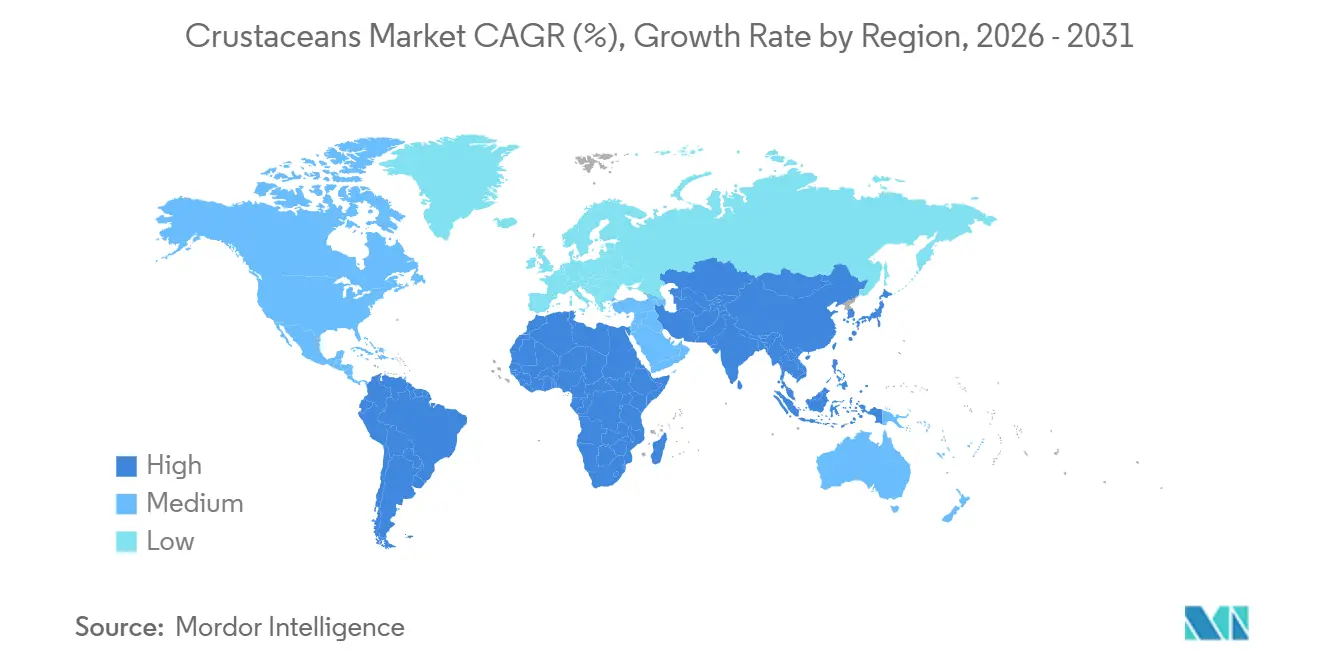
- By geography, Asia-Pacific led the crustaceans market size in 2025, accounting for 59.0%, and South America is anticipated to grow at a 7.3% CAGR through 2031.
Note: Market size and forecast figures in this report are generated using Mordor Intelligence’s proprietary estimation framework, updated with the latest available data and insights as of January 2026.
Global Crustaceans Market Trends and Insights
Drivers Impact Analysis*
| Driver | (~) % Impact on CAGR Forecast | Geographic Relevance | Impact Timeline |
|---|---|---|---|
| Rising global per-capita seafood intake in flexitarian diets | +1.2% | North America, Europe, and urban Asia-Pacific | Medium term (2-4 years) |
| Expansion of Asia-Pacific shrimp aquaculture capacity | +1.5% | Asia-Pacific core, and spillover to South America | Long term (≥ 4 years) |
| Increased export demand from emerging economies | +0.9% | Middle East, Africa, and South America | Medium term (2-4 years) |
| Technological innovations in on-board and on-shore processing | +0.7% | Early adoption in North America and Europe | Short term (≤ 2 years) |
| Blockchain-enabled traceability premiums | +0.6% | Europe, North America, and select Asia-Pacific markets | Short term (≤ 2 years) |
| Investments in low-carbon recirculating aquaculture systems (RAS) | +0.8% | Europe, North America, and pilot projects in the Middle East | Long term (≥ 4 years) |
| Source: Mordor Intelligence | |||
Rising Global Per-Capita Seafood Intake in Flexitarian Diets
Growing consumer preference for seafood as a healthy and sustainable protein source is supporting demand for crustaceans worldwide. According to the Food and Agriculture Organization's SOFIA 2026 report, global per capita availability of aquatic animal food increased to an estimated 21.3 kg in 2024, up from 20.7 kg in 2022, reflecting the continued expansion of seafood consumption across both developed and emerging markets[1]Source: FAO, “SOFIA 2026: Global fisheries and aquaculture production reaches new highs,” fao.org. Increasing urbanization, rising disposable incomes, and the growing adoption of flexitarian diets are encouraging consumers to substitute red meat with seafood, particularly shrimp, crab, and other value-added crustacean products. Producers are responding by expanding ready-to-cook, peeled, and processed product offerings that improve convenience and support retail and foodservice demand. As global seafood consumption continues to rise, sustained demand for crustaceans is anticipated to support production, processing, and trade, driving long-term growth in the global crustaceans market.
Expansion of Asia-Pacific Shrimp Aquaculture Capacity
Asia-Pacific continues to drive the growth of the global crustaceans market through sustained expansion of shrimp aquaculture and ongoing investments in production efficiency. According to the FAO's State of World Fisheries and Aquaculture (SOFIA) 2026, Asia accounted for 76% of global fisheries and aquaculture production in 2024, highlighting the region's central role in global aquatic food supply[2]Source: FAO, “FAO Regional Office for Asia and the Pacific-Asia drives global aquatic production to record high, powered by aquaculture expansion,” fao.org. Producers across major shrimp-producing countries are adopting improved breeding programs, automated feeding systems, enhanced biosecurity measures, and precision pond management to increase productivity and reduce production risks. At the same time, expanding production capacity in Latin America is strengthening export supply, while technological investments in Europe are supporting sustainable and high-value aquaculture production. These developments are improving production efficiency, enhancing supply resilience, and supporting long-term growth in the global crustaceans market.
Increased Export Demand from Emerging Economies
Rising seafood consumption and improving import infrastructure in emerging economies are creating new growth opportunities for the global crustaceans market. Increasing urbanization, higher disposable incomes, and changing dietary preferences are driving demand for shrimp, crab, and other premium seafood products across the Middle East, Africa, and parts of Asia. At the same time, investments in cold-chain logistics, seafood distribution networks, and modern retail channels are improving product availability and supporting higher import volumes. Exporters are increasingly diversifying their destination markets beyond traditional buyers in North America, Europe, and Japan to reduce market concentration risks and capture demand from high-growth economies. This expansion of export destinations is strengthening international trade flows and supporting the long-term growth of the global crustaceans market.
Technological Innovations in On-Board and On-Shore Processing
Automated seafood processing lines introduced by equipment manufacturers are helping processors reduce labor requirements while improving product yield and processing consistency. Ecuadorian exporters rolled out blast-freezing tunnels that chill shrimp to -40 °C in 90 minutes, preserving muscle texture and lowering thaw drip loss. High-pressure processing plants in the United States operate at 87,000 pounds per square inch, killing pathogens without chemicals and opening sushi-grade retail niches. These upgrades enable direct-to-consumer shipping and reduce shrinkage costs, improving margins throughout the crustaceans market.
Restraints Impact Analysis*
| Restraint | (~) % Impact on CAGR Forecast | Geographic Relevance | Impact Timeline |
|---|---|---|---|
| Disease outbreaks in aquaculture ponds | -1.1% | Asia-Pacific core, and spillover to South America | Short term (≤ 2 years) |
| High price volatility of feed and fuel | -0.8% | Global, acute in Asia-Pacific and South America | Medium term (2-4 years) |
| Stricter environmental compliance costs | -0.6% | Asia-Pacific, Europe, and select South American markets | Long term (≥ 4 years) |
| Anti-dumping duties and other trade policy uncertainties | -0.5% | North America, Europe, and indirect impact on Asia-Pacific exporters | Medium term (2-4 years) |
| Source: Mordor Intelligence | |||
Disease Outbreaks in Aquaculture Ponds
Vietnam reported 15%-25% pond yield losses from White Spot Syndrome Virus in 2024, forcing emergency harvests that flooded spot markets and depressed mid-grade prices. Thailand logged 18 Early Mortality Syndrome events in Surat Thani during early 2025, prompting eight-week fallow periods that disrupted contract fulfillment. India’s Andhra Pradesh growers saw vannamei survival rates slip to 60% in late 2024 after WSSV flare-ups. Implementing pathogen-free post-larvae certifications and closed-loop intake systems adds USD 1,500-3,000 per hectare, a burden that smallholders struggle to absorb. Consequently, integrators with in-house hatcheries and veterinary labs expanded their footprint in the crustaceans market by acquiring distressed farms.
High Price Volatility of Feed and Fuel
Feed and fuel price fluctuations remain a major restraint on the crustaceans market because they directly affect production costs and farm profitability. According to the Food and Agriculture Organization (FAO), feed accounts for 30–60% of aquaculture production costs, making crustacean producers highly sensitive to changes in the prices of soybean meal, fishmeal, cereals, vegetable oils, and energy[3]Source: Food and Agriculture Organization, “AQUAFEEDS IN ASIA - A REGIONAL OVERVIEW,” fao.org. Volatility in these globally traded commodities increases uncertainty in production planning and compresses operating margins, particularly for small and medium-sized producers that have limited purchasing power or risk-management capabilities. Rising fuel costs further increase expenses associated with aeration, water circulation, harvesting, transportation, and cold-chain logistics. As a result, producers often delay production expansion, reduce stocking densities, or postpone capital investments during periods of elevated input price volatility, limiting growth across the global crustaceans market.
*Our forecasts treat driver/restraint impacts as directional, not additive. The impact forecasts reflect baseline growth, mix effects, and variable interactions.
Geography Analysis
Asia-Pacific accounted for 59% of the crustaceans market value in 2025, supported by Vietnam, India, Thailand, China, and Bangladesh, which supply a significant share of globally traded farmed shrimp. Vietnam’s aquaculture production includes a significant volume of vannamei shrimp, with the majority exported to key markets such as the United States, European Union, Japan, and South Korea. India’s shrimp exports have shown substantial growth, although anti-dumping regulations are influencing a shift toward Gulf markets. In Indonesia, the adoption of automated feeders by eFishery has enhanced operational efficiency and highlighted the potential of digital tools in optimizing the crustaceans market.
South America delivers the fastest 7.3% CAGR between 2026 and 2031, anchored by Ecuador’s white-shrimp monoculture and Brazil’s emerging vannamei farms. Ecuador experienced significant growth in shrimp exports in 2024, driven by expanded acreage in the Guayas and El Oro provinces and improved biosecurity measures that reduced disease incidence. Brazil's shrimp production showed notable performance, with a considerable portion exported to the European Union. Local producers are exploring pilot projects for Recirculating Aquaculture Systems (RAS) to address disease challenges in estuarine areas. Chile’s king crab fisheries continue to contribute significantly to the economy, although quota adjustments in 2025 have impacted growth despite strong demand from Asian markets.
North America accounts for a significant share of the global market value and is experiencing steady growth. The United States sources shrimp from multiple countries, with India, Ecuador, and Indonesia being key suppliers. Canada is a major exporter of lobster and continues to focus on improving oxygenated container technology to support live arrivals in East Asia. Europe holds a notable portion of the market value and is witnessing growth, supported by increasing certification penetration for imported shrimp. The Middle East and Africa collectively represent a smaller but growing share of the market. Saudi Arabia demonstrates strong demand for seafood, particularly shrimp, while Nigeria’s cold-chain infrastructure plays a crucial role in enabling market expansion beyond coastal areas. These varied regional growth drivers highlight the importance of flexible supply chain routing and tailored certifications within the crustaceans market.


Competitive Landscape
The crustaceans market is characterized by competition among integrated aquaculture companies, seafood processors, exporters, and regional suppliers operating across the global value chain. Companies differentiate themselves through breeding capabilities, farming operations, processing expertise, cold-chain infrastructure, and access to domestic and international markets. Charoen Pokphand Foods operates a feed-to-farm model, supplying contract growers with proprietary vannamei post-larvae and bundled offerings that include feed, probiotics, and processing services. Maruha Nichiro and Nippon Suisan Kaisha utilize sub-zero logistics to serve Japan's sashimi market, achieving 25%–30% premiums over frozen imports while maintaining product quality during peak holiday seasons.
Competitive differentiation is increasingly shaped by investments in integrated production systems, digital aquaculture technologies, and sustainability initiatives. Producers are adopting automated feeding systems, water quality monitoring, and data-driven farm management tools to improve productivity, optimize input use, and strengthen supply chain transparency. Companies are also expanding value-added product portfolios and certification capabilities to meet evolving retailer and consumer requirements. In Europe, Aquaculture Stewardship Council (ASC) certification has become an important market access requirement, providing certified producers with a competitive advantage while increasing compliance expectations for new entrants.
Competitive advantage is increasingly defined less by production capacity and more by control of data, biosecurity protocols, and direct-to-consumer fulfillment. Companies that integrate artificial intelligence-enabled feeding, blockchain-based traceability, and closed-loop water treatment are strengthening their position with retailers facing stricter sustainability and carbon-labeling requirements. Consolidation is likely to continue as well-capitalized players acquire uncertified farms, reinforcing barriers to entry without creating monopoly risk while preserving competitive fluidity within the crustaceans market.
Recent Industry Developments
- January 2026: Food Animal Initiative (FAI), a research and development company focused on aquaculture welfare, has launched a "Shrimp Hub" to help shrimp aquaculture companies implement better welfare practices. Building on its global efforts, including the Tilapia Welfare Egypt Project and partnerships with organizations like Spring Genetics, FAI offers online learning platforms and training programs to enhance animal welfare, now extending its focus to all professionals in the shrimp supply chain.
- October 2025: The French aquaculture company Lisaqua has raised USD 10.69 (EUR 9 million) million in funding to advance the industrialization of its land-based, antibiotic-free shrimp farming process. This financing will support the development of an industrial-scale shrimp farm in Monthyon, with a production capacity of 100 metric tons per year. The project is backed by the French government’s “Première Usine” (First Plant) program, which is part of the France 2030 investment plan.
- July 2024: India's finance minister unveiled measures to bolster the nation's seafood export competitiveness. The minister proposed slashing the Basic Customs Duty (BCD) on select items, including broodstock, polychaete worms, shrimp, and fish feed, down to 5%. Additionally, to further invigorate seafood exports, several inputs essential for producing shrimp and fish feed have been granted exemptions from Customs Duty.


Global Crustaceans Market Report Scope
Crustaceans are a group of aquatic invertebrate animals belonging to the subphylum Crustacea that have a hard exoskeleton, segmented bodies, and jointed appendages. Commercially important crustaceans include shrimp, prawns, crabs, lobsters, crayfish, and krill, which are harvested from capture fisheries or produced through aquaculture for human consumption.
The Crustaceans Market Report is segmented by Geography (North America, South America, Asia-Pacific, Europe, the Middle East, and Africa). The Report Includes Production Analysis (Volume), Consumption Analysis (Value and Volume), Export Analysis (Value and Volume), Import Analysis (Value and Volume),Wholesale Price Trend Analysis and Forecast, List of Key Players, and More. The Market Forecasts are Provided in Terms of Value (USD) and Volume (Metric Tons).
By Geography
| North America | United States | Production Analysis |
| Consumption Analysis (Consumption Value and Volume) | ||
| Import Market Analysis (Import Value, Volume, and Key Supplying Markets) | ||
| Export Market Analysis (Export Value, Volume, and Key Destination Markets) | ||
| Wholesale Price Trend Analysis & Forecast | ||
| Regulatory Framework | ||
| List of Key Players | ||
| Logistics | ||
| Seasonality Analysis | ||
| Canada | Production Analysis | |
| Consumption Analysis (Consumption Value and Volume) | ||
| Import Market Analysis (Import Value, Volume, and Key Supplying Markets) | ||
| Export Market Analysis (Export Value, Volume, and Key Destination Markets) | ||
| Wholesale Price Trend Analysis & Forecast | ||
| Regulatory Framework | ||
| List of Key Players | ||
| Logistics | ||
| Seasonality Analysis | ||
| Mexico | Production Analysis | |
| Consumption Analysis (Consumption Value and Volume) | ||
| Import Market Analysis (Import Value, Volume, and Key Supplying Markets) | ||
| Export Market Analysis (Export Value, Volume, and Key Destination Markets) | ||
| Wholesale Price Trend Analysis & Forecast | ||
| Regulatory Framework | ||
| List of Key Players | ||
| Logistics | ||
| Seasonality Analysis | ||
| Europe | Germany | Production Analysis |
| Consumption Analysis (Consumption Value and Volume) | ||
| Import Market Analysis (Import Value, Volume, and Key Supplying Markets) | ||
| Export Market Analysis (Export Value, Volume, and Key Destination Markets) | ||
| Wholesale Price Trend Analysis & Forecast | ||
| Regulatory Framework | ||
| List of Key Players | ||
| Logistics | ||
| Seasonality Analysis | ||
| United Kingdom | Production Analysis | |
| Consumption Analysis (Consumption Value and Volume) | ||
| Import Market Analysis (Import Value, Volume, and Key Supplying Markets) | ||
| Export Market Analysis (Export Value, Volume, and Key Destination Markets) | ||
| Wholesale Price Trend Analysis & Forecast | ||
| Regulatory Framework | ||
| List of Key Players | ||
| Logistics | ||
| Seasonality Analysis | ||
| Russia | Production Analysis | |
| Consumption Analysis (Consumption Value and Volume) | ||
| Import Market Analysis (Import Value, Volume, and Key Supplying Markets) | ||
| Export Market Analysis (Export Value, Volume, and Key Destination Markets) | ||
| Wholesale Price Trend Analysis & Forecast | ||
| Regulatory Framework | ||
| List of Key Players | ||
| Logistics | ||
| Seasonality Analysis | ||
| France | Production Analysis | |
| Consumption Analysis (Consumption Value and Volume) | ||
| Import Market Analysis (Import Value, Volume, and Key Supplying Markets) | ||
| Export Market Analysis (Export Value, Volume, and Key Destination Markets) | ||
| Wholesale Price Trend Analysis & Forecast | ||
| Regulatory Framework | ||
| List of Key Players | ||
| Logistics | ||
| Seasonality Analysis | ||
| Spain | Production Analysis | |
| Consumption Analysis (Consumption Value and Volume) | ||
| Import Market Analysis (Import Value, Volume, and Key Supplying Markets) | ||
| Export Market Analysis (Export Value, Volume, and Key Destination Markets) | ||
| Wholesale Price Trend Analysis & Forecast | ||
| Regulatory Framework | ||
| List of Key Players | ||
| Logistics | ||
| Seasonality Analysis | ||
| Italy | Production Analysis | |
| Consumption Analysis (Consumption Value and Volume) | ||
| Import Market Analysis (Import Value, Volume, and Key Supplying Markets) | ||
| Export Market Analysis (Export Value, Volume, and Key Destination Markets) | ||
| Wholesale Price Trend Analysis & Forecast | ||
| Regulatory Framework | ||
| List of Key Players | ||
| Logistics | ||
| Seasonality Analysis | ||
| Asia-Pacific | China | Production Analysis |
| Consumption Analysis (Consumption Value and Volume) | ||
| Import Market Analysis (Import Value, Volume, and Key Supplying Markets) | ||
| Export Market Analysis (Export Value, Volume, and Key Destination Markets) | ||
| Wholesale Price Trend Analysis & Forecast | ||
| Regulatory Framework | ||
| List of Key Players | ||
| Logistics | ||
| Seasonality Analysis | ||
| India | Production Analysis | |
| Consumption Analysis (Consumption Value and Volume) | ||
| Import Market Analysis (Import Value, Volume, and Key Supplying Markets) | ||
| Export Market Analysis (Export Value, Volume, and Key Destination Markets) | ||
| Wholesale Price Trend Analysis & Forecast | ||
| Regulatory Framework | ||
| List of Key Players | ||
| Logistics | ||
| Seasonality Analysis | ||
| Vietnam | Production Analysis | |
| Consumption Analysis (Consumption Value and Volume) | ||
| Import Market Analysis (Import Value, Volume, and Key Supplying Markets) | ||
| Export Market Analysis (Export Value, Volume, and Key Destination Markets) | ||
| Wholesale Price Trend Analysis & Forecast | ||
| Regulatory Framework | ||
| List of Key Players | ||
| Logistics | ||
| Seasonality Analysis | ||
| Bangladesh | Production Analysis | |
| Consumption Analysis (Consumption Value and Volume) | ||
| Import Market Analysis (Import Value, Volume, and Key Supplying Markets) | ||
| Export Market Analysis (Export Value, Volume, and Key Destination Markets) | ||
| Wholesale Price Trend Analysis & Forecast | ||
| Regulatory Framework | ||
| List of Key Players | ||
| Logistics | ||
| Seasonality Analysis | ||
| Philippines | Production Analysis | |
| Consumption Analysis (Consumption Value and Volume) | ||
| Import Market Analysis (Import Value, Volume, and Key Supplying Markets) | ||
| Export Market Analysis (Export Value, Volume, and Key Destination Markets) | ||
| Wholesale Price Trend Analysis & Forecast | ||
| Regulatory Framework | ||
| List of Key Players | ||
| Logistics | ||
| Seasonality Analysis | ||
| South America | Brazil | Production Analysis |
| Consumption Analysis (Consumption Value and Volume) | ||
| Import Market Analysis (Import Value, Volume, and Key Supplying Markets) | ||
| Export Market Analysis (Export Value, Volume, and Key Destination Markets) | ||
| Wholesale Price Trend Analysis & Forecast | ||
| Regulatory Framework | ||
| List of Key Players | ||
| Logistics | ||
| Seasonality Analysis | ||
| Chile | Production Analysis | |
| Consumption Analysis (Consumption Value and Volume) | ||
| Import Market Analysis (Import Value, Volume, and Key Supplying Markets) | ||
| Export Market Analysis (Export Value, Volume, and Key Destination Markets) | ||
| Wholesale Price Trend Analysis & Forecast | ||
| Regulatory Framework | ||
| List of Key Players | ||
| Logistics | ||
| Seasonality Analysis | ||
| Middle East | Saudi Arabia | Production Analysis |
| Consumption Analysis (Consumption Value and Volume) | ||
| Import Market Analysis (Import Value, Volume, and Key Supplying Markets) | ||
| Export Market Analysis (Export Value, Volume, and Key Destination Markets) | ||
| Wholesale Price Trend Analysis & Forecast | ||
| Regulatory Framework | ||
| List of Key Players | ||
| Logistics | ||
| Seasonality Analysis | ||
| United Arab Emirates | Production Analysis | |
| Consumption Analysis (Consumption Value and Volume) | ||
| Import Market Analysis (Import Value, Volume, and Key Supplying Markets) | ||
| Export Market Analysis (Export Value, Volume, and Key Destination Markets) | ||
| Wholesale Price Trend Analysis & Forecast | ||
| Regulatory Framework | ||
| List of Key Players | ||
| Logistics | ||
| Seasonality Analysis | ||
| Turkey | Production Analysis | |
| Consumption Analysis (Consumption Value and Volume) | ||
| Import Market Analysis (Import Value, Volume, and Key Supplying Markets) | ||
| Export Market Analysis (Export Value, Volume, and Key Destination Markets) | ||
| Wholesale Price Trend Analysis & Forecast | ||
| Regulatory Framework | ||
| List of Key Players | ||
| Logistics | ||
| Seasonality Analysis | ||
| Africa | Egypt | Production Analysis |
| Consumption Analysis (Consumption Value and Volume) | ||
| Import Market Analysis (Import Value, Volume, and Key Supplying Markets) | ||
| Export Market Analysis (Export Value, Volume, and Key Destination Markets) | ||
| Wholesale Price Trend Analysis & Forecast | ||
| Regulatory Framework | ||
| List of Key Players | ||
| Logistics | ||
| Seasonality Analysis | ||
| Nigeria | Production Analysis | |
| Consumption Analysis (Consumption Value and Volume) | ||
| Import Market Analysis (Import Value, Volume, and Key Supplying Markets) | ||
| Export Market Analysis (Export Value, Volume, and Key Destination Markets) | ||
| Wholesale Price Trend Analysis & Forecast | ||
| Regulatory Framework | ||
| List of Key Players | ||
| Logistics | ||
| Seasonality Analysis | ||
| Kenya | Production Analysis | |
| Consumption Analysis (Consumption Value and Volume) | ||
| Import Market Analysis (Import Value, Volume, and Key Supplying Markets) | ||
| Export Market Analysis (Export Value, Volume, and Key Destination Markets) | ||
| Wholesale Price Trend Analysis & Forecast | ||
| Regulatory Framework | ||
| List of Key Players | ||
| Logistics | ||
| Seasonality Analysis | ||
| By Geography | North America | United States | Production Analysis |
| Consumption Analysis (Consumption Value and Volume) | |||
| Import Market Analysis (Import Value, Volume, and Key Supplying Markets) | |||
| Export Market Analysis (Export Value, Volume, and Key Destination Markets) | |||
| Wholesale Price Trend Analysis & Forecast | |||
| Regulatory Framework | |||
| List of Key Players | |||
| Logistics | |||
| Seasonality Analysis | |||
| Canada | Production Analysis | ||
| Consumption Analysis (Consumption Value and Volume) | |||
| Import Market Analysis (Import Value, Volume, and Key Supplying Markets) | |||
| Export Market Analysis (Export Value, Volume, and Key Destination Markets) | |||
| Wholesale Price Trend Analysis & Forecast | |||
| Regulatory Framework | |||
| List of Key Players | |||
| Logistics | |||
| Seasonality Analysis | |||
| Mexico | Production Analysis | ||
| Consumption Analysis (Consumption Value and Volume) | |||
| Import Market Analysis (Import Value, Volume, and Key Supplying Markets) | |||
| Export Market Analysis (Export Value, Volume, and Key Destination Markets) | |||
| Wholesale Price Trend Analysis & Forecast | |||
| Regulatory Framework | |||
| List of Key Players | |||
| Logistics | |||
| Seasonality Analysis | |||
| Europe | Germany | Production Analysis | |
| Consumption Analysis (Consumption Value and Volume) | |||
| Import Market Analysis (Import Value, Volume, and Key Supplying Markets) | |||
| Export Market Analysis (Export Value, Volume, and Key Destination Markets) | |||
| Wholesale Price Trend Analysis & Forecast | |||
| Regulatory Framework | |||
| List of Key Players | |||
| Logistics | |||
| Seasonality Analysis | |||
| United Kingdom | Production Analysis | ||
| Consumption Analysis (Consumption Value and Volume) | |||
| Import Market Analysis (Import Value, Volume, and Key Supplying Markets) | |||
| Export Market Analysis (Export Value, Volume, and Key Destination Markets) | |||
| Wholesale Price Trend Analysis & Forecast | |||
| Regulatory Framework | |||
| List of Key Players | |||
| Logistics | |||
| Seasonality Analysis | |||
| Russia | Production Analysis | ||
| Consumption Analysis (Consumption Value and Volume) | |||
| Import Market Analysis (Import Value, Volume, and Key Supplying Markets) | |||
| Export Market Analysis (Export Value, Volume, and Key Destination Markets) | |||
| Wholesale Price Trend Analysis & Forecast | |||
| Regulatory Framework | |||
| List of Key Players | |||
| Logistics | |||
| Seasonality Analysis | |||
| France | Production Analysis | ||
| Consumption Analysis (Consumption Value and Volume) | |||
| Import Market Analysis (Import Value, Volume, and Key Supplying Markets) | |||
| Export Market Analysis (Export Value, Volume, and Key Destination Markets) | |||
| Wholesale Price Trend Analysis & Forecast | |||
| Regulatory Framework | |||
| List of Key Players | |||
| Logistics | |||
| Seasonality Analysis | |||
| Spain | Production Analysis | ||
| Consumption Analysis (Consumption Value and Volume) | |||
| Import Market Analysis (Import Value, Volume, and Key Supplying Markets) | |||
| Export Market Analysis (Export Value, Volume, and Key Destination Markets) | |||
| Wholesale Price Trend Analysis & Forecast | |||
| Regulatory Framework | |||
| List of Key Players | |||
| Logistics | |||
| Seasonality Analysis | |||
| Italy | Production Analysis | ||
| Consumption Analysis (Consumption Value and Volume) | |||
| Import Market Analysis (Import Value, Volume, and Key Supplying Markets) | |||
| Export Market Analysis (Export Value, Volume, and Key Destination Markets) | |||
| Wholesale Price Trend Analysis & Forecast | |||
| Regulatory Framework | |||
| List of Key Players | |||
| Logistics | |||
| Seasonality Analysis | |||
| Asia-Pacific | China | Production Analysis | |
| Consumption Analysis (Consumption Value and Volume) | |||
| Import Market Analysis (Import Value, Volume, and Key Supplying Markets) | |||
| Export Market Analysis (Export Value, Volume, and Key Destination Markets) | |||
| Wholesale Price Trend Analysis & Forecast | |||
| Regulatory Framework | |||
| List of Key Players | |||
| Logistics | |||
| Seasonality Analysis | |||
| India | Production Analysis | ||
| Consumption Analysis (Consumption Value and Volume) | |||
| Import Market Analysis (Import Value, Volume, and Key Supplying Markets) | |||
| Export Market Analysis (Export Value, Volume, and Key Destination Markets) | |||
| Wholesale Price Trend Analysis & Forecast | |||
| Regulatory Framework | |||
| List of Key Players | |||
| Logistics | |||
| Seasonality Analysis | |||
| Vietnam | Production Analysis | ||
| Consumption Analysis (Consumption Value and Volume) | |||
| Import Market Analysis (Import Value, Volume, and Key Supplying Markets) | |||
| Export Market Analysis (Export Value, Volume, and Key Destination Markets) | |||
| Wholesale Price Trend Analysis & Forecast | |||
| Regulatory Framework | |||
| List of Key Players | |||
| Logistics | |||
| Seasonality Analysis | |||
| Bangladesh | Production Analysis | ||
| Consumption Analysis (Consumption Value and Volume) | |||
| Import Market Analysis (Import Value, Volume, and Key Supplying Markets) | |||
| Export Market Analysis (Export Value, Volume, and Key Destination Markets) | |||
| Wholesale Price Trend Analysis & Forecast | |||
| Regulatory Framework | |||
| List of Key Players | |||
| Logistics | |||
| Seasonality Analysis | |||
| Philippines | Production Analysis | ||
| Consumption Analysis (Consumption Value and Volume) | |||
| Import Market Analysis (Import Value, Volume, and Key Supplying Markets) | |||
| Export Market Analysis (Export Value, Volume, and Key Destination Markets) | |||
| Wholesale Price Trend Analysis & Forecast | |||
| Regulatory Framework | |||
| List of Key Players | |||
| Logistics | |||
| Seasonality Analysis | |||
| South America | Brazil | Production Analysis | |
| Consumption Analysis (Consumption Value and Volume) | |||
| Import Market Analysis (Import Value, Volume, and Key Supplying Markets) | |||
| Export Market Analysis (Export Value, Volume, and Key Destination Markets) | |||
| Wholesale Price Trend Analysis & Forecast | |||
| Regulatory Framework | |||
| List of Key Players | |||
| Logistics | |||
| Seasonality Analysis | |||
| Chile | Production Analysis | ||
| Consumption Analysis (Consumption Value and Volume) | |||
| Import Market Analysis (Import Value, Volume, and Key Supplying Markets) | |||
| Export Market Analysis (Export Value, Volume, and Key Destination Markets) | |||
| Wholesale Price Trend Analysis & Forecast | |||
| Regulatory Framework | |||
| List of Key Players | |||
| Logistics | |||
| Seasonality Analysis | |||
| Middle East | Saudi Arabia | Production Analysis | |
| Consumption Analysis (Consumption Value and Volume) | |||
| Import Market Analysis (Import Value, Volume, and Key Supplying Markets) | |||
| Export Market Analysis (Export Value, Volume, and Key Destination Markets) | |||
| Wholesale Price Trend Analysis & Forecast | |||
| Regulatory Framework | |||
| List of Key Players | |||
| Logistics | |||
| Seasonality Analysis | |||
| United Arab Emirates | Production Analysis | ||
| Consumption Analysis (Consumption Value and Volume) | |||
| Import Market Analysis (Import Value, Volume, and Key Supplying Markets) | |||
| Export Market Analysis (Export Value, Volume, and Key Destination Markets) | |||
| Wholesale Price Trend Analysis & Forecast | |||
| Regulatory Framework | |||
| List of Key Players | |||
| Logistics | |||
| Seasonality Analysis | |||
| Turkey | Production Analysis | ||
| Consumption Analysis (Consumption Value and Volume) | |||
| Import Market Analysis (Import Value, Volume, and Key Supplying Markets) | |||
| Export Market Analysis (Export Value, Volume, and Key Destination Markets) | |||
| Wholesale Price Trend Analysis & Forecast | |||
| Regulatory Framework | |||
| List of Key Players | |||
| Logistics | |||
| Seasonality Analysis | |||
| Africa | Egypt | Production Analysis | |
| Consumption Analysis (Consumption Value and Volume) | |||
| Import Market Analysis (Import Value, Volume, and Key Supplying Markets) | |||
| Export Market Analysis (Export Value, Volume, and Key Destination Markets) | |||
| Wholesale Price Trend Analysis & Forecast | |||
| Regulatory Framework | |||
| List of Key Players | |||
| Logistics | |||
| Seasonality Analysis | |||
| Nigeria | Production Analysis | ||
| Consumption Analysis (Consumption Value and Volume) | |||
| Import Market Analysis (Import Value, Volume, and Key Supplying Markets) | |||
| Export Market Analysis (Export Value, Volume, and Key Destination Markets) | |||
| Wholesale Price Trend Analysis & Forecast | |||
| Regulatory Framework | |||
| List of Key Players | |||
| Logistics | |||
| Seasonality Analysis | |||
| Kenya | Production Analysis | ||
| Consumption Analysis (Consumption Value and Volume) | |||
| Import Market Analysis (Import Value, Volume, and Key Supplying Markets) | |||
| Export Market Analysis (Export Value, Volume, and Key Destination Markets) | |||
| Wholesale Price Trend Analysis & Forecast | |||
| Regulatory Framework | |||
| List of Key Players | |||
| Logistics | |||
| Seasonality Analysis | |||


Key Questions Answered in the Report
What is the global value of the crustaceans market in 2026?
The crustaceans market size is USD 78.5 billion in 2026.
Which region is expanding fastest?
South America is advancing at a 7.3% CAGR from 2026 to 2031, propelled by Ecuador’s and Brazil’s shrimp capacity additions.
Why are traceability systems important for exporters?
Blockchain traceability can secure 12%-15% retail price premiums by verifying farm origin and antibiotic records, especially in Europe.
What are the main cost headwinds for producers?
Disease management, soybean meal price swings, diesel inflation, and new effluent-control standards collectively squeeze farm margins.
Page last updated on:


 Your data is secure and never sold or shared.


