
Crowdsourced Testing Market Size and Share
Market Overview
| Study Period | 2020 - 2031 |
|---|---|
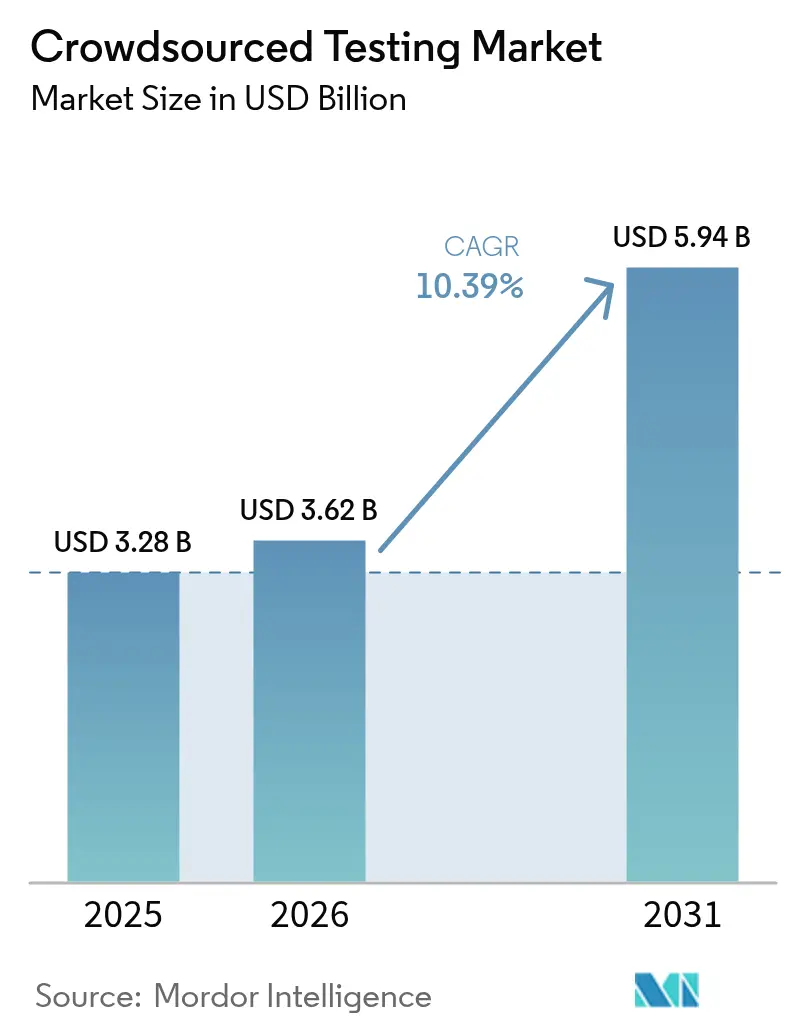
| Market Size (2026) | USD 3.62 Billion |
| Market Size (2031) | USD 5.94 Billion |
| Growth Rate (2026 - 2031) | 10.39 % |
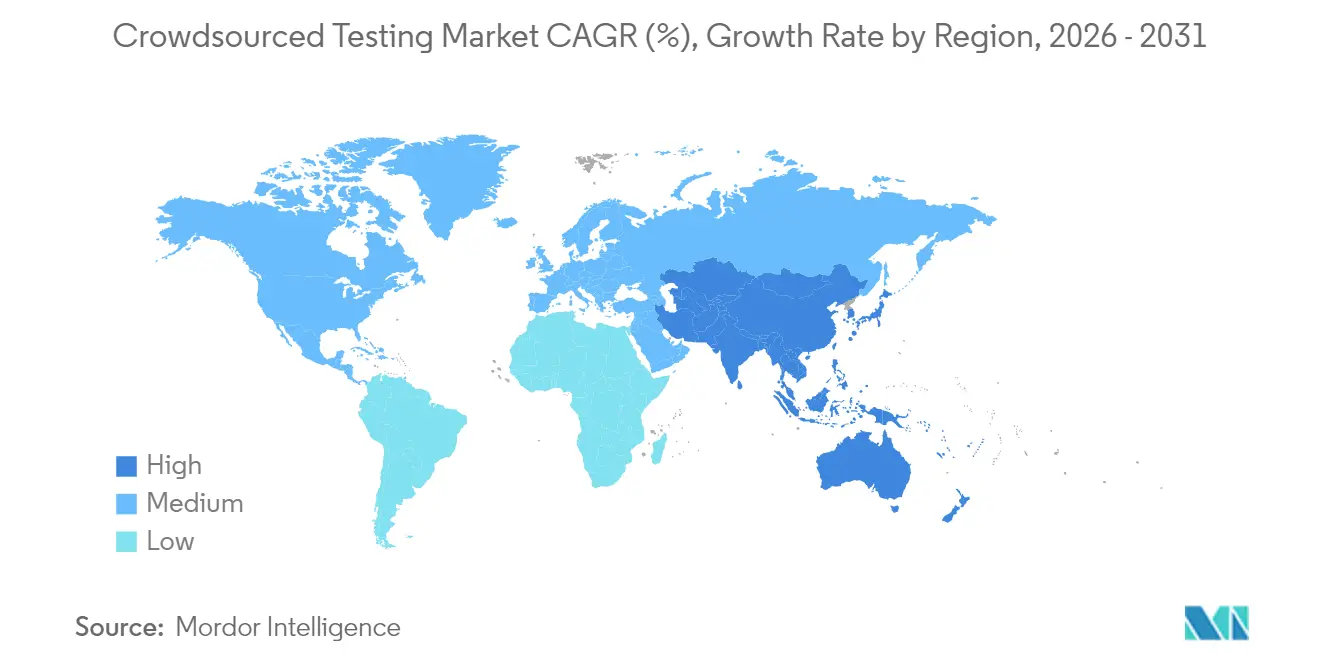
| Fastest Growing Market | Asia Pacific |
| Largest Market | North America |
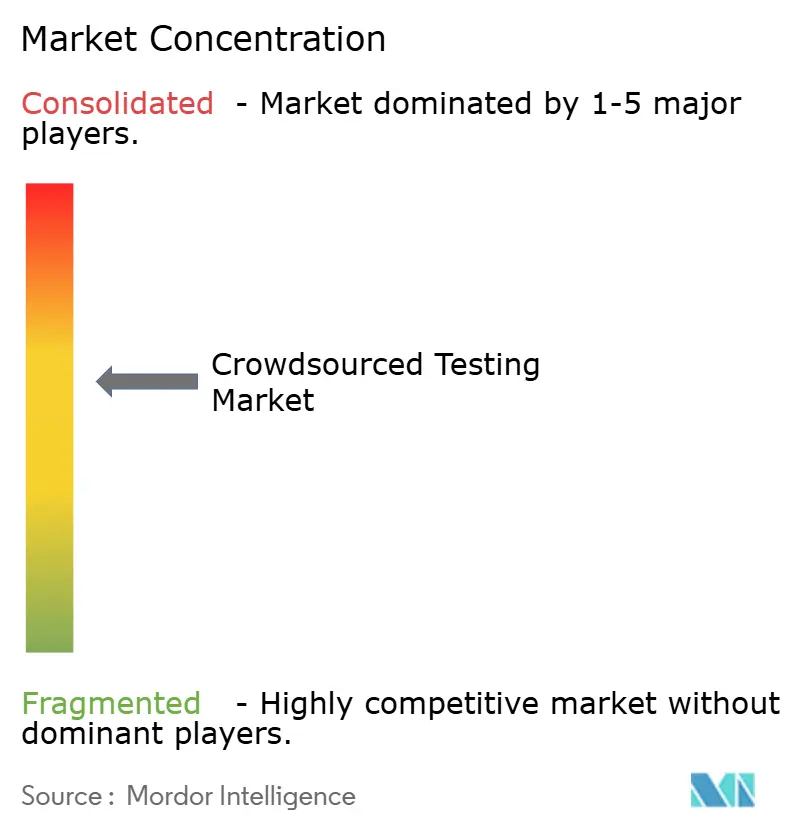
| Market Concentration | Medium |
Major Players *Disclaimer: Major Players sorted in no particular order Image © Mordor Intelligence. Reuse requires attribution under CC BY 4.0. | |
Crowdsourced Testing Market Analysis by Mordor Intelligence
The crowdsource testing market size is expected to grow from USD 3.28 billion in 2025 to USD 3.62 billion in 2026 and is forecast to reach USD 5.94 billion by 2031 at 10.39% CAGR over 2026-2031. Sustained momentum reflects enterprises shifting from centralized quality-assurance teams toward globally distributed tester communities able to validate software in real-world scenarios. Accelerating mobile-application launches, mounting device and operating-system fragmentation, and tightening security and compliance mandates in financial services and healthcare continue to steer demand. Competitive focus turns to AI-driven orchestration that cuts test-cycle time, while rising IoT adoption opens new revenue streams for platforms that can replicate complex edge environments. Meanwhile, the crowdsource testing market benefits from cost-flexible business models attractive to cash-constrained SMEs that need rapid quality validation without permanent staffing overhead.
Key Report Takeaways
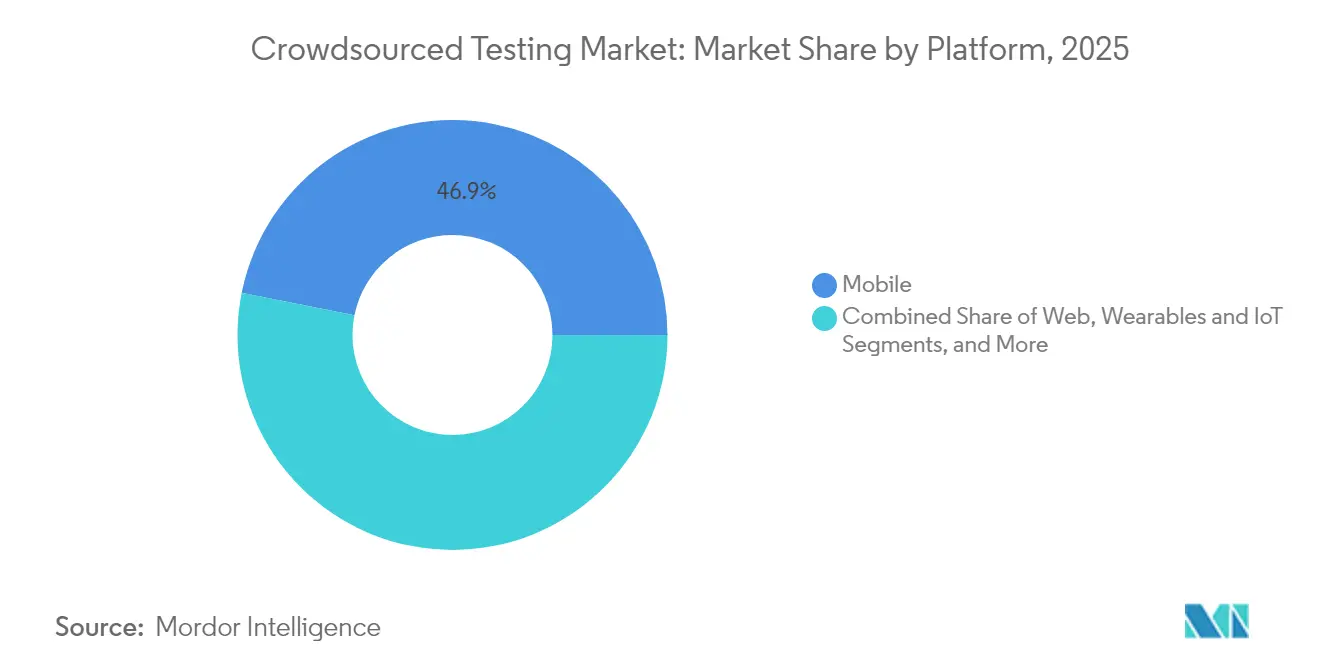
- By platform, mobile held 46.85% of the crowdsource testing market share in 2025, whereas wearables and IoT applications are set to expand at an 11.62% CAGR through 2031.
- By organization size, large enterprises accounted for 55.60% of the crowdsource testing market size in 2025; SMEs are forecast to log the fastest 10.55% CAGR.
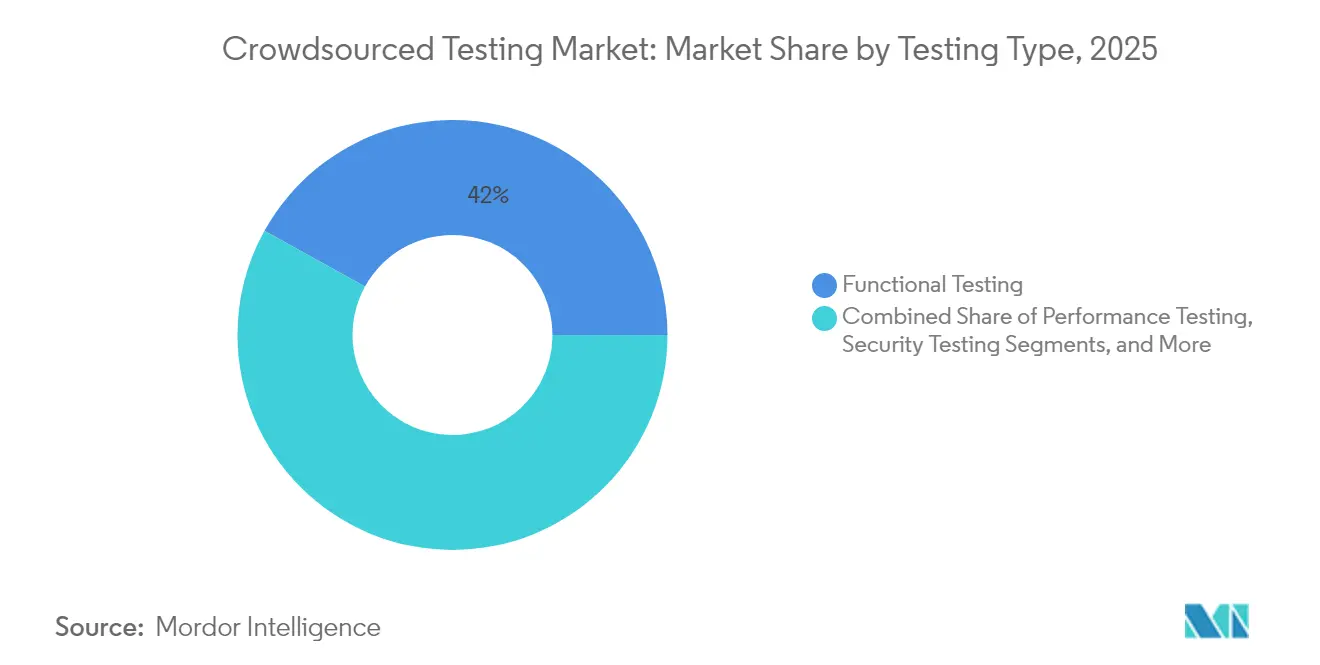
- By testing type, functional testing led with 41.95% revenue share in 2025; penetration testing is poised to accelerate at a 12.45% CAGR to 2031.
- By end-user vertical, BFSI commanded 27.25% share of the crowdsource testing market size in 2025, while healthcare and life sciences are projected to grow at an 11.05% CAGR.
- By region, North America dominated with 36.10% crowdsource testing market share in 2025; Asia-Pacific is projected to advance at a 12.10% CAGR.
Note: Market size and forecast figures in this report are generated using Mordor Intelligence’s proprietary estimation framework, updated with the latest available data and insights as of 2026.
Market Trends and Insights
Drivers Impact Analysis of Crowdsourced Testing Market*
| Driver | (~) % Impact on CAGR Forecast | Geographic Relevance | Impact Timeline |
|---|---|---|---|
| Rise in OS / Device / App Proliferation (mainstream) | +2.8% | Global, with higher impact in North America and APAC | Medium term (2-4 years) |
| Shift to Agile and DevOps Requiring Continuous QA (mainstream) | +2.1% | Global, with higher impact in North America and Europe | Short term (≤ 2 years) |
| Cost-efficient Scaling of QA via Global Tester Pools (mainstream) | +1.9% | Global, with higher impact in emerging markets | Medium term (2-4 years) |
| Growing Pen-Testing Mandates for App-Sec Compliance (under-the-radar) | +1.5% | North America and Europe | Medium term (2-4 years) |
| AI-assisted Crowd Orchestration Unlocks Real-time Feedback (under-the-radar) | +1.3% | Global, with early adoption in North America | Long term (≥ 4 years) |
| Expansion of Mobile and IoT App Economies | +1.2% | Global, with higher impact in APAC | Medium term (2-4 years) |
| Source: Mordor Intelligence | |||
AI-assisted crowd orchestration unlocks real-time feedback
Machine-learning algorithms streamline tester selection, task routing, and result aggregation, reducing project turn-around times by 40% and boosting defect-detection accuracy on Global App Testing’s platform[1]. Seamless integration with continuous-integration pipelines removes prominent delays in agile release cycles. As tester metadata grows, algorithmic precision improves, creating reinforcing network effects that raise switching costs for enterprise customers. These dynamics reinforce the long-run competitive advantage of early movers in the crowdsource testing market.
Growing pen-testing mandates for app-sec compliance
Regulations such as the EU Digital Operational Resilience Act compel financial institutions to conduct recurring penetration tests, pushing enterprises toward external vulnerability-assessment communities capable of simulating diverse attack vectors.[2] Bugcrowd processed more than 184 million security tests in 2024, underscoring the widening gap between internal resources and modern threat landscapes. When financial firms blended in-house security teams with crowdsourced penetration programs, vulnerability detection improved by 45%, cementing security testing as a durable growth pocket.
Cost-efficient scaling of QA via global tester pools
Variable-cost engagement models let smaller firms dial test capacity up or down to match release schedules, sparing them the fixed payroll of full-time QA teams. SMEs leveraging crowdsource programs reported meaningful cost avoidance while accessing regional devices and network conditions that in-house labs cannot replicate.[3] This economic elasticity accelerates innovation sprints and reduces time-to-market for resource-constrained digital start-ups.
Shift to agile and DevOps requiring continuous QA
DevOps teams need testing executed in parallel with development streams, rather than in separate phases. Crowdsource testing services embed directly into continuous-integration workflows, enabling organizations to shrink average release cycles by 50% while sustaining quality targets. Microservice architectures only heighten the need for broad environment coverage that distributed tester communities satisfy.
Restraints Impact Analysis of Crowdsourced Testing Market*
| Restraint | (~) % Impact on CAGR Forecast | Geographic Relevance | Impact Timeline |
|---|---|---|---|
| Data-privacy and IP-leakage Concerns (mainstream) | -1.4% | Global, with higher impact in Europe and North America | Medium term (2-4 years) |
| Fragmented Tester Quality and Governance Gaps (mainstream) | -1.2% | Global | Short term (≤ 2 years) |
| Rising Crowd-worker Acquisition Costs in Tier-1 Regions (under-the-radar) | -0.8% | North America and Western Europe | Medium term (2-4 years) |
| Limited Domain Knowledge for Regulated Industries (under-the-radar) | -0.7% | Global, with higher impact in highly regulated markets | Long term (≥ 4 years) |
| Source: Mordor Intelligence | |||
Data-privacy and IP-leakage concerns
Enterprises handling proprietary code hesitate to expose pre-release builds on open tester networks. Research highlights blockchain-anchored audit trails that secure intellectual property while maintaining transparency, yet regulatory ambiguity and cross-border data-transfer rules still discourage broad adoption.
Fragmented tester quality and governance gaps
Absence of universal certification for crowd testers leads to inconsistent defect-detection rates and variable test-execution standards. Platforms are responding with competency-ranking engines and real-time performance dashboards, but until governance frameworks mature, organizations must invest in secondary validation layers, diluting cost savings.
*Our forecasts treat driver/restraint impacts as directional, not additive. The impact forecasts reflect baseline growth, mix effects, and variable interactions.
Crowdsourced Testing Market Segment Analysis
By Platform:
Mobile dominance expands IoT demandMobile applications accounted for 46.85% of crowdsource testing market share in 2025 on the back of device fragmentation that obliges validation across hundreds of handset models. The crowdsource testing market size tied to mobile is forecast to expand as 5G adoption heightens latency-sensitive use cases. IoT and wearables, while still a smaller base, are pacing at an 11.62% CAGR to 2031 as smart-home, industrial, and healthcare endpoints multiply. According to the US NIST IoT Advisory Board, interoperability and security remain top challenges, magnifying testing requirements in multisensor edge environments. Web and desktop segments together form the remainder but are ceding share to mobile-first initiatives.
Second-order effects arise from the 5G-IoT convergence that mandates end-to-end testing in ultra-low-latency contexts. Traditional lab setups rarely replicate real-world network jitter, whereas distributed testers operating on live networks surface defects earlier. Consequently, investors continue to back platforms that prioritize field-based testing at scale, reinforcing the leadership of the crowdsource testing market.

By Organization Size:
SME adoption acceleratesLarge enterprises retained 55.60% of 2025 revenue, often blending in-house and external testers for user acceptance, localization, or security sprints. Still, SMEs produced the fastest 10.55% CAGR because variable-cost models align with lean budgeting. Studies show SMEs leveraging crowdsource testing and slashing upfront infrastructure outlays while broadening coverage across markets otherwise unreachable on tight timelines. With venture funding cycling back into early-stage software firms, the pipeline of SME customers for the crowdsource testing market remains strong.
Platform providers adapt pricing tiers to lower entry barriers, offering usage-based subscriptions that automatically scale with build frequency. This approach embeds testing into the development cadence of start-ups without locking them into multi-year contracts, further enlarging the crowdsource testing industry’s addressable base.
By Testing Type:
Security testing gains momentumFunctional testing stayed dominant at 41.95% in 2025, but penetration testing now logs a 12.45% CAGR as regulators lean on continuous security validation. Continual regulatory escalation ensures security-focused engagements command premium bill rates, pushing platforms to curate vetted white-hat communities. AI-assisted exploit generation further boosts demand because it equips testers with toolkits that automate reconnaissance, enabling deeper coverage within contract windows.
By End-User Vertical:
Healthcare transformation acceleratesBFSI held 27.25% of the crowdsource testing market size in 2025 due to open-banking rollouts and payment-security mandates. Healthcare and life sciences, however, chart the steepest 11.05% CAGR, driven by telemedicine, remote monitoring, and digital therapeutics that must meet stringent usability and privacy expectations. Real-world validation across patient devices ensures accessibility compliance and patient trust, propelling healthcare clients to allocate higher testing budgets.
Retail, e-commerce, and media collectively represent a sizable share as consumer apps race for frictionless experiences and uptime during peak seasons. Edge cases, such as disability-access evaluation or cross-browser rendering, underscore the crowdsource testing market’s versatility for customer-centric industries.
Geography Analysis
North America Crowdsourced Testing Market
North America accounted for 36.10% of 2025 revenue, anchored by mature DevOps adoption and strict compliance regimes such as SOX, HIPAA, and state-level data-privacy statutes. Deep venture ecosystems spur continual tooling innovation, and enterprise buyers value AI-enabled test orchestration that fits existing CI/CD pipelines. As major platforms mature, clients increasingly shift from project-based to subscription engagements, stabilizing revenue visibility across the crowdsource testing market.
APAC Crowdsourced Testing Market
Asia-Pacific is the fastest-growing geography at a 12.10% CAGR to 2031, fueled by mobile-first digital agendas in China, India, and Southeast Asia. GSMA counts 1.8 billion mobile subscribers in the region, with mobile internet contributing 5.3% of GDP, highlighting vast application footprints requiring real-world validation. Government initiatives around smart cities and consumer fintech heighten the need for local language, device, and network testing coverage, positioning regional tester communities as priceless assets.
EMEA and South America Crowdsourced Testing Market
Europe captures roughly one-quarter of global spend. GDPR, the Digital Services Act, and the NIS 2 Directive all demand rigorous software assurance, boosting penetration and compliance testing engagements. Platforms invest in tester certification and secure data-handling frameworks to satisfy stringent European privacy rules. Meanwhile, South America and the Middle East, and Africa remain nascent but are closing infrastructure gaps quickly. Smartphone adoption and fintech expansion set the stage for double-digit growth, though tester-quality governance and cross-border data provisions remain hurdles.
Regulatory Landscape
Crowdsourced testing operates within a growing set of software assurance, privacy, and supply-chain security requirements that shape how external tester communities are onboarded, segmented, and governed. In the United States, January 2026 guidance from the White House Office of Management and Budget (OMB Memorandum M-26-05) reinforced a risk-based approach to software and hardware security for federal contexts. That guidance increased emphasis on evidence-driven controls, secure development practices, and accountability across the delivery chain. In parallel, NIST guidance for vulnerability disclosure programs (Vulnerability Disclosure Program guidance aligned with SP 800-216) supports more structured VDP processes, strengthening the role of managed crowdsourced security workflows for enterprises and contractors.
Jurisdiction-specific constraints also shape cross-border execution, particularly for security and compliance testing. The US Department of Justice Data Security Program (April 2025) restricts who can perform certain security audit activities involving sensitive personal or government-related data when connected to covered persons or countries of concern. This pushes providers to implement geo-fencing, data minimization, and access controls for tester pools. In China, GB/T 43741-2024 formalizes network security crowd-testing service expectations, and specifies that cyber crowd-testing for critical information infrastructure occurs under the guidance of authorized cybersecurity departments. This framework drives demand for documented governance and controlled tester engagement. At the process level, standard frameworks such as ISO/IEC/IEEE 29119 (software testing series, 2021-2022) and domestic specifications like T/CQAE 11017-2021 and T/CQAE 11020-2022 contribute to more formal service-quality assurance requirements for crowdsourcing organizers and platforms.
Value Chain Analysis
The crowdsourced testing value chain begins with demand owners, including BFSI, healthcare, IT and telecom, retail and e-commerce, and media firms that need real-world coverage for functional, performance, usability, accessibility, and security testing across mobile, web, desktop, and emerging IoT endpoints. Inputs include diverse real devices and browsers, live network conditions (Wi-Fi, 4G, 5G), localized language and cultural contexts, and tester skill profiles ranging from QA professionals to domain users. Platforms sit at the core of delivery by providing test design intake, secure build distribution, crowd recruitment and vetting, orchestration, evidence capture (logs, screenshots, recordings), defect triage, and analytics for release readiness.
Downstream delivery is closely tied to SDLC and DevOps tooling, where findings are converted into tickets and workflow artifacts. As a result, integrations and partner ecosystems matter in execution. Recent partnerships show tighter coupling with identity and developer workflows, including UserTesting partnered with LinkedIn (April 2025) to use Verified on LinkedIn for participant identity verification, addressing trust and panel integrity concerns. LambdaTest also expanded alliances spanning DevOps and mobile automation, including a partnership with KineticSkunk (March 2025) and deeper collaboration with Appium (July 2025). Ecosystem build-out extends functional QA into security and broader delivery partners, as reflected in Testlio's Apex Partner Programme with Bugcrowd and InnoWave (October 2025). Key bottlenecks include ensuring qualified tester availability for specific geographies and regulated domains, managing data privacy and IP exposure during pre-release distribution, and maintaining consistent execution quality across large, distributed tester communities.
Competitive Landscape
The crowdsource testing market is moderately fragmented. Providers differentiate through AI-first orchestration, domain specialization, and seamless CI/CD integrations. Global App Testing, Bugcrowd, Testlio, and Cigniti continue to scale tester communities while investing in automation that curates skills and allocates tasks with minimal human oversight.
Strategic activity concentrates on broadening platform ecosystems: API marketplaces, plug-ins for Jenkins and GitLab, and analytics dashboards that convert raw test data into release readiness insights. Partnerships form with cybersecurity vendors to embed crowdsourced pen-testing into full-stack DevSecOps programs. Incremental acquisitions target niche expertise such as AR/VR testing or automotive-grade software assurance to deepen vertical portfolios.
Emerging entrants pursue vertical specialization, tailoring tester pools and workflows to regulated fields like healthcare or automotive functional safety. Blockchain-anchored intellectual-property protection gets early-stage funding, courting clients wary of code leakage. Competitive intensity also reflects rising tester-acquisition spend in tier-1 economies, prompting firms to seed communities in Latin America, Africa, and Southeast Asia, where device diversity adds incremental value at sustainable cost.
Crowdsourced Testing Industry Leaders
-
Applause App Quality Inc.
-
Testbirds GmbH
-
Global App Testing
-
Bugcrowd Inc.
-
test IO Inc.
- *Disclaimer: Major Players sorted in no particular order
Crowdsourced Testing Market Companies Covered in this Report
- Applause App Quality Inc.
- Global App Testing
- test IO Inc.
- Testbirds GmbH
- Cobalt Labs Inc.
- Bugcrowd Inc.
- Synack Inc.
- Rainforest QA Inc.
- Digivante Ltd.
- Flatworld Solutions Pvt Ltd
- Qualitest Group
- QA InfoTech (QAIT)
- Infosys Ltd (Digital Assurance)
- Planit Testing
- Qualitrix Technologies Pvt Ltd
- CrowdSource Testing SpA
- Cigniti Technologies Ltd
- Frugal Testing
- Ubertesters Inc.
- Testlio Inc.
- UserTesting Inc.
- Digisphere Solutions (99tests)
Market Opportunities and Future Outlook
New demand pockets are emerging around testing AI-enabled digital experiences, where automated scripts alone do not capture conversational, cultural, and accessibility edge cases. Platforms are productizing human-in-the-loop evaluation and rapid feedback loops for AI features embedded into everyday software workflows, as illustrated by Global App Testing launching GAT AI GroundTruth (March 2026) for human-centered generative AI evaluation and Digivante launching JourneyEval AI (June 2026) to deliver structured crowd-based evaluations within 24 hours. This combination creates whitespace for providers that can pair crowd governance, fast turnaround, and evidence capture with Responsible AI policies, accessibility checks, and enterprise-grade reporting.
Another opportunity area is tighter alignment between crowdsourced security testing and compliance-driven programs, particularly where government and regulated-industry buyers need structured processes and approved channels. Bugcrowd's partnership with Carahsoft (April 2026) to offer FedRAMP-authorized proactive security testing solutions highlights a pathway for crowdsourced security providers to access public sector procurement through compliance-aligned distribution. In parallel, policy and standards signals such as OMB M-26-05 (January 2026) and NIST-aligned vulnerability disclosure guidance reinforce demand for well-governed external testing mechanisms. Constraints such as the DOJ Data Security Program (April 2025) also elevate the need for data residency controls, segmented tester pools, and auditable access management. Providers that operationalize these controls, along with integrations into CI/CD toolchains and identity verification, can broaden usage beyond episodic projects into ongoing release workflows for mobile, IoT, and security testing.
Recent Industry Developments in Crowdsourced Testing Market
- June 2026: Applause announced a collaboration with Progress Software to reduce accessibility issues in the ShareFile platform. The collaboration underscores how crowd-based testing is being applied to accessibility and usability requirements inside enterprise SaaS products, expanding crowdtesting from functional QA into compliance-oriented digital experience validation.
- May 2026: Bugcrowd launched reinforcement learning environments designed to help AI models learn real-world security skills. This broadened Bugcrowd's human-augmented security testing toolkit toward AI-assisted workflows, supporting faster triage and scalable testing programs for modern application security needs.
- February 2025: Applause expanded accessibility expertise and testing coverage for Webex by Cisco. The engagement highlights enterprise buyer demand for specialized crowd capabilities tied to accessibility and digital experience quality in widely deployed collaboration software.
Crowdsourced Testing Market Report Scope and Research Methodology
Market Definition and Coverage
This market covers paid, third party crowdsourced software testing services where distributed external testers validate digital products on real devices, OS versions, networks, and in real user conditions, including localization and language requirements.
Scope exclusions: We exclude in house beta communities, unpaid open source testing contributions, and pure bug bounty programs that only reward security findings.
Segments Covered in This Report
- By Platform
- Web
- Mobile
- Desktop
- Wearables and IoT
- Others
- By Organization Size
- Small and Medium-sized Enterprises (SMEs)
- Large Enterprises
- By Testing Type
- Functional Testing
- Performance Testing
- Security / Pen-Testing
- Others
- By End-user Vertical
- BFSI
- IT and Telecom
- Retail and E-commerce
- Healthcare and Life Sciences
- Media and Entertainment
- Others
- By Geography
- North America
- United States
- Canada
- Mexico
- South America
- Brazil
- Argentina
- Rest of South America
- Europe
- Germany
- United Kingdom
- France
- Spain
- Italy
- Rest of Europe
- Asia-Pacific
- China
- India
- Japan
- South Korea
- Australia
- Rest of Asia-Pacific
- Middle East and Africa
- GCC
- Turkey
- South Africa
- Rest of Middle East and Africa
- North America
Data Sources, Market Sizing, and Validation
Desk Research
Desk research starts with public baselines that explain how much software is being built and maintained, and what quality and security requirements are tightening. We mainly refer to sources such as the US Bureau of Labor Statistics for software workforce trends, NIST for software and cybersecurity guidance, and ISO and IEC publications that shape testing and quality expectations.
To ground the model in real world demand signals, we also use sources such as the US SEC filings of listed buyers and service providers, OECD and World Bank indicators for digital adoption, and national telecom or ICT authority releases where available. Patent databases are used to sanity check the pace of automation, test automation enabled by AI, and device coverage themes that affect service mix. For company revenue splits and faster cross checks on private entities, we selectively use paid company financials and news intelligence subscriptions. These examples are not exhaustive, and many other public sources were also used to collect data, validate assumptions, and clarify open questions.
Primary Interviews and Surveys
Primary interviews focus on validating what clients actually buy and how vendors price and deliver it, which is hard to infer from public data alone. We speak with service providers, platform operators, test community managers, and enterprise QA leaders across Americas, EMEA, and APAC so assumptions on device coverage, localization intensity, and managed versus on demand mixes can be confirmed.
Distribution of primary research fieldwork respondents
| Company type | Respondent position | Region |
|---|---|---|
| Top tier: 30% | CXOs: 14% | APAC: 52% |
| Mid tier: 53% | Functional/Unit leaders: 32% | EMEA: 29% |
| Smaller Players: 17% | Managers: 54% | Americas: 19% |
Market-Sizing & Forecasting
Our sizing begins from a top down demand pool view, where software testing and QA spend is reconstructed and then filtered to the portion that is outsourced to external crowdsourced models. The split is guided by interview inputs on where crowdsourcing is chosen, such as release acceleration needs, device and OS fragmentation, and the need to test under real network conditions.
The model uses a small set of repeatable drivers, including the number of active digital products needing frequent releases, mobile app adoption levels, and the share of testing work sent to external providers. We also model the mix of functional versus localization and accessibility work, and typical price points by engagement type, such as test cycle, test case, or subscription like program. Where data is patchy, bottom up checks are used to adjust totals, including sampled vendor revenue run rates, observed client program sizes, and ASP based times volume approximations by major regions.
For forecasting, we mainly apply scenario analysis, where each driver is projected under a base case and then stress tested for changes in release cadence, automation penetration, and enterprise cost control cycles. Assumptions are revisited with experts so the forward path stays aligned with how budgets and delivery models are expected to shift.
Data Validation & Update Cycle
Findings are validated through triangulation across the model, desk signals, and primary feedback, so any single source does not over steer the outcome. Outliers are flagged when implied spend per application, tester utilization, or regional growth differs sharply from what interviews and public demand indicators suggest, and then the inputs are rechecked.
Before sign off, results go through multi step analyst review, with re contact triggers when a new pricing pattern, service packaging change, or macro event materially changes the demand outlook. Reports are refreshed annually, and interim updates are made for material events. Right before delivery, a fresh pass is done so clients receive the most current view.
Mordor Intelligence's Crowdsourced Testing Market Size Compared Against Other Published Estimates
Published estimates for crowdsourced testing often differ because each publisher draws the line differently between crowd based QA services and adjacent areas, such as managed testing, security only programs, or broader software testing spend. Differences also come from how pricing is converted across regions, and whether the sizing starts from demand indicators or from vendor revenue roll ups.
The main gap comes from mixing security bug bounty payouts and in house beta communities into the same bucket. Mordor Intelligence counts only paid, third party crowdsourced testing services and keeps those adjacent activities out of the total.
Benchmark comparison
| Source | Market Size | Gaps in Research Methodology |
|---|---|---|
| Mordor Intelligence | USD 3.62 B (2026) | |
| Regional Consultancy A | USD 2.40 B (2024) | Uses an earlier base year and applies broad adoption ratios without clearly separating paid crowdsourced testing from other outsourced QA and platform bundled services, which lowers the near term total. |
| Trade Journal B | USD 2.60 B (2023) | Starts from a press release style base year and extends growth with a single CAGR assumption, while scope details on exclusions, currency timing, and service mix shifts are not transparently validated. |
Taken together, the spread is mostly explained by what is included as crowdsourced testing and by the year chosen for the starting point. By keeping inputs tied to observable delivery drivers like release frequency, device coverage needs, and engagement pricing, the estimate remains easier to trace and repeat when the market is updated.
Key Questions Answered in the Report
What is crowdsource testing?
Crowdsource testing is a quality-assurance approach that hires distributed testers worldwide to validate software on real devices and networks, delivering rapid, real-world feedback without the fixed costs of in-house labs.
How large is the crowdsource testing market in 2026?
The market stands at USD 3.62 billion in 2026 and is forecast to reach USD 5.94 billion by 2031, growing at a 10.39% CAGR.
Which platform segment is growing the fastest?
Wearables and IoT applications form the quickest-expanding platform segment, advancing at an 11.62% CAGR through 2031.
Why are small and medium enterprises adopting crowdsource testing?
SMEs favor variable-cost tester pools that scale up during product launches, helping them avoid the overhead of full-time QA teams while still accessing diverse devices and locations.
What are the main challenges to wider adoption?
Key hurdles include data-privacy and intellectual-property concerns, fragmented tester quality, and rising talent-acquisition costs in tier-1 regions.
Which region leads the global market today?
North America holds the largest share at 36.10% due to stringent compliance rules and mature DevOps practices, while Asia-Pacific is recording the fastest growth.