
Crowdfunding Market Size and Share
Market Overview
| Study Period | 2020 - 2031 |
|---|---|
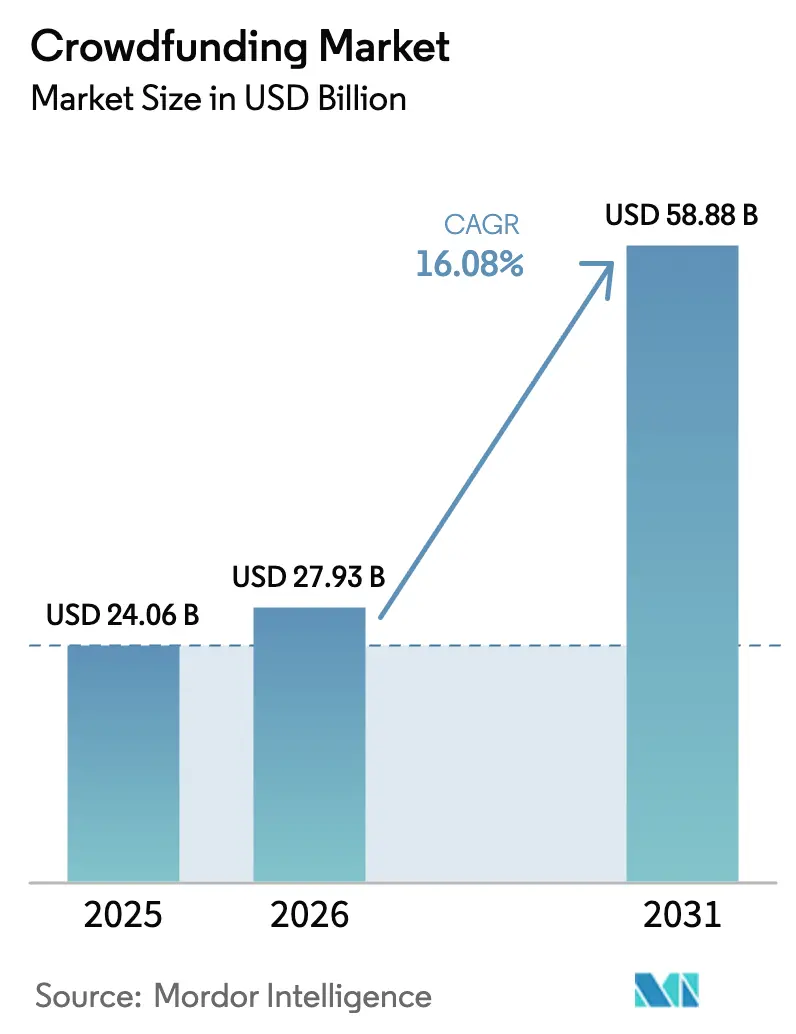
| Market Size (2026) | USD 27.93 Billion |
| Market Size (2031) | USD 58.88 Billion |
| Growth Rate (2026 - 2031) | 16.08% CAGR |
| Fastest Growing Market | Africa |
| Largest Market | Asia Pacific |
| Market Concentration | Low |
Major Players *Disclaimer: Major Players sorted in no particular order Image © Mordor Intelligence. Reuse requires attribution under CC BY 4.0. | |
Crowdfunding Market Analysis by Mordor Intelligence
The Crowdfunding Market size is projected to be USD 24.06 billion in 2025, USD 27.93 billion in 2026, and reach USD 58.88 billion by 2031, growing at a CAGR of 16.08% from 2026 to 2031. This robust trajectory reflects regulatory harmonization in Europe, blockchain-enabled fractional ownership in Asia Pacific, and artificial-intelligence-driven campaign optimization that jointly lift success rates and widen investor participation. Asia Pacific retains leadership on the crowdfunding market with its mobile-first culture, dense micro-investment networks, and tokenization-friendly rules, while Africa posts the fastest regional growth as payment-gateway access improves. Hybrid structures that embed smart-contract capabilities are steadily eroding the dominance of traditional reward campaigns, and institutional investors are entering the crowdfunding market at scale as secondary-market pathways increase liquidity. Cloud-native platforms now underpin most transaction volumes, enabling real-time risk monitoring and cross-border KYC orchestration.
Key Report Takeaways
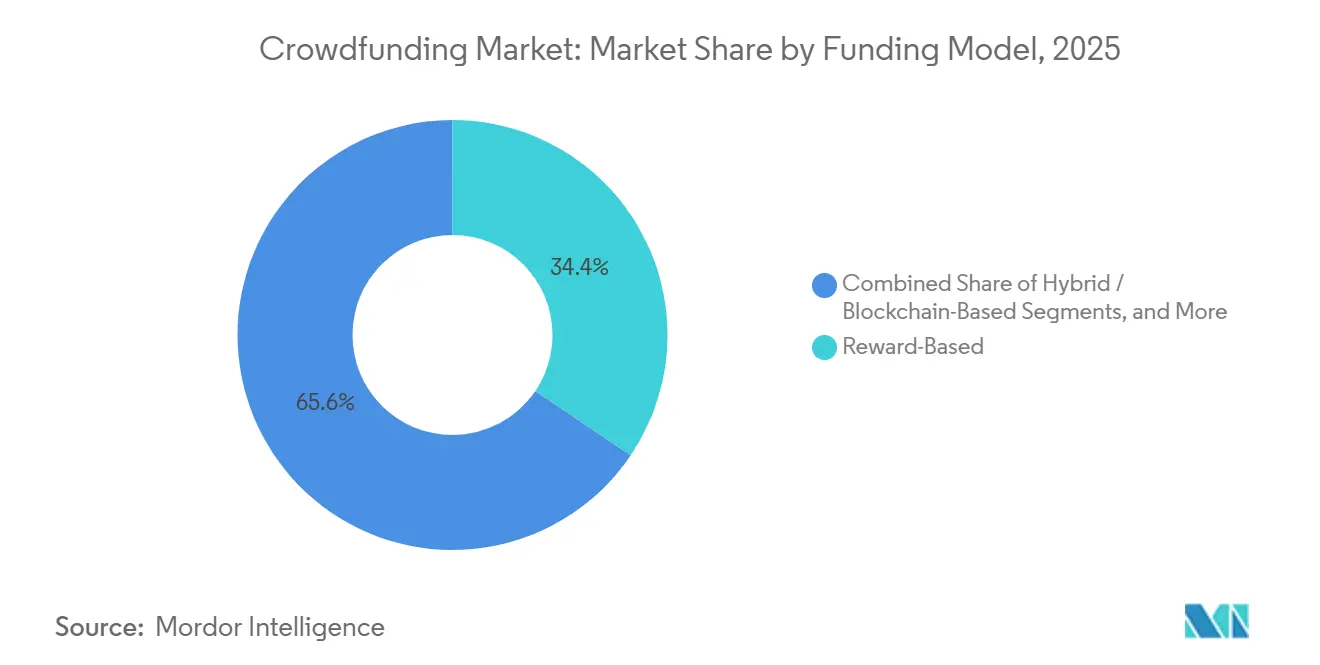
- By funding model, reward-based campaigns led with 34.44% revenue share in 2025, while hybrid structures are advancing at a 16.22% CAGR through 2031.
- By investment size, micro investments held 50.24% of the crowdfunding market share in 2025; large-ticket campaigns above USD 1 million are forecast to expand at a 17.06% CAGR to 2031.
- By platform deployment, cloud-based architecture captured 72.69% share of the crowdfunding market size in 2025 and is growing at a 17.56% CAGR through 2031.
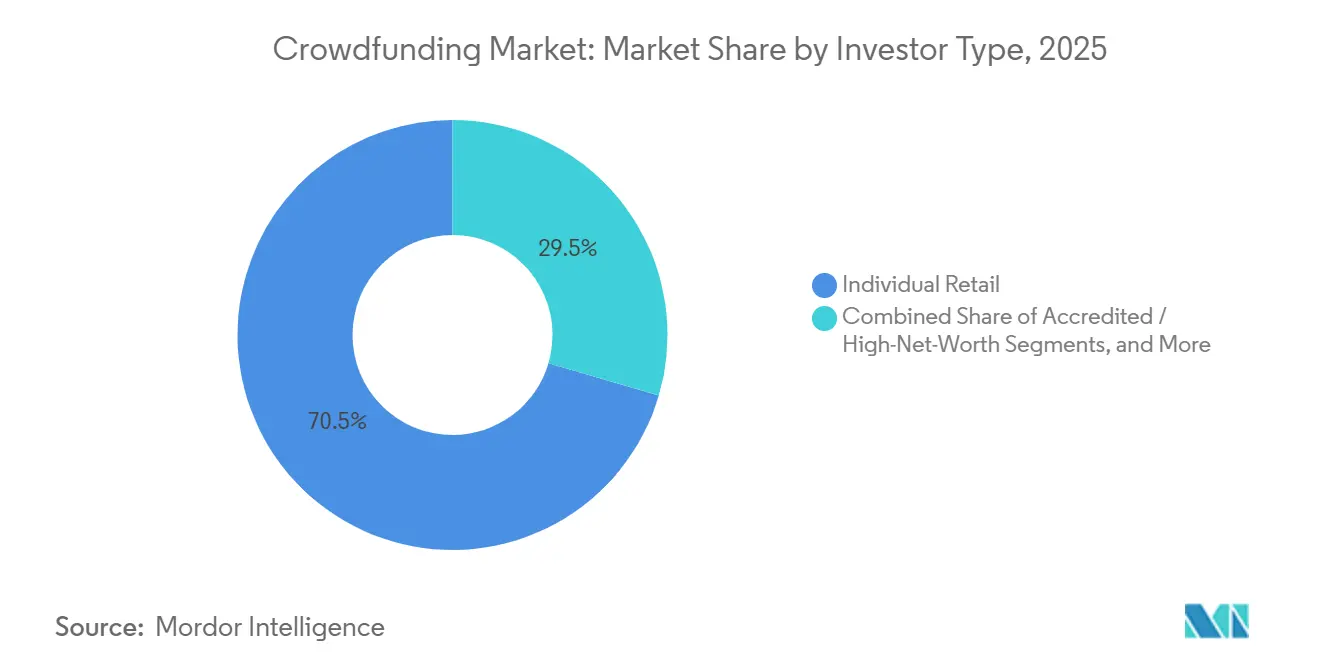
- By investor type, retail investors accounted for 70.46% share in 2025, whereas institutional participation is recording the highest CAGR of 16.88% through 2031.
- By application sector, technology and innovation dominated with 30.12% share in 2025, yet real-estate campaigns are advancing at a 16.46% CAGR toward 2031.
- By geography, Asia Pacific commanded 50.28% share in 2025, while Africa remains the fastest growing region at a 17.54% CAGR to 2031.
Note: Market size and forecast figures in this report are generated using Mordor Intelligence’s proprietary estimation framework, updated with the latest available data and insights as of January 2026.
Global Crowdfunding Market Trends and Insights
Drivers Impact Analysis*
| Driver | (~) % Impact on CAGR Forecast | Geographic Relevance | Impact Timeline |
|---|---|---|---|
| Social-media virality boosts reward campaigns | +2.1% | North America and Europe | Short term (≤ 2 years) |
| EU-wide ECSP regulation unlocks cross-border equity crowdfunding | +2.8% | Europe, spill-over to Middle East and Africa | Medium term (2-4 years) |
| AI-powered campaign analytics lift success rates | +2.5% | Global | Medium term (2-4 years) |
| Blockchain tokenization enables fractional real estate | +3.0% | Asia Pacific core, spill-over to North America and Middle East | Long term (≥ 4 years) |
| Corporate ESG commitments fund social-impact projects | +1.9% | Africa and South America | Medium term (2-4 years) |
| Rising adoption of Shariah-compliant platforms | +1.7% | Middle East, Malaysia, Indonesia | Long term (≥ 4 years) |
| Source: Mordor Intelligence | |||
EU-Wide ECSP Regulation Unlocking Cross-Border Equity Crowdfunding
The European Crowdfunding Service Providers Regulation 2020/1503 offers a single passport that lets platforms reach investors across all member states without opening local entities. This lowers legal overhead, aggregates liquidity, and expands issuer reach, all while capping offering size at EUR 5 million (USD 4.24 million) and mandating standardized disclosures.[1]Financial Services Agency, “Regulatory Reforms for Start-Ups,” fsa.go.jp Seedrs and Crowdcube now penetrate Southern and Eastern Europe, while regulators in the Gulf and Africa benchmark the framework to accelerate convergence. Persistent divergence in AML interpretations still raises compliance duplication, favoring platforms with large legal teams.
AI-Powered Campaign Analytics Increasing Success Rates Globally
Machine-learning engines parse historical pledge data and real-time engagement metrics to optimize pricing, reward tiers, and launch timing. Peer-reviewed studies show a 15-20-percentage-point lift in success rates for AI-enhanced campaigns. Natural-language models refine pitch quality, while anomaly detection blocks fake backers and duplicate wallets. These dual functions enhance investor trust and drive adoption in markets previously hamstrung by fraud.
Emergence of Blockchain Tokenization Enabling Fractional Real Estate in Asia Pacific
Tokenization splits high-value property into low-denomination digital securities. Japan’s 2024 reforms raised the small-offering cap to JPY 500 million (USD 3.35 million), clearing a path for security-token offerings under the crowdfunding market. Singapore’s MAS guidance likewise clarifies when tokens qualify as securities, enabling platforms such as RealX to market units cross-border. Smart contracts automate rental payouts and compliance, making fractional property stakes liquid and transparent.
Corporate ESG Commitments Channeling Funds Into Social-Impact Campaigns
Multinationals are routing sustainability budgets into campaigns that finance solar mini-grids, community clinics, and smallholder farming, often matching retail contributions to double the proceeds. Transparent reporting satisfies disclosure rules and boosts brand equity. Dependence on a handful of corporate backers nonetheless poses concentration risk if priorities shift during economic downturns.
Restraints Impact Analysis*
| Restraint | (~) % Impact on CAGR Forecast | Geographic Relevance | Impact Timeline |
|---|---|---|---|
| High platform fraud losses undermine trust | -2.3% | Asia Pacific, parts of South America and Africa | Short term (≤ 2 years) |
| Fragmented KYC/AML rules raise compliance costs | -1.8% | Europe and United States | Medium term (2-4 years) |
| Crowdfunding fatigue reduces donation conversion | -1.5% | Global, acute in North America and Europe | Short term (≤ 2 years) |
| Restricted payment-gateway access in Africa | -1.4% | Africa, selective South America and Asia Pacific | Long term (≥ 4 years) |
| Source: Mordor Intelligence | |||
High Platform Fraud Losses Undermining Investor Trust in Asia Pacific
Fraudulent campaigns and misappropriation of funds persist where supervision lags transaction volumes. Some operators bypass requirements for segregated accounts and audits, eroding confidence among repeat backers. Japan’s Securities and Exchange Surveillance Commission has tightened oversight, yet enforcement remains uneven, allowing rogue platforms to arbitrage weak jurisdictions.
Fragmented KYC/AML Rules Elevating Compliance Costs
The ECSP passport does not harmonize identity checks, so platforms juggle 27 divergent KYC rulebooks and must tailor workflows country-by-country, driving up legal spend.[2]U.S. Securities and Exchange Commission, “Early-Stage Investors,” sec.gov U.S. operators face analogous friction when reconciling federal exemptions with state “blue-sky” laws, limiting smaller entrants. Platforms onboarding investors from multiple member states must maintain parallel compliance workflows, each tailored to national regulator expectations, and bear the cost of duplicative legal reviews and technology integrations.
*Our forecasts treat driver/restraint impacts as directional, not additive. The impact forecasts reflect baseline growth, mix effects, and variable interactions.
Segment Analysis
By Funding Model: Hybrid Structures Re-Define Capital Access
Reward campaigns accounted for a 34.44% crowdfunding market share in 2025, yet hybrid tokens are advancing at a 16.22% CAGR as smart contracts blend perks with equity rights. Equity rounds benefit from the SEC’s 2021 rule change allowing raises up to USD 5 million, broadening the crowdfunding market. Debt-based models meet underserved borrowers in emerging economies, while donation drives surge during health crises.
Hybrid offerings satisfy investor hunger for upside and liquidity. Republic now converts perks into equity through rolling funds, and Japan’s new small-offering regime expressly accommodates token offerings. Tax clarity and secondary-market rules remain works in progress, adding operational complexity even as adoption accelerates.


By Investment Size: Institutional Capital Scales Large-Ticket Campaigns
Micro pledges below USD 10,000 still account for 50.24% share in 2025, but large-ticket rounds over USD 1 million show a 17.06% CAGR as pension funds and family offices embrace the crowdfunding market. SEC reforms that drop caps for accredited investors encourage seven-figure checks. Small investments between USD 10,000 and USD 250,000 serve accredited angels and syndicates that pool capital to access deal flow curated by platforms, while medium-sized investments between USD 250,000 and USD 1 million bridge the gap between angel rounds and institutional Series A financings.
Platforms respond with tiered KYC, side letters, and cap-table integrations acceptable to sophisticated allocators. AngelList reports that one-third of its seed deals involve AI startups, illustrating how institutional flows favor high-growth themes. The risk is crowding out retail backers who value community over financial returns.
By Platform Deployment: Cloud Infrastructure Enables Real-Time Compliance
Cloud implementations captured 72.69% of the crowdfunding market size in 2025 and are growing at a 17.56% CAGR as operators favor scalable data centers with embedded AML utilities. Elastic capacity keeps sites responsive during viral launches, and multi-region nodes meet data-residency mandates. Cloud platforms integrate third-party identity-verification services, sanctions-screening databases, and fraud-detection algorithms that reduce manual review workloads and accelerate investor onboarding from days to minutes.
On-premise installations remain among institutions that value direct control but face higher capex and slower feature rollouts. Japan’s Payment Services Act now allows cloud-hosted third-party custodians, further tilting the competitive field toward cloud natives.
By Investor Type: Retail Dominance Gives Way to Institutional Flows
Retail still commands 70.46% share, emblematic of the crowdfunding market’s democratized origins, yet institutional capital is growing fastest at 16.88% CAGR. Accredited and high-net-worth individuals occupy a middle tier, participating in equity and real-estate crowdfunding campaigns that require investor certification but offer higher return potential and secondary-market liquidity, while corporate strategics leverage campaigns for early product validation.
Kalshi’s USD 1 billion raise in December 2025 underscores mainstream appetite for new models that fuse trading with crowdfunding mechanics. Nonetheless, preferential terms demanded by institutions can dilute the egalitarian ethos central to crowdfunding.
By Application Sector: Real Estate Outpaces Technology in Growth
Technology and innovation held 30.12% share in 2025, but real estate is expanding at a 16.46% CAGR as tokenization lowers entry thresholds. Food and beverage, media, and healthcare enjoy steady volumes, while social-impact projects harness corporate ESG matches to amplify donor reach. Food and beverage campaigns attract consumer-product entrepreneurs launching direct-to-consumer brands, while media and entertainment projects fund film productions, music albums, and gaming titles that offer backers exclusive content and creative input.
Japan’s liberalized offering caps reduce costs for tokenized property sales, giving real estate a structural advantage. Automated rent distribution and transparent ledgers entice both retail and institutional buyers into the crowdfunding market.
Geography Analysis
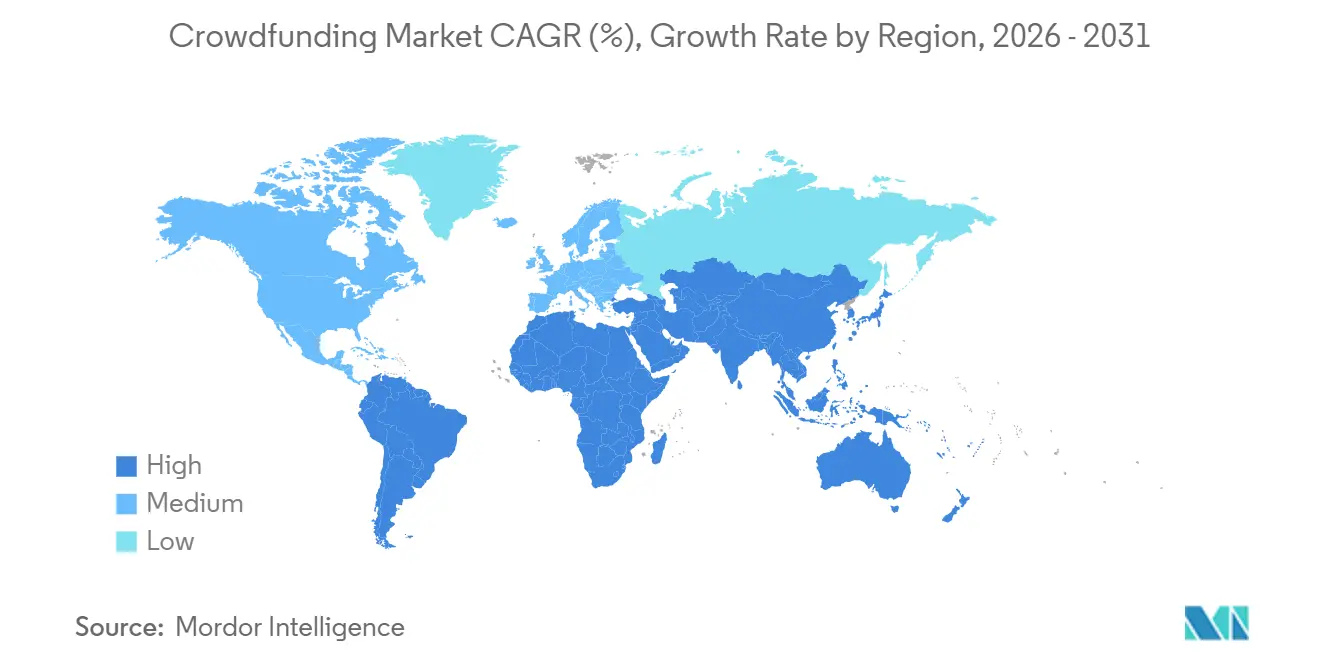
Asia Pacific commands half of global volume, driven by mobile wallets, supportive sandbox regulations, and the 2024 Japanese reforms that quadrupled small-offering limits. The region’s blockchain hubs Singapore, Hong Kong, and Tokyo host security-token exchanges that deepen liquidity and anchor the crowdfunding market. Fraud concerns remain pronounced in China and parts of Southeast Asia, yet AI-powered monitoring is narrowing the trust gap.
Africa’s 17.54% CAGR stems from mobile-money ubiquity and corporate ESG inflows. Platforms integrate M-Pesa rails to accept pledges without bank accounts, broadening reach. However, high network fees and restricted card gateways in West Africa raise operating costs, delaying expansion into francophone countries.[3]Milaap, “Trust and Transparency,” milaap.org
North America benefits from a deep base of accredited investors and the SEC’s relaxed caps, fueling mega rounds that blur lines with venture capital. Europe leverages the ECSP passport to knit fragmented markets, but divergent AML rules keep compliance costs high, consolidating share among larger operators.
South America faces currency volatility, so Brazilian and Argentine platforms now offer stablecoin-denominated campaigns to hedge inflation. The Middle East’s Shariah-compliant structures are gaining traction, especially in the Gulf, where asset-backed profit-sharing aligns with Islamic finance principles.

Regulatory Landscape
The regulatory environment continues to formalize around investment-based crowdfunding, while execution of KYC/AML requirements still varies materially by jurisdiction. In Europe, Regulation (EU) 2020/1503 (the European Crowdfunding Service Providers Regulation, ECSPR) provides a cross-border passport for platforms and standardizes core investor protections, with offerings capped at EUR 5 million. The framework was supplemented by Commission Delegated Regulation (EU) 2024/358, which added technical standards for credit scoring, pricing, and risk management practices used in crowdfunding project selection and loan-based models.
In the United States, Regulation Crowdfunding (Reg CF) allows eligible issuers to raise up to USD 5 million in a 12-month period via SEC-registered intermediaries, under defined issuer and investor limitations. On February 17, 2026, the SEC Division of Corporation Finance issued additional Compliance and Disclosure Interpretations for Reg CF that clarified practical items such as switching intermediaries, eligibility, and financial reporting treatment when an offering extends beyond a fiscal year-end. Across both regions, the main shift is operational clarification rather than new exemptions, which raises the importance of scalable compliance tooling for platforms that manage multi-country onboarding and disclosure workflows.
Value Chain Analysis
The crowdfunding value chain begins with issuers (startups, SMEs, creators, nonprofits, and real-estate sponsors) that structure campaigns, disclosures, and project narratives, then connects to platform operators that handle listing, marketing orchestration, escrow and segregated fund handling, and investor communications. Transaction execution depends on payment processors and banking partners, while identity verification vendors, sanctions screening, and AML monitoring utilities support onboarding and compliance. For equity and token-enabled structures, registrars or transfer agents, custodians, and in some markets exchanges or secondary trading venues operate downstream to maintain ownership records and enable liquidity pathways.
Technology vendors sit across the chain, providing cloud infrastructure, fraud analytics and AI scoring engines, and blockchain or smart-contract tooling for fractional ownership and automated settlements. In reward-based models, post-funding execution extends into contract manufacturers, logistics providers, and fulfillment partners, where production delays and supply chain slippage can translate into refunds and reputational pressure for platforms. EU ECSPR-related obligations influence the chain by codifying platform duties around disclosures and risk management, while country-by-country KYC/AML interpretations create branching processes that increase operating costs and tend to favor platforms with integrated, configurable compliance stacks.
Competitive Landscape
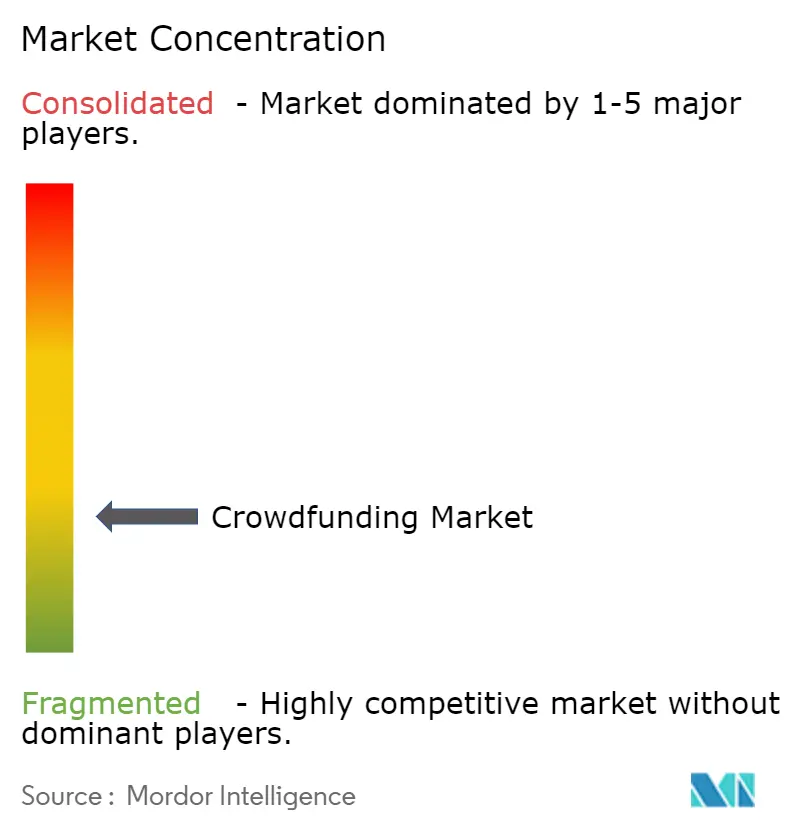
The crowdfunding market remains fragmented, with Kickstarter and Indiegogo defending legacy reward niches while Republic, Seedrs, and Fundable vie for equity dominance. Kickstarter’s June 2024 shake-up that replaced seven senior officers reveals mounting pressure to reignite growth as rewards plateau.
Republic’s purchase of Seedrs in 2024 forged a trans-Atlantic powerhouse positioned to exploit the ECSP passport, while Kalshi’s USD 1 billion war chest underscores momentum for prediction-based models that merge crowdfunding with market speculation. Technology differentiation clusters around AI scoring engines, blockchain custody, and cloud-native compliance.
Platforms that integrate sanctions screening, biometric KYC, and automated AML monitoring retain investor trust and gain regulatory goodwill. Institutional capital intensifies rivalry; platforms offering co-investment rights, board seats, and secondary liquidity attract pension funds, while retail-centric portals emphasize community perks. Barriers to entry rise as multi-jurisdictional rules favor well-capitalized operators with robust legal teams.
Crowdfunding Industry Leaders
Kickstarter PBC
Indiegogo Inc
Fundable LLC
Crowdcube Limited
GoFundMe Inc.
- *Disclaimer: Major Players sorted in no particular order

Market Opportunities and Future Outlook
Opportunity is clustering around compliance-grade scaling, particularly for platforms that support multiple jurisdictions and investor types. The ECSPR passport in Europe and the SECs ongoing clarification of Reg CF operations, including the February 2026 Compliance and Disclosure Interpretations, are pushing intermediaries to standardize how rolling limits, eligibility checks, and reporting transitions are handled, which increases demand for machine-assisted onboarding, document generation, and audit-ready reporting. Platforms that combine repeatable cross-border KYC orchestration, integrated sanctions screening, and explainable fraud controls are matching the same direction regulators are taking and the expectations seen in institutional due diligence.
A second opportunity is emerging at the intersection of tokenization and real-asset crowdfunding, where fractionalization reduces entry sizes and smart contracts automate distributions and compliance logic. Asia Pacific provides concrete examples through Japans 2024 reforms that raised the small-offering cap to JPY 500 million and through Singapores MAS guidance on when tokens fall under securities rules, widening pathways for regulated token offerings tied to real estate and other private assets. At the same time, platforms are moving beyond one-off campaigns toward institutional-grade rails, including partnerships that link equity crowdfunding to broader capital-market infrastructure, which creates space for secondary-market workflows, custody integrations, and cap-table automation aligned with larger and more structured raises.
Recent Industry Developments
- May 2026: Kickstarter PBC expanded its Kickstarter Partner Program coverage for hardware creators by adding Circuits Central as an Expert Partner, offering design-for-manufacturing reviews and production support. This shifts more value into post-funding execution, helping creators reduce manufacturing risk that can trigger late deliveries and refund pressure. The move also strengthens Kickstarters ecosystem differentiation versus pure listing-and-payments platforms.
- February 2026: Crowdcube aligned more closely with public-market infrastructure by finalizing a partnership with London Stock Exchange Group to act as a retail gateway for PISCES, the Private Intermittent Securities and Capital Exchange System. The step links equity crowdfunding participation with emerging private-asset trading mechanisms, reinforcing the importance of secondary liquidity and compliant investor access. It also signals a push toward institutional-grade pathways for later-stage private-company investment.
- October 2025: Indiegogo launched a reimagined crowdfunding platform experience built on Gamefound infrastructure, standardizing campaigns on a Fixed Funding model with a simplified fee structure and updated KYC onboarding. Consolidating the operating model reduces campaign complexity for creators and creates a clearer backer proposition with fewer outcome variations. The platform redesign underscores the competitive emphasis on reliability, trust, and streamlined compliance as crowdfunding scales beyond early adopter segments.


Research Methodology Framework and Report Scope
Market Definition and Coverage
For this methodology, the crowdfunding market is the total value of funds raised through online crowdfunding platforms across major campaign formats, counted on an annual basis and converted to USD.
Scope exclusions: Offline fundraising drives and consumer loans that are issued outside recognized crowdfunding regulations are excluded from the market totals.
Segmentation Overview
- By Funding Model
- Reward-Based
- Equity-Based
- Debt / P2P Lending
- Donation-Based
- Hybrid / Blockchain-Based
- Real-Estate-Specific Crowdfunding
- By Investment Size
- Micro (Less Than USD 10 k)
- Small (USD 10 k - 250 k)
- Medium (USD 250 k - 1 m)
- Large (Greater Than USD 1 m)
- By Platform Deployment
- Cloud-Based
- On-Premise
- By Investor Type
- Individual Retail
- Accredited / High-Net-Worth
- Institutional
- Corporate Strategic
- By Application Sector
- Technology and Innovation
- Food and Beverage
- Media and Entertainment
- Real Estate and Construction
- Healthcare and Life Sciences
- Social Impact and Non-Profit
- Consumer Products and Fashion
- Other Application Sectors
- By Geography
- North America
- United States
- Canada
- Mexico
- South America
- Brazil
- Argentina
- Rest of South America
- Europe
- Germany
- United Kingdom
- France
- Italy
- Spain
- Russia
- Rest of Europe
- Asia Pacific
- China
- Japan
- India
- South Korea
- Australia and New Zealand
- Southeast Asia
- Rest of Asia Pacific
- Middle East
- Saudi Arabia
- United Arab Emirates
- Turkey
- Rest of Middle East
- Africa
- South Africa
- Nigeria
- Kenya
- Rest of Africa
- North America
Data Sources, Market Sizing, and Validation
Desk Research
Desk research was used to set the market boundary and to anchor the model to public signals that can be checked year after year. We referenced sources such as central bank and financial regulator releases on crowdfunding and securities rules, World Bank financial access indicators, OECD digital economy and SME financing publications, UNCTAD e-commerce and cross-border digital trade notes, and patent databases to see platform feature themes.
These inputs were combined with company filings, investor presentations, major platform disclosures, and credible press coverage to map demand drivers like online payments adoption and small business funding needs. Where needed, paid subscriptions for company financials and news intelligence were used to confirm revenue ranges and corporate actions that influence platform activity. The sources listed here are illustrative only, and many other public and paid references were also used for collection, validation, and clarification.
Primary Interviews and Surveys
Primary work was used to stress-test desk assumptions and to fill gaps that are not consistently published, like typical fee take rates, cross-border campaign mixes, and how quickly new rules change platform eligibility. We spoke with platform operators, payment and compliance advisors, campaign managers, and repeat fundraisers across APAC, EMEA, and the Americas so the demand pool could be interpreted consistently by region.
Distribution of primary research fieldwork respondents
| Company type | Respondent position | Region |
|---|---|---|
| Top tier: 39% | CXOs: 12% | APAC: 40% |
| Mid tier: 45% | Functional/Unit leaders: 43% | EMEA: 34% |
| Smaller Players: 16% | Managers: 45% | Americas: 26% |
Market-Sizing & Forecasting
Sizing starts from a top-down build where platform-enabled funds raised are reconstructed using regional activity indicators and regulatory coverage, then converted into a single USD value using yearly average currency rates. To keep the totals realistic, we corroborated the outputs with selective bottom-up approximations, such as sampled platform volumes, typical ticket sizes by campaign format, and channel checks on fee take rates, which are then used to adjust outliers.
Key inputs that shaped the model include the number of active crowdfunding campaigns, average pledge or investment per campaign, the share of funding that sits in equity, lending, reward, and donation formats, and the portion of volume that is cross-border versus domestic. We also tracked supportive or restrictive rule changes, and shifts in online payment usage, because these often change conversion rates from visitors to contributors. For forecasting, scenario analysis was used to reflect how regulation, consumer confidence, and platform onboarding standards can tighten or loosen volumes over time, and the scenario weights were aligned to what interviewees expect in the next few years. When bottom-up data was missing for smaller markets, gaps were handled using proxy ratios from comparable markets with similar digital penetration and regulatory maturity, then re-checked with experts.
Data Validation & Update Cycle
Model outputs are checked against independent signals like announced funding totals, known seasonality around major campaigns, and shifts in reported platform traffic and conversion patterns. When a country or campaign format shows an unusual jump or drop, we revisit the drivers, re-check currency timing, and re-contact sources if the change cannot be explained by a clear event.
Before sign-off, the analysis goes through multiple internal reviews so assumptions, arithmetic, and scope mapping are consistent across regions. The report is refreshed annually, with interim updates triggered by material regulatory actions, platform shutdowns, or sharp macro changes that can impact fundraising appetite. Right before delivery, a final pass is performed so clients receive the most current view supported by the same repeatable steps.
Mordor Intelligence's Crowdfunding Market Size Measured Against Other Published Estimates
Published market values for crowdfunding often do not match because the definition of what is being counted can change from one source to the next, and that choice directly affects the final USD total. Differences also come from how currency conversion is timed, whether lending-style activity is included, and how often assumptions are refreshed.
The table shows a clear spread that mostly comes from scope boundaries and the unit being measured, and in Mordor Intelligence's model the market is counted as total annual funds raised across reward, equity, debt or peer-to-peer, and donation campaigns, using yearly average FX, which is not the same as counting only platform fee revenue or only software-related sales.
Benchmark comparison
| Source | Market Size | Gaps in Research Methodology |
|---|---|---|
| Mordor Intelligence | USD 27.93 B (2026) | |
| Trade Journal A | USD 17.72 B (2024) | Uses a narrower perimeter and earlier-year snapshot, with some lending-style activity and cross-border volumes treated inconsistently across regions, which keeps the total lower versus a full funds-raised view. |
| Industry Bulletin B | USD 22.12 B (2024) | Presents a single-point projection that does not clarify whether it measures funds raised or a revenue proxy, and the scope notes are limited on campaign types and FX timing, which can shift totals materially. |
What matters most for decision-making is matching the number to the question being asked. When the scope is anchored to funds raised and the inputs are checked with repeatable indicators and interview feedback, the final market value becomes easier to trace, compare across years, and explain on a simple driver basis.


Key Questions Answered in the Report
How large is the global crowdfunding market in 2026?
The crowdfunding market size stands at USD 27.93 billion in 2026 and is projected to double by 2031.
Which region leads current crowdfunding volumes?
Asia Pacific holds 50.28% of 2025 transaction value, supported by mobile payments, micro-investments, and tokenization rules.
What funding model is growing fastest?
Hybrid blockchain-enabled structures are expanding at a 16.22% CAGR as they combine reward perks with equity and secondary-market liquidity.
How are institutional investors influencing the space?
Institutional capital is the fastest-growing investor segment at 16.88% CAGR, driving larger ticket sizes and secondary-market development.
Which application sector shows the strongest growth momentum?
Tokenized real-estate projects are advancing at a 16.46% CAGR, outpacing technology campaigns due to lower entry thresholds and automated rent distributions.
What is the main regulatory catalyst in Europe?
The ECSP Regulation creates a single EU passport for platforms, simplifying cross-border equity crowdfunding and expanding the addressable investor base.
Page last updated on:


