
Coupling Agent Market Size and Share
Market Overview
| Study Period | 2020 - 2031 |
|---|---|
| Market Size (2026) | USD 1.75 Billion |
| Market Size (2031) | USD 2.18 Billion |
| Growth Rate (2026 - 2031) | 4.46 % |
| Fastest Growing Market | Asia Pacific |
| Largest Market | Asia Pacific |
| Market Concentration | Medium |
Major Players *Disclaimer: Major Players sorted in no particular order Image © Mordor Intelligence. Reuse requires attribution under CC BY 4.0. | |
Coupling Agent Market Analysis by Mordor Intelligence
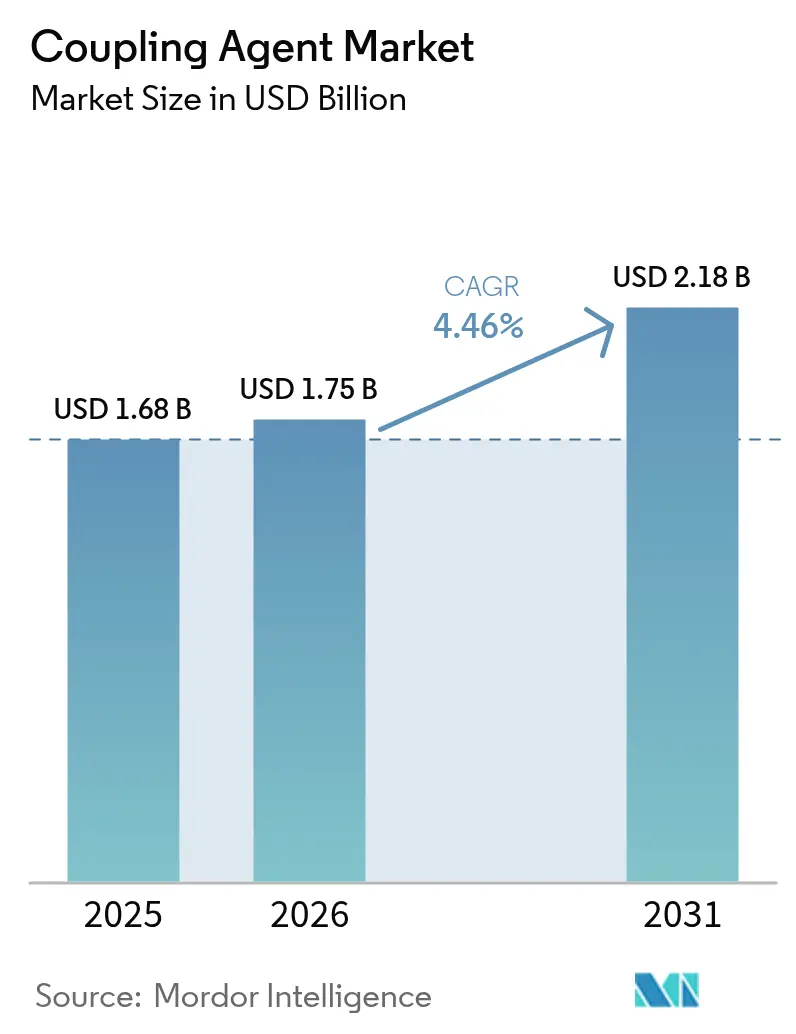
The Coupling Agent Market size was valued at USD 1.68 billion in 2025 and estimated to grow from USD 1.75 billion in 2026 to reach USD 2.18 billion by 2031, at a CAGR of 4.46% during the forecast period (2026-2031). Rising demand for multi-material designs in automotive, construction, and electronics manufacturing continues to cement coupling agents as performance-critical additives rather than commodity chemicals. Lightweight vehicle architectures, green tires, solvent-free construction sealants, and advanced semiconductor packages all rely on specialized interfacial chemistry, keeping the coupling agents market resilient despite raw-material cost swings. Competitive intensity stays moderate because no single supplier controls a dominant share, yet scale economies and niche formulation expertise both create viable strategic paths. Regional growth remains skewed toward Asia-Pacific, where expanding tire and automotive output intersects with a vast local consumer base to reinforce capacity-driven cost advantages.
Key Report Takeaways
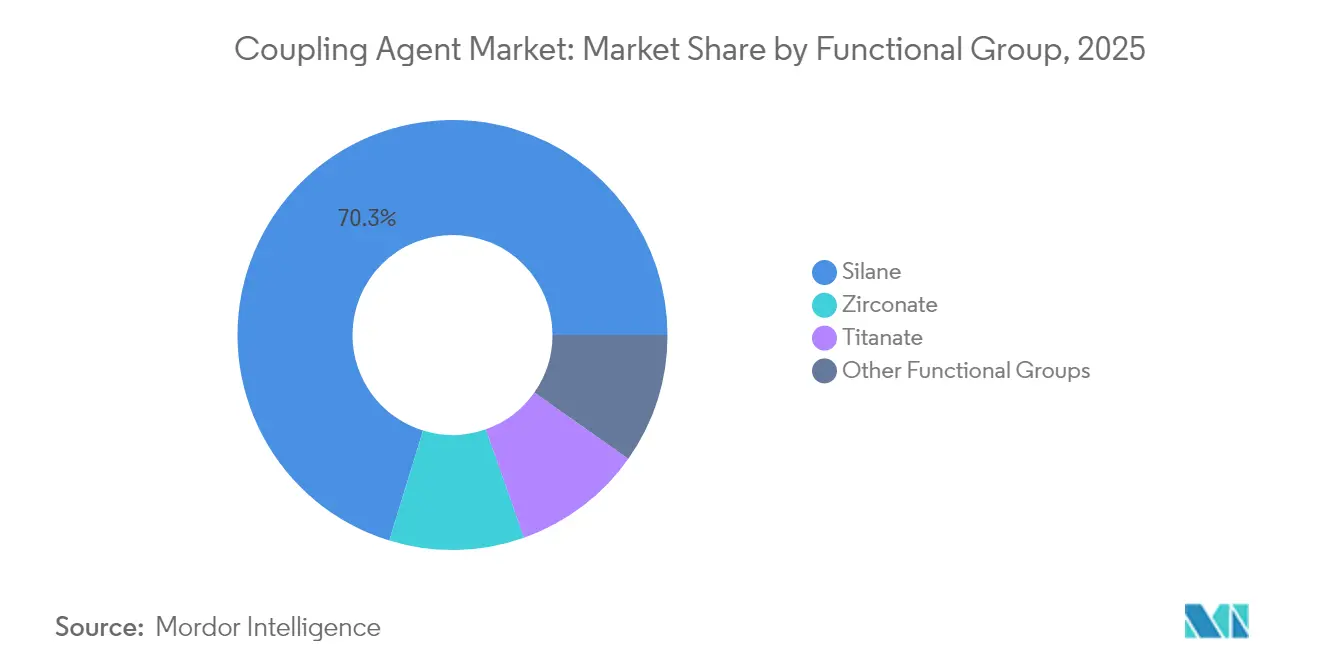
- By functional group, silane chemistry led with 70.25% revenue share in 2025, while zirconate variants posted the fastest 4.73% CAGR through 2031.
- By application, rubber and plastics captured 46.10% of the coupling agents market share in 2025 and are projected to expand at a 4.62% CAGR to 2031.
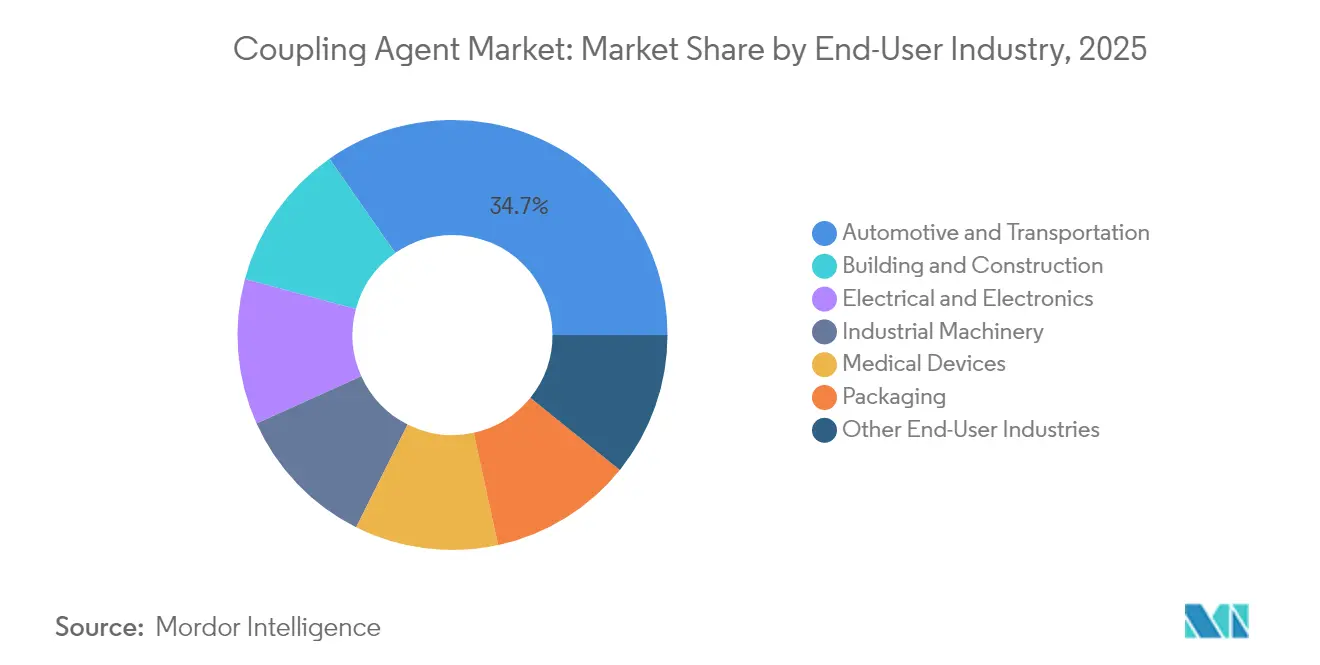
- By end-user, automotive and transportation held 34.70% of the coupling agents market size in 2025 and will advance at the highest 4.78% CAGR over the forecast horizon.
- By geography, Asia-Pacific dominated with 38.30% share in 2025 and is set to grow at a 4.67% CAGR up to 2031.
Note: Market size and forecast figures in this report are generated using Mordor Intelligence’s proprietary estimation framework, updated with the latest available data and insights as of 2026.
Market Trends and Insights
Drivers Impact Analysis of Coupling Agent Market*
| Driver | (~) % Impact on CAGR Forecast | Geographic Relevance | Impact Timeline |
|---|---|---|---|
| Green-tire demand for silica–silane technology | +1.2% | Global, with APAC and Europe leading adoption | Medium term (2-4 years) |
| Lightweight plastics & composites adoption | +0.9% | North America & Europe automotive, APAC aerospace | Long term (≥ 4 years) |
| Construction sealants & adhesives boom | +0.7% | APAC core, spill-over to MEA and Latin America | Short term (≤ 2 years) |
| Electronics miniaturization & moisture protection | +0.6% | APAC electronics hubs, expanding to global | Medium term (2-4 years) |
| Shift to solvent-free SMP adhesives | +0.4% | Europe and North America regulatory-driven | Long term (≥ 4 years) |
| Source: Mordor Intelligence | |||
Lightweight plastics & composites adoption
Automotive OEMs targeting stringent fleet-average CO₂ caps increasingly rely on carbon-fiber-reinforced plastics, aluminum–polymer hybrids, and multi-material joints that must survive vibration, salt-spray, and temperature cycles. The U.S. Department of Energy’s 2025 harsh-environment materials roadmap identifies functional surface treatments—including silane-anchored primers—as a cross-cutting enabler for next-generation chassis and battery enclosures[1]. Additive-manufactured aerospace brackets fabricated via direct ink writing posted 39% tensile-stiffness gains once silane-modified pre-impregnation was introduced, illustrating how 3D-printing unlocks new demand nodes for coupling agents.
Construction sealants & adhesives boom
Rapid urbanization across India, Indonesia, and Vietnam boosts volumes of glazing sealants, structural silicone adhesives, and façade coatings. Moisture-cure polyurethane and silyl-modified polymer (SMP) technologies dominate specifications in tropical climates because silane-terminated networks resist humidity-induced debonding. Huntsman’s 2025 portfolio repositioning toward battery-material and construction-adhesive chemistries exemplifies how integrated producers chase high-growth civil-infrastructure opportunities. Growing adoption of building-information-modeling workflows is spawning smart-adhesive systems that pair mechanical bonding with embedded sensors—a functionality best delivered through tailored coupling-agent interfaces.
Electronics miniaturization & moisture protection
Advanced wafer-level packages in 5G handsets and AI accelerators demand ultrathin, low-dielectric barrier films that combat moisture-induced delamination. Shin-Etsu’s 2024 hydrocarbon resins for 5G substrates highlight the shift toward formulations stable at elevated reflow temperatures yet compatible with intricate copper redistribution layers. Research on chemical-catalytic silicon-dioxide wafer bonding achieved higher adhesion energy at reduced anneal temperatures, confirming the performance leverage of optimized silane chemistries in chiplet architectures. As component footprints shrink, precise control of silane-concentration and condensate cross-link density becomes critical for maintaining dielectric integrity.
Shift to solvent-free SMP adhesives
European VOC ceilings and stricter EPA oversight in North America accelerate the migration from solvent-borne contact cements to moisture-cure SMP systems. Coupling-agent innovation now centers on room-temperature-curing alkoxysilane oligomers that match historical bond strength while eliminating isocyanates and methylene chloride. The South Coast Air Quality Management District’s updated Rule 1151 underscores the compliance pressure pushing formulators toward silane-rich, solvent-free technologies[2]. Winning suppliers invest in tailor-made silane blends that deliver rapid green strength without sacrificing storage stability.
Restraints Impact Analysis of Coupling Agent Market*
| Restraint | (~) % Impact on CAGR Forecast | Geographic Relevance | Impact Timeline |
|---|---|---|---|
| Silane raw-material price volatility | -0.8% | Global, with Asia-Pacific manufacturing most exposed | Short term (≤ 2 years) |
| Stringent VOC & health regulations | -0.5% | Europe and North America regulatory-driven | Medium term (2-4 years) |
| Titanium-tetrachloride supply risk | -0.3% | Global titanate coupling agent production | Medium term (2-4 years) |
| Source: Mordor Intelligence | |||
Silane raw-material price volatility
Ethyl-silicate and chlorosilane feedstock prices swung up to 18% quarter-on-quarter during 2024 as storms interrupted coastal Chinese production clusters. Limited shelf life forces formulators to run lean inventories, magnifying the cash-flow impact of spot-market spikes. Suppliers with backward integration into silicon-metal smelting or long-term chloride contracts shield margins better, prompting merger interest from commodity siloxane makers aiming to lock in monomer security. Tier-two players lacking hedging tools confront tighter working-capital cycles, which may trigger further consolidation.
Stringent VOC & health regulations
The European Chemicals Agency tightened restrictions on specific organosilicon compounds in 2024, raising compliance-testing costs and lengthening product-registration lead times. In the United States, the EPA broadened methylene-chloride prohibitions, catalyzing a shift to water-based adhesion promoters that often require higher silane-loading levels but deliver lower immediate tack. Smaller formulators must either fund new analytical labs or exit solvent-borne lines, concentrating future growth among well-capitalized multinationals capable of rapid reformulation.
*Our forecasts treat driver/restraint impacts as directional, not additive. The impact forecasts reflect baseline growth, mix effects, and variable interactions.
Coupling Agent Market Segment Analysis
By Functional Group:
Silane Chemistry Dominates Multi-Substrate InterfacesSilane variants commanded 70.25% of 2025 revenue, underlining their unrivaled compatibility with both organic polymers and inorganic fillers. Stable siloxane linkages generated through hydrolysis and condensation let formulators bridge glass, metal, mineral, and polymer surfaces in a single step, driving sustained preference within the coupling agents market. Zirconate molecules, although representing a smaller share, posted the quickest 4.73% CAGR to 2031 because they tolerate service temperatures that cause siloxane scission. Titanate offerings remain niche, often selected for moisture-sensitive filled-polyolefin systems where their chelating action suppresses water-induced viscosity rise.
Recent academic work shows that integrating a 2-pyrone-4,6-dicarboxylic-acid moiety into polydimethylsiloxane chains raises thermal-oxidative resistance by 27 °C while doubling lap-shear strength on aluminum substrates. Such results validate ongoing efforts to extend conventional silane performance envelopes rather than replace the chemistry outright. Consequently, the coupling agents market continues to revolve around incremental silane innovation alongside targeted zirconate deployment in high-heat aerospace and electronics assemblies.

By Application:
Rubber & Plastics Lead the Green-Mobility TransitionRubber and plastics captured 46.10% of 2025 demand and are forecast to grow at a 4.62% CAGR through 2031, confirming their status as the prime engine of coupling agents market expansion. Silica-silane tire treads lower rolling resistance, while silanized glass or basalt fibers reinforce polyamide and polypropylene body-in-white parts without penalizing recyclability. Adhesives and sealants remain the next-largest outlet, propelled by megacity housing starts and retrofits that favor SMP bonding over mechanical fasteners. Paints and coatings rely on organofunctional silanes to enhance adhesion to galvanized steel façades and composite panels.
Additive-manufactured components now form a fast-emerging sub-application: studies revealed that pre-impregnated continuous-fiber filaments coated with 3-aminopropyl-triethoxysilane attained 58% higher tensile strength than unmodified controls, offering designers confidence to substitute 3D-printed parts for milled aluminum in drones and sporting goods. These performance gains ensure an expanding future addressable base for the coupling agents market within high-value engineered plastics.
By End-User Industry:
Automotive Continues to Champion LightweightingAutomotive and transportation accounted for 34.70% of 2025 usage and will record a 4.78% CAGR through 2031, aligning with aggressive fleet electrification and weight-reduction targets worldwide. Battery-electric vehicles incorporate multi-material packs where thermally conductive gap fillers must adhere to both aluminum cases and polymeric dielectric films, an interface managed through epoxy-functional silanes. Electric drivetrains also raise under-hood operating temperatures, accelerating interest in zirconate and phosphate coupling chemistries.
Building and construction forms the second-largest outlet, capitalizing on high-rise glass façades, modular prefabrication, and net-zero retrofits that depend on long-term sealant durability. Electronics demand, while smaller in tonnage, commands premium unit values because each advanced package layer integrates microliter quantities of silane but yields outsized device-level reliability improvements. The push for solid-state batteries, hydrogen fuel cells, and smart-grid hardware further diversifies coupling-agent targets, reinforcing growth prospects for suppliers able to cross-pollinate learning from automotive to energy-storage ecosystems.
Geography Analysis
APAC Coupling Agent Market
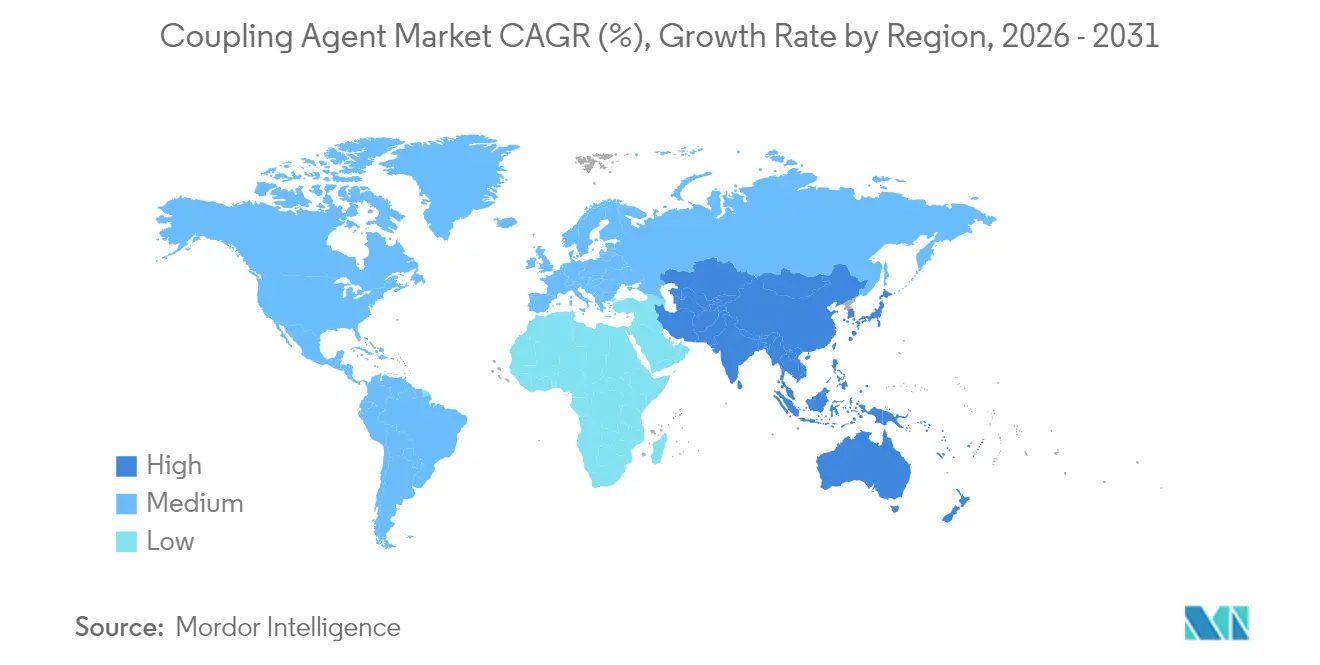
Asia-Pacific retained a 38.30% share in 2025 and will expand at a 4.67% CAGR to 2031, cementing its position as the epicenter of coupling agents market demand. China produces over half of the world’s radial tires, and every incremental switch from carbon-black to silica–silane tread blends directly amplifies local silane offtake. India’s passenger-car assembly capacity is set to surpass 7 million units by 2027, escalating consumption of adhesion promoters for glass bonding, under-body coatings, and lightweight composites. Japan and South Korea concentrate on high-margin electronics and semiconductor applications where ultra-pure silanes deliver critical moisture barriers. ASEAN economies, especially Vietnam and Thailand, attract foreign direct investment into tire, electronics, and consumer-appliance plants, providing new customer bases for regional silane producers.
North America Coupling Agent Market
North America represents a mature yet technologically dynamic arena. The Inflation Reduction Act’s domestic-content rules incentivize U.S. and Mexican battery and EV OEMs to source local coupling-agent volumes, potentially disrupting Asia-centric supply chains. OEM migration toward resin-transfer-molded pickup frames and carbon-fiber driveshafts pushes demand for aminosilane surface treatments. Canada’s oil-sands equipment and Arctic infrastructure create niche requirements for coupling systems resilient to thermal shock and chemical exposure.
Europe Coupling Agent Market
Europe’s stringent Green Deal legislation forces rapid reformulation toward low-VOC, bio-based chemistries. German carmakers lead global deployment of mixed-material battery trays secured with silane-cured adhesives, while Nordic prefabricated timber high-rises rely on silane-enhanced hybrid sealants for fire integrity and moisture control. Eastern European markets enlarge the addressable base as Momentive extended its Safic-Alcan partnership in 2024 to strengthen regional distribution. Collectively, these dynamics ensure that Europe remains both a compliance catalyst and a premium segment within the global coupling agents market.
Regulatory Landscape
Regulatory compliance for coupling agents is increasingly shaped by chemical inventory and exposure-risk controls, which affects registration timelines, testing cost, and market access for organofunctional silanes used in adhesives, sealants, rubber, plastics, and electronics. In the United States, the EPA finalized amendments to TSCA new chemicals procedural regulations in December 2024, raising the importance of upfront dossier quality and inventory status verification for new or modified coupling-agent chemistries.
Requirements for food-contact and restricted substances are also tightening around downstream adhesive systems where coupling agents are embedded. In the European Union, a REACH amendment published in June 2026 set a migratable nickel release limit of 0.5 ug/cm2/week for load-bearing structural epoxy applications, effective July 1, 2026, which increases validation requirements for epoxy-based bonding systems that may incorporate silane adhesion promoters. In the United States, FDA updates in 2026 (including 21 CFR Part 117 and updates to 21 CFR Part 175.300) reinforce migration-limit compliance for certain adhesive categories, encouraging formulators to support food-contact claims with more explicit test evidence rather than generalized positioning.
Value Chain Analysis
The coupling agent value chain starts with upstream feedstocks such as silicon metal and alcohols, which are converted into chlorosilanes and organosilanes, then further processed into organofunctional silane coupling agents. Smaller volumes of titanate and zirconate alternatives also rely on titanium-related intermediates. Production economics and resilience depend heavily on purification, moisture-controlled handling, and access to consistent upstream inputs, since small impurity variations can contribute to adhesion failure in demanding end uses.
Downstream qualification and validation are another binding constraint. In automotive and transportation, customer approval workflows (often aligned with PPAP-type requirements) can take 12-24 months and include thermal cycling, humidity-resistance, and chemical-exposure testing, extending time-to-revenue for new grades and favoring suppliers with application labs and long-term OEM relationships. Downstream routes run through direct supply to rubber compounders, plastics masterbatchers, adhesive and sealant formulators (including SMP systems), and electronics materials processors, with distribution networks supporting standardized silane grade nomenclature used in procurement (for example, KH-550, KH-560, KH-570, KH-580, KH-792). Logistics and service intensity also differentiate suppliers because many customers require local technical support and just-in-time inventory near manufacturing hubs. The competitive set includes integrated multinationals with siloxane chains and regional producers competing on cost and responsiveness, while channel activity, such as Nanjing Capatue Chemical Co., Ltd. exhibiting at Wire 2026 in Germany in April 2026, reflects how producers use trade and industry platforms to reach cable, plastics, and industrial formulation customers.
Competitive Landscape
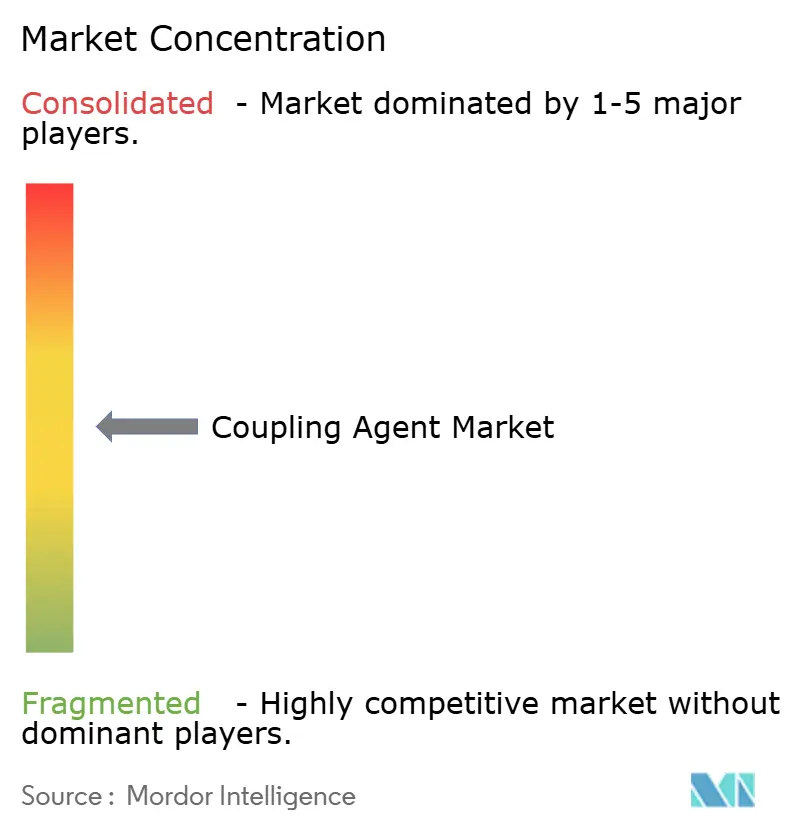
The coupling agents industry features a moderately fragmented competitive structure. Dow, Evonik, Shin-Etsu, Momentive, and Wacker command multiregional production footprints and integrated siloxane chains, affording them procurement advantages and global technical-service networks. Yet specialty houses such as Gelest or Nusil carve profitable niches through custom organofunctional silanes, ultra-high-purity grades, and collaborative formulation services. Market entry barriers stay moderate: capital outlay for basic silane hydrolyzers is manageable, but replicating multipurpose pilot labs and application-testing centers demands larger investment.
Strategic trends emphasize vertical integration and solution bundling. Evonik’s 2024 merger of its Silica and Silanes activities into Smart Effects targets combined offerings of coupling agents with reinforcing fillers to capture greater share of tire customers’ compound budgets. Wacker collaborates with adhesive formulators to preload silane crosslinkers into SMP polymer drums, simplifying downstream blending and locking in long-term volume contracts. Conversely, innovators explore bio-silane precursors derived from rice-husk ash and sugarcane bagasse to decouple pricing from chlorosilane feedstock volatility.
Coupling Agent Industry Leaders
-
Momentive
-
Dow
-
Evonik Industries AG
-
Wacker Chemie AG
-
Shin-Etsu Chemical Co., Ltd.
- *Disclaimer: Major Players sorted in no particular order
Coupling Agent Market Companies Covered in this Report
- 3M
- Arkema
- Dow
- Evonik Industries AG
- Gelest Inc.
- HEXPOL AB
- Huntsman Corporation
- JNC Corporation
- Kenrich Petrochemicals Inc.
- Momentive
- Shin-Etsu Chemical Co., Ltd.
- Sika AG
- Wacker Chemie AG
Market Opportunities and Future Outlook
White space is opening around local-for-local supply of high-purity, application-tailored silanes for electronics, EV-related materials, and green-tire compounding, where customers increasingly link performance outcomes to controlled chemistry and lot-to-lot consistency. Concrete investment and footprint changes reinforce this shift. Momentive and Jiangxi Hungpai formed a joint venture through an agreement signed in February 2025, with a focus on silanes manufacturing and commercialization in Asia, and Wacker commissioned new specialty silane production lines at its Zhangjiagang site in China in May 2025 to serve electronics and New Energy Vehicle demand. Together, these moves suggest that regional production, shorter lead times, and technical-service proximity are becoming core competitive requirements.
A second opportunity set is emerging in compliance-driven reformulation of adhesives and sealants. Regulatory pressure on VOCs and specific substances increases demand for silane systems that work with waterborne and solvent-free chemistries and for clearer migration-limit compliance pathways. Evonik broadened its silane additives and adhesion promoter portfolio in 2025 with products positioned for VOC-reduced, labeling-optimized formulations, while FDA and EU REACH updates in 2026 sharpen the need for test-backed compliance in certain adhesive categories. Suppliers combining coupling agents with formulation support, validation packages, and region-specific compliance dossiers are improving their route to specification in regulated end markets such as construction, industrial bonding, and selected food-facility applications.
Recent Industry Developments in Coupling Agent Market
- June 2026: The European Commission published a REACH amendment setting a 0.5 ug/cm2/week migratable nickel release limit for load-bearing structural epoxy applications, effective July 1, 2026. This increases compliance testing and documentation needs for epoxy-based bonding systems where silane coupling agents are used to boost adhesion and durability. The change pushes formulators and coupling-agent suppliers to strengthen traceability and validation packages for EU-facing products.
- February 2025: Momentive signed a definitive agreement with Jiangxi Hungpai New Material Co., Ltd. to establish a joint venture for the manufacturing, promotion, and sale of silanes in Asia. The move supports in-region production for major demand centers tied to tires, plastics, and adhesives, tightening supply reliability and lead times for customers. It also elevates competitive pressure on suppliers serving Asia-Pacific without localized manufacturing and technical support.
- May 2024: KCC Corporation completed the full acquisition of Momentive Performance Materials, marking a major ownership and integration change for a key global supplier of organosilane coupling agents and related silicone technologies. The transaction strengthens KCC's ability to align Momentive's product development and capacity planning with broader silicone value-chain priorities. Customers and competitors monitored the deal for its implications on portfolio focus, supply assurance, and investment direction across silanes and downstream applications.
Coupling Agent Market Report Scope and Research Methodology
Market Definition and Coverage
This market is defined as the revenue generated from coupling agents that improve bonding between dissimilar materials, mainly polymers, fillers, fibers, and substrates, across industrial manufacturing uses. Values reflect sales of these chemistries into end-use applications where interfacial adhesion improvement is the intended function.
Scope exclusions: We exclude unrelated additives that do not act as coupling agents, along with in-house processing aids not sold as commercial coupling agent products.
Segments Covered in This Report
- By Functional Group
- Silane
- Titanate
- Zirconate
- Other Functional Groups
- By Application
- Rubber and Plastics
- Adhesives and Sealants
- Paints and Coatings
- Fiber Treatment
- Other Applications
- By End-User Industry
- Automotive and Transportation
- Building and Construction
- Electrical and Electronics
- Industrial Machinery
- Medical Devices
- Packaging
- Other End-User Industries
- By Geography
- Asia-Pacific
- China
- India
- Japan
- South Korea
- ASEAN
- Rest of Asia-Pacific
- North America
- United States
- Canada
- Mexico
- Europe
- Germany
- United Kingdom
- France
- Italy
- Spain
- Russia
- Rest of Europe
- South America
- Brazil
- Argentina
- Rest of South America
- Middle East and Africa
- Saudi Arabia
- United Arab Emirates
- South Africa
- Egypt
- Rest of Middle East and Africa
- Asia-Pacific
Data Sources, Market Sizing, and Validation
Desk Research
Desk work starts by mapping where coupling agents are consumed and what drives usage in rubber and plastics, fiber treatment, adhesives and sealants, and paints and coatings. We use public information to set boundaries on what counts as a coupling agent and to understand typical demand cycles tied to industrial output.
Sources reviewed include items such as USGS materials statistics, United States International Trade Commission trade and tariff data, Eurostat industrial production series, and UN Comtrade trade flows. These help us sanity-check direction and scale for regional consumption and trade movement. We also refer to company annual reports and investor presentations, association websites, and reputable industry press to track capacity changes, plant startups, and product positioning by supplier. Where helpful, a paid subscription for company financials and a patent database are used to support supplier mapping and technology trend checks. This list is not exhaustive, and additional public references were used for data collection, validation, and clarification.
Primary Interviews and Surveys
Primary work is used to pressure-test what we see in public sources and to fill gaps on pricing logic, typical treat rates, and the mix shift across silane, titanate, and zirconate chemistries. We spoke with participants across the value chain, including raw material-side experts, formulators and compounders, distributors, and procurement or product teams at end users. We also covered major demand regions so regional assumptions are not overfit to one geography.
Distribution of primary research fieldwork respondents
| Company type | Respondent position | Region |
|---|---|---|
| Top tier: 30% | CXOs: 18% | APAC: 43% |
| Mid tier: 49% | Functional/Unit leaders: 40% | EMEA: 33% |
| Smaller Players: 21% | Managers: 42% | Americas: 24% |
Market-Sizing & Forecasting
Sizing begins with a top-down build where industrial production and trade indicators are used to reconstruct the addressable demand pool for coupling agents, and then the pool is filtered through application-level adoption. Because the math can drift if any single data series is overstated, we cross-check results using selective bottom-up approximations, such as sampled supplier revenue ranges, channel feedback, and a volume-times-average selling price (ASP) sense check.
Key inputs used in the model include the split of demand across rubber and plastics, adhesives and sealants, paints and coatings, and fiber treatment, along with regional manufacturing output trends, construction activity direction, and lightweighting intensity in transportation components. We also track formulation trends that can change consumption per unit, such as higher filler loadings, increased use of glass fiber, and shifts in resin systems that alter coupling chemistry preference. Pricing is handled through an ASP progression approach where regional price bands are updated with feedstock and energy cost direction, then converted into USD using consistent currency timing for the modeled year.
For forecasting, scenario analysis is used so growth can be framed around realistic industrial output cases and adoption changes that were validated during interviews. Where bottom-up signals are thinner in smaller regions, we handle gaps by applying conservative penetration and pricing assumptions, and then revisiting them during validation.
Data Validation & Update Cycle
Validation is done in layers so obvious errors are caught early and judgment calls are documented. We compare model outputs against independent signals like trade direction, supplier capacity announcements, and application-level growth patterns. We then review outliers by geography or chemistry to see whether variance is driven by a real shift or a mismatch in an assumption.
Before sign-off, the model is reviewed by another analyst who checks formulas, unit consistency, and the logic behind key drivers. Reports are refreshed annually, and interim updates are triggered when material events occur, such as large capacity additions, sharp currency moves, or policy changes that can shift pricing. Right before delivery, a fresh pass is completed so the latest public and interview inputs are reflected in the final numbers.
Mordor Intelligence's Coupling Agent Market Size Measured Against Other Published Estimates
Published market sizes for coupling agents can look far apart because each publisher locks in different timing for currency conversion, uses a different ASP path, and updates key assumptions on a different schedule. When these choices stack up, the same demand story can convert into a noticeably different USD value.
A refresh-led gap is common in this market because prices can move with feedstock and energy changes, and exchange rates can swing the reported total even when underlying volumes are stable. The table spread is also influenced by whether estimates apply a single global ASP, whether they weight more toward rubber and plastics versus other uses, and whether older base-year pricing is carried forward without rechecking against current supplier and customer feedback, which is where Mordor Intelligence applies tighter checks.
Benchmark comparison
| Source | Market Size | Gaps in Research Methodology |
|---|---|---|
| Mordor Intelligence | USD 1.75 B (2026) | |
| Industry Consultancy A | USD 0.60 B (2024) | Uses a smaller reported base-year value and a different year for currency conversion, and it can understate totals if price bands and application weights are not refreshed with recent regional cost changes. |
| Data Publisher B | USD 0.55 B (2024) | Often relies on broad type and application splits with limited transparency on ASP updates, which can compress the market value when older price points are extended into the base year without revalidation. |
Overall, the differences mainly trace back to timing and pricing mechanics rather than a single disputed demand driver. By keeping the scope anchored to coupling-agent functionality and by rechecking ASP and currency assumptions during updates, we keep the estimate traceable to clear inputs that can be repeated and audited.
Key Questions Answered in the Report
What is the current Coupling Agent Market size?
The coupling agents market size reached USD 1.75 billion in 2026.
What is the expected CAGR for coupling agents through 2031?
Forecasts indicate a 4.46% CAGR over the 2026-2031 period.
Which functional group dominates demand?
Silane chemistry led with 70.25% market share in 2025 due to its broad compatibility.
Why are green tires important for coupling agents suppliers?
Silica–silane tread compounds lower rolling resistance by 15-20%, driving sustained silane consumption.