
Market Overview
| Study Period | 2020 - 2031 |
|---|---|
| Market Size (2026) | USD 3.40 Billion |
| Market Size (2031) | USD 4.19 Billion |
| Growth Rate (2026 - 2031) | 4.28 % |
| Fastest Growing Market | Asia Pacific |
| Largest Market | North America |
| Market Concentration | Low |
Major Players *Disclaimer: Major Players sorted in no particular order Image © Mordor Intelligence. Reuse requires attribution under CC BY 4.0. | |
Cosmetic Packaging Machinery Market Analysis by Mordor Intelligence
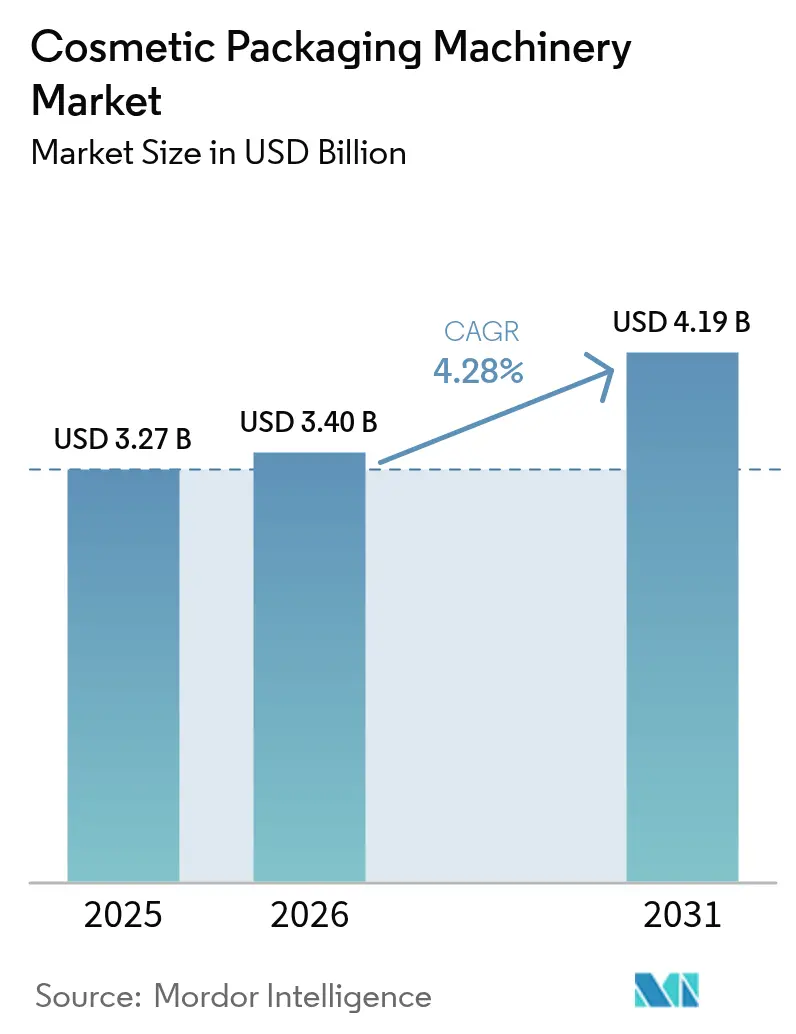
The cosmetic packaging machinery market size is projected to be USD 3.27 billion in 2025, USD 3.40 billion in 2026, and reach USD 4.19 billion by 2031, growing at a CAGR of 4.28% from 2026 to 2031. Intensifying beauty-product launches, faster changeover expectations, and the need for serialization are reshaping investment priorities across filling, capping, labeling, and inspection lines. Brands are seeking shorter payback horizons, which is pushing original-equipment manufacturers to unbundle automation modules and bundle lease-back financing. Regulatory pressure for recyclable formats is accelerating adoption of mono-material tubes and lightweight pumps that require servo-driven tension control. The skilled-labor deficit continues to lift demand for fully automatic systems with remote diagnostics, while geopolitical restrictions on advanced servo components are bifurcating the supplier landscape.
Key Report Takeaways
- By automation level, fully automatic systems held 62.43% of the cosmetic packaging machinery market share in 2025, while semi-automatic systems recorded the highest projected 5.61% CAGR through 2031.
- By machine type, form-fill-seal equipment led with 28.13% of market share in 2025; labeling machines are forecast to expand at a 5.27% CAGR to 2031.
- By packaging type, bottles, pumps, and dispensers accounted for 34.79% of market share in 2025, whereas tubes, sachets, and pouches are advancing at a 5.78% CAGR over 2026-2031.
- By cosmetic product, skin-care products captured 38.94% share in 2025; hair-care is the fastest-growing segment with a 6.02% CAGR through 2031.
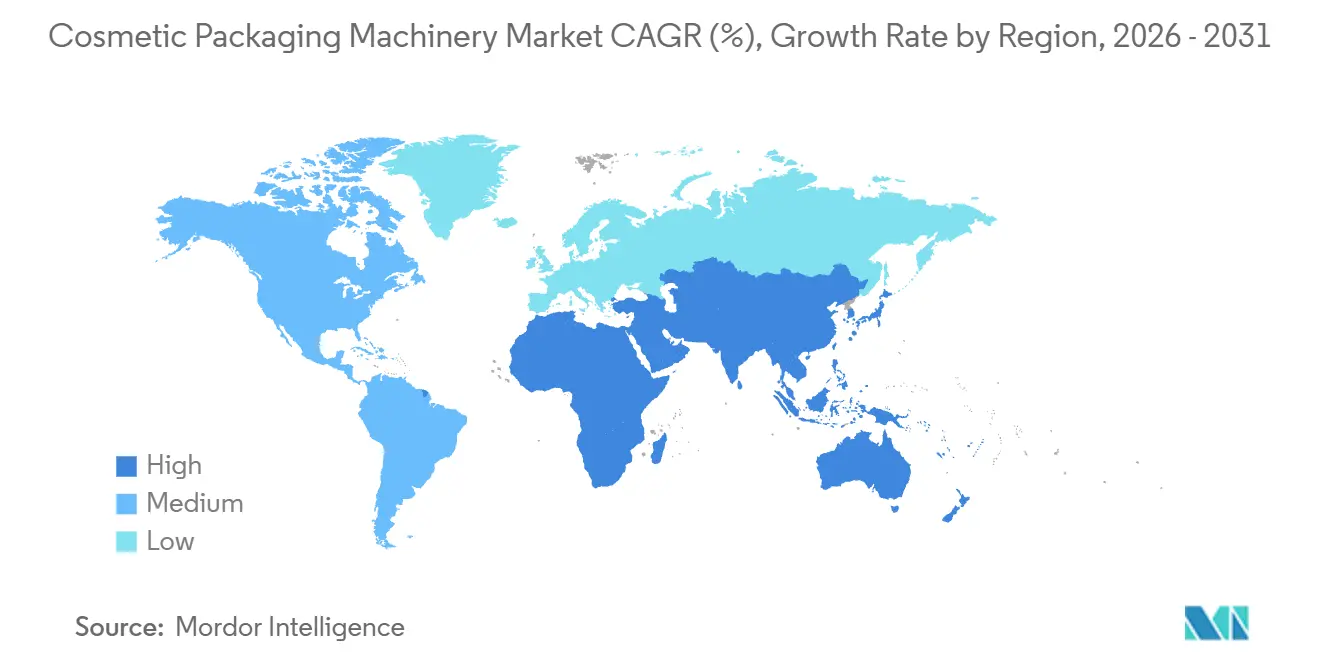
- By geography, North America commanded a 39.87% share in 2025, while Asia-Pacific is set to expand at a 6.11% CAGR, driven by domestic fill-finish capacity in China and India.
Note: Market size and forecast figures in this report are generated using Mordor Intelligence’s proprietary estimation framework, updated with the latest available data and insights as of 2026.
Market Trends and Insights
Drivers Impact Analysis of Cosmetic Packaging Machinery Market*
| Driver | (~) % Impact on CAGR Forecast | Geographic Relevance | Impact Timeline |
|---|---|---|---|
| Growing Demand for Personal Care and Beauty Products | +0.9% | Global, with accelerated growth in Asia-Pacific (China, India, South Korea) and Middle East | Medium term (2-4 years) |
| Increasing Industrial Automation and Smart Packaging Lines | +1.1% | North America, Europe, Asia-Pacific (Japan, South Korea) | Long term (≥ 4 years) |
| E-Commerce Shift Toward Smaller SKUs and Flexible Formats | +0.8% | Global, particularly North America and Europe for direct-to-consumer brands | Short term (≤ 2 years) |
| Sustainability Regulations Pressuring Eco-Friendly Packaging | +0.7% | Europe (EU microplastics ban), North America (state-level extended producer responsibility) | Medium term (2-4 years) |
| AI-Enabled Vision Inspection Boosts Throughput | +0.6% | North America, Europe, Asia-Pacific (advanced manufacturing hubs) | Short term (≤ 2 years) |
| Indie Cosmetic Brands Need Agile Short-Run Equipment | +0.5% | North America, Europe, Australia (localized production) | Short term (≤ 2 years) |
| Source: Mordor Intelligence | |||
Growing Demand for Personal Care and Beauty Products
Rising disposable income, premiumization, and social-media influence have lifted line-utilization rates above 85 % in mature markets, encouraging contract manufacturers to add second and third shifts rather than build new plants. A German plant using magnetic-transport conveyors cut changeover time from 45 minutes to under 10 minutes, enabling weekly SKU counts to top 120 without sacrificing output.[1]Beckhoff Automation, “XTS Conveying for Cosmetics,” beckhoff.com Asia-Pacific middle-class consumers increasingly insist on halal, vegan, and cruelty-free credentials, so vision systems now verify label claims in real time. Prestige distribution channels tighten acceptable defect levels to below 200 ppm, which is accelerating migration toward fully enclosed, sensor-rich equipment. As beauty companies roll out limited-edition collaborations, machinery that handles multiple container shapes without cross-contamination has become a procurement priority.
Increasing Industrial Automation and Smart Packaging Lines
Packaging cells now ship with embedded IoT sensors that capture cycle-time deviation, torque anomalies, and fill-weight drift, helping operators intervene before deviations trigger batch holds. A deep-learning vision platform launched in 2024 inspects label placement and seal integrity at more than 600 units per minute and reduces false rejects by 40 % compared with rule-based tools.[2]Cognex Engineering, “In-Sight 2800 Performance Note,” cognex.com Digital-twin commissioning shortens on-site installation by up to half, vital when lease agreements penalize late ramp-up. Collaborative robots for case packing reassign human operators to quality audits, while predictive maintenance routines schedule bearing replacements between production sprints. Taken together, these upgrades lift overall equipment effectiveness and justify a two- to three-times capital premium over legacy semi-automatic machinery.
E-Commerce Shift Toward Smaller SKUs and Flexible Formats
Direct-to-consumer channels rely on order sizes below two units, making sachets, trial-size tubes, and single-dose capsules attractive for postal delivery without dimensional-weight penalties. Flexible form-fill-seal lines capable of 15-minute format swaps now allow contract manufacturers to cluster multiple micro-brands on one shift. Digital presses such as the HP Indigo 25K can run cosmetic label jobs as small as 2,500 units, supporting rapid iteration cycles.[3]HP Industrial Press Division, “Indigo 25K Label Success Story,” hp.com Refillable packaging models are further fragmenting SKU counts, prompting OEMs to develop change-part systems that accept asymmetric geometries and nested inserts without manual adjustment. As a result, flexible equipment has evolved from a tactical fix for small orders into a cornerstone of omnichannel fulfillment strategies.
Sustainability Regulations Pressuring Eco-Friendly Packaging
The European Union microplastics ban coming into force in 2027 is accelerating mono-material tube adoption and paper-based laminate trials. New fiber-based tubes with polyethylene liners cut plastic content by 50 % while maintaining barrier integrity. Machinery vendors have responded with servo-driven heat-seal heads that adjust dwell time in real time based on film thickness and ambient humidity. State-level extended-producer-responsibility schemes in the United States impose fees on non-recyclable packs, making lightweight designs that reduce material mass by 20-30 % financially attractive. Together, these policies redirect capital toward equipment that can seal thinner walls, handle post-consumer-recycled resins, and record process data for compliance audits.
Restraints Impact Analysis of Cosmetic Packaging Machinery Market*
| Restraint | (~) % Impact on CAGR Forecast | Geographic Relevance | Impact Timeline |
|---|---|---|---|
| High Upfront Capital Expenditure | -0.7% | Global, acute in South America and Africa | Short term (≤ 2 years) |
| Volatile Prices of Precision Components and Steel | -0.5% | Global supply-chain concentration in Asia-Pacific | Medium term (2-4 years) |
| Shortage of Skilled Mechatronics Technicians | -0.6% | North America, Europe, Australia | Long term (≥ 4 years) |
| Export Controls on Advanced Servo Drives and Sensors | -0.3% | Asia-Pacific, Middle East, Africa | Medium term (2-4 years) |
| Source: Mordor Intelligence | |||
High Upfront Capital Expenditure
Fully automatic cosmetic filling lines range from USD 500,000 to USD 2.5 million, a commitment that can stretch payback periods for mid-tier contract manufacturers. Elevated interest rates have made traditional term loans less attractive, so vendors now market 36-month leases with per-unit usage fees. Although these structures align payments with production volume, they embed implicit borrowing costs above 8 % and penalize seasonal operations. Cash-constrained brands often delay automation until utilization rates rise above 70 %, which reinforces a two-tier market; global consumer-goods giants amortize equipment across multiple plants, while regional players rely on refurbished machinery. Component inflation adds further pressure, with servo-drive prices rising faster than headline steel costs.
Shortage of Skilled Mechatronics Technicians
A 2024 industry survey found that 95 % of consumer packaged goods companies struggle to recruit qualified packaging technicians. High turnover erodes institutional knowledge and forces repeated onboarding, depressing overall equipment effectiveness. Only 14 % of firms consider printed standard-operating procedures effective, underscoring the need for interactive, augmented-reality training modules. OEMs now bundle remote-diagnostics agreements that let factory-based specialists guide on-site staff through troubleshooting. While such tools narrow skill gaps, they cannot replace core competencies in programmable-logic controllers and servo tuning. The issue is most acute in regions where vocational curricula lag behind the pace of installed automation.
*Our forecasts treat driver/restraint impacts as directional, not additive. The impact forecasts reflect baseline growth, mix effects, and variable interactions.
Cosmetic Packaging Machinery Market Segment Analysis
By Machine Type:
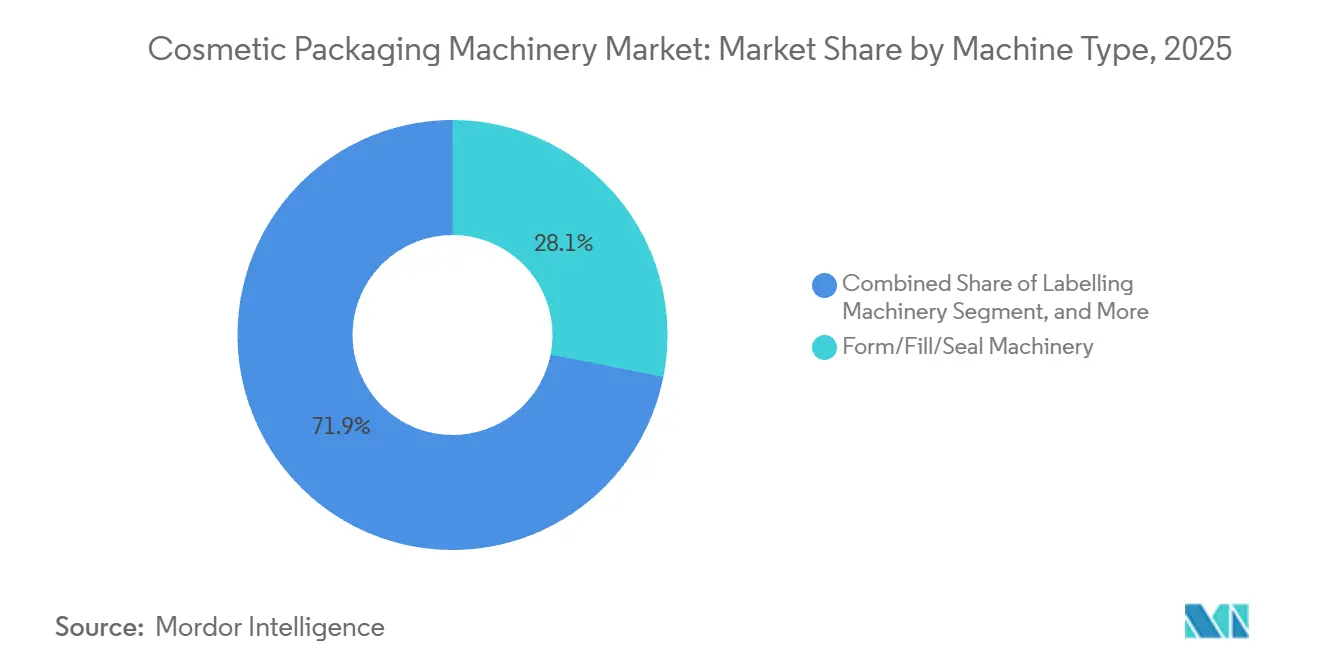
Labeling Equipment Gains Momentum on Serialization DemandsLabeling units are projected to outpace the broader cosmetic packaging machinery market with a 5.27% CAGR through 2031. Form-fill-seal systems held the largest share of 28.13% in 2025, yet brands focusing on traceability now prioritize printers and applicators that integrate QR codes and NFC tags. In consequence, the cosmetic packaging machinery market for labeling lines is growing as governments mandate unique identifiers and shoppers scan packs for authenticity checks. Vision-guided reject stations attached to these lines eliminate manual reinspection, supporting defect thresholds of fewer than 150 ppm. Growth also reflects a pivot toward augmented-reality triggers that unlock digital tutorials and loyalty programs. Machinery suppliers offer modular heads that swap between paper labels and shrink sleeves without tool changes, a design that lowers downtime and aligns with sustainability targets. Integrators bundle cloud-based data capture so brand owners can trace every lot back to plant, line, and operator, satisfying ISO 22716 record-keeping rules. Rising e-commerce penetration further increases label complexity, as fulfillment centers prefer unit-level barcodes that withstand abrasion during automated picking.
Semi-automatic label dispensers remain relevant for indie brands but are gradually ceding ground to servo-driven applicators capable of 600-plus units per minute. Investments focus on camera-based alignment that compensates for bottle wobble and glare from metallic inks. The cosmetic packaging machinery market share commanded by form-fill-seal equipment will persist, yet its growth is closely tied to single-serve sachets and sample pouches. These lines now host ultrasonic sealing jaws and gas-flush modules to preserve vitamin-rich emulsions. Meanwhile, capping, cartoning, and bundling machines plug into unified controls for uninterrupted data hand-off, simplifying validation in regulated export markets.


By Automation Level:
Fully Automatic Lines Retain the Performance EdgeFully automatic systems captured 62.43% of the market share in 2025, and semi-automatic systems recorded the highest projected 5.61% CAGR through 2031. Continuous motion conveyors and multi-axis robots achieve shorter tact times than intermittent machines, enabling contract manufacturers to achieve the throughput needed to service multiple brand owners simultaneously. Predictive-maintenance dashboards stream sensor data to cloud servers, alerting technicians before micro-stops snowball into hour-long outages.
The cosmetic packaging machinery market size associated with semi-automatic lines is not shrinking in absolute terms, yet its relative weight declines as lease-to-own models dilute capital hurdles. Semi-automatic fillers now ship with upgrade paths that add robotic capping modules when volumes justify. This modular strategy reduces obsolescence risk and keeps initial invoices below USD 150,000, an amount compatible with venture-backed start-ups. Nevertheless, once monthly order volumes pass 100,000 units, most operators migrate to fully automatic configurations to recover labor, energy, and scrap savings.
By Packaging Type:
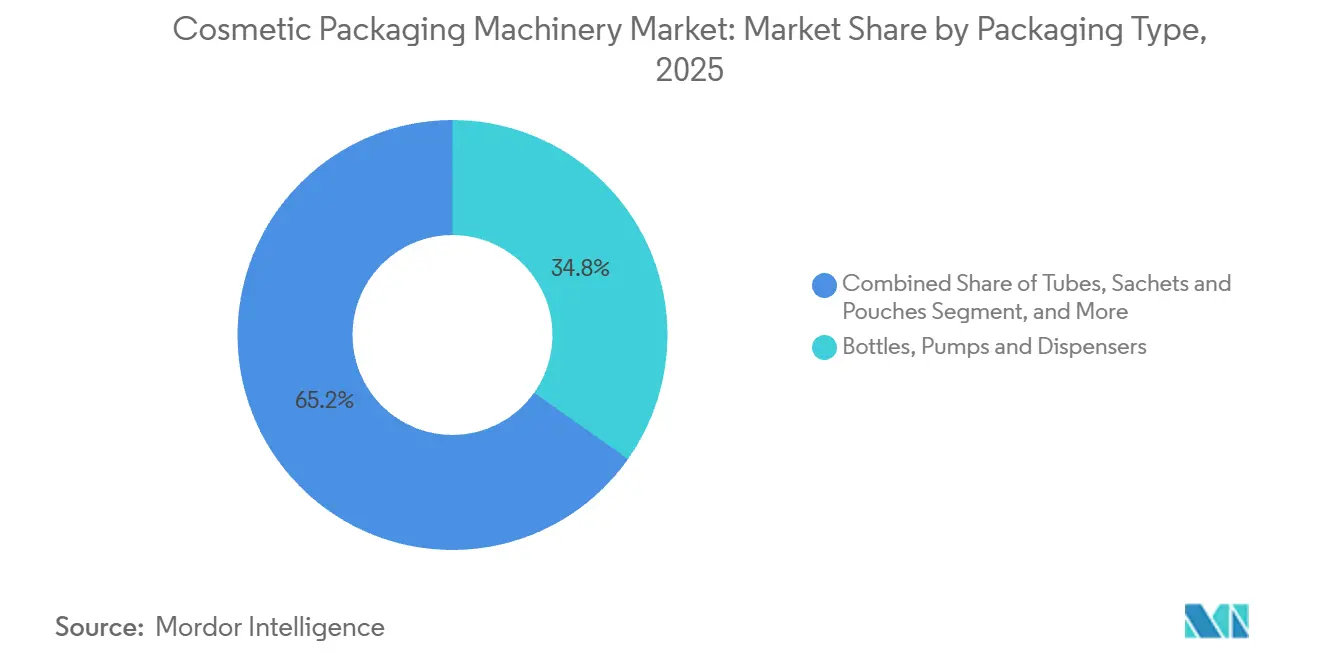
Tubes and Pouches Ride Refill EconomicsBottles and pumps hosted 34.79% of the market share in 2025, whereas tubes, sachets, and pouches are advancing at a 5.78% CAGR over 2026-2031. Refillable cartridges and single-dose pouches align with consumers who seek to reduce waste without compromising hygiene. Machinery dedicated to tubes must now handle wall thicknesses below 300 microns and adjust sealing parameters in milliseconds, tasks that are impossible for legacy thermal knives. The cosmetic packaging machinery market for tube fillers is therefore capturing incremental capex as brands localize production to avoid tariffs on empty containers.
Flexible films also support cost-effective sampling programs, enabling marketers to seed social media influencers without shipping heavy glass jars. Servo-driven tension control maintains print registration, even on contoured pouches, ensuring shelf impact. Rigid jars continue to dominate rich balms and scrubs, but their share erodes where airlines enforce 100-milliliter liquid limits. Brands consequently reformat hero SKUs into 30-gram pods, compelling OEMs to integrate scale weighers and nitrogen flushers on the same frame.
By Cosmetic Product:
Hair-Care Accelerates on Salon PremiumizationSkin-care retained 38.94% share in 2025, buoyed by demand for airless pumps that shield retinol and vitamin C from oxidation. Yet hair care is the fastest-growing segment, with a 6.02% CAGR through 2031. Sulfate-free shampoos foam more readily, so gravity-fed fillers risk bubble formation that disrupts cap torque. Servo-controlled bottom-up nozzles solve this problem, reducing rework and elevating equipment prices. The cosmetic packaging machinery market share for hair-care lines will therefore widen as salons upsell bond-repair treatments and color-safe conditioners.
Make-up manufacturers chase sustainability targets with magnetic refill pans, requiring precision stamping and pick-and-place robots to avoid contaminating surface finishes. Fragrance bottlers continue to rely on crimping heads capable of ±0.05-millimeter positional accuracy to stop propellant leaks. Specialty segments such as men’s grooming integrate aluminum tubes that require lower crimp force and anodized surface coatings, encouraging equipment suppliers to diversify head materials.
Geography Analysis
North America Cosmetic Packaging Machinery Market
North America leads the cosmetic packaging machinery market with 39.87 % of market share in 2025, supported by mature contract-manufacturing infrastructure and robust replacement demand. Domestic brands target two-day shipping windows, driving investment in digital changeover technologies that compress downtime to single-digit minutes. The United States benefits from equipment-financing options unavailable in many emerging markets, allowing mid-cap producers to automate earlier in their life cycles. Canada’s clean-energy incentives lower operating costs for servo-rich lines, improving net present value calculations.
APAC Cosmetic Packaging Machinery Market
Asia-Pacific trails in absolute revenue but posts the fastest 6.11 % CAGR through 2031. China adds capacity to sidestep tariffs on imported finished goods, and provincial grants subsidize vision-inspection retrofits. India’s cosmetics ecosystem, centered in Bengaluru and Mumbai, installs digital presses that print 2,500-unit label runs, ideal for regional formulations sold through e-commerce. Southeast Asian assemblers, however, face export controls on advanced servos, lengthening lead times and prompting multinational customer pivots to joint ventures with Japanese or South Korean integrators.
The Americas and EMEA Cosmetic Packaging Machinery Market
Europe ranks third in revenue yet sets global compliance benchmarks. The EU microplastics ban triggers a spike in mono-material tube demand, fostering machinery upgrades that measure moisture in real time to avoid laminate delamination. OEMs headquartered in Italy and Germany accelerate R and D spending on paper-based laminates even as regional order books flatten near term. South America grows more slowly due to currency volatility and high loan rates, though Brazil and Argentina still import flexible fillers to serve indie brands. The Middle East and Africa adopt duty-free-zone strategies to attract contract-manufacturing investments, while Mexico captures near-shoring flows under the USMCA agreement by offering dual-plant footprints that cut border dwell times.

Regulatory Landscape
In the European Union, Regulation (EU) 2025/40 on Packaging and Packaging Waste (PPWR) entered into force on February 11, 2025 and resets recyclability-by-design and packaging compliance obligations for products placed on the EU market. For cosmetic packaging machinery, this shifts demand toward equipment that can process mono-material structures, post-consumer recycled resins, and lightweight formats while maintaining seal integrity and lot-level data capture to support compliance audits.
On machine safety and conformity, the European Commission published Commission Implementing Decision (EU) 2026/546 in March 2026, updating the list of harmonised standards supporting compliance under the machinery framework, including EN 415-2:2025 for packaging machines handling pre-formed rigid containers. In parallel, cosmetics manufacturing compliance requirements (such as ISO 22716 record-keeping referenced by brand and contract manufacturer validation practices) and the United States FDA implementation of the Modernization of Cosmetics Regulation Act (MoCRA) keep pressure on equipment builders to deliver documentation-ready designs, traceability features, and validation support alongside throughput improvements.
Value Chain Analysis
The value chain starts with component and subsystem suppliers (servo drives, sensors, vision cameras, stainless-steel wetted-path assemblies, PLCs and HMI software), feeding OEMs that design and assemble core modules such as filling, capping, labeling, inspection, and cartoning/case packing. System integrators and turnkey line providers connect multi-station cells and digital layers (remote diagnostics, OEE dashboards, recipe management), then distribute through direct sales and regional agents to end users including brand-owned factories and contract manufacturers. Aftermarket services (spares, change parts, qualification documentation, and remote support) also form a recurring revenue layer that shapes OEM platform decisions.
Performance and risk concentrate at integration and commissioning. Bottlenecks often stem from speed mismatches between filler, labeler, and downstream pack-out, interface gaps in multi-vendor lines, and changeover downtime as SKU counts rise. As a result, procurement increasingly favors suppliers that can deliver validated, modular, upgradeable lines (adding robotic capping, vision rejection, or serialization-ready labeling) while providing GMP-aligned documentation practices associated with cosmetic manufacturing controls (commonly anchored to ISO 22716 expectations). The skilled technician shortage and the need for rapid format swaps further lift demand for digital service capability, including remote diagnostics and standardized FAT/SAT execution, as a differentiator across otherwise comparable machine specifications.
Competitive Landscape
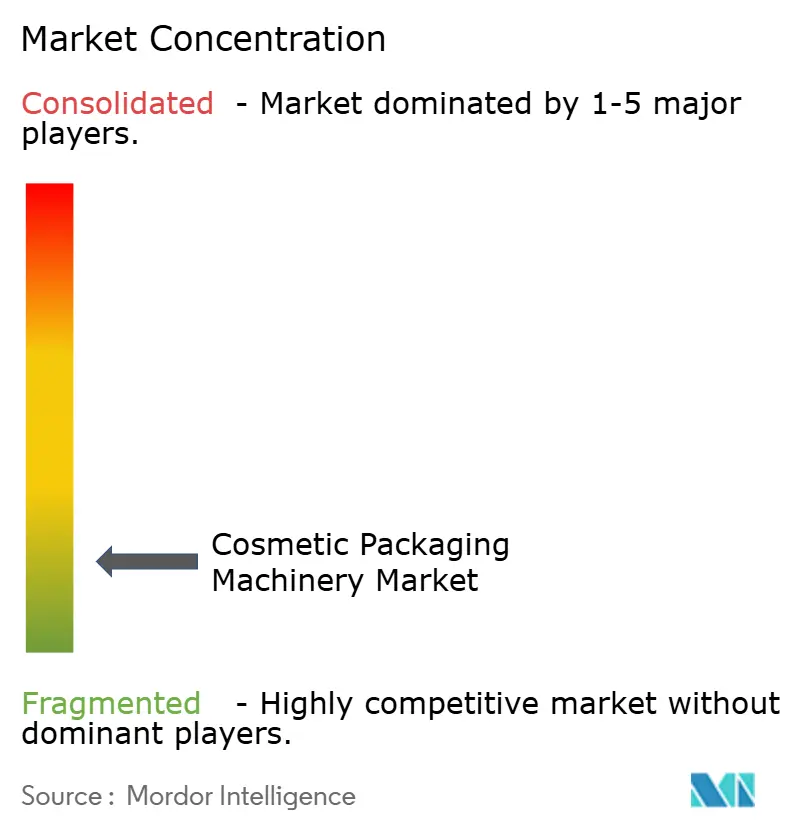
The cosmetic packaging machinery market is fragmented. Each leverages installed bases to sell multi-year service contracts that include 24-hour remote monitoring. Asian assemblers undercut list prices by up to 40 %, but premium brands often select European lines for their proven validation documents. Platform architectures that allow filling, capping, and labeling modules to slide onto a common backbone dominate recent launch announcements.
Technology differentiation centers on vision-inspection fidelity, changeover speed, and digital-twin accuracy. A 2024 camera platform cut false rejects by 40 % in high-refraction bottles, an advantage that justifies premium per-camera pricing. Leasing and usage-based contracts attract cash-focused indie brands, but they also shift residual-value risk back to suppliers, increasing emphasis on modular designs that can retrofit future compliance features. Patent filings surge in servo-tension control for paper-laminate tubes and in AI-based defect classification, signaling where next-generation margins will accrue.
Mergers and acquisitions continue. Duravant announced its Pattyn buyout to deepen horizontal form-fill-seal know-how, while Sidel commissioned an aseptic PET line in India to anchor future aftermarket sales. Partnerships proliferate: Aptar teamed with Pinard on an airless PET bottle with 40 % less plastic; Silgan prepared a recyclable tube-pump line that ships in November 2026. Disruptors such as Unmade use cloud dashboards and modular fillers to serve 50-unit pilot runs, forcing incumbent OEMs to reassess minimum-order thresholds.
Cosmetic Packaging Machinery Industry Leaders
Syntegon Technology GmbH
IMA Industria Macchine Automatiche SpA
Marchesini Group SpA
Coesia S.p.A (PackSys Global etc.)
ProMach Inc.
- *Disclaimer: Major Players sorted in no particular order
Cosmetic Packaging Machinery Market Companies Covered in this Report
- Syntegon Technology GmbH
- IMA Industria Macchine Automatiche SpA
- Marchesini Group SpA
- Coesia S.p.A (PackSys Global etc.)
- ProMach Inc.
- Accutek Packaging Equipment Co.
- Krones AG
- Sidel Group
- Optima Packaging Group GmbH
- Norden Machinery AB
- Barry-Wehmiller (Pneumatic Scale Angelus)
- Uhlmann Packaging Systems
- ProSys Innovative Packaging Equipment
- TurboFil Packaging Machines LLC
- Vetraco Group
- Zhejiang Rigao Machinery Corp.
- Quadpack
- Cosmogen
- APACKS
- Shemesh Automation

Market Opportunities and Future Outlook
Compliance-driven packaging redesign in Europe creates near-term whitespace for machinery retrofits and new lines that can run recyclable structures, particularly mono-material tubes, lightweight pumps, and thinner-wall containers, without sacrificing seal quality or torque control. The EU PPWR (Regulation (EU) 2025/40), in force since February 2025, supports investment in heat-seal control, in-line inspection, and process-data capture that help brands and contract manufacturers demonstrate recyclability-by-design and reduce fees associated with non-recyclable packaging in jurisdictions that apply EPR-style mechanisms.
Digitalization and AI-enabled production support a second set of opportunities, especially equipment that reduces dependence on scarce mechatronics labor through remote support, guided troubleshooting, and higher-fidelity in-line inspection. A concrete signal comes from South Korea, where Cosmecca Korea was selected in June 2026 for a government AI manufacturing program tied to building an AI-based autonomous manufacturing platform, reinforcing demand for packaging lines that integrate machine data, diagnostics, and automation layers rather than stand-alone stations. At the same time, faster SKU churn from e-commerce and refill models increases the need for tool-less changeover, modular station upgrades, and flexible labeling and verification capabilities that connect traceability and brand-authenticity features to high-mix, short-run operations.
Recent Industry Developments in Cosmetic Packaging Machinery Market
- April 2026: Syntegon demonstrated its neXt system architecture at Interpack 2026, integrating platforms such as HFX flow-wrapping and TRX topload cartoning into a more standardized, connected packaging approach. The development supports faster line configuration and serviceability for high-mix beauty packaging operations where modular add-ons and digital connectivity are becoming procurement requirements.
- February 2026: Syntegon launched the AIM9 high-speed inspection platform positioned for pharmaceutical and cosmetic applications, including container closure integrity testing at high throughput. This expands the inspection and compliance toolset available to cosmetic packers seeking lower defect rates and more automated quality assurance on fast lines.
- August 2024: IMA Group completed the acquisition of Sarong Packaging Machinery and Sarong Packaging Materials divisions, strengthening its footprint across personal care and adjacent regulated packaging operations. The acquisition broadened IMA's portfolio and integration capability, reinforcing the shift toward single-supplier, end-to-end line offerings that combine primary and secondary packaging equipment with lifecycle support.


Cosmetic Packaging Machinery Market Report Scope and Research Methodology
Market Definition and Coverage
This market covers revenues earned from machines and systems used to fill, close, label, inspect, and pack cosmetic products into their final sale-ready packs, across common container formats and automation levels.
Scope exclusions: We exclude cosmetic packaging materials and finished cosmetic products, and we do not count general-purpose industrial machinery unless it is used for cosmetic packaging applications.
Segments Covered in This Report
- By Machine Type
- Form/Fill/Seal Machinery
- Labelling Machinery
- Capping Machinery
- Wrapping and Bundling Machinery
- Cartoning and Case-Packing Machinery
- Inspection and Vision Systems
- Other Machine Types
- By Automation Level
- Fully-Automatic Systems
- Semi-Automatic Systems
- By Packaging Type
- Rigid Containers and Jars
- Tubes, Sachets and Pouches
- Bottles, Pumps and Dispensers
- Flexible Films and Wraps
- By Cosmetic Product
- Skin-Care Products
- Hair-Care Products
- Make-Up and Color Cosmetics
- Fragrances and Deodorants
- Other Cosmetic Products
- By Geography
- North America
- United States
- Canada
- Mexico
- South America
- Brazil
- Argentina
- Rest of South America
- Europe
- Germany
- France
- United Kingdom
- Italy
- Rest of Europe
- Asia-Pacific
- China
- Japan
- South Korea
- India
- Australia
- Rest of Asia-Pacific
- Middle East and Africa
- Middle East
- Saudi Arabia
- United Arab Emirates
- Turkey
- Rest of Middle East
- Africa
- South Africa
- Kenya
- Rest of Africa
- Middle East
- North America
Data Sources, Market Sizing, and Validation
Desk Research
Desk work started with a clean view of demand signals behind cosmetic pack line investments, then mapped those signals to the machine categories typically installed in cosmetic plants. We used public sources including UN Comtrade for packaging machinery trade flows, the US International Trade Commission data tools for cross-checking product codes, Eurostat for industrial and trade indicators, the World Bank for macro series used in forecasting, and OECD industry statistics for manufacturing trends.
To keep the model grounded, we also reviewed company annual reports and investor presentations for capacity additions and capex cues, alongside press coverage and association websites that describe packaging and automation adoption. Where needed, paid subscriptions for company financials and for shipment-level import and export records were used to validate regional supplier presence and timing of equipment deliveries. These desk sources are not exhaustive, and additional public references were used for data collection, validation, and clarification during the research process.
Primary Interviews and Surveys
Primary work focused on interviews and structured surveys with packaging line integrators, machinery OEM-side teams, component ecosystem contacts, and end users running cosmetic filling and secondary packaging lines. Because this is a global market, inputs were checked across APAC, EMEA, and the Americas so that our assumptions on automation mix, typical line speeds, and price bands could be confirmed and adjusted where local buying patterns differ.
Distribution of primary research fieldwork respondents
| Company type | Respondent position | Region |
|---|---|---|
| Top tier: 25% | CXOs: 12% | APAC: 46% |
| Mid tier: 57% | Functional/Unit leaders: 35% | EMEA: 31% |
| Smaller Players: 18% | Managers: 53% | Americas: 23% |
Market-Sizing & Forecasting
Sizing is built with a top-down demand reconstruction, where cosmetic production and pack format mix are translated into expected packaging line needs, then converted into annual equipment spending by machine group. We also corroborate the totals using selective bottom-up approximations, mainly supplier and channel checks and sampled ASP multiplied by expected unit deployments, so the overall result can be adjusted if it drifts from field signals.
Key inputs used in the model include the split of cosmetic output across skin care, hair care, makeup, and fragrances, the share of packs running on rigid versus tubes and pouches, the automation mix between fully automatic and semi-automatic lines, typical changeover frequency for short runs, and the spread of inspection and vision adoption for quality checks. Pricing logic is handled through region-specific ASP bands for major equipment blocks such as form-fill-seal, capping, labeling, cartoning and case packing, and inspection modules, with gaps filled using closest comparable machines when a niche configuration has limited visibility.
For forecasting, we run scenario analysis anchored on macro indicators and packaging investment intent captured in interviews, followed by a smoothing step to avoid sharp year-to-year jumps that are not supported by plant expansion cycles. When input variables conflict, more repeatable indicators such as trade activity and installed base replacement rhythm are weighted higher in the final forecast path.
Data Validation & Update Cycle
Outputs are validated through multiple checks, including reconciliation against trade direction, capacity addition announcements, and the implied equipment intensity per level of cosmetic output. When a region shows a sudden swing, the assumptions are re-opened and, if needed, respondents are re-contacted to confirm whether the change is due to pricing, delayed projects, or a real shift in automation demand.
Before sign-off, the model and its inputs go through an internal review so unit logic, currency handling, and time alignment stay consistent across geographies. Reports are refreshed annually, and interim updates are made when material events occur that can change equipment spending patterns. A final refresh pass is performed right before delivery so clients receive an up-to-date view rather than an older snapshot.
Mordor Intelligence's Cosmetics Packaging Machinery Market Size Compared With Other Published Estimates
Market values for cosmetic packaging machinery often differ across publications because the scope boundary is not identical, and the way pricing and timing are treated can vary by author. Differences also arise from whether estimates include only dedicated cosmetic lines or also pull in broader packaging equipment used across multiple industries.
By tracking machine-type level spending and refreshing currency timing assumptions, Mordor Intelligence keeps the estimate tied to cosmetic-dedicated packaging applications and avoids inflating totals with adjacent general packaging equipment revenues. Gaps also show up when an estimate assumes a more aggressive capex cycle, applies a single global ASP uplift, or does not separate fully automatic lines from semi-automatic systems when projecting replacement and upgrade pace.
Benchmark comparison
| Source | Market Size | Gaps in Research Methodology |
|---|---|---|
| Mordor Intelligence | USD 3.40 B (2026) | |
| Trade Journal A | USD 4.93 B (2024) | Uses an earlier base year and a broader coverage narrative that may mix cosmetic-dedicated lines with wider packaging equipment demand, and it provides limited detail on machine-type splits and currency timing. |
| Global Consultancy B | USD 2.97 B (2023) | Anchors sizing on a shipments-and-revenue framing with a different product taxonomy and horizon, which can compress values if complete line integration and higher automation ASP bands are not consistently captured. |
The spread across the table is mainly explained by scope boundaries, base-year alignment, and how equipment ASP progression is handled over the cycle. With a model that stays close to cosmetic pack format demand signals and is cross-checked through supplier and trade-based indicators, the final value remains traceable to clear variables and repeatable steps for year-to-year updates.


Key Questions Answered in the Report
What is the projected value of the cosmetic packaging machinery market by 2031?
The market is forecast to reach USD 4.19 billion by 2031.
Which machine type is growing fastest in cosmetic packaging applications?
Labeling equipment, driven by serialization and digital-engagement mandates, is advancing at a 5.27% CAGR.
Why are brands investing in fully automatic packaging lines?
Fully automatic systems cut changeover time, embed predictive maintenance, and deliver uptime needed for multi-shift operations.
How do sustainability rules influence equipment design?
EU and U.S. regulations favor mono-material tubes and lightweight formats, prompting machines with precise heat-seal and moisture-control features.
What regions will add the most new packaging-machinery capacity?
Asia-Pacific, especially China and India, will post the highest 6.11% CAGR as local fill-finish plants bypass tariffs.
How are suppliers addressing the technician shortage?
OEMs integrate remote diagnostics and augmented-reality guides that allow fewer, less experienced staff to maintain complex lines.
Page last updated on:


 Your data is secure and never sold or shared.


