
Coronary Artery Bypass Grafting Market Size and Share
Market Overview
| Study Period | 2020 - 2031 |
|---|---|
| Market Size (2026) | USD 18.57 Billion |
| Market Size (2031) | USD 24.20 Billion |
| Growth Rate (2026 - 2031) | 5.44 % |
| Fastest Growing Market | Asia-Pacific |
| Largest Market | North America |
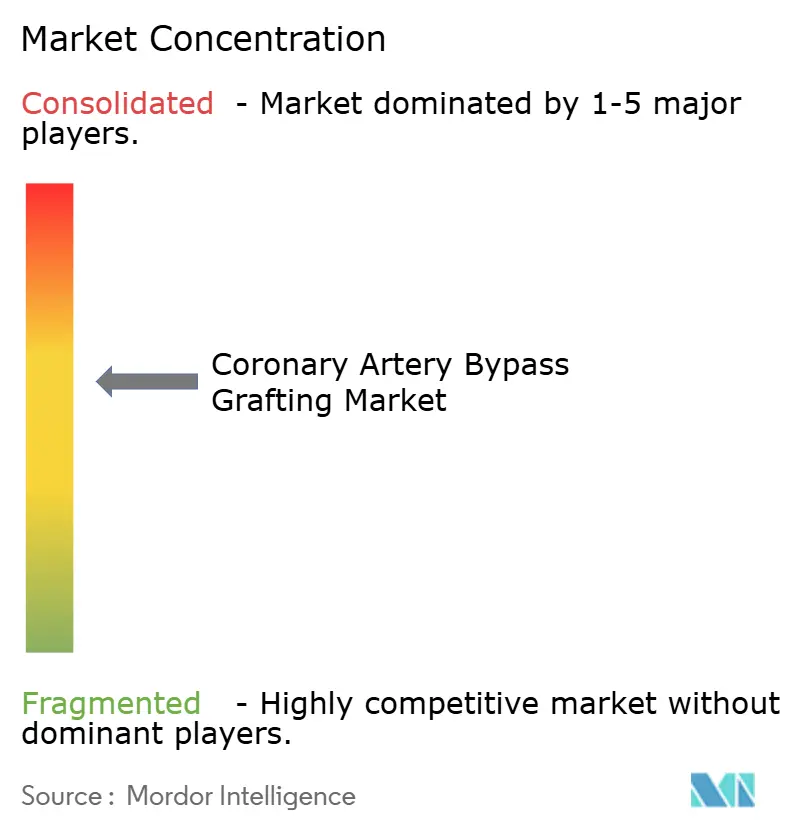
| Market Concentration | Medium |
Major Players *Disclaimer: Major Players sorted in no particular order Image © Mordor Intelligence. Reuse requires attribution under CC BY 4.0. | |
Coronary Artery Bypass Grafting Market Analysis by Mordor Intelligence
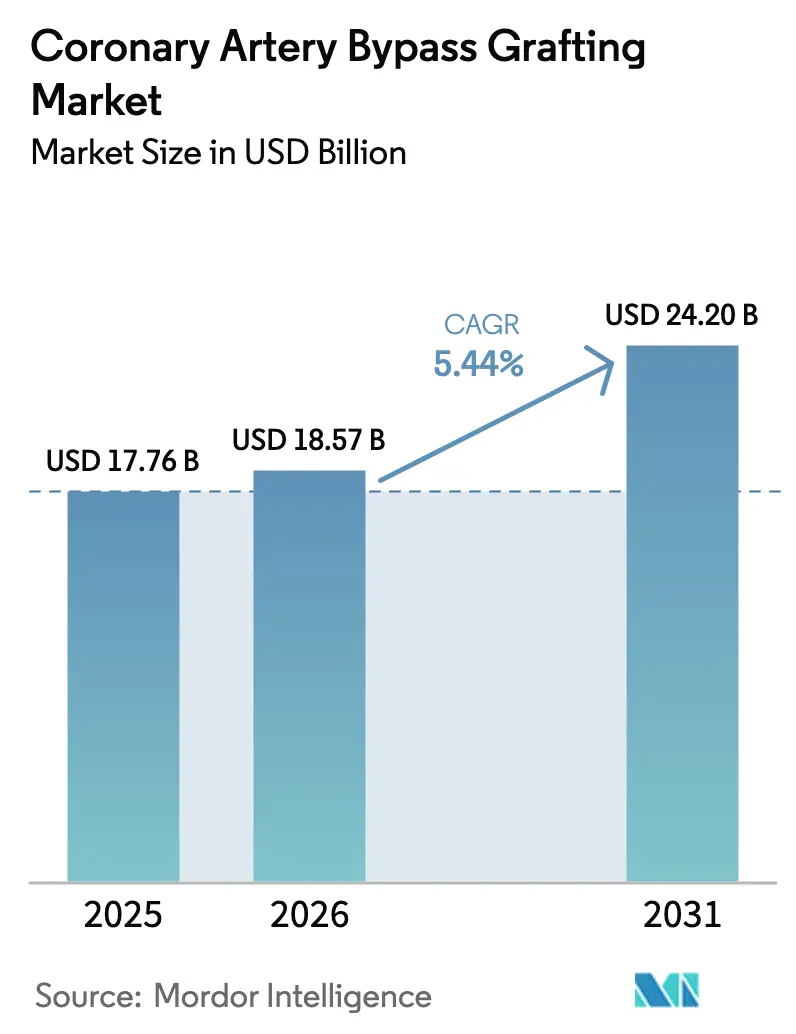
The Coronary Artery Bypass Grafting Market size is expected to grow from USD 17.76 billion in 2025 to USD 18.57 billion in 2026 and is forecast to reach USD 24.20 billion by 2031 at 5.44% CAGR over 2026-2031.
Hospitals continue to reserve surgery for complex multivessel disease, while routine lesions migrate to percutaneous coronary intervention, which keeps overall volumes stable but lifts average procedure value. Rising multimorbidity in aging G-20 populations and the documented survival edge of surgery over PCI in high SYNTAX-score cases reinforce demand even as robotic platforms compress length of stay.[1] Device makers counter competitive pressure with service contracts that cushion hardware cycles and with external stent innovations that extend graft longevity. Meanwhile, bundled-payment pilots in the United States and Germany reward centers that deliver complete revascularization with fewer readmissions, nudging hospitals toward multi-arterial grafting.
Key Report Takeaways
- On-pump surgery captured 54.73% of 2025 procedure-type revenue; minimally invasive and robotic CABG is projected to expand at a 9.24% CAGR through 2031.
- Heart positioners and tissue stabilizers led the 2025 product and services category with 26.63% of sales, while endoscopic vessel-harvesting systems are forecast to post the fastest growth at an 8.13% CAGR to 2031.
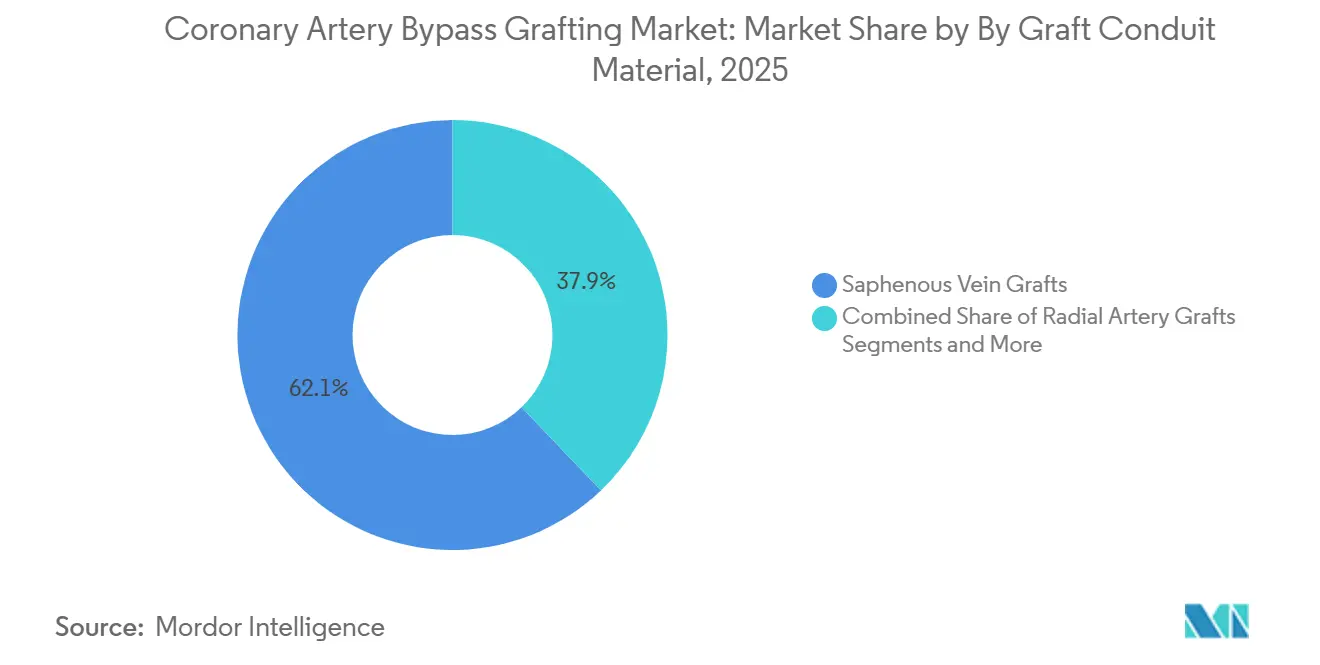
- Saphenous vein grafts commanded 62.14% of 2025 conduit value; synthetic and bio-engineered grafts are expected to grow at an 8.56% CAGR over the same period.
- Triple bypass procedures accounted for 30.53% of surgery complexity share in 2025, whereas quadruple-and-higher bypass operations are set to advance at a 9.23% CAGR through 2031.
- Hospitals held 64.25% of end-user revenue in 2025; ambulatory surgical centers represent the fastest-growing site of care with a 7.44% CAGR to 2031.
- North America controlled 36.44% of geographic revenue in 2025, while Asia-Pacific is projected to register the strongest regional expansion, at a 7.03% CAGR over 2026-2031.
Note: Market size and forecast figures in this report are generated using Mordor Intelligence’s proprietary estimation framework, updated with the latest available data and insights as of January 2026.
Market Trends and Insights
Drivers Impact Analysis of Coronary Artery Bypass Grafting Market*
| Driver | (~) % Impact on CAGR Forecast | Geographic Relevance | Impact Timeline |
|---|---|---|---|
| Rising prevalence of complex multivessel CAD and diabetes | +1.2% | Asia-Pacific, Middle East showing highest absolute case growth | Medium term (2-4 years) |
| Aging population in G-20 economies expanding surgical candidate pool | +1.5% | North America, Europe, Japan, South Korea | Long term (≥ 4 years) |
| Guideline preference for CABG over PCI in high SYNTAX-score disease | +0.8% | North America, Western Europe | Short term (≤ 2 years) |
| Transition to mini-sternotomy and robotic CABG unlocking day-7 discharge | +0.9% | North America, Europe, urban Asia-Pacific | Medium term (2-4 years) |
| Commercialization of external stents for saphenous vein grafts | +0.6% | Europe, early adoption in North America | Medium term (2-4 years) |
| Regional bundled-payment pilots rewarding multi-arterial grafting outcomes | +0.5% | United States, Germany, Netherlands | Short term (≤ 2 years) |
| Source: Mordor Intelligence | |||
Rising Prevalence of Complex Multivessel CAD and Diabetes
Diabetes sharply increases vessel disease complexity, and patients with both conditions see better survival with surgery than with PCI.[2]The International Diabetes Federation expects diabetic adults to climb to 783 million by 2045, with most of the growth in low- and middle-income countries. In parallel, Asia faces a projected 91.2% jump in cardiovascular mortality by 2050, keeping surgical demand on a steep upward slope.[3] Because diabetic multivessel disease often exceeds SYNTAX 22, guidelines now direct such cases to heart teams for CABG referral. As screening improves and populations age, the coronary artery bypass grafting market gains a sizeable inflow of high-complexity candidates.
Aging Population in G-20 Economies Expanding Surgical Candidate Pool
Citizens aged 65 and older will represent 24.3% of the G-20 population by 2050. Older patients present diffuse disease and more left main involvement, both indications for complete surgical revascularization. Japan, Germany, Italy, and South Korea face the steepest demographic curves, while the U.S. training pipeline has doubled cardiothoracic residents since 2008. However, perfusionist numbers lag; half of the current U.S. workforce may retire by 2031. This imbalance fuels wait lists in Canada and the United Kingdom, intensifying pressure on hospitals to streamline case scheduling.
Guideline Preference for CABG Over PCI in High SYNTAX-Score Disease
The 2021 ACC/AHA/SCAI revascularization guideline assigns Class I status to CABG for left main or multivessel disease with SYNTAX > 22. Real-world evidence from 2024 shows minimally invasive direct CABG cutting myocardial infarction risk by 54% versus second-generation drug-eluting stents. Electronic medical record decision-support tools now flag high-SYNTAX cases for surgical consult, shifting referral volumes toward operating rooms in academic networks.
Transition to Mini-Sternotomy and Robotic CABG Unlocking Day-7 Discharge
A 2024 meta-analysis reported 96% graft patency and sub-1% mortality for robotic CABG, with median stay shortened by two to three days. Leasing plans introduced by Intuitive Surgical in 2024 lower capital barriers, letting mid-sized hospitals adopt the technology. CMS bundled-payment rules reward institutions that discharge patients sooner and curb readmissions, so robotic programs increasingly move low-risk cases into same-week discharge pathways.
Restraints Impact Analysis of Coronary Artery Bypass Grafting Market*
| Restraint | (~) % Impact on CAGR Forecast | Geographic Relevance | Impact Timeline |
|---|---|---|---|
| PCI drug-eluting stent iterations lowering repeat-intervention rates | –0.7% | North America, Western Europe, urban Asia-Pacific | Medium term (2-4 years) |
| Limited global stock of CABG-skilled surgeons and perfusionists | –0.9% | Global, acute in Canada, United Kingdom, Australia | Short term (≤ 2 years) to Long term (≥ 4 years) |
| Procedural CO₂ footprint scrutiny in EU ETS phase-in | –0.3% | Europe with spill-over to United Kingdom, Switzerland | Short term (≤ 2 years) |
| Rising U.S. tariffs on precision CABG components inflating ASPs | –0.4% | United States with ripple effects on global supply chains | Short term (≤ 2 years) to Medium term (2-4 years) |
| Source: Mordor Intelligence | |||
PCI Drug-Eluting Stent Iterations Lowering Repeat-Intervention Rates
Biodegradable-polymer stents cut four-year major adverse events to 14.2% from 23.0% in recent randomized work. With second-generation everolimus devices delivering sub-10% five-year failure, intermediate SYNTAX cases now lean toward PCI. Johnson & Johnson’s 2024 purchase of Shockwave Medical adds lithotripsy that lets interventionalists tackle calcified lesions once sent to surgery. As the technology diffuses, the coronary artery bypass grafting market faces gradual patient leakage in Western referral patterns.
Limited Global Stock of CABG-Skilled Surgeons and Perfusionists
Canada has only 375 perfusionists for 39 million citizens, and vacancies stand near 40. A CBC investigation tied 80 deaths to delayed surgery in Quebec during 2023-2024. U.S. surveys predict a 35.1% perfusionist shortfall by 2031. Low-income nations lack accredited schools, pushing hospitals to recruit overseas staff, which inflates costs and caps procedure volumes.
*Our forecasts treat driver/restraint impacts as directional, not additive. The impact forecasts reflect baseline growth, mix effects, and variable interactions.
Coronary Artery Bypass Grafting Market Segment Analysis
By Procedure Type:
Robotic Platforms Reshape Length-of-Stay EconomicsOn-pump techniques retained 54.73% of revenue in 2025, maintaining the largest coronary artery bypass grafting market share, while the coronary artery bypass grafting market size for minimally invasive and robotic platforms is set to expand at a 9.24% CAGR through 2031. Hospitals value on-pump CABG for reliable myocardial protection when tackling three-vessel disease. Off-pump surgery holds niche appeal for calcified aortas but shows no survival edge in pooled data. Robotic systems close the cosmetic gap with PCI, reducing sternotomy discomfort and freeing ICU beds within 48 hours. Training curves have shortened to roughly 20 cases, and new leasing models spread capital outlays across five-year horizons.
Growth in robotic procedures also enables select cases in ambulatory centers, especially single- or double-vessel disease with preserved ventricular function. CMS pays a single bundled rate, so facilities that discharge on or before postoperative day 3 keep more of the margin. As hospitals chase these savings, the phrase coronary artery bypass grafting market will increasingly denote an ecosystem where acuity stratification, not volume, drives revenue.


By Product and Services:
Endoscopic Harvesting Gains as Surgeons Prioritize CosmesisHeart positioners and tissue stabilizers led 2025 sales at 26.63%, but endoscopic harvesting devices will grow fastest at 8.13% through 2031. Their use drops leg-wound infection to below 2% and trims operative time by nearly 25 minutes in contemporary series. Cardiopulmonary bypass consoles face elongated replacement cycles—often exceeding 15 years—as vendors deliver modular oxygenator upgrades. Services tied to those consoles generate 30% of Getinge’s cardiovascular revenue, smoothing demand across purchase cycles.
Anastomosis assist tools gain traction in robotic cases where instrument articulation is limited. Meanwhile, regional suppliers compete on cannula price, especially in India and Brazil, although U.S. centers pay a premium for heparin-bonded tubing that reduces hemolysis. Vendor consolidation continues; 62% of U.S. programs have trimmed their supplier list by at least 20% since 2021. This shift concentrates bargaining power and reinforces the dominance of multinational brands in the coronary artery bypass grafting market.
By Graft / Conduit Material:
External Stents Extend Saphenous Vein DurabilitySaphenous vein grafts held 62.14% value in 2025, but the coronary artery bypass grafting market size for synthetic and bio-engineered conduits is projected to grow at 8.56% through 2031. External stents like VEST reduce intimal hyperplasia, lifting four-year perfect patency by 33 percentage points. Internal thoracic arteries remain the gold standard for the left anterior descending artery with >90% ten-year patency, and their bilateral use is rising despite a slightly higher sternal infection risk in diabetics.
Radial artery grafts deliver 80-85% ten-year patency when paired with ≥70% target stenosis, making them the conduit of choice for right coronary lesions. Tissue-engineered constructs enter adult trials in 2026, promising off-the-shelf options that remodel into living vessels. Once safety data mature, these innovations could redefine the coronary artery bypass grafting market landscape by shrinking the gap between surgical and endovascular durability.
By Surgery Complexity:
Quadruple Bypass Surges as Diabetes Drives Diffuse DiseaseTriple grafting made up 30.53% of 2025 cases, yet quadruple-plus procedures will grow at 9.23%, the highest rate among complexity tiers. Diffuse plaque in diabetic and older patients often mandates four or five distal anastomoses to avoid incomplete revascularization. Bilateral thoracic artery use in these extensive cases reduces ten-year mortality by 20% but doubles sternal-wound infection to near 2-3% in diabetes cohorts.
Asia-Pacific sees the sharpest rise in high-complexity surgeries as late presentation converges with rising diabetes prevalence. Operative times stretch past five hours, and conduit demand increases, boosting sales of connector systems that speed sequential anastomoses. This shift underlines how procedure mix, not just total case count, shapes revenue pools within the coronary artery bypass grafting market.
By End User:
Ambulatory Centers Pilot Same-Day CABGHospitals retained 64.25% share in 2025 and will stay dominant because they own ICUs and perfusion teams. Still, ambulatory surgical centers are forecast to log a 7.44% CAGR through 2031 as robotic technology and enhanced recovery protocols make same-day discharge feasible for select patients. Cardiac centers anchored to academic institutes run early trials and training that validate safety before diffusion to community settings.
The broadened end-user mix dilutes fixed-cost coverage for hospital theaters, pushing administrators to focus on complex referrals and hybrid OR upgrades. Clinics that master perioperative tele-monitoring can capture follow-up revenue while lowering readmission risk, a critical advantage in bundled-payment economics. Collectively, these dynamics reinforce segmentation depth within the coronary artery bypass grafting market.
Geography Analysis
North America Coronary Artery Bypass Grafting Market
North America generated 36.44% of 2025 revenue, rooted in roughly 200,000 annual U.S. procedures and early adoption of robotic consoles. Medicare reimbursement for multi-arterial grafting plus bundled payments under BPCI Advanced keep profit pools attractive despite stable case counts. Canada’s perfusionist shortage produced 80 surgery-delay deaths in Quebec during the 18 months to mid-2024. Mexico continues to send complex cases north, bolstering regional volumes.
APAC Coronary Artery Bypass Grafting Market
Asia-Pacific will record a 7.03% CAGR through 2031, the fastest of any region, as diabetes prevalence and infrastructure investment collide. China has added more than 200 cardiac surgery units since 2020; many feature hybrid suites capable of both CABG and transcatheter valve work. India’s market splits between high-volume private chains in metros and resource-limited public hospitals elsewhere. Japan and South Korea aim to mitigate workforce gaps by expanding integrated six-year cardiothoracic residencies, helping preserve procedure capacity as populations age past 30% elderly.
Europe, Middle East and South America Coronary Artery Bypass Grafting Market
Europe trails in growth but retains significant volume, led by Germany’s 70,000 annual cases. The EU Emissions Trading System now pressures hospitals to curb OR carbon output, nudging procurement toward reusable instruments. The United Kingdom adopted the VEST external stent in five trusts, setting precedent for technology appraisal across the bloc. Gulf nations in the Middle East recruit international surgical teams to build regional hubs, while Brazil and Argentina ramp private-sector robotic programs to serve patients once bound for U.S. centers.

Regulatory Landscape
Regulation in the coronary artery bypass grafting market spans oversight of high-risk implantables (conduits, oxygenators, cannula sets), controls for capital equipment (cardiopulmonary bypass systems), and quality reporting that ties into hospital reimbursement. In the United States, FDA pathways include Traditional 510(k) clearances for many perfusion circuit components and graft-related devices, with vascular graft oversight referenced under 21 CFR 870.3450, while biological tissue-based devices may proceed through PMA frameworks and supplements. In February 2026, the FDA approved a PMA supplement (P970031 S078) for Medtronic's Freestyle Bioprosthesis that included a Pre-Determined Change Control Plan for qualifying new bovine and porcine tissue suppliers, showing a practical route to supply-chain changes without repeating full supplement cycles.
In Europe, timelines for cardiovascular implant conformity assessment continue to be shaped by EU Medical Device Regulation (EU 2017/745). For certain high-risk devices, the transitional window remains active through 2027, and Notified Body capacity continues to gate new implant categories such as bioengineered conduits. On the payer and quality side, outcome monitoring influences practice and purchasing: CMS maintains CABG-related quality measures under MIPS (for example, Quality ID #168, Surgical Re-Exploration), and state Medicaid programs can add utilization controls. Louisiana Medicaid issued updated clinical guidance for coronary artery bypass grafting with explicit coding and medical-necessity documentation tied to prior authorization (updated guidance posted in April 2026), reinforcing how administrative policy affects procedure flow and product selection.
Value Chain Analysis
The CABG value chain starts with upstream materials and components (medical-grade metals and polymers for cannulas, tubing, and connectors; membranes and coatings for oxygenators; electronics and software for pumps and monitoring) and moves into OEM manufacturing and validation for cardiopulmonary bypass machines, endoscopic vessel harvesting systems, stabilizers/positioners, and anastomosis-assist devices. Core multinationals such as Medtronic, Getinge, LivaNova, Terumo, and Edwards Lifesciences anchor the capital equipment and integrated disposables ecosystem, while regional suppliers compete heavily in price-sensitive consumables and tubing sets. Sterilization capacity, cleanroom assembly, and quality-system documentation are key control points, because product families often span multiple regulatory classes and must maintain traceability across lots used in high-acuity surgeries.
Downstream, distribution is dominated by direct sales and long-term service agreements for heart-lung machines and associated disposables, with hospitals and cardiac centers centralizing vendor lists to simplify training, stocking, and compliance. Service contracts and remote monitoring offerings help vendors smooth demand across long replacement cycles for installed consoles, while procedure shifts toward minimally invasive and robotic CABG increase pull-through for endoscopic harvesting platforms and specialty anastomosis tools. Trade frictions and tariffs on precision components, notably affecting the United States with ripple effects across global sourcing, keep attention on dual sourcing, inventory planning, and supplier qualification strategies, including FDA-recognized approaches such as change-control planning within regulated biological and implantable product lines.
Competitive Landscape
Five multinational firms such as Medtronic, Edwards Lifesciences, LivaNova, Getinge, and Terumocontrol the majority of capital equipment sales, leaving consumables to a fragmented set of regional vendors. Edwards booked USD 5.44 billion in 2024 net sales, with surgical products at USD 981.3 million and R&D at 19% of revenue. Medtronic bundles heart-lung machines with long-term service, locking in customers for a decade. LivaNova leverages its Sorin heritage to dominate oxygenators while branching into neuromodulation.
Getinge derives 30% of cardiovascular turnover from service contracts and now offers remote perfusion circuit monitoring. Terumo competes on hi-flow tubing and low-prime oxygenators popular in off-pump cases. Intuitive Surgical upended capital cycles by rolling out a leasing plan in 2024, sparking interest among community hospitals that previously balked at USD 2 million list prices.
White-space innovation targets external vein stents and tissue-engineered grafts. Vascular Graft Solutions awaits U.S. clearance after its pivotal trial failed to meet the primary endpoint, but subset wins keep surgeons engaged. Smaller firms like AtriCure bundle atrial fibrillation ablation tools with CABG kits, broadening addressable spend per procedure. As buyers consolidate vendors, integrated portfolios and post-sale support become decisive in the coronary artery bypass grafting market.
Coronary Artery Bypass Grafting Industry Leaders
-
Medtronic Plc
-
Getinge AB
-
Terumo Corporation
-
LivaNova PLC
-
Edwards Lifesciences
- *Disclaimer: Major Players sorted in no particular order
Coronary Artery Bypass Grafting Market Companies Covered in this Report
- Abbott Laboratories
- Artivion
- AtriCure
- B. Braun
- Boston Scientific
- Edward Lifesciences
- Genesee Biomedical
- Getinge
- Karl Storz
- LeMaitre Vascular
- LivaNova
- Medtronic
- MicroPort
- Novadaq Technologies
- Stryker
- Teleflex
- Terumo
- Vitalitec
- W. L. Gore & Associates
Market Opportunities and Future Outlook
A major opportunity sits in expanding the addressable conduit pool and improving long-term graft durability for patients with limited autologous vessel options. Evidence is accumulating for off-the-shelf, tissue-engineered vascular graft approaches: in April 2026, independent researchers reported a first clinical implantation of an off-the-shelf acellular tissue-engineered vessel for CABG in Europe, and Vascudyne has published 12-month outcomes from its VCAB-1 experience in JACC: Case Reports (March 2026). These early clinical steps create whitespace for conduit products that can reduce vein harvesting morbidity and standardize graft availability, while increasing demand for supporting instrumentation, handling kits, and post-market surveillance capabilities needed for implantable graft adoption.
Another opportunity is workflow modernization around minimally invasive and robotic CABG, where instrument ecosystems and perioperative protocols shape throughput and length-of-stay economics under bundled-payment environments described in the report context. In January 2026, the U.S. FDA cleared non-force-feedback instruments for Intuitive Surgical's da Vinci 5 system during cardiac procedures, broadening tool availability for robotic surgeons and supporting hospital programs seeking more reproducible minimally invasive pathways. Adjacent innovation in anastomosis-enabling technologies also expands the solution stack: the SAFE-CAB prospective safety and effectiveness work on an excimer laser-assisted non-occlusive anastomosis system (completed May 2026), plus ongoing work on perivascular local drug delivery concepts (for example, sirolimus and rosuvastatin combinations aimed at neointimal hyperplasia), point to device-and-therapy combinations that can raise graft patency performance and increase per-procedure product intensity without relying on higher procedure volume alone.
Recent Industry Developments in Coronary Artery Bypass Grafting Market
- June 2026: Medtronic completed its acquisition of Scientia Vascular for USD 550 million, adding neurovascular access technologies to its portfolio. While not a CABG-only transaction, the deal reinforces Medtronic's strategy of integrating procedural access and therapy-adjacent assets that can strengthen contracting leverage and cross-selling across hospital cardiovascular purchasing channels.
- February 2025: Getinge announced the phase-out of its surgical perfusion business unit. The move reshapes competitive dynamics for perfusion consumables and heart-lung machine support, creating room for peers such as LivaNova and other perfusion-focused suppliers in hospitals that standardize on fewer vendors.
- January 2024: Johnson and Johnson completed the purchase of Shockwave Medical, expanding its interventional toolkit with intravascular lithotripsy for calcified coronary disease. As catheter-based capabilities broaden for lesions historically referred to surgery, the acquisition adds substitution pressure at the margin and raises the bar for CABG programs to differentiate through complete revascularization, minimally invasive approaches, and graft-durability innovations.
Coronary Artery Bypass Grafting Market Report Scope and Research Methodology
Market Definition and Coverage
This market covers the value generated from coronary artery bypass grafting (CABG) care, including procedure delivery plus the key CABG-specific devices, consumables, and supporting services used during these surgeries across major regions.
Scope exclusions: We exclude non-surgical coronary interventions (such as stents), diagnostics-only cardiology services, and routine long-term drug therapy costs outside the CABG episode of care.
Segments Covered in This Report
- By Procedure Type
- On-pump CABG
- Off-pump CABG
- Minimally Invasive and Robotic-Assisted CABG
- By Product and Services
- Cardiopulmonary Bypass Machines
- Endoscopic Vessel Harvesting Systems
- Heart Positioners & Tissue Stabilizers
- Cannulas & Tubing Sets
- Anastomosis Assist Devices
- Services
- Others
- By Graft / Conduit Material
- Saphenous Vein Grafts
- Internal Thoracic Artery Grafts
- Radial Artery Grafts
- Synthetic & Bio-engineered Grafts
- By Surgery Complexity
- Single Bypass
- Double Bypass
- Triple Bypass
- Quadruple & Higher
- By End User
- Hospitals
- Cardiac Centres & Clinics
- Ambulatory Surgical Centres
- Academic & Research Institutes
- By Geography
- North America
- United States
- Canada
- Mexico
- Europe
- Germany
- France
- United Kingdom
- Italy
- Spain
- Rest of Europe
- Asia-Pacific
- China
- Japan
- India
- South Korea
- Australia
- Rest of Asia-Pacific
- Middle East & Africa
- GCC
- South Africa
- Rest of Middle East & Africa
- South America
- Brazil
- Argentina
- Rest of South America
- North America
Data Sources, Market Sizing, and Validation
Desk Research
For desk research, we start with public healthcare statistics to understand CABG procedure volumes, care settings, and payer context before translating them into market value assumptions. Source types reviewed include, for example, World Health Organization health indicators, OECD Health Statistics, U.S. CDC and National Center for Health Statistics releases, Medicare payment rule updates, and peer-reviewed cardiothoracic surgery journals that discuss CABG utilization and outcomes.
We also review hospital annual reports, investor presentations, and regulatory or clinical guideline updates from cardiology and cardiothoracic associations to track how CABG practice is changing (for example, shifts toward off-pump or minimally invasive approaches). To support company revenue mapping and patent tracking around surgical tools and conduit solutions, we use paid subscriptions for company financials and intelligence plus patent databases. These examples are not exhaustive, and we also consulted other public sources to collect, cross-check, and clarify inputs.
Primary Interviews and Surveys
Primary interviews are used to pressure test the demand pool and pricing logic, especially where published procedure counts, device attach rates, or reimbursement signals do not fully align. We speak with cardiac surgeons, cath lab and OR procurement teams, hospital administrators, and device distribution channel contacts across APAC, EMEA, and the Americas, and we re-check key assumptions with follow-up outreach when variances appear.
We also use respondent input to refine how CABG-specific equipment and consumables are allocated within the CABG episode in different care settings, since reported revenue splits often differ from what procedure-only datasets capture.
Distribution of primary research fieldwork respondents
| Company type | Respondent position | Region |
|---|---|---|
| Top tier: 27% | CXOs: 18% | APAC: 43% |
| Mid tier: 53% | Functional/Unit leaders: 31% | EMEA: 33% |
| Smaller Players: 20% | Managers: 51% | Americas: 24% |
Market-Sizing & Forecasting
Sizing starts from a top-down build where national and regional CABG procedure activity is reconstructed using public health system statistics, hospital discharge signals, and cardiothoracic service availability, then converted into value using typical episode-level pricing and device utilization patterns. Because not every country reports CABG volumes consistently, missing points are filled using proxy indicators such as coronary artery disease burden, cardiac surgery capacity, and referral intensity, and then checked with clinician and hospital feedback.
To keep the model practical, inputs include CABG procedure mix (on-pump vs off-pump and minimally invasive or robotic-assisted), average length of stay and OR time trends that influence resource use, graft conduit utilization patterns, device attach rates for bypass support equipment, and reimbursement or patient out-of-pocket shifts by region. Results are then corroborated with selective bottom-up approximations, including sampled pricing checks with hospitals and distributors plus supplier-side revenue splits by CABG-relevant product lines. This helps adjust totals when the implied value per procedure appears inconsistent.
For forecasting, scenario analysis is applied around procedure volume recovery, guideline-driven adoption shifts, and payer pressure on pricing, followed by an exponential smoothing pass on stable series where historical variability is low. Final forecasts are aligned to what interviewees expect for surgical throughput, staffing constraints, and technology adoption, and each key assumption is documented so it can be repeated or updated later.
Data Validation & Update Cycle
Validation is done by comparing modeled revenues against independent signals, including implied CABG value per procedure by region, consistency with reimbursement ranges, and the direction of procedure mix changes reported by clinicians. When a country-level output is too high or too low versus these checks, the drivers are revisited, and we may re-contact sources to confirm whether the issue is price, volume, or scope.
Before sign-off, the model goes through multi-step analyst reviews that include variance checks across regions and sensitivity testing on the most important assumptions. The report is refreshed annually, and interim updates are added when material events occur, such as major guideline changes or reimbursement shifts. Right before delivery, a final analyst pass is completed so clients receive the most current view based on the latest available data.
Mordor Intelligence's Coronary Artery Bypass Grafting Market Sizing Compared With Other Published Estimates
Published CABG market values often do not match each other because each publisher draws the line differently on what is counted, which year is treated as the reference point, and how procedure volumes are translated into dollars. Differences also come from currency timing, the mix of procedure types assumed, and how aggressively future adoption of minimally invasive and robotic approaches is modeled.
The main gap comes from whether the estimate is limited to CABG procedures only or also adds CABG-specific equipment, consumables, and supporting services. Mordor Intelligence counts value only when it is directly tied to the CABG episode and mapped to procedure activity and realistic utilization rates by region.
Benchmark comparison
| Source | Market Size | Gaps in Research Methodology |
|---|---|---|
| Mordor Intelligence | USD 18.57 B (2026) | |
| Global Consultancy A | USD 13.31 B (2024) | Uses a different base year and appears to emphasize procedure categories and end users without clearly normalizing episode-level pricing and device utilization across regions, which can lower the implied value per procedure in the starting year. |
| Regional Consultancy B | USD 16.20 B (2024) | Blends procedure and device narratives but presents a shorter forecast window and a 2024 anchor, which can shift currency conversion timing and adoption assumptions for minimally invasive and robotic-assisted CABG versus later base-year builds. |
Overall, the spread is mainly explained by scope choice, base-year anchoring, and the assumed conversion from procedures to revenue. By tying totals back to procedure activity, typical episode economics, and region-level checks, our estimate stays traceable to inputs that can be reviewed and updated without relying on hidden data.
Key Questions Answered in the Report
How large is the coronary artery bypass grafting market in 2026?
The coronary artery bypass grafting market size reached USD 18.57 billion in 2026 and is projected to grow steadily through 2031.
What is the expected CAGR for global CABG revenue?
Market revenue is forecast to increase at a 5.44% CAGR from 2026 to 2031.
Which CABG procedure type is growing fastest?
Minimally invasive and robotic CABG is projected to post a 9.24% CAGR, the highest among all procedure types.
Why are external stents drawing attention in vein grafting?
Devices such as VEST cut intimal hyperplasia and raise four-year perfect patency from 48% to 81%, improving long-term graft durability.
Which region offers the strongest growth outlook?
Asia-Pacific is forecast to expand at a 7.03% CAGR to 2031, propelled by rising diabetes prevalence and ongoing infrastructure investment.
How are bundled-payment models influencing CABG practice?
Programs like CMS BPCI Advanced reward complete revascularization with short stays, pushing hospitals toward multi-arterial and robotic strategies that lower readmissions.