
Corn Starch Market Size and Share
Market Overview
| Study Period | 2021 - 2031 |
|---|---|
| Market Size (2026) | USD 30.12 Billion |
| Market Size (2031) | USD 40.25 Billion |
| Growth Rate (2026 - 2031) | 5.97 % |
| Fastest Growing Market | Asia Pacific |
| Largest Market | North America |
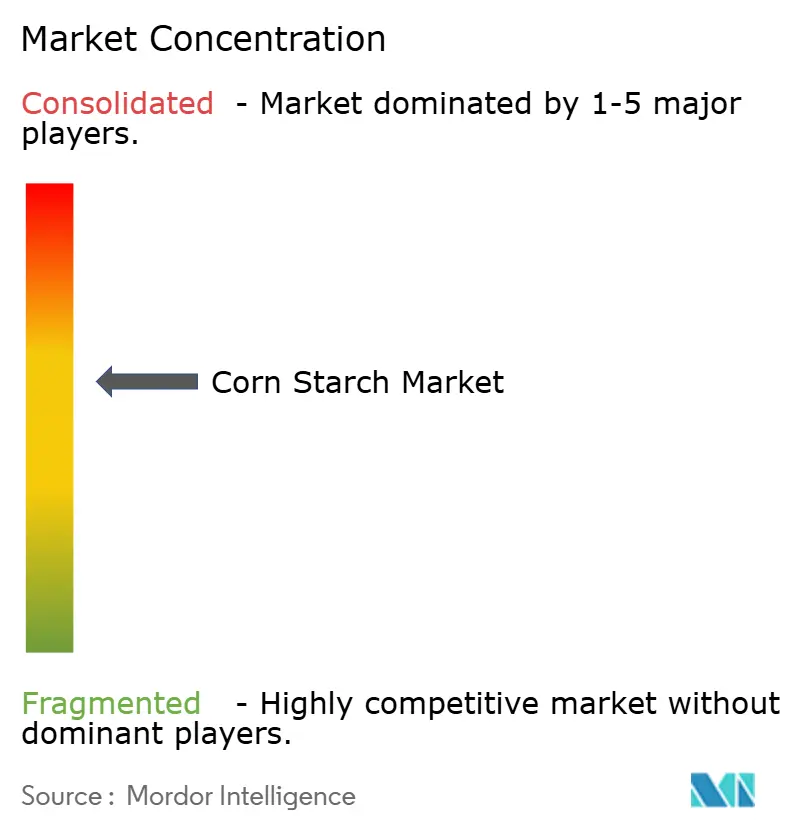
| Market Concentration | Medium |
Major Players *Disclaimer: Major Players sorted in no particular order Image © Mordor Intelligence. Reuse requires attribution under CC BY 4.0. | |
Corn Starch Market Analysis by Mordor Intelligence
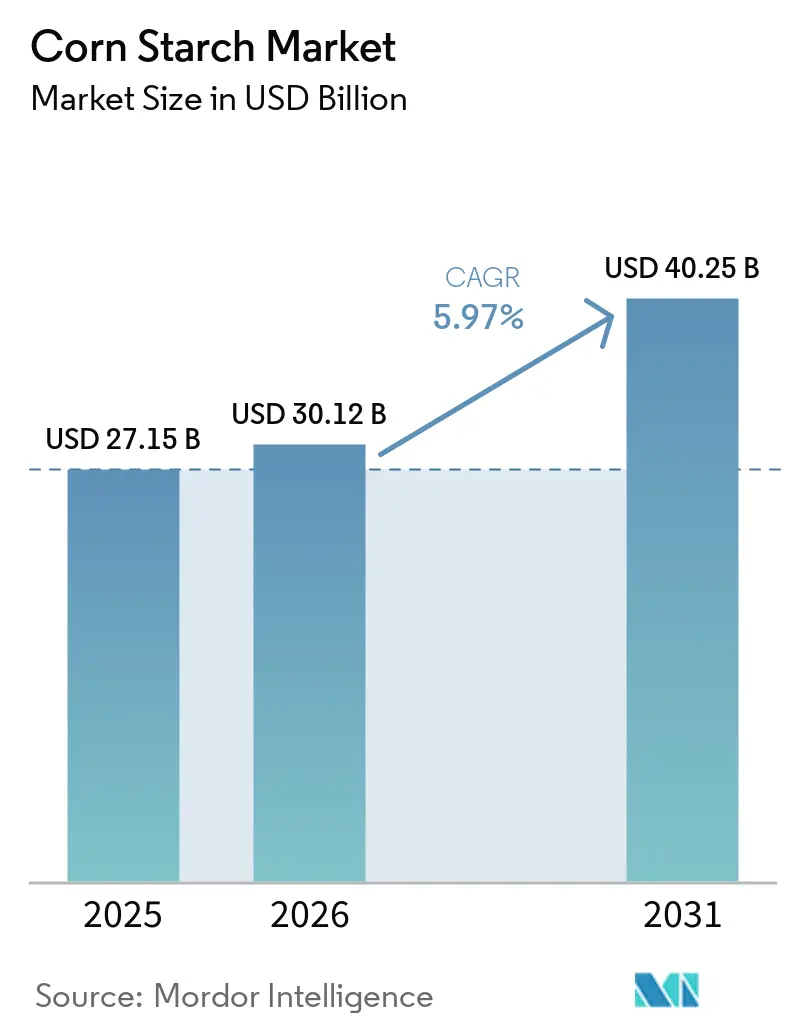
The corn starch market size is valued at USD 30.12 billion in 2026, growing from the 2025 value of USD 27.15 billion, and is forecast to climb to USD 40.25 billion by 2031, advancing at a 5.97% CAGR. Rising clean-label mandates, a widening preference for bio-based industrial feedstocks, and regulatory support for natural excipients are reshaping procurement decisions across food, pharmaceutical, and paper value chains. North American consumption remains anchored by mature wet-milling assets, but Asia-Pacific is escalating capacity to capture demand from packaged-food and generic-drug producers. Patent activity in enzyme-assisted starch modification, up 22% year-over-year in 2025, signals a pivot from commodity tonnage to functional specialization. Meanwhile, federal procurement rules that favor ingredients with renewable-carbon content are cementing corn starch as a default input across adhesives, coatings, and biodegradable films. Margin expansion opportunities center on non-GMO and dual-certified grades, where customers continue to absorb premiums of 15–25% for supply-chain assurance and clean-label positioning.
Key Report Takeaways
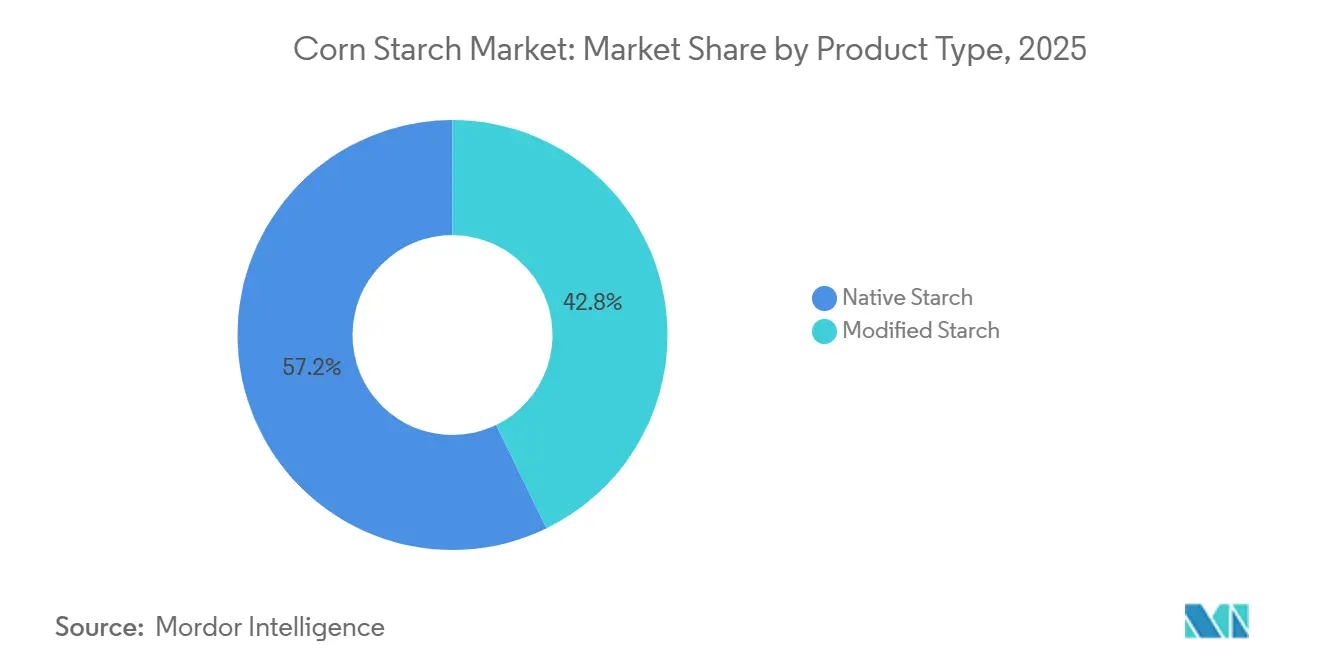
- By type, native starch captured 57.21% of value in 2025, while modified grades are forecast to expand at a 7.48% CAGR to 2031.
- By form, powder held 83.28% of volume in 2025; liquid starch is advancing at a 6.89% CAGR through 2031.
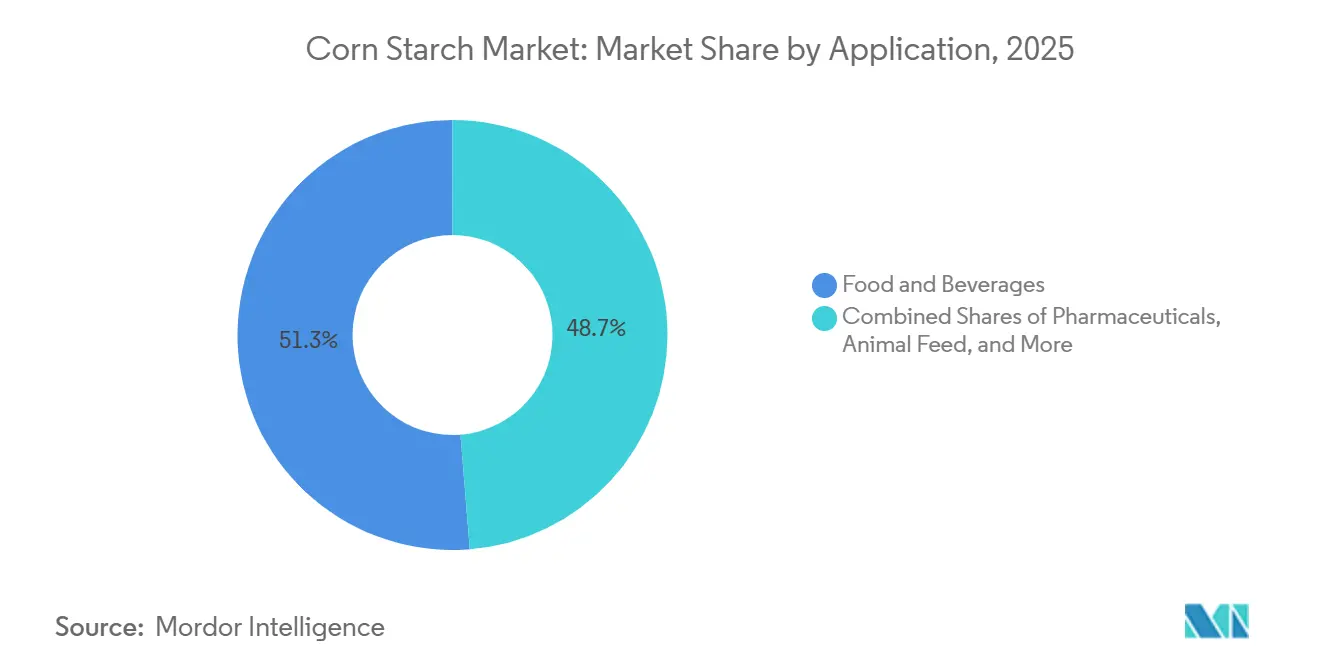
- By application, food and beverages led with 51.28% of revenue in 2025, whereas pharmaceuticals are set to rise at a 7.45% CAGR during 2026-2031.
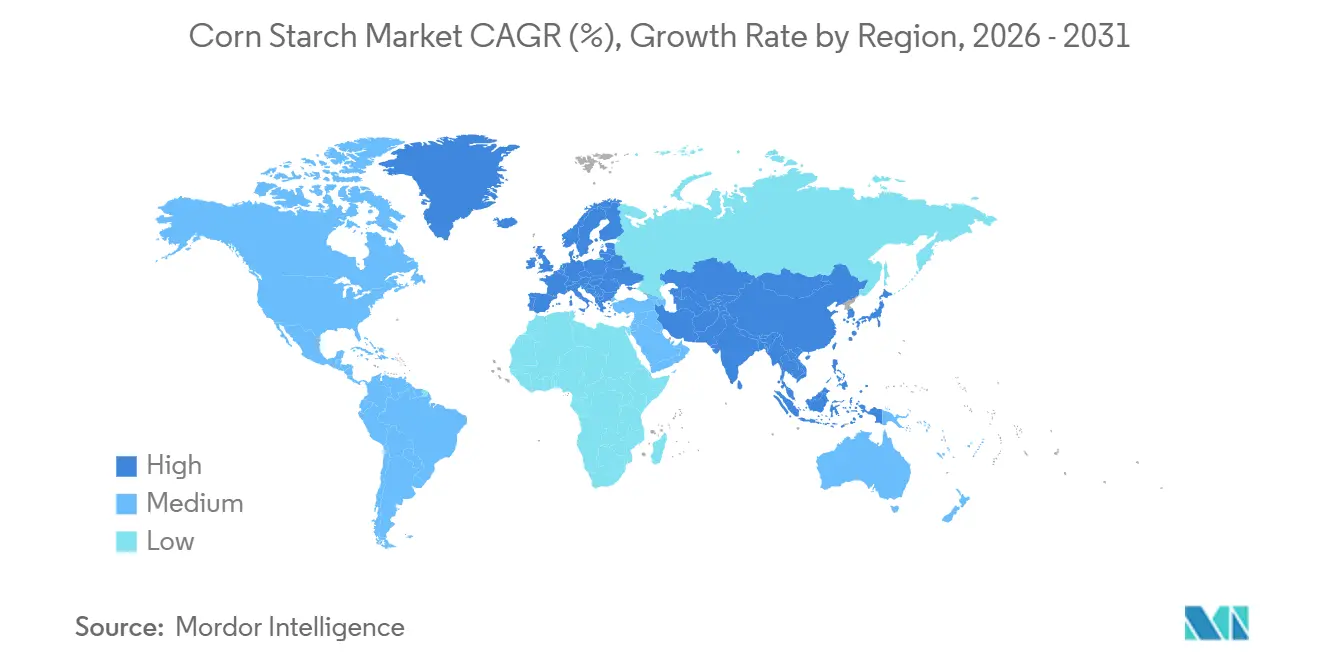
- By geography, North America commanded 35.46% of 2025 turnover, while Asia-Pacific is forecast to log a 7.89% CAGR to 2031.
Note: Market size and forecast figures in this report are generated using Mordor Intelligence’s proprietary estimation framework, updated with the latest available data and insights as of January 2026.
Market Trends and Insights
Drivers Impact Analysis of Corn Starch Market*
| Drivers | (~) % Impact on CAGR Forecast | Geographic Relevance | Impact Timeline |
|---|---|---|---|
| Growing Demand for Clean Label Products to Fuel Native Corn Starch Demand | +1.2% | Global, led by North America and Western Europe | Medium term (2–4 years) |
| High Demand for Gluten-Free and Allergen-Free Binders in Processed Food | +0.9% | North America, Europe, Australia | Short term (≤2 years) |
| Pharmaceutical Sectors Shift Toward Natural Excipients Fuel Corn Starch Adoption | +1.5% | Asia-Pacific core, spillover to Middle East and Africa | Long term (≥4 years) |
| Use of Modified Corn Starch as a Fat-Replacer Gains Popularity in Low-Calorie Products | +0.8% | North America, Western Europe | Medium term (2–4 years) |
| Government Push for Bio-Based Industrial Raw Material Encourages Corn Starch Usage | +1.1% | Global, strongest in United States, European Union, China | Long term (≥4 years) |
| Health-Focused Snacking Spurs Uptake of Corn Starch as Ingredients | +0.7% | Global, urban centers in Asia-Pacific and North America | Short term (≤2 years) |
| Source: Mordor Intelligence | |||
Growing Demand for Clean-Label Products Fuels Native Corn Starch Adoption
Brands are increasingly leveraging native corn starch as a strategic asset due to consumers' rising preference for recognizable ingredient lists. A 2025 survey by the International Food Information Council revealed that 68% of U.S. shoppers actively avoid products with chemical-sounding additives, up from 54% in 2022. Native corn starch, labeled simply as "corn starch," caters to this demand without compromising texture in sauces, soups, and dairy products. Additionally, early 2024 guidance from the European Food Safety Authority (EFSA) reaffirmed that native starches do not require an E-number designation[1]. This offers formulators a compliance advantage in markets where avoiding E-numbers influences purchasing decisions, as noted in the EFSA Journal. However, native starch performs poorly under high shear or freeze-thaw conditions. Consequently, brands launching ambient-stable or frozen products continue to rely on modified grades. This has created a bifurcated demand pattern that benefits suppliers with dual production capabilities. Ingredion's Q3 2025 earnings call underscored this trend, reporting an 11% year-over-year growth in clean-label native starch volumes in North America, compared to a 4% increase in modified-starch volumes, highlighting the consumer-driven shift.
Pharmaceutical Sectors Shift Toward Natural Excipients Accelerates Corn Starch Uptake
Regulatory changes are driving generic-drug manufacturers to replace synthetic binders with pharmacopeial-grade corn starch. In June 2024, the U.S. FDA updated its Inactive Ingredient Database, identifying 23 synthetic disintegrants for increased post-market monitoring. Meanwhile, corn starch, a trusted component in oral solid dosage forms for over 70 years, remains unaffected by new restrictions. In March 2025, India's Central Drugs Standard Control Organisation introduced draft guidance requiring domestic tablet manufacturers to source at least 30% of excipients from plant-based or mineral origins by 2028, favoring corn-starch suppliers with ISO 9001 and Good Manufacturing Practice certifications. Similarly, in August 2025, China's National Medical Products Administration mandated that new generic applications justify the use of synthetic excipients over natural alternatives. This regulatory shift has created a structural demand boost: Roquette's pharma-starch division reported a 19% revenue growth in fiscal 2025, driven by Asian generic manufacturers transitioning from polyvinylpyrrolidone to pregelatinized corn starch.
Use of Modified Corn Starch as Fat Replacer Gains Traction in Low-Calorie Formulations
Governments are addressing rising obesity-related health costs by encouraging food product reformulations. Modified starches that replicate the texture of fat are gaining traction in reduced-calorie dairy, bakery products, and dressings. The U.S. Department of Health and Human Services' 2024–2030 dietary guidelines recommend limiting saturated fat to 10% of daily caloric intake. In response, food manufacturers are substituting 20–40% of butter or cream with enzymatically modified waxy corn starch, which provides a creamy texture at just one-ninth the caloric density. Tate & Lyle launched its clean-label fat replacer, CLARIA, in late 2023. By 2025, CLARIA generated USD 47 million in sales, with yogurt and ice-cream applications accounting for 62% of its volume, as reported in the company's annual report. In May 2025, the European Commission updated its Farm to Fork Strategy, targeting a 15% reduction in average per-capita saturated-fat intake by 2030. This update highlights the increasing regulatory demand for fat-mimetic ingredients across the EU's 27 member states. Additionally, fat replacers offer the benefit of extending shelf life by reducing lipid oxidation. This enables brands to lower preservative usage while enhancing their clean-label positioning. These combined advantages support a 20–30% price premium over conventional modified starches.
Government Push for Bio-Based Industrial Raw Materials Strengthens Corn Starch Demand
Policy frameworks in the United States, the European Union, and China are increasingly incorporating bio-based content mandates into public procurement and industrial subsidies. This development positions corn starch as a preferred feedstock for products such as adhesives, coatings, and biodegradable plastics. The U.S. Department of Agriculture's BioPreferred Program, reauthorized in the 2024 Farm Bill with a 40% budget increase, now requires federal agencies to prioritize purchasing products containing at least 25% bio-based carbon. Corn starch, being 100% plant-derived, automatically qualifies under this mandate. Similarly, the European Union's Circular Economy Action Plan, revised in February 2025, introduced a binding requirement for member states to source 20% of industrial polymers and binders from renewable feedstocks by 2030, with financial penalties for non-compliance. In China, the Ministry of Industry and Information Technology, in July 2025, classified corn-starch-based corrugating adhesives as a "priority green material," enabling paper mills transitioning from synthetic resins to access low-interest loans and tax rebates. Reflecting this trend, Cargill's 2025 sustainability report revealed a 27% year-over-year increase in bio-industrial starch sales. Corrugating adhesives and biodegradable film resins contributed equally to this growth, and Cargill expects policy-driven demand to sustain double-digit growth through 2028.
Restraints Impact Analysis of Corn Starch Market*
| Restraints | (~) % Impact on CAGR Forecast | Geographic Relevance | Impact Timeline |
|---|---|---|---|
| Fluctuating Corn Prices Impact Market Dynamics | -0.6% | Global, acute in North America and South America | Short term (≤2 years) |
| Challenges in Native Starch Storage and Functionality | -0.3% | Tropical & subtropical regions (Asia-Pacific, Middle East and Africa) | Medium term (2–4 years) |
| Regulatory Restrictions on GMO Corn-Based Ingredients | -0.5% | EU, China, parts of Latin America | Long term (≥4 years) |
| Complex Processing for Modified Starch Raises Manufacturing Cost | -0.4% | Global, most acute in emerging markets | Medium term (2–4 years) |
| Source: Mordor Intelligence | |||
Fluctuating Corn Prices Inject Margin Volatility Across the Value Chain
During the first nine months of 2025, corn futures on the Chicago Mercantile Exchange ranged between USD 4.12 and USD 4.70 per bushel. This price volatility was driven by weather disruptions in the United States Corn Belt and fluctuating export demand from China. The 14% price variation has compressed margins for starch producers, as their customer contracts typically fix selling prices for six to twelve months. The U.S. Department of Agriculture's October 2025 World Agricultural Supply and Demand Estimates report projected a 3.2% decline in global corn ending stocks for the 2025–2026 marketing year[2]. This decline was attributed to below-trend yields in Argentina and Brazil, which together account for 22% of the global corn trade. Smaller starch producers without hedging programs or long-term grain contracts are under significant pressure. According to industry cost models, a 10% increase in corn costs results in a 6–7% reduction in gross margins. This is because starch conversion adds limited value, and energy costs are largely fixed. Larger companies like Archer Daniels Midland and Cargill mitigate these risks through vertical integration. For example, ADM's 2025 annual report stated that 68% of the corn it processes for starch is sourced from company-owned elevators or multi-year farmer contracts, protecting it from spot-market price spikes. Another strategy gaining momentum is the co-location of starch plants with ethanol facilities. This setup enables producers to sell corn oil and distillers' grains as co-products, effectively reducing the net cost of starch production by 8–12%.
Regulatory Restrictions on GMO Corn Tighten Supply Chains and Raise Costs
Under the European Union's stringent GMO-labeling regime, outlined in Regulation (EC) No 1829/2003 and enforced through random testing at ports of entry, starch importers are required to certify that any product containing more than 0.9% GMO material is labeled. However, most European food brands reject labeled ingredients, pushing suppliers to procure non-GMO corn at a premium of 15–25%. China's revised GB 2763 standard, which will take effect in January 2025, significantly lowers the allowable GMO-corn residue thresholds in food-grade starch from 5% to 0.5%. This stricter regulation forces Chinese importers to secure identity-preserved shipments with third-party certification, increasing landed costs by USD 18–22 per metric ton. In April 2025, India's Food Safety and Standards Authority proposed mandatory GMO disclosure for all starches used in packaged foods through a consultation paper. Despite this growth, non-GMO corn still accounts for only 2.3% of total U.S. corn plantings, creating a persistent supply-demand imbalance that keeps non-GMO premiums high. Producers who invest in dedicated non-GMO handling - such as separate silos, rigorous cleaning protocols, and detailed chain-of-custody documentation - can capture these premiums. However, the required capital investment, ranging from USD 3–5 million for a mid-sized wet mill, discourages smaller operators and consolidates non-GMO capacity among leading players.
*Our forecasts treat driver/restraint impacts as directional, not additive. The impact forecasts reflect baseline growth, mix effects, and variable interactions.
Corn Starch Market Segment Analysis
By Type:
Modified Starch Gains Ground on Functional VersatilityIn 2025, native starch accounted for 57.21% of the market's value. However, modified grades are expected to grow at a strong 7.48% CAGR, indicating a shift in market trends by 2031. This growth highlights increasing demand for improved stability, whether heat, shear, or freeze-thaw, in frozen entrees and ready-to-eat desserts. The market for modified corn starch is projected to expand further, driven by pharmaceutical buyers favoring pregelatinized options that can cut compression time by up to 20%. Producers are offsetting higher conversion costs with price premiums ranging from 20% to 35%. They are also leveraging expanded Codex authorizations, which, in 2024, added 18 new food categories.
While price-sensitive regions continue to rely on native starch for ambient snacks and bakery fillings, a significant shift is evident. By 2025, organized retail in India reached 14% penetration, boosting frozen and chilled product channels and creating opportunities for modified offerings. In China, wet-millers increased acetylated capacity by 22% between 2023 and 2025 to meet the growing demand from frozen-dumpling lines, which experienced 16% growth that year. As a result, the corn starch market is expected to follow a dual path: native starch will retain its scale, while modified grades will drive revenue and margin growth.
By Form:
Powder Dominates, Yet Liquid Starch Gains in Just-in-Time Supply ModelsIn 2025, powder represented 83.28% of shipments due to its low moisture content, which provides shelf stability and compatibility with dry mixes, particularly in pharmaceuticals and snack production. Liquid starch, supplied as a 35–40% solids slurry, is experiencing an 6.89% CAGR. This growth is attributed to paper mills and beverage plants implementing continuous-feed systems, which not only eliminate dust exposure but also cut batch preparation time by 30 to 40 minutes. While powder will maintain its dominance in the corn starch market, the rising demand for liquid starch reflects advancements in process engineering for large-scale operations.
Infrastructure limitations keep powder prevalent in fragmented markets that lack bulk-tanker facilities. Furthermore, microbial-count restrictions under EU Regulation 2073/2005 require costly cold-storage or preservative solutions for liquid formats in ready-to-eat foods, hindering adoption among smaller processors. In Western Europe, bakeries are increasingly adopting hybrid procurement models, sourcing powder for dough and liquid for fillings. This trend highlights the application-specific decisions that enable both forms to coexist within the corn starch market.
By Application:
Food and Beverages Lead, Pharmaceuticals Surge on Generic-Drug ExpansionIn 2025, food and beverages represented 51.28% of demand, driven by categories such as bakery, dairy, confectionery, and sauces that depend on corn starch for thickening, gelling, and stabilizing. The pharmaceutical segment of the corn starch market is experiencing the fastest growth, with a 7.45% CAGR. This growth is fueled by regulatory support for natural excipients and increasing tablet production capacity in India, China, and Brazil. In personal care, the transition away from talc contributed to a 7.2% rise in corn starch usage in dry shampoos and powder foundations in 2025.
Paper and corrugating, which currently account for 12% of the volume, are benefiting from the growth of e-commerce packaging and the bio-content provisions of ISO 15361, which enhance starch adhesion compared to synthetic resins. However, animal feed trials face limited growth as they are perceived as a lower-cost carbohydrate alternative, though aquaculture pellets have established a stable niche. Mills are leveraging dual-certified starch that complies with both food and pharmaceutical standards, enabling them to manage order fluctuations more effectively. ADM has reported that 23% of the output from its Clinton plant now qualifies for pharmaceutical markets.

Geography Analysis
North America Corn Starch Market
In 2025, North America contributed 35.46% of global corn starch revenue, driven by its well-established food-processing industry, robust pharmaceutical-excipient supply chains, and proximity to the U.S. Midwest, the world's largest corn-growing region. According to the U.S. Department of Agriculture's Economic Research Service in September 2025, domestic corn-starch consumption increased by just 2.1% year-over-year, while exports of specialty modified starches rose by 9%, highlighting a move toward higher-value offerings. Canada's food-processing sector, supported by trade agreements with the EU and Asia, is driving demand for pharma-grade starch. To meet this demand, Ingredion expanded its Cardinal plant in Ontario, Canada, in mid-2025 with a CAD 28 million investment, targeting both domestic tablet manufacturers and export markets. Meanwhile, Mexico's corn-starch market is growing at 6.7%, fueled by the nearshoring of food production for the U.S. and increased domestic consumption of snacks. Organized retail sales in Mexico grew by 11% in 2025, according to the Mexican Association of Retail Chains (ANTAD Mexico).
APAC Corn Starch Market
Asia-Pacific's strong 7.89% CAGR is primarily attributed to the rapid industrialization of food processing in China and India, government support for local excipient production, and growing middle-class demand for convenience foods. The China Starch Industry Association reported that China's corn-starch production reached 14.2 million metric tons in 2025, a 7% increase from 2024, driven by capacity expansions in Shandong and Jilin provinces. In India, domestic players like HL Agro Products and Gujarat Ambuja Exports increased production, supported by the government's Production-Linked Incentive scheme, which provides a 10% capital subsidy for starch-plant investments exceeding INR 500 million. This led to a 16% decline in starch imports in fiscal 2025. While Japan and Australia are smaller markets, they are growing at 5.1% and 6.3%, respectively, with clean-label and organic starches commanding premiums of 30–50% over conventional grades. Southeast Asia, particularly Indonesia, Thailand, and Vietnam, is emerging as a key growth area. Starch demand in the region rose by 9.8% in 2025, driven by increased production of instant noodles, snacks, and ready-to-drink beverages, according to the ASEAN Food Processors Association[3].
EMEA and South America Corn Starch Market
Europe's corn starch market is growing at an annual rate of 6.1%, influenced by strict GMO regulations, ambitious sustainability targets, and a mature food industry that emphasizes functional innovation over volume growth. The European Starch Industry Association's 2025 annual review revealed that EU starch production reached 11.3 million metric tons, with corn starch accounting for 62% of the total. The share of non-GMO corn starch increased to 41% in 2025, up from 34% in 2023. Germany, France, and the Netherlands lead production, hosting facilities from major players like AGRANA, Tereos, and Avebe. Meanwhile, Eastern European countries such as Poland, Hungary, and Romania are attracting greenfield investments due to lower labor costs and proximity to non-GMO corn fields. In South America, a 7.3% CAGR is being driven by Brazil and Argentina. These countries, as major corn producers, are expanding domestic starch-processing capacity to capture value-added margins instead of exporting raw grain. Brazil's starch production grew by 12% in 2025, according to the Brazilian Starch Association. Lastly, while the Middle East and Africa represent the smallest region with a 4.9% CAGR, growth is evident in countries like Egypt, South Africa, and Saudi Arabia, where government-led food-security initiatives are boosting local ingredient production.
Regulatory Landscape
Corn starch regulations generally split native grades, which are treated as conventional food ingredients, from modified grades, which are handled as regulated food additives across many jurisdictions. In the United States, unmodified corn starch is generally recognized as safe for food use, while modified food starch must comply with FDA requirements in 21 CFR 172.892, which defines permitted chemical and enzymatic treatments and the associated use conditions. FDA also provides guidance on common or usual naming conventions for starches used in foods. For cross-border shipments, corn (maize) starch is commonly classified under HS 1108.12, and in the United States HTS 1108.12.00 carries a specific duty rate (with preferential rates available under certain trade programs), making correct tariff classification and documentation an operational requirement for importers and distributors.
China introduced a notable food-safety update with GB 31637-2025 (National Food Safety Standard for Edible Starch), which entered into force on March 16, 2026, replacing GB 31637-2016 and adding a hydrocyanic acid limit (10 mg/kg). Internationally, compliance programs often reference the Food Chemicals Codex (FCC) specifications for purity and quality, alongside Codex Alimentarius frameworks, to align specifications across export markets and reduce rework for multinational food and pharmaceutical customers.
Value Chain Analysis
The corn starch value chain begins with corn cultivation and aggregation (farmers, elevators, and cooperatives), then moves into wet-milling where corn is steeped and fractionated into starch and co-products such as corn oil, fiber, and protein. Wet-milling is capital and energy intensive, and steeping is a major time and energy step, so scale, plant utilization, and access to low-cost utilities shape conversion economics. Large integrated processors, including Cargill, Archer Daniels Midland (ADM), Ingredion, Tate & Lyle, Roquette, and AGRANA, typically run multi-plant networks to manage regional corn availability, qualify for non-GMO or identity-preserved requirements, and serve food, pharma, and industrial demand with consistent specifications.
Downstream, starch is sold as native or further converted into functional grades (physical, enzymatic, or chemical modification) and derivatives that match specific applications, including food thickening and texture, tablet binding and disintegration, paper and corrugating adhesives, and industrial binders. Distribution typically includes direct supply to large users (paper mills, packaged-food manufacturers, and pharmaceutical excipient buyers) and ingredient distributors for smaller accounts, where documentation such as specifications, traceability, allergen statements, and certification packs (including non-GMO and pharma quality systems) is often as critical as price. Value capture is increasingly concentrated in specialty and certified grades, while corn price volatility and the need for dedicated handling, such as separate silos, cleaning protocols, and chain-of-custody systems, remain key bottlenecks for smaller producers.
Competitive Landscape
Established multinational corporations and regional players in specialized application segments share the global corn starch market, which shows moderate concentration. The market is characterized by the presence of well-established companies with a strong global footprint, alongside smaller regional players catering to niche applications. Key market players encompass Cargill Incorporated, Archer Daniels Midland Company, Ingredion Incorporated, Tate & Lyle PLC, and Roquette Frères.
Companies are competing through innovation in specialty starches, developing value-added products with enhanced functionality for specific applications. The clean-label segment has become a focus area, where manufacturers invest in physical modification techniques to improve performance while maintaining natural ingredient status. Companies are also differentiating themselves through sustainability initiatives, implementing responsible sourcing practices, and eco-friendly production methods to meet regulatory requirements and consumer preferences.
Regional manufacturers are strengthening their positions by utilizing local market knowledge and operational flexibility to serve niche markets, especially in emerging economies where proximity to demand centers offers logistical benefits. Companies are implementing backward integration strategies to control corn cultivation, ensuring quality and supply stability in volatile agricultural markets. Process optimization and quality control technologies have become essential for maintaining cost competitiveness in this price-sensitive market with narrow profit margins.
Corn Starch Industry Leaders
-
Cargill Incorporated
-
Archer Daniels Midland Company
-
Ingredion Incorporated
-
Tate & Lyle PLC
-
Roquette Freres
- *Disclaimer: Major Players sorted in no particular order
Corn Starch Market Companies Covered in this Report
- Cargill Incorporated
- Archer Daniels Midland Company
- Ingredion Incorporated
- Tate & Lyle PLC
- Roquette Frères SA
- AGRANA Beteiligungs AG
- Südzucker AG
- Associated British Foods PLC
- Grain Processing Corporation
- Tereos Group
- Avebe UA
- Zhucheng Xingmao
- Global Bio-Chem Technology Group
- HL Agro Products Pvt. Ltd
- Gujarat Ambuja Exports Ltd
- Longlive Bio-Technology
- DFE Pharma
- Egyptian Corn Starch Company
- Angel Starch and Food Pvt. Ltd
- Emsland-Stärke GmbH
Market Opportunities and Future Outlook
Capacity additions and asset transfers are creating room for specification-led corn starch supply, especially where local food processing and excipient demand are scaling faster than legacy milling footprints. In India, new and expanded wet-milling investments are supporting domestic and regional sourcing: Sanstar commissioned expanded capacity at its Dhule facility in May 2026, and Regaal Resources commissioned an expanded maize processing facility in Kishanganj, Bihar in May 2026, adding higher crushing capacity and derivative outputs, including liquid glucose and maltodextrin. Together, these projects broaden the set of locally produced starches and derivatives that can be qualified by multinational food and pharma customers, reducing lead times and reliance on imports for standardized grades.
Bio-industrial pull-through is another opportunity area where starch demand is tied to renewable carbon procurement and bio-based materials manufacturing. Qore, a Cargill and HELM joint venture, commenced production in July 2025 at its Eddyville, Iowa facility producing bio-based 1,4-butanediol from dent corn, reinforcing a pathway from corn processing into higher-value chemical intermediates used in performance materials. In parallel, carbon-intensity reduction programs are becoming a qualification lever for major buyers and public procurement, and projects such as EPA-approved CO2 sequestration at PureField Ingredients in April 2026 point to operational pathways (CCS-enabled plants) that can support lower-carbon starch and derivative supply for customers with audited sustainability requirements.
Recent Industry Developments in Corn Starch Market
- May 2026: Archer Daniels Midland (ADM) announced a multimillion-dollar investment to upgrade its Clinton, Iowa, corn processing facility by adding two high-speed receiving pits (25,000 bushels per hour each) and increasing grain storage capacity. The upgrades target faster grain intake and reduced truck dwell time, supporting higher utilization and more reliable feedstock flow into corn processing operations tied to starch and derivative output.
- March 2025: Cargill inaugurated a new corn milling plant in Gwalior, Madhya Pradesh, operated through an arrangement with Saatvik Agro Processors, with initial capacity cited at 500 tons per day. The site expands Cargill-linked regional milling coverage for starch and related ingredients into central India, aligning supply closer to confectionery, infant nutrition, and dairy manufacturing clusters.
- September 2024: Ingredion partnered with AGRANA to increase starch production in Romania, strengthening manufacturing presence in Eastern Europe. The move supports regional supply of specialty starches and improves service levels for food and industrial customers operating under tighter GMO and documentation requirements across Europe.
Corn Starch Market Report Scope and Research Methodology
Market Definition and Coverage
For this study, the corn starch market covers the commercial value of corn-derived starch sold into downstream use, spanning native and modified forms used across food, animal feed, industrial processing, and pharmaceutical-related applications.
Scope exclusions: We exclude fuel-ethanol volumes and any revenues that sit fully inside retail or logistics markups rather than the starch product sale.
Segments Covered in This Report
- Type
- Native Starch
- Modified Starch
- Form
- Powder
- Liquid
- Application
- Food and Beverages
- Pharmaceuticals
- Personal Care and Cosmetics
- Animal Feed
- Paper and Corrugating
- Other Applications
- By Geography
- North America
- United States
- Canada
- Mexico
- Rest of North America
- Europe
- Germany
- United Kingdom
- Italy
- France
- Spain
- Netherlands
- Rest of Europe
- Asia-Pacific
- China
- India
- Japan
- Australia
- Rest of Asia-Pacific
- South America
- Brazil
- Argentina
- Rest of South America
- Middle East and Africa
- South Africa
- Saudi Arabia
- Rest of Middle East and Africa
- North America
Data Sources, Market Sizing, and Validation
Desk Research
Desk research starts by building the supply and demand context for corn wet milling and starch output so the later assumptions do not rely on guesswork. Public agriculture and industry series are used to anchor volumes and cross-border flows, including USDA production and trade series, FAOSTAT crop balances, UN Comtrade customs statistics, and Eurostat/PRODCOM manufacturing categories.
To translate activity into value, pricing and conversion context are added from peer-reviewed food science journals, updates from national food safety and labeling regulators, and trade association publications that discuss starch uses and specification trends. Company annual reports, investor decks, and press coverage are reviewed next to track capacity additions, outages, and product-mix changes, and then these are cross-checked using paid subscriptions for company financials and intelligence, plus shipment-level import and export records where helpful. The sources listed here are illustrative, and additional public documents and datasets were also used during data collection, validation, and clarification.
Primary Interviews and Surveys
Primary work is used to stress-test the desk assumptions on what share of wet-milling output is marketed as starch, how modified versus native mix is evolving, and what typical pricing behavior looks like by use case. We spoke with producers, distributors, and large end users across APAC, EMEA, and the Americas, so regional utilization rates, trade substitution dynamics, and contract structures could be compared before finalizing the model.
Distribution of primary research fieldwork respondents
| Company type | Respondent position | Region |
|---|---|---|
| Top tier: 29% | CXOs: 17% | APAC: 44% |
| Mid tier: 50% | Functional/Unit leaders: 26% | EMEA: 29% |
| Smaller Players: 21% | Managers: 57% | Americas: 27% |
Market-Sizing & Forecasting
Sizing is built first through a top-down reconstruction that links corn wet-milling activity to starch output, and then converts that output to marketed value by applying use-adjusted price bands. The model is then corroborated with selective bottom-up checks, such as sampled supplier revenue disclosures, channel conversations on typical contract pricing, and simple volume times ASP calculations for a few major consuming regions, which helps identify potential overcounts.
Key inputs that drive the totals include corn availability and grind volumes, starch yield factors from wet milling, the split between native and modified starch, end-use demand signals from packaged food and industrial processing, and trade intensity where imports substitute domestic supply. For forecasting, scenario analysis is used around corn price direction, capacity utilization, and demand strength in major end uses, and these scenarios are aligned to what interviewees expect for pricing pass-through and utilization changes. When a country-level data series is thin, nearby benchmarks and trade flow proxies are used, and the adjustment is kept transparent so it can be revisited as new data arrives.
Data Validation & Update Cycle
Validation is done by triangulating the final outputs against independent signals, including production and trade totals, reported capacity moves, and observed pricing direction, and then checking whether implied per-ton values look realistic. Any large variances are reworked by revisiting conversion assumptions, regional mix, and currency timing, followed by a second analyst review before sign-off.
The dataset is refreshed on an annual cycle, and interim checks are triggered when material events occur, such as a major plant expansion, a sharp corn price swing, or policy changes that shift food labeling and starch substitution. Before delivery, we run an updated pass on the latest public releases so the shared numbers reflect the most current view.
Mordor Intelligence's Corn Starch Market Size Compared With Other Published Estimates
Published market values for corn starch can look far apart because different studies use the market label differently, and because they do not always align on the same pricing basis and channel stage. The selected year, constant versus current dollars, and whether modified starch and adjacent sweetener categories are grouped together can all shift the headline figure.
In our work, the biggest gap drivers are usually scope and what is counted as the sell-in value, since some sources price closer to retail equivalents while others stop at producer revenues, and that creates a different starting point before forecasting. Another driver is how volumes are inferred, where trade-only views can understate domestic consumption in large producing countries, and then the ASP path is pushed by a different corn price pass-through assumption. This is why the spread shown below occurs for the corn starch market when the definition is kept at first-sale values in constant 2024 dollars, as applied by Mordor Intelligence.
Benchmark comparison
| Source | Market Size | Gaps in Research Methodology |
|---|---|---|
| Mordor Intelligence | USD 30.12 B (2026) | |
| Industry Statistics Publisher A | USD 16.70 B (2024) | Uses a producer and importer revenue construct that excludes logistics and retail margins and is tied to a specific manufacturing code, which can omit value uplift from modified starch conversion and specialty distribution stages. |
| Global Publisher B | USD 24.00 B (2024) | Anchors the series on a different base year and often bundles a wider type list (including sweetener-related categories) and mixed end-use pricing, which can change the implied ASP path versus a first-sale starch-only treatment. |
Taken together, the differences are mostly explained by which revenue point is being measured and whether adjacent corn-derived ingredients are blended into the same bucket. By keeping the steps tied to observable wet-milling output, trade substitution, and realistic pricing bands, the final number stays traceable and easier to re-check when assumptions change.
Key Questions Answered in the Report
How large is the corn starch market in 2026?
The corn starch market size reached USD 30.12 billion in 2026 and is projected to approach USD 40.25 billion by 2031.
Which region will add the most incremental demand for corn starch by 2031?
Asia-Pacific is forecast to expand at an 7.89% CAGR, the fastest among all regions, driven by packaged-food and generic-drug capacity additions.
What factors drive modified corn starch adoption?
Demand for heat, shear, and freeze-thaw stability in frozen meals and low-calorie formulations is lifting modified grades at a 7.48% CAGR.
Which application segment is growing fastest?
Pharmaceuticals, used mainly as tablet binders and disintegrants, are projected to grow at an 7.45% CAGR through 2031.