
Cord Blood Banking Services Market Size and Share
Market Overview
| Study Period | 2020 - 2031 |
|---|---|
| Market Size (2026) | USD 35.81 Billion |
| Market Size (2031) | USD 49.85 Billion |
| Growth Rate (2026 - 2031) | 6.84 % |
| Fastest Growing Market | Asia-Pacific |
| Largest Market | North America |
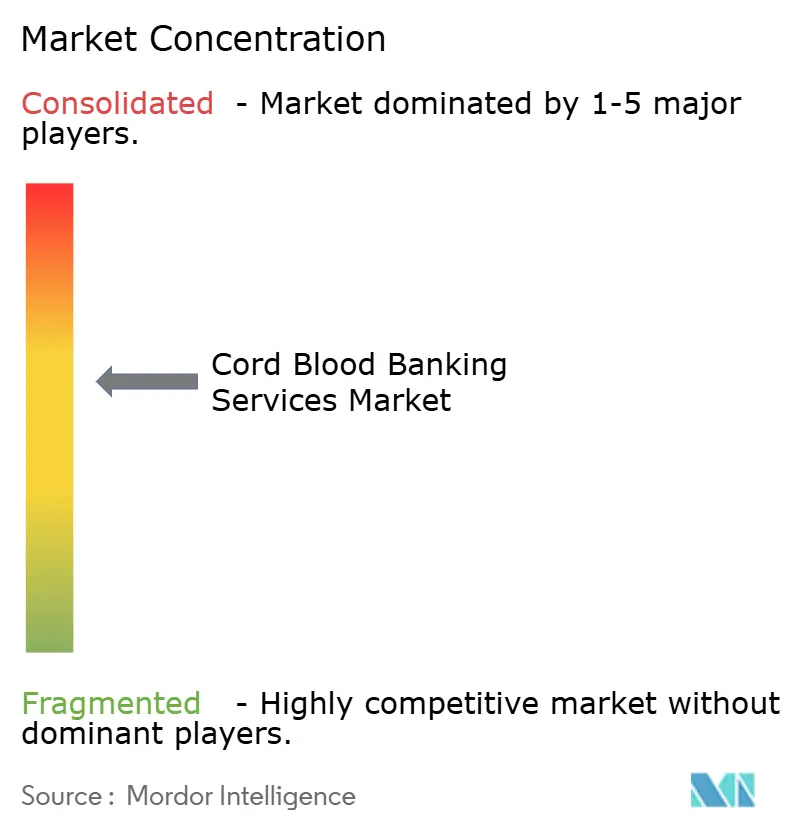
| Market Concentration | Medium |
Major Players *Disclaimer: Major Players sorted in no particular order Image © Mordor Intelligence. Reuse requires attribution under CC BY 4.0. | |
Cord Blood Banking Services Market Analysis by Mordor Intelligence
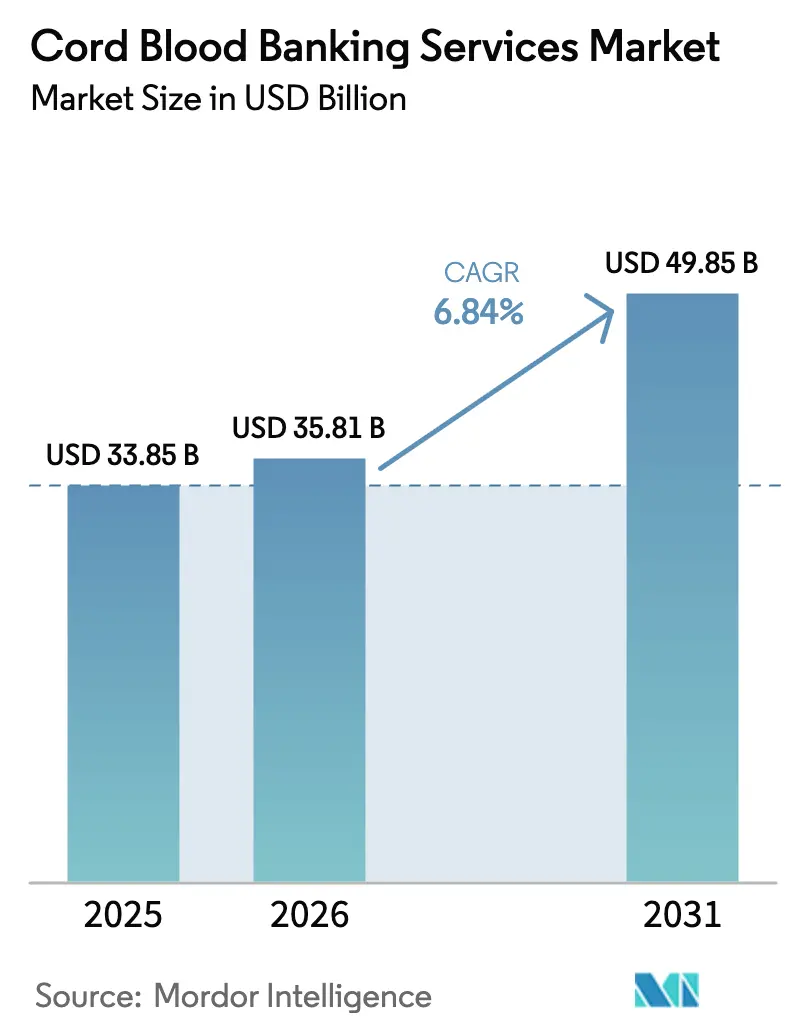
The Cord Blood Banking Services Market size is expected to grow from USD 33.85 billion in 2025 to USD 35.81 billion in 2026 and is forecast to reach USD 49.85 billion by 2031 at 6.84% CAGR over 2026-2031.
Clinical validation, such as the FDA’s December 2025 approval of the ex-vivo expanded product Omisirge for severe aplastic anemia, is removing long-standing dose constraints and raising physician confidence in cord blood–based transplants.[1] Parents are becoming more aware that private storage can serve as biological insurance against transplant-treatable diseases, a trend reinforced by obstetrician endorsement and targeted digital campaigns. Meanwhile, public banks are benefiting from new government funding that underwrites collection costs and broadens genetic diversity, making publicly donated units more accessible to transplant centers.[2] Technology upgrades—automated closed-system processing, real-time cryogenic monitoring, and blockchain audit trails—are lowering contamination risk and aligning operations with AABB and FACT-NetCord standards. These combined forces are steering the cord blood banking services market toward steady, mid-single-digit annual expansion while encouraging new hybrid service models that blend public altruism with private optionality.
Key Report Takeaways
- By bank type, private operators held 59.24% of the cord blood banking services market share in 2025, while public banks are projected to post the highest growth at a 9.14% CAGR through 2031.
- By storage service, combined processing and storage accounted for 47.25% of the cord blood banking services market size in 2025, whereas processing-only contracts are forecast to expand at a 9.53% CAGR over 2026-2031.
- By component, cord blood led with 72.64% cord blood banking services market share in 2025; cord tissue is set to rise fastest, advancing at a 10.43% CAGR to 2031.
- By application, cancers captured 37.67% of the cord blood banking services market size in 2025, while metabolic disorders are on track for the quickest growth at a 10.32% CAGR through 2031.
- By end user, hospitals and clinics commanded 43.74% cord blood banking services market share in 2025, with research institutes expected to grow at the highest 9.54% CAGR during 2026-2031.
- By geography, North America led with 39.54% cord blood banking services market share in 2025, whereas Asia-Pacific is forecast to register the strongest regional expansion at an 8.24% CAGR to 2031.
Note: Market size and forecast figures in this report are generated using Mordor Intelligence’s proprietary estimation framework, updated with the latest available data and insights as of January 2026.
Market Trends and Insights
Drivers Impact Analysis of Cord Blood Banking Services Market*
| Driver | (~) % Impact on CAGR Forecast | Geographic Relevance | Impact Timeline |
|---|---|---|---|
| Growing Incidence of Transplant-Treatable Diseases | +1.2% | North America, Europe | Long term (≥ 4 years) |
| Rising Parental Awareness & Private Bank Uptake | +1.5% | Urban North America, Europe, Asia-Pacific | Medium term (2-4 years) |
| Government Funding for Public Banks | +0.9% | North America, Europe, select Asia-Pacific | Medium term (2-4 years) |
| Advances in Cryopreservation & Processing Tech | +1.1% | Global, led by North America and Europe | Long term (≥ 4 years) |
| Ex-Vivo Stem-Cell Expansion Platforms | +1.3% | North America, Europe, Japan | Long term (≥ 4 years) |
| Hybrid Public-Private Cost-Sharing Models | +0.8% | Asia-Pacific, Middle East, Latin America | Medium term (2-4 years) |
| Source: Mordor Intelligence | |||
Growing Incidence of Transplant-Treatable Diseases
Leukemias and inherited anemias continue to lift transplant demand, and cord blood fills critical gaps when matched adult donors are unavailable. Acute lymphoblastic and acute myeloid leukemia account for roughly 60% of pediatric cord blood grafts, while sickle cell disease and beta-thalassemia are accelerating fastest in high-carrier geographies.[3] Expanded newborn screening is also pushing metabolic-disorder transplants earlier when outcomes are best, as five-year survival exceeds 80% for Hurler syndrome treated before nine month. Payers in several European states now reimburse private banking for families with proven genetic risk, reinforcing the medical value proposition.
Rising Parental Awareness & Private Bank Uptake
Parents in major cities increasingly recognize that banked units offer a low-probability but high-value safety net. Up-front fees of USD 1,400–2,300 plus annual storage of USD 125–300 remain palatable to affluent households, and partnerships such as Cord Blood Registry’s whole-exome sequencing bundle allow families to align storage with genetic insights. Autologous use rates stay below 1%, yet the perceived downside of not storing remains a potent motivator, keeping private demand resilient.
Government Funding for Public Banks
Public inventories depend on government grants that subsidize collection and maintain diverse tissue types. In 2024 the U.S. Health Resources and Services Administration awarded USD 16.5 million across five banks, securing a 150,000-unit inventory for unrelated transplant needs. Comparable programs in the EU and Japan link funding to transplant activity, ensuring stable quality yet exposing budgets to policy shifts.
Advances in Cryopreservation & Processing Tech
Automated closed systems now reclaim more cells and cut contamination risk compared with manual methods. New facilities feature redundant liquid-nitrogen supply and unit-level blockchain tracking, as shown by Cryo-Cell International’s 56,000-square-foot Durham site opened in 2024. Vitrification is also gaining ground for cord tissue, where mesenchymal cells respond poorly to slow-freeze methods.
Restraints Impact Analysis of Cord Blood Banking Services Market*
| Restraint | (~) % Impact on CAGR Forecast | Geographic Relevance | Impact Timeline |
|---|---|---|---|
| High Private-Banking Costs | –0.7% | Emerging Asia-Pacific, Latin America | Short term (≤ 2 years) |
| Limited Approved Clinical Applications | –0.5% | Global | Medium term (2-4 years) |
| Regulatory Accreditation Gaps | –0.4% | Asia-Pacific (ex-Japan), Middle East, Latin America | Long term (≥ 4 years) |
| Competition From iPSC Sources | –0.6% | North America, Europe, Japan | Long term (≥ 4 years) |
| Source: Mordor Intelligence | |||
High Private-Banking Costs
Prices exclude many households where annual income is below USD 10,000, especially in emerging markets facing currency swings that push fees even higher. Only a handful of insurers pay for storage, restricting penetration outside upper-income tiers.
Limited Approved Clinical Applications
Although about 80 disorders qualify for cord blood treatment, most private-bank marketing stresses potential regenerative uses, such as cerebral palsy, that lack Phase III proof. Consumer-protection bodies in Australia and Canada have warned against overstatement, forcing some firms to tone down advertising.
*Our forecasts treat driver/restraint impacts as directional, not additive. The impact forecasts reflect baseline growth, mix effects, and variable interactions.
Cord Blood Banking Services Market Segment Analysis
By Bank Type:
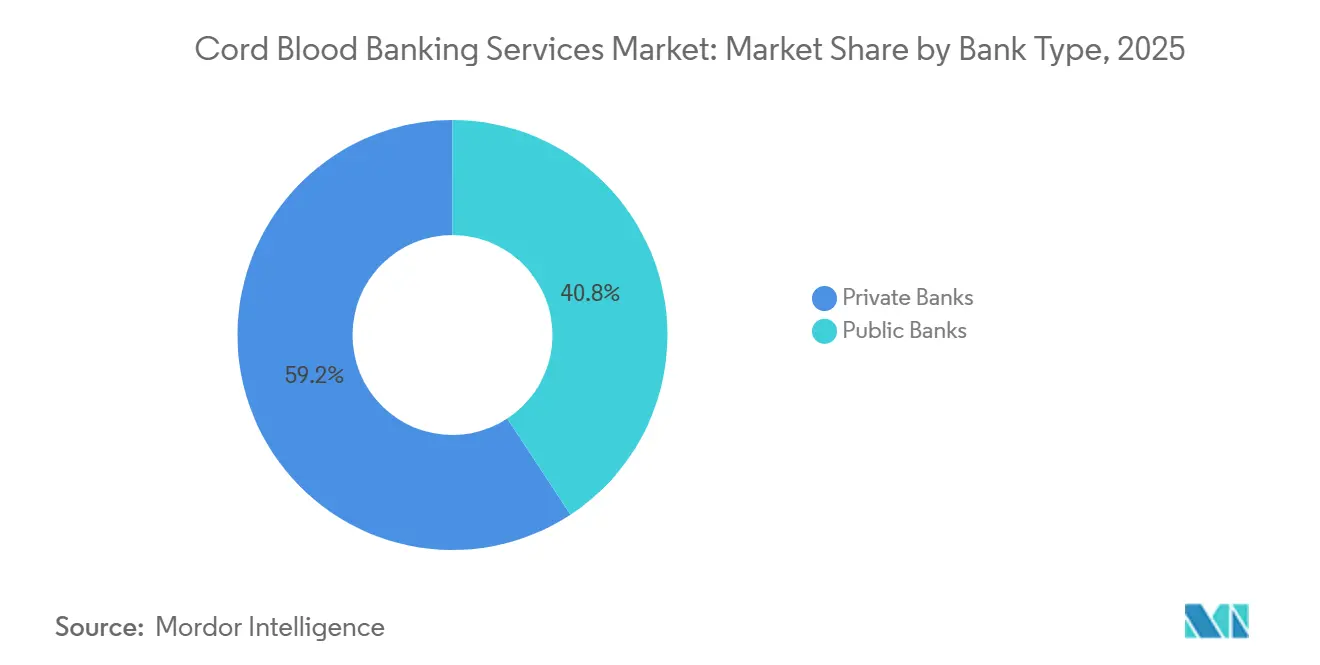
Public Funding Spurs Faster GrowthPublic institutions held 40.76% of the cord blood banking services market in 2025 and are set to grow 9.14% annually through 2031 as governments underwrite inventory diversity. Private players retain leadership due to entrenched brands and direct-to-consumer marketing, yet autologous usage below 1% continues to attract scrutiny and fosters new hybrid pricing that preserves consumer choice while enriching public stocks.
Private operators now layer genetic screening, tissue add-ons, and future access to ex-vivo expansion to justify premiums, aiming to limit cannibalization by hybrids. Public banks counter with broader HLA coverage and rising transplant success, positioning altruistic donation as both socially responsible and medically efficient.
By Storage Service:
Processing-Only Contracts AccelerateHospitals increasingly choose processing-only deals to avoid the capital burden of maintaining large cryogenic vaults, giving this niche a projected 9.53% CAGR. Combined processing and storage still represents 47.25% of 2025 revenue and remains the staple for full-service private banks that promote custody continuity and tighter chain-of-identity.
Banks investing in mega-facilities benefit from lower per-unit costs, yet they must also manage courier times, as cell viability drops when more than 48 hours elapse between collection and freezing. Storage-only agreements, though minor, attract parents who wish to move previously banked units into higher-accredited vaults, often after an international relocation.
By Component Type:
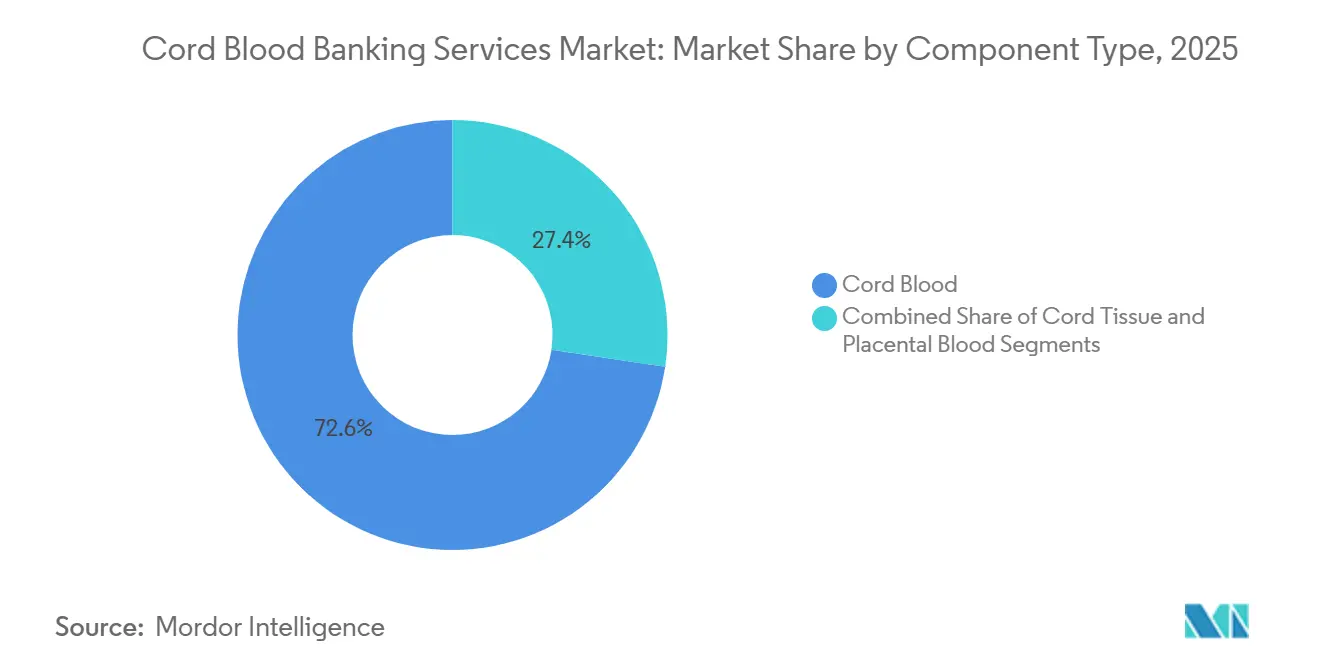
Cord Tissue Gains MomentumCord blood continues to anchor 72.64% of the cord blood banking services market size, supported by decades of transplant data and new expansion approvals that remove adult-dose issues. Cord tissue, rich in mesenchymal cells, is set to grow 10.43% a year thanks to promising trials in graft-versus-host disease and orthopedic repair. Private banks bundle tissue with blood to raise average revenue per enrolment and hedge therapeutic uncertainty.
Placental blood offers bigger cell doses but adds collection complexity and contamination risk, keeping its adoption moderate. As vitrification protocols improve, tissue banking costs are falling, closing the price gap with standard cord blood storage.

By Application:
Metabolic Disorders Rise FastestCancers held 37.67% of 2025 revenue, driven by leukemia and lymphoma transplants, yet metabolic disorders are sprinting ahead at a projected 10.32% CAGR. Early treatment of Hurler syndrome and Krabbe disease shows clear neurologic benefit, prompting broader newborn screening and quicker transplant referral.
Sickle cell disease and beta-thalassemia also expand solidly, aided by gene-editing programs that rely on banked stem cells. Experimental neurological uses remain in clinical limbo after mixed trial outcomes, tempering growth for the “Others” category.
By End User:
Research Institutes Expand Inventory NeedsHospitals and clinics perform most transplants and held 43.74% share in 2025, but research institutes will grow 9.54% annually as they test ex-vivo expansion, gene editing, and iPSC comparators. Each Phase II study can consume hundreds of units, providing public banks with a new revenue stream while sharpening demand for high-quality, protocol-grade material.
Specialty transplant centers retain mid-single-digit growth by adopting haploidentical approaches that rely on T-cell depletion. Home storage remains fringe because regulators warn against at-home dewars that lack validated temperature monitoring.
Geography Analysis
North America Cord Blood Banking Services Market
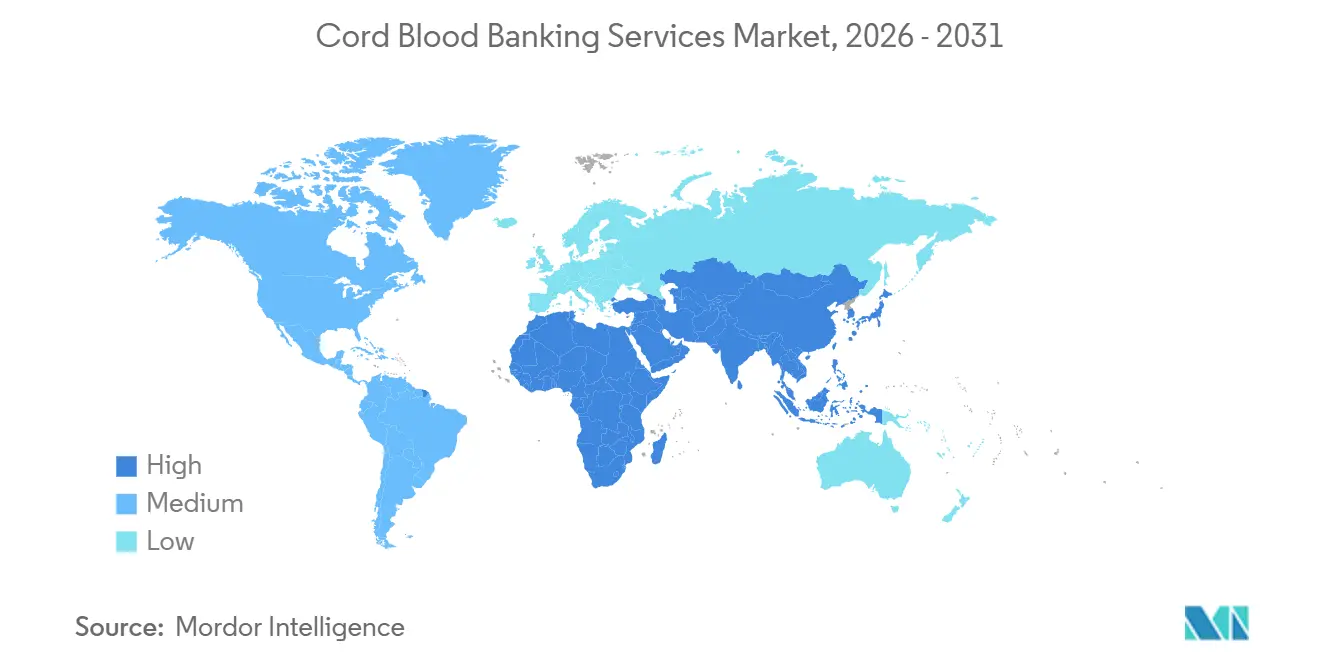
North America led with 39.54% share in 2025 on the strength of mature private banking, FDA-mandated quality controls, and National Cord Blood Inventory funding of USD 16.5 million that preserved 150,000 diverse units. Canada emphasizes units from Indigenous populations to close HLA gaps, while Mexican parents often store across the border to access U.S. oversight. Competition among Cord Blood Registry, ViaCord, and Cryo-Cell squeezes margins and encourages service bundling.
APAC Cord Blood Banking Services Market
Asia-Pacific should post the fastest regional CAGR at 8.24%. China’s seven-license cap creates quasi-monopolies that drive premium pricing and medical tourism, with China Cord Blood Corporation reporting USD 180 million in 2024 revene. India’s LifeCell and StemCyte expand at 15% a year as middle-class awareness and obstetric endorsements climb. Japan maintains stringent quality through its centralized network, while Australia limits operators to three through Therapeutic Goods Administration licensing.
Europe, Middle East and LATAM Cord Blood Banking Services Market
Europe held roughly one-quarter of 2025 revenue. Robust public networks in the United Kingdom and Germany use performance-based funding to focus on transplant success, while private banking remains below 5% penetration due to cultural preference for public donation. Conditional EMA approval of Zemcelpro places the region at the forefront of expanded cord blood therapies. In the Middle East, Abu Dhabi Biobank’s 100,000-unit vault positions the UAE as a cross-border storage hub, whereas Latin America contends with uneven accreditation; Brazil’s ANVISA imposes GMP rigor, but neighboring countries lag, prompting families to store across borders for better assurance.
Regulatory Landscape
Cord blood banking is governed by a patchwork of biologics, tissue, and healthcare-service licensing frameworks that differ by intended use and destination market. In the United States, cord blood intended for unrelated allogeneic use is regulated by the FDA as a biological product, and distribution requires an IND or approval via a Biologics License Application (with establishments also complying with 21 CFR Part 1271 requirements for donor screening and testing, as well as current good tissue practice). Quality expectations are commonly benchmarked against AABB and FACT-NetCord standards for collection, processing, storage, labeling or traceability, and release.
Across Europe, Directive 2004/23/EC (and implementing technical directives such as 2006/17/EC) sets quality and safety requirements for tissues and cells, while National Competent Authorities oversee authorization and inspection of tissue establishments. In Asia, licensing regimes add operational resilience requirements: Singapore regulates cord blood banking under the Healthcare Services Act 2020 and the Healthcare Services (Cord Blood Banking Service) Regulations 2021, including mandated contingency plans to protect safety, quality, viability, and potency. India relies on Indian Council of Medical Research (ICMR) guidelines alongside the Drugs and Cosmetics Act and Rules, which shapes how banks validate processes, manage advertising boundaries, and document traceability for domestic and cross-border use.
Value Chain Analysis
The cord blood banking value chain starts at maternity hospitals and obstetric networks that drive enrollment, consent, and point-of-collection execution, followed by validated collection kits and labeling or traceability systems that support chain-of-identity. Time- and temperature-controlled logistics move units from the delivery room to the processing laboratory, where banks perform intake inspection, infectious disease testing and donor eligibility review, volume reduction and cell recovery (increasingly through closed and automated processing platforms), and controlled-rate freezing prior to long-term cryogenic storage with continuous monitoring and disaster-recovery provisions.
Downstream, distribution and release management ties inventories to transplant centers, hospitals, and research institutes through strict documentation, transport qualification, and accreditation audits (AABB and FACT-NetCord in many referral pathways). Bottlenecks concentrate in single-vendor dependence for processing consumables and devices, as well as regulatory-driven changes in collection components, which can require revalidation and disrupt continuity for multi-site networks. Technology insertion points, such as Cryoviva Life Sciences introducing PrepaCyte-CB in India through an exclusive partnership (July 2026), show how banks adopt higher-recovery processing tools to improve unit utility and reduce per-unit cost while maintaining compliance and interoperability for clinical and research demand.
Competitive Landscape
The largest companies in the market includes Cord Blood Registry, China Cord Blood Corporation, ViaCord, Cryo-Cell International, and Cordlife, indicating moderate concentration. China Cord Blood leverages limited licenses to maintain regional dominance, while Cryo-Cell pursues scale economies through its automated Durham facility that holds 500,000 units. Cord Blood Registry differentiates through added genetic services and research ties that integrate its inventory into precision-medicine pipelines.
Regional entrants focus on Southeast Asia, the Middle East, and Latin America, where regulatory pathways remain fragmented yet demand is climbing. Hybrid public-private pricing, ex-vivo expansion partnerships, and bundled tissue offerings are the primary levers for newcomers. Switching costs are low once units are banked, yet reputational trust and accreditation status erect meaningful barriers.
Cord Blood Banking Services Industry Leaders
-
Cord Blood Registry (CBR) |
-
China Cord Blood Corporation
-
Cryo-Cell International
-
FamiCord Group
-
Revvity
- *Disclaimer: Major Players sorted in no particular order
Cord Blood Banking Services Market Companies Covered in this Report
- AlphaCord
- Americord Registry
- Be The Match BioTherapies
- Biovault
- Boyalife Group
- Canadian Blood Services – CBB
- China Cord Blood Corp.
- Cord Blood Registry (CBR)
- Cordlife Group Ltd
- Cryo-Cell International
- FamiCord Group
- LifeCell International
- New York Blood Center (NCBP)
- NHS Cord Blood Bank
- Revvity Inc.
- Smart Cells International
- Stem Cell Technologies
- StemCyte
- Vita34 AG
Market Opportunities and Future Outlook
A primary opportunity sits at the intersection of clinical validation and inventory monetization beyond traditional single-unit transplants. The FDA approval of Omisirge in December 2025 reinforced confidence in ex vivo expansion approaches that address historical dose constraints, and new clinical readouts continue to support cord blood as an accessible starting material for advanced graft strategies. For example, Fred Hutchinson Cancer Center reported Phase 2 results in April 2026 for a pooled cord blood stem cell product (dilanubicel) used alongside umbilical cord blood in leukemia and myelodysplastic syndrome patients, which supports broader adoption pathways that increase demand for higher-quality, well-characterized units and more reliable release readiness.
Operational whitespace remains in upgrading quality systems and scaling to meet standardized expectations across geographies and customer types (including transplant and hospital processing-only contracts, and research consumption). FACT and AABB accreditation status, along with regulator-aligned documentation for donor eligibility, traceability, and validated cryogenic contingency planning, are used as commercial differentiators in both private and public models, including hybrid approaches linked to public inventory diversity programs such as HRSA-backed National Cord Blood Inventory contracting in the United States. Banks can also expand service value by bundling genetic screening, tissue add-ons, and digital chain-of-custody tools, while newer work on cryopreservation solutions optimized for expanded HSPCs offers another path for banks aiming to support ex vivo expansion and translational research workflows with higher post-thaw recovery and more consistent product performance.
Recent Industry Developments in Cord Blood Banking Services Market
- April 2026: Cryo-Cell International received renewed FACT accreditation for cord blood collection, banking, and release for administration, extending validity through April 3, 2029. The renewal reinforces third-party quality assurance in a market where hospitals and transplant centers screen banks for validated processes and auditable chain-of-identity.
- February 2026: Cordlife Group announced an agreement to acquire a 10% equity stake in China Cord Blood Corporation in exchange for selling an indirect stake in China Stem Cells (South) Co. The transaction signals continued cross-border positioning around licensed Chinese cord blood capacity, where limited permits can shape regional competitive dynamics. The move aligns with a broader strategy to consolidate access to regulated capacity and support multi-site processing networks across Asia.
- November 2025: A Maricopa County judge denied Cord Blood Registry (CBR) Systems’ motion to dismiss a consumer fraud lawsuit filed by the Arizona Attorney General. The ruling kept litigation pressure on private-bank marketing and sales practices, increasing the importance of substantiated clinical-use claims and tighter compliance review of customer-facing communications.
Cord Blood Banking Services Market Report Scope and Research Methodology
Market Definition and Coverage
This market covers paid services used to collect, process, test, and cryogenically store stem cells sourced at birth from umbilical cord blood and related birth tissues, so the sample can be used later for medical or research needs.
Scope exclusions: We exclude general prenatal testing, routine hospital delivery charges, and downstream cell therapy treatment costs that happen after a stored unit is released for use.
Segments Covered in This Report
- By Bank Type
- Public
- Private
- By Storage Service
- Processing-only
- Storage-only
- Combined Processing & Storage
- By Component Type
- Cord Blood
- Cord Tissue
- Placental Blood
- By Application
- Cancers
- Blood Disorders
- Metabolic Disorders
- Others
- By End User
- Hospitals & Clinics
- Specialty Transplant Centers
- Research Institutes
- Home Storage Users
- By Geography
- North America
- United States
- Canada
- Mexico
- Europe
- Germany
- France
- United Kingdom
- Italy
- Spain
- Rest of Europe
- Asia-Pacific
- China
- Japan
- India
- South Korea
- Australia
- Rest of Asia-Pacific
- Middle East & Africa
- GCC
- South Africa
- Rest of Middle East & Africa
- South America
- Brazil
- Argentina
- Rest of South America
- North America
Data Sources, Market Sizing, and Validation
Desk Research
Desk research was used to set the boundaries for what counts as a banking service, and to build clean starting points for volume and pricing assumptions. We reviewed public, non-paywalled references from sources such as the US CDC (birth statistics), the US FDA (HCT/P and cord blood related guidance), HRSA resources on public cord blood banking, and WHO health statistics to frame addressable births and health system capacity.
We also checked peer-reviewed journals and clinical trial registries to understand how often cord blood units are used and which indications are most cited, which helped sanity-check long-term storage demand. Other secondary inputs included company filings and investor presentations, reputable press coverage, patent databases for cryopreservation and processing techniques, and a news and financials database for event tracking. The sources listed here are illustrative only, and many additional references were used for data collection, validation, and clarification.
Primary Interviews and Surveys
Primary interviews and structured surveys were used to confirm service bundles, renewal behavior, and how pricing changes with processing type, storage duration, and add-on testing. We spoke with operators, channel partners, and clinical stakeholders across Americas, EMEA, and APAC to close gaps from desk research and test assumptions against observed buying and operating patterns.
Distribution of primary research fieldwork respondents
| Company type | Respondent position | Region |
|---|---|---|
| Top tier: 30% | CXOs: 16% | APAC: 44% |
| Mid tier: 52% | Functional/Unit leaders: 36% | EMEA: 34% |
| Smaller Players: 18% | Managers: 48% | Americas: 22% |
Market-Sizing & Forecasting
Our sizing starts with a top-down demand pool built from live births by region, which is then filtered through cord blood banking penetration and the split between private and public storage. Once the addressable volume is established, revenues are reconstructed using typical one-time processing and collection fees plus recurring annual storage fees, with separate logic for combined packages where they are commonly sold.
To keep the model grounded, we used selective bottom-up approximations as cross-checks, such as provider revenue ranges, sampled price lists, and channel checks on how often families renew storage beyond the initial term. Key inputs that moved the model included birth trends, public donation rates, private storage uptake, average storage contract length, annual storage renewal rates, and typical price ranges for processing plus long-term storage (including how cord tissue or placental components are priced when bundled).
For forecasting, scenario analysis was used, supported by expert views on how regulation, awareness, and clinical utilization are likely to shift adoption over time. When data was thin for smaller countries, proxy assumptions were applied using comparable healthcare spend, birth volumes, and observed uptake in similar markets, and then adjusted after primary feedback.
Data Validation & Update Cycle
Validation is done in several passes so the totals stay consistent with real-world signals. Analysts compare outputs to independent indicators such as birth statistics, stated bank capacity cues, and reported operating scale, and then we re-check any large jumps that do not align with observed pricing and renewal behavior. When mismatches show up, follow-up calls are triggered and the assumptions are corrected before sign-off.
The report is refreshed annually, and interim updates are made when material events affect pricing, demand, or service availability. Before final delivery, a last review pass is completed so the market view reflects the latest available data and consistent currency timing across regions.
Mordor Intelligence's Cord Blood Banking Services Market Size Compared Against Other Published Estimates
Published market values for cord blood banking services can look far apart, even when they seem to talk about the same topic. The gaps usually come from how each study treats service bundles, which birth-tissue components are counted, and how pricing is converted and updated across countries.
A refresh-led difference shows up quickly in this market, because fees are a mix of upfront processing charges and recurring storage renewals, and both move at different speeds by region. When exchange-rate timing, renewal rates, and package-level average selling prices are updated together, the total aligns better with current buying behavior, which is the approach applied in Mordor Intelligence's model.
Benchmark comparison
| Source | Market Size | Gaps in Research Methodology |
|---|---|---|
| Mordor Intelligence | USD 35.81 B (2026) | |
| Global Consultancy A | USD 26.99 B (2024) | Uses an earlier base year, and the pricing build appears more anchored to historical fee levels, which can understate revenue when storage renewals and bundled add-ons expand faster than births. |
| Industry Publisher B | USD 3.27 B (2025) | Likely applies a narrower revenue boundary (often closer to storage services only or limited bank types) and may exclude parts of the service chain such as processing and testing, which reduces the counted revenue pool. |
Across the table, the spread can be explained mainly by base-year choice, which services are counted as billable banking revenue, and how recurring storage fees are carried forward in the forecast. By keeping the scope tied to collection, processing, testing, and cryogenic storage, and then stress-checking ASP and renewal assumptions, the final market value stays traceable to clear inputs and repeatable steps.
Key Questions Answered in the Report
What CAGR is expected for the cord blood banking services market through 2031?
The market is projected to grow at 6.84% annually from 2026 to 2031.
Why are public cord blood banks expanding faster than private banks?
Government grants that cover collection expenses and build genetically diverse inventories are driving a 9.14% CAGR for public banks.
Which component type is growing fastest?
Cord tissue is forecast to expand at 10.43% a year due to rising interest in mesenchymal stem-cell therapies.
How does Omisirge affect adult transplantation?
Omisirge’s ex-vivo expansion overcomes historical cell-dose limits, cutting neutrophil-engraftment time by about half.
What factors limit wider private-bank adoption?
High up-front and annual storage fees, along with a limited set of FDA-approved uses, constrain take-up among middle-income families.