Content Intelligence Market Size and Share
Market Overview
| Study Period | 2020 - 2031 |
|---|---|
| Market Size (2026) | USD 2.59 Billion |
| Market Size (2031) | USD 9.15 Billion |
| Growth Rate (2026 - 2031) | 28.74% CAGR |
| Fastest Growing Market | Asia Pacific |
| Largest Market | North America |
| Market Concentration | Medium |
Major Players *Disclaimer: Major Players sorted in no particular order Image © Mordor Intelligence. Reuse requires attribution under CC BY 4.0. | |
Content Intelligence Market Analysis by Mordor Intelligence
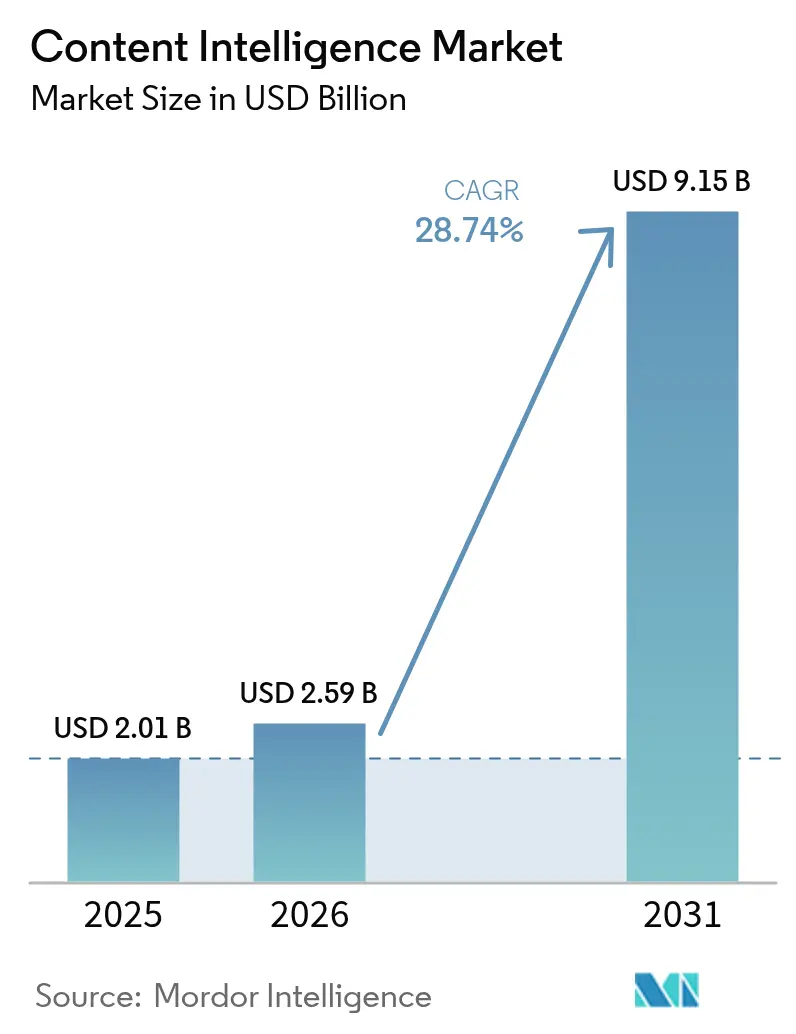
The Content intelligence market size is expected to grow from USD 2.01 billion in 2025 to USD 2.59 billion in 2026 and is forecast to reach USD 9.15 billion by 2031 at 28.74% CAGR over 2026-2031. This growth trajectory mirrors enterprises’ need to apply AI-driven content optimization to rising data volumes and heightened customer expectations. Mandatory WCAG 3.0 accessibility rules, the rapid shift to video-first engagement, and the availability of cost-efficient small language models are reinforcing near-term adoption. Vendors that deliver cloud scalability, hybrid data-sovereignty options, and outcome-based pricing gain an edge as organizations focus on measurable returns. Competitive dynamics intensify as synthetic audience data and zero-party targeting unlock granular personalization, prompting traditional content management providers to integrate generative AI to keep pace.
Key Report Takeaways
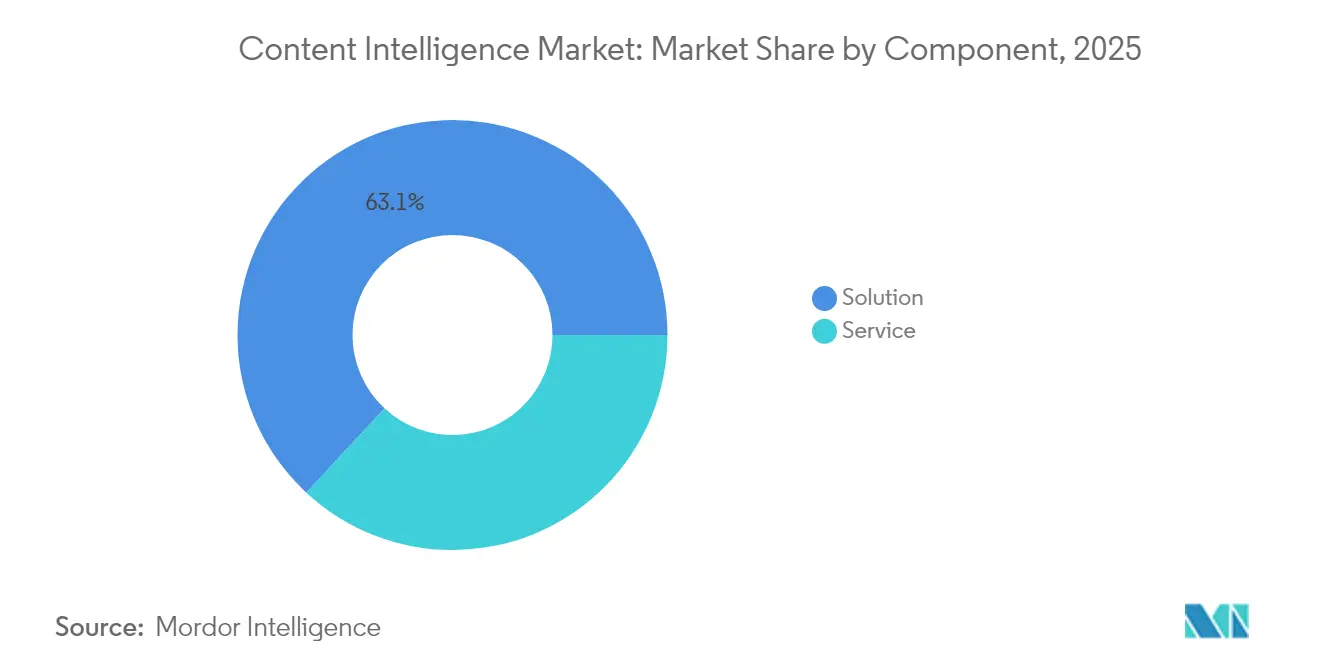
- By component, Solutions retained 63.10% of the Content intelligence market share in 2025, while Services is forecast to rise at a 33.02% CAGR through 2031.
- By deployment, cloud led with 76.20% share in 2025; the hybrid segment is expanding at a 35.95% CAGR to 2031.
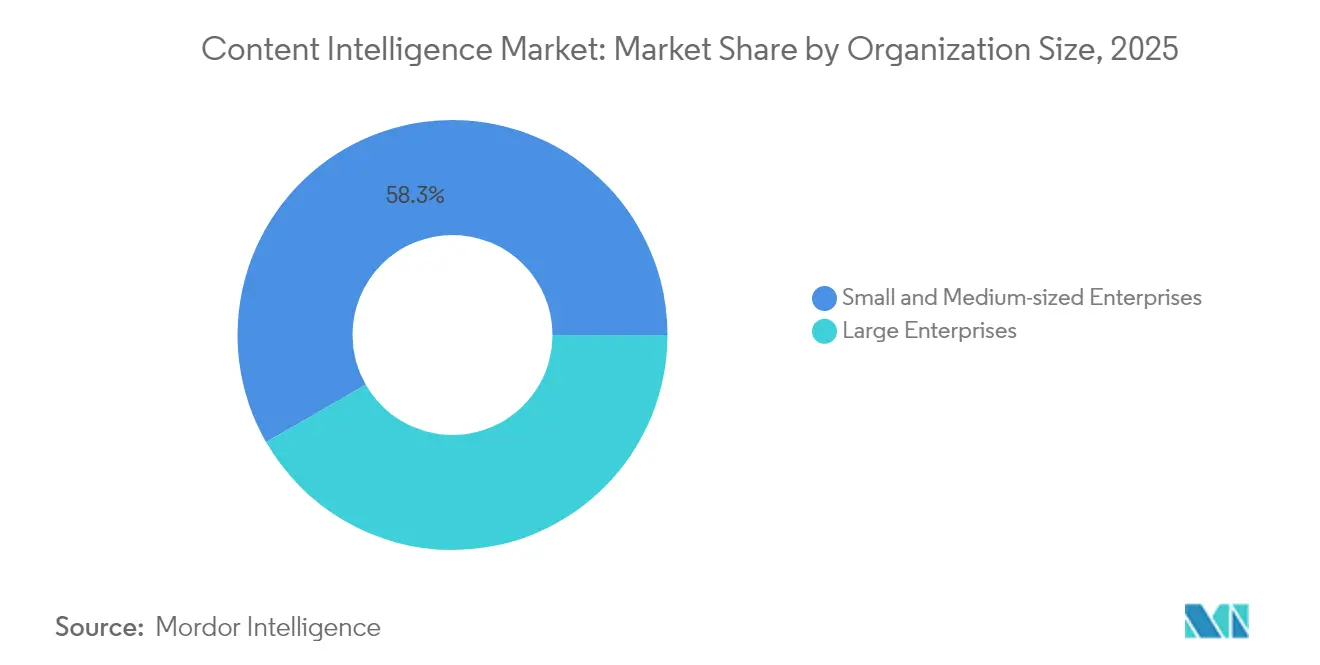
- By organization size, SMEs held 58.30% of the market in 2025 and are advancing at a 34.22% CAGR to 2031.
- By end-user vertical, Media and Entertainment accounted for 25.60% revenue in 2025, whereas Healthcare and Life-sciences is growing fastest at a 32.02% CAGR to 2031.
- By geography, North America contributed 37.40% of 2025 revenue, while Asia-Pacific is forecast to grow at a 33.84% CAGR through 2031.
Note: Market size and forecast figures in this report are generated using Mordor Intelligence’s proprietary estimation framework, updated with the latest available data and insights as of 2026.
Global Content Intelligence Market Trends and Insights
Drivers Impact Analysis*
| DRIVER | (~) % IMPACT ON CAGR FORECAST | GEOGRAPHIC RELEVANCE | IMPACT TIMELINE |
|---|---|---|---|
| Demand for personalised, data-driven content at scale | +8.2% | Global, with early gains in North America and EU | Medium term (2-4 years) |
| AI/ML integration across martech stacks | +7.8% | Global, spill-over from APAC to MEA | Short term (≤ 2 years) |
| Omnichannel content explosion on video and social platforms | +6.4% | APAC core, expanding to North America | Medium term (2-4 years) |
| Accessibility regulations (WCAG 3.0) accelerating adoption | +4.1% | North America and EU, with compliance spillover globally | Long term (≥ 4 years) |
| Deployment of in-house small language models lowering TCO | +5.7% | Global, with enterprise concentration in developed markets | Short term (≤ 2 years) |
| Synthetic audience data unlocking zero-party targeting | +3.9% | North America and EU, emerging in APAC | Medium term (2-4 years) |
| Source: Mordor Intelligence | |||
Demand for personalised, data-driven content at scale
Enterprises now recognize that generic messaging struggles to cut through sophisticated consumer filters. Adobe’s Customer Experience Orchestration platform demonstrated engagement gains of up to 30% for banner variants in 2024.[1]: Adobe, “Introducing New Generative AI Capabilities in Adobe Experience Manager Sites,” business.adobe.com The move toward first-party data strategies gives firms proprietary fuel for ever-more-accurate personalization models. Organizations using content intelligence market platforms report 40-70% faster creation cycles and higher relevance scores, confirming that scale and quality are no longer trade-offs. Financial services, healthcare, and retail all cite similar benefits as AI tailors content to regulatory or customer nuances. The emphasis on performance measurement accelerates spending on analytics modules that quantify engagement lifts. These dynamics strengthen the content intelligence market outlook for mid-term growth.
AI/ML integration across martech stacks
Generative AI has shifted from bolt-on feature to core infrastructure. Adobe’s GenStudio unifies creation, brand governance, and analytics in one workflow, showing how AI removes hand-offs that slowed production.[2]Adobe, “Adobe Expands GenStudio Content Supply Chain Offering for Marketing and Creative Teams,” news.adobe.com OpenText’s Titanium X combines 15 AI aviators and more than 100 agents, promising USD 1 billion in savings over a decade for process-heavy clients. Consolidation pressures legacy vendors to upgrade or risk displacement by AI-native entrants. Firms now budget for continuous model tuning, agent orchestration, and data-ops rather than one-time licenses. Early adopters of integrated stacks credit AI orchestration for real-time A/B testing and fully automated campaign iteration. This integration drives a sustained uplift across the content intelligence market through 2030.
Omnichannel content explosion on video and social platforms
Short-form video, live commerce, and interactive media multiply content variants per campaign. Adobe Premiere Pro’s Generative Extend now automates editing and localization across formats and languages, trimming adaptation times by up to 80%.[3]Adobe, “Adobe Expands GenStudio Content Supply Chain Offering for Marketing and Creative Teams,” news.adobe.com Asia-Pacific’s creator economy, valued at USD 135.2 billion in 2023 with 207 million contributors, signals the scale of assets that require AI assistance. Brands leveraging the content intelligence market achieve faster platform compliance, timely reactions to algorithm shifts, and consistent brand voice. Social commerce growth drives demand for clip-level optimization, thumbnail generation, and noise-reduction algorithms. Together these factors sustain high growth momentum, especially in APAC, over the medium term.
Accessibility regulations (WCAG 3.0) accelerating adoption
WCAG 3.0 moves from rule-based criteria to outcome-based testing, making manual inspection insufficient. Acquia’s early analysis underscores the need for AI engines that score color contrast, alt-text quality, and navigation patterns in real time. US rules effective June 28, 2025, mandate WCAG 2.1 Level AA today, with WCAG 3.0 on the horizon, pushing firms to embed accessibility checks into every asset. Integrated accessibility modules inside content intelligence market platforms cut remediation costs by 60-80% and lower legal risk. Vendors combine automated audits with natural-language suggestions so editors can correct issues inside their workflow. Long-term compliance pressure ensures steady uptake even after initial deadlines pass.
Restraints Impact Analysis*
| RESTRAINTS | (~) % IMPACT ON CAGR FORECAST | GEOGRAPHIC RELEVANCE | IMPACT TIMELINE |
|---|---|---|---|
| Data-privacy and GDPR / DMA compliance costs | -4.3% | EU core, expanding globally through regulatory spillover | Long term (≥ 4 years) |
| Shortage of content-AI talent and change-management gaps | -3.7% | Global, with acute shortages in developed markets | Medium term (2-4 years) |
| GPU/ASIC supply-chain bottlenecks inflating inference costs | -2.8% | Global, with manufacturing concentration in APAC | Short term (≤ 2 years) |
| Hallucination-driven brand-liability risks | -2.1% | Global, with regulatory focus in North America and EU | Medium term (2-4 years) |
| Source: Mordor Intelligence | |||
Data-privacy and GDPR / DMA compliance costs
OpenAI’s EUR 15 million fine in 2025 illustrates the financial exposure tied to data misuse. New European Data Protection Board guidance obliges firms to justify every personal-data use in training, monitoring, and inference. Enterprises adopting the content intelligence market must therefore invest in privacy-preserving architectures, on-premise deployments, and synthetic data pipelines. Compliance audits add 25-40% to total cost of ownership, slowing buying cycles in heavily regulated sectors. Despite the drag, firms accept higher costs to retain EU market access.
Shortage of content-AI talent and change-management gaps
A limited pool of professionals who combine AI, content strategy, and governance extends project timelines by 6-12 months in many organizations. Resistance from creative teams that perceive automation as a threat adds further friction. Successful rollouts pair upskilling programs with phased automation to build trust. Vendors supplement software with managed services to close skill gaps, yet scarcity remains a medium-term brake on the content intelligence industry.
*Our forecasts treat driver/restraint impacts as directional, not additive. The impact forecasts reflect baseline growth, mix effects, and variable interactions.
Segment Analysis
By Component: Services Drive Implementation Excellence
Services captured rapid growth with a 33.02% CAGR through 2031 even though Solutions retained 63.10% of 2025 revenue. The Content intelligence market size for services is projected to climb sharply as companies need consulting, workflow redesign, and change management alongside tooling. Larger regulated enterprises turn to specialized integrators that align AI output with compliance obligations. Case in point, Adobe’s collaboration with PwC targets heavily regulated verticals to bundle platform, data governance, and domain expertise. Solutions revenue remains sizable, yet commoditization of basic AI features tempers its pace. Vendors differentiate by embedding industry-specific models and low-code orchestration, yet buyers still lean on service partners to translate capability into business value. That dependence underpins sustained Services acceleration across the content intelligence market.
Implementation success metrics underscore the shift: organizations pairing software and managed services report 20-30% higher adoption rates and quicker time-to-value than tool-only deployments. Subscription-based services now account for 76% of Veritone’s customer contracts, signaling a pivot toward outcome-centric engagements. Over the forecast horizon, mature enterprises will rebalance budgets toward advisory, model fine-tuning, and continuous optimization as AI moves from pilot to production.


By Deployment: Hybrid Architectures Balance Performance and Sovereignty
Cloud remained dominant at a 76.20% share in 2025, but hybrid configurations now post the fastest trajectory at 35.95% CAGR. The Content intelligence market share for hybrid setups rises as firms split sensitive data onto local clusters while keeping burst workloads in public clouds. Hybrid rollouts lower latency for real-time personalization and meet jurisdictional data mandates without forgoing elastic scaling. Early adopters have measured 30-50% operating-expense savings compared with all-cloud when processing heavy multimedia assets. Vendors respond with containerized micro-services that slide easily between environments, shielding users from infrastructure complexity.
On-premise instances hold niche value for defense and highly regulated healthcare customers. The release of small, domain-tuned language models that perform well on CPU cores further reduces reliance on GPU-rich data centers, making local inference practical. Over time, multi-cloud control planes that abstract policy, model versioning, and usage metering will become standard. This flexibility cements hybrid as a mainstream choice across the content intelligence market.
By Organization Size: SMEs Lead Adoption and Growth
SMEs controlled 58.30% of 2025 revenue and generate the steepest growth at a 34.22% CAGR. Consumption-based SaaS levels entry barriers, enabling smaller firms to match enterprise-grade personalization with lean teams. The content intelligence market size for SME solutions is expanding as vendors introduce intuitive dashboards, pre-set workflows, and template libraries that cut configuration overhead. For many SMEs, AI automation is not optional but a requirement to compete against larger budgets. Automated captioning, image generation, and basic editorial checks free staff to focus on strategic content.
Large enterprises retain significant spending power, yet intricate compliance demands and cross-department coordination slow their rollouts. Consequently, SME volumes help vendors amortize R&D and sharpen ease-of-use features that later benefit all tiers. Competitive pressures will keep vendors pursuing price-transparent plans favored by small businesses, thereby sustaining the dual leadership of SMEs in adoption and growth.
By End-User Vertical: Healthcare Accelerates Beyond Media Leadership
Media and Entertainment held the most revenue at 25.60% in 2025, exploiting AI for audience analytics, automated editing, and multi-language localization. Healthcare-and Life-sciences leads in pace with a 32.02% CAGR. Clinics and pharmaceutical firms need automated patient education, clinical documentation, and compliance filings. Integrated language models that translate medical jargon into lay summaries shorten turnaround and reduce staff workload. Early pilots show 40% faster discharge-summary preparation and improved patient satisfaction scores.
In financial services, banks use AI-curated content to streamline compliance reports and customer onboarding. Government bodies, such as Singapore’s Ministry of Manpower, employ conversational agents for dispute resolution, achieving a 500% jump in self-service outcomes. Manufacturing, IT, and telecommunications sectors adopt AI for product documentation and support chat, while retail leans on automated catalog descriptions and localized offers. Diversifying use cases reinforce steady vertical expansion within the content intelligence market.
Geography Analysis
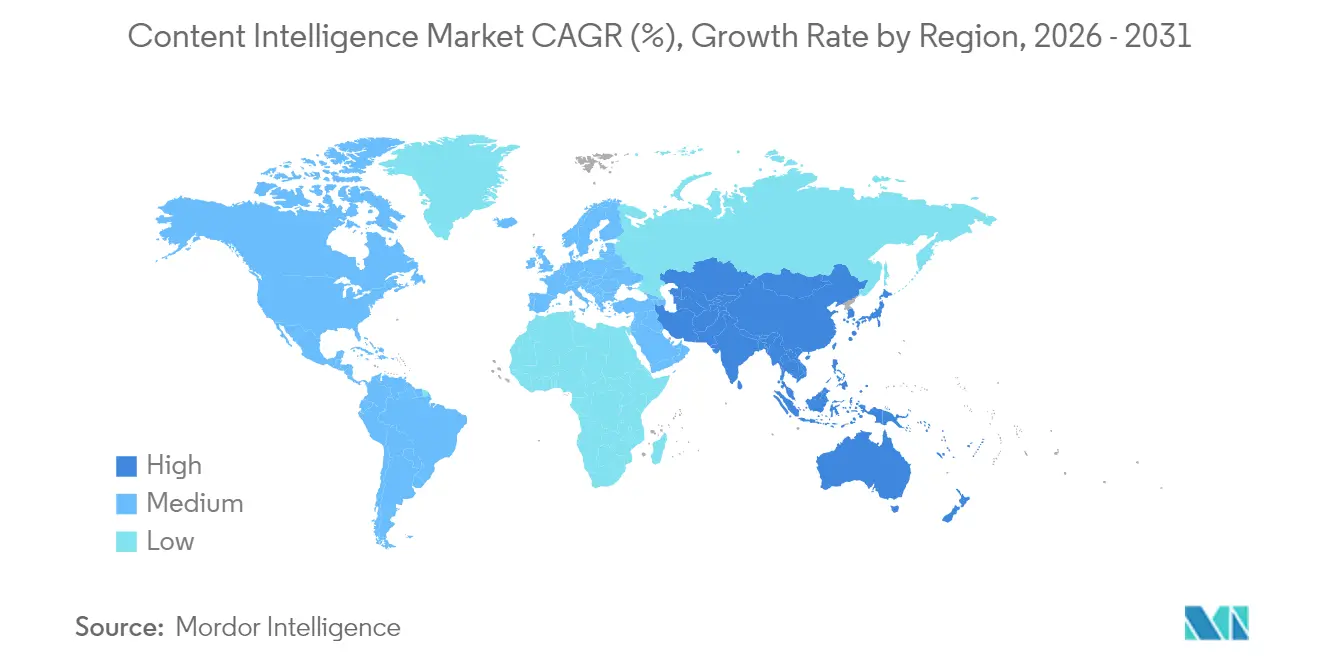
North America generated 37.40% of 2025 revenue thanks to early enterprise AI rollouts and deep cloud infrastructure. The region maintains clear leadership, yet growth stabilizes as large enterprises shift from experimentation to optimization. The Content intelligence market size in North America climbs steadily, supported by regulatory pushes for accessibility and rising zero-party data strategies. Vendor ecosystems cluster around established tech hubs, securing venture funding and fostering partnerships with system integrators.
Asia-Pacific exhibits the fastest pace at 33.84% CAGR, driven by national AI programs and a flourishing creator economy that fuels demand for multilingual, multi-platform content. Local start-ups launch lightweight models fine-tuned for regional languages, helping brands localize at scale. Hybrid cloud adoption also rises where data-residency rules coexist with cost pressures. These forces gradually chip away at North American dominance, although the two regions together still command most of the content intelligence market.
Europe shows resilient expansion as GDPR and the forthcoming EU AI Act compel enterprises to adopt content governance and explainability tooling. Many firms choose hybrid or on-premise deployments to align with stringent data-sovereignty mandates. South America and the Middle East and Africa remain nascent but attractive; improved broadband and government digitization plans create green-field opportunities for SaaS providers. Global penetration confirms that AI-enabled content intelligence is trending from early adopter privilege toward mainstream necessity.

Regulatory Landscape
Content intelligence deployments are increasingly shaped by AI and data governance rules, especially in the European Union. Under the EU AI Act (Regulation 2024/1689), obligations for General Purpose AI (GPAI) models have applied since 2 August 2025, pushing providers and enterprise users to operationalize documentation, transparency, and governance processes that affect content generation, classification, and personalization workflows. Accessibility compliance is also acting as a practical adoption catalyst in North America and Europe, with US rules effective June 28, 2025 requiring WCAG 2.1 Level AA compliance today and driving demand for automated auditing and remediation within content pipelines as WCAG 3.0 moves toward outcome-based testing.
In the United States, federal actions in 2026 increased attention on AI oversight and national-level alignment. The White House released a National AI Legislative Framework in March 2026 that calls for a unified federal approach, and a June 2026 Executive Order on promoting advanced AI innovation and security introduced government-facing requirements, including benchmarking processes for covered frontier models. Across Asia, new national AI laws add additional compliance layers for global vendors and multinational buyers, including South Korea's Basic AI Act (effective 22 January 2026) and Texas' Responsible AI Governance Act (effective 1 January 2026), reinforcing the need for configurable governance, audit trails, and data-sovereignty aware deployments.
Value Chain Analysis
The content intelligence value chain starts with data inputs and content sources, including enterprise content repositories (web, documents, creative assets, product catalogs, support knowledge bases), consumption and interaction signals (search, clickstream, engagement, conversion), and governance metadata (taxonomies, brand guidelines, approvals, and compliance attributes). Upstream enabling layers include cloud and compute infrastructure (GPU/CPU resources for training and inference), model and tooling providers (NLP, vision, and generative AI components, embedding and vector search, orchestration), and security and privacy controls that support data minimization, retention, and access management.
Midstream, platform vendors automate tagging, enrichment, classification, summarization, translation, and performance analytics, and integrate with CMS, DAM, marketing automation, collaboration, and workflow systems. Downstream, service providers and systems integrators implement and operate these workflows, including discovery, content operations redesign, model tuning, governance setup, and ongoing optimization, where managed services become important for change management and compliance alignment across teams. The final stage is activation and measurement across channels (web, email, social, video, commerce, and AI search surfaces), with performance outcomes fed back into planning and creation to reduce fragmentation and rework.
Competitive Landscape
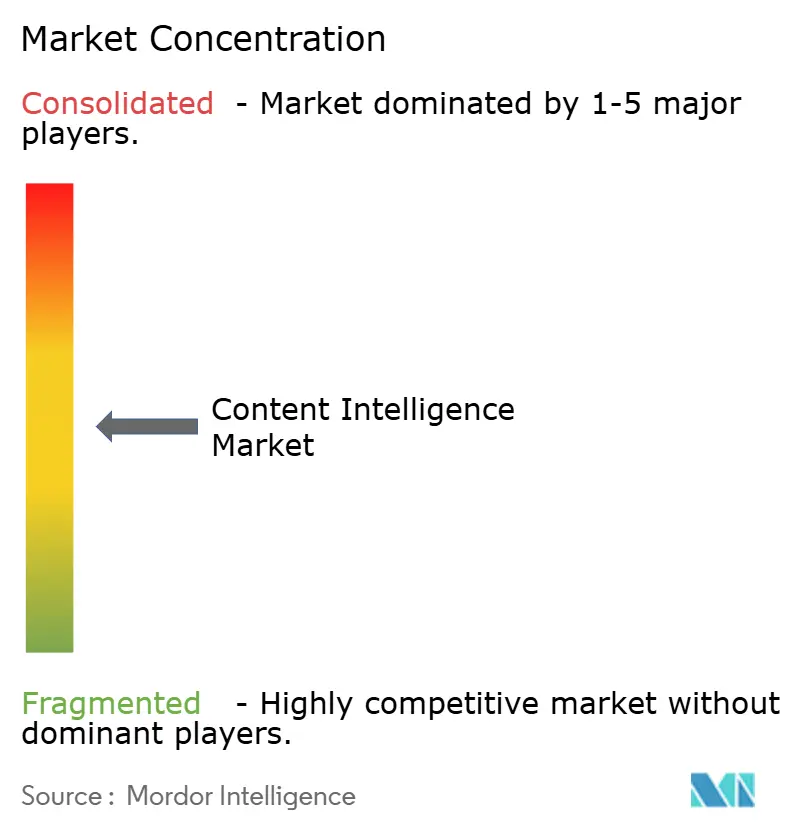
Competition is moderately fragmented, with no single vendor holding overwhelming sway. Adobe, Microsoft, and OpenText marshal large-scale R&D budgets and broad suites that combine creative tools, experience platforms, and enterprise agents. Their integrated ecosystems, exemplified by Adobe’s GenStudio and Firefly, appeal to buyers seeking one-stop solutions. Mid-tier specialists such as Acrolinx and Veritone counter by focusing on linguistic quality, domain-specific models, or media-centric pipelines. Start-ups highlight automation depth and rapid iteration to capture unmet niches.
M&A activity remains brisk as traditional content management vendors absorb AI start-ups to close feature gaps. Partnerships with global consultancies position platform providers to deliver full-stack solutions that join software with advisory. Competitive advantage increasingly rests on model governance, fine-tuning ease, and certification for regulated industries rather than core content management functions, which are now table stakes. Buyers scrutinize proof-of-value pilots, reference architectures, and vendor roadmaps before committing to multi-year deals. This market structure supports innovation, yet consistent performance and compliance credentials determine long-term share gains across the content intelligence market.
Content Intelligence Industry Leaders
Adobe Inc.
OpenText Corporation
Semrush Holdings Inc
Acrolinx GmbH
Veritone Inc.
- *Disclaimer: Major Players sorted in no particular order

Market Opportunities and Future Outlook
A clear whitespace area sits in end-to-end, governed content supply chains where intelligence is embedded from planning through activation and measurement, rather than bolted onto content management as reporting. Enterprise moves in 2026 show demand for operational, brand-safe automation: Adobe introduced Adobe Brand Intelligence in April 2026 to use feedback, annotations, and approvals as a learning signal so AI agents can produce content aligned with brand identity, addressing a common gap between creative production and enforceable brand governance. This creates an opportunity for vendors and integrators that can standardize content-as-data foundations (metadata, taxonomies, approval states) and connect intelligence into downstream activation systems for measurable iteration.
Another opportunity is AI-search visibility and reputation management as brands shift discovery toward LLM and AI-assisted search interfaces. Semrush expanded AI visibility capabilities in 2026, including broader country coverage and prompt-scale benchmarking via its AI Visibility Index, reinforcing the need for content intelligence that tracks how brand content is represented, cited, and summarized by AI systems. Buyers also continue to prioritize deployment flexibility for privacy, residency, and cost control, which sustains demand for hybrid architectures and smaller in-house language models that keep sensitive content local while still enabling scalable workflows across channels and regions.
Recent Industry Developments
- April 2026: Adobe launched Adobe Brand Intelligence and expanded GenStudio capabilities to use feedback, annotations, and approval data as a learning signal that helps AI-assisted content creation stay aligned with brand identity. The release strengthens Adobe's position in content supply chain workflows where governance and consistency determine scale, especially for enterprises running high-volume, multi-team production.
- October 2025: Adobe announced Firefly Foundry to let enterprises create tailored generative AI models trained on proprietary brand assets. By enabling customization with first-party content, the move supports differentiated brand output while tightening control over style, quality, and reuse across channels.
- October 2024: Adobe launched GenStudio for Performance Marketing to accelerate campaign production with generative AI and performance insights. Bringing creative generation and measurement closer together pushes the market toward closed-loop optimization where content variants can be produced, tested, and refined faster within a single workflow.


Research Methodology Framework and Report Scope
Market Definition and Coverage
This market covers software and related services that help organizations understand, score, and optimize digital content using analytics and AI, so content can perform better across channels and teams.
Scope exclusions: We exclude generic content creation tools, core content storage systems, and standalone marketing automation that does not provide content intelligence outputs.
Segmentation Overview
- By Component
- Solution
- Service
- By Deployment
- Cloud
- On-premise
- Hybrid
- By Organisation Size
- Small and Medium-sized Enterprises (SMEs)
- Large Enterprises
- By End-user Vertical
- Media and Entertainment
- Government and Public Sector
- Banking, Financial Services and Insurance (BFSI)
- IT and Telecommunications
- Manufacturing
- Healthcare and Life-sciences
- Retail and e-Commerce
- Others
- By Geography
- North America
- United States
- Canada
- Europe
- Germany
- United Kingdom
- France
- Rest of Europe
- Asia-Pacific
- India
- China
- Japan
- Rest of Asia-Pacific
- South America
- Brazil
- Argentina
- Rest of South America
- Middle East and Africa
- Saudi Arabia
- South Africa
- United Arab Emirates
- Rest of Middle East and Africa
- North America
Data Sources, Market Sizing, and Validation
Desk Research
Desk work starts with building a clean view of how content analytics and AI software spending is tracked in public statistics, and then narrowing it to the content intelligence use cases. We used sources such as the US Bureau of Labor Statistics, US Census data for business activity, and World Bank digital indicators to anchor macro assumptions that affect software adoption.
To make the model practical, we also reviewed public filings and investor presentations, product documentation, and credible press to understand packaging patterns like subscription pricing, seat based licensing, and usage add-ons. For market signals that are hard to see in public tables, we used paid company financials subscriptions and paid patent databases to cross-check vendor focus and product direction. These desk research sources are illustrative only, and many other public and paid references were used to collect data, validate it, and clarify gaps.
Primary Interviews and Surveys
Primary work was used to confirm what buyers actually pay for, how bundles are structured, and which adjacent tools are typically counted in or left out. We spoke with a mix of product, sales, and implementation leaders, along with enterprise content owners and digital marketing teams, and coverage was kept balanced across APAC, EMEA, and the Americas so regional adoption patterns were not guessed.
These interviews helped us tighten assumptions on attach rates to content operations, typical contract lengths, and the share of services revenue that is directly tied to content intelligence deployments.
Distribution of primary research fieldwork respondents
| Company type | Respondent position | Region |
|---|---|---|
| Top tier: 29% | CXOs: 21% | APAC: 41% |
| Mid tier: 49% | Functional/Unit leaders: 34% | EMEA: 33% |
| Smaller Players: 22% | Managers: 45% | Americas: 26% |
Market-Sizing & Forecasting
Sizing is built using a top-down approach where enterprise software spend and digital experience budgets are reconstructed by region, and then filtered through content workflow adoption, AI feature penetration, and observed pricing structures. Once that demand pool is shaped, we corroborate totals using selective bottom-up approximations, such as sampling published price points, mapping typical user counts for common deployments, and sense-checking against vendor revenue exposure discussed in interviews.
A few inputs that matter for this market include the pace of digital content volume growth, the share of content managed across multiple channels, cloud adoption in marketing and content stacks, typical subscription ARPU ranges (seat and usage), and services attach rates for onboarding and governance. When direct data is missing for smaller categories, gaps are handled by using proxy indicators like buyer adoption rates from interviews and applying conservative price bands, which are then rechecked against regional spending patterns.
For forecasting, we apply scenario analysis with a base case informed by expert views on AI feature adoption timing, budget tightening or expansion, and enterprise compliance needs that drive content standardization. Assumptions are kept simple and traceable so the path from driver to revenue is easy to explain and reproduce.
Data Validation & Update Cycle
Validation is done through triangulation across the model, desk signals, and what respondents report is happening in live deals. Outputs are compared against independent indicators such as software spending direction, cloud migration pace, and the implied revenue per customer, and then anomalies are reviewed before sign-off.
If a variance is large, we re-check scope mapping and, when needed, reconnect with selected experts to verify the assumption that caused the swing. Reports are refreshed annually, and interim updates are made when material events change pricing, packaging, or adoption behavior. Before delivery, a final analyst pass is completed so clients receive the most current view available.
Mordor Intelligence's Content Intelligence Market Size Measured Against Other Published Estimates
Published market sizes for content intelligence can look far apart because the term is used differently across studies, and because pricing and bundling vary by buyer maturity. Differences also show up when one study reports a base year and another reports a forecast year as the headline number, which can make growth look larger than it is.
Some estimates fold in broader categories like content analytics, digital experience platforms, or general marketing optimization software. In Mordor Intelligence, revenue is counted only when the product or service is sold with clear content intelligence functions (for example, content scoring, performance insights, and optimization guidance), and adjacent platforms are excluded if they do not directly produce those outputs.
Benchmark comparison
| Source | Market Size | Gaps in Research Methodology |
|---|---|---|
| Mordor Intelligence | USD 2.01 B (2025) | |
| Global Consultancy A | USD 2.77 B (2025) | The estimate appears to use a wider basket that can include broader content analytics and adjacent experience stack revenues, which lifts totals even when content intelligence features are bundled. |
| Industry Publisher B | USD 2.68 B (2025) | The figure is sensitive to more aggressive adoption and pricing uplift assumptions across the forecast window, and it is less clear how services, implementation, and recurring subscriptions are separated to avoid double counting. |
The spread across published numbers is mostly explained by what gets included alongside core content intelligence and how bundles are treated in revenue counting. By tying the model to buyer budgets, adoption rates, and realistic subscription pricing checks, we keep the market size easier to audit and stable to update year after year.


Key Questions Answered in the Report
What is the current valuation of the content intelligence market?
The market is valued at USD 2.59 billion in 2026 and is projected to hit USD 9.15 billion by 2031 at a 28.74% CAGR.
Which region shows the fastest growth in content intelligence adoption?
Asia-Pacific leads with a 33.84% CAGR through 2031, propelled by national AI strategies and a booming creator economy.
Why are services outpacing solutions in growth?
Enterprises realize ROI depends on implementation expertise, driving the services segment to a 33.02% CAGR versus commoditizing software tools.
How do WCAG 3.0 regulations influence market demand?
Outcome-based accessibility rules require automated monitoring, prompting firms to embed AI-powered compliance checks and accelerating platform adoption.
What deployment model is gaining traction alongside cloud?
Hybrid architectures are rising at a 35.95% CAGR as organizations blend cloud scalability with on-premise data sovereignty.
Which vertical is expanding fastest beyond media and entertainment?
Healthcare & Life-sciences is growing at a 32.02% CAGR due to patient-centric content needs and stringent documentation requirements.
Page last updated on: